Centrica Invests In Renewable Energy Storage Capabilities To Boost UK’s Energy Security And Accelerate Transition To Net Zero
The title of this post, is the same as that of this press release from Centrica.
These two paragraphs are effectively headings.
Centrica plc announces a strategic partnership and £70 million investment in Highview Power and its first clean energy storage project in Carrington, Manchester.
Centrica’s investment will be a key part of a £300 million funding package to develop the first commercial-scale Liquid Air Energy Storage plant in the UK, which will boost the UK’s energy security and accelerate the transition to net zero.
These four paragraphs give more details on the deal.
The investment, which forms part of our plans to invest between £600m – £800m a year until 2028, will be structured as £25m of convertible debt at Highview Enterprises Limited, being the Highview Power holding company and £45m of debt funding at the Carrington Liquid Air Energy Storage project, phased over the project construction. The investment delivers several benefits to Centrica:
Robust standalone returns aligned with Centrica’s capital allocation framework and returns thresholds
Aligned to our green-focused investment programme targeting assets which complement our existing capabilities, provide balance to the portfolio, and align to the needs of the energy transition
Includes rights to equity participation and energy optimisation from future projects in Highview’s £9 billion project pipeline.
At a first look, it appears to give Centrica robust returns and some security for their £70 million investment.
But it is the last paragraph that I like. Does it mean that Centrica can cherry-pick, the projects that it likes and fit its own objectives and expertise from Highview’s £9 billion project pipeline and take-up some equity?
Whatever it means, It looks like it will be good for Centrica.
Do the other partners have similar rights to equity?
Suppose Goldman Sachs have a long-term client in the Mid-West of the United States, who are an electricity generator, with perhaps half-a-dozen coal-fired power stations.
As the client needs to decarbonise and it is believed that Highview’s long duration batteries can replace small coal-fired power stations, it is likely that a Highview solution will at least be examined.
If the client goes down the Highview route, Goldman Sachs might like to continue their long-term relationship, by taking a share in the equity.
Rio Tinto Punts On British Start-Up To Plug Renewables Gap
The title of this post is the same as that of this article on the Australian Financial Review.
The article is a must-read and these are a few points.
- Highview is readying to take a big punt on the Australian market, with Rio Tinto and the Northern Territory government shaping up as potential customers.
- Highview is very committed to Australia. We think Australia can be as big as the UK for us, given their ambitions,
- Highview is working on concepts with Rio Tinto. And separate from Rio, we are well advanced in the Northern Territory with the government there to provide a solution to decarbonise the power grid.
- The process uses existing hardware from the gas industry, and the plant’s life should be at least 40 years – five times longer than a battery.
- Highview could replace fossil-fuel gas plants in situ, and could also be an alternative to the more complex and capital-intensive option of pumped hydro.
- Highview already had staff operating in Brisbane.
- Highview was negotiating the long-term contract with the government in Darwin, and had engaged Australian banks to start testing the market for a local fundraising.
- In Britain, Highview hopes to be putting four 2.5-gigawatt assets into planning this year – one in Scotland, three with Orsted in England.
As I said, the article is a must-read and it proves to me that Highview is on its way.
Are Goldman Sachs Stitching Together A Large Deal On Energy Storage?
In UK Infrastructure Bank, Centrica & Partners Invest £300M in Highview Power Clean Energy Storage Programme To Boost UK’s Energy Security, I talked about a deal to invest £300 million into energy storage company; Highview Power.
These three paragraphs are from the Highview Power news item, on which I based my post.
Highview Power has secured the backing of the UK Infrastructure Bank and the energy industry leader Centrica with a £300 million investment for the first commercial-scale liquid air energy storage (LAES) plant in the UK.
The £300 million funding round was led by the UK Infrastructure Bank (UKIB) and the British multinational energy and services company Centrica, alongside a syndicate of investors including Rio Tinto, Goldman Sachs, KIRKBI and Mosaic Capital.
The investment will enable the construction of one of the world’s largest long duration energy storage (LDES) facilities in Carrington, Manchester, using Highview Power’s proprietary LAES technology. Once complete, it will have a storage capacity of 300 MWh and an output power of 50 MWs per hour for six hours. Construction will begin on the site immediately, with the facility operational in early 2026, supporting over 700 jobs in construction and the supply chain.
Note.
- The UK Infrastructure Bank is a is a British state-owned development bank.
- Centrica plc is an international energy and services company.
- Rio Tinto is a leading global mining group that focuses on finding, mining and processing the Earth’s mineral resources.
- The Goldman Sachs Group, Inc. is a leading global investment banking, securities and investment management firm.
- KIRKBI is the Kirk Kristiansen family’s private holding and investment company founded to build a sustainable future for the family ownership of the LEGO Group.
- Mosaic Capital are an American investment firm.
With six partners, that is just £50 million per partner.
As that sum is very much small change for the likes of these guys and the question of taking an equity stake is not mentioned in Highview Power’s news item, it looks like this deal could be a try-before-you-buy deal with some of the partners or a simple investment with others.
Consider.
- Gresham House, Gore Street and others have proven that investing in lithium-ion batteries give a good return on investment.
- The Carrington long duration energy storage facility will be located near to the 884 MW gas-fired Carrington power station. I suspect that Centrica and Rio Tinto will be interested to see how the hybrid power-station performs.
- Could the Lego Group owners be looking at using solar power, wind power and a LDES to reduce the carbon footprint of their stores?
I would assume, that all the investors would get full details on the performance of the batteries.
Someone To Build The LDES
In Bilfinger Drives Highview Power’s Innovative Storage Project, Accelerating The Energy Transition, I describe how German company will build the Carrington LDES.
The Advantages Of An LDES over a BESS
This is only a short list, of the advantages I see.
- An LDES is easily recyclable.
- The LDES has less exotic materials.
- An LDES can be built from zero-carbon steel.
- Highview are claiming a 40-year life for their LDES.
- Highview is already talking about 200MW/2.5GWh LDES systems.
- Two 200MW/2.5GWh systems working together with a wind or solar farm, can replace a 400 MW gas- or coal-fired station.
- I suspect one of Highview’s LDES systems could be placed offshore, if needed.
I also believe that Highview’s LDES systems could be incorporated into complex chemical plants to increase the efficiency.
Are Goldman Sachs Stitching Together A Large Deal On Energy Storage?
Everything now seems to be in place to build these LDES one after the other, to accelerate the energy transition.
With a good supply of orders and enough money to build each system, I cab see no reason, why several systems a month cannot be built and installed.
I have worked with companies like Goldman Sachs in the past, and I wouldn’t be surprised to find, that they have created the consortium, so that all members get the returns and recognition, they disserve.
Adding Lego Group To The Consortium Could Be A Masterstroke
The Lego Group has lots of stores and theme parks worldwide and a reputation for good design and environmental standards.
Last year, I wrote Bedford Depot’s Massive Solar Roof Helps Thameslink On Way To Net Zero. This was putting a solar roof on a rail depot, but surely buildings like this would be suitable for a Highview LDES.
Naked Football
My house was designed by an architect, but built by the worst form of cost-cutting builder. As the house has a lot of windows facing South, I suspect the architect specified air-conditioning. But the builder left it out!
I fitted a single unit, which helped keep the temperatures fairly good.
Then it failed and the rip-off firm who fitted it couldn’t fix it. They told me, they’d never seen a system like it, when they came for the service. They took my money and now it sits there like a folly in my living room.
Last week, I finally got my TV aerial system fixed and for the first time in about two years I can get a good signal in my bedroom, as well as my living room and the downstairs bathroom.
My bedroom is at times, the only reasonably cool room in hot weather in the house.
So now, by getting naked, I can watch the football in comfort.
Bilfinger Drives Highview Power’s Innovative Storage Project, Accelerating The Energy Transition
The title of this post, is the same as that of this press release from Bilfinger, who are a European multinational engineering and services company.
This is the first paragraph of the Wikipedia entry for Bilfinger.
Bilfinger SE (previously named Bilfinger Berger AG) is a European multinational company specialized in civil and industrial construction, engineering and services based in Mannheim, Germany.
Fifty years ago, I was playing a very small part in the designing of complex chemical plants for ICI. My part was mainly to check, the mathematics and dynamics for the designs, the engineers wanted to use.
The experience certainly left me with the belief, that to design a world-class chemical plant is not an easy process.
So if I was needing a complex chemical plant, I would call in the experts.
A Highview Power energy storage system, may not be a chemical plant, but it shares many of the factors of chemical plants, waterworks and sewage plants. So building one, needs a company, with wide experience, which Bilfinger certainly appear to have.
This paragraph from the press release, summarises Bilfinger’s roll in Hghview Power’s Manchester project to create a 50 MW/300 MWh battery based on Highview’s proprietary long duration energy storage system.
The scope of Bilfinger’s services ranges from the procurement of steel to extensive plant construction services, including mechanical, electrical, instrumentation, insulation, painting and structural steel work, along with the overall management of all aspects of construction, including civil works and equipment installation. As principal contractor, Bilfinger is committed to ensuring the highest safety standards on site.
In UK Infrastructure Bank, Centrica & Partners Invest £300M in Highview Power Clean Energy Storage Programme To Boost UK’s Energy Security, I described how Highview Power had recruited high-class backers to fix the companies finances.
It looks like the Bilfinger deal to build the first system, is the last piece of the jigsaw and will see Highview Power on its way.
£20 Electronic Ear-Clips Train The Body To Decrease Blood Pressure
The title of this post, is the same as that of this article in The Times.
These two paragraphs outline how the device is used.
A £20 device that delivers “tingling” electric pulses to the ears and can be worn at home could be almost twice as effective as drugs at reducing blood pressure, a neuroscientist has said.
Early trials suggest that wearing the small electrodes clipped to the ears for half an hour per day over two weeks while relaxing, watching TV or eating can reduce blood pressure by up to 15mm of mercury (mm Hg), compared with 8mm Hg to 10mm Hg for drugs such as Ace inhibitors or beta-blockers.
It appears the device has been developed at University College London.
Would I Use Electronic Ear-Clips To Control My Blood Pressure?
Soon after my wife died in 2007, my cholesterol levels rose.
The Ipswich Town Physiotherapist, who was a drinking partner before matches at Portman Road, recommended that I see his dietician.
She identified the following.
- My diet had changed since my my wife’s death, as I was choosing the food and doing the cooking.
- She suspected, that I wasn’t eating enough soluble fibre.
- I was eating enough fruit and vegetables.
Her solution was two-fold.
- Swap butter and other spreads for Benecol.
- Make sure, I eat, at least one small tin of baked beans every week.
Obviously, as I had been found to be coeliac in 1997, I should stay gluten-free.
I’ve seen other dieticians since and none have criticised, what she said.
No doctor has also ever said, that there is something wrong with my cholesterol.
After my stroke in 2010, I was put on Warfarin to thin my blood.
The only addition to my cocktail of drugs, was that after an unexplained collapse, I was put on blood pressure drugs.
So to return to the question I asked at the top of this section.
I may take six or seven drugs and vitamin tablets every day, but swapping one or two for half-an-hour with an electronic device wouldn’t be too much trouble.
That is, if I could tolerate the device, as I’m not keen on headphones.
But it could be an interesting alternative to taking pharmaceutical drugs.
Where’s The Plan, Rishi?
In RWE Goes For An Additional 10 GW Of Offshore Wind In UK Waters In 2030, I detailed how RWE intended to add an extra 10 GW of offshore wind to the seas around the UK.
As our current offshore wind capacity is around 15 GW, another 10 GW would surely be very welcome.
My post also outlined H2ercules, which is Germany’s massive project to create a hydrogen network to bring hydrogen to Southern Germany.
I also gave details of the hydrogen hub at Wilhelmshaven, which is being built by Uniper to feed H2ercules with green hydrogen from around the world.
I believe that some of this hydrogen for H2ercules will take a short trip across the North Sea from UK waters, after being created by offshore electrolysers.
Rishi Sunak’s Manifesto Speech – June 11
I also reported on Rishi Sunak’s Manifesto Speech, which he made on June 11th. This is an extract
This document on the Policy Mogul web site is entitled Rishi Sunak – Conservative Party Manifesto Speech – Jun 11.
These are three paragraphs from the speech.
We don’t just need military and border security. As Putin’s invasion of Ukraine has shown, we need energy security too. It is only by having reliable, home-grown sources of energy that we can deny dictators the ability to send our bills soaring. So, in our approach to energy policy we will put security and your family finances ahead of unaffordable eco zealotry.
Unlike Labour we don’t believe that we will achieve that energy security via a state-controlled energy company that doesn’t in fact produce any energy. That will only increase costs, and as Penny said on Friday there’s only one thing that GB in Starmer and Miliband’s GB Energy stands for, and that’s giant bills.
Our clear plan is to achieve energy security through new gas-powered stations, trebling our offshore wind capacity and by having new fleets of small modular reactors. These will make the UK a net exporter of electricity, giving us greater energy independence and security from the aggressive actions of dictators . Now let me just reiterate that, with our plan, we will produce enough electricity to both meet our domestic needs and export to our neighbours. Look at that. A clear, Conservative plan not only generating security, but also prosperity for our country.
It is now nine days since Rishi made that speech and I can’t remember any reports about an energy security policy, which he outlined in the last paragraph of my extract from his speech.
He particularly mentioned.
- New gas-powered stations
- Trebling our offshore wind capacity
- Having new fleets of small modular reactors.
He also said we would have sufficient electricity to export to our neighbours. As I said earlier some of this energy will be in the form of hydrogen, which has been created by offshore electrolysers.
If we are exporting electricity and hydrogen to Europe, this is likely to have three effects.
- An improvement in Europe’s energy security.
- H2ercules will improve and decarbonise German industry, using UK hydrogen.
- The finances of UK plc will improve.
It looks like there will be winners all round.
Rishi also said this, in his speech.
As Putin’s invasion of Ukraine has shown, we need energy security too.
The gas-powered stations, offshore wind farms and the fleets of small modular reactors, will be part of the equation.
But I believe, we need three other components to complete our energy security.
- The upgrading of the National Grid.
- The building of four x 2 GW interconnectors between Scotland and Eastern England.
- Large amounts of energy storage.
Note.
- The Great Grid Upgrade and the four x 2 GW interconnectors are being planned.
- In Huge Boost To UK Supply Chain As National Grid Launches The Great Grid Partnership With Seven New Industry Partners, All United In The Drive To Deliver The Great Grid Upgrade, I describe how National Grid has setup the Great Grid Partnership to deliver the Great Grid Upgrade.
- In UK Infrastructure Bank, Centrica & Partners Invest £300M in Highview Power Clean Energy Storage Programme To Boost UK’s Energy Security, I describe how the big boys do a deal with Highview Power to create affordable batteries for the UK and the world.
- In Grid Powers Up With One Of Europe’s Biggest Battery Storage Sites, I describe how the very large Swardeston BESS is to be built near Norwich.
- In Mercia Power Response & RheEnergise Working Together To Build Long Duration Energy Storage Projects In The UK, I describe another UK-developed long duration energy storage system, which is now being planned.
- In National Grid Shares Proposals For Green Electricity Projects In Lincolnshire And West Norfolk, Needed To Boost Home-Grown Energy Supplies And Progress Towards Net Zero, I describe National Grid’s projects in the East of England.
- In UK ESO Unveils GBP 58 Billion Grid Investment Plan To Reach 86 GW of Offshore Wind By 2035, I show how we’re not that far away from 86 GW by 2035.
- In 400k For National Grid Innovation Projects As Part Of Ofgem Fund To Help Shape Britain’s Net Zero Transition, I describe how National Grid is using innovation to help target net-zero by 2035.
- In Iberdrola Preparing Two East Anglia Offshore Wind Projects For UK’s Sixth CfD Round, I describe how Iberdrola is getting 1.7 GW ready for commissioning in 2026.
- In National Grid To Accelerate Up To 20GW Of Grid Connections Across Its Transmission And Distribution Networks, I describe how National Grid are accelerating the development of the electricity networks. 10 GW of battery storage is a collateral benefit.
These ten projects, most of which are financed and/or underway, would appear to be good foundations, on which to build the Great Grid Upgrade.
It looks to me, that National Grid, RWE, Centrica, Iberdrola and others, by just doing what comes naturally have offered the next government a road to a future.
It will be interesting, what gets said before the election.
How To Avoid Middle-Aged Spread: Go To Private School
The title of this post, is the same as that of this article in The Times.
This is the sub-heading.
In their mid-forties, those who were educated privately are more likely to be a healthy weight and have lower blood pressure, the research found
These two paragraphs give some more details.
People who go to private school or a Russell Group university are healthier and slimmer in middle age, research has shown.
In their mid-forties, those who were educated privately are more likely to be a healthy weight, have lower blood pressure and perform better on a cognitive task than those who went to state schools.
Note.
- I went to a good grammar school and a Russell Group University.
- So did my late wife!
- Both us were slim and fairly fit until our late fifties.
The research was from University College London.
Norway’s Sovereign Wealth Fund Acquires Stake In 573 MW Race Bank Offshore Wind Farm
The title of this post, is the same as that of this article on offshoreWIND.biz.
This is the sub-heading.
A consortium made up of investment funds belonging to Australia-headquartered Macquarie Asset Management and Spring Infrastructure Capital has reached an agreement to divest a 37.5 per cent stake in the 573 MW Race Bank offshore wind farm in the UK to Norges Bank Investment Management.
These four paragraphs give more details of the deal.
The stake was sold to the Norwegian sovereign wealth fund for approximately GBP 330 million (about EUR 390.6 million).
According to Norges Bank Investment Management, the fund acquired Macquarie European Infrastructure Fund 5’s 25 per cent stake and Spring Infrastructure 1 Investment Limited Partnership’s 12.5 per cent interest in the Race Bank offshore wind farm.
A Macquarie Capital and Macquarie European Infrastructure Fund 5 consortium acquired a 50 per cent stake in Race Bank during the construction phase in 2016. Macquarie Capital divested its 25 per cent stake in the wind farm in 2017.
With the deal, Arjun Infrastructure Partners will remain co-investor for 12.5 per cent of the wind farm and Ørsted will remain a 50 per cent owner and operator of Race Bank.
These are my thoughts.
The Location of Race Bank Wind Farm
This map from the Outer Dowsing Web Site, shows Race Bank and all the other wind farms off the South Yorkshire, Lincolnshire and Norfolk coasts.
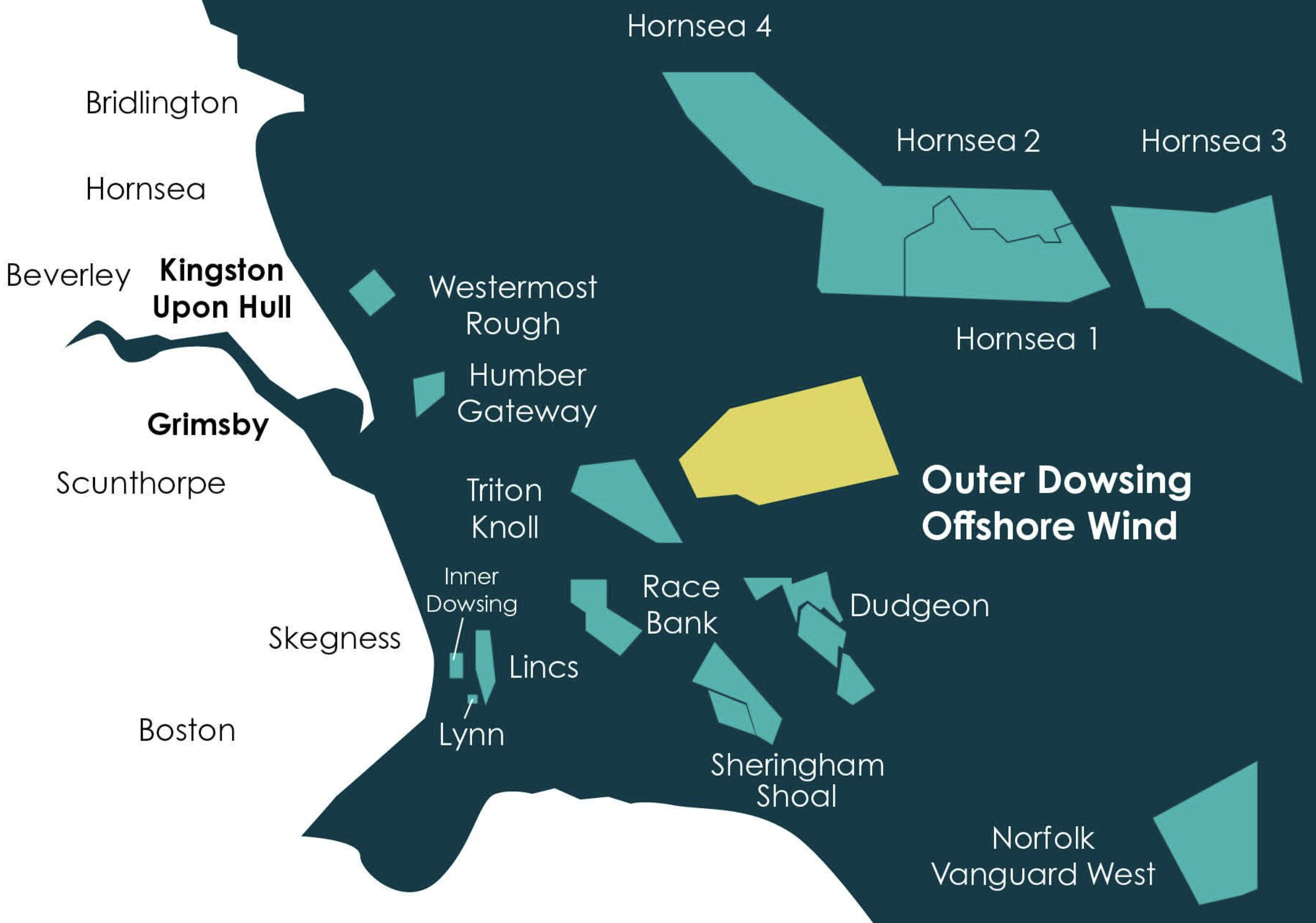
From North to South, wind farm sizes and owners are as follows.
- Hornsea 1 – 1218 MW – Ørsted, Global Infrastructure Partners
- Hornsea 2 – 1386 MW – Ørsted,Global Infrastructure Partners
- Hornsea 3 – 2852 MW – Ørsted
- Hornsea 4 – 2600 MW – Ørsted
- Westernmost Rough – 210 MW – Ørsted and Partners
- Humber Gateway – 219 MW – E.ON
- Triton Knoll – 857 MW – RWE
- Outer Dowsing – 1500 MW – Corio Generation, TotalEnergies
- Race Bank – 573 MW – Ørsted,
- Dudgeon – 402 MW – Equinor, Statkraft
- Lincs – 270 MW – Centrica, Siemens, Ørsted
- Lynn and Inner Dowsing – 194 MW – Centrica, TCW
- Sheringham Shoal – 317 MW – Equinor, Statkraft
- Norfolk Vanguard West – 1380 MW – RWE
Note.
- There is certainly a large amount of wind power on the map.
- Hornsea 1, 2 and 3 supply Humberside.
- Hornsea 4 will supply Norwich and North Norfolk.
- Norfolk Vanguard West would probably act with the other two wind farms in RWE’ Norfolk cluster.
- Ignoring Hornsea and Norfolk Vanguard West gives a total around 4.5 GW.
- There are also two 2 GW interconnectors to Scotland (Eastern Green Link 3 and Eastern Green Link 4) and the 1.4 GW Viking Link to Denmark.
I wouldn’t be surprised to see a large offshore electrolyser being built in the East Lincolnshire/West Norfolk area.
The primary purpose would be to mop up any spare wind electricity to avoid curtailing the wind turbines.
The hydrogen would have these uses.
- Provide hydrogen for small, backup and peaker power stations.
- Provide hydrogen for local industry, transport and agriculture,
- Provide hydrogen for off-gas-grid heating.
- Provide methanol for coastal shipping.
Any spare hydrogen would be exported by coastal tanker to Germany to feed H2ercules.
Do We Need Wind-Driven Hydrogen Electrolysers About Every Fifty Miles Or so Along The Coast?
I can certainly see a string along the East Coast between Humberside and Kent.
- Humberside – Being planned by SSE
- East Lincolnshire/West Norfolk – See above
- North-East Norfolk – See RWE Goes For An Additional 10 GW Of Offshore Wind In UK Waters In 2030.
- Dogger Bank – See RWE Goes For An Additional 10 GW Of Offshore Wind In UK Waters In 2030.
- Sizewell – See Sizewell C And Hydrogen.
- Herne Bay – Under construction
I can see others at possibly Freeport East and London Gateway.
Hybrid And Over 1.100 kW Strong: Rolls-Royce Presents New mtu Propulsion Concepts For Military Vehicles Of The Future
The title of this post, is the same as that of this press release from Rolls-Royce.
These two paragraphs detail some of the philosophy and features behind the hybrid power units.
Electrification and hybridisation will give tactical vehicles new capabilities in the field. To this end, Rolls-Royce’s new mtu hybrid drive combines the advantages of a high-performance diesel engine with those of a battery-electric drive. The highly integrated propulsion system requires comparatively little installation space in the vehicle in order to maximise the volume available for equipment and crew. The core of the solution is a highly mobile and extremely compact drive solution, taking into account increasing cost pressure, tight budgets and the need for significantly larger vehicle fleets.
For quiet operation, for example in a concealed position, the high-performance batteries previously charged in diesel mode, supply the vehicle’s electrical and electronic systems. This is done without the noise and thermal footprint of the diesel engine – and over a longer period of time. This makes the vehicle more difficult to locate for enemy reconnaissance. The so-called “anti-idling” mode not only ensures better camouflage of the vehicle, but also significantly reduces fuel consumption when the vehicle is on standby. The range of the vehicles and the downstream logistics chain for refuelling the vehicles are optimised.
Hopefully, power concepts like these will lead to highly capable fighting vehicles, that will defeat the threats we face from the East.
But surely, as hybrid power develops and embraces the use of clean fuels like green hydrogen and green methanol, power units like these will be found in other applications, both on land and on the sea.
And how about a hydrogen-hybrid rail locomotive to haul trains in noise-sensitive areas!

