Additional Double Track In South Wales
In the July 2018 Edition of Modern Railways, there is an article entitled KeolisAmey Wins Welsh Franchise.
This is said about the additional double track on the South Wales Metro.
Additional double track will be needed in 15 locations to support increased Core Valley Lines (CVL) frequencies.
So where are these locations?
I shall start by listing all the single platform stations.
I have ignored the following.
- Terminal stations.
- Stations on the Coryton Line.
I have grouped them by branch.
Aberdare Branch
Merthyr Branch
Rhondda Line
Rhymney Line
These total up to fourteen stations.
As the Butetown Branch will be extended through Cardiff Bay station and this station will need a second platform, does this add up to the fifteen new sections of double-track?
How Difficult Will It Be To Add A Second Track At Stations?
Of the fifteen stations, those on the Aberdate, Merthyr and Rhondda will only see the Stadler Citylink Metro vehicles, which will be running to the same rules as trams.
So could it be that these stations will be arranged like this stop on the London Tramlink, which is typical of many tram stops throughout the UK, Europe and the world?
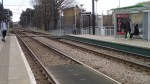

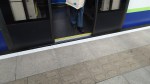

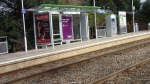

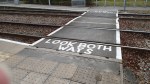
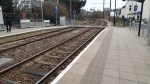
Note.
- There is no bridge.
- There is full step-free access.
- The overhead wires are kept well out of thew way.
As most tram networks have done in the UK, they could design a modern suite of shelters, ticket machines, information displays, seats help points and other items.
I suspect that the platform height would be designed to fit both the tri-mode Stadler Flirts and the Stadler Citylink Metro Vehicles.
The only stations that are served exclusively by the tri-mode Stadler Flirts and might be given an extra track are Pontlottyn and Brithdir stations at the Northern end of the Rhymney Line.
These stations only get four tph in both directions.
Do Many Stations Have Passing Freight Trains?
I never like to be on a platform, when a freight train goes through and it happens regularly at stations near me like Canonbury and Dalston Kingsland.
I looked on Real Time Trains and there don’t appear to be many such trains on the CVL
I suspect too, that they could use temporal separation, with any freight trains ruining, when the Metro is closed.
Conclusion
I do find it strange that the total number of one platform stations is the same as the number of locations, where the track will be doubled.
But surely, if all stations were on a double-track, this would give the maximum flexibility to run services.
If too, the stations could be built without footbridges to the standards of trams, then construction costs could be saved!
More On Discontinuous Electrification In South Wales
In the July 2018 Edition of Modern Railways, there is an article entitled KeolisAmey Wins Welsh Franchise.
This is said about the electrification on the South Wales Metro.
KeolisAmey has opted to use continuous overhead line equipment but discontinuous power on the Core Valley Lnes (CVL), meaning isolated OLE will be installed under bridges. On reaching a permanently earthed section, trains will automatically switch from 25 KVAC overhead to on-board battery supply, but the pantograph will remain in contact with the overhead cable, ready to collect power after the section. The company believes this method of reducing costly and disruptive engineering works could revive the business cases of cancelled electrification schemes. Hopes of having money left over for other schemes rest partly on this choice of technology.
Other points made include.
- A total of 172 km. of track will be electrified.
- The system is used elsewhere, but not in the UK.
- Disruptive engineering works will be avoided on fifty-five structures.
- Between Radyr and Ninian Park stations is also proposed for electrification.
Nothing is said about only electrifying the uphill track, which surely could be a way of reducing costs.
Ystrad Mynach To Rhymney
The article also states that on the Rhymney Line, the section between Ystrad Mynach and Rhymney stations will be run on batteries.
- The distance is about ten miles.
- The altitude difference is is about 125 metres.
- The station area at Rhymney station will be electrified.
- Rhymney will be an overnight stabling point.
- Trains will change between overhead and battery power in Ystrad Mynach station.
- Trains could charge the batteries at Rhymney if required.
Effectively, there is a avoidance of at least fourteen miles of electrification.
- Four miles of double track between Ystrad Mynach and Bargoed.
- Six miles of single track between Bargoed and Rhymney.
But as Rhymney to Ystrad Mynach currently takes about fourteen minutes, there will have to be some extra double-track, so that the required frequency of four trains per hour (tph) can be achieved.
None of this extra track will need electrification.
As the trains working the Rhymney Line will be tri-mode Stadler Flirts, with the capability of running on electricity, diesel or battery, I don’t think that KeolisAmey are taking any risks.
The Merthyr Line
The Merthyr Line splits North of Abercynon station into two branches to Aberdare and Merthyr Tydfil stations.
- South of Abercynon the branch is double-track.
- Both branches are single track.
- The Aberdare branch is about eight miles long.
- Aberdare is around 40 metres higher than Abercynon.
- Trains take 27 minutes to climb between Abercynon and Aberdare stations and 21 minutes to come down.
- The Merthyr Tydfil branch is about ten miles long
- Merthyr Tydfil is around 80 metres higher than Abercynon.
- Trains take 27 minutes to climb between Abercynon and Merthyr Tydfil stations and 21 minutes to come down.
If the proposed four tph are to be run on these branches, there would need to be some double-tracking North of Abercynon.
Will both tracks be electrified, or will it be possible with just electrifying the uphill track?
The Rhondda Line
The Rhondda Line splits from the Merthyr Line to the North of Pontypridd station and goes North to Treherbert station.
- South of Porth station, the line is double-track.
- North of Porth station, the line is single-track with a passing loop at Ystrad Rhondda station.
- Treherbert is 90 metres higher than Porth..
- Trains take 28 minutes to climb between Porth and Treherbert and 20 minutes to come down.
If the proposed four tph are to be run on this branch, there may need to be some double-tracking North of Porth.
Will both tracks be electrified, or will it be possible with just electrifying the uphill track?
Conclusion
I suspect there’ll be more savings, as the engineers get to grips with the capabilities of battery trains and discontinuous electrification.
As I said, will it be necessary to electrify downhill tracks?
The tri-mode Stadler Flirts and the Stadler Citylink Metro vehicles could use regenerative braking to their batteries.
The use of gravity in this way to charge the batteries, would increase the efficiency of the South Wales Metro.
Will Crossrail Trains Run 24 Hours?
The title of this post is the same as that of this article on the Londonist.
We don’t know the answer yet, but the article feels we should never say never.
After all, if Gatwick Airport has trains on a 24/7 basis, surely Heathrow should!
England In Kaliningrad
There is a good chance, that my great-great-great-grandfather; Robert Muller, came from East Prussia, the capital of which was Konigsberg East Prussia was annexed by the Soviet Union after the Second World |War and Konigsberg was renamed Kaliningrad.
My father was about fourteen, when his grandfather died and my father once told me, that his grandfather had told him, about meeting Robert, who would have been his grandfather’s grandfather.
Apparently, the elderly man didn’t speak any English and only spoke German. Knowing that my male line is Jewish, I wonder if it wasn’t German but Yiddish.
Konigsberg was an important city and the Prussian
Wikipedia has a section about the Jews in Konigsberg, where this is said.
The Jewish population of Königsberg in the 18th century was fairly low, although this changed as restrictions became relaxed over the course of the 19th century. In 1756 there were 29 families of “protected Jews” in Königsberg, which increased to 57 by 1789. The total number of Jewish inhabitants was less than 500 in the middle of the 18th century, and around 800 by the end of it, out of a total population of almost 60,000 people.
Speaking to someone at the German History Museum, a lot of Jewish men had to leave East Prussia, when they became adults, unless they were protected.
As Robert would have been a young adult,, when he turned up in Bexley, I suspect that soon after he qualified as a tailor, he left the area.
This keeping out of the way of trouble, is very much a family trait.
Konigsberg was at that time a port city and there was quite a lot of trade with London. So I suspect getting to London was not that great a problem.
I very much regret not asking my father for more details.
Like me my father was an atheist, although with a Jewish philosophy of life. He was also very much against fascists, communists and dictators of both the left and right. He was proud to have been at the Battle of Cable Street, when the East End of London stopped Oswald Mosley and his Blackshirts.
In some ways, I regret not being at the match tonight. But then I was advised that there would be trouble.
I have been to the Polish border with the Russian enclave. I wrote about it in At Poland’s Border With Russia.
Progress On The Northern Line Extension Shafts
This article on IanVisits is entitled London Railway Upgrades – A Progress Report.
This is said about the Northern Line Extension.
The enclosure over the Kennington Green shaft, which protected nearby residents from noise, dust and light pollution from the tunnelling works has been removed, enabling construction of the new headhouse and subway.
This Google Map shows the location of the two shafts at Kennington Green and Kennington Park.

Note the two barn-like green buildings, one of which is labelled Kennington Green.
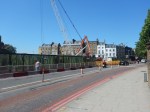
These pictures, which were taken today, show the site of Kennington Green shaft.
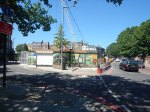
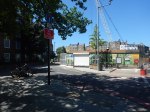
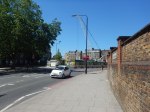
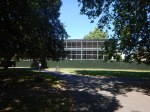
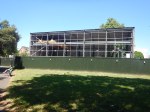
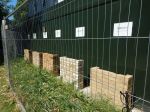
And these show the site of the Kennington Park shaft.

Note.
- The Kennington Green site appears to be nearer to completion, than the Kennington Park site.
- They are asking the public to vote on the options for the brick cladding for the headhouse.
It would appear that the headhouse at Kennington Park will be incorporated in a public building.
Hot Air From The Underground
This article on IanVisits is entitled London Railway Upgrades – A Progress Report.
These are three entries from a long list.
Northern Line
- The pump house steelwork on Islington’s Bunhill scheme has been completed. When working, waste heat from the Northern line will be piped into nearby homes.
Piccadilly Line
The York Road disused station is being studied for a possible heat extraction upgrade, with low grade heat then supplied to a nearby user.
Victoria Line
Work on a feasibility study into a heat extraction scheme at Forest Road vent shaft at the northern end of the Victoria line to reuse the heat for local homes is under way.
It is good to see waste heat from the Underground being used for a serious purpose.
I would hope that extracting heat, also cools the tunnels!
Retrofitted Hydrogen Fuel Cell EMU Concept Presented
The title of this post is the same as that of this article on Global Rail News, that was published in April 2014.
This is the first two paragraphs.
The possibility of retro-fitting diesel multiple units (DMUs) to run on hydrogen fuel cell technology has been put to the test as part of an RSSB and Network Rail-funded innovation research programme.
Fuel Cell Systems, which has worked alongside the University of Birmingham and Hitachi Rail Europe, says the six-month study has demonstrated the feasibility of installing hydrogen fuel cell technology on DMUs as an alternative to electrification.
It strikes me that some serious people are involved in this project.
The report on the project was published in June 2016 and it is stored here on the University pf Birmingham web site.
A Very Smart Class 319 Train
On my trip to Bricket Wood station yesterday, I travelled from Watford Junction station in a very smart Class 319 train.
These pictures show the train.
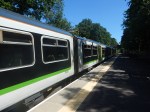
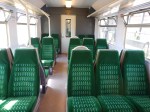
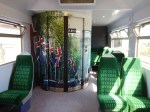
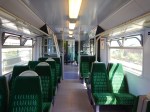
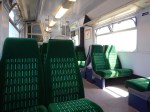
It certainly shows how Mark 3-based stock has the ability to scrub up well!
West Midlands Trains have nine of these Class 319 trains, which are mainly used for peak hour services on the West Coast Main Line.
One gets used on the Abbey Line.
The current arrangement probably works reasonably well from the train operators point of view.
However, passengers probably need a regular half-hourly service, which would need two trains and a passing loop at Bricket Wood station.
These trains are going to be replaced with new five-car Class 730 trains in 2020-21.
Will these new trains be used on the Abbey Line?
If the passing loop is installed at Bricket Wood, then two trains might be able to provide a half-hourly service. Although, having seen Bricket Wood station yesterday, a passing loop with electrification and a second platform would be a more expensive .option.
I discuss the various options in Could Modern Technology And Developments Improve the Abbey Line?.
Bricket Wood Station – 25th June 2018
These pictures show Bricket Wood station on the Abbey Line.
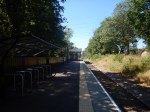
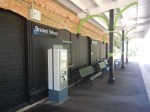
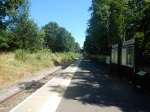
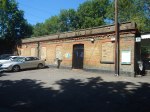
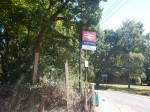
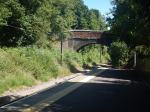
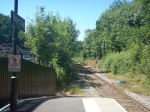
It was a tidy clean station served by a very smart Class 319 train.
Wikipedia says the following about the future of the station.
Installation of Oyster card readers on the stations along the branch is a possibility, although there are other ticketing options too.
Restoration of the crossing loop is being considered by the local authorities and Network Rail, which would facilitate trains running every 30 minutes.
Both actions would appear to be sensible. In Could Modern Technology And Developments Improve the Abbey Line?, I discuss how by using trains with batteries and a loop without electrification, may be an alternative way to install a passing loop.
I suspect that the station is long enough for a six-car train.
 The Anonymous Widower