Legal & General Has Acquired One Of The Last Major Crossrail Development Sites
The title of this post, is the same as that of this article on City AM.
There have been several stories like this is recent months and I think it shows how Crossrail will generate new housing an business developments across London.
New Greater Anglia Trains To Be Stored At Heritage Line
The title of this post is the same as that of this article in Rail Magazine.
- Greater Anglia are paying the Mid-Norfolk Railway, three million pounds to store the new trains.
- The heritage railway will create new sidings and some double track.
- It looks a good deal and both parties are quoted as being pleased with the deal.
I wonder, if this could be the start of something a lot bigger.
Norfolk County Council and other interests would like to create the Norfolk Orbital Railway to run National Rail services in a circular route starting and finishing at Norwich station and going via Cromer, Sheringham, Dereham and Wymondham stations.
It strikes me that the works proposed by the Mid-Norfolk Railway will improve the route to Dereham.
Dereham and Wymondham are towns with populations of just under nineteen thousand and fourteen thousand respectively and large numbers of residents of the area, commute to Norwich.
- It could be that a direct service to Norwich might work!
- Greater Anglia certainly have enough trains for a service of a few trains per day.
- The infrastructure will be there by Spring 2019.
Given the closeness to Crown Point Depot, could Greater Anglia use the line for testing trains and training drivers?
There is also the problem of Trowse swing bridge, which is one of the biggest bottlenecks on the UK rail network.
Rebuilding is talked about, but it would probably mean services from the South into Norwich station would have to be stopped.
- Trowse station lies just to the South of the bridge.
- It was last used in 1986 as a te,temporary terminus during electrification.
- According to Wikipedia, it could be reactivated.
Would sidings on the Mid-Norfolk Railway be useful for stabling trains, if the bridge was closed for rebuilding?
Thoughts On A Hydrogen-Powered Class 321 Train
A hundred and seventeen Class 321 trains were built around 1990 and a hundred and four, which are currently in service with Greater Anglia, are due to be replaced by new Class 720 trains.
Alstom and the trains owners; the Eversholt Rail Group, plan to convert some of these trains to hydrogen power.
The Class 321 Train
The basic characteristics of these trains are as follows.
- They have a 100 mph operating speed.
- They are built for operation on 25 KVAC overhead electrification.
- The closely-related Class 456 trains can run on 750 VDC third-rail electrification.
- They have a formation of DTCO+TSO+MSO+DTSO.
- Note that only the third car is powered.
- Thirty of the trains have been refurbished in the Renatus project, which includes an upgraded interior and a new traction package, which includes regenerative braking.
This picture shows on of the driving trailers of a Class 321 train.
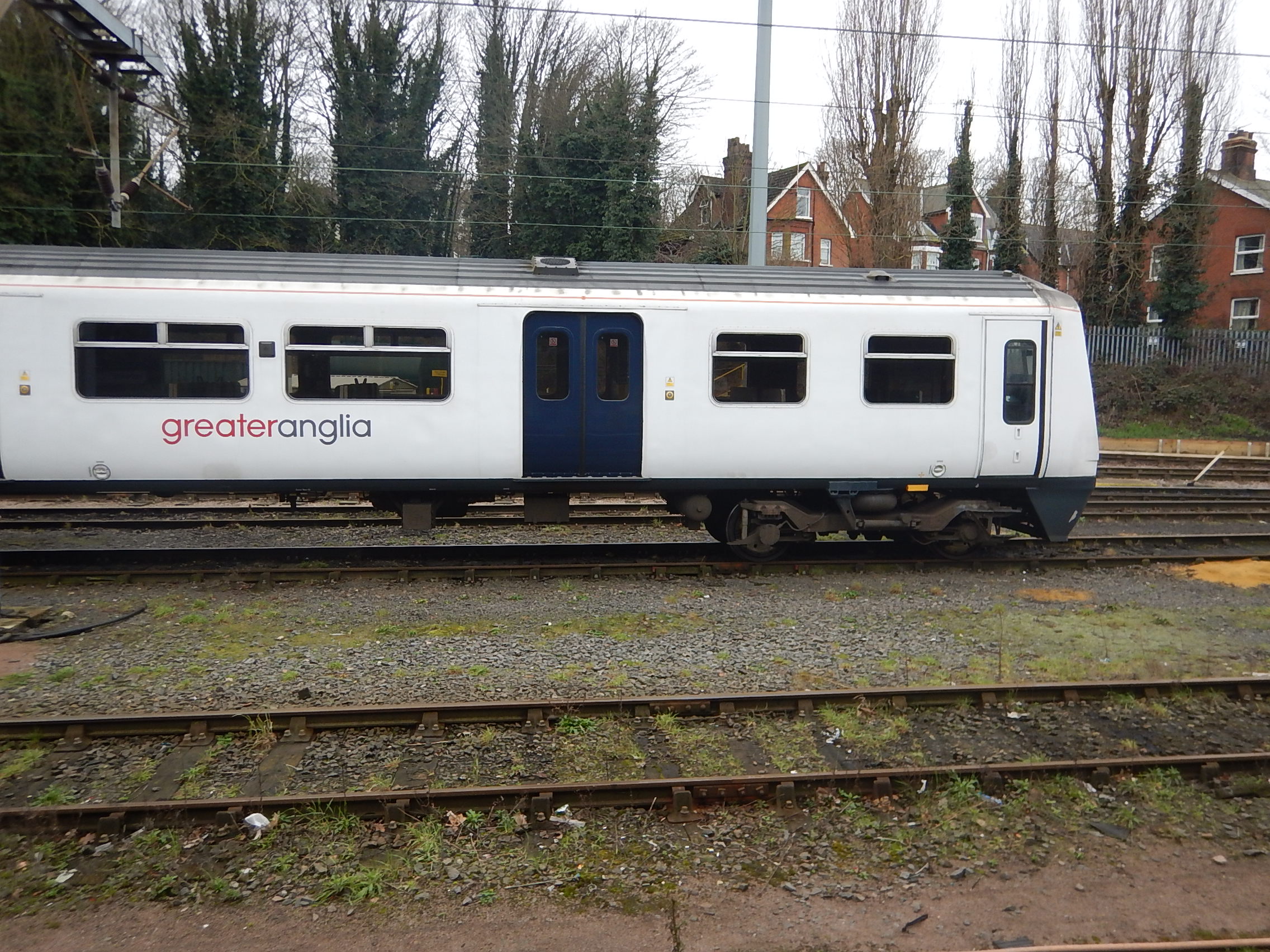
Note the large amount of space underneath.
If the Class 321 train has a problem, when converted to a modern efficient train, it is that the front end of the train has the aerodynamics of a large brick outhouse.
The Electrical System Of A Class 321 Train
I don’t know the electrical system of a Class 321 train, but I do know that of the Class 319 trains, which were built a couple of years earlier in the same factory at York These trains have a 750 VDC bus from one end of the train to the other.
As Class 321 and Class 319 trains have a similar train formation and a common Mark 3 heritage, I suspect that the electrical systems are the same and both have this 750 VDC bus.
Regenerative Braking
Regenerative braking is an important part of any modern train, as it saves energy.
Normally, the energy generated as a train stops, is returned through the electrification to power other nearby trains.
But with a hydrogen-powered train, that may not be connected to the electrification, the energy has to be stored on the train to avoid being wasted.
The Alstom Coradia iLint Train
Alstom have developed a hydrogen-powered version of the Coradia Lint train, which they call an iLint.
This promotional video shows how Alsthom’s hydrogen-powered Coradia iLint works.
<span class=”embed-youtube”></span>
Summarising, Alstom’s video the Coradia iLint works in the following way.
- The hydrogen fuel cell turns hydrogen gas into electricity.
- The electricity is used to power the train or is stored in a lithium-ion battery.
- The computer on the train monitors the system and controls it in an intelligent manner.
I wouldn’t be surprised to find out the system works in the same way as a serial hybrid vehicle like a New Routemaster bus.
- The power source; hydrogen fuel cell in the train or small diesel generator in the New Routemaster, charges the battery directly.
- The power source shuts down automatically, when the charge in the battery reaches a certain high level.
- The power source starts up automatically, when the charge in the battery reaches a certain low level.
- The battery moves the vehicle using one or more electric traction motors.
- The battery powers all the other systems in the vehicle.
- When the vehicle brakes, the traction motors generate electricity, which is stored in the battery.
The great advantage of this system is its simplicity, as the vehicle is effectively powered from a single source; the battery.
There is also an independently-controlled charging system for the battery.
A Possible Layout For A Hydrogen Powered Class 321 Train
Hydrogen powered trains need the following components.
- Hydrogen tank.
- Fuel cell to convert hydrogen to electricity.
- Battery to store energy from both the fuel cell and regenerative braking.
- Intelligent control system to control everything.
Positioning the last item shouldn’t be a problem, but could the other three larger components be placed under the train?
There’s certainly plenty of space under the two driving cars.
The battery would be connected to the following.
- The 750 VDC bus to power the train.
- The regenerative braking system.
- The hydrogen fuel cell.
The train’s computer would control the systems intelligently.
Powering The Class 321 Train From Electrification
Class 321 trains were designed as electric trains and I’m certain they could be made to run on 25 KVAC overhead or 750 VDC third rail electrification.
The electrically similar Class 319 trains are being converted into bi-mode Class 769 trains, so I wouldn’t be surprised to see the hydrogen-powered Class 321 trains being able to use electrification directly.
The Battery Size
How large would a battery need to be to store energy from both the fuel cell and regenerative braking?
I will start by calculating the kinetic energy of a Class 321 train, as the battery must be able to store all the energy generated by regenerative braking, when the train stops in a station from an operating speed of up to 100 mph.
- A Class 321 train weighs 137.9 tonnes
- A train can accommodate a total of about 320 seated and standing passengers.
- With bags, buggies and the other things passengers bring on, let’s assume an average passenger weight of 90 kg, which gives an extra 28.8 tonnes.
- I will assume a total weight of ten tonnes for the battery, hydrogen fuel cell and hydrogen tank
- So I will assume that an in service Class 321 train weighs 176.7 tonnes.
Calculating the kinetic energy of the train for various speeds gives.
- 50 mph – 12.3 kWh
- 75 mph – 28 kWh
- 90 mph – 40 kWh
- 100 mph – 49 kWh
Note that speed increases the kinetic energy much more than weight. This is because kinetic energy is proportional to the square of the speed and only proportional to the weight.
Even if the extra equipment weighed twenty tonnes, the kinetic energy at 100 mph only increases to 51.8 kWh.
As the battery will have to store this energy after a stop from 100 mph, I suspect that the battery will have a capacity somewhere between 50 and 100 kWh.
A Bombardier Primove 50 kWh battery, which is built to power trams and trains, has the following characteristics.
- A weight of under a tonne.
- Dimensions of under two x one x half metres.
- The height is the smallest dimension, which must help installation under the train floor or on the roof.
I conclude that Alstom won’t have any problems designing a battery with sufficient capacity, that can be fitted under the floor of a Class 321 train.
The Train Will Need An Intelligent Computer System
The hydrogen-powered Class 321 train could have up to four methods of charging the battery.
- From 25 KVAC overhead electrification
- From 750 VDC third rail electrification
- From the hydrogen fuel cell.
- From regenerative braking.
The computer would try to ensure the following.
- There was always spare capacity in the battery to accept the energy from regenerative braking.
- Trains stop in a station with a full battery.
- Hydrogen consumption is minimised.
The computer might even be programmed with the route and use GPS or digital signalling to optimise the train to that route.
It’s all very basic Control Engineering.
Alstom’s Marketing Philosophy
Watch Alstom’s video embedded in this post and they stress the environmental credentials of hydrogen power and particularly the Cordadia iLint.
They also show a caption which states that 195 states have made a commitment to zero carbon emissions.
That could be a very big market
The Coradia iLint will probably be a good train, but I suspect it may have a few problems satisfying a large market.
- It is only two cars.
- The current design can’t work on overhead electric power.
- It is based on a Lint 54, which has only 160 seats.
- Operating speed is 140 kph.
- They are new trains and manufacturing may be expensive.
On the other hand, Class 321 trains have the following characteristics.
- They are four car trains.
- The trains can work from 25 KVAC overhead electrification.
- The trains are built to a smaller loading gauge than the iLint.
- I suspect that they could be easily converted to other overhead and third-rail electrification voltages.
- Each train has 309 seats.
- Operating speed is 160 kph.
- They are existing trains and manufacturing may be more affordable.
It should also be said, that there is a massive amount of knowledge accumulated in the UK over thirty and more years, about how to refurbish, modify and update Mark 3-based rolling stock.
Once the concept of a hydrogen-powered Class 321 train is proven and certified, Alstom would probably be able to produce four-car hydrogen-powered trains at a fair rate, as they become available from Greater Anglia.
Conclusion
I have come to the following conclusions.
- The Class 321 train will make a good hydrogen-powered train.
- Alstom would not have looked at converting a thirty-year-old train to hydrogen power, if they thought it would be less than good.
- British Rail’s design of a 750 VDC bus makes a lot of the engineering easier and enables the train to be tailored for world-wide markets, with different electrification systems and voltages.
- Having two different trains will give Alstom better coverage of an emerging market.
I suspect in a few years time, if the hydrogen project is successful, Alstom will design and manufacture, a whole family of hydrogen-powered trains, with different gauges, capacities and operating speeds.
Has The World Cup Draw Been Kind To England?
When the draw was made for the World Cup, I didn’t pay much attention.
Perhaps, I should because England and Belgium were drawn in one the last two groups, they are playing virtually last in every round of matches.
So they are getting a good look at those they might meet in the future.
I don’t know how much of an advantage it is! But we shall see!
A Detailed Layout Drawing For A Class 345 Train
Someone has requested this using a Freedom of Information request.
Click to access the detailed layout drawing for a Class 345 train.
The formation of a Class 345 train is as follows.
DMS+PMS+MS1+MS3+TS(W)+MS3+MS2+PMS+DMS
Note.
- Eight cars have motors and only one doesn’t.
- The train is composed of two identical half-trains, which are separated by the TS(W) car.
- There are four wheelchair spaces in the TS(W) car.
There is also other information on the drawing.
- 454 seated passengers.
- 1046 standing passengers calculated using a density of 4.025/m² of available floor standing area.
- 4 wheelchair spaces.
- 1500 passengers total
- 51 priority spaces compliant with PRM-TSI
- Trailer car length is 22,500 mm.
- Driver car length is 23,615 mm.
- Train length is 203,380 over mm. body ends.
There’s more information, based on what I read off the end of a train in Weight And Dimensions Of A Class 345 Train.
I estimated the weight of a nine car train to be 328.40 tonnes.
Kinetic Energy Of A Full Class 345 Train
I will assume the following
Train weight is 328.4 tonnes.
It is jam-packed with 1,500 passengers, with an average weight of 90 Kg. with their baggage.
Passenger weight is 13.50 tonnes
This gives a total train weight of 341.9
Calculating the kinetic energy for various speeds gives.
30 mph – 8.5 kWh
50 mph – 23.7 kWh
75 mph – 53.4 kWh
90 mph – 76.9 kWh
I used Omni’s Kinetic Energy Calculator.
Currently, the cost of a kWh of electricity is about fifteen pence to domestic customers, so accelerate a full Class 345 train to 90 mph, costs at that rate around £11.50.
The Deep Resource web site gives various conversion factors.
- A kilogram of coal can be converted into 8.1 kWh.
- A litre of diesel can be converted into 10 kWh.
- A kilogram of hydrogen can be converted into 33.6 kWh.
It’s so easy to do these calculations today, as you can find little calculators and information all over the Internet.
Stadler Flirt And Bombardier Aventra Tri-Modes Compared
In this post, I will assume that a tri-mode train is capable of the following.
- Running using 25 KVAC overhead and/or 750 VDC third-rail electrification.
- Running using an on-board power source, such as diesel, hydrogen or Aunt Esme’s extra-strong knicker elastic.
- Running using stored energy for a reasonable distance.
I would suggest that a reasonable distance for battery power would include routes such as.
- Northallerton – Middlesbrough
- Ashford – Hastings
- Lancaster – Barrow
- Preston – Burnley
Preferably, the trains should be able to go out and back.
The Stadler Flirt Tri-Mode
What we know about the Stadler Flirt Tri-Mode has been pieced together from various sources.
The tri-mode trains for South Wales and the Class 755 trains for East Anglia use the same picture as I pointed out in Every Pair Of Pictures Tell A Story.
This leads me to surmise that the two trains are based on the same basic train.
- Three or four passenger cars.
- A power-pack in the middle with up to four Deutz 16 litre V8 diesel engines.
- 25 KVAC overhead electrification capability.
- 100 mph operating speed.
This is a visualisation of the formation of the trains clipped from Wikipedia.
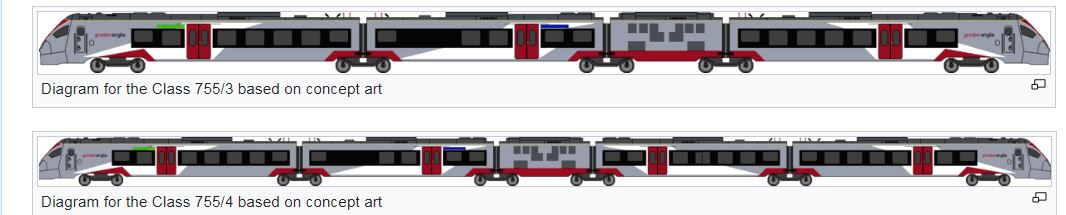
One of the routes, on which Greater Anglia will be using the trains will be between Lowestoft and Liverpool Street, which shows the versatility of these trains.
They will be equally at home on the rural East Suffolk Line with its numerous stops and 55 mph operating speed, as on the Great Eastern Main Line with its 100 mph operating speed.
South of Ipswich, the diesel engines will be passengers, except for when the catenary gets damaged.
In Tri-Mode Stadler Flirts, I said this.
I would expect that these trains are very similar to the bi-mode Stadler Flirt DEMUs, but that the power-pack would also contain a battery.
As an Electrical and Control Engineer, I wouldn’t be surprised that the power-pack, which accepts up to four Deutz diesel engines, can replace one or two of these with battery modules. This could make conversion between the two types of Flirt, just a matter of swapping a diesel module for a battery one or vice-versa.
Note that the three-car Class 755 trains for Greater Anglia have two diesel engines and the four-car trains have four engines.
In the July 2018 Edition of Modern Railways, there is an article entitled KeolisAmey Wins Welsh Franchise.
This is said about the Stadler Tri-Mode Flirts on the South Wales Metro.
The units will be able to run for 40 miles between charging, thanks to their three large batteries.
So could it be that the tri-mode Stadler Flirts have three batteries and just one diesel engine in the four slots in the power-pack in the middle of the train?
The Bombardier High Speed Bi-Mode Aventra
In the July 2018 Edition of Modern Railways, there is an article entitled Bi-Mode Aventra Details Revealed.
As is typical with Bombardier interviews, they give their objectives, rather than how they aim to achieve them.
In Bombardier Bi-Mode Aventra To Feature Battery Power, I said this.
The title of this post is the same as this article in Rail Magazine.
A few points from the article.
- Development has already started.
- Battery power could be used for Last-Mile applications.
- The bi-mode would have a maximum speed of 125 mph under both electric and diesel power.
- The trains will be built at Derby.
- Bombardier’s spokesman said that the ambience will be better, than other bi-modes.
- Export of trains is a possibility.
Bombardier’s spokesman also said, that they have offered the train to three new franchises. East Midlands, West Coast Partnership and CrossCountry.
Very little more can be gleaned from the later Modern Railways article.
Good Customer Feedback
Would they say anything else?
But Bombardier have claimed in several articles, that the Aventra has been designed in response to what operators and passengers want.
Performance
The Modern Railways article gives this quote from Des McKeon of Bombardier.
From the start we wanted to create a bi-mode which would tick all the boxes for the Department of Transport and bidders.
That means a true 125 mph top speed and acceleration which is equally good in both electric and diesel modes. We have come up with a cracking design which meets these criteria.
I also think it is reasonable to assume that the performance of the proposed trains is very similar or better to that of Bombardier’s Class 222 train, which currently run on the Midland Main Line.
After all, you won’t want times between London and the East Midlands to be longer.
Distributed Power
Distributed power is confirmed in the Modern Railways article, by this statwment from Des McKeon of Bombardier.
The concept involves underfloor diesel engines using distributed power.
But distributed power is inherent in the Aventra design with the Class 345 trains.
I found this snippet on the Internet which gives the formation of the nine-car trains.
When operating as nine-car trains, the Class 345 trains will have two Driving Motor Standard Opens (DMSO), two Pantograph Motor Standard Opens (PMSO), four Motor Standard Opens (MSO) and one Trailer Standard Open (TSO). They will be formed as DMSO+PMSO+MSO+MSO+TSO+MSO+MSO+PMSO+DMSO.
Eight cars are motored and only one is a trailer.
The snippet has a date of August 13th, 2016, so it could be out of date.
It would also appear that the Class 720 trains for Greater Anglia, which are built to cruise at 100 mph, do not have any trailer cars.
It will be interesting to observe the formation of the Class 710 trains, when they start running in the autumn.
Surely to have all these traction motors in each car must be expensive, but it must give advantages.
Perhaps, each motored car has a battery to handle the regenerative braking. This would minimise the power passed between cars, which must be energy efficient for a start.
Consider the following.
- An MS1 car for a Class 345 train weighs 36.47 tonnes.
- A typical car can accommodate a total of about 175 seated and standing passengers.
- With bags, buggies and other things passengers bring on, let’s assume an average passenger weight of 90 kg, this gives an extra 15.75 tonnes.
- Suppose the battery were to weigh a tonne
- So I will assume that an in service MS1 car weighs 53.2 tonnes.
Calculating the kinetic energy of the car for various speeds gives.
- 75 mph – 8.3 kWh
- 90 mph – 12 kWh
- 100 mph – 14.8 kWh
- 125 mph – 23 kWh
Considering that the Bombardier Primove 50 kWh battery, which is built to power trams and trains, has the following characteristics.
- A weight of under a tonne.
- Dimensions of under two x one x half metres.
- The height is the smallest dimension, which must help installation under the train floor or on the roof.
I don’t think Bombardier would have trouble finding a battery to handle the regenerative braking for each car and fit it somewhere convenient in the car.
Underneath would be my position, as it is closest to the traction motors.
So just as traction is distributed, could the batteries and diesel power be distributed along the train.
Underfloor Diesel Engines
The full statement about what Des McKeon said, that I used earlier is as follows.
The concept involves underfloor diesel engines using distributed power, but that designing from scratch enabled Bombardier to fit these without having to substantially raise the saloon floor height on any of the vehicles.
When asked about which diesel engines would be used, Mr. McKeon also confirmed that there were at least two potential suppliers, and that the diesel engines fitted would comply with the latest and highest emissions standards.
Conversion to pure electric operation is also a key design feature, with the ability to remove the diesel engines and fuel tanks at a later date, if they were no longer required.
One of my customers fror data analysis software, was Cummins, who have supplied Bombardier with diesel engines in the past. One thing that impressed me, was that they have an ability to reposition all the ancillaries on a diesel engine, so that, if required for a particular application, it could be fitted into a confined space.
I believe from what I saw, that Cummins or one of the other diesel engine manufacturers could supply a low-height diesel engine with an adequate power level to fit under the car floor without raising it by an unacceptable amount.
If you travel on one of London’s New Routemaster buses and sit in the back seat downstairs, at times you can just about hear the diesel engine, which is placed under and halfway-up the stairs, as it starts and stops. But generally, the engine isn’t audible.
A typical Volvo double-decker bus like a B5TL, is powered by a 5.1 litre D5K-240 engine, which is rated at 240 bhp/177 kW.
By contrast, the New Routemaster is powered by a Cummins ISBe engine with a capacity of 4.5 litres and a rating of 185 bhp/138 kW. One of the major uses of a larger 5.9 litre version of this engine is in a Dodge Ram pickup.
The two buses do a similar job, but the New Routemaster uses twenty percent less power.
The saving is probably explained because the New Routemaster is effectively a battery bus with regenerative braking and a diesel engine to charge the battery.
I am led to the conclusion, that Bombardier plan to fit an appropriately sized diesel engine under the floor of each car in the train.
Bombardier built the 125 mph Class 222 train, which have a 19-litre Cummins QSK19 engine rated at 750 bhp/560 kW, in each car of the train. I can’t find the weight of a car of a Class 222 train, but that for a similar 220 train is around 46.4 tonne, of which 1.9 tonnes is the diesel engine.
Applying the same logic, I can calculate the energy for a single-car of a Class 222 train.
- A typical car weighs 46.4 tonnes.
- A typical car can accommodate a total of about 75 seated and standing passengers.
- With bags, buggies and other things passengers bring on, let’s assume an average passenger weight of 90 kg, this gives an extra 6.75 tonnes.
- So I will assume that an in service car weighs 53.2 tonnes.
Remarkably, the weight of the two cars is the same. But then the Aventra has more passengers and a heavy battery and the Class 22 train has a heavy diesel engine.
As both trains have the same FLexx-Eco bogies, perhaps the car weight is determined by the optimum weight the bogies can carry.
Calculating the kinetic energy of the car for various speeds gives, these figures for a single car of a Class 222 train.
- 75 mph – 8.3 kWh
- 90 mph – 12 kWh
- 100 mph – 14.8 kWh
- 125 mph – 23 kWh
I will also adjust the figures for the proposed high speed bi-mode Aventra, by adding an extra tonne to the weight for the diesel engine and fuel tank.
This gives the following figures for a tri-mode 125 mph Aeventra.
- 75 mph – 8.5 kWh
- 90 mph – 12.1 kWh
- 100 mph – 15 kWh
- 125 mph – 23.5 kWh
Note that increase in speed is much more significant, than any increase in weight of the car, in determining the car energy.
I will now look at how the high speed bi-mode Aventra and a Class 222 train, running at 125 mph call at a station and then accelerate back to this speed after completing the stop.
The high speed bi-mode Aventra will convert the 23.5 kWh to electrical energy and store it in the battery.
After the stop, probably eighty percent of this braking energy could be used to accelerate the train. I m assuming the eighty percent figure, as regenerative braking never recovers all the braking energy.
This would mean that to get back to 125 mph, another 5.1 kWh would need to be supplied by the diesel engine.
In contrast the diesel engine in the car of the Class 222 train would need to supply the whole 23 kWh.
As the time to accelerate both trains to 125 mph will be the same, if Bombardier are to meet their probable objective of similar performance between the following.
- Bi-mode Aventra in electric mode
- Bi-mode Aventra in diesel mode.
- Class 222 train.
This means that the size of diesel engine required in the bi-mode Aventra’s diesel in each car is given by.
560 * 5.1/23 = 124 kW or 166 bhp.
The quiet Cummins ISBe engine with a capacity of 4.5 litres and a rating of 185 bhp/138 kW from a New Routemaster bus, would probably fit the bill
Could we really be seeing a 125 mph bi-mode train powered by a posse of Amrican pick-up truck engines?
The mathematics say it is possible.
If you think, I’m wrong feel free to check my calculations!
Last Mile Operation
The Modern Railways article, also says this about last mile operation.
The option for last-mile operation or for using this technology through short sections, such as stations will also be available, although Mr. McKeon said this is not in the core design.
I think there is more to this than than in the words.
The South Wales Metro is making extensive use of discontinuous electrification to avoid the need to raise bridges and other structures. I said more in More On Discontinuous Electrification In South Wales.
The ability to run on a few hundred metres of overhead rail or wire, without any power would be very useful and allow electrification to be simplified.
Imagine too a section of line through a Listed station or historic landscape, where electrification would be difficult for heritage reasons.
The train might glide silently through on battery power, after lowering the pantograph automatically. It would raise automatically, when the electrification was reached on the other side.
And then there’s all the depot and stabling advantages, of using batterry power to cut the amount of electrification and improve safety.
Future Fuels
The Modern Railways article, also says this about future fuels.
Mr McKeon said his view was that the diesel engines will be required for many years, as other power sources do not yet have the required power or efficiency to support inter-city operation at high speeds.
Running at high speeds in itself is not the problem, as a train with good aerodynamics and running gear will run easily without too many losses due to friction.
The biggest use of traction energy will be accelerating the train up to operating speed after each stop.
It is too early yet to judge whether fuels like hydrogen will be successful, but other areas will improve and make trains more efficient.
- Improved aerodynamics.
- Better traction motors.
- Better batteries with a higher energy storage per kilogram of battery weight.
- More efficient, quieter and less polluting diesel engines.
- More intelligent control systems for the train and to inform and assist the driver.
I also think there is scope for electrifying sections of track, where energy use is high.
Interior And Passenger Comfort
The Modern Railways article finishes with this paragraph.
In terms of the interior, Mr. Mckeon said the aim was to offer passenger comfort to match that on an EMU. The key elements of this are to have less vibration, less noise and an even floor throughout the passenger interior.
I believe my calculations have shown that using batteries to handle regenerative braking, substantially reduces the size of the diesel engines required, to about that of those in a serial hybrid bus, like a New Routemaster.
These smaller engines are much quieter, with much less noise and vibration.Their smaller size will also make designing a train with a uniform even floor a lot easier.
Comparing The Two Trains
Operating Speed
The maximum operating speed of the two trains is as follows.
- Tri-Mode Stadler Flirt – 100 mph
- High Speed Bi-Mode Aventra – 125 mph
This would appear to be a point to Bombardier. But could the speed of the tri-mode Stadler Flirt be increased?
125 mph Flirt EMUs do exist, but these don’t have the power pack in the middle, which may have the capability to introduce unwelcome dynamics into the train.
On the other hand, the high speed bi-mode Aventra, is dynamically at least, very much a conventional non-tilting high speed train., even if the way the train is powered is unconventional.
UK high speed trains have generally been capable of greater than 125 mph.
- The InterCity 125 set the world record for a diesel train at 148 mph, on the first of November 1987.
- The InterCity 225 was designed to run at 140 mph (225 kph) with in-cab signalling. In 1989, one train achieved 161 mph.
- Class 395 trains regularly run at 140 mph on HS1 and have run at 157 mph.
- Class 800, Class 801 and Class 802 trains are all designed to run at 140 mph with in-cab signalling.
I can’t help thinking that Bombardier’s engineers know a way of obtaining 140 mph out of their creation.
Calculation shows that the kinetic energy of one car of a high speed bi-mode Aventra travelling at 140 mph is 30 kWh, which is still easy to handle, in a train with a battery and a diesel engine in each car.
Could this train be the ideal classic-compatible train for High Speed 2?
Battery Range
I said earlier that the range of the Tri-Mode Stadler Flirt will be forty miles on batteries.
So how far will Bombardier’s high speed bi-mode Aventra go on full batteries?10 and 17
I speculated that these trains are formed of cars with a 50 kWh battery and a small diesel engine of about 124 kW in each car.
In an article in the October 2017 Edition of Modern Railways, which is entitled Celling England By The Pound, Ian Walmsley says this in relation to trains running on the Uckfield Branch, which is not very challenging.
A modern EMU needs between 3 and 5 kWh per vehicle mile for this sort of service.
So the range could be somewhere between 10 and 17 miles.
But the more efficient the train, the greater the distance.
Reducing energy consumption to 2 kWh per vehicle mile would give a range of 25 miles.
Adding More Cars
Adding more cars to an Aventra appears to be fairly easy, as these trains can certainly be ten-car units.
But doing this to a Tri-Mode Stadler Flirt may be more difficult due to the train’s design. Five or possibly six cars might be the limit.
Have Bombardier Got A Cunning Plan For Voyagers?
In the July 2018 Edition of Modern Railways, there is an article entitled Bi-Mode Aventra Details Revealed.
A lot of the article takes the form of reporting an interview with Des McKeon, who is Bombardier’s Commercial |Director and Global Head of Regional and Intercity.
This is a paragraph.
He also confirmed Bombardier is examining the option of fitting batteries to Voyager DEMUs for use in stations.
The Voyager family of trains has three members.
- Class 220 trains – Voyagers – 34 trains of four cars – operated by CrossCountry.
- Class 221 trains – Super Voyagers – 44 trains of four or five cars – operated by CrossCountry
- Class 222 trains – Meridians – 27 trains of four, five or seven cars – operated by East Midlands Trains.
The trains have the following characteristics in common.
- They are diesel electric multiple units.
- Each car is powered by an underfloor Cummins QSK19 diesel engine of 750 hp/560 kW.
- They are capable of 125 mph running.
- Some trains are fitted with tilting, which isn’t used.
- The trains have rheostatic braking.
- They meet or could easily meet the latest accessibility regulations for passengers of reduced mobility.
- Train length appears to be flexible and cars seem to be able to be swapped around in a particular class.
I think it is true to say that the operators have a few problems with these trains.
- Some passengers think the trains are rather cramped.
- There is also a noise and vibration problem when the engines are working hard.
- There have been problems with seawater getting in the resistor banks for the rheostatic braking on Class 220 trains at Dawlish.
- CrossCpuntry would welcome extra capacity.
- Both operators would probably welcome better fuel consumption on the trains.
How Would You Fit A Battery To A Voyager?
All these trains seem to be fitted with rheostatic braking.
Effectively, the traction motors generate electricity when they work in reverse to slow the train. On a modern train this electricity is either returned through the electrification to power other trains or stored in a battery.
But on these Voyagers, it is passed through resistors on the roof and used to heat the sky.
Consider these facts for a four-car Class 220 train.
- The train has an operating speed of 125 mph.
- Each car has its own diesel engine.
- The train has a weight of 185.6 tonnes.
- The train has seats for two hundred passengers.
- If we assume that each passenger weighs 90 Kg. with their baggage this gives a total train weight of 203.6 tonnes.
Calculating the kinetic energy of the train for various speeds gives
- 75 mph – 32 kWh
- 90 mph – 46 kWh
- 100 mph – 56 kWh
- 125 mph – 89 kWh.
Every time a train stops, this energy goes to waste.
The simplest thing to do, would be to divert this energy to an appropriately sized battery in each car. As there is four cars in the train, a battery of 50 kWh in each car would probably be sufficient.
If the battery was full, then the energy would still go to the resistors on the roof.
You’ve now got a full battery, but how would you use the energy in a productive manner?
The easiest and probably best thing to do with it, is to power the hotel functions of the train like air-conditioning, lights, doors and toilets. This is an approach taken by Hitachi on their Class 800 trains, as this diagram confirms.

The diagram is contained in this document on the Hitachi Rail web site, which is entitled Development of Class 800/801 High-speed Rolling Stock for UK Intercity Express Programme.
The document is a fascinating read.
Using the energy to power the traction motors and move the train might be possible, but I suspect it might be too complicated and expensive.
The simple system of the braking energy charging the battery and then using this energy for hotel power has advantages, both for Hitachi and Voyagers.
- The engines generally won’t need to run in a station to provide hotel power,as Des McKeon noted.
- The control electronics would be reasonably simple.
- Many of the existing expensive components like engines and traction motors probably wouldn’t need to be changed.
- There might be maintenance savings on the brakes.
- Less fuel will need to be expended to provide hotel power.
- If say the train has to halt perhaps because of a signalling or track fault, hotel power can be provided without running the engines.
- If batteries are supplying the hotel power, the train may have more power for traction.
I obviously don’t know how independent each car is from the next, but if each is independent, then there could be further advantages in converting, testing and maintaining the cars.
Conclusion
It looks to be a good plan.
In
Maghull North Station – 29th June 2018
I went to the new Maghull North station today.

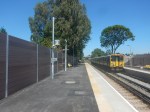

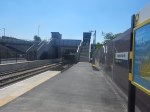

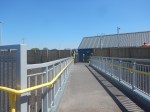
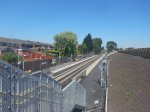

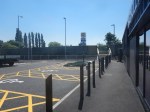
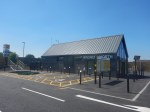
There are still a few things to do, like add the grass and complete the lifts, but the station is now operational.
Other issues include.
Car Parking
I have a feeling that this could be a station, where the car parks could be a victim of the station’s success. There weren’t many spaces today.
Car parking does appear to be free and a p[passenger who lives nearby, said that you can never park at Maghull station, which is the next station towards Liverpool.
Kiosk
There didn’t appear to be a kiosk of any sort.
Ticketing
I didn’t see a ticket machine and the ticket office was closed!
Conclusion
It looked to be a well-built and functional step-free station.
Liverpool South Parkway Station Stands In For Lime Street
I went to Liverpool to see the new Maghull North station and a few other things in the Second City.
Liverpool Lime Street station is closed at the moment due to major works, so all London trains are going only as far as Liverpool South Parkway station.
These pictures show the station.


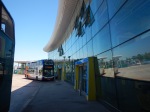
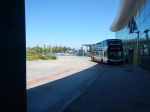


The station was coping well, as passengers from outside Liverpool ytansferred to Merseyrail to continue their journeys to the City Centre.
On my visit to Liverpool, I went first to Maghull North station, so I got a Southport train on Merseyrail’s Northern Line to Sandhills station, where I changed trains.
There are not many cities in the UK, which have the luxury of an alternative terminus of the quality of Liverpool South Parkway station to stand in, when the main station has to be closed.
When we left for London, the train initially went towards Liverpool and then crossed over to the line to London, before coming back through the Liverpool South Parkway station.
This was because the station wasn’t designed for use as a terminus and there is no other way to get the train on the right line for Crewe and the South.
It would also appear from the pictures, that to cope with the length of the eleven-car Virgin Pendelinos, that a temporary platform extension has been built.
More On Tri-Mode Stadler Flirts
In the July 2018 Edition of Modern Railways, there is an article entitled KeolisAmey Wins Welsh Franchise.
This is said about the Stadler Tri-Mode Flirts on the South Wales Metro.
The units will be able to run for 40 miles between charging, thanks to their three large batteries.
In Tri-Mode Stadler Flirts, I said this.
I would expect that these trains are very similar to the bi-mode Stadler Flirt DEMUs, but that the power-pack would also contain a battery.
As an Electrical and Control Engineer, I wouldn’t be surprised that the power-pack, which accepts up to four Deutz diesel engines, can replace one or two of these with battery modules. This could make conversion between the two types of Flirt, just a matter of swapping a diesel module for a battery one or vice-versa.
Note that the three-car Class 755 trains for Greater Anglia have two diesel engines and the four-car trains have four engines.
So could it be that the tri-mode Stadler Flirts have three batteries and just one diesel engine in the four slots in the power-pack in the middle of the train?
I wonder how much energy storage you get for the weight of a V8 diesel, as used on a bi-mode Flirt?
The V8 16 litre diesel engines are made by Deutz and from their web site, it looks like they weigh about 1.3 tonnes.
How much energy could a 1.3 tonne battery store?
The best traction batteries can probably store 0.1 kWh per kilogram. Assuming that the usable battery weight is 1.2 tonnes, then each battery module could store 120 kWh or 360 kWh if there are three of them.
How Far Would A Full 360 kWh Battery Take A Three-Car Flirt?
In an article in the October 2017 Edition of Modern Railways, which is entitled Celling England By The Pound, Ian Walmsley says this in relation to trains running on the Uckfield Branch, which probably has a terrain not much different to the lines to the South and West of Cardiff.
A modern EMU needs between 3 and 5 kWh per vehicle mile for this sort of service.
This would mean that a 360 kWh battery would take a three-car train between twenty-four and forty miles. The claim in Modern Railways of a forty mile range, isn’t that out of line.
How Much Energy Is Needed To Raise A Three-Car Flirt From Ystrad Mynach To Rhymney?
In Tri-Mode Stadler Flirts, I estimated the following about the weight of three-car Flirt.
- I reckon, that the weight of the train will be around 130 tonnes.
- I will assume 150 passengers at 80 Kg. each, which gives a weight of 12 tonnes.
Raising it through the 125 metres between Ystrad Mynach and Rhymney, will need 48 kWh.
But what about stopping and starting at the seven stations on the route?
At every stop, a proportion of the energy will be recovered. If 20% is lost at every station, I think we can add about another 20 kWh of energy use.
And then there’s the power rneeded to run the train. Using the Ian Walmsley formula shown earlier, we get between
three-cars x 10 miles x 3kWh and three-cars x 10 miles x 5 kWh or between 90 kWh and 150 kWh.
It would appear there is certainly enough power from a full battery, that will have been charged all the way from Cardiff to drive a three-car Flirt up to Rhymney on battery power.
For a four-car train my weight estimate is 166 tonnes, which means Raising the train between Ystrad Mynach and Rhymney, will need 57 kWh.
I estimate that losses for stopping and stasrting would be about 24 kWh
Train running power would be between 120 kWh and 200 kWh.
It would still be possible to go between Ystrad Mynach and Rhymney on battery power.
Conclusion
It looks to me, that Stadler have designed a tri-mode train on steroids!
 The Anonymous Widower