How Many Shoppers Will Mourn The Death Of BHS?
I suspect, I’ve not been into BHS to buy anything this century.
I used to use the one in Ipswich occasionally, as they had a very conveniently placed toilet if you were passing on the way between a lunchtime pub and the football. But now that I live in London, when I go to the football, my route is different and the station and the ground have good toilets as well.
I also used to use their Oxford Street store, as a cut-through from Oxford Circus station to John Lewis, especially when it was raining. But about five years ago, BHS blocked the route off, so that ended my visits to that store.
I shan’t be bothered if all the BHS stores in the country close. And I suspect most people, unless it effects their employment won’t be bothered either.
In fact, it might be better for me, as I wonder if John Lewis will take over the Oxford Street store and use it innovatively with their flagship store next door.
My Solar Panels Are On The Roof
My solar panels are now on my large flat roof.



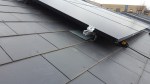
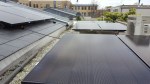
The installation was surprisingly painless, with the only work inside the house, the fitting of the control box near to my main consumer unit.
I have been monitoring all weekend on my laptop.
The Windsor Link Railway Gets Public Approval
This article in the Windsor Express reveals the results of the consultation of a railway to connect the town’s two railway stations.
Surprisingly in my view, 64% of the public approved of the project.
I am dubious, that this project will ever get built, as it is too radical and Network Rail have their own plans for more railways into Heathrow.
But if I was Lord Adonis, I’d recommend building the line, as I think it gives tremendous possibilities for business, tourism and leisure in the Thames Valley.
Where Are The Battery Trains?
I was asked this question last week and it is just as much a puzzle to me, as it is to the person, who asked the question.
There doesn’t appear to be much hard news and in the May 2016 Edition of Modern Railways, IPEMUs to give them Network Rail’s preferred name or battery trains, as some will call them, there was only one reference to trains powered by the technology.
There was an article entitled Bi-Modes To Bexhill?, which contained the sentence.
Also under consideration is replacement of Class 170 DMUs by bi-mode or battery trains on the Marshlink route.
In several posts here, I believe I have shown how IPEMU technology can improve the UK rail network and from numerous on-line sources, I have come to the conclusion that the mathematical and operational reasons behind the trains are sound.
But I come to the following possible reasons, for the non-appearance of the battery trains.
The Technology Doesn’t Work
Although, this could be the reason, I find it unlikely, given that the IPEMU is just a slightly bigger application, than say a hybrid bus or a plug-in electric car.
There have been some problems with buses and cars, but nothing so serious to prompt wholesale withdrawal from service.
It should also be pointed out, that because of the physics of steel-wheel-on-steel-rail, IPEMUs have an advantage over their rubber-tyred cousins.
The Batteries Don’t Work
Some might question the batteries, but battery technology is moving on apace and Bombardier are reportedly testing four different battery systems in Mannheim.
Installing IPEMU Technology On A Class 387 Train Has Issues
The most likely train to be given an IPEMU capability is a Class 387 train.
It is closely related to the Class 379 train, that was used successfully as a public test train.
As two of the possible applications of an IPEMU; Uckfield Branch and the Marshlink Line, are in the territory of Southern, who are an operator of Class 387 trains, I don’t think obtaining a train for a prototype should be a problem.
But one problem that might have arisen is that all of the Class 387 trains in service can’t be given an IPEMU capability, as there is a major modification needed to install the on-board energy storage.
In which case, are we waiting for the first of Porterbrook’s new build of twenty to be manufactured?
There could of course be other technical issues that must be solved.
- I have seen nothing about how two or three IPEMUs would be coupled together to make longer trains. This will be very important to some operators.
- Control of the pantograph, so if possible it deploys automatically.
- The choice of battery.
I think it could be the last, as the one thing Bombardier, don’t want is a train with not quite enough range and unreliable energy storage.
Are Bombardier Going For KERS?
I think we could see something truly mind-blowing in train on-board energy storage in the future.
My money would be on a flywheel-based system similar to KERS, as is used in Formula One and that has been successfully tested in hybrid buses.
The company behind all this technology is called Torotrak. who are based in Leyland in Lancashire. I wrote about the company recently in Low Emission Buses On Hold. In the post I quote, the company as saying this.
Beyond this, Torotrak said its KERS off-highway technology has gained significant traction and said it has seen strong interest in its V-Charge technology from carmakers.
What do they mean by off-highway technology?
So will we be seeing the Formula One train?
I have no idea, but I have made a small investment in Torotrak shares. So at least, I’ve put my money where my mouth is!
Certainly, waiting for train-based KERS, would explain the delay!
The Trains Are Too Expensive
This must always be a possibility and there might be a problem, in that using IPEMUs may be more expensive for the operator, but produce a large saving for the owner of the infrastructure.
So places, where there is a strong connection between the tracks and trains, like London, Merseyside and perhaps Chiltern, may be more enthusiastic about IPEMUs. Merseyrail have been quoted, that they are thinking about IPEMUs!
There Are Issues With Class 700 Trains
Class 700 trains certainly haven’t started running on Thameslink and the May 2016 Edition of Modern Railways reported that although, there are issues, they are nearing resolution.
Once these trains are starting to be delivered, the current electric trains on the route Class 319, 377 and 387 trains can start to be released.
Only the two Electrostars; 377 and 387 trains could be converted to IPEMUs.
So is the knock-on from the non-introduction of the Class 700 trains, meaning that operators are fighting over the Class 387 trains, as I pointed out in Are The TOCs Auguing Over The Class 387 Trains?
Once a supply of Class 387 trains are available, will we see some given an IPEMU capability?
Southern’s Labour Relations Problems Are Getting In The Way
Southern seem to be going to have a summer of discontent, with all sorts of labour relations problems.
So could this be another factor holding up the release of the Class 387 trains?
Is Everybody Waiting For Sir Richard?
If you have a Class 387 IPEMU, that could run at 110 mph on main lines and then could perhaps do sixty miles on batteries, the routes that might be possible include.
- Euston to Blackpool
- Euston to Chester
- Euston to Huddersfield
- Kings Cross to Harrogate
- Kings Cross to Hull
- Kings Cross to Lincoln
- Kings Cross to Middlesbrough
In A High Speed Train With An IPEMU-Capability, I showed that extensions to fast routes might have applications for a fast IPEMU.
All the routes named come into the category of high speed routes with extensions and all are in Virgin Territory, so are we waiting for the Great Publicist to unveil the Green Formula One Train?
At least he would solve the problem of what to call the trains. Batteries are something in a mobile device not a train!
Conclusion
I think that probably the non-appearance is down to a mixture of issues, with technical ones and a shortage of Class 387 trains most prominent.
I do think though, that we shall be seeing IPEMUs working on the UK rail network within a year.
Consider.
- Network Rail are doing extensive work to create a fast double-track railway line between St. Pancras and Corby.
- The Uckfield Branch has been upgraded for twelve-car trains. Would they do that, just to run strings of Class 170 DMUs?
- The Marshlink Line is being upgraded.
- The new East Anglian franchise specified extra points would be given to those who used new technology.
- IPEMUs could run Euston to Blackpool, Euston to Chester, Birmingham New Street to Rugeley and many other routes tomorrow.
I think we’re waiting for a technical issue to be solved.
It’s either batteries or multiple running of trains, which would certainly be needed for some services.
A High Speed Train With An IPEMU-Capability
Bombardier were reported by Ian Walmsley in the April 2016 Edition of Modern Railways, to be developing Aventra, with a 125 mph capability.
Bombardier have also told me, that all Aventras will be wired so they could be fitted with on-board energy storage.
I don’t know all the masses and speeds, but imagine if an Aventra with an IPEMU capability ran at high speed down an electrified main line and then with its on-board energy storage full to brimming, turned on to line with a reasonably high speed, where it might make a number of calls before returning.
A typical line could be London to Norwich via Cambridge, along the Breckland Line, which is not electrified from Ely to Trowse Junction south of Norwich. Parts have a 90 mph speed limit and I’m sure the speeds could be improved.
The train would need to use the energy storage, but this storage would be partially recharged every time the train stopped, by the regenerative braking of the train.
An interesting fact, is that the kinetic energy of a train is given by half the mass times the square of the speed. So if the train leaves the electrified section, as fast as is reasonably possible, it is carrying extra energy.
Because of the regenerative braking of Aventras and for that matter, Electrostars and some other trains. some of this energy can be recovered and stored in the on-board energy stoppage of an IPEMU, every time the train stops at a station
Intuition and many years of doing this sort of dynamic simulation, tells me, that the faster the train goes at the start, lengthens the range if on-board energy storage is available.
It is worth noting the energy levels involved. If you take the energy of a train travelling at 40 mph as one, the energy of a train travelling at 60 mph is 2.25 times as much and one travelling at 125 mph, a massive 9.76 times.
I think that other factors will also help.
- A track built for speed.
- Modern signalling.
- An efficient train.
- Low dwell-times in stops.
- Advanced driving aids.
- Good driving.
I suspect that Network Rail and Bombardier are doing extensive simulations of possible routes for trains with an IPEMU capability.
These calculations will probably show some routes are more suitable than others.
A route that could might be ideal, would be a branch where the line speed was high to a single station, so that by the use of the regenerative braking, the train could start the return journey with a high level of energy in the storage.
London to Norwich via Cambridge, is not a line to a single station, but both ends are electrified, so the trains will start the journey with full storage, probably losing a proportion of the energy at each stop.
I’d love to be doing those simulations. But it’s all physics that Isaac Newton would have understood.
An Announcement From TfL
This article in Rail Technology Magazine is entitled Battersea Power Station to be extensively redesigned for Northern Line extension.
I think that they’ve found that putting together the new Battersea station, is not as simple as the developers thought.
In fact, they could have discounted it, as how many of the developers, architects or owners of the new properties will actually use the line?
But Londoners, visitors and others are looking forward to the Northern Line Extension, as it gives access to an area, that is not the easiest place to visit, unless you use several buses or a long walk.
However, the most significant news in the article is the last paragraph.
At the same meeting, the committee were also asked to authorise TfL to submit a proposal for a final fixed licencing price in order to commercially exploit the software used in its contactless payment systems.
Does this mean, that London’s contactless payment system will be seen all over the world?
I certainly hope so, as I’ve never found a system that comes within a hundred miles of London’s proven go-anywhere ticketing on either an Oyster-like card or a contactless bank-card.
If I ruled the world, I’d make this compulsory for all public transport!
It would create the biggest economic stimulus to tourism and trade, since coins were first used in the Iron Age.
The Kettering To Oakham Line
I took this picture, where the Kettering to Oakham Line branches away from the Midland Main Line, a few kilometres north of Kettering station at Glendon Junction.

The Kettering To Oakham Line Leaves The Midland Main Line
I was surprised to see that the junction is only single-track.
Glendon Junction To Corby
This Google Map shows the layout of the lines to the South-East of Rushden.
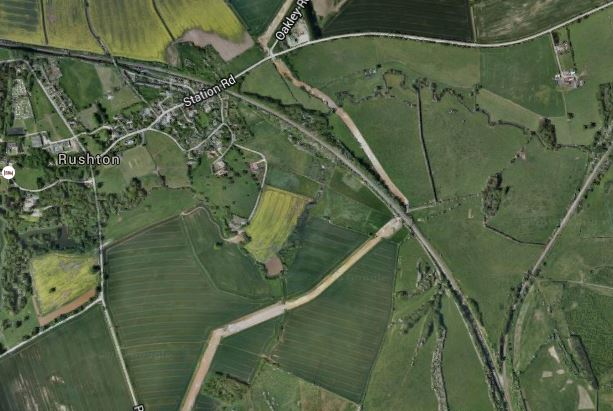
Rushton And Glendon Junction
Note that there is no chord allowing trains from the North to go towards Corby.
The Station Road, which crosses the Midland Main Line was probably the site of Glendon and Rushden station, which closed in 1960.
The junction is towards the South-East corner of the map, with the Midland Main Line going towards the North-West and the Kettering to Oakham Line to the North-East.
This second Google map, shows the actual junction.
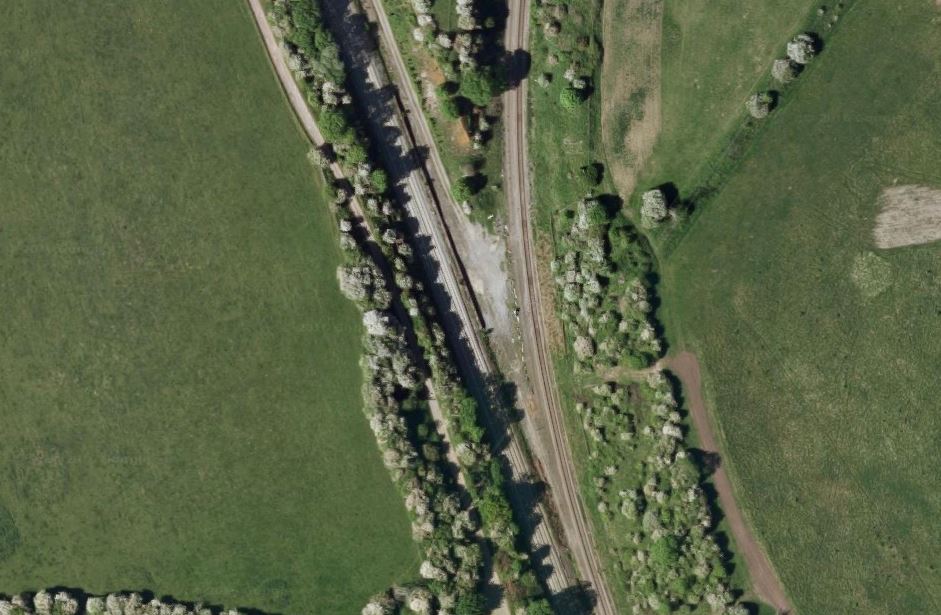
The Junction
It clearly shows the single-track nature of the junction. The line is single-track all the way to Corby station.
This Google Map shows Corby station.
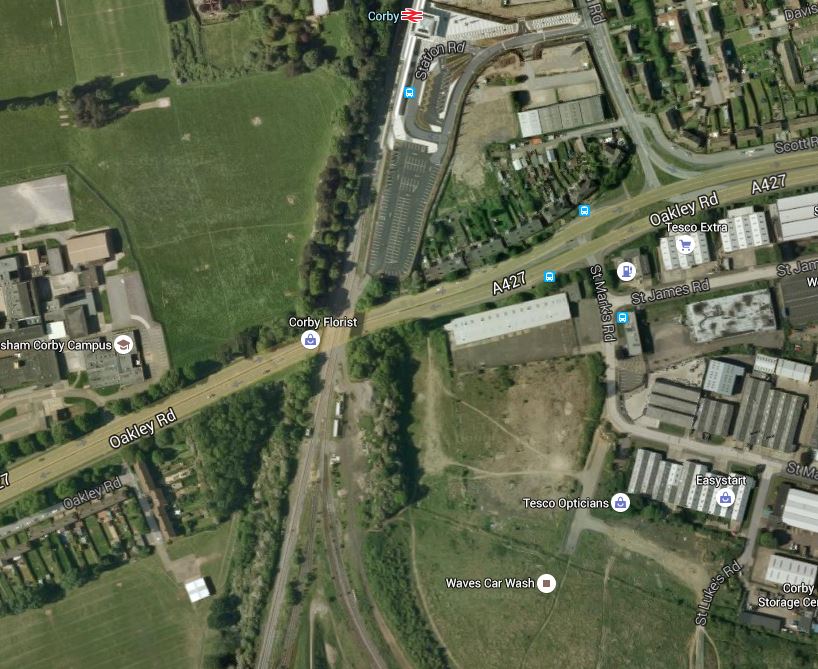
Corby Station
The Kettering to Oakham Line goes virtually North-South through the station.
Note that there appears to be an old railway going away to the South-East.
Future Services Between London and Corby
Wikipedia says this will happen in the future.
It is planned that a half-hourly London St Pancras to Corby service will operate from December 2017 using new Class 387 trains, once the Midland Main Line has been electrified beyond Bedford as part of the Electric Spine project. Network Rail has also announced that it plans re-double the currently singled Glendon Junction to Corby section as part of this scheme.
I don’t think it will happen like that, as I can’t see Bedford to Corby being electrified in time. There’s also the problem of the arguments about who gets the Class 387 trains, that I wrote about in Are The TOCs Arguing Over The Class 387 Trains?
However, this article on the Network Rail web site, which is entitled Work to upgrade railway between Corby and Kettering enters next phase, It talks about the installation of a second track between Glendon Junction and Corby to pave the way for additional passenger and freight services from the end of 2017.
I would assume that improving from Kettering to Corby, will not only allow more trains, but also improve speeds and reduce energy consumption.
Could this mean that Class 387 trains with an IPEMU capability could be used on the St. Pancras to Corby route, as they’d only have to go from Bedford to Corby and back to Bedford on a full load of electricity in their on-board storage device?
I estimate the distance is probably about 25-30 miles both ways, so it might just be possible.
As I wrote in The High Speed Train With An IPEMU Capability, it could be easier for an IPEMU running efficiently at high speed on entry to bridge a gap in the electrification.
Remember that 159 miles of the Midland Main Line is cleared for 125 mph running, so a Class 387 IPEMU could be running at its full speed of 110 mph at or through Kettering station. If it was to stop at Kettering station, as much as possible of the train’s kinetic energy could be used to top-up the on-board energy storage, so that the train had as much on-board energy for a short run to Corby and back on a fast efficient line with no stops.
Is this Network Rail’s Plan B to get electric trains to run a half-hourly service to Corby?
But as electrification proceeded North from Bedford, this would make running Class 387 IPEMUs easier, as every mile of electrified line, would take two off the total needed to be run using on-board energy storage.
So could we be seeing creeping electrification along the Midland Main Line, as every mile erected would gradually bring more destinations within range of St. Pancras?
I certainly think, that as spare Class 387 trains will be available from later this year and an IPEMU capability could be added fairly easily as it was to the Class 379 train demonstrator for IPEMU technology, that we could be seeing electric trains running to Corby before the date of 2019, which is quoted as the date, when Corby will be electrified.
Aventras For East Midlands Trains
I have assumed that the only electric train, that will be available for East Midlands Trains would be Class 387 train. These could be given an IPEMU capability and they would probably be able to reach Corby, when track improvements and additional electrification allowed.
But Bombadier’s Aventra is coming.
A 125 mph Aventra was reported as possible by Ian Walmsley in the April 2015 Edition of Modern Railways.
In his article about the Aventra, Ian Walmsley said this about an order for Aventras.
But the interesting one to me is East Midlands Trains electrics. As a 125 mph unit it could cope well with Corby commuters and the ‘Master Cutler’ crowd – It’s all about the interior.
So the same train could do all express routes and also act as the local stopping train.
But as Bombardier have stated that all Aventras will be wired so they can be fitted with on-board energy storage, we have a train, that can thunder up and down the Midland Main Line with its sections of 125 mph running and then take to the branch lines like Corby and Nottingham using the energy storage.
I don’t know where 125 mph running is possible, but as IPEMUs have regenerative braking as standard and charge the batteries when they stop, ready for a quick getaway, there must be an advantage in having a battery high speed train, as energy in a moving body is proportional to the square of the speed. I investigated this more in A High Speed Train With An IPEMU-Capability, where I came to the conclusion that faster IPEMUs may give more advantages than slower ones.
Class 800 Trains For East Midlands Trains
Until Ian Walmsley’s statement about the 125 mph Aventra, I’d always thought that Class 800 trains, in either bi-mode or electric variants were a shoe-in for the Midland Main Line.
They are the right size, with the right performance, but they do have three problems.
- Corby needs an increased service now.
- Unless some of GWR’s order is diverted to the East Midlands, the trains could not be delivered for some years.
- Political lobbying would press for trains to be used in the East Midlands to be built there.
But they are a possibility.
As an electrical engineer though, I like the concept of Bombardier’s IPEMU, as I think that designed into a new train, it could offer savings in electrification and electricity costs.
Take Leicester station, shown in this Google Map.

Leicester Station
It needs to be upgraded for electrification and because of its prominent position on the Midland Main Line, closing the station to install the overhead wires would be difficult to say the least.
Supposing the overhead wires were not installed in Leicester station, how would a bi-mode Class 800 handle the station? It would put the pantograph down as it was slowing for the station and use its diesel power in the station. On leaving, it would wait until the wires started again and then raise the pantograph.
An IPEMU would use a similar procedure, but would use its on-board energy storage to bridge the electrification gap. But it has one great advantage in that all of the energy dissipated in the braking for the station would be used to top-up the on-board energy storage, which is used to restart the train.
So if the IPEMU route is chosen I see the following advantages.
- Stations like Leicester, Derby and Nottingham don’t need to be electrified with all the problems that entails.
- The route through the World Heritage Site of the Derwent Valley can be left without electrification.
- The electrification doesn’t need to be capable of handling regenerative braking, as the trains look after that method of valuable energy saving.
- East Midlands Trains get an electric train only fleet.
The only problem is running electric freight trains.
Onward From Corby
East Midlands Trains do run services past Corby, with some services going to Oakham and on to Derby.
This is a diagram of the line between Corby and Oakham.
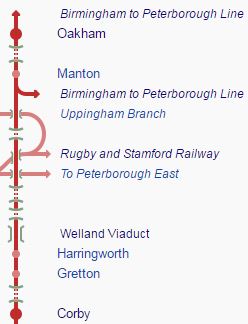
Corby To Oakham
The line is double-tracked, looks to be picturesque and includes five tunnels and the Welland Viaduct shown in this Google Map.
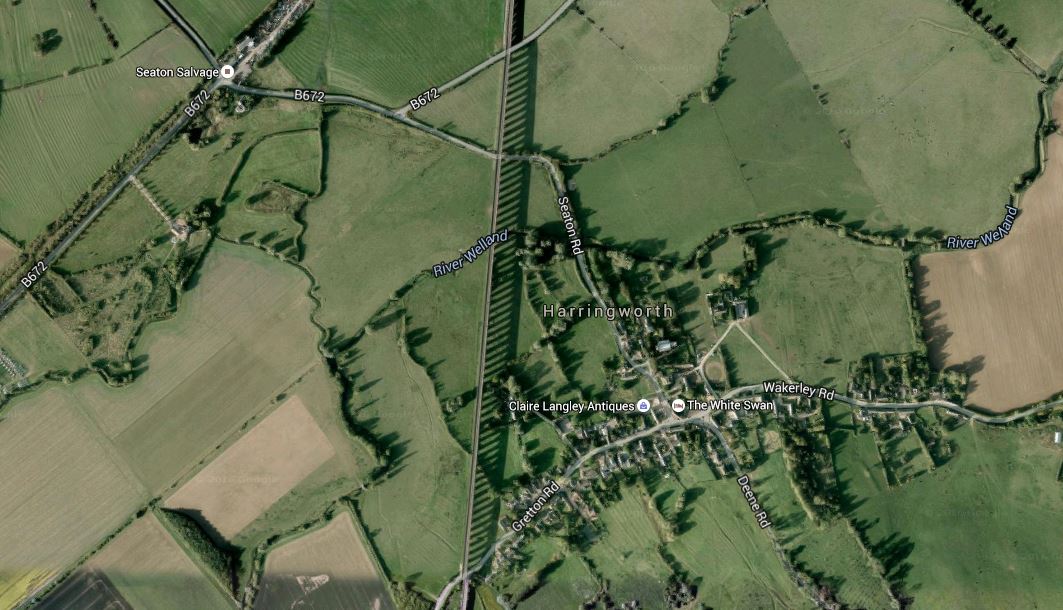
Welland Viaduct
Note the shadows of the eighty-two arches. It was built in 1878 and you can understand why it is Grade II Listed building.
I suspect Network Rail have filed electrification of this line under something like Avoid if Possible.
Under Services in the Wikipedia entry for Oakham station, this is said.
A single daily return service to London St Pancras commenced on 27 April 2009 running via Corby and is notable for being the first regular passenger service to cross the spectacular and historic Welland Viaduct since 1966. The company introduced a further return service from Derby via East Midlands Parkway (for East Midlands Airport) from May 2010. Further services may be introduced in the future. The initial London service had been due to start on 14 December 2008 but because of a delay in reaching agreement with the Department for Transport and the rolling stock operating company (ROSCO) for the four additional trains needed for the service EMT started the service around four months later.
Running electric trains with an IPEMU capability to Corby would probably mean that EMT would look at the possibility of extending the trains to Oakham.
I have a feeling that the Welland Viaduct could cause problems, because of its Listed status, so using IPEMUs to provide the passenger service to Oakham, would neatly sidestep any heritage problems associated with overhead wiring.
Once Derby and Corby are both electrified, the route would be fully open to electric multiple units with an IPEMU capability as there is only a gap of about thirty miles in the wiring.
Oakham Station
There is also the problem of Oakham station, which is best summed up by this Google Map.
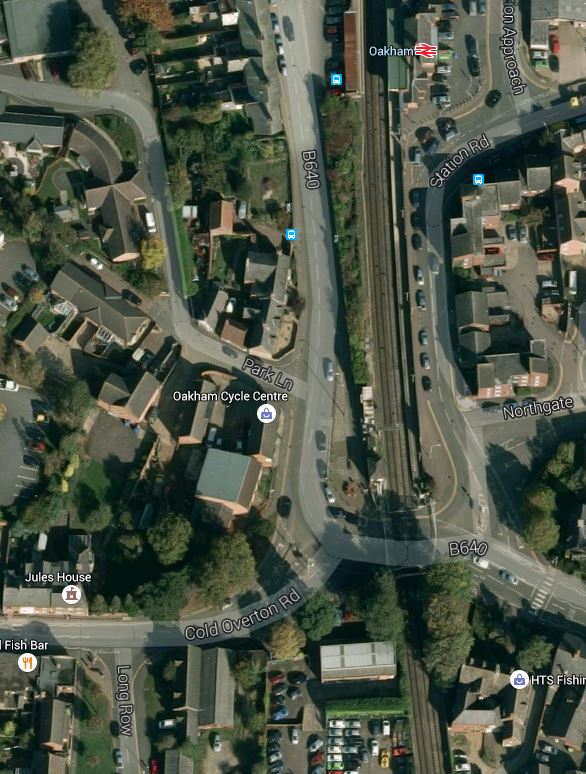
Oakham Station And Level Crossing
It is in the centre of the town and hemmed in by a major road. South of the station is a notorious level crossing, that needs to be replaced or avoided.
Network Rail engineers must have sleepless nights about this problem, especially as large numbers of long freight trains hauled by noisy Class 66 locomotives use the line through the station and the crossing to get between Felixstowe and Nuneaton.
Even the opening of the East West Rail Link, which will see some freight trains use the line between Cambridge and Bedford, will only offer a solution, where the freight trains are diverted through Cambridge and its increasingly busy station. What would the City and the University have to say about that?
So it would seem that another simple route for freight trains must be found.
Conclusion
The route between Kettering and Oakham is important and will be developed.
If East Midlands Trains or its successor go for either the rumoured 125 mph Aventra IPEMU or Class 800 bi-mode trains, they could improve the passenger service between London, Luton Airport, Kettering, Corby, Oakham, Melton Mowbray, Leicester, Loughborough, East Midlands Parkway and Derby, by opening up a second route.
In the meantime, it looks like Network Rail’s Plan B of a faster dopuble-track line to Corby could deliver better services using an IPEMU-variant of the Class 387 train.
Low Emission Buses On Hold
One of my Google Alerts has picked up this story on the London South East web site, which is entitled Torotrak Shifts Focus Following Delays In UK Low-Emission Bus Grants.
The report is on this web site, as these buses were trialled in Gillingham.
This is also said in the story.
This uncertainty, coupled with low fuel prices, has caused bus operators to postpone investing in low-emission technologies, Torotrak said. As a result, it and partner Wrightbus will delay further investment in the launch of Torotrak’s KERS technology for buses until the situation becomes clearer.
Torotrak will redeploy its cash resources on other, revenue-generating and near-term commercial opportunities in response to the delays.
Beyond this, Torotrak said its KERS off-highway technology has gained significant traction and said it has seen strong interest in its V-Charge technology from carmakers.
So what might all this mean?
Could New Technology Help Save Steel Jobs?
One of my first jobs was in the instruments laboratory of Enfield Rolling Mills in the early 1960s. As someone with a mind like a sponge, I never missed storing away every piece of useful engineering and scientific information, I might encounter.
The company was involved in the rolling and the production of materials from non-ferrous metals, like copper, bronze, brass and aluminium. For instance, they did a lot of work with the continuous casting of metals like bronze and aluminium.
The company also used scrap metal as a source of raw material for their processing. One of their problems was identifying the scrap before processing and they had experimented with using a radioactive isotope to see, if it could give them an accurate opinion.
It probably wasn’t the best thing to do!
But since then technology has moved on.
I just wonder now, whether mass spectrometry could correctly identify the exact grade of a large piece of brass, bronze or steel!
If it could, I suspect that we could use our scrap metals to avoid refining new.
So I searched using “automatic steel scrap sorting” and found this page entitled Laser Methods For Automatic Scrap Metal Sorting.
And this page on the Oxford Instruments web site entitled Scrap Metal Analysis, Sorting and Recycling.
Who needs blast furnaces?
We just mine the scrap, rather than send it to China!
 The Anonymous Widower