Silvertown Tunnel Works – 24th September 2023
I took these pictures of the Silvertown Tunnel works on the North Bank of the Thames today.


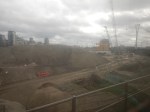
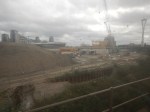


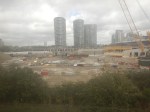




I was on a train going to Woolwich Arsenal.
What Is The Silvertown Tunnel?
The title of this section, is the same as that of this article on the Londonist, which is an excellent description of the Silvertown Tunnel.
The article says this about tolls.
The new tunnel will require you to part with some pounds if you want to use it. Despite the consultation on this taking place a decade ago, the final details have yet to be publicised. We can expect something similar to the Dartford Crossing (currently £2.50 for cars etc, free for motorbikes/mopeds).
As there is a mayoral election next year, I doubt that Sadiq Khan will announce the charge on the Silvertown and Blackwall Tunnels before the election.
Let’s Play Accountants
This is a paragraph in the Londonist Article.
Construction of the tunnel is eating up something like £1.2 billion (2020 estimate). It’ll then cost another estimated £1 billion over 25 years to pay for maintenance, financing and operation. Riverlinx paid up-front costs and will be paid back by TfL through money collected from tolls.
The running costs would appear to be a billion over 25 years, which is £ 40,000,000 in a year.
This is said on this page on the Greater London Assembly web site.
Blackwall tunnels (northbound and southbound) each carry approximately 50,000 vehicles per day in only two lanes of traffic.
That means that each tunnel handles approximately 18,250,000 vehicles per year.
Dartford Crossing charges are according to the Wikipedia entry are as follows.
- Cars, motorhomes, small minibuses – £ 2.50
- 2-axle buses, coaches, vans, goods – £ 3.00
- Multi-axle goods, coaches – £ 6.00
The Wikipedia entry also says this about the capacity and traffic through and over the Dartford Crossing.
The design capacity is 135,000 vehicles per day, but in practice the crossing carries around 160,000.
My good friend; Bob from the 1970s had an impeccable cv.
- Chief Accountant of Vickers.
- Chief Management Accountant of Lloyds Bank.
He was also one of two outstanding practical accountants I have known.
Several of his practical tips on how to handle money in computers, ended up in Artemis; the project management computer system, I wrote in the 1970.
Bob and I would solve problems in Mother Bunches Wine Bar and I suspect, we’d come to the conclusion, that an average charge of £3 per vehicle will be charged in the Blackwall and Silvertown Tunnels.
I also believe from my fluid flow experience, that a proportion of the excess traffic through and over the Dartford Crossing will divert to the new Silvertown Tunnel.
- Together the Blackwall and Silvertown Tunnels will have four lanes in both directions.
- The Silvertown Tunnel will hopefully designed to modern standards and be more free-flowing, than the Blackwall.
- Sat-navs will direct drivers to the quickest routes.
Just as water finds its own level, an equilibrium will develop between the flows.
- I suspect that during the day, the flow over the Dartford Crossing will drop to the design capacity of 135,000
- At night, will vehicles divert through the free-flowing Blackwall and Silvertown Tunnels?
- Will those living in North Central London inside the North Circular Road drive through the Blackwall and Silvertown Tunnels?
- Will the free-flowing Blackwall and Silvertown Tunnels encourage people crossing the Thames to use their car, rather than the train, as the car is more convenient and the toll will be less than the train fare?
- We should also beware that new roads, railways and tunnels generate new traffic, that no-one predicts.
My feeling is that combined traffic through the four lanes of the Blackwall and Silvertown Tunnels will be upwards of seventy thousand per day.
I can now calculate revenue for different levels of combined traffic through the Blackwall and Silvertown Tunnels.
- 40,000 vehicles in each direction per day is a total of 29,200,000 vehicles per year, which would raise £ 87.6 million per year in toll charges.
- 50,000 vehicles in each direction per day is a total of 36,500,000 vehicles per year, which would raise £ 109.5 million per year in toll charges.
- 60,000 vehicles in each direction per day is a total of 43,800,000 vehicles per year, which would raise £ 131.4 million per year in toll charges.
- 70,000 vehicles in each direction per day is a total of 51,100,000 vehicles per year, which would raise £ 153.3 million per year in toll charges.
- 80,000 vehicles in each direction per day is a total of 58.400,000 vehicles per year, which would raise £ 175.2 million per year in toll charges.
I am assuming the following.
- All days of a 365-day year have similar traffic.
- Everybody pays without fuss, by technology like number-plate recognition.
- The average toll chare paid is £ 3.
I am drawn to the conclusion, that the contract signed between Transport for London and Riverlinx, is a licence to print money.
Even, if the tunnels only attract 40-50,000 vehicles per day, the revenue is way in excess of the £40 million needed for maintenance, financing and operation of the Silvertown Tunnel.
I have a few further thoughts and questions.
Who Are Riverlinx?
This is said on the About Roverlinx page of the Riverlinx web site.
TfL awarded Riverlinx SPV (Special Purpose Vehicle) the contract for financing and overseeing the design, build and maintenance of the Silvertown Tunnel in 2019.
The Riverlinx CJV (Construction Joint Venture) is contracted by TfL and Riverlinx SPV to complete the design and construction works, delivering the Silvertown Tunnel on time and on budget.
Riverlinx CJV is a joint venture, a partnership bringing together international, market leading expertise from three civil engineering and construction companies: BAM Nuttall, Ferrovial Construction and SK ecoplant.
In collaboration with TfL, our supply chain and other key stakeholders in the project, Riverlinx CJV will complete construction of the Silvertown Tunnel in Spring 2025.
Note.
- BAM Nuttall is a construction and civil engineering company, that is a subsidiary of the Dutch Royal BAM Group.
- Ferrovial Construction is the construction subsidiary of Spanish company; Ferrovial.
- SK ecoplant is a subsidiary of the South Korean conglomorate; SK Group.
These companies should be capable of building the Silvertown Tunnel.
Where Will The Money To Build The Tunnel Come From?
In World’s Largest Wind Farm Attracts Huge Backing From Insurance Giant, using an article in The Times, I explain how Aviva invest our pensions and insurance money in wind farms.
Strangely, a tolled tunnel is a bit like a wind farm financially, in that if it’s working and the wind is blowing or the traffic is coming, it will continue to generate an income.
Built by quality construction companies, as most tunnels are, they will be the sort of investment, that would satisfy the Avivas of this world.
Will Riverlinx Get All The Tolls From The Tunnel?
Nothing is said about how the excess of income over expenditure will go.
I suspect, as the project is being designed, financed and built by Riverlinx, that they will not go unrewarded.
Will The Mayor Set The Toll Charges?
I suspect that the Mayor and TfL will set the charges.
These are some figures with different charges for 70,000 vehicles in each direction per day or a total of 51,100,000 vehicles per year.
- £3 in each direction would raise £ 153.3 million per year in toll charges.
- £4 in each direction would raise £ 204.4 million per year in toll charges.
- £5 in each direction would raise £ 255.5 million per year in toll charges.
- £6 in each direction would raise £ 306.6 million per year in toll charges.
Note.
- Some of the papers are talking of a four pound charge.
- A pound increase may not be much to the average driver, but they will certainly mount up.
Higher toll charges could be used by an unscrupulous Mayor to deter vehicles entering Central London or nudge people towards public transport.
What Happens If The Tunnel Springs A Leak?
I can remember the following tunnels being built under the Thames in my lifetime.
- Blackwall Tunnel – second bore
- Dartford Tunnel
- DLR to Greenwich and Lewisham
- DLR to Woolwich
- Elizabeth Line to Woolwich
- Jubilee Line – four crossings
- Victoria Line to Vauxhall
None of these seven seems to have sprung a leak recently. And neither have the older Victorian tunnels.
Tunnels with an income stream, appear to be a good risk, if they don’t spring a leak.
But London tunnels don’t seem to have a high likelihood of leaking.
Fines
Fines could be a problem, but this article on Kent Online, which is entitled Dartford Crossing Continues To Generate more Than One-Third Of Income From Fines As Profits Total More Than £100m, says otherwise.
Conclusion
This would appear to be a low risk venture and I suspect it will make Riverlinx and TfL a lot of money.
Ørsted Divests Remaining Stake In London Array For EUR 829 Million
The title of this post, is the same as that of this article on offshoreWIND.biz.
This is the sub-heading.
Ørsted has signed an agreement with funds managed by Schroders Greencoat to divest its remaining 25 per cent minority interest in the London Array offshore wind farm in the UK.
These first three paragraphs outline the deal and give Ørsted reasons.
The total value of the transaction is GBP 717 million (approximately EUR 829 million).
Ørsted originally owned 50 per cent of the project and divested an initial 25 per cent of London Array to Caisse de dépôt et placement du Québec (CDPQ) in 2014.
The company does not have operations and maintenance (O&M) responsibility at the 630 MW London Array, and as the firm only holds a minority interest, Ørsted said it considers the asset non-strategic.
Note.
- Ørsted is the world’s largest developer of offshore wind power by number of built offshore wind farms.
- Schroders Greencoat LLP is a specialist manager dedicated to the renewable energy infrastructure sector.
This is a typical transaction, which is enabled between companies in the world’s financial centres all the time.
- Company A has an asset, which generates a predictable cash flow and needs money to invest in similar assets.
- Fund B has lots of money, but needs a predictable cash flow to pay interest to its investors.
So it is not surprising, that Fund B buys the asset from Company A.
I should say that the project management computer system, that I designed; Artemis was leased to the end users.
This eased the process of funding the sales.
In later years, I seem to remember, that we took bundles of leases with companies like BAe, BP, Shell, Texaco and sold them to banks, who needed a safe investment.
30 MW Offshore Wind Turbines Being Considered For New Project In Sweden
The title of this post, is the same as that of this article on offshoreWIND.biz.
This is the sub-heading.
Freja Offshore, a joint venture between Hexicon and Mainstream Renewable Power, has submitted an application for an offshore wind farm in Sweden that could have an installed capacity of between 2 GW and 2.5 GW and, according to the project’s consultation document, could feature wind turbines of up to 30 MW per unit.
This paragraph, indicates how turbines have grown over the last two decades.
The wind turbines in the future will probably be taller, the rotor diameter larger and the turbines more powerful, the joint venture says in the consultation document, and compares the largest wind turbines launched in 2011, which have a rotor diameter of 164 metres and an installed capacity of 8 MW, with those launched 10 years later, featuring a rotor diameter of 236 metres and an output of 15 MW.
Moving on a few years to 2030 and it doesn’t seem unreasonable that turbine size will double again to 30 MW.
I could see them becoming the standard turbine, providing they aren’t too heavy for the fixed foundations or floats.
It would be an interesting exercise to model the costs of wind farms, as the turbines get bigger.
With North Sea oil and gas, I was told several times, by Artemis users, that as cranes got larger, which allowed bigger lifts, the costs of offshore infrastructure decreased.
Note.
Run Larger, Multi-Site Offshore Wind Tenders, French Energy Commission Recommends To Gov’t
The title of this post, is the same as that of this article on offshoreWIND.biz.
This is the sub-heading.
The French Energy Regulatory Commission (CRE) has recommended that the government conducts larger offshore wind tenders, inviting bids for several sites. This is according to the latest update from CRE, which has now published specifications for the country’s AO5 tender for a floating wind farm in southern Brittany.
Looking at the building of large numbers of wind turbines and their fixed or floating foundations, I am drawn to the conclusion, that it might be better if all were as identical as possible.
I should also note, that we were very successful selling Artemis project management systems in France. Our manager in the country, said it was because all the country’s top managers had been to the same schools and universities and passed the best solutions around themselves.
So perhaps a standard solution appeals to the French psyche?
In the UK, BP are currently designing and planning these fixed foundation wind farms.
- Mona – 1500 MW – 35 m. depth – 30 km. offshore
- Morgan – 1500 MW – 35 m. depth – 30 km. offshore
- Morven – 2907 MW – 65-75 m. depth – 60 km. offshore
Given that Mona and Morgan are in the Irish Sea and Morven is North-East of Aberdeen, I wouldn’t be surprised to find that BP treat these three projects as two separate 3 GW projects, which could share the same turbine design and fixed foundation designs, that were very similar.
I’m sure BP would save money, if they used a similar design philosophy on all three projects.
125 mph Upgrade For MML OLE South Of Bedford
The title of this post, is the same as that of an article in the June 2023 Edition of Modern Railways.
This is the sub-heading.
Targeted Investment Benefits From Project SPEED Approach
The main objective was to upgrade the 1980s electrification between Bedford and St. Pancras, so that it could support 125 mph running by East Midlands Railway’s new Class 810 trains.
Originally, a total replacement was envisaged, but in the end a more selective approach will be carried out.
This paragraph indicates the benefits of the approach.
The proposal for wholesale replacement of the OLE South of Bedford would have cost several hundreds of millions of pounds, whereas the approved scheme comes in at just £84 million, around one-third of the previous cost – testament to the application of SPEED principles.
I have a couple of thoughts.
Network Rail’s Project Management
If I go back to the 1970s and 1980s, when we were developing and selling the project management system; Artemis to the world, we sold very few systems to the UK Government and none to British Rail or the NHS. Later Artemis was used on the Channel Tunnel and the Rail Link to London, the Jubilee Line Extension, sections of the Docklands Light Railway and railways in Australia and Hong Kong.
So it is good to see, Network Rail getting to grips with managing the electrification upgrade of the Midland Main Line with some good project management.
An Encounter With A Group Of Drivers
It might have been five years ago, when I travelled with a group of drivers from East Midlands Trains positioning to St. Pancras.
- One of the observations they had was that the Class 700 trains coming into service were not fast enough as they were only 100 mph trains, whereas their Class 222 trains were capable of 125 mph.
- Since then the Class 360 trains have been introduced on Corby services. These trains have been uprated from 100 to 110 mph.
- We now have the situation, where Class 810 trains capable of running at 125 mph will replace the Class 222 train.
If you look at the traffic at West Hampstead Thameslink station, you can see that Both Thameslink and East Midlands Railway are using the fast lines, through platforms 3 and 4.
The fast lines have a maximum speed of 125 mph North of Luton and generally 100-110 mph between Luton and West Hampstead Thameslink station.
Would it help the timetabling of services on the Midland Main Line, if the Thameslink services were capable of running faster, when they were using the fast lines?
I feel the drivers may have a point.
Coeliac Journey Through Covid-19 – Introduction
Introduction
I am coeliac and I had an interesting journey through the Covid-19 pandemic.
My experiences will be laid out in this narrative, as I believe they might be of use to someone.
I was born in 1947 and after a good education at Minchenden Grammar School in North London, I read Electrical Engineering and Electronics at Liverpool University, where in addition to getting a B. Eng degree, I met and married my late wife; Celia. We had three boys in the early seventies.
My working life was mainly spent in the solving of mathematical problems and writing software to perform complex calculations mainly in the fields of data analysis, project management, statistics and the solving of simultaneous differential equations.
The Artemis software, that I wrote in the 1970s, controlled the building of the Channel Tunnel, was the software of choice in the development of the North Sea oil and gas fields and was even used by NASA to plan the missions of the Space Shuttles and their refurbishment after each flight.
My business partners and myself sold the company to the American aerospace company; Lockheed in the 1980s.
Since then, I have been involved in various ventures.
The most successful was to back two inventors, who had developed an aerosol valve that used nitrogen as the propellant.
We sold that on to Johnson & Johnson, but the experience led to the development of the Respimat Inhaler for Boehringer Ingelheim.
Hail The Hercules
The title of this post was used on the front page to indicate an article in the Meccano Magazine about the arrival of the Lockheed Hercules in the mid-1950s.
The Wikipedia entry for the Hercules, starts with this sentence.
The Lockheed C-130 Hercules is an American four-engine turboprop military transport aircraft designed and built by Lockheed (now Lockheed Martin). Capable of using unprepared runways for takeoffs and landings, the C-130 was originally designed as a troop, medevac, and cargo transport aircraft.
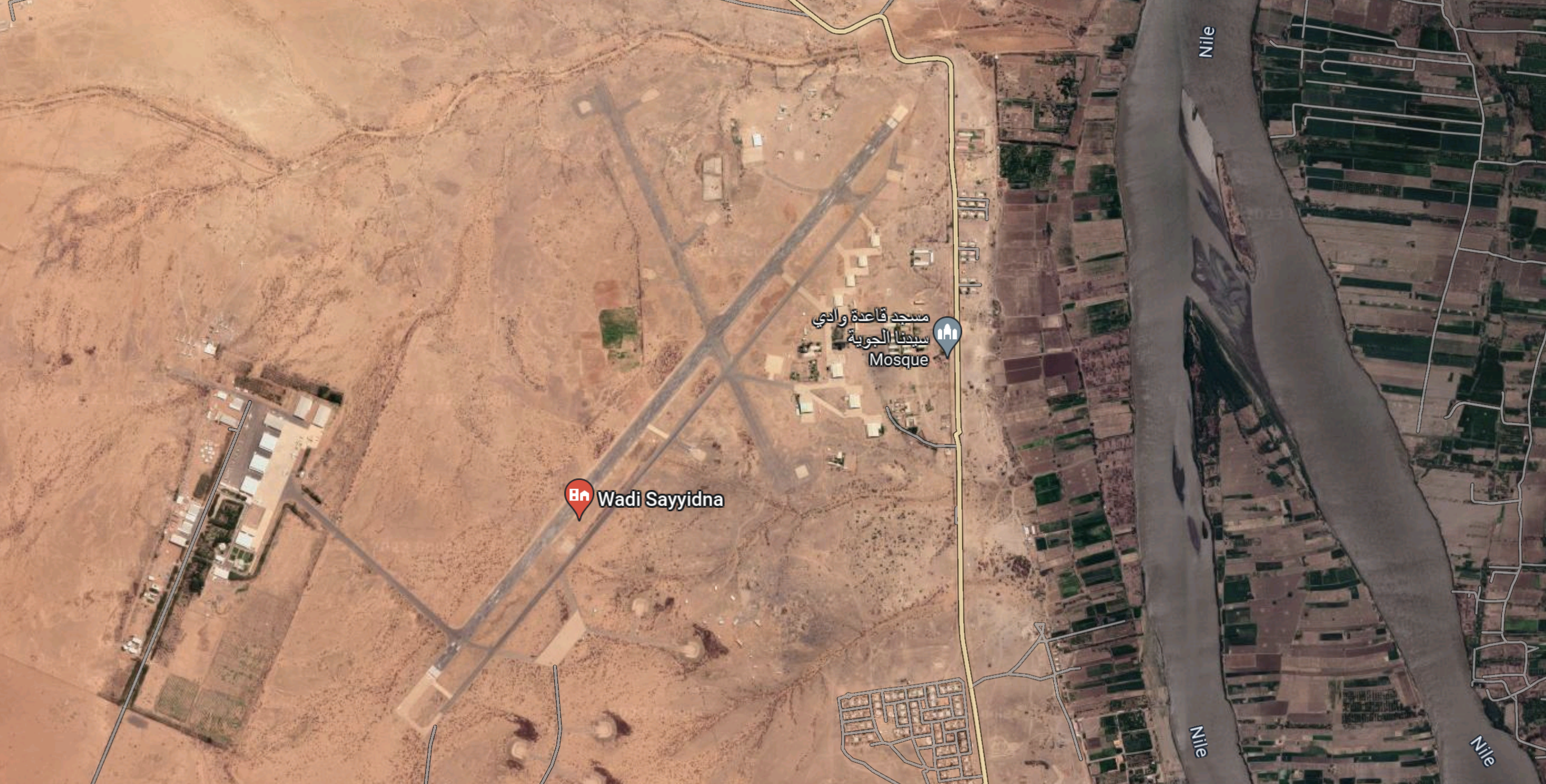
The aircraft first flew in 1954 and nearly seventy years later they are still doing the same operations, they were designed for, with various reports of Hercules flying to the remote Wadi Seidna airstrip in Sudan.
This Google Map shows the airstrip.
Note.
- There appears to be two runways and some form of operational building or terminal.
- The River Nile is at the East of the map.
It looks like an airfield, where Hercules are intended to be used, even in circumstances, where severe damage has been inflicted to the runway.
When Metier Management Systems and Artemis were sold to Lockheed, I had several conversations with senior people and the company was and probably still is rightly proud of its long-lived design.
Meet HiiROC, The Startup Making Low-Cost Hydrogen Free From Emissions
The title of this post, is the same as that of this article on UKTN.
This article explains the technology behind, what I feel is one of the most promising start-ups, I’ve seen.
It is certainly a must read.
This paragraph explains how they plan to lease the machines.
It plans to bring in revenue by leasing its machines to companies charging on the output of hydrogen and carbon.
That is almost how we sold the Artemis project management software, I wrote over forty years ago.
- Our bank manager liked it, as we were leasing to companies like BP, Chevron and Shell.
- His bosses liked it, as leasing companies don’t normally have that dodgy word; innovation.
- Our in-house accountant liked it, as we had an easy to predict cash flow.
- Our customers liked it, as all they had to provide was a 13-amp socket and paper for the printer.
It was a model that served us well.
Conclusion
The more I learn of HiiROC, the more I like the company.
ESB Invests In Floating Offshore Wind Mooring Tech
The title of this post, is the same as that of this article on offshoreWIND.biz.
This is the sub-heading.
Ireland’s Electricity Supply Board (ESB) has announced that it will invest in Dublin Offshore Technology (DOT), a company specialising in floating offshore wind mooring technology
These three paragraphs, outline the new relationship.
DOT has developed a technology solution for floating offshore wind mooring systems which provides significant design improvements for the wind farm, the company said.
The optimised mooring system delivers these benefits using locally-sourced materials tried and tested in the offshore environment with no degradation over the full lifetime of the wind farm, according to the Irish energy company.
By partnering with DOT, ESB will be able to leverage its expertise and resources to accelerate the development and delivery of its floating wind project portfolio.
In 13 Offshore Wind Projects Selected In World’s First Innovation And Targeted Oil & Gas Leasing Round, I wrote about how ESB and DOT were working together on Malin Sea Wind.
This update on the Dublin Offshore web site describes the Malin Sea Wind project.
In the early days of North Sea oil and gas, I saw relationships like these form and blossom. You could argue that the success of the project management system; Artemis, that I wrote, benefitted from close relationships with major oil companies and large international engineering companies.
History is just repeating itself.
Maritime UK Launches Offshore Wind Plan
The title of this post, is the same as that of this article on offshoreWIND.biz.
This is the sub-heading.
Maritime UK has unveiled its Offshore Wind Plan which makes a series of recommendations for how the maritime sector, the offshore wind sector, and governments can work together to maximise growth
These are the first three paragraphs and they outline the plan.
The plan outlines how the growth of offshore wind can provide opportunities across the maritime supply chain in sectors like ports, shipbuilding, crewing, and professional services.
Opportunities identified in the Offshore Wind Plan include building vessels in the UK to support developments and further growing UK ports as centres for manufacturing and assembly for offshore developments
Key recommendations and proposals within the plan include: creating quality career pathways for young people; rewarding higher UK supply chain content in offshore wind projects; reforming the planning system to enable green projects to be delivered quicker; and encouraging lenders and investors to finance infrastructure and vessels
Note.
- Maritime UK have a web site.
- The report seems to be comprehensive.
- The report predicts hundreds of ships to build and service wind farms will be needed.
Overall, Maritime UK feel that the maritime sector has a lot to gain from co-operation with the offshore wind sector.
Improved Service Operation Vessels (SOVs)
I don’t see why the large number of Service Operation Vessels (SOVs) needed to serve all the wind farms around our shores, can’t be designed and substantially built in the UK.
In the 1970s, one of Metier Management Systems’ customers for Artemis were the shipbuilders; Austin & Pickersgill, who at the time were building a cargo ship called the SD14, which had been designed to replace the American Liberty ships.
In total 211 SD14s were built in the UK, Greece, Brazil and Argentina.
SD14 stands for Shelter Deck – 14,000 tonnes.
We surely have the technology from companies like BAe Systems, Rolls-Royce and others to design an advanced Service Operation Vessel.
 The Anonymous Widower