Looking At The East West Railway Between Bedford And Cambridge
Updated Post
I have updated this post in June 2021 to add extra information, that has now become available.
The route that has been chosen by East West Railway is Route E.
Route E is described in Wikipedia as follows.
Route E involves running from the existing Bedford station heading north then running to Tempsford where a new station would be built then (bypassing Sandy) the route heads east to Cambourne where a new station would be built. The route then joins an existing line northbound to Cambridge.
These maps show the route between Bedford and Cambridge stations in sections.
Bedford And Tempsford
This map shows the Western section between Bedford and Tempsford.
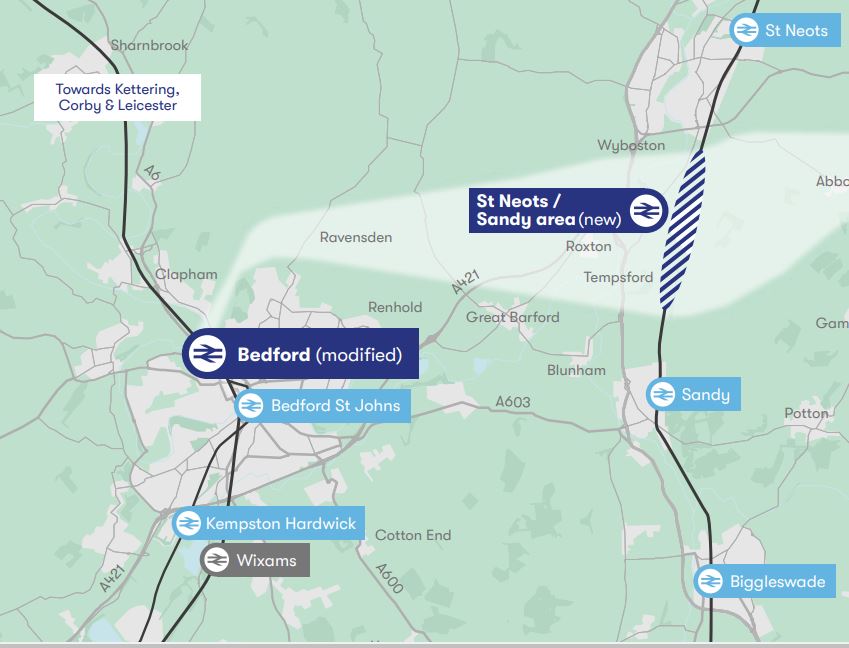
Note.
- Kempston Hardwick and Bedford St. Johns are existing stations on the existing Marston Vale Line, which could substantially be the route of the East West Railway between Bedford and stations to the West like Bletchley, Milton Keynes, Oxford and Reading.
- Bedford station is on the Midland Main Line.
- Wixams station is a proposed station on the Midland Main Line, which also might be served by the East West Railway.
- Biggleswade, Sandy and St. Neots stations are on the East Coast Main Line (ECML).
I’ll now take a quick look at the route through Bedford and the proposed Wixams station.
Bedford Station
Bedford station is served by the following train services.
- It is a terminus for Marston Vale Line services to and from Bletchley station.
- It is a terminus for Thameslink services to and from London St. Pancras International station and the South as far as Brighton.
- East Midlands Railway services between London St. Pancras International station and the East Midlands and Sheffield call at the station.
Midlands Connect are also proposing a service between Bedford and Leeds.
- It would use High Speed Two Classic-Compatible trains.
- This would use High Speed Two to the North of East Midlands Hub station.
- Times would drop between Bedford and Leeds from 140 minutes to 66 minutes.
I wonder, if this service were to be successful, that more services could be run from Bedford to the North.
There would certainly be massive advantages in developing Bedford as a major interchange between the East West Railway and the Midland Main Line.
This Google Map shows Bedford station.
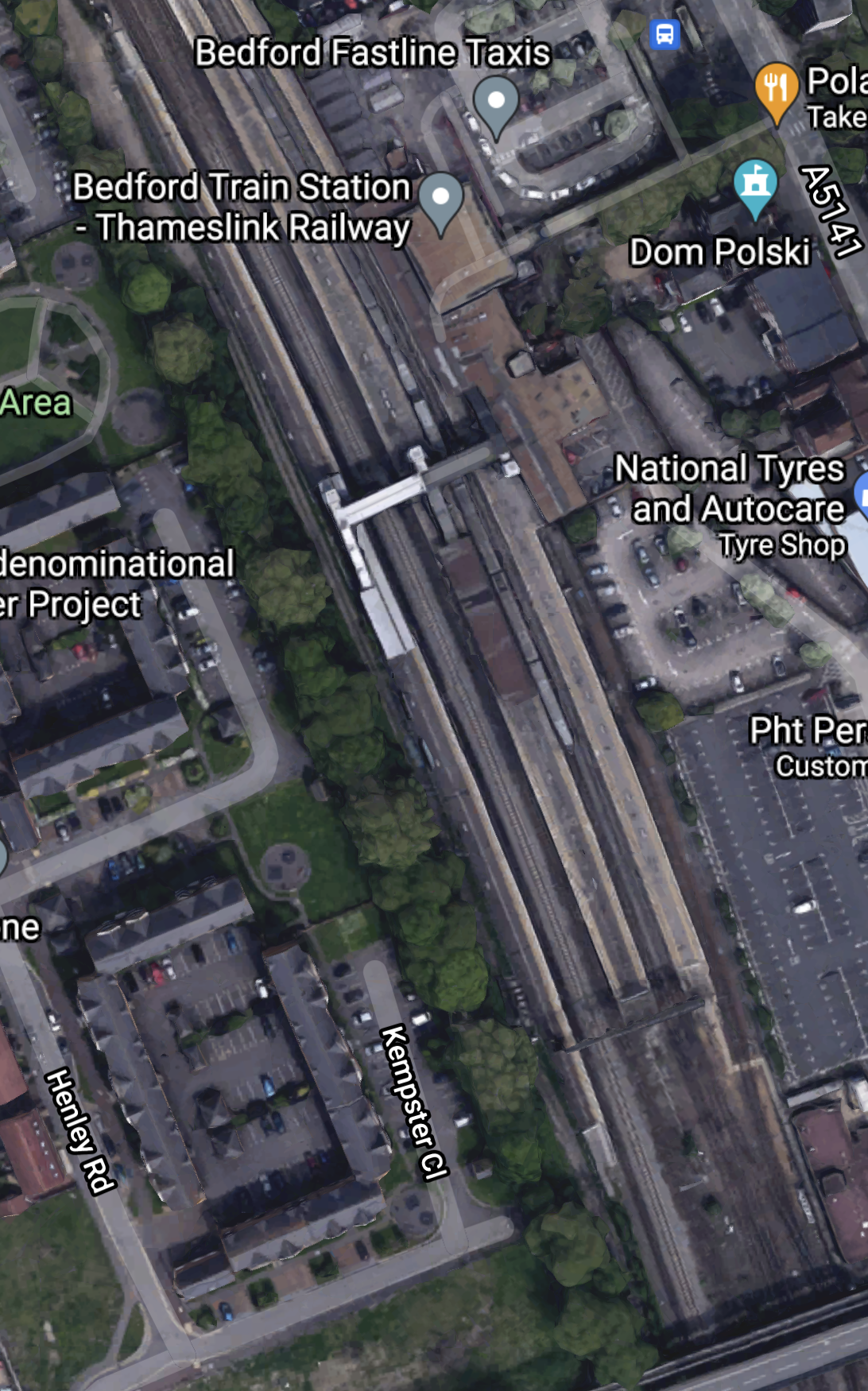
Bedford station currently has five platforms.
- 1a – A bay platform for Marston Vale Line services
- 1 and 2 – Thameslink
- 3 – Southbound East Midlands Railway
- 4 – Northbound East Midlands Railway
Note.
- Platform 1a is about a hundred metres long.
- There is a fast line between Platforms 3 and 4.
- There is space to the West of Platform 4
I can come to these conclusions about Bedford station.
If a new platform is needed to handle more services at the station, there is space to build it.
According to East West Railway Company To Start Second Phase Of Rolling Stock Procurement, three-car trains are to be used by the East West Railway and these can be handled by the current Platform 1a.
As Bedford station is to be rebuilt, any issues can be sorted.
This Google Map shows the area to the North of the station.
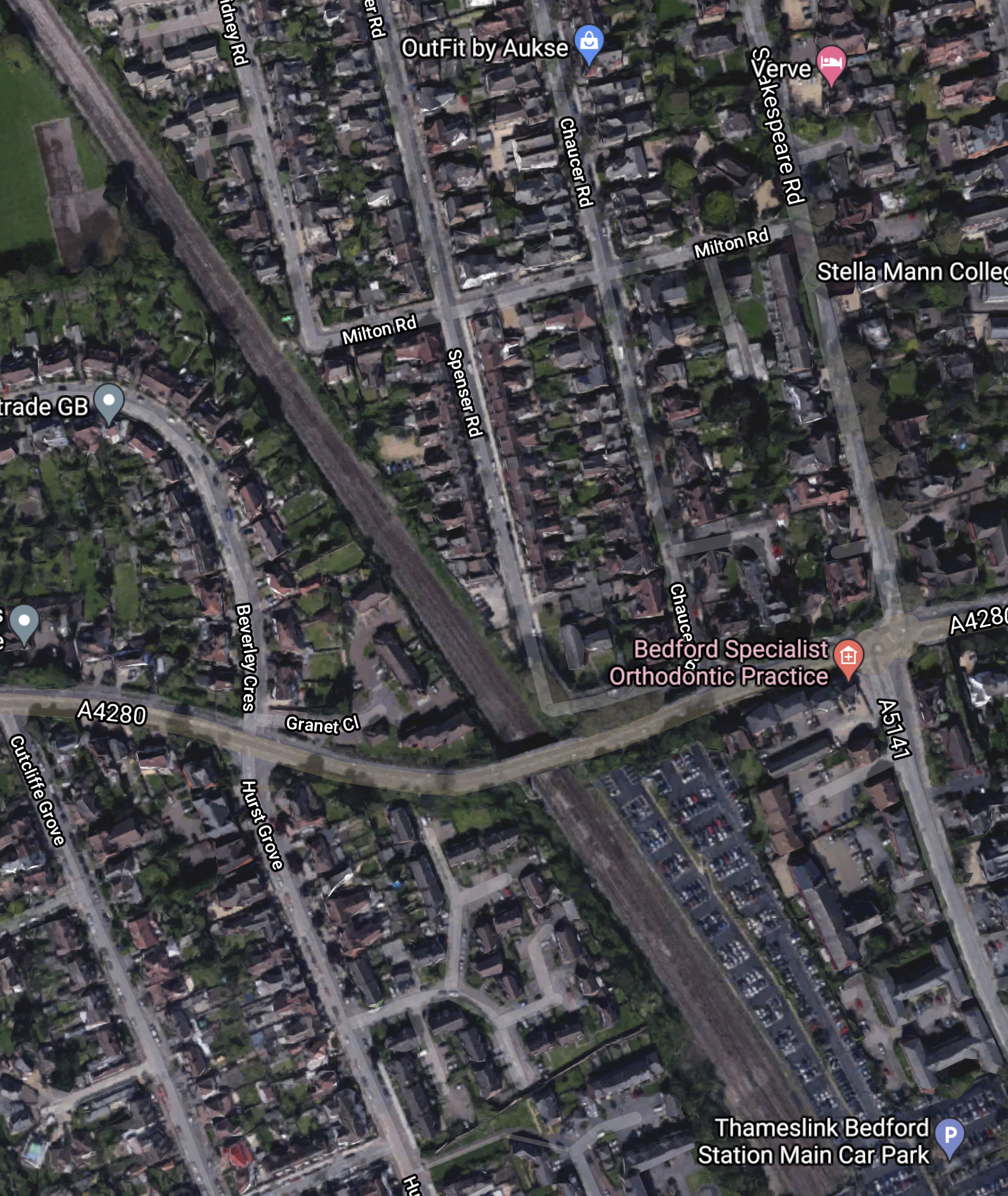
Note that some of the roads to the North-East of the railway are named after poets. This is the Poets area of Bedford.
This article on the BBC is entitled East-West Rail: Bedfordshire Residents Give Their Views On £5bn Scheme and it details the opposition to the route including a section about the Poets area.
EWR Co says it could acquire or demolish 53 properties in the Bromham Road district of Bedford, known as the Poets area.
In addition, a further 16 properties could be demolished between Bedford and Cambridge.
This Google Map shows the Midland Main Line through Bedford.
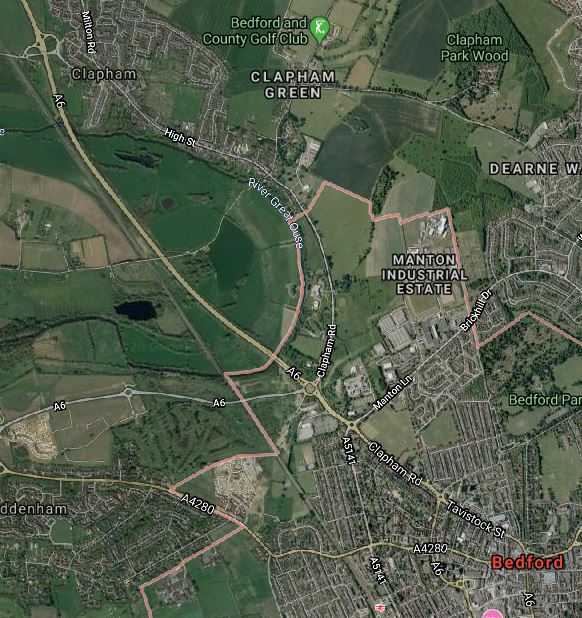
Note.
- Bedford station is at the bottom of the map towards the East.
- The village of Clapham is towards the top of the map.
- The A6 road runs up the Eastern side of the railway.
What I find interesting, is that, to the East of the Midland Main Line between Bedford and Clapham appears to be mainly open farmland.
Is there sufficient space to build a flying junction, so that trains could go between Bedford and Cambridge in a smooth manner? From a quick look at this map, it appears to me that this would be possible.
It might even be possible to build a full triangular junction, North of Bedford, so that trains could go between the East and the Northbound Midland Main Line.
It looks to me to be a very important junction, that gives lots of possibilities for new passenger and freight services.
- Passenger trains between Cambridge and Sheffield via Leicester and Derby.
- Freight trains between Felixstowe and Derby, Nottingham and Sheffield.
- Could the route be used for stone trains between the Peak District and the massive building developments in the City of London?
This ideas would be for starters!
But I do feel that Network Rail have lots of strong reasons to take a North-Easterly route out of Bedford.
But this route is not popular with those that live in the area.
This Google Map shows the area South of Bedford towards the Wixams development.
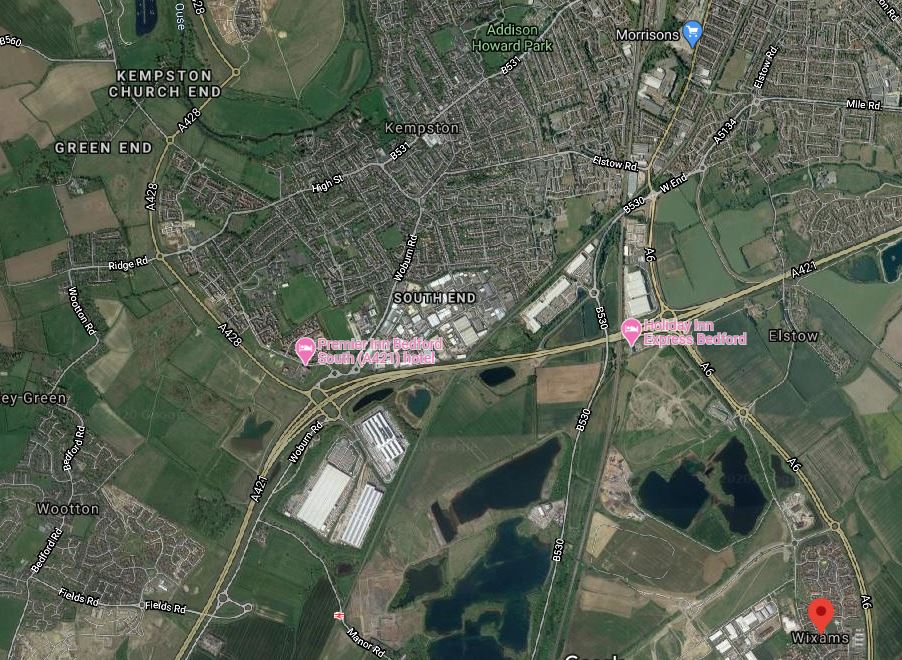
Note.
- The large new village of Wixams is shown by the red arrow.
- Kempston Hardwick station can be picked out to the West of Wixams, close to the bottom of the map.
- The Midland Main Line can be picked out running South between Wixams and Kempston Hardwick.
The area looks like it is ripe for housing and commercial development between all the water.
I can envisage the East West Railway and the Midland Main Line doing the following.
- Sharing tracks through Bedford and a new Wixams station, if that is desired.
- A flying junction would then allow the two routes to split.
- The East West Railway would go West to places like Bletchley, Milton Keynes, Oxford and Reading.
- The Midland Main Line would go South to Luton, London and beyond.
The East West Railway would open up a massive housing development at Wixams with connections to Cambridge, London, Milton Keynes, Oxford and beyond.
It strikes me, that one of the reasons for choosing Route E, is that this is the route, that opens up the Wixams development.
Could A Southern Route Be Used Around Bedford?
It probably could but, if the trains were to serve Bedford they’d need to reverse in Bedford station.
If the East West Railway goes to the North of Bedford, the following is possible.
- East West Railway trains going East could share Platform 4 with Northbound East Midlands Railway services.
- East West Railway trains going West could share Platform 3 with Southbound East Midlands Railway services.
- East West Railway trains going West could also have a cross-platform interchange with Thameslink.
Train operation would be much simpler.
Through Tempsford
This map shows the Western section around Tempsford, where it crosses the ECML.
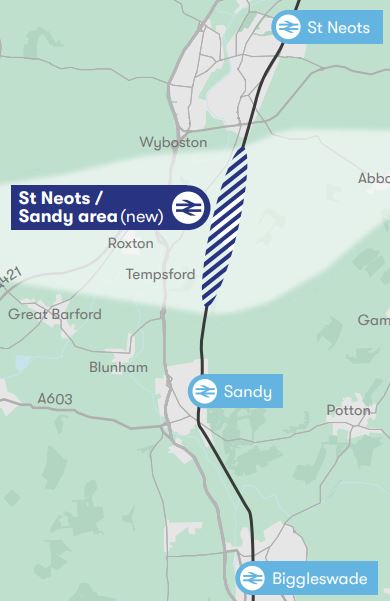
Note.
- Biggleswade, Sandy and St. Neots stations are on the ECML.
- There might be opportunities to improve the section of the ECML in this area.
- The light-coloured East-West band through the new station, is the proposed route of the East West Railway.
This Google Map shows the area North from Sandy.
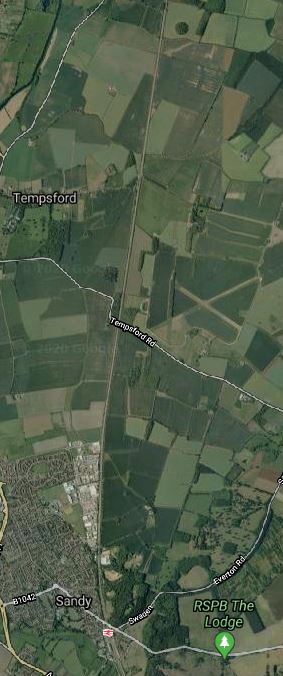
Note.
- Sandy station can be seen at the bottom of the map.
- Tempsford can be seen about three-quarters of the way up the map.
- The ECML runs North-South up the middle of the map.
- The former RAF Tempsford can also be seen on the East side of the ECML.
- One interesting place on the map is the RSPB at Sandy.
Has the route been chosen to the North of Sandy to avoid the RSPB, who might not be in favour of a new railway?
- I could envisage an impressive interchange station at Tempsford, if East West Railway decided to build it.
- The East West Railway and the ECML could cross at right angles.
- Platforms on both routes could be connected by lifts, escalators and stairs.
- There looks like there could be space for lots of car parking.
Alternatively, a full junction could be built so that trains could swap between the two routes. But I suspect this would be too expensive.
The View From St. Neots
This article on the BBC is entitled St Neots: ‘I Think This Could Put Our Town On The Map’.
This is the first paragraph.
For the first time in its 1,000 years of history, St Neots could get its own voice in Parliament as part of a reshuffle of constituency boundaries. What difference could it make for a town that is the largest in Cambridgeshire?
The This in in the title is their own MP.
This is also said about transport links in the town.
he town, which is 45 minutes to London by rail, is getting a new bypass and is also at the centre of the new Cambridge to Oxford east-west rail link.
“There are phenomenal opportunities here for new business, all this development is happening around us,” adds Mr Hughes.
“All the people who used to travel to London – because St Neots is a commuter town – during the pandemic, they’ve opened the door, walked into the town and realised there’s a wonderful bohemia here.
There are also complaints in the article about the lack of jobs.
Surely, if the new station at Tempsford was well-designed and had enough car-parking, some of those commuters could work in Cambridge.
Tempsford And Cambourne
This map shows the central section between Tempsford and Cambourne.
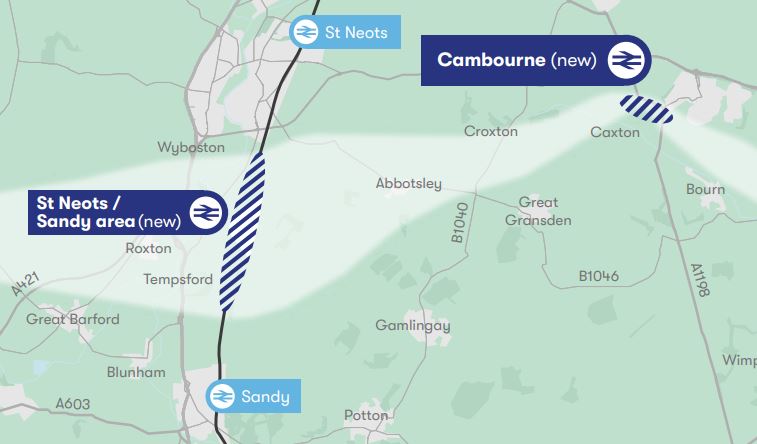
Note.
- Sandy and St. Neots stations are on the ECML.
- The light-coloured East-West band through the new Tempsford and Cambourne stations, is the proposed route of the East West Railway.
This Google Map shows the area between Tempsford and Cambourne.
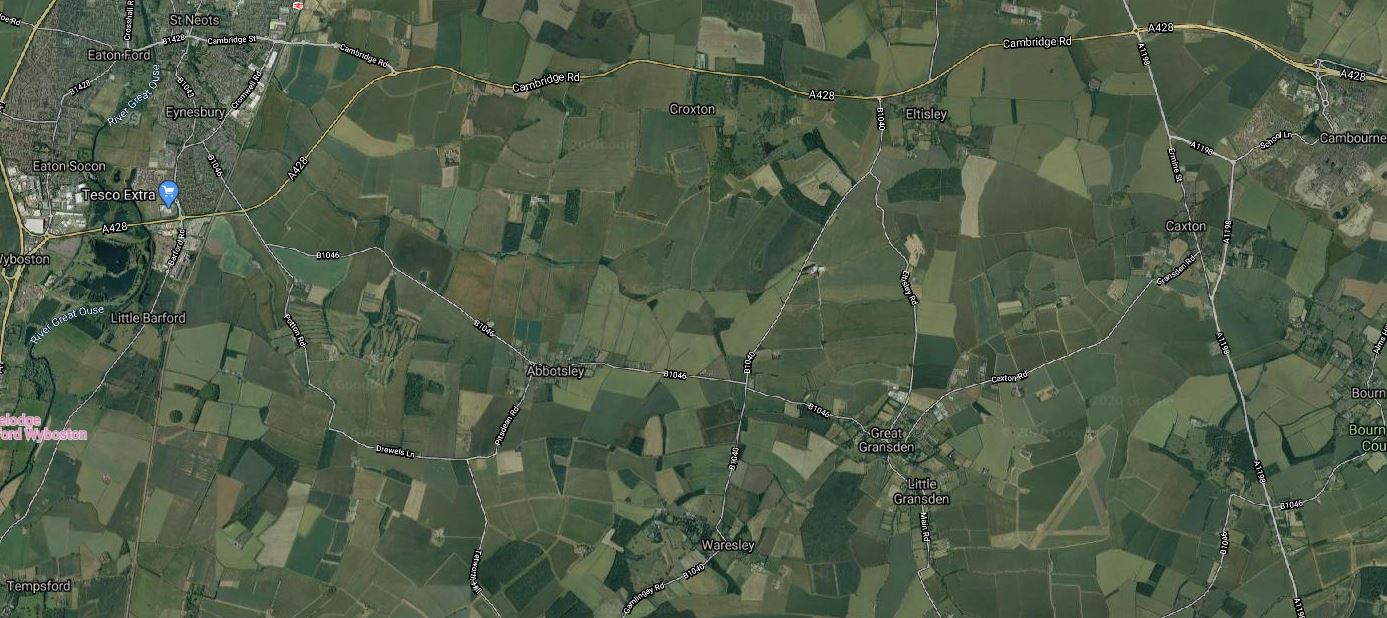
Note.
- Tempsford is in the South-West corner of the map.
- Cambourne is in the North-East corner of the map.
- St. Neots station is in the North-West corner of the map.
It certainly isn’t an area of the country with many important buildings around.
Through Cambourne
This Google Map shows the central section through Cambourne.
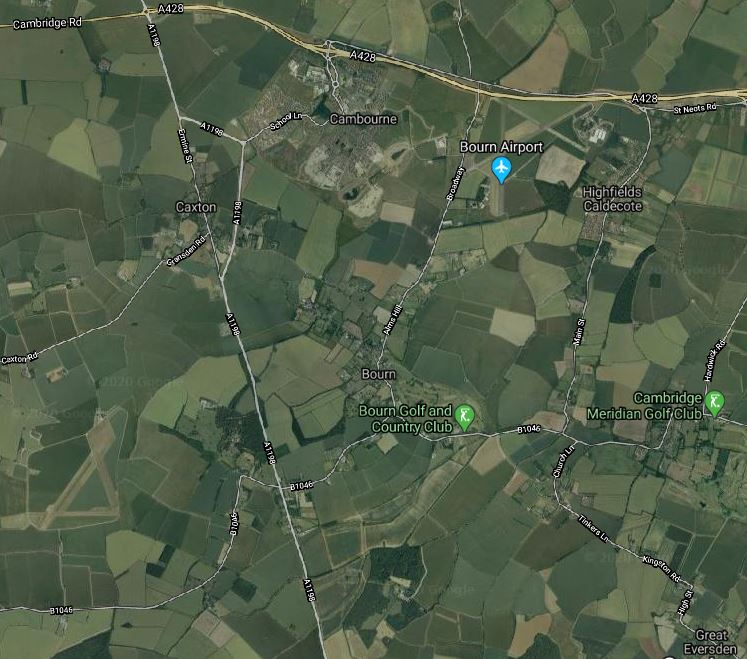
Note.
- The new village of Cambourne by the A428.
- The A1198 road going North-South between Huntingdon and Royston.
- The village of Great Eversden in the South-East corner of the map.
From looking at the various maps and knowing the area well, I suspect the East West Railway will take the following route.
- Approach from the West and cross the A1198 to the North of Caxton.
- Pass South of Cambourne, where a station could be built. The station could be fairly simple, but there is plenty of space, especially if cycling to the train is encouraged.
- Pass North of Bourn and Bourn Golf and Country Club.
- Pass North of Great Eversden and leave the map in the South-East corner.
It looks to be a fairly simple section.
Great Eversden And Cambridge
This Google Map shows the area from Great Eversden to the Trumpington Park-and-Ride, which is served by the Cambridgeshire Guided Busway.

Note.
- Great Eversden is in the South-West corner of the map.
- The M11 runs diagonally across the Eastern end of the map.
- Trumpington is at the Eastern end of the map.
- The track bed of the old Varsity Line is clearly visible.
The question has to be asked, if it would be worthwhile rebuilding this section.
Consider.
- Part of the trackbed is used for the Ryle Telescope.
- Part of the trackbed is used for the Cambridgeshire Guided Busway.
- The route doesn’t serve Addenbrooke’s Hospital.
- Cambridge also has ambitions to extend the Cambridgeshire Guided Busway to Hauxton and create the Cambridge Autonomous Metro, which I wrote about in Consultation On The Cambridge Autonomous Metro.
This map shows the proposed layout of the Cambridgeshire Autonomous Metro.
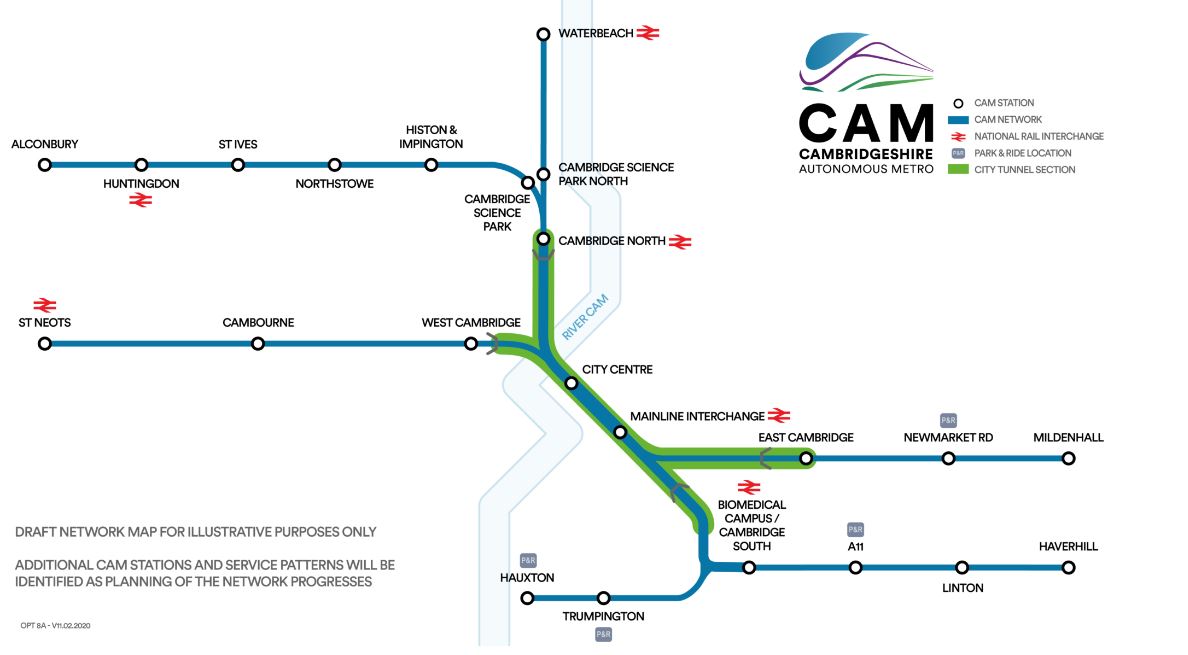
Note.
- The green section will be in tunnel.
- The Trumpington Branch is extended to Hauxton,
This Google Map shows the area to the South West of Cambridge between Hauxton and Addenbrooke’s Hospital.

Note.
- Addenbrooke’s Hospital is in the North-East corner of this map.
- The Trumpington Park-and-Ride is to the East of the M11.
- Shelford station is in the South-East corner of the map.
- The West Anglia Main Line running past the hospital, splits into two, with one branch going West to Royston and Hitchin and the other going South to Harlow and London.
The two maps taken together weave quite a complicated pattern.
The East West Railway and the Cambridge Autonomous Metro could probably be tweaked so that they could both be created.
- The East West Railway could take a slightly more Southerly route and pass to the West of Hauxton to join the Royston and Cambridge Line to get to Cambridge South and Cambridge stations.
- The Cambridge Autonomous Metro would pass over or under the M11 and terminate at a suitable place on the East of Hauxton.
There might even be a solution involving a joint station to the West of the M11
EWR Targets Short-Term Fleet Ahead Of Possible Electrification
The title of this post is the same as that of this article on Rail Magazine.
This is the introductory paragraph.
Electrification could yet be on the agenda for East West Rail, after Government ministers confirmed that the decision not to wire the reopened railway could be reversed.
East West Railway (EWR) also announced last week, that it was looking for second-hand diesel multiple units to start services.
- The lease will be for four years, with a possible extension of two years.
- The deal is worth £40million and will include maintenance.
- The deal will end on May the 10th 2028.
- 12 to 14 three-car trains are required.
- Services will start at the end of 2024.
It looks to me, that this deal has interim written all over it.
Could Class 170 Trains Be Used For East West Railway?
Class 170 trains come in two- and three-cars and by 2024 many could be being replaced by trains with a smaller carbon-footprint.
If you look at the three-car Class 170 trains, they are the following numbers of trains with various companies.
- Class 170/1 – CrossCountry – 10
- Class 170/2 – Transport for Wales – 8
- Class 170/3 – Abellio ScotRail – 26
- Class 170/3 – CrossCountry – 2
- Class 170/4 – Abellio ScotRail – 13
- Class 170/4 – Northern Trains – 16
There are also some Class 170/5 and Class 170/6 trains, that it appears will be consolidated into ten three-car trains for CrossCountry.
Could CrossCountry Provide The Trains For East West Railway?
I think one likely scenario would be for the trains for East West Rail to come from CrossCountry‘s mixed fleet of Class 170 trains.
Consider.
- CrossCountry need a bit of a fleet change as they still ten High Speed Trains, that will need to be replaced with more modern rolling stock.
- CrossCountry have been criticised for a lack of capacity.
- Several of CrossCountry’s services are run by diesel trains on electrified tracks.
Perhaps, if they replaced the fleet with a customised variant of Hitachi’s Class 800 trains, they might offer a better service to their customers.
- Each train would be five cars long.
- Trains would be able to work in pairs.
- Trains might have electric, battery and diesel capabilities.
- Some would be dual-voltage trains and able to work on both 25 KVAC overhead and 750 VDC third rail electrification.
I’m sure those clever people at Rock Rail are working on an appropriate specification, just as they did for Avanti West Coast with their customised variant of Hitachi’sClass 800 trains.
Looking at the delivery schedules for various fleets of Hitachi trains, we find.
- East Midlands Railway will be receiving 33 x five-car Class 810 bi-mode trains in 2020-2022.
- Avanti West Coast will be receiving 13 x five-car AT-300 bi-mode trains in 2020-2022.
- Avanti West Coast will be receiving 10 x seven-car AT-300 electric trains in 2020-2022.
Could the CrossCountry fleet be delivered in 2022-2024 to allow the Class 170 trains to be released?
Could Class 185 Trains Be Used For East West Railway?
TransPennine Express have a fleet of 51 three-car Class 185 trains.
The future of these trains is uncertain, as TransPennine Express is renewing their fleet.
- They are all fully-compliant with the latest regulations.
- They are 100 mph trains,
- They are the right length.
- They can work in pairs to increase capacity.
These trains would be easy to freshen up for East West Railway.
Could Bombardier Voyagers Provide The Trains For East West Railway?
There are four fleets of Bombardier Voyagers, that by the end of 2024 could be looking for a new home.
- Thirty-four Class 220 trains could be released by 2024 by CrossCountry, if they replace their fleet with new trains.
- Twenty-four Class 221 trains could be released by 2024 by CrossCountry, if they replace their fleet with new trains.
- Twenty Class 221 trains will be released by 2022 by Avanti West Coast, when they replace their fleet with new AT-300 trains.
- Twenty-seven Class 222 trains will be released by 2022 by East Midlands Railway, when they replace their fleet with new Class 810 trains.
These fleets could be updated for the East West Railway.
- They are all fully-compliant with the latest regulations.
- They are 125 mph trains.
- Bombardier have been working on various schemes to fit batteries to these trains, to reduce running on diesel.
They could also be rebuilt to any required length.
Fast Forward To May 2028
By 2028, the following will have happened.
- High Speed Two will have been substantially completed and electrified at Calvert, where it crosses the East West Railway.
- East West Railway will be connected to the electrified West Coast Main Line at Bletchley.
- East West Railway will be connected to the electrified Midland Main Line at Bedford.
- New Hitachi Class 810 trains will be running through Bedford.
- Future connections to the electrified East Coast Main Line at Sandy and the electrified West Anglia Main Line at Cambridge South will have been designed, if not well underway or even completed.
East of Calvert, there will be plenty of electricity to power any electrification.
The article also quotes a Government minister as saying there will be passive provision for electrification. This is sensible, as the clearances required for 25 KVAC overhead electrification are not that much higher, than those needed for the largest freight containers.
So the two major requirements for 25 KVAC overhead electrification; electricity supply and gauge-clearance, appear to be met in the basic design of the East West Railway.
The East West Railway will also have one characteristic, that has been lacked, by most of the railways we have electrified in the last few years.
It will be a substantially new railway, although quite a few miles will have been rebuilt on an existing track bed.
It is my view after looking at several electrification schemes in the last ten years, that when we have electrified a substantially new railway, we have made a much better fist of it, in terms of both cost and timescale.
Could this be, that if the track-bed has just been created or relaid, it is well surveyed and the engineers and workers, who laid it, can be asked their opinion, so fewer costly mistakes are made?
It should also be said, that the route of the East West Railway goes through fairly flat country, which probably doesn’t have the sewers and mine-shafts, that have plagued the erection of electrification in recent years.
I wonder, if having looked in detail at the costs, the builders of East West Railway have found that perhaps around 2023, after a detailed survey of the route, they can build the railway at a cost, which includes electrification, that still offers benefits.
What Would Be The Benefits Of Electrification Of The East West Railway?
The benefits of electrification are generally as follows.
- Faster passenger and freight trains because of higher cruising speed and greater acceleration.
- Lower carbon emissions.
Faster trains would lead to more trains running over the railway.
Will The Electrification Be Full Or Partial?
I believe that Hitachi and other ,manufacturers will produce passenger trains with the following abilities.
- To use either 25 KVAC overhead or 750 VDC third-rail electrification.
- To use onboard energy storage for running a number of miles.
- To charge onboard energy storage, whilst dynamically connected to electrification.
- To charge onboard energy storage, whilst stationary in a station or siding.
- To swap between electrification and energy storage modes at operating speed.
These trains will be able to run on partially-electrified lines, by using energy storage to bridge gaps in the electrification.
In Sparking A Revolution, I gave this specification for a Hitachi battery-electric train.
- Range – 55-65 miles
- Performance – 90-100 mph
- Recharge – 10 minutes when static
- Routes – Suburban near electrified lines
- Battery Life – 8-10 years
It looks like a route run by Hitachi battery-electric trains could have approximately sixty mile gaps in the electrification.
The trouble with gaps, is that they would mean that electric freight locomotives could not be used on the route.
One possibility could be the new tri-mode Class 93 locomotive, which has the following power sources.
- 1.3 MW on diesel
- 4.055 MW on electric
- A power boost on battery
Hopefully, it can switch seamlessly between the various modes at line speed.
Until we see these locomotives in operation, we will not know if they can haul a maximum weight freight train all the way from Felixstowe to Ipswich and on to London, Cambridge or Peterborough.
Freight Trains Through Cambridge And Onto The East West Railway
In Roaming Around East Anglia – Freight Trains Through Newmarket, I said this.
The East West Rail Consortium plan to change the route of freight trains to and from Haven Ports; Felixstowe, Harwich and Ipswich to the West of Kennett station.
In this document on the East-West Rail Consortium web site, this is said.
Note that doubling of Warren Hill Tunnel at Newmarket and
redoubling between Coldham Lane Junction and Chippenham Junction is included
in the infrastructure requirements. It is assumed that most freight would operate
via Newmarket, with a new north chord at Coldham Lane Junction, rather than
pursuing further doubling of the route via Soham.
How would these changes affect Newmarket and the horse-racing industry in the town?
I believe that many freight trains would go straight through Cambridge and Cambridge South stations and onto the East West Railway.
One point to note, is that all of the route between Felixstowe and Cambridge South station has been gauge-cleared for the largest container trains and electrification.
This would surely make it reasonably easy to electrify all the way between Felixstowe and Cambridge South station.
Conclusion
I am coming to the conclusion, that given the importance of the rail freight route between Felixstowe and the Midlands, that something like the following will happen.
- 2024 – Diesel passenger trains start running between Reading and Bedford via Didcot, Oxford and Bletchley
- 2026 – Opening of Cambridge South station.
- 2028 – Partial or full electrification is erected between Reading and Bedford
- 2028 – Battery-electric passenger trains replace the diesel passenger trains.
- 2030 – Opening of the full route between Reading and Cambridge.
- 2935 – Opening of a fully-developed route though Newmarket to allow freight trains to go between Felixstowe and the East West Railway.
It appears to me, that by using diesel trains for an interim period, they can open the Reading and Bedford service early, whilst they complete the East West Railway.
MK-Bedford New Line Mooted
The title of this post, is the same as the title of an article in the April 2018 Edition of Modern Railways.
This is the first paragraph.
A new railway between Milton Keynes and Bedford for the East West Rail project has been suggested as a way of avoiding problems with the Marston Vale Line, where the hourly stopping service and numerous level crossings limit capacity for through regional trains.
Another aim is that the next phase of the project should be completed by the end 2022, which is between a one and two years earlier than the existing target.The Chairman of the East West Rail Company, then said he’d like the the railway to open in 2027.
The article says a new route will be expensive, but innovative ways of doing things could help.
Consider these points about the Marston Vale Line
- The stations need development.
- There are at least thirteen level crossings.
- New houses are being built near some stations.
- The operating speed is just 50 mph.
- Finding a new route at Fenny Stratford, Woburn Sands, Aspley Guise, Ridgmont and Lidlington could be difficult.
- The railway passes under the M1 and the A421, so moving these crossing points could be difficult.
It’s all a complicated design problem.
East West Rail could borrow a trick from the Heathrow Southern Railway, which is planned to run alongside the M25 to get to Heathrow. The new railway could be routed alongside the A421 in the Bedford area.
This Google Map shows the A421 to the South of Bedford.
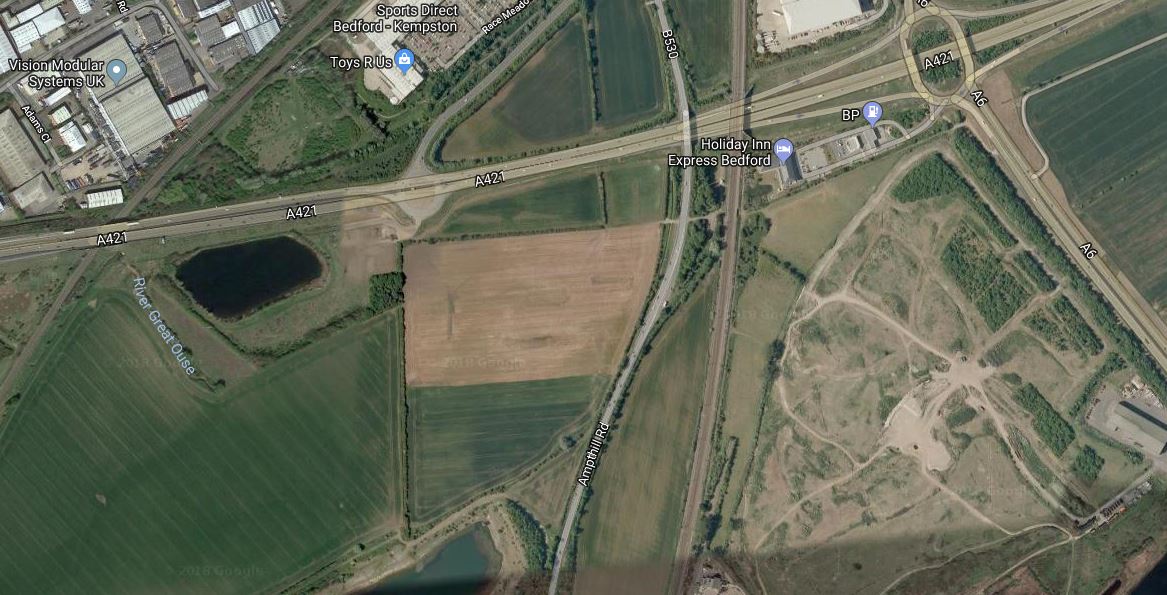
Note.
- The Marston Vale Line goes across the North West corner of the map.
- The Midland Main Line goes across the map in a North-South direction.
- The roundabout at the North East connects the A421 to the A6.
- The building by the roundabout is a hotel.
If the East West Rail Link was routed alongside the by-pass a station could be built where the two lines cross.
- The Midland Main Line and Thameslink would be linked to the East West Rail Link.
- Passengers for Bedford would be able to use the frequent Thameslink service to get to the town.
- A big Park-and-Ride could be built.
- Marston Vale Line services would take the same route as they do now, via Bedford St. Johns station.
If it was desired, chords could be built to enable services on the East West Rail Link to serve Bedford with a reverse in Bedford station.
Oxford has a Parkway station, Milton Keynes has a Milton Keynes South station at Bletchley, Cambridge will probably have a Cambridge South station, so why shouldn’t Bedford have a Bedford South station?
East West Rail To Be A ‘Diesel Commuter Railway’
The title of this post is the same as that of this article in Rail News. The article talks about the design of the East West Railway.
The East West Railway is important for three reasons.
- It creates a passenger rail link between the high-tech cities of Reading, Oxford, Milton Keynes and Cambridge.
- There are various sites on the route, where much-needed development of houses is proposed and these would benefit from the railway.
- Likewise the developments would provide passengers for the railway.
Rob Brighouse is chairman of the company setup to build the rail link and he indicates more details of the proposal to reopen the railway.
Purpose Of The Railway
Rob Brighouse says this about the purpose of the railway.
The route has changed from being an electrified corridor for freight – part of the ‘electric spine’ envisaged in 2012 – to become a diesel operated commuter railway, at least for the foreseeable future.
So it looks like the railway will be built without provision for long and heavy freight trains.
But I wouldn’t rule out fast parcels and light freight traffic using diesel or bi-mode multiple units, capable of 100 mph. Would these trains be something like a modern version of a Class 325 train?
In practice, this probably means that no provision is made for long freight loops and some of the connections to other lines can be simpler.
Single Or Double Track
Nothing is said about whether the design is for a single or double track railway.
I doubt there is much money to be saved by adding sections of single-track.
The Wikipedia entry for the East West Railway indicates that the Oxford to Bletchley section is proposed to have a 100 mph operating speed.
For these and other reasons, I feel that the engineers designing the line, will ensure that it is a double track 100 mph line.
The section along the Marston Vale Line would need to be upgraded if 100 mph double-track is the standard.
I also think that almost uniquely for a railway in the UK, that the line could be built virtually level with very gentle turns, so that little energy is wasted fighting the terrain.
Level Crossings
West of Bletchley, there are few if any level crossings, but those between Bletchley and Bedford would need to be removed, if the railway was to be built as a fast and smooth line.
Electrification
Rob Brighouse said this about electrification of the route.
I am not planning on making specific provision for electrification. If there are locations where it can be accommodated at a sensible price and it’s much more effective today than tomorrow then we will certainly look at that, yes.
I will review the work that has already been done to adjust structures on the Bicester-Bletchley section. If it creates many abortive costs by cancelling that work then obviously that will inform the decision, but if the work can be done later then that’s what I’ll be looking at. At the moment we are looking at a non-electrified route.
That is a pragmatic approach.
As I said previously, I believe that a well-designed almost-level 100 mph double track could mean that the amount of carbon dioxide produced by an energy- efficient diesel or bi-mode train would not be excessive.
The approach would also have these advantages.
- The route would be available to diesel or bi-mode trains immediately after it is built and certified.
- Electrification of the new railway at a later date with 25 KVAC overhead electrification would be relatively easy, if the building of the initial line is properly documented.
- Overbridges, station platforms and other structures could be built or rebuilt with the required clearance for electrification at a convenient time.
- In the next few years, more efficient battery, hydrogen-powered or whatever trains might be built, which could take advantage of the line.
Electrifying the line, only when needed would delay the time, when a lot of money is spent!
Proposed Services Along The Route
This document on the East West Railway web site, shows the following services.
Bedford to Oxford and Reading
- Due to open in 2022.
- Calling at Ridgmont, Woburn Sands, Bletchley, Winslow, Bicester Village, and Oxford Parkway
- 1 train per hour in each direction
- Approximate journey time: Bedford to Oxford 61 minutes
The current Bletchley to Bedford service will continue.
Milton Keynes to Oxford and Reading
- Due to open in 2022
- Calling at Bletchley, Winslow, Bicester Village and Oxford Parkway
- 1 train per hour in each direction
- Approximate journey time: Milton Keynes to Oxford 41 minutes
Combined with the Bedford service, Bletchley, Winslow, Bicester Village and Oxford Parkway will get two trains per hour (tph) to and from Oxford and Reading.
Milton Keynes to Aylesbury and London Marylebone
- Due to open in 2024
- Bletchley, Winslow, Aylesbury Vale Parkway, Aylesbury, Princes Risborough and High Wycombe
- 1 train per hour in each direction
- Approximate journey time: Milton Keynes to Aylesbury 33 minutes
Winslow will be getting three tph in both directions.
Nothing has been said about services to the East of Bedford.
There must be endless possibilities, as Ipswich and Norwich are mentioned in East West Railway articles.
Train Length
As to train length, I suspect that this is much on the lines of how long is a piece of string.
So will they just start with a four- or five-car train and see how it goes?
This approach was tried on the London Overground and the Borders Railway and in both cases, train capacity had to be increased.
At least most modern trains like Aventras from Bombardier and those from Hitachi are cut-and-shut trains, that can be easily extended, by adding cars in the middle.
The platforms are a bigger problem, if they need to be lengthened.
So I would build them long enough to handle two five-car trains working as a pair.
The pair of trains could also join and split en-route if required.
- Two trains start from Ipswich and Norwich.
- They join at Cambridge and proceed along the East West Railway.
- They split at Oxford, with one section going to Reading and the other going to Swindon or Bristol.
The trains would need end gangways, so passengers could get into the right part of the train.
Hitachi already have automatic joining and splitting with Class 385 trains, so that isn’t a problem.
Train Frequency
The line will be built with the following characteristics.
- Double track
- 100 mph operating speed.
- Level with gentle curves.
- No level crossings.
- No slow freight trains.
- 100 mph trains.
- Modern signalling as on Crossrail and Thameslink
I don’t think that a headway as low as six or even four minutes between trains will be unreasonable.
Headway could also be variable along the route.
Bi-Mode Trains
Going from East to West along the route, the following stations are or will be on electrified lines.
- Cambridge – Electrified
- Cambridge South – New station at Addenbrooke’s Hospital – Electrified
- Sandy – Crossing the electrified East Coast Main Line.
- Bedford – Crossing the electrified Midland Main Line.
- Bletchley – Crossing the electrified West Coast Main Line.
- Didcot – Electrified
- Reading – Electrified
So it would surely be prudent to run bi-mode trains on the line, so they may be able to take advantage of the electrification at the ends of the line.
Bi-mode trains will improve in the next few years with the following features.
- The ability to change between electric and diesel at line speed.
- Batteries could handle regenerative braking in both electric and diesel mode and help to asccelerate the train, when running on diesel.
- The ability to raise and lower the pantograph quickly and without driver intervention.
- Overhead or third-rail electrification could be used to fully charge the battery, if required.
I feel it would be very feasible to use bi-mode trains on the route and they would create less carbon-dioxide than a pure diesel.
I would also opt for bi-mode trains with a top speed of 125 mph on electrified lines, so extensions on the four connecting lines with this capability, would be possible and efficient.
Strategic short lengths of electrification would make the trains more energy-efficient.
Didcot
Didcot Parkway station sits on the junction where the East West Railway will join the Great Western Main Line.
This Google Map shows the junction.
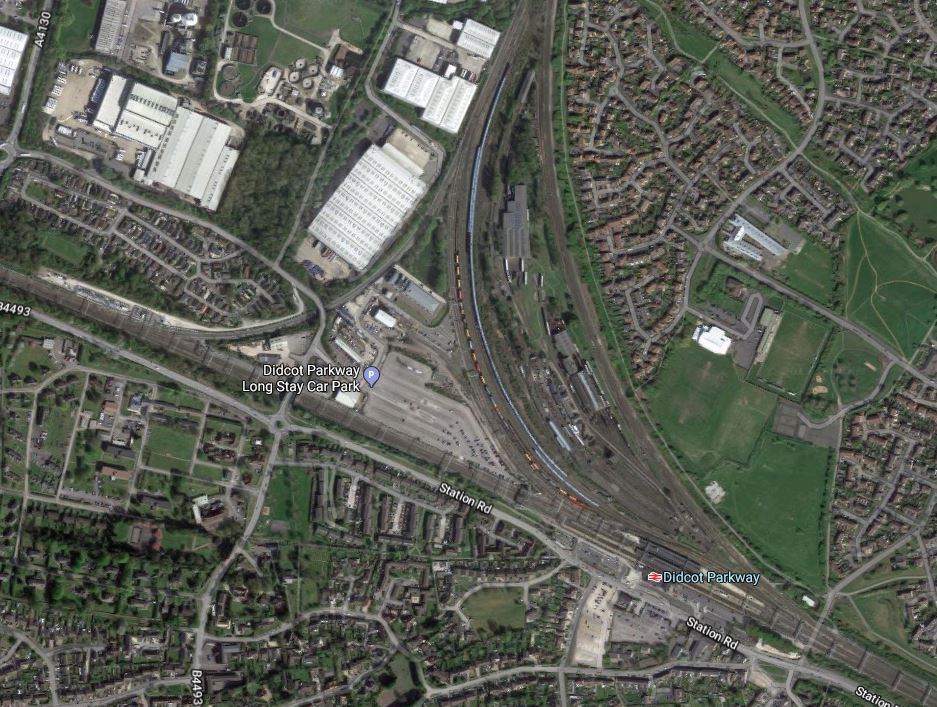
Note the Great Western Main Line going across the map.
- Reading is to the East.
- Swindon is to the West.
- Lines give connection to the East West Railway in both directions.
At some point in the future, services on the East West Railway could go to and from the West to perhaps serve Wales and the West.
If East West Railway adopt the same policy as they have with the Marston Vale Line, I will assume that other services between Reading and Oxford will remain unchanged.
Oxford
Oxford station will be a key interchange on the East West Railway.
I very much suspect though that services will be arranged at Oxford, so that change between local and East West Railway services is just a hop-off one train and hop-on another, or perhaps a walk across the platform.
Bletchley
A flyover at Bletchley station takes the East West Railway over the West Coast Main Line, which I discussed the in The Bletchley Flyover.
Connectivity
At present trains can also use the flyover to go in both directions between the Northbound West Coast Main Line and the Westbound East West Railway.
I also think trains can connect on the flat between the Southbound West Coast Main Line and the Eastbound East West Railway.
Will the building of the East West Railway increase connectivity at Bletchley?
The Bletchley Flyover And The New Platforms
This picture shows the Bletchley flyover.

Note.
- It is a massive concrete structure.
- It is almost a mile long.
- It is not electrified.
- West Coast Main Line is electrified using 25 KVAC overhead wires.
- Two new platforms for the East West Railway will be built on the flyover to enable interchange with the West Coast Main Line.
- Services will use the flyover to access Milton Keynes Central station.
This is a visualisation of how the proposed Bletchley station with the extra platforms could look.
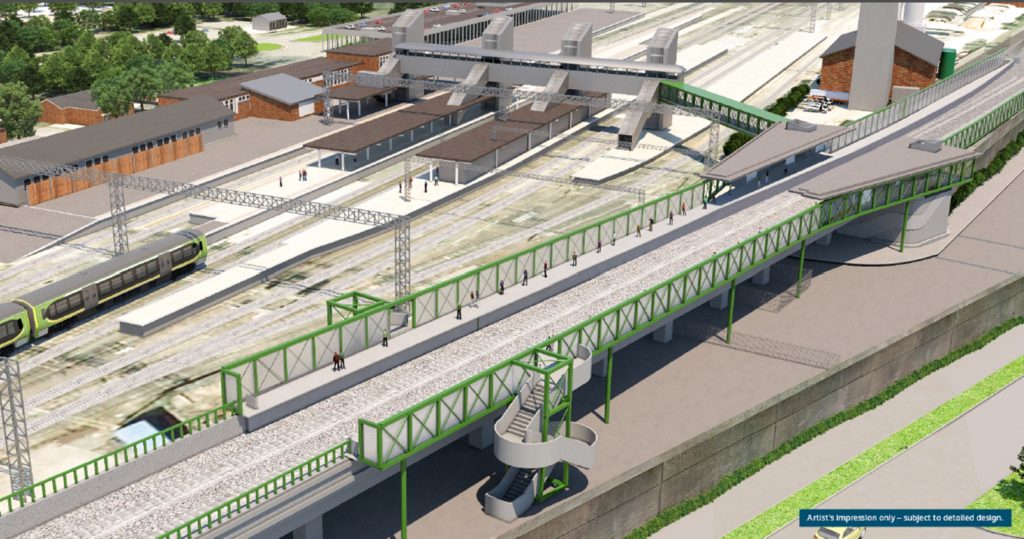
I think the architects and engineers have created a good design.
- A new entrance to the station on the other side of the West Coast Main Line has been created.
- Interchange between the West Coast Main Line and the East West Railway will be step-free.
- No electrification of the East West Railway is shown.
I also think it could be built for an affordable cost.
Electrification At Bletchley
As substantial work will have to be done on the viaduct, would it be prudent to at least prepare the viaduct for electrification, when the new platforms for the East West Railway are created?
If a short section of electrification was added here will be beneficial for train operation.
- Bi-mode trains could use it to reduce their diesel consumption and carbon footprint.
- In future, battery trains could use it to charge their batteries.
Electrification of the flyover is a decision for the accountants.
But as the company building the line, will also operate some of the trains, they can offset construction against running costs.
Bedford
In the next phase of the building of the East West Railway, which is projected to be completed in 2022, Bedford station will be the Eastern terminus.
The service would probably use the existing platform 1A.
Under Future Developments in the Wikipedia entry for Bedford station, this is said.
Plans were being promoted by Network Rail and Bedford Borough Council for the redevelopment of the station quarter.
Platform 1A will be extended through the existing building to accommodate 12-car trains; presently it is only long enough to handle four-car trains and is a terminating bay.
Such a platform would be able to terminate trains arriving from.
- Midland Main Line and Thameslink from the South.
- Midland Main Line from the North.
- The East West Railway.
The longer platform will need to be electrified to be able to handle Thameslink trains.
But it would enable services from the East West Railway to connect to the North at Bedford along the Midland Main Line.
Until more detail is published, I can’t say any more about Bedford.
Sandy
Sandy will be where the East West Railway crosses over the electrified East Coast Main Line.
I suspect that the design of this station will build on experience of Bletchley and hopefully it will be a convenient step-free interchange between services on both lines.
As with the new platforms at Bletchley, it could be relatively easy to provide a short length of electrification at the station.
Cambridge, Ipswich And Norwich
Only Cambridge on the West Anglia Main Line is electrified on the route of the East West Railway.
Wires reach to Ely in the North and Stansted Airport and London in the South.
Consider.
- Greater Anglia are going to use Stadler Class 755 bi-mode trains on lines without electrification from Cambridge to Ipswich and Norwich.
- The Breckland Line to Norwich could be turned into an almost-level 100 mph-plus line with very little infrastructure to slow trains.
- The Breckland Line is lightly used, with a passenger service of two tph and very few freight trains.
- Cambridge to Ipswich is partially electrified.
- Cambridge and/or Peterborough to Ipswich has a passenger service of two tph and large numbers of heavy freight trains.
Bi-mode trains would probably be the preferred choice of train to the East of Cambridge.
Battery Trains
If you look at the lengths of the various sections of the East West Railway, they are as follows.
- Cambridge South – Sandy – 22 miles
- Sandy – Bedford – 9 miles
- Bedford – Bletchley – 24 miles
- Bletchley – Bicester – 20 miles
- Bicester – Oxford – 14 miles
- Oxford – Didcot – 14 miles
Consider.
- No section is very long and all would be within the capability of battery trains in a few years.
- Charging would be at both ends of the line in Cambridge and between Didcot and Reading.
- But this might not be enough, especially if the trains used battery power at the Cambridge end to reach Ipswich and Norwich.
- The solution would probably be to add enough electrification at Bletchley, Bedford and Sandy.
If battery trains do finally arrive, the East West Railway would be a very appropriate line to embrace the technology.
New Technology
If ever there was a railway, where new technology would be understood and welcomed by passengers, it must surely be the East West Railway between Cambridge in the East and Oxford and Reading in the West.
One big advantage this route has over others in the UK, is that I believe it could be built almost-level with perhaps the biggest gradient being climbing over the Bletchley flyover. The energy needs of a modern train could be low.
Hydrogen-Powered Trains
Hydrogen-powered trains are effectively bi-mode trains with batteries, that use a hydrogen-powered power-pack instead of a diesel one to generate electricity when needed.
In this Press Release, Alsthom give a lot of details of their hydrogen-powered Coradia iLint.
- Completely emission-free
- 1000 km range on a tank-full of hydrogen.
- 140 kph operating speed.
Alsthom have received their first order for fourteen trains from Germany.
I believe, that once they are fully developed, they could be ideal for the East West Railway.
Solar-Powered Trains
This may seem bizarre, but read Solar Power Could Make Up “Significant Share” Of Railway’s Energy Demand.
I believe that small solar-farms with batteries could be used to advantage on this line.
- The line could be designed almost level and could have very low traction power consumption.
- Much of the route goes through open countryside, where people don’t seem to object to solar farms.
- Third-rail electrification could be installed at stations and for perhaps a kilometre on either side, to charge batteries on trains.
- The electrification could also accelerate the trains on their way.
- Power to the track would only be switched on when a train is present, thus reducing consumption and increasing safety.
- The electricity generated could power the stations.
Why not?
Additional Services
The East West Railway will have created extra capacity in a loop round London, that Rob Brighouse will be free of slow, heavy freight.
I believe that train operating companies will make use of the new route.
- It will be a 100 mph double-track railway with plenty of capacity.
- If built as an almost level track, it could offer substantial energy savings.
- It will have connections to four electrified main lines radiating from London.
- It will be free of slow, heavy freight trains.
However, it would need suitable diesel, bi-mode or hydrogen trains capable of 100 mph running.
But it could be a very efficient and lower-cost route across England!
Parcels And Light Freight
As I said earlier, I feel the route will also be used by fast parcels and light freight trains based on diesel or bi-mode multiple units.
As an example, plans exist to create a major freight airport at Doncaster-Sheffield Airport, which I wrote about in A Station At Doncaster Sheffield Airport. Part of the plan involves, diverting the East Coast Main Line to serve the Airport directly.
Amazon already flies parcels into the Airport and these could be loaded onto bi-mode express parcel trains, which could go down the electrified East Coast Main Line before taking the East West Railway to travel to Wales and the West of England.
Birmingham To Stansted Airport
Thjis one tph service is run by CrossCountry and goes via Cambridge, Ely, Peterborough, Leicester and Nuneaton. If CrossCountry were to switch to 125 mph bi-mode trains, might it be an alternative to use the East West Railway and perhaps the West Coast Main Line, where paths will be released once, HS2 is opened.
It would certainly be a faster and more economical journey
New Or Rerouted CrossCountry Services
Many of CrossCountry’s services take forever and visit some unsuspected stations. But obviously, it’s what their customers want.
I suspect though with 125 mph bi-mode trains, CrossCountry would look seriously about the possibility of using the East West Railway with its connections to four electrified main lines.
Marston Vale Services
This document on the East West Railway web site, says that current hourly services between Bletchley and Bedford along the Marston Vale Line will continue.
- On that section, the long distance trains are planned to stop at just Ridgmont and Woburn Sands stations.
- Low-performance Class 230 trains planned for the line could slow fast traffic.
- Especially if they stick to the current journey time of forty-three minutes.
- Would an express want to get stuck behind a a slow local train?
I wonder how fast a 100 mph diesel multiple unit like a Class 172 train could go between Bedford and Bletchley?
I think it won’t be fast enough to avoid delaying East West Railway services.
So, something radical will need to be done.
It might be the solution would be to build that section of the route with three tracks; two for the East West Railway and a bi-directional one for the Marston Vale services.
- This would separate the fast and local services.
- There’s certainly plenty of space alongside the current tracks.
At least there don’t seem to have been many protests about building the East West Railway.
Conclusion
I think we could see the East West Rasilway built in a totally-different way.
- Track designed for low energy use and fast, frequent trains.
- Innovative trains.
- Reduced carbon emissions, by the application of new technologies.
It could truly be a railway for the twenty-first century!
Thameslink Services Through Brockley
This post is a follow up to Thameslink’s 24tph Introduction Held Over To 2019, which I wrote yesterday, after doing a little bit of digging anf buying the printed copy of Rail Magazine.
When the full 24 trains per hour (tph) timetable is fully implemented the routing of Thameslink services through South London could be as in the provisional timetable in Wikipedia.
- 1/2 – Bedford to Brighton – via London Bridge, East Croydon and Gatwick Airport
- 3/4 – Bedford to Gatwick Airport – via London Bridge and East Croydon
- 5/6 – Peterborough to Horsham – via London Bridge and East Croydon
- 7/8 – Cambridge to Brighton – via London Bridge, East Croydon and Gatwick Airport
- 9/10 – Cambridge to Maidstone East – via London Bridge, New Cross and Swanley
- 11/12 – Bedford to East Grinstead – via London Bridge and East Croydon
- 13/14 – Bedford to Littlehampton – via London Bridge, East Croydon and Gatwick Airport
- 15/16 – Luton to Rainham – via London Bridge, New Cross and Greenwich
- 17/20 – St. Albans to Sutton – Bia London Blackfriars and the Sutton Loop
- 21/22 – Luton or Kentish Town to Orpington – via London Blackfriars and Catford
- 23/24 – Welwyn Garden City to Sevenoaks – via London Blackfriars, Catford and Otford.
Looking at the routes of these trains shows.
- Twelve tph will run between London Bridge and East Croydon along the Brighton Main Line through stations between Brockley Norwood Junction.
- Ten tph serve Gatwick Airport.
- Ten tph serve Luton Airport.
This morning I stood on Brockley stations and counted trains on the two fast lines of the Brighton Main Line.
In half an hour, I counted less than eight trains in each direction of which one was Network Rail’s leaf cleaning train and another was the Thameslink service between London Bridge and Brighton.
This article in Rail Magazine is entitled Thameslink’s 24tph Introduction Held Over To 2019.
This is a paragraph.
However, GTR will start running some trains on routes earlier than planned. Speaking exclusively to RAIL on November 15, Chris Gibb, chairman of the Thameslink Programme Industry Readiness Board, said that as soon as drivers were trained, GTR services would be diverted via London Bridge from January instead of May, and via the Canal Tunnels from April.
From my observations this morning and my scrutiny of the proposed timetable, it would appear that the twelve tph between London Bridge and East Croydon can be accommodated on the fast lines of the Brighton Main Line, given the following conditions.
- The track and signalling between London Blackfriars and New Cross Gate via London Bridge is completed.
- The London Bridge to Brighton service is discontinued, as Thameslink will replace it.
Thameslink running through London Bridge from January, will surely mean the following.
- Faster and more reliable services between London and Gatwick Airport and the South Coast, using more direct route and the Brighton Main Line, North of East Croydon.
- Less congestion on the Blackfriars route for Thameslink, as it winds through South London.
At present only four tph run on Thameslink, that could use the new direct route.
So if these transfer in January to their own platforms in London Bridge, there will be improvements.
In the Rail Magazine article, Chris Gibb also stated that the Canal Tunnels will be in use by April.
So will we see services gradually added to the Thameslink service, as the route proves it is capable of handling the trains?
This is no Big Bang change, but a simple step-by-step process.
More Details In The Print Copy Of Rail Magazine
The full Rail Magazine article has now been published in print and I have a copy.
Chris Gibb describes the May 2018 timetable change as a Big Bang.
- Capacity increase of 35,000-40,000 into the core at Peak periods.
- New service between Cambridge and Brighton.
- New service between Horsham and Peterborough.
- New service between Luton and the Medway Towns.
- New service between Littlehampton and Bedford.
- New service between East Grinstead and Bedford.
There will be 18 tph through the core.
The article say this frequency will rise to 20 tph in December 2018 and 22 tph in May 2019.
A Possible Thirty Tph Through The Core
The Rail Magazine article also says this.
He (Chris Gibb) explained that 30 tph could run through the core, but that infrastructure either side of it, would not support this.
This increase must open up the possibility of new destinations to the North and South.
Everybody would have their favourites.
Mine could be.
- Ashford International for Eurostar.
- Old Oak Common via the Dudding Hill Line.
- Kettering and Corby
- Milton Keynes
It will be interesting to see what is proposed, let alone implemented.
Should Thameslink Be Extended To Corby?
I ask this question as someone who created his pension pot from writing the algorithms to allocate resources in the planning of projects and because I know that the number of train paths on the Midland Main Line is very tight for the number of services required.
This document on the Network Rail web site has this paragraph.
Electrification of the MML north of Bedford to Kettering and Corby is scheduled to be completed by December 2019.
The Wikipedia entry for Corby station has a section entitled Future, where this is said.
It is planned that a half-hourly London St Pancras to Corby service will operate from December 2019 using new Class 387 trains, once the Midland Main Line has been electrified beyond Bedford as part of the Electric Spine project. Network Rail has also announced that it plans to re-double the currently singled Glendon Junction to Corby section as part of this scheme.
So how will the second service in each hour be provided?
Bedford To St. Pancras
Looking at Bedford, it would appear the following trains run to London.
- East Midlands Trains in 39-40 minutes
- Thameslink in 57-59 minutes at a frequency of four trains per hour (tph).
- A Limited-Stop Thameslink in 52 minutes.
As Thameslink has now fully introduced an all-Class 700 train service, could we be seeing a faster service?
Bedford To Corby
The current hourly service between St. Pancras and Corby stops at Bedford and takes thirty-four minutes between Bedford and Corby with stops at Wellingborough and Kettering.
A modern electric train like a Class 700 train, might be able to do the return trip from Bedford to Corby in under an hour. If a Class 700 train can’t do it, then a Class 387 train certainly could.
This would mean that one way to provide the extra service between St. Pancras and Corby would be to extend one of the four tph Bedford to Brighton services to Corby.
This approach would give the following advantages
- No extra train path is needed South of Bedford.
- Corby, Kettering and Wellingborough would get a choice of service.
- Corby, Kettering and Wellingborough would have a direct link to Crossrail.
But there would be disadvantages.
- The Thameslink service would be a few minutes slower.
- The Class 700 trains don’t have tables, cup-holders, wi-fi and power sockets.
- The Class 700 trains are only 100 mph trains and probably not fast enough.
The obvious solution is to run the service with a faster electric train, which addresses the deficiencies of the Class 700 trains.
The Ultimate Solution
The Midland Main Line between Bedford and Glendon Junction for Corby is at least three tracks, with in most places space for a fourth.
I believe the following improvements should be made to the route between Bedford and Glendon Junction.
- All the tracks between Bedford and Corby should be upgraded to be as fast as possible, so that 110 or 125 mph trains to Corby could make full use of their speed, without using the two Fast Lines.
- Wellingborough station should have the fourth platform restored.
- Extra stations, including a Parkway station, could be added if required.
Thameslink would acquire a number of 110 or 125 trains and replace the four tph service between Brighton and Bedford, with a four tph service between Brighton and Corby.
Class 387 trains would probably be acceptable. Especially, as Govia Thameslink Railway uses these trains on Cambridge services.
The consequences of doing this would be.
- The current one tph path between St. Pancras and Corby on the Fast Lines would be released.
- Platform needs at St. Pancras would be reduced.
- No extra Slow Line paths would be needed.
- Bedford would get the same four tph service to London all day.
- Corby, Kettering and Wellingborough would get four tph to St. Pancras.
Twelve faster trains would be needed to provide a full four tph service between Corby and St. Pancras.
Alternatively, you could extend just two opf the four tph from Brighton tom Bedford to Corby!
This would mean.
- Bedford would get the same four tph service to London all day.
- Corby, Kettering and Wellingborough would get two tph to St. Pancras.
Six faster trains would be needed.
Conclusion
I am led to the conclusion, that by providing some extra 110 or 125 mph trains for Thameslink, that the service on the Midland Main Line can be improved significantly.
It also leads me to believe that the specification of the Class 700 trains was created by someone with worse vision than George Shearing.
The trains lack a lot of features like wi-fi and power sockets.
But more importantly, they lack the 110 mph capability of trains like the |Class 350, Class 387 and Class 379 trains, which enables them to run efficiently with express services cruising at 125 mph.
By Rail From Bedford To Northampton
One of my Google Alerts picked up this article from the Northampton Chronicle, which is entitled Rail campaigners reject calls by St James residents to re-open Northampton link road.
There used to be a Bedford to Northampton Line, but it has been gradually abandoned, despite interest in using it for the following.
- As an extension to Thameslink to Northampton.
- As a freight route to the West Midlands.
I also feel that with Bedford likely to be an important station on the East-West Rail Link, surely the rail link to Northampton shouldn’t be compromised, so that it can’t be reinstated.
- It would make journeys between Cambridge, Ipswich and Norwich and Northampton and the West Midlands a lot easier.
- Freight from between Felixstowe and the West Midlands would have an alternative route.
I don’t think anything will happen soon, but the expansion of Thameslink and the East West Rail Link to Bedford will make everybody think.

