Ecojet: Dale Vince Launches An Aviation Revolution
The title of this post is the same as that as this news story from Ecotricity.
This is the sub-heading.
The world’s first electric airline powered by renewable energy
These three paragraphs outline the project.
Ecotricity founder, Dale Vince, has announced the launch of Ecojet, the world’s first Electric Airline, powered by renewable energy. The move marks the beginning of an aviation revolution by making net-zero, emission-free air travel possible for the first time.
Ecojet’s fleet will comprise conventional planes retrofitted with hydrogen-electric powertrains. Once converted, the aircraft will operate with the same power output as before, but with a one-hundred percent reduction in CO2 emissions.
The decision to repurpose old planes rather than build new models from scratch will save 90,000 tonnes of carbon per year. The only byproduct will be water, which can be captured and released into the lower atmosphere to avoid the harmful effects of contrails.
These ae my thoughts.
The Aircraft
The news story contains pictures of two aircraft; a de Havilland Canada Twin Otter and a 737 or A320 variant.
- It also says that hydrogen-electric powertrains will be used.
- ZeroAvia in partnership with Cranfield Aerospace are developing such a powertrain and I suspect they could have one certified by 2025.
This would be used in the Twin Otter.
But what about 737 or A320 variant?
Airbus are already proposing the ZEROe Turbofan, which appears to be based on an improved A320 neo.
But the image on the news story looks more like a Boeing 737 from the wing-tips.
This article on the IET web site, which is entitled Airbus And Boeing To Embrace Hydrogen From Mid-2030s, indicates that it will be the mid-2030s before hydrogen twinjets of this size are in service.
This paragraph from the news story indicates his philosophy about the aircraft.
Short-term, to secure routes and a license from the Civil Aviation Authority, Ecojet will initially launch using conventionally fuelled planes. Ecojet will launch with two different sizes of turboprop aircraft (a 19-seat aircraft and a 70-seat aircraft). These aircraft will be retrofitted with the hydrogen-electric powertrains as they become approved for service by the CAA – the first retrofits will take place in 2025, one year after the commencement of flights.
Note.
- The news story clearly states that two types of aircraft will be used; a 19-seat turboprop and 70-seat turboprop.
- So the second picture of a Boeing 737 had nothing to do with the news story.
- They will be retrofitted with hydrogen-electric powertrains, when they have been certified.
- Flights are planned to start next year.
It looks a very canny philosophy, as Ecojet will be able to prove the route with aircraft running on traditional fuels or sustainable aviation fuel (SAF) and only switch to hydrogen, when the hydrogen-electric powertrains are proven, certified and installed, and the hydrogen infrastructure is in place.
The Smaller Aircraft
The first picture in the news story is of a de Havilland Canada Twin Otter.
- This aircraft accommodates 19-20 passengers.
- It has two turboprop engines.
- Production started in 1966 and it is still ongoing.
- Nearly a thousand have been built, so plenty of nearly-new examples will be available for refurbishment and conversion.
- Loganair operate three aircraft in Scotland.
It looks fairly certain, that Ecojet’s 19-seat aircraft will be a Twin Otter.
The Larger Aircraft
Possibilities would include these aircraft.
- ATR-72 – 72 seats
- de Havilland Canada Dash 8 – > 50 seats
Note.
- Both aircraft are still in production.
- In ZeroAvia To Bring Zero-Emissions Flight To Sweden, I talk about how ZeroAvia have sold their hydrogen-electric powertrains to Swedish ATR-72 operator; Braathens and are targeting Dash 8 operators.
- In Universal Hydrogen Successfully Completes First Flight Of Hydrogen Regional Airliner, I talk about Universal Hydrogen’s successful progress in selling hydrogen-electric powertrains for ATR-72s and Dash 8s. The first flight of their system was in an ATR-72.
It looks to me, that Dale Vince has a choice of two 70-seat aircraft and hydrogen-electric powertrains from two manufacturers; ZeroAvia and Universal Hydrogen.
In Monte To Purchase 100 FC Aircraft Drives From ZeroAvia, I talk about how Monte Aircraft Leasing have done a deal with ZeroAvia to lease ZeroAvia’s hydrogen-electric powertrains to regional airlines.
Has Dale Vince done a deal with Monte Aircraft Leasing for his aircraft?
- Monte Aircraft Leasing and ZeroAvia would get an eco-celebrity customer, who could even be the launch customer.
- Ecojet’s aircraft would all have similar ZeroAvia hydrogen-electric powertrains, although the size might be different.
- Dale Vince would only be sharing the risk, if the technology was a dog.
- De Havilland Canada and/or ATR will see how the passengers like zero-carbon flight.
There is also, one of aviation’s most powerful companies close to the deal, as Airbus own half of ATR.
Airbus are developing the hydrogen-powered ZEROe Turboprop, which is shown in this Airbus image.
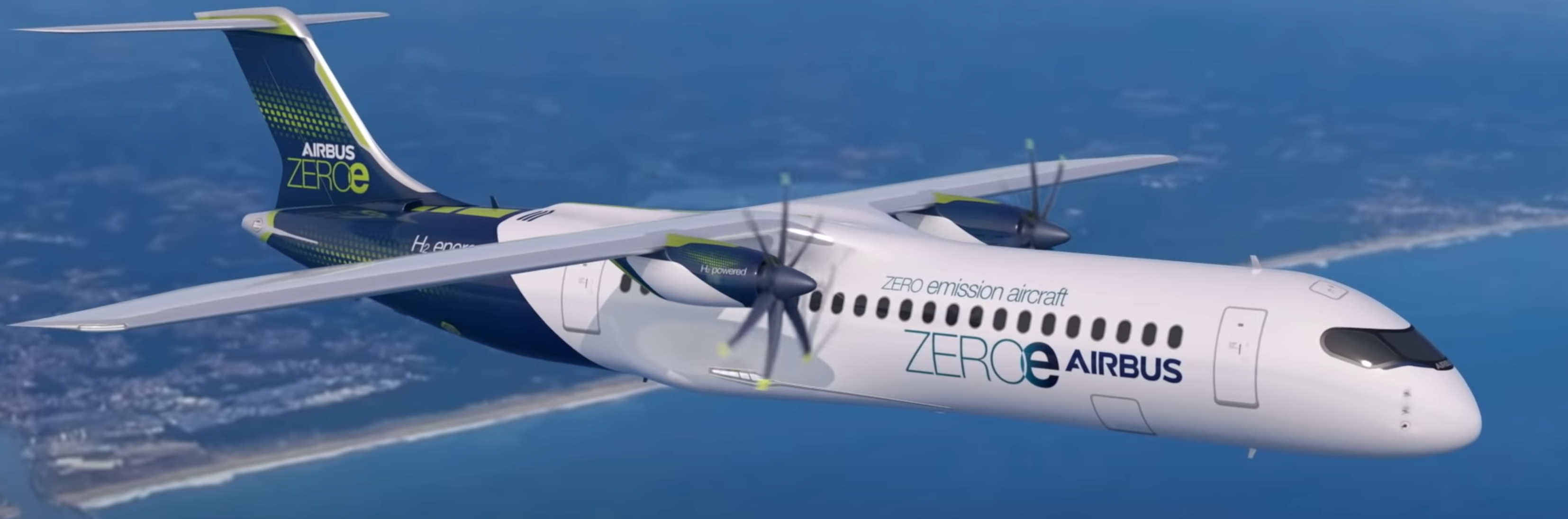
Note.
- It looks very much like an improved ATR-72.
- It has more extreme propellers and probably better aerodynamics.
- Airbus might like to persuade Ecojet to use ATR-72s as their 70-seat airliner.
- Information from an operator of hydrogen-powered airliners would be very valuable to Airbus.
I wouldn’t be surprised to see Ecojet lease some nearly new ATR-72s.
Would Airbus Fit ZeroAvia Hydrogen-Electric Powertrains In The ZEROe Turboprop?
This page on the Airbus website is entitled ZEROe.
In a section, which is entitled Hydrogen Propulsion To Power Future Aircraft, this is said.
All three ZEROe concepts are hybrid-hydrogen aircraft. They are powered by hydrogen combustion through modified gas turbine engines. Liquid hydrogen is used as fuel for combustion with oxygen.
In addition, hydrogen fuel cells create electrical power that complements the gas turbine, resulting in a highly efficient hybrid-electric propulsion system. All of these technologies are complementary, and the benefits are additive.
In 2022, we launched our ZEROe demonstrator with the aim to test hydrogen combustion technology on an A380 multimodal platform. Through future ground and flight testing, we expect to achieve a mature technology readiness level for a hydrogen-combustion propulsion system by 2025.
Note.
- Airbus state they are using modified gas turbine engines.
- Airbus also talk about using fuel cells to create electrical power that complements the gas turbines.
- Could the hydrogen fuel cells be used to power the aircraft’s systems, like avionics, control systems, air-conditioning and the hydrogen system for the main engine?
- This concept of effectively a hydrogen auxiliary power unit, might be a more efficient way of using the hydrogen, which either gives longer range or a smaller fuel tank.
- In The ZEROe Demonstrator Has Arrived, I talk about the ZEROe Demonstrator, which is a modified Airbus A 380.
Did the adding of hydrogen fuel cells to the ZEROe aircraft, lead to the concept of a hydrogen-powered auxiliary power unit, that I talked about in Airbus To Trial In-flight Auxiliary Power Entirely Generated By Hydrogen?
It looks to me, that Airbus have developed their own simple concept of powering the aircraft.
I doubt they will need ZeroAvia’s technology.
But.
- Aircraft manufacturers like Airbus generally fit the best and most suited engines they can find in their aircraft.
- The Wikipedia entry for ZeroAvia says that the prototype hydrogen-electric powertrain is in the cabin, consisting of two fuel cells and a lithium-ion battery for peak power.
- ZeroAvia have powerful shareholders like Amazon, Bill Gates and Royal Dutch Shell.
- ZeroAvia have also received grants from the UK Government.
I wouldn’t be surprised to learn, that Airbus have taken a long hard look at ZeroAvia’s technology.
After all, ZeroAvia could probably build a hydrogen fuel cell power pack, that would meet Airbus’s needs for a hydrogen-powered auxiliary power unit.
Remember too, that many fleets of aircraft have been updated with new engines for decades and I don’t think Airbus would mind ZeroAvia giving a new zero-carbon lease of life to the hundreds of ATR-72s in service around the world.
Surely, a successful hydrogen-powered ATR-72 is only going to create more interest in airlines buying ZEROe Turboprops.
All the converted aircraft will still need support from ATR.
Both the converted and new aircraft will need hydrogen refuelling services, so could the two aircraft use a common standard.
Airbus and ZeroAvia would appear to have several common interests.
Ecojet’s Core Route
This is a paragraph from the news story on the Ecotricity web site.
Dale has partnered with experienced pilot Brent Smith and a team of aviation specialists to set up Ecojet. Flights across the UK will commence in early 2024, starting with the Edinburgh to Southampton route, and expanding to mainland Europe shortly after, with long-haul flights planned for the future.
Note.
- The ATR-72 has a range of 949 miles, which is more than adequate for Southampton and Edinburgh, which is just over 350 miles.
- Diagonal journeys in the UK are often the most passenger-unfriendly by rail and tend to use diesel trains.
- Southampton Airport has good road and rail connections, with the terminal less than a minute from the station.
- Edinburgh Airport has good road and tram connections, with rail connections needing a short journey on the tram.
- Southampton Airport has flights to the Channel Islands, Ireland and Schiphol.
- Edinburgh Airport has a comprehensive service from major airlines and low-cost carriers, and several flights to destinations in the North of Scotland and on the Islands.
I think that it is a well-chosen core route for their 70-seat aircraft.
Which Routes Will Ecojet Fly With The Twin Otters?
Consider.
- My Scottish friends tell me that flying to the Scottish Islands, like the Hebrides, Orkney and Shetland is expensive.
- The growth of the Scottish wind power industry will mean, that more capacity is needed to serve the North of Scotland and the Islands.
- Tourism to the North of Scotland and the Islands is on the up.
- There will not be a shortage of green electricity to produce green hydrogen.
- The North of Scotland isn’t short of airports.
- The Twin Otter has a surprisingly long range on aviation fuel and I suspect, that a hydrogen version would be designed to have a similar range.
- The longest flight needed would probably be Edinburgh and Sumburgh, which is about 280 miles, which should be well within the range of a Twin Otter.
- I suspect that hydrogen refuelling could be easily provided at enough airports, to support hydrogen-powered airliners.
- I am sure, that the Twin Otters could be used on a network of zero-carbon flights from Edinburgh to the North of Scotland and the Islands.
- A zero-carbon airline would help Scotland’s net-zero ambitions.
There is certainly a need for another airline to connect Edinburgh to the North of Scotland and the Islands and the infrastructure could be upgraded to support a hydrogen-based zero-carbon airline.
Could Ecojet build a similar network at Southampton, that served the Channel Islands, Southern Ireland and Northern France?
Conclusion
There’s a lot more to this venture, than there appears at first sight.
O wish Vince and his partners well, but as a coeliac, I’ll skip the food.
Universal Hydrogen CEO Sees Jetmakers Backing New Fuel
The title of this post is the same as that of this article on Reuters.
It is mainly predictions by Paul Eremenko, who is Chief Executive of Universal Hydrogen, about the future of the single-aisle jet airliner market.
I wrote in detail about their technology in Could Universal Hydrogen’s Concept Create A Hydrogen-Powered Single-Aisle Airliner?.
I firmly believe they have a concept that will work and look forward to flying in a hydrogen-powered aircraft using Universal Hydrogen’s technology before the end of the decade.
Could Universal Hydrogen’s Concept Create A Hydrogen-Powered Single-Aisle Airliner?
Universal Hydrogen are making some of what I would consider the right moves.
Hydrogen Supply
Universal Hydrogen have signed a supply contract with Fortescue Future Industries for the supply of green hydrogen.
The deal is described in this press release on the FFI web site, which is entitled FFI And Universal Hydrogen Join Forces To Decarbonise Aviation.
Collaboration With Airbus
There is an article on BusinessWire, which is entitled Universal Hydrogen Announces New Engineering Development Center Located In Toulouse, France, The Heart of European Aviation.
Toulouse is the home of Airbus.
The Capsule Concept
The capsule concept could be universal.
These are widths of various planes and trains.
- De Havilland Canada Dash 8-400 – 2.52 metres – Internal
- Airbus ATR 72 – 2.57 metres- Internal
- Airbus A320neo – 3.7 metres – Internal
- Boeing 737 – 3.53 metres – Internal
- Class 800 train – 2.7 metres – External
- Class 66 locomotive – 2.65 metres – External
I suspect that if the design is correct, then one size of capsule can be made to fit a variety of applications.
Application To Regional Aviation
I discussed this in Flybe Appears To Be On The Way Back.
I believe that De Havilland Canada Dash 8s and Airbus ATR 72s could be converted to hydrogen.
Road Transport
Surely, the capsules would be too big for road transport in the UK and many other countries.
But they would probably be ideal to deliver hydrogen to bus and truck depots and filling stations for hydrogen vehicles. They would just be plugged in and then could start dispensing the fuel.
Decarbonation Of Diesel Locomotives
Consider.
- The cross-section of a diesel locomotive even in the UK, is larger than that of a regional airliner.
- Most of the space in the body of a diesel locomotive is taken up by a large diesel engine.
- Fuel ells or a small gas turbine could be small compared to the diesel engine.
- Most existing diesel locomotives have electric transmissions.
I believe that many diesel-electric locomotives could be converted to hydrogen power and some could use Universal Hydrogen’s capsules.
Zero-Carbon Backup Generators
Many pieces of important infrastructure, like data centres, hospitals and large railway stations have backup generators.
Universal Hydrogen’s capsules could provide hydrogen for zero-carbon backup generators.
Universal Hydrogen’s Ideas For Single-Aisle Airliners
In the Product page on the Universal Hydrogen web site, there is a section, which is entitled Single Aisle / Narrowbody, where this is the first two sentences.
The majority of aviation emissions are produced by the single aisle (also known as narrowbody) fleet, dominated by the Boeing 737 and Airbus A320 families of aircraft. Both Boeing and Airbus are likely to develop a replacement for these venerable models for entry into service in the mid 2030s.
Alongside the text is this graphic, which compares various airliners.
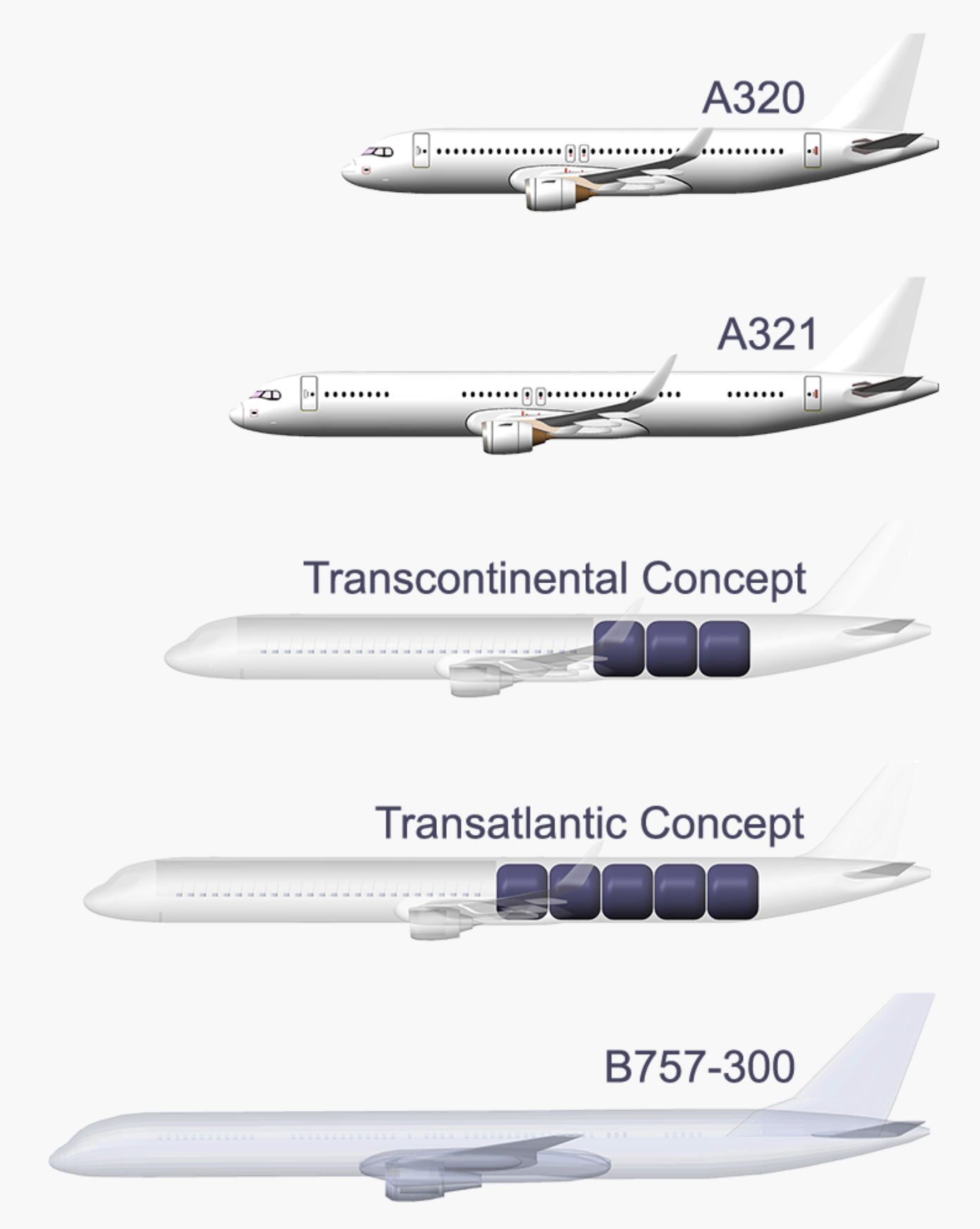
Universal Hydrogen are proposing that Airbus stretch the A321, so that hydrogen capsules can be fitted in the rear of the fuselage, so that the aircraft has similar proportions to the Boeing 757.
Read the full text on the Product page of the Universal Hydrogen web site.
I can see that if they could prove the concept with the Regional Airliner, they could develop the two concepts shown in the graphic.
Conclusion
This is a simple, but very exciting project.
Is Lumo The Ryanair Of Rail?
Someone had to draw the comparison between Lumo and Ryanair and it was The Times, that used a headline of Lumo, The Ryanair Of Rail, Gets The Green Light On East Coast, for their article about the new London and Edinburgh rail service in their article today.
But how alike are the two business models?
Standard Planes And Trains
The Boeing 737 and the Airbus A 320, as used by Ryanair and easyJet are the two workhorses of short haul airlines.
It can also be said, that Hitachi’s AT-300 train is becoming the workhorse of long-distance rail services in the UK.
Customised Interiors
Ryanair and easyJet do customise the interiors of their aircraft to a certain extent and from pictures on the Internet Lumo appear to have done the same.
If you look at the widths of the planes and trains on Wikipedia, you find these values.
- Airbus A 320 – 3.95 metres
- Boeing 737 – 3.8 metres
- Class AT-300 train – 2.7 metres
Dividing by the number of seats across, which is six for the planes and four for the train gives these figures.
- Airbus A 320 – 0.66 metres
- Boeing 737 – 0.63 metres
- Class AT-300 train – 0.67 metres
I know there is an aisle down the middle, so let’s say that it is 0.60 metres. This gives these spaces for each seat.
- Airbus A 320 – 0.56 metres
- Boeing 737 – 0.53 metres
- Class AT-300 train – 0.53 metres
I think that is adequate space for a designer to do a good job.
This picture shows the interior of a Great Western Railway Class 802 train, which use a similar body shell to the trains used by Lumo.
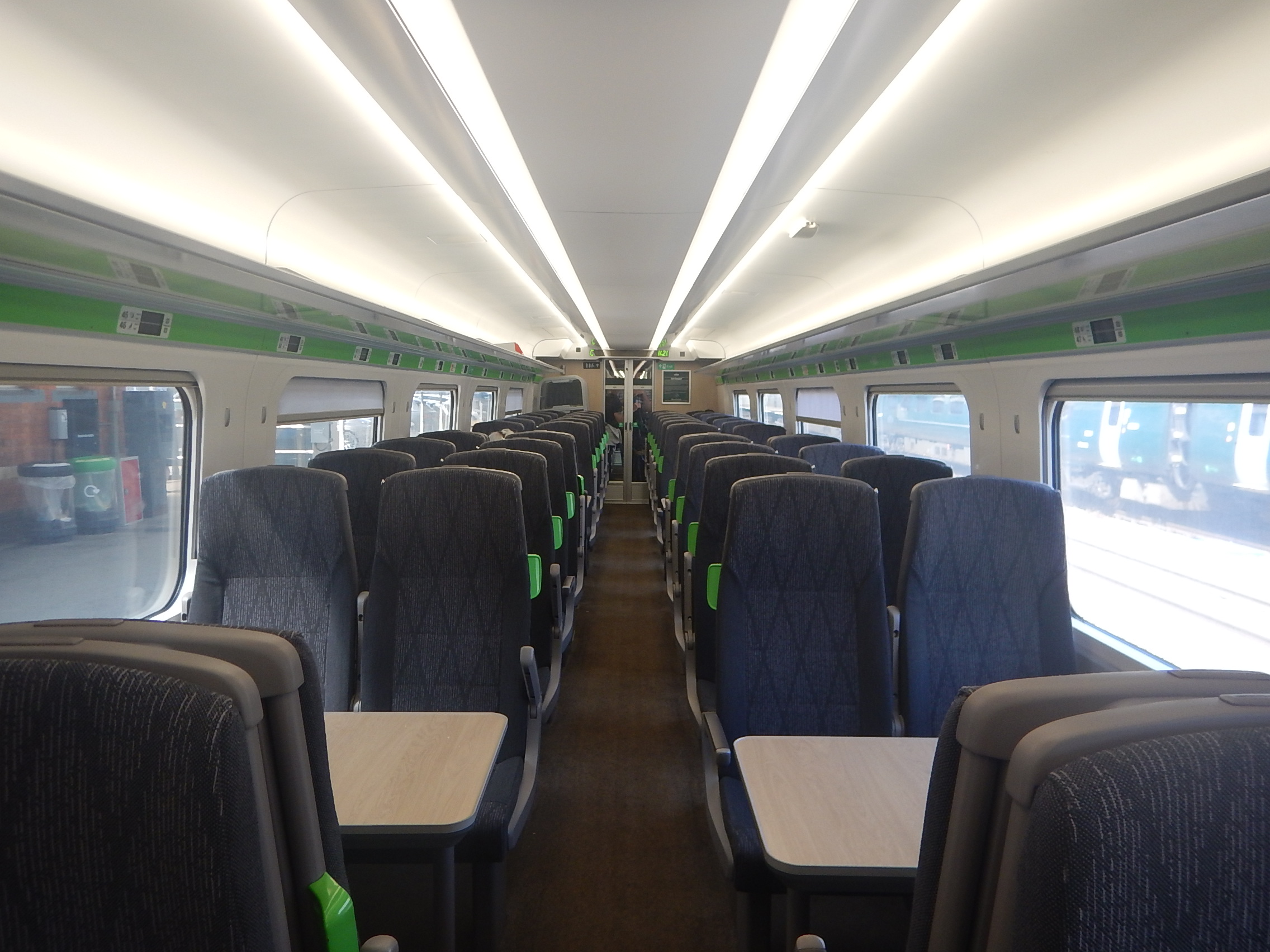
Note.
- The aisle looks to be similar in width to a seat.
- There is a bag shelf above the windows and lots of coat hooks.
As both Lumo and Great Western Railway are both First Group companies, is it likely that the interior dimensions are similar, so that standard trolleys could be used and training could be eased and shared between companies in the group.
This picture shows a trolley fitting in between the tables on a Great Western Railway service.

I suspect, if they design everything together, Lumo could make best use of a narrow aisle to give the seats a bit more width.
This last picture shows TransPennine Express Class 802 train at Willesden Junction station.
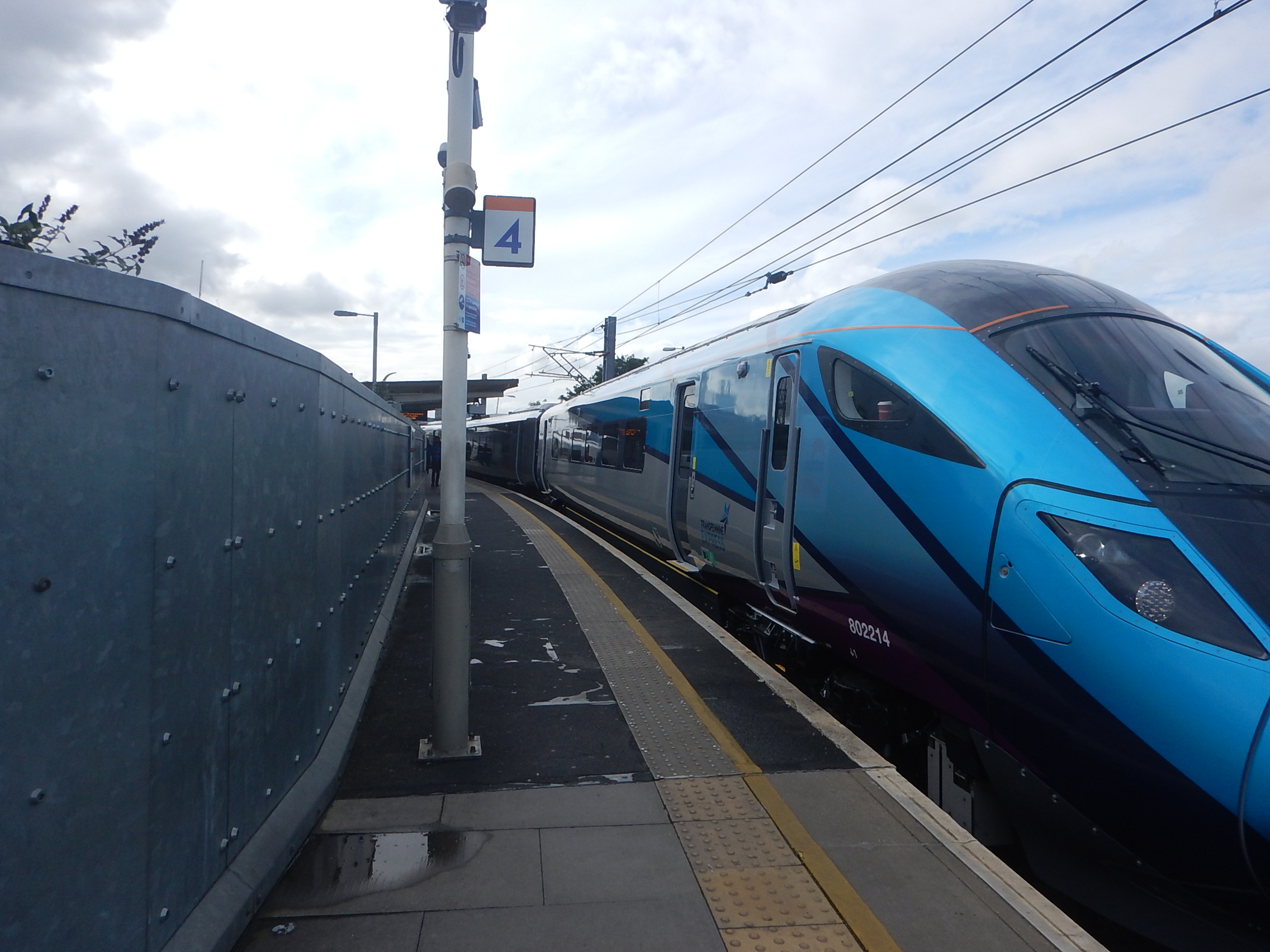
Note how the lower part of the side of the train is curved. Is this to get a bit more room for the seat squab?
Passengers Per Metre
This is only a rough calculation and shows typical passengers, fuselage or car length and passengers per metre.
- Airbus A 320 – 164 passengers – 37.57 metres – 4.4 px/metre
- Boeing 737 – 160 passengers – 37.0 metres – 4.3 px/metre
- Class AT-300 train – 96 passengers – 26 metres – 3.7 px/metre
Passenger density in the train is about fourteen percent less.
Toilets
In The Definitive Seating Layout Of Lumo’s Class 803 Trains, I said this.
This article on Economy Class and Beyond is entitled Enter Lumo – The New East Coast Railway Competitor.
It contains a drawing from Lumo, which shows the layouts of the seats on the train.
-
- Coach A – 44 Standard seats – 8 Priority seats – 2 Wheelchair spaces – 2 Tip up seats – Accessible toilet – 56 Total seats
- Coach B – 84 Standard seats – 12 Priority seats – Bike store – Toilet – 96 Total seats
- Coach C – 84 Standard seats – 12 Priority seats – 96 Total seats
- Coach D – 84 Standard seats – 12 Priority seats – Bike store – Toilet – 96 Total seats
- Coach E – 52 Standard seats – 8 Priority seats – 2 Tip up seats – Accessible toilet – 62 Total seats
Note.
-
- This is a total of 406 seats.
- Judging by the position of the tip-up seats they are for staff and perhaps emergency use, if say a coffee gets spilled on a seat.
- Each car has a pair of tables, where four can sit. As Lumo’s business model allows early booking, if you and your partner want to take the kids to see granny on her birthday, you should be able to get a table, by booking early.
- There are two bike stores in Coaches B and D.
These are some further thoughts.
Toilet Provision
I was on an LNER Class 800 train earlier this week and needed to go to the toilet.
-
- I wasn’t sure which way I needed to go, as I couldn’t see a sign pointing me to the toilet, but in the end I struck lucky.
- You don’t have that problem with Lumo’s trains, as there appears to be a toilet at both ends of the three middle coaches, either in your car or the next.
- If you’re in one of the driver cars, there is an accessible toilet at the blunt end.
I don’t think anybody will argue with the toilet provision on Lumo’s trains.
Typically a Boeing 737 or an Airbus A320 will have two toilets for about 160 passengers.
Lumo’s trains have two accessible toilets and two ordinary ones for 406 passengers.
Ease Of Boarding
If you want to catch a train at virtually any station in the UK, in most cases, you just turn up something like fifteen minutes before the departure time, present your ticket and get on the train.
Planes used to be like that in the UK, but they aren’t any more.
Catering
In the article in The Times, Matt Lee, who is Lumo’s customer experience director, said they have been free to develop their own systems. He says this about the catering.
Catering will be a Deliveroo-style service: passengers can order M&S or Pret sandwiches in advance and have them delivered to their seat. “We are a testbed for other FirstGroup train operators.
Will they do gluten-free?
Luggage
Lumo have a luggage courier service called LumoLuggage.
Service Expansion
Suppose an airline or a train operating company wants to run additional services to add capacity to a route.
With an airline, they will need to obtain additional take-off and landing slots to fly the route.
But Lumo are running five-car trains on a route, where all the stations can handle nine-car trains and possibly a pair of five-car trains.
So Lumo just add extra cars to the fleet, so that they match the number of cars running on the route to the demand.
The only costs to increase the capacity are those of the extra cars and a proportionate number of extra staff.
Conclusion
I can see this service model being copied by other train operators in other countries.
I’m looking forward to going North on Wednesday.
 The Anonymous Widower