Ocean Winds Enters Lease Agreement With Crown Estate For 1.5 GW Celtic Sea Floating Wind Project
The title of this post, is the same as that of this article on offshoreWIND.biz.
This is the sub-heading.
Ocean Winds has entered into an agreement for lease with the Crown Estate for a 1.5 GW floating offshore wind project, for which the developer secured a site in the Round 5 seabed auction last year.
These two paragraphs add detail to the story.
Offshore Wind Leasing Round 5, the UK’s first dedicated floating wind seabed leasing round, was launched in February 2024, offering three areas. In June 2025, the Crown Estate announced Equinor and Gwynt Glas, a joint venture between EDF and ESB, as preferred developers for two project sites and said it was working to ensure the delivery of the full potential capacity of Round 5, which is up to 4.5 GW.
Equinor and Gwynt Glas entered into lease agreements for their floating wind projects in October 2025 and, the following month, the Crown Estate said Ocean Winds had secured the third floating offshore wind site in the Celtic Sea.
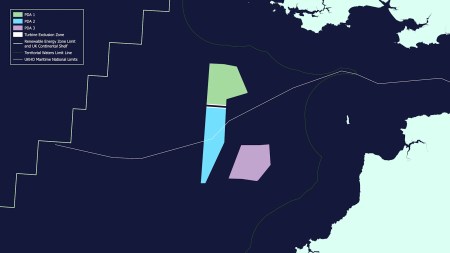
This map shows the three wind farms, that make up the Glynt Glas wind farm.
Note.
- It is expected to be built from and connect to the grid at Port Talbot in South Wales.
- The three sites are expected to be commissioned by the early-to-mid 2030s.
- The elongated white dot to the East of the wind farms would appear to be Lundy Island.
- The large bay to the North of Lundy is Carmarthen Bay with Caldey Island at its West end and Llanelli on its East.
- The Gower separates Swansea Bay from Carmarthen Bay.
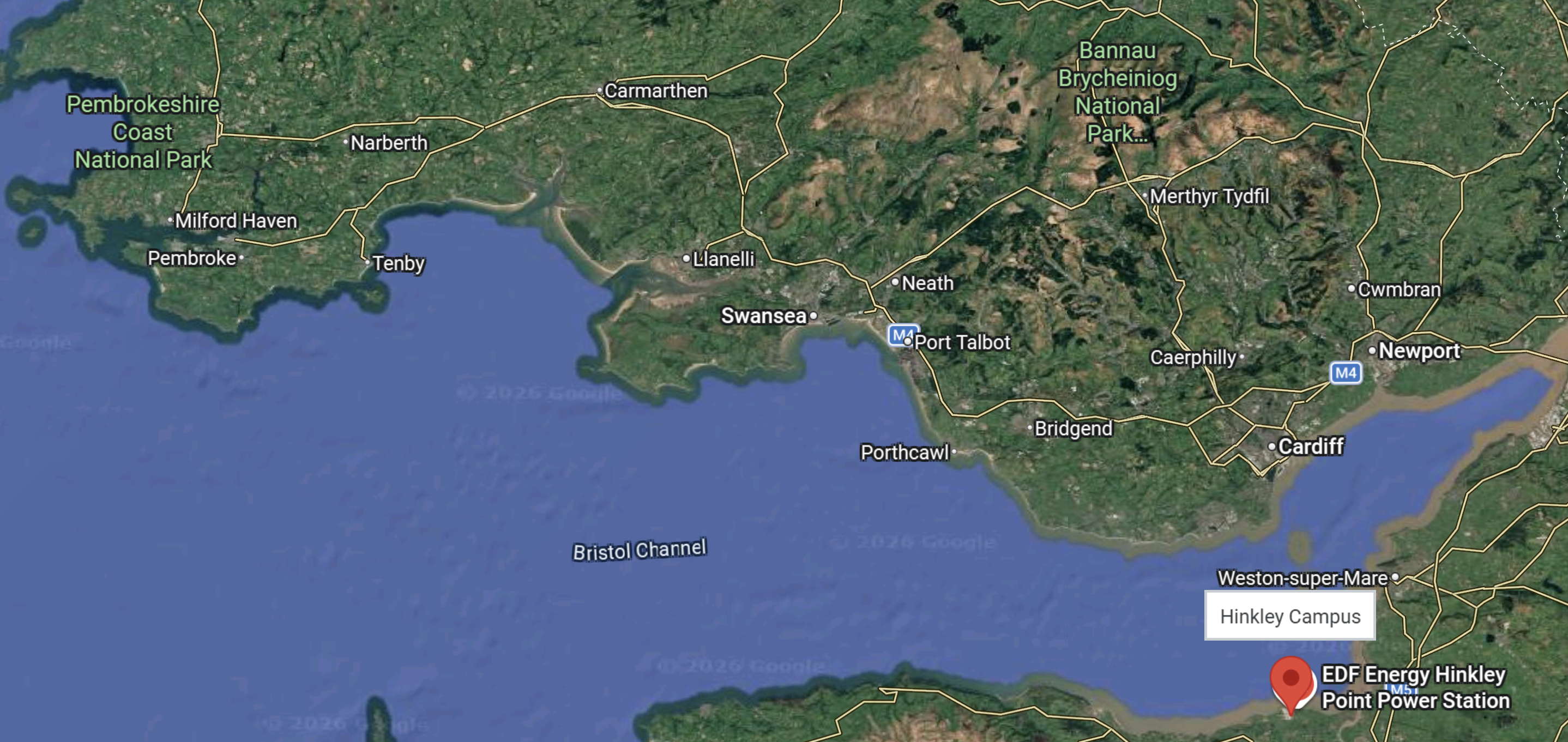
This Google Map shows the Bristol Channel from the wind farms in the West to Cardiff and Hinkley Point.
Note.
- Along the North coast of the Bristol Channel, working from West to East, my 78-year-old eyes can pick out Milford Haven, Pembroke, Caldey Island, Tenby, Llanelli, Swansea, Port Talbot, Porthcawl, BridgendCaerphilly, Cardiff and Newport.
- Coming back along the South Coast, I can see Weston-super-Mare, Hinkley Point C and the tip of Lundy Island in line with Tenby.
- The three sections of Glynt Glas will each generate 1.5 GW, making a total of 4.5 GW.
- Hinkley Point C when completed, will be a 3.26 GW nuclear power station.
- There is also a 2.2 GW gas-fired power station at Pembroke.
Nearly 8 GW of renewable electricity should be enough to convert Port Talbot steelworks to the manufacture of green steel.
How Much Wind Power Is Planned For The Western Approaches?
I asked Google AI, the title of this section and received this answer.
The UK has a target of 50 GW of offshore wind by 2030, with significant projects planned for the Celtic Sea (part of the Western Approaches), which is a key area for 5 GW of floating wind. Total UK offshore wind pipeline capacity exceeds 93 GW, with major developments in this region focusing on floating technology.
Key details regarding wind power in the Western Approaches (specifically the Celtic Sea) include:
Celtic Sea Developments: The area is a primary focus for floating wind projects, designed to capitalize on deep-water potential, with 5 GW of floating wind expected to be deployed across the UK by 2030.
Pipeline and Capacity: The total UK pipeline for offshore wind, which includes the Western Approaches, is 93 GW, and the government is aiming for 43-50 GW of installed offshore capacity by 2030.
Project Status: The region is expected to benefit from the Crown Estate’s leasing rounds aimed at accelerating floating wind, with 15.4 GW of new projects submitted across the UK in 2024.
Wales/South West England Context: Wales has 1.4 GW of projects in the pre-application stage, with some potential for developments off the South West coast.
For more detailed information on specific projects and their development status, you can visit the RenewableUK website and RenewableUK website.
It looks like about 20 GW of offshore wind could be installed in the Western Approaches.
Pension Power Backing For New Battery Energy Storage Plant
The title of this post, is the same as that of this article on Nation.Cymru.
These paragraphs outline the project,
A new battery energy storage plant at the site of a decommissioned power station will be funded by Welsh pensioners.
The plan for the facility at the former Uskmouth B Power Station at the Gwent Wetlands on the edge of Newport, was approved by the city council’s planning committee this January.
The batteries will store excess power during times of “excess supply” and then put that electricity back into the grid when demand is higher.
The Greater Gwent Pension Fund, which manages the retirement savings of more than 65,000 members from Blaenau Gwent, Caerphilly, Monmouthshire Newport and Torfaen councils as well as 52 other active employers in the Gwent region, has revealed it is investing in the project.
According to their Wikipedia entry, the Uskmouth power stations have had rather a chequered history and both appear to be currently non-productive.
- The original coal-fired Uskmouth A has been demolished and the site is now occupied by an 832 MW gas-fired CCGT power station. Currently, it is in a ‘dormant’ state, after its owner entered administration.
- The original coal-fired Uskmouth B has been converted and now can generate 363 MW on a mixture of biomass and waste plastic. Uskmouth B is currently being demolished.
This press release from Quinbrook Infrastructure Partners is entitled Quinbrook To Build Large-Scale Battery Storage Project At Uskmouth, South Wales.
This is the sub-heading.
Uskmouth will be one of the largest storage projects in the UK and will directly support the UK’s energy transition.
These first two paragraphs outline the project.
Quinbrook Infrastructure Partners (“Quinbrook”), a specialist investment manager focused on renewables, storage and grid support infrastructure has acquired the exclusive development rights for one of the UK’s largest battery storage projects to date.
The planned 230MW / 460MWh Battery Energy Storage System (“BESS”), will be located at the site of the former Uskmouth coal fired power station in south Wales (“Project Uskmouth”) and will seek to utilise existing power transmission infrastructure and provide a new lease of life to the area. Uskmouth was acquired from Simec Atlantis Energy Limited (“SAE”). Quinbrook has partnered with Energy Optimisation Solutions Limited (“EOS”) in the origination and development of Project Uskmouth, which represents a major anchoring project in the planned re-development and regeneration of the Uskmouth site into a Sustainable Energy Park that will support innovative future industry. Quinbrook considers these types of regeneration projects as key to making meaningful contributions to delivery of the Government’s Levelling Up ambitions.
Note.
- The battery can supply 230 MW for two hours.
- It looks like the battery will replace the older of the two power stations and work with the relatively-modern 832 MW gas-fired CCGT power station.
- Will they act as backup to renewables?
As there are very few renewables in the area, will this work with the wind farms being developed in the Celtic Sea or are Quinbrook anticipating wind farms South of Newport in the Bristol Channel?
I have a few thoughts.
Will Uskmouth Work With Hinckley Point C?
This Google Map shows the relative locations of Uskmouth and Hinckley Point C.

Note.
- Uskmouth is just South of Newport, in the North-East corner of the map.
- I estimate that Uskmouth and Hinckley Point C are 24.7 miles apart.
A cable across the Bristol Channel would surely increase the energy security of South Wales.
Will There Be Wind Farms In The Bristol Channel?
I feel that this is inevitable.
This document on the Welsh Government web site is entitled Future Potential For Offshore Wind In Wales, was written by The Carbon Trust.
This paragraph is the document’s assessment of wind farms in the Bristol Channel.
Despite high energy demand and good infrastructure, environmental conditions in the Bristol Channel
makes this area challenging for offshore wind development. In addition to lower average wind speeds,
the Bristol Channel has complex seabed, including areas of hard rock, and is exposed to strong tidal
currents from the Severn Estuary. Seabed conditions and tidal currents were the main drivers behind
cancellation of the Atlantic Array project and it is considered unlikely that a developer would look to
revive this site in the near-term, particularly given competition with other more favourable UK sites.
That doesn’t seem very promising.
But this is the document’s assessment of wind farms in the Pembrokeshire Atlantic area.
Exposure to the prevailing south-westerly Atlantic wind and swells means that the waters off
Pembrokeshire have excellent wind speeds, often exceeding 10 m/s, but also a harsher wave
environment than elsewhere in Wales. Significantly, water depths quickly increase to over 50m,
suggesting that floating foundations are likely to be required, particularly if projects are located
further from shore, which is likely given constraints from environmental impact and seascape near to
the Pembrokeshire Coast National Park.Grid infrastructure is constrained for thermal generation but should not be a barrier to new
renewables. The Greenlink interconnector could also support the addition of new capacity. The region
has good port infrastructure at Milford Haven and Pembroke Dock, which is already actively pursuing
upgrades to future proof the port for potential offshore wind deployment.
That is a lot more promising.
- Some demonstration wind farms are under development.
- Hopefully, the steel would be available at Port Talbot.
- I can see this area, having almost 50 GW of floating wind.
I do feel though, that once the sea off Pembrokeshire is full of wind farms, that developers will turn their attention to the more difficult waters of the Bristol Channel.
Is The Uskmouth BESS A Good Investment?
The Nation.Cymru article discusses this and what they say is well worth reading.
My feelings are that the BESS will be very busy balancing electricity on the South Wales Coast and to and from Ireland using the 500 MW Greenlink Interconnector, which opens this year.
These electrical systems are relatively easy to model and I suspect Quinbrook wouldn’t be investing, if the BESS was not going to generate a substantial income.
 The Anonymous Widower