Minimum Age To Be A Train Driver Lowered To 18
The title of this post, is the same as that of this article on the BBC.
This is the sub-heading.
Eighteen-year-olds will be allowed to drive trains after the minimum age was lowered from 20 in a bid to tackle driver shortages.
These first three paragraphs add detail.
UK rail services are frequently disrupted due to a lack of drivers being available, and the problem is set to get worse with companies struggling to replace a growing number of people retiring with new recruits, the government said.
Transport Secretary Heidi Alexander announced the change as “bold action to improve train services and unlock thousands of jobs”.
Union Aslef said it would open up opportunities for school or college leavers, while the Rail Safety and Standards Board said its research found “18-year-olds are capable of safely becoming train drivers”.
This paragraph from Google AI, says you only have to be sixteen to join the British Army.
The minimum age to join the UK Army as a Regular Soldier is 16. However, you’ll be a Junior Soldier until you turn 18, at which point you can transition to a regular role. To join the Army Reserve, you need to be at least 18. The upper age limit for joining the Army Reserve as a soldier is the day before your 43rd birthday.
A similar age of sixteen, applies to the Royal Navy and the Royal Air Force, with eighteen applying for the Police.
How Does This Compare With Driving A Bus?
This paragraph from Google AI, gives the driving age for a bus.
The minimum age to become a bus driver in the UK is 18 years old. However, to drive a full-sized bus (Category D), you must be 24 years old, unless you are undergoing the Initial Driver CPC (Certificate of Professional Competence) qualification. For Category D1 (minibus), the minimum age is also 18.
Google AI gives this description of Category D1.
PSV (Public Service Vehicle) Class D1 licence, also known as a PCV (Passenger Carrying Vehicle) licence or a minibus licence, allows you to drive a minibus for hire or reward. This licence category applies to minibuses with up to 16 passenger seats and a maximum length of 8 meters, and can tow trailers up to 750kg. To obtain a D1 licence, you need to pass a medical check, a theory test, and a practical driving test.
I suspect that many eighteen-year-olds are capable enough to hold a PCV licence.
What sort of vehicle will someone with a PCV licence be able to drive?
Wrightbus subsidiary ; Rightech has just released a suitable vehicle.
- It is battery-electric powered.
- It can seat up to twelve passengers.
- It is six metres long.
- It has a range of 112 miles.
It has a high-specification, which includes air-conditioning.
This image is courtesy of Rightech.
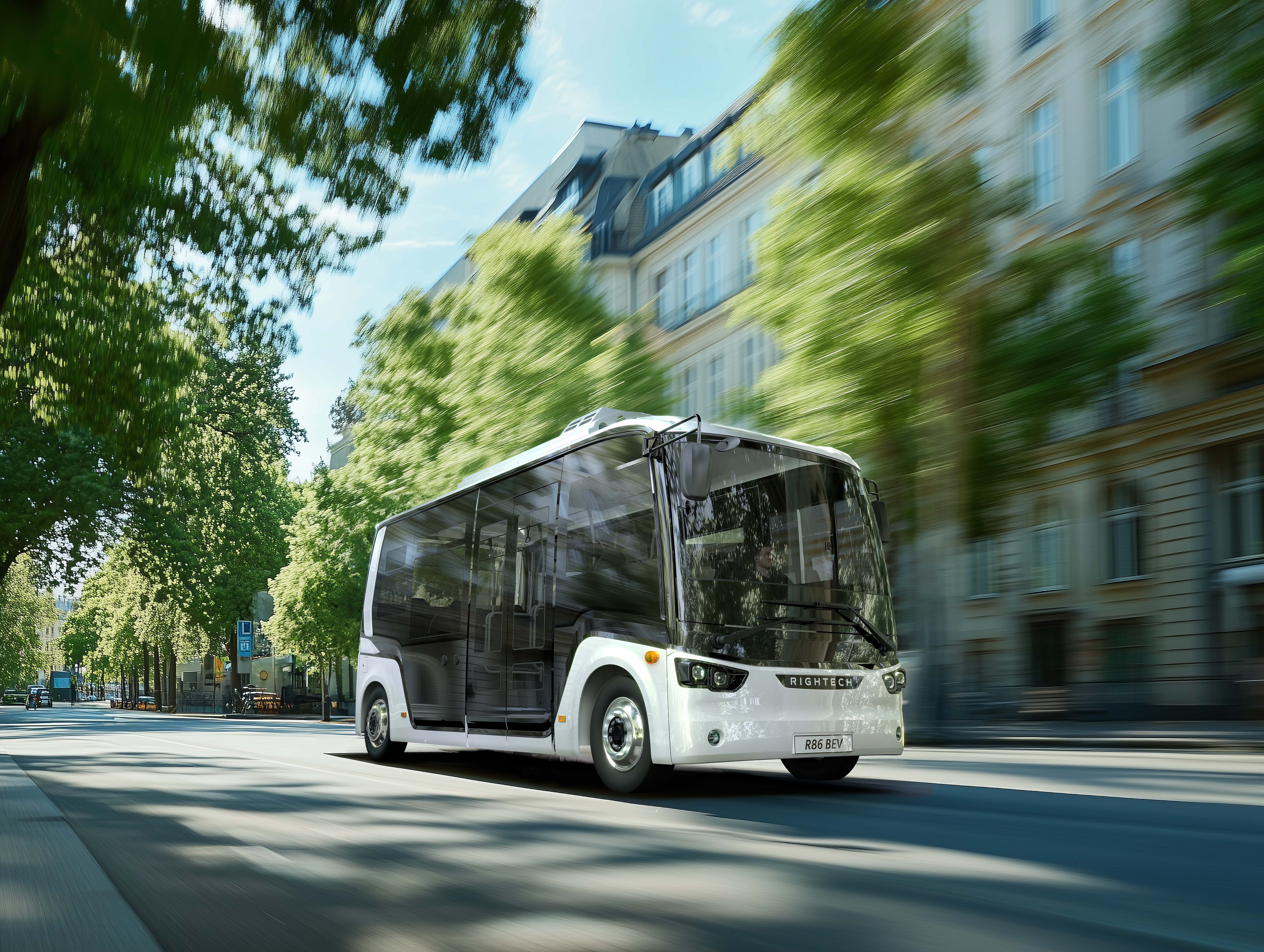
I can see bus operating companies, creating a career structure, that starts drivers on a PCV licence and progresses them upwards to the full PSV licence at 24.
Conclusion
I feel this could be a very sensible decision and like the age and competence structure for bus drivers, it creates worthwhile jobs for 18-24 year olds.
Arriva Group Submits Open Access Rail Application To Connect Newcastle And Brighton, Via London Gatwick
The title of this post, is the same as that of this press release from Arriva Group.
These three bullet points act as sub-headings.
- New services operated by Arriva’s Grand Central would introduce a direct rail connection between the Northeast and Midlands to London Gatwick and the South Coast.
- Making better use of available network capacity, the proposed route would connect underserved communities in the UK and enhance long-distance connectivity without the need to interchange through London.
- The application reflects Arriva’s wider European strategy to connect people and places through sustainable transport solutions, strengthening regional economies and supporting modal shift.
This introductory paragraph provides more details.
Arriva Group has today announced it is submitting an open access application to the Office of Rail and Road (ORR) to introduce a new direct rail service between Newcastle and Brighton, via London Gatwick, providing vital connectivity for underserved communities along the route.
Other points to note include.
- There will be five trains per day in each direction.
- The proposed service would call at Durham, Darlington, Northallerton, York, Doncaster, Sheffield, Derby, Burton-on-Trent, Birmingham New Street, Warwick Parkway, Banbury, Oxford, Reading, Wokingham, Guildford, Redhill, London Gatwick and Haywards Heath.
- The service would be operated by Grand Central.
- The service could be introduced from December 2026.
It will be the be the first direct service between Newcastle and Brighton.
This final paragraph outlines where the service fits in Arriva’s wider philosophy.
The plans are part of Arriva Group’s broader commitment to strengthening regional connectivity and making better use of available rail capacity. By opening up new travel corridors, Arriva is helping to connect more people to jobs, education and leisure opportunities – and to encourage a greater shift from private cars to public transport.
There are certainly plenty of places in Europe, that could use a service like this one between Brighton and Newcastle.
In The Ultimate Open Access Service, I describe a possible open access service between Amsterdam and Hamburg, which is about the same distance as Brighton and Newcastle, which is 372.8 miles by Arriva’s proposed route.
These are some of my thoughts in no particular order.
A High-Class Service Between Oxford And Brighton Could Be An Interesting Development In Its Own Right
Governments, rail operators and passenger groups of all persuasions and flavours have warmly welcomed the planned reopening of the rail route between Oxford and Cambridge.
I suspect an Oxford and Brighton service would be equally welcomed.
Brighton may not be an academic powerhouse yet, but it does have one thing that Oxford and Cambridge lack ; the sea.
Gatwick Airport Will Surely Welcome The Extra Connectivity
Gatwick Airport will expand and extra rail services will do the following for the airport.
- Make it easier to get the planning permission for the second runway.
- Make it easier for passengers and airport and airline staff to get to the airport.
- Surely, the more direct rail connections the airport has, will increase the likelihood, that families and other groups, will choose to fly from Gatwick.
- More train services could cut the amount of car parking per flight needed at the airport.
Gatwick Airport station has recently rebuilt and added extra capacity, so I doubt there will be trouble accommodating another ten trains per day.
Would The Army Welcome The New Service?
Two of the British Army’s main training areas are in North Yorkshire and in Surrey.
Would they find a train service between the two areas useful?
What Trains Will Grand Central Trains Use For The New Service?
In Arriva Group Invests In New Battery Hybrid Train Fleet In Boost To UK Rail Industry, I talked about how Grand Central will be acquiring Hitachi trains for their routes between London and Bradford and Sunderland.
- These will be Hitachi tri-mode trains.
- The trains will have a range of over forty miles on batteries.
- They will probably be serviced in Yorkshire or the North-East.
- The trains will be built by Hitachi at Newton Aycliffe, with batteries from Turntide Technologies in Sunderland.
- The first trains will be delivered in 2028.
As Arriva intend to start services from December 2026, they would probably use diesel trains to start with.
I would expect that Grand Central would go for a unified fleet, which would mean more Hitachi tri-mode trains.
For convenience, they could all be serviced at Doncaster, which all Grand Central services will pass through.
What Sections Will Not Be Electrified Between Brighton and Newcastle?
As far as I can see from OpenRailwayMap, the following sections of the route are not electrified.
- Two sections of the North Downs Line – 29 miles.
- Didcot and Birmingham New Street – 80.9 miles
- Birmingham New Street and Derby – 41.3 miles
- Derby and Sheffield – 36.4 miles
- Sheffield and Doncaster – 18.4 miles
Note.
- Electrification South of Reading will be third rail, so some trains will need to have third-rail shoes.
- The length without electrification is a total of 206 miles.
- As Newcastle and Doncaster, Redhill and Brighton, Reading and Didcot, and Birmingham New Street station are all electrified, the longest sections the trains would run without electrification would be between Didcot and Birmingham New Street and between Birmingham New Street and Doncaster.
- The planned electrification between Derby and Sheffield would make life easier.
It appears that trains capable of handling a hundred miles of unelectrified railway are needed.
Hitachi have shown that a five-car train with one battery will travel 70 km (43.5 miles) on a full battery, so one with three batteries should be able to manage the hundred miles needed in a few years.
Will Any Extra Electrification Be Needed?
I think Birmingham New Street station will be the critical point.
- The next electrification on the route to the South of Birmingham New Street is at Didcot, which is 80.9 miles away.
- The next electrification on the route to the North of Birmingham New Street is at Doncaster, which is 96.1 miles away.
These battery ranges should be possible, but an alternative would be to provide an electrified platform at one or more intermediate stations to be safe.
Stations that could be equipped to the South would include Oxford and Banbury and to the North would include Burton-on-Trent, Derby and Sheffield.
Perhaps electrifying a single platform at these stations, should be the first thing to be done, so that battery-electric trains can run on some useful routes as soon as they are delivered and approved.
Electric Trains, Even Battery-Electric Ones, Will Be Quick Off The Mark
Electric trains have good acceleration and I wonder, if this acceleration will enable stops, that are not feasible with diesel trains to be fitted in with electric trains, without having to take the same time penalty.
This might allow useful stops to be added to the service.
- Chesterfield is not mentioned, but most trains passing through stop.
- As I said, Farnborough North could be a useful stop for the Army.
- There might be a case for selective stopping patterns.
Battery-electric trains stop without any noise or pollution.
Connection To The Ivanhoe Line At Burton-on-Trent
The proposed Ivanhoe Line is intended to link Burton-on-Trent and Leicester.
As it is intended that the Newcastle and Brighton service will call ten times per day at Burton-on-Trent station, this must surely improve the economics of the Ivanhoe Line.
Are there any other new or reopened rail schemes, that will be helped by the proposed Brighton and Newcastle service?
Updated Frequencies At Sheffield
Currently, trains at Sheffield have these daily frequencies to the towns and cities on the proposed Newcastle and Brighton route.
- Newcastle – 18
- Durham – 16
- Darlington – 15
- Northallerton – 0
- York – 19
- Doncaster – 64
- Derby – 58
- Burton-on-Trent – 9
- Birmingham New Street – 21
- Warwick Parkway – 0
- Banbury – 0
- Oxford – 3
- Reading – 4
- Wokingham – 0
- Guildford – 0
- Redhill – 0
- London Gatwick – 0
- Haywards Heath – 0
- Brighton – 0
Note.
- Sheffield gets five trains per day (tpd) direct connections to nine new destinations.
- Other useful destinations will get five more tpd.
- Reading is a useful interchange for Wales and the West.
- Guildford is a useful interchange for Portsmouth, Southampton and West Surrey.
- Reading and Guildford have coach services to Heathrow.
There are also a large number of universities along the route.
Hitachi Can Offer A One-Supplier Battery-Electric Train Solution
It should be noted that Hitachi can offer a complete package including battery-electric trains and all the electrification, transformers and other electrical gubbins needed.
So perhaps for the Chiltern Main Line, which is used for part of the route between Didcot and Birmingham, Hitachi could deliver a one-supplier solution, that would also electrify Chiltern’s services between Marylebone and Birmingham Moor Street.
Remember, Chiltern are another Arriva Group company.
If Hitachi get this right, I can see other lines being electrified in this way.
Could This One-Supplier Battery-Electric Solution Be Exported?
I discussed this in Arriva Group Invests In New Battery Hybrid Train Fleet In Boost To UK Rail Industry, where I suggested that the United States could be a market.
- Arriva Group are ultimately American-owned.
- Hitachi’s battery technology is also American-owned.
In these days of Trump’s tariffs, these could prove useful facts.
As Arriva Group used to be owned by Deutsche Bahn, they may be another interested party, especially as they have a lot of lines, where I believe Hitachi’s solution would work.
Conclusion
A battery-electric railway service of nearly four hundred miles would certainly attract the passengers.
Is This Weapon Helping The Ukranians?
In The Times today, there is an article, which gives a list of what weapons have been supplied to the Ukrainians.
Included are.
- Javelins from the US and Estonia
- Stingers from Germany and the Netherlands
- Panzerfaust 3 from the Netherlands.
But there is no mention of the MBT LAW. This is the introduction to the Wikipedia entry for the weapon.
The Main Battle Tank and Light Anti-tank Weapon (MBT LAW), also known as the NLAW, is a joint British and Swedish short-range fire-and-forget anti-tank missile system. Designed for use by infantry, the MBT LAW is shoulder fired and disposable, firing once before being disposed of. It is currently in use with the military forces of the United Kingdom, Finland, Luxembourg, Ukraine, and Sweden, among others.
There is a lot of interesting information in the Wikipedia entry.
- It is fired once and the launcher is thrown away.
- It has a soft-launch, which allows it to be fired from an enclosed space.
- It is designed to be fired at moving targets.
I also think, that it could be a weapon, where a dummy version could be built that would be a superb training simulator.
- The trainee would sit on the range with his dummy weapon and go through the process of identifying a target and pulling the trigger.
- The dummy could even simulate the forces of launching a real missile.
- The simulator would calculate the trajectory of the missile and tell the trainee and his instructor, if they had hit the target.
The missile would not be fired and there would be no damage to the target.
This is said about deliveries to Ukraine.
At least 2,000 NLAW units are known to be supplied to Ukraine by the United Kingdom by 19 January 2022 and more shipments, including by other supporters, can be assumed amid the Russian invasion of Ukraine.
The Times says this about the training of Ukrainian forces and British Army tactics.
Since 2015 about 22,000 Ukrainian troops have been trained by the British Army as part of Operation Orbital.
Price said anti-armour ambushes of the sort deployed by Ukrainian forces were pretty much the bread and butter of the British infantry, adding: “If you have a classic column of 10 to 20 tanks and you’ve got a wide field of fire then you can knock two or three of them out and then the rest are sitting ducks and they can’t reverse out. Then you finish them off,” he said.
Note that Price is Kevin Price a former British Army major.
It sounds like a few well-trained soldiers sitting in a protected bunker armed with this missile could play havoc with a tank formation.
 The Anonymous Widower