New Hydrogen Double-Decker Bus Launched
The title of this post is the same as that of this article on Air Quality News.
This is the introductory paragraph.
Arcola Energy and Optare Group have announced the launch of a hydrogen fuel cell double-decker bus.
A few points from the article about the Metrodecker H2 hydrogen bus.
It is based on the design of an electric version of the existing Metrodecker.
- It will be built in the UK.
- It will carry 90 passengers.
- It will have a range of between 200 and 250 miles.
- It is planned to enter service in 2021.
It looks like we now have three double-deck hydrogen bus projects in the UK, with one each from AlexanderDennis, Optare and Wrightbus.
The Range
The range of the bus between 200 and 250 miles, which depends on specification and capacity, deserves a comment.
This range is of the same order as that of a Tesla Model S with a 75 kWh battery.
A Bus For The Twenty-First Century
What puzzles me, is why bus drivers in London, seem to be suffering more from COVID-19 infection, than drivers elsewhere!
In London, all buses have two or three doors and contactless ticketing, whereas in many parts of the UK, there is often only one door and no contactless ticketing.
This must mean, that there is generally less interaction between the driver and passengers in the capital. So logic would say, that outside of London, there should be more passing of infections between everybody on the bus.
An Observation In Manchester
Ten years ago, I observed behaviour on a single-door Manchester bus going to Oldham, with a union rep for bus drivers, who by chance happened to be sitting beside me.
The scrum as passengers entered and left the bus by the same door was horrific and the rep told me, that the local riff-raff were always trying to nick the driver’s money.
He told me, that a London system based on contactless ticketing was union policy and would cut attacks on staff, which he said had virtually stopped in London.
A Bus For The Twenty-First Century
The government has said that millions will be available for new zero-carbon buses, powered by hydrogen. I doubt that batteries will be able to provide enough power for many years.
It is my belief that given the new circumstances, that the bus should also have the following features.
- It should be as infection-unfriendly as possible, as COVID-19 won’t be the last deadly infection.
- Contactless ticketing by credit card or pass.
- Full CCTV to identify non-payers or those with stolen cards.
- Two doors with one in the middle for entry and one at the back for exit.
- It would be possible on some routes for both doors to be used for entry and exit.
- Wheelchairs would enter and leave by the middle door, where the ramp would be fitted.
I would put the stairs to the top deck on the left hand side of the bus, with the foot of the stairs leading directly into the lobby by the middle door.
The Van Hool ExquiCity
The Van Hool ExquiCity is an alternative solution, that is already running in Belfast, where it is named Glider.
It is probably best described as a double-ended articulated bus, that runs on rubber tyres, that thinks it’s a tram.
This press release from Ballard is entitled Ballard-Powered Fuel Cell Tram-Buses From Van Hool Now in Revenue Service in France, describes the latest hydrogen-powered version of the Exquicity, which is now in service in Pau in France.
- Each bus appears to be powered by a 100 kW hydrogen fuel cell.
- The buses are over eighteen metres long.
- Twenty-four metre double-articulated tram-buses are available.
- The buses seat 125 passengers
- The buses have a range of 300 kilometres between refuelling.
I like the concept, as it brings all the advantages of a tram at a lower cost.
Here’s a video.
It certainly seems a quiet bus.
I desperately need to get to Pau to see these vehicles.
Conclusion
We could design a new bus for the twenty-first century, that tackles the problems facing the bus industry.
- Climate change and global warming.
- Control of deadly infections like COVID-19.
- Efficient, fast ticketing.
- Attacks on staff.
- Petty crime.
- Access to public transport for the disabled, the elderly and those with reduced mobility.
We certainly have the skills to design and manufacture a suitable bus.
Hiring More Female Lorry Drivers Would Cut Accidents
The title of this post is the same as that of this article in The Times.
A study by the University of Westminster has shown that women drivers have less accidents.
This is a paragraph from the article.
Academics called for more women to be recruited to driving jobs in light of their better road safety record. They said that greater gender equality in positions that rely on motoring skills such as driving taxis, HGVs and delivery vans was needed to help cut deaths.
The article didn’t give any prediction about what will happen in the future.
So here goes!
We are already seeing taxis and delivery vans going zero carbon and I think within twenty years or even less, a large proportion of taxis, HGVs and delivery vans will be either battery-powered, or more likely, in my view, hydrogen-powered.
Look at the LEVC black taxi and compare it to its diesel forerunner.
- It is more environmentally-friendly.
- It has a lot of driver and passenger-friendly features.
But it is more expensive.
I suspect that the capital cost of a zero-carbon HGV bus or delivery van, will also be more expensive, than the current diesels.
- As to the fuel costs between diesel, battery and hydrogen, this would depend on the application, but fuel costs tend to even themselves out.
- There could be a saving with battery- and hydrogen-powered vehicles in terms of maintenance, just because they are less complicated.
Summing up I could say the following.
- I am fairly sure, that a zero-carbon taxi, HGV bus or delivery van will have an acquisition cost, that is higher than a diesel version.
- I also think that if the vehicle was run on a twenty-four hour basis, that the fuel costs would be comparable per mile, but maintenance costs would be less.
- So I think it likely, that vehicle owners would be more likely to want to run vehicles on a twenty-four hour basis, to get a better return on their capital.
Surely, this would require more drivers.
Consider.
- A lot of black taxis in London are shared between two drivers.
- There have been several instances, where I have read that a couple have both been London Underground drivers, as they can arrange shifts to fit in with child care and domestic duties.
- The partner of a driver, will surely know what the job entails.
- Driving a modern HGV or bus, is a lot less gruelling than it used to be.
Will more family-friendly methods of working emerge, that allows partners of existing drivers to join the profession?
London Underground certainly changed working conditions to get enough driver for the Night Tube.
Conclusion
Would employing more female drivers cut accidents?
It all depends on the quality of the drivers; both male and female.
But, I suspect that improvements in all vehicles in the future, will cut accidents anyway!
Coronavirus Pushes Switch From Cash To Card Payment
The title of this post is the same as that as this article on Railway Gazette.
This is the introductory paragraph.
Cash sales of tickets on the Metlink transport network in Greater Wellington will end on March 23, in a move which Metlink said was designed ‘to stay one step ahead of Covid-19 and give our passengers and staff more peace of mind’.
Should all buses, trams and trains go cash-free and contactless in the UK?
Sadiq Khan Scraps Tube Fare Freeze In Mayoral Election Pledge To Only Freeze Bus Fares
The title of this post is the same as that of this article on ITV.
This is the introductory paragraph.
Sadiq Khan has announced that if re-elected as Mayor of London, he’ll freeze bus fares for the next four years and ensure any other TfL fare rises are lower than the rate of inflation.
When I first heard of Sadiq Khan’s fare freeze for the 2016 Mayor of London election, I considered it a blatant electoral bribe, as the finances just didn’t add up.
I’m not sure, who I will be voting for next year, but it will be a North London candidate.
Recently, there have been cuts to buses in North and Central London, but few, that I can ascertain in the South of the City. Could this be because, if a Mayor cuts buses or any other services in their area, they get incessant pestering, as they go about their business? So do Mayor’s cut, where they are not instantly recognised?
JCB Heir And Wrightbus Owner Jo Bamford: ‘We Can Sell Our Hydrogen Bus Around The World’
The title of this post is the same as that of this article in The Telegraph.
The sub-title is.
The Wrightbus boss has a dream: using JCB skills, he hopes to turn its iconic red ‘Boris bus’ green.
The article is hope for the future of Northern Ireland.
Remember that hydrogen buses like diesel buses need an appropriate fuel, so where do they get hydrogen from?
Step forward ITM Power, who are the UK’s hydrogen company, based in Rotherham.
They are backed by a variety of companies and Government agencies including JCB.
Will The Queen Be Amused?
The picture shows another terrible bus livery in dark colours.
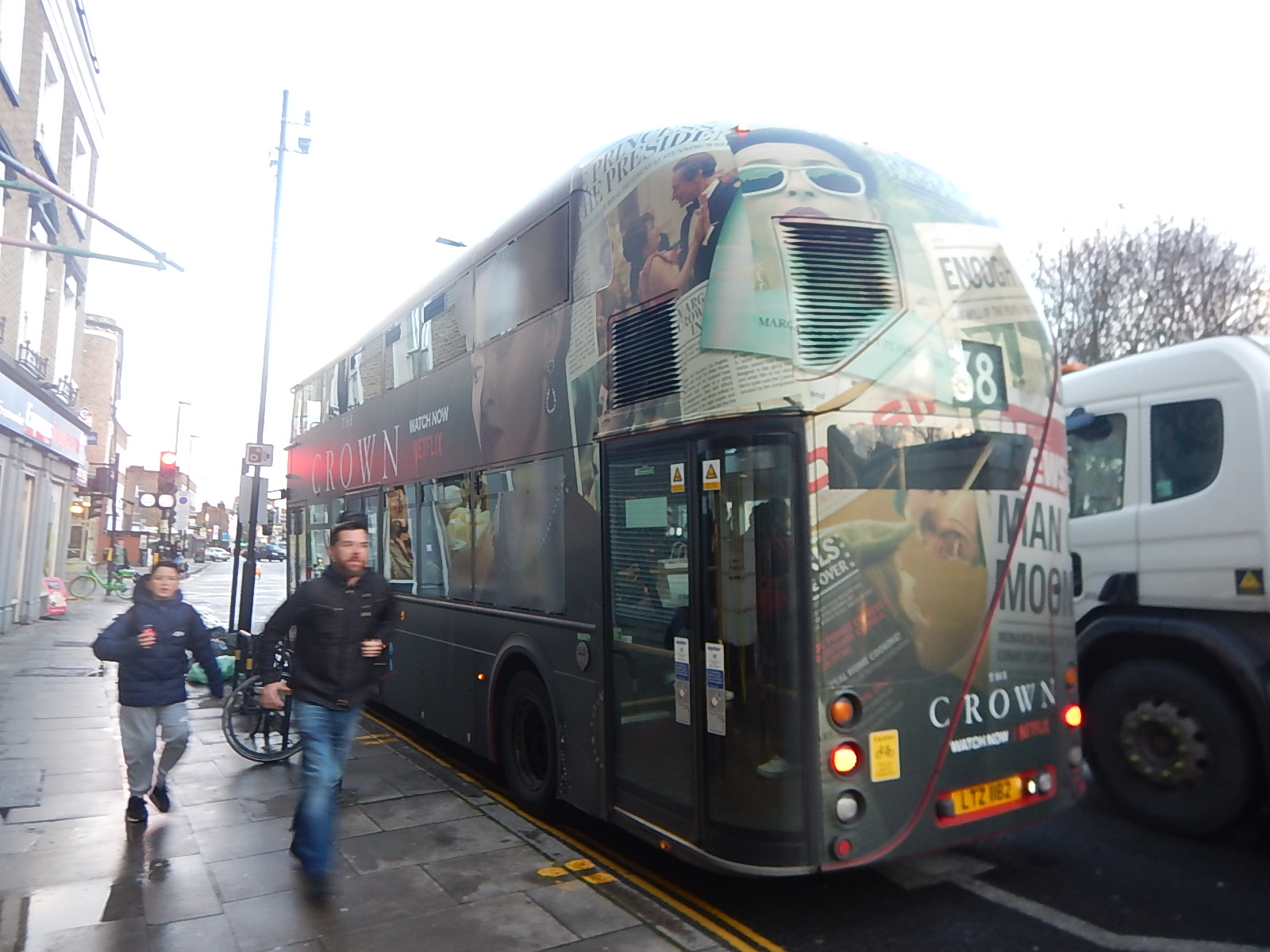
Try spotting one of these in the distance with dodgy eyesight!
There seems to be a design competition, to see who can design the most camouflaged bus!
When I first saw this bus, I thought it was advertising Crown’s new paint for the Army!
My Bus Stop At Moorgate Has Been Reopened
The easiest way to get to my house is to get a 21, 76 or 141 bus from outside Moorgate station. All stop within a hundred metres of my house.
For several years the stop has been a temporary affair, whilst Moorgate station is rebuilt.
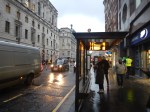
But now it’s a proper stop with a next bus display and a shelter.
Much of what I need in life, is available close to this stop.
- On the other side of the road is a Marks and Spencer store with both food and clothes.
- Within twenty metres of the stop, there are Boots, Hotel Chocolat, Pret a Manger and Leon.
- There’s a PC World and a Rymans around the corner.
And underneath it all is Crossrail!
I will have my own personal frequent bus route to London’s new rail line!
A Design Crime Of A Bus Livery
This bus livery must be the worst I’ve seen and it does appear sometimes, that designers are looking to design the worst they can.

I didn’t have any idea what it was advertising.
A Radical Government Would Consider Making Bus Travel Free
The title of this post is taken from the sub-title of the first leading article in today’s Times.
This is the last paragraph.
This is an opportunity for the government to be bold and help those deprived northern areas that voted Conservative for the first time. It should raise spending on buses and force the mainly private companies to provide many more services and routes. It should also encourage them to use electric or hydrogen-powered vehicles. But if it really wants to encourage a better quality of life and improved economic prospects for the north and other regions, it should consider making bus journeys free. At present millions of elderly people and children benefit from free bus passes . Why not extend this to all? That would send a message that this really is a people’s government.
The Times has a point. In fact it has several.
 The Anonymous Widower