George Clooney And Matt Damon Relax In Cambridge
Usually, when a story about celebrities relaxing ends up in the media, it usually concerns something like alcohol, drugs or bad behaviour.
But not this story from Cambridge, where George Clooney and Matt Damon are making a film. Here’s the final paragraphs.
Damon turned up with Clooney and two other men, and spent the hour “shooting hoops”, before Miss Shadrack said she had to inform them their time was up as others were waiting to use the court.
“They were very nice, such lovely people, and they posed for some pictures and chatted with people, but they didn’t say anything about the film they were making,” she said.
It looks like a good time was had by all!
A New Superwheat
You’d think as a coeliac, I would not be in favour of the new superwheat developed at Cambridge as reported on the BBC.
British scientists say they have developed a new type of wheat which could increase productivity by 30%.
The Cambridge-based National Institute of Agricultural Botany has combined an ancient ancestor of wheat with a modern variety to produce a new strain.
But I think this is a victory for traditional high-class science. As I understand it, after hearing the scientist on the radio, the combining of the two plants was done using the sort of methods, that have been used for years. Albeit with some clever seed incubation. No direct manipulation of the genes was involved.
So as this could give a yield increase of 30%, what would happen if these methods were applied to the other staple crops of the world.
Sadly, the problem is that, the Cambridge route doesn’t make any money for the big corporations of this world, who feel that the GM route is much more profitable.
I am not totally against GM, but it has to be used ethically and where it is demonstrated that it the only way to create an important product, such as a new cancer drug.
The Water We Drink
The BBC has done a blind tasting test of the tap water from various parts of the United Kingdom.
I don’t drink much water directly, although I do drink a lot of it in cups of tea all day.
I was brought up in London and I suspect that the water I drink now in Hackney is vaguely similar to that I had sixty years ago in Enfield. It’s probably exactly the same to that we had in the Barbican, as that area is only a kiolmetre or so away and I can see the flats from the corner of my road.
I certainly will drink it again, if there is nothing else, which is something I hardly ever did, whilst living away from London.
Except for the four years or so, that I lived in Liverpool, I’ve always lived in hard water areas. In fact, at one time, I lived in Melbourn near Cambridge, which in the 1970s reputedly had the hardest water in England. It also had quite a few sets of twins and the doctor thought there was a connection.
It’s funny, though but a few months ago after a couple of days in Liverpool, the tastes and smells around my mouth were quite different. It was almost if they were much fresher. But that could have been the Liverpudlian sea air.
Incidentally, one of the waters they tasted was from Woodbridge in Suffolk, where C and I lived for twenty or so years. The water didn’t come out well in the taste test! But I do remember C, who was an obsessive water drinker, saying she didn’t like the water, when we moved to Newmarket. She used to drink masses of bottled water, although usually insisted on tap water in a restaurant.
A Pedestrian Trap In Cambridge
Cambridge is not a city to live in or visit, if you have walking difficulties.
The pavements in the centre tend to be rather narrow and they are narrowed even more by the bicycles chained to any conceivable anchor point. But this broken rail by Parker’s Piece takes the biscuit.
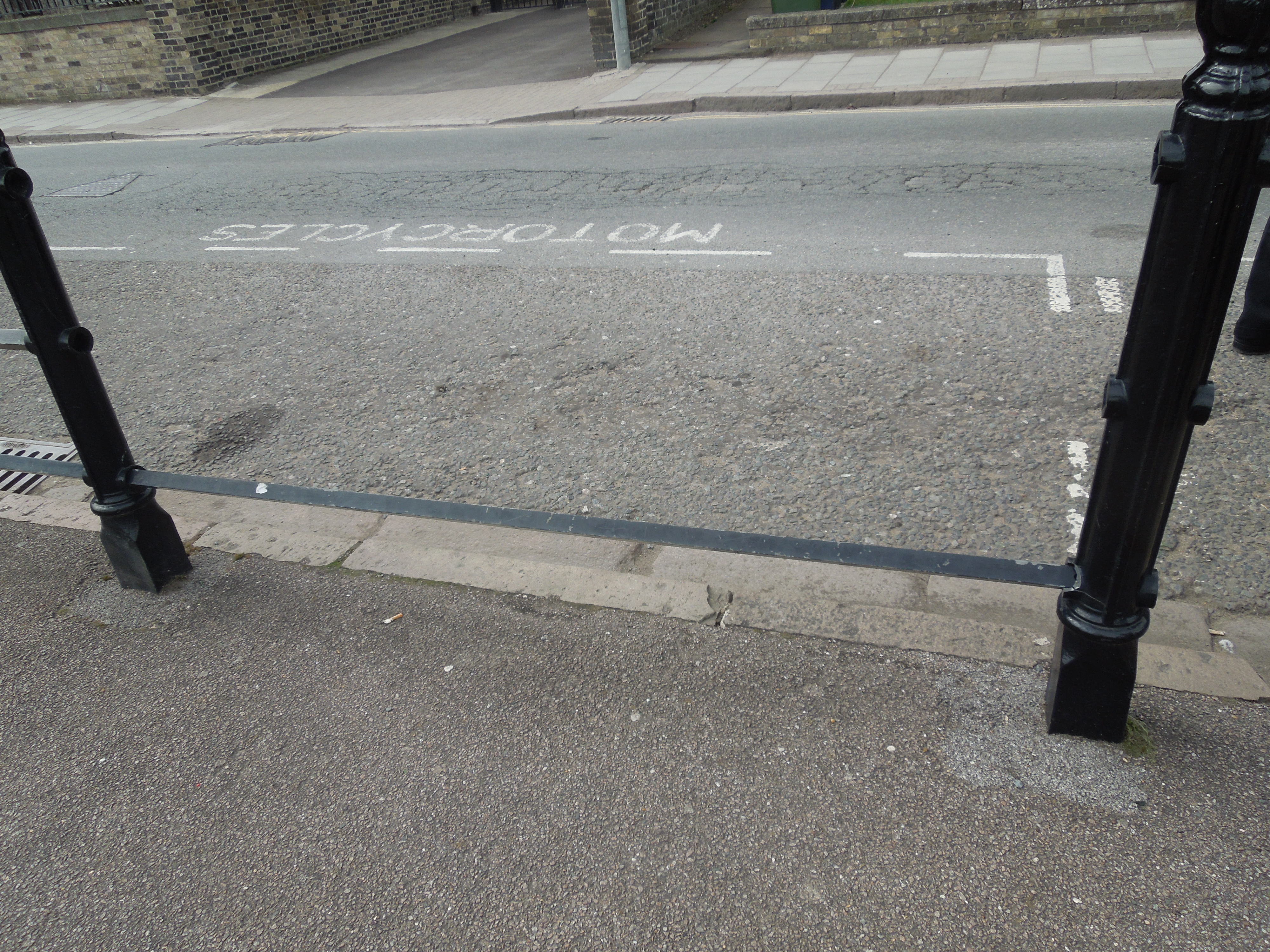
A Pedestrian Trap In Cambridge
I suppose it was lucky, that there was enough contrast between the rail and the ground. If they are going to have single rails, they should at least paint them orange.
I have reported it!
The Fastest Gluten Free Pasta In The East
I eat quite a bit of gluten-free pasta in Carluccio’s, but in some ways the best place for this is their restaurant in Cambridge.
Normally, when you ask for gluten-free pasta, they advise you there will be a little wait, but not yesterday.
So just as I was settling down to have a long sip of lemonade, which had just been delivered to my table, I was surprised to see the pasta arrive. This was probably only after about five or six minutes after I’d ordered it.
As I used to live in the area and be a patient of a gastro-enterologist at Addenbrookes, I know the area has a high number of coeliacs. Why this should be so, I know not!
But I also know that the restaurant uses methods to get the pasta to the table quickly.
The pasta was excellent incidentally and tasted exactly the same as in their other restaurants.
Cambridge Annoys Bus Passengers
Yesterday, I wanted to go to the football at Ipswich, but as there is no decent place to eat near Portman Road and I didn’t want to travel out in the rush hour, I decided to go to to Cambridge for lunch and then have a drink with an old friend at Thurston, just outside Bury St. Edmunds.
I haven’t been to Cambridge for a few months and when I got there I found I couldn’t find the bus stop to get me to the centre. I had missed the only information in the station.
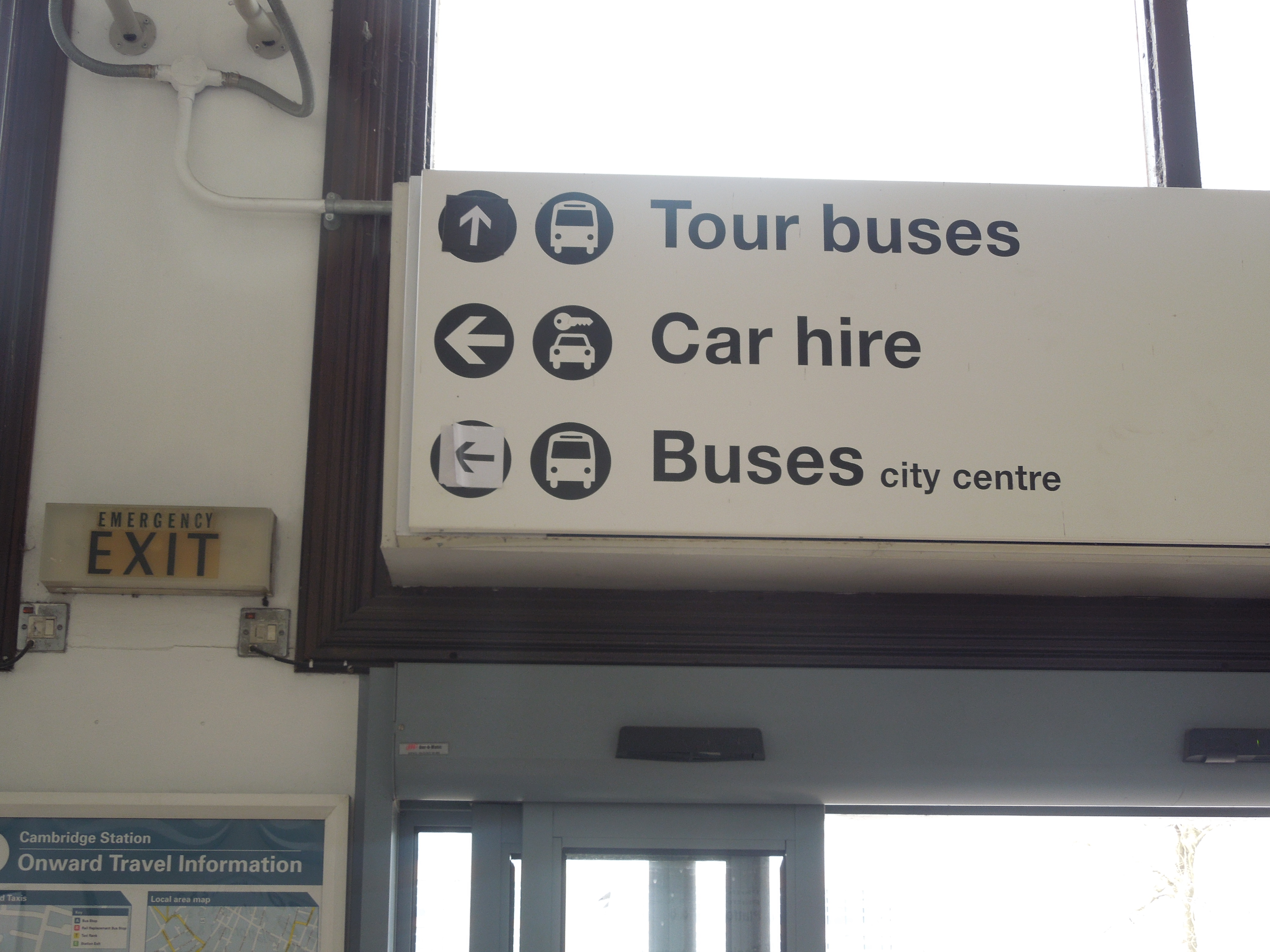
Bus Information At Cambridge
There was nothing else and no-one to ask.
I did find a fellow passenger, who showed me to the stop, but she added the new stop position, meant that she regularly missed her train, because of there being no drop-off in front of the station, as there used to be.
It does strike me, that the new traffic layout at the station has been designed to get the buses out of the way of cars and taxis. But then how many councillors and City officials responsible for signing off the new layout actually use the buses.
I think with Cambridge’s unique traffic problems and large numbers of visitors, that something better could have been done.
But whatever is done, some better information in the station is needed.
Bus-Only Tunnels Under Cambridge
This story popped up, when I displayed the previous one about the lorry on the busway.
i know Cambridge well, and as a study in the City showed in 2008, the concept might just work.
Cambridge is a traffic nightmare at the moment and will only get worse, unless something is done.
I suppose, a cross-city tram, powered as in Seville or Nice is another possibility.
Some very radical thinking is needed.
Is This The Next Antibiotic?
Read any paper or web site this morning and the doom-sayers are saying that growing resistance to antibiotics is a big risk to us all. Read about it here on the BBC web site.
The BBC News tonight did talk about a company called Phico. I looked at their web site and although I know little of pharmaceuticals, I do feel that this company may have the look of another success out of Cambridge.
Let’s hope that for everyone’s sake, they’ve got it right!
Note that, because of the backing of the Wellcome Trust, they shouldn’t be lacking in resources.
DNA Sequencing On The NHS
This is due to be announced soon and it’s already here on the Downing Street web-site.
Sadly, it’s too late for my wife and son, who died of cancer in 2007 2010 respectively.
My wife had a squamous cell carcinoma of the heart, which is so rare and deadly, that I don’t think any new technique would have helped. The doctors at Papworth Hospital, where she was treated had never seen such a vicious cancer. Short of a transplant or an unexpected miracle nothing could have saved her.
In my son’s case of pancreatic cancer, his lifestyle hadn’t helped and he might have stood a chance, if Trafford General Hospital where he was first treated in Manchester had picked it up earlier. As it is, they didn’t and Addenbrooke’s took their time too, as it was unexpected. Knowing what I know now, I would have got him to Cambridge earlier or taken him to Liverpool, where treatment of pancreatic cancer is a specialty.
So although the sequencing of cancer sufferers DNA will help in many cases, it wouldn’t have helped in their two cases, which were so tragic for my family.
What would have helped my son, would have been better diagnosis of his problem at an earlier date.
My wife went to the hospital fairly soon after she started running out of puff. She also led an exemplary life with regard to food, drink, not smoking and keeping very fit. Although that couldn’t be said for my son, who smoked heavily. And not just tobacco!
As an aside here, I am a coeliac.
This disease can be picked up by looking at the DNA. So if DNA sequencing becomes commonplace, looking for hereditary diseases like this may be a sensible and worthwhile use of the technique.
Hope For The Paralysed
I say hope, but this story from the BBC is a good news story to start the week. This is the first few paragraphs.
Scientists have reversed paralysis in dogs after injecting them with cells grown from the lining of their nose.
The pets had all suffered spinal injuries which prevented them from using their back legs.
The Cambridge University team is cautiously optimistic the technique could eventually have a role in the treatment of human patients.
The study is the first to test the transplant in “real-life” injuries rather than laboratory animals.
It may only be a first step on the long road to getting the paralysed to walk again. But it is a very significant first step.
I also think it’s very good, that the scientists did the research on dogs that had been injured in the normal course of life. It shows that often you don’t have to do experiments on healthy animals. All it needs is to think hard about what you’re doing.
So congratulations to Cambridge and its vets and scientists!
I think Jasper the dachshund will be one of the most famous dogs in the world.
 The Anonymous Widower