Centrica Set For Solar Boost With Acquisition Of Two Projects In South-West England
The title of this post, is the same as that of this press release from Centrica.
These three bullet points act as sub-headings.
- Two green energy schemes adding 32MW of solar and battery capacity – enough to power 7,800 homes per year
- Site in Dorset sees construction of a 16MW solar farm and 3MW of battery storage, with a second operational site in Wiltshire adding 13MW of solar capacity
- Investment part of Centrica’s £4bn green-focused investment plan by 2028
These four paragraphs give more details of the Dorset site.
In Dorset, the business has acquired development rights for the construction of a 16MW solar farm and 3MW battery storage plant near Winterborne Whitechurch.
The project breaks ground in early 2024, with the first power exported to the grid in 2025.
The site at Winterborne Whitechurch will be a co-located asset, with the solar farm and battery storage facilities using the same connection point to the grid, helping to maximise the grid connection.
The site is able to power 4,600 homes a year, supported by the battery that can deliver two-hours of energy for a similar number of properties.
But this is no bog-standard wind farm with an attached battery.
This web site introduces Blandford Hill Eco Hub.
This is the second paragraph on the web site’s home page.
The Blandford Hill Eco Hub project consists of an electric vehicle (EV) charging station, a 15 megawatt ground-mounted solar farm and a 3 megawatt battery storage faciality on land south of the A354 at Blandford Hill, Winterborne Whitechurch near Blandford Forum in Dorset. By combining green electricity generation, storage and charging, we’re maximising the green potential with charging for up to 19 EVs at a time.
Note.
- It’s rather a coincidence that the solar farm and battery are almost the same size to those in Centrica’s acquisition.
- The site appears to have been developed by a company called the Pegasus Group, that has used the trade name of Naturalis.
- It does look to me, that Centrica have bought this electric vehicle service station site.
- Centrica get a site to charge nineteen EVs at a time, with its own solar farm and battery.
- The location close to the village means that staff from the village could walk or cycle to work.
- All plans and planning permissions have been thought through and obtained.
- The site even has a dog-walking area, so you can walk the dog, whilst charging your car.
Perhaps, Centrica have a plan to roll out lots of electric vehicle service stations and it was cheaper to buy a innovative prototype, than do the research themselves?
Pegasus Group do seem to design quality projects.
This Google Map shows the location of the site.

Note.
- The village is Winterborne Whitechurch.
- The road going South-West and North-East is the A354 road, which runs between Dorchester in the South-West and Blandford Forum in the North-East.
- The electric vehicle service station appears to be in the large field to the South of the A 354.
It looks like the service station meets the three most important properties of a development; location, location and location.
Could This Site Be Updated To Hydrogen?
Consider.
- Centrica have a substantial interest in a company called HiiROC, who use a technique called plasma electrolysis to extract hydrogen from any hydrocarbon gas.
- The HiiROC process could be used to extract hydrogen from methane, where there is a reliable electricity supply.
- If Winterborne Whitechurch is connected to the gas grid, then I’m certain, that a HiiROC system connected to the solar farm/battery system should be able to fuel passing hydrogen-powered vehicles.
Updates like this could see hydrogen-powered vehicles finally increase their market share.
The Second Site In Wiltshire
This paragraph details the Wiltshire site.
In addition, the business has also acquired the operational Roundponds Solar Farm in Wiltshire. The 13MW solar farm was commissioned in 2015 and is capable of providing energy for around 3,200 homes every year.
This looks like one of those investments, where big companies let small companies get all the permissions and build the asset, before they buy it.
Conclusion
These two projects fit into Centrica’s future development plan.
The last paragraphs, gives a few details of some of Centrica’s new assets.
The Winterborne and Roundponds projects will contribute towards Centrica’s long-term plan to deliver a portfolio of green energy transition assets. They follow the construction of an 18MW solar farm at Codford, Wiltshire which was commissioned in 2023 and a 20MW hydrogen-ready gas-fired peaking plant in Worcestershire. In addition, Centrica is delivering a 50MW battery storage project in Brigg, Lincolnshire, which is nearing completion.
It will be interesting to see what other assets Centrica acquire in the next couple of years.
Centrica And Moog Inc. Agree Major Solar Power Purchase Agreement
The title of this post is the same as that of this press release from Centrica.
This is the sub-heading.
Centrica Business Solutions has completed a long-term solar power purchase agreement (PPA) with aerospace defence designer and manufacturer, Moog Inc. The solar array will accelerate the decarbonisation of its aerospace manufacturing site in Wolverhampton and help the business achieve its net zero goals.
These three paragraphs introduce the project.
The agreement sees Centrica lease roof space from Moog Inc. to install a 2,200 solar panel array capable of generating circa 1MW. The energy company will finance the project and have agreed on a PPA with Moog Inc. for the renewable electricity generated on site.
Construction is set to complete in the spring and the panels will provide Moog Inc. with 800 MWh of renewable, reliable energy every year for the next 25 years – around 10 per cent of the site’s existing electricity requirements.
This gives Moog Inc. price certainty and access to green electricity without any upfront costs, and it will reduce operational CO2 emissions by 175 tonnes every year.
Note.
- The roof is one of Centrica’s biggest roof top solar arrays to date.
- It’s the first retrofit on an existing manufacturing plant of a solar array for Moog Inc. and wthe’re looking forward to doing more.
The Wikipedia entry for Moog Inc. starts with this paragraph.
Moog is an American-based designer and manufacturer of electric, electro-hydraulic and hydraulic motion, controls and systems for applications in aerospace, defense, industrial and medical devices. The company operates under four segments: aircraft controls, space and defense controls, industrial controls, and components. Moog is headquartered in Elma, New York and has sales, engineering, and manufacturing facilities in twenty-six countries.
Bill Moog, who founded the company, was a cousin of the guy who invented the Moog synthesizer.
Their products feature on the Airbus A 350, the Boeing 787, the Lockheed Martin F 35 and are used to operate the roofs on Centre Court and Court One at Wimbledon.
Conclusion
We will see a lot more solar installations like these.
I am not sure of the type of solar panels used on Moog’s Wolverhampton factory, but these roofs must be an ideal place to use BIPVco steel solar panels as Network Rail used at Denmark Hill station.

This roof became operational in 2021.
This picture shows a Ventum Dynamics turbine on Skegness Pier.
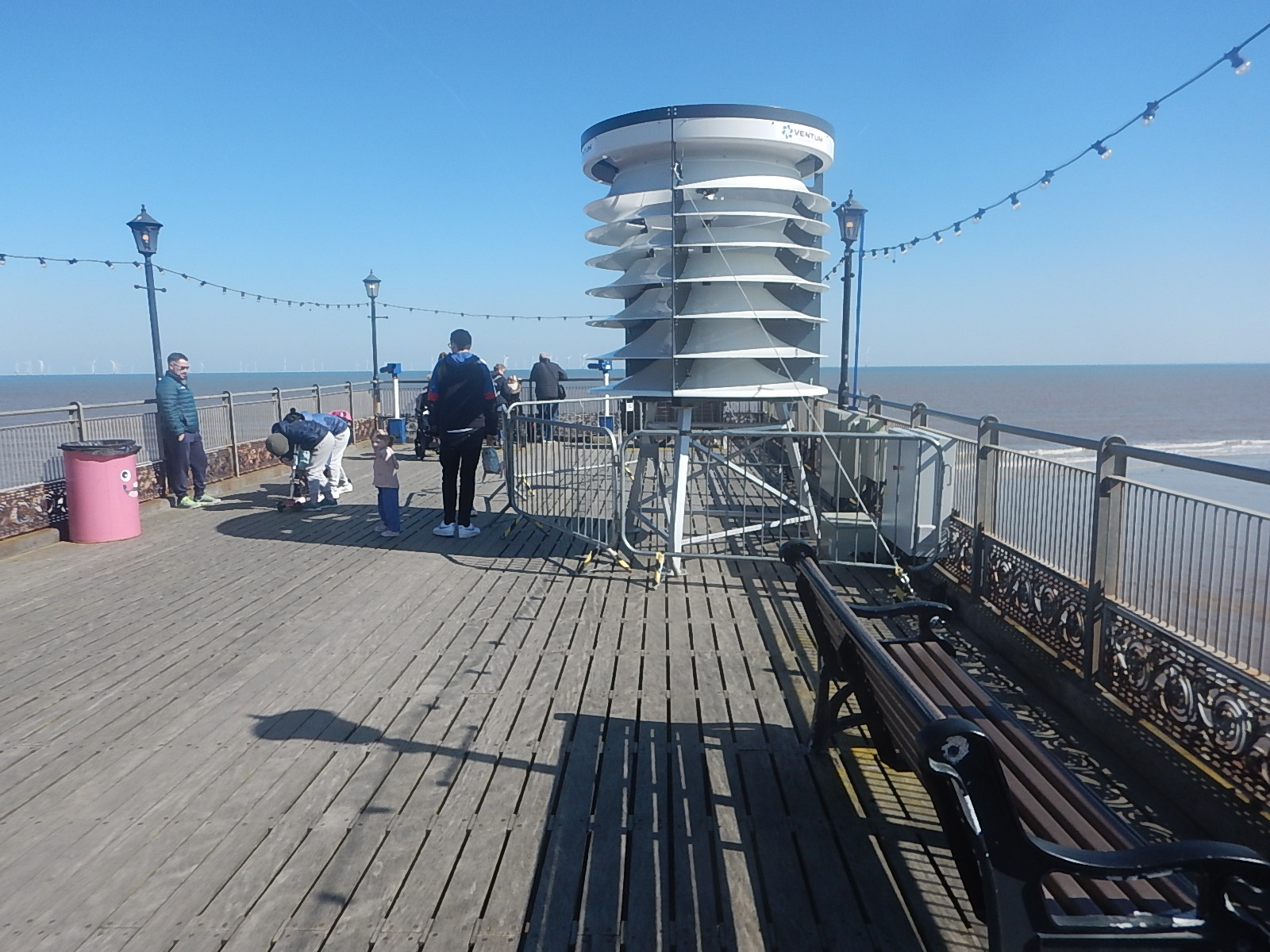
On the Ventum Dynamics web site, there are several pictures of buildings with flat roofs, that have several turbines on each.
I believe these turbines would fit neatly on some large industrial roofs with solar panels to form an efficient wind/solar application.
The Modern Way To Grow Tomatoes
I was looking around the Centrica Business Solutions web site, when I found this page, which is entitled Second CHP Powers New Greenhouses At Frank Rudd & Sons, that describes how tomatoes are grown in large greenhouses.
These paragraphs introduce Frank Rudd & Sons and what they do.
Frank Rudd & Sons is a family-run producer of cherry vine and plum tomatoes, generating around 1,500 tonnes of produce every year. Based in Over Peover, near Knutsford, the business was started in 1939 and is now run by the third generation of the Rudd family.
Their greenhouses use an innovative growing system, with suspended grow bags full of nutrient seed. This means they’re able to grow tomatoes for 11 months of the year – and also means they have a continual need for heat.
What’s more, when they constructed new greenhouses – going from 9 acres of glass to 15 acres – Frank Rudd & Sons needed an energy partner who could support their increase in demand.
These paragraphs describes Centrica Business Solutions’s solution.
Centrica Business Solutions originally partnered with Frank Rudd & Sons in 2017 to install a new Combined Heat and Power (CHP) unit to power their operations. When Frank Rudd & Sons began to expand their greenhouses in 2023, they needed to install a second CHP to meet their increased demand. Once again, they invited Centrica Business Solutions to support.
We designed and installed a turnkey 1.5MW CHP system to power their production processes. The CHP generates heat and carbon dioxide, which are both fed into their greenhouses and are vital components to the growing process. The system also generates electricity, which Frank Rudd & Sons sells back to the grid through an export agreement – giving the business a significant ongoing revenue stream.
One of the pictures shows that the CHP unit is from Rolls-Royce mtu.
National Gas To Trial Gravitricity’s H2 Storage Solution
The title of this post, is the same as that of this article on The Engineer.
This is the sub-heading.
Gravitricity’s H2FlexiStore system for underground hydrogen storage could see a pilot built in 2025 after National Gas secured Ofgem funding to explore the technology.
There is then a graphic, which gives a good visual explanation.
The patented system uses lined geological shafts to store up to 100 tonnes of pressurised hydrogen at 220 bar, equivalent to about 3.33GWh of energy. Unlike natural storage such as salt caverns and disused gas fields, the shafts can be sited anywhere. Gravitricity has previously stated its preference for co-locating the storage near to renewable generation and potential major consumers of hydrogen such as heavy industry.
I can see that this simple system can have a lot of diverse uses.
In Centrica Completes Work On 20MW Hydrogen-Ready Peaker In Redditch, I talked about how Centrica had refurbished a decommissioned peaker plant.
One of these stores would keep a 20 MW peaker plant running for a week.
It would also work well with a HiiROC hydrogen system.
Centrica Completes Work On 20MW Hydrogen-Ready Peaker In Redditch
The title of this post, is the same as that of this press release from Centrica.
This is the sub-heading.
Construction is complete on Centrica’s new 20MW hydrogen-blend-ready gas-fired peaking plant in Worcestershire, transforming the previously decommissioned Redditch power plant.
These paragraphs give more details of the project.
The plant is designed to support times of high or peak demand for electricity. Peaking plants only operate when production from renewables can’t meet demand, supporting the energy transition by maintaining a stable electricity supply. The Redditch site can power the equivalent of 2,000 homes for a full day, helping to maintain stability and reliability on the grid.
The plant is capable of using a blend of natural gas and hydrogen, futureproofing the site and supporting the UK’s transition towards a decarbonised energy system.
The Redditch peaking plant forms part of Centrica’s plans to invest between £600m – £800m a year until 2028 in renewable generation, security of supply, and its customers, including building out a portfolio of flexible energy assets. That includes the redevelopment of several legacy power stations, including the Brigg Energy Park in to a power generation and battery storage asset, and the first power station in the UK to be part-fuelled by hydrogen.
I also wrote Centrica Business Solutions Begins Work On 20MW Hydrogen-Ready Peaker In Redditch, about this project.
HiiROC
I wonder if this power station will be fitted with a HiiROC system, which will split the natural gas into two useful products; hydrogen and carbon black.
I wrote about HiiROC in Centrica Partners With Hull-Based HiiRoc For Hydrogen Fuel Switch Trial At Humber Power Plant.
I can see lots of HiiROC systems creating a hydrogen feed, to decarbonise various processes.
Whose Engines Are Used At Redditch?
Centrica still haven’t disclosed, whose engines they are using.
Energy Security Boost After Centrica And Repsol Agree LNG Supply Deal
The title of this post, is the same as that of this press release from Centrica.
This is the sub-heading.
Centrica Energy and Repsol today announced the signing of a deal that will improve the UK’s energy security in the coming years.
These two paragraphs give more details of the deal.
The deal will see Centrica purchase 1 million tonnes of Liquified Natural Gas (LNG) shipments between 2025 and 2027. All of these cargoes are expected to be delivered to the Grain LNG import terminal in Kent.
The deal marks an additional move by Centrica to build further resilience in the UK’s energy security. It follows a 15 year, $8bn deal with Delfin Midstream in July 2023, a three-year supply agreement with Equinor that will heat 4.5m UK homes through to 2024 and the reopening and expansion of the Rough gas storage facility in October 2022 and June 2023 respectively. Rough now provides half of the UK’s total gas storage capacity with the potential to store over 50 billion cubic feet (bcf) of gas, enough to heat almost 10% of UK homes throughout winter.
Centrica do seem to be keeping us supplied with gas.
Two days ago, National Grid published this press release, which is entitled Grain LNG Signs New Deal With Venture Global Further Strengthening The Security Of Supply Of LNG To The United Kingdom.
This is the sub-heading.
Today (5 February), Grain LNG and Venture Global have announced the execution of a binding long-term terminal use agreement (TUA) enabling the regasification and sale of LNG from all of Venture Global’s LNG terminals in Louisiana, including CP2 LNG, subject to obtaining necessary federal permits.
These two paragraphs give more details of the deal.
Under the agreement, Venture Global will have the ability to access 3 million tonnes per annum (3MTPA) of LNG storage and regasification capacity at the Isle of Grain LNG receiving terminal for sixteen years beginning in 2029, equivalent of up to 5% of average UK gas demand.
This is the second agreement from Grain LNG’s competitive auction process which was launched in September 2023. The successful outcome of the auction further secures the future of Europe’s largest LNG import terminal into the mid 2040s.
Two big deals in the same week is not to be sneezed at and must be good for the UK’s energy security.
Grain LNG
The Grain LNG web site, greets you with this message.
Welcome To Europe’s Largest Liquified Natural Gas Terminal, Grain LNG
Grain LNG is the gateway connecting worldwide LNG to the European energy market, making a genuine difference to people’s lives. Find out all about our cutting-edge operations – showcasing our leadership in powering the future – and why Grain LNG is at the forefront of energy as we move towards net zero.
There is also a video.
This Google Map shows the location of Grain LNG on the Isle of Grain.
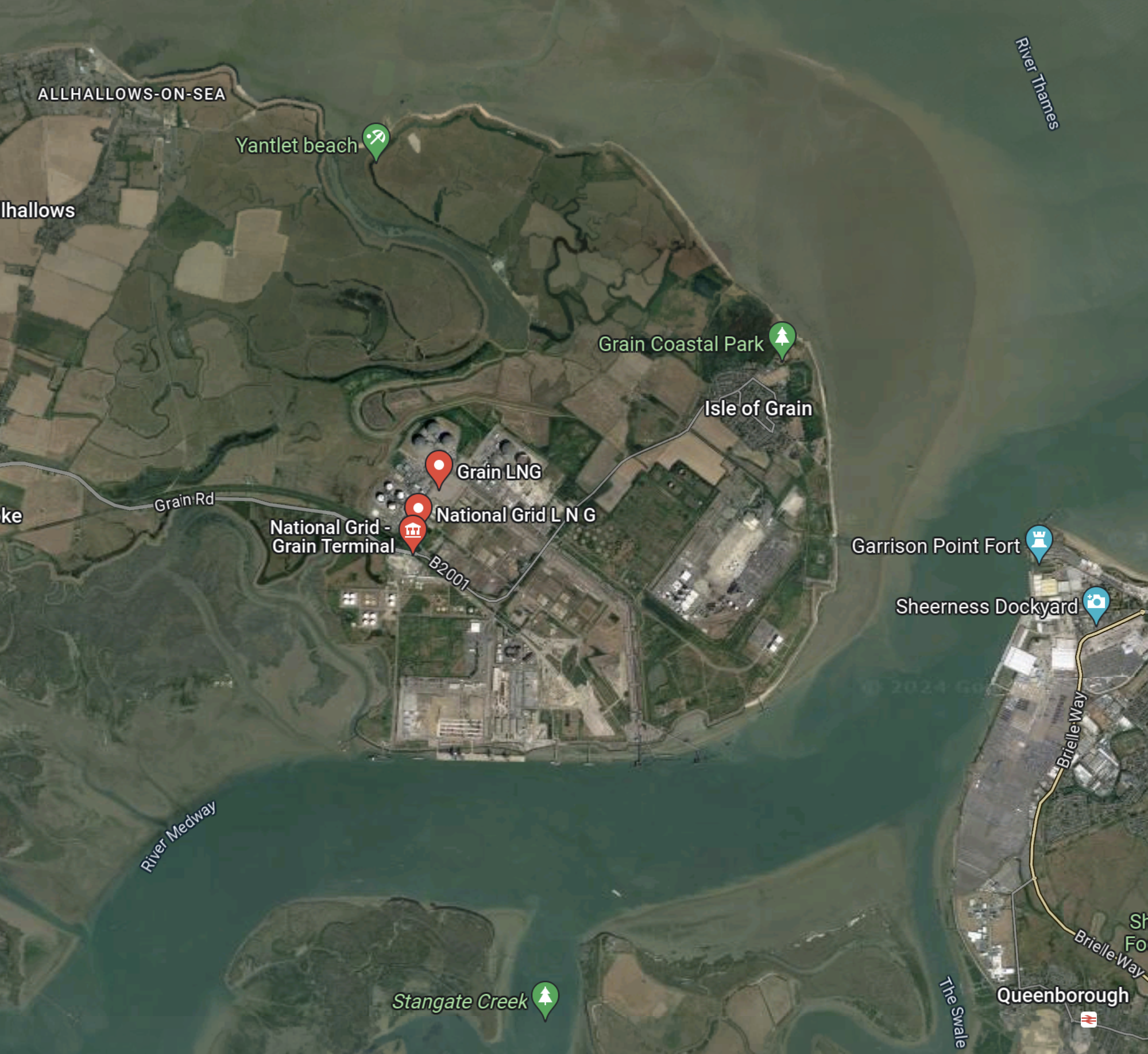
Note.
- The River Medway flows into the River Thames between the Isle of Grain on the left and the Isle of Sheppey on the right.
- From South to North, the red arrows indicate, the National Grid – Grain Terminal, National Grid L N G and Grain LNG.
There would appear to be space for expansion.
British Gas Joins Forces With Samsung To Help Customers Power Smarter Energy Use
The title of this post, is the same as that of this press release from Centrica.
This is the sub-heading.
British Gas and Samsung have today announced the exciting first step in a long-term venture – aimed at helping customers better manage their energy use and increase the adoption of low carbon heating technologies in homes across Britain.
These are the first two paragraphs.
The collaboration will see British Gas integrate with Samsung’s SmartThings app to help customers optimise their home appliances to use energy when the cost and demand are lower. This is now possible through the integration of SmartThings Energy and British Gas’ PeakSave demand flexibility scheme informing customers (by sending notifications via their smartphone, TV or other compatible devices) of the best times to use household appliances to save money.
The PeakSave scheme includes PeakSave Sundays, running every Sunday until the end of February with half-price electricity from 11am to 4pm for British Gas customers and PeakSave Winter events which encourages customers to move their electricity use out of peak times when there is high demand on Britain’s energy grid.
As a Graduate Control Engineer, I believe that this could make optimising your energy use much easier.
- It would surely be a lot easier to check usage on your phone rather than a smart meter, when you perhaps cook a ready meal, so that you can see if your microwave or traditional cooker is cheapest.
- Suppose you and everybody, who lives with you are out for supper and British Gas want to cut off your gas for a reward, you can make an appropriate decision.
- Hopefully, if you have the right controls, you’ll be able to switch lights and appliances off and on.
The possibilities are endless.
I shall certainly be looking at the reviews of this app.
There is a section in the press release called Scaling Up Low Carbon Heating Opportunities, where this is said.
The collaboration will also help support customers in their journey to decarbonising their homes by introducing smart technologies in a way that is simple and empowering. From early 2024, British Gas will include Samsung heat pumps in its offering to British households to support the UK’s commitment to reach net zero by 2050.
The venture will see specially trained British Gas surveyors and engineers working with consumers to explain the benefits of heat pumps and then conducting the installations on-site. Samsung will be supporting workforce training as part of their efforts to upskill the heating industry to ensure there are enough installers to service the expected growing demand.
British Gas also offers customers the chance to purchase heat pumps through flexible financing methods. This, combined with the recently increased UK Government Boiler Upgrade Scheme grant of £7,500, creates an attractive package of financing options to help people make the transition more affordable.
Various plumbers, who I would trust, have given me different views about heat pumps.
I suspect the Samsung’s SmartThings app might be able to simulate your energy usage with or without the heat pump, as it would know your energy use with your current boiler.
I was doing similar calculations for chemical plants in the early 1970s at ICI, using a PACE 231-R computer.

Consider.
- It may look rather old fashioned, but it could solve a hundred simultaneous differential equations in one go.
- Two similar computers linked together were the analogue half of NASA’s moon mission simulator.
- Without these wonderful machines, NASA would not have been able to re-calculate the dynamics of Apollo 13 and the mission would be remembered as a disaster, rather than the first space rescue.
The average current smart phone has more computing power than a PACE 231-R.
What’s In It For Samsung?
I have a Samsung television, but unfortunately it has a screen fault because of age. So if I had the Samsung app and liked it, I might buy another Samsung TV.
Similarly, the app might give me a financial reason to buy a Samsung heat pump.
Samsung will sell more equipment.
What’s In It For Centrica?
Centrica would appear to be a loser, as bills will fall and they could be paying customers to not use energy.
But they are surely hoping that their market share will increase and I’m sure Samsung will give them a commission.
What’s In It For The Consumer?
Hopefully, they’ll get lower energy bills.
But also they might get a lot of convenience controlling their appliances and heating.
Conclusion
Using energy is becoming a computer game with monetary rewards.
Is the deal between Centrica/British Gas and Samsung another deal that has been brought to fruition by the Korean President’s visit to the UK?
It looks like this is the third recent deal signed between UK and Korean companies, after these two.
- South Korea, UK Strenghten Offshore Wind Ties
- UK And South Korea Help Secure Millions For World’s Largest Monopile Factory
I suspect, there might be a few more deals, if Charles and Camilla really turned on the charm.
In Mersey Tidal Project And Where It Is Up To Now, I wrote about talks between Liverpool City Council and Korea Water about a tidal barrage of the Mersey. This project must surely be a possibility!
This is said in the Wikipedia entry for Korean Air under Fleet Plans.
At the Association of Asia Pacific Airlines Assembly in 2018, Korean Air announced that it was considering a new large widebody aircraft order to replace older Airbus A330, Boeing 747-400, Boeing 777-200ER and Boeing 777-300. Types under consideration for replacement of older widebody aircraft in the fleet include the Boeing 777X and Airbus A350 XWB. At the International Air Transport Association Annual General Meeting (IATA AGM) in Seoul, Chairman Walter Cho said Korean Air’s widebody order is imminent and it is considering an extra order of Airbus A220 Family including developing version, Airbus A220-500.
Note.
- Airbus A350 XWB have Welsh wings and Rolls-Royce engines.
- Airbus A220-500 are made in Canada with wings and composite parts from Belfast. Rolls-Royce may have a suitable engine.
Could a deal have something in it for the UK?
Although Korea has its own SMR program, I wonder, if there could be a link-up between Korean industry and Rolls-Royce over SMRs?
BESS Projects Represent ‘Encouraging Progress’ in New York Efforts To Replace Dirty And Polluting Peakers
The title of this post, is the same as that of this article on Energy Storage News.
These are the first three paragraphs.
Battery storage is playing an active role in helping New York City retire its fleet of peaker power plants, with around 700MW of its most polluting power generation assets already fully retired.
According to a new report, 4,019MW – about two-thirds of a 6,093MW fleet – has either retired or put in place plans to replace turbines with cleaner technologies since New York adopted its climate goals and environment protection policies in 2019.
In addition to 700MW already retired, around the same amount again is actively being moved towards end of life.
Note.
- Just over 6,000 MW seems a lot of extra peaker power, even for a city as large as New York.
- But at least over 4 GW has been retired or the plans to replace it with cleaner technologies are in place.
- The New Yorkers certainly seem to be getting on with the conversion, with about a GW/per year either retired or planned to do so.
The article says this about batteries.
Battery storage is one of a number of different technologies that can be used to replace peaking capacity. While lithium-ion batteries with 4-hour duration might be the most directly analogous in terms of technical capability to peakers, effectively retiring the power plants could be facilitated with a combination of other resources including rooftop solar, offshore wind and energy efficiency measures.
I find the 4-hour duration interesting, but I suspect the Yanks know what they’re doing.
So if you were going to replace the 240 MW Glanford Brigg power station, which Centrica describe as a peaker station, with energy storage, you’d use a 240 MW/960 MWh battery, if you were working to New York rules.
Batteries in the UK, that I’ve talked about lately include.
Amp Hunterston – 400 MW/800 MWh – 2 hours
Amp Kincardine – 400 MW/800 MWh – 2 hours
- Carlton Energy Park – 1040 MW/2080 MWh – 2 hours – Close to an 884 MW gas-fired power station.
- Coalburn – 500 MW/1000 MWh – 2 hours- Close to a 946 MW collection of wind farms.
- Gateway Energy Centre – 450 MW/900 MWh – 2 hours – Close to an 732 MW gas-fired power station.
- Normanton Energy Reserve – 500 MW/1000 MWh – 2 hours
- Richborough Energy Park – 100 MW/100 MWh – 1 hour
- Spalding Energy Centre – 550 MW/1100 MWh – 2 hours – Close to an 860 MW gas-fired power station.
Note.
- The first field is Output/Storage Capacity.
- The second field is the duration.
- I have assumed Spalding Energy Centre is another two hour duration system, like Gateway Energy Centre, which is also being developed by Intergen.
- Two hours seems to be the most common duration for a UK battery.
Adding the batteries up gives a virtual 3940MW/7780MWh battery.
It amazing how they add up to quite large values. But then every little helps!
And these are only the ones I’ve talked about.
Centrica Business Solutions Delivers Significant Energy Savings For The Pirbright Institute
The title of this post, is the same as that of this press release from Centrica.
These three paragraphs outline the project.
Centrica Business Solutions has partnered with The Pirbright Institute to deliver sustainable on-site technology that will help reduce its net energy use by more than 10 per cent by 2026.
Centrica installed a new Combined Heat and Power Plant (CHP), which will provide around 75 per cent of Pirbright’s future power needs. The CHP uses natural gas to generate electricity and hot water at the site, with its exhaust gases also used to feed into a heat recovery generator to provide steam. It means CHP technology is over twice as efficient as conventional power sources and can lower organisational reliance on the Grid.
The Institute, which is dedicated to the study of infectious diseases of farm animals, has already devised an energy plan which has introduced energy-saving upgrades across the Surrey campus, including the closure of energy-inefficient buildings, the introduction of efficient lighting and a programme to raise staff awareness of energy consumption.
The system is still powered by natural gas.
Liverpool University
I was an undergraduate at Liverpool University and according to this page on their web site, which is entitled Sustainability, they seem to be following a similar route to the Pirbright Institute.
With a heading of Energy And Carbon, this is the mission statement.
The University’s ambition is to be a climate-resilient campus, that has minimal negative and maximum positive environmental impact, achieving net zero carbon by 2035. We monitor energy and carbon across the entire University as part of the Climate plan and in support of the Sustainability Strategy and Strategy2026 net zero carbon targets.
One section of the page has a title of The Green Recovery with Clarke Energy at the University’s Energy Centre, where this is said.
The University of Liverpool generates up to 90% of its campuses electricity needs on site in the Energy Centre, through CHP. Clarke Energy help the University operate CHP in the most efficient way, keeping us on track with technological developments, such as how the CHP can be adapted to take different fuel blends.
Although there is a nod to different fuel blends, I suspect that the system, like that at Pirbright, is currently powered by natural gas.
Clarke Energy, is headquartered in Liverpool and is a division of Kohler.
Centrica And HiiROC
CHP systems are becoming more common and like these two systems, they are generally powered by natural gas.
In Plans Submitted For Hydrogen Pilot Plant At Humber Power Station, I describe how Hull-based start-up; HiiROC are going to help fuel a gas-fired power station with a hydrogen blend.
This is a paragraph from this article on Business Live, which describes Centrica’s relationship with HiiROC.
It comes as the owner of British Gas has also increased its shareholding in the three-year-old business to five per cent. Last November it was one of several investors to pump £28 million into HiiRoc alongside Melrose Industries, HydrogenOne, Cemex, Hyundai and Kia, who joined existing strategic investors Wintershall Dea and VNG.
HiiROC’s system can take any hydrocarbon gas from biomethane, through chemical plant waste gas to natural gas and convert it to hydrogen and carbon black.
Carbon black has a large number of manufacturing uses and can also be used in agriculture to improve soil.
It looks to me, that HiiROC’s systems will be a simple way to convert natural gas-powered CHPs to zero carbon.
Firm Develops Jet Fuel Made Entirely From Human Poo
The title of this post, is the same as that of this article on the BBC.
This is the sub-heading.
A new aviation company has developed a type of jet fuel made entirely from human sewage.
These are the first three paragraphs.
Chemists at a lab in Gloucestershire have turned the waste into kerosene.
James Hygate, Firefly Green Fuels CEO, said: “We wanted to find a really low-value feedstock that was highly abundant. And of course poo is abundant.”
Independent tests by international aviation regulators found it was nearly identical to standard fossil jet fuel.
It certainly seems to have a lot going for it.
I have some other thoughts.
What About Disposable Nappies?
I wrote Are Disposable Nappies A Wasted Resource?, about making hydrocarbon fuels from disposable nappies.
Should Disposable Nappies Be Collected Separately?
My food waste is collected separately in a special bin. Hackney Council say this is what happens to food waste.
Food waste from households in Hackney is sent to an anaerobic digestion facility in south east England, where it’s turned into renewable energy to power homes and biofertiliser to be spread on local farmland to grow crops.
Surely, a similar or appropriate process could be used for disposable nappies.
Biomethane From Sewage Works
In Centrica Signs UK Biomethane Agreement With Yorkshire Water And SGN Commercial Services, I wrote about how Centrica have found a way to distribute biomethane from sewage works using the UK’s gas grid.
Could Firefly take the solids and Centrica the biomethane?
Given that water companies are regularly blamed for spilling sewage could there be an opportunity for a large sewage works to be a major producer of green fuels for agriculture, aviation, industry and road transport.
 The Anonymous Widower