Do As I Say Not As I Do!
I don’t support Greenpeace directly, although I follow some of their ideas and I’m happy to use their research to back up a principle I believe in.
My reasons for not supporting them financially, is that they have chugged me and I don’t support charities who do that.
But also, I feel some of their stunts are more about raising money than anything else.
I also feel in some cases their views are wrong and that these views have set back the lot of some people, who don’t live in the same decent circumstances, as most who work for and support the charity.
But today, I read the report on how one of their senior executives commutes from Luxembourg to Amsterdam by air, rather than uses the train. It’s reported in several newspapers and the report in the Daily Mail is here.
On reading this report, I suspect a lot of Greenpeace’s supporters have decided not to do so any more!
It’s not as though there aren’t other charities working in the same area.
Not Taking Notice Of My Unsubscribes
One national charity, which I think does a lot of good work, but which I’ve never supported keeps sending me e-mails, so I might buy something from them on-line.
I unsubscribe each time, but still they keep coming. I think I’ve had thirteen since the start of November.
I do wonder, if a lot of people now wouldn’t support this charity, as they’ve had a similar treatment. Which I wouldn’t!
If I get a tin rattler in front of me, they’ll get the reasons.
Better Than Chugging
I saw this sign outside Oxfam in Islington.
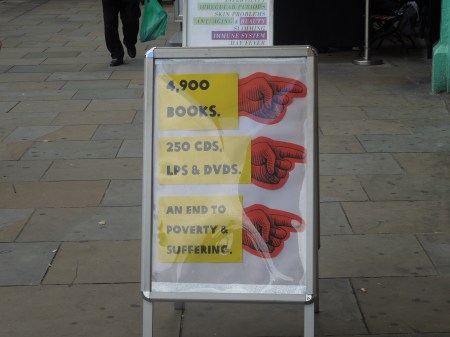
Better Than Chugging
It’s so much better than annoying people with chuggers.
I’m Closing My Rate Setter Account
I have just sent this e-mail to Rate Setter.
I’ve never really got into Ratesetter, so I’d like to close everything down, or at least withdraw the money that has not been lent.
It’s just that the concept of the site requires a lot of managing and as Zopa now has their Safeguard product, which gives me a reasonable rate and quite a bit of security, I might just as well have the use of the money or give it to charity.
Is It Illegal To Sell Pens In Stations?
Yesterday, I dropped my pen on the way to Clapham Junction station.
So I thought, I’d buy one there!
But I couldn’t, despte trying about six of the many kiosks in the station.
I got no luck!
In fact, I don’t think I’ve managed to buy a nice standard-issue Bic biro in a station in perhaps the last ten years.
In the end, I bought two in a small general store in Bognor.
But that’s a long way to go for a pen!
I did ask the ticket collector on the train and he said he’d had to buy one himself before he started work. He certainly didn’t think that they were ever used for attacks on staff or other passengers.
I think the solution is to have pen dispensers on stations, where say for a pound or two, you can get a suitable pen. All profits could go to a charity like Railway Children.
Katherine Jenkins At The Marathon
There seems to have been a lot of criticism of Katherine Jenkins at the London Marathon. It’s reported here on the BBC. This is an extract, containing comments from a Daily Mail columnist.
She then criticised the singer’s appearance, describing her £200 Prada sunglasses, full make-up, “immaculate” ponytail and “raisin-sized” diamond earrings.
So what! She wouldn’t be the first runner, who wanted to look her best.
I actually saw her perform once at a private party and she was definitely worth whatever the organisers paid.
Is this just another case of Tall Poppy Syndrome?
If I was a celebrity treated in this way in these circumstances by a columnist, I’d challenge them to a race, with the loser paying several thousand to a charity of the winner’s choice.
Passing It On
I mentioned in this post, that my Aunt Gladys paid for our marriage licence, as I was totally skint, on condition that I passed it on.
Some years later in Ipswich in about 1980, a young guy wrote to me asking for sponsorship for Operation Raleigh. I passed the loan from my Aunt on, adding a bit more, and I received a series of letters as he traversed the globe. I did say, that if he ever was a success to pass the loan on to another person, who’d make use of it.
then about seven or eight years ago, he found me on the Internet and said that the loan had been passed on again with the same conditions.
I should say, this is not the only chain I’ve started, but none have kept going so long.
The Joke’s On The Recession
We may be in the depth of a recession, but you wouldn’t suss this from the magnificent response of the public to Comic Relief, as reported here on the BBC.
Checking Foreign Aid
There has been a lot of discussion in the last day or so about foreign aid and whether it is worth it.
A few years ago, I went to a presentation by a senior manager in Unicef.
They said, one of the biggest problem, was checking that aid was spent correctly. Ask the government if the £2million had been spent on say measles immunisation and you would get the answer the government wanted you to hear.
So Unicef always asked an independent organisation, such as a University to check. Even in some of the poorest and less academic countries, academic standards usually ensured that Unicef got an honest answer, they could trust.
The British government should use similar methods to check all aid is correctly spent on what it was intended.
The BBC’s Top Story Today
This story about Irish ‘nuns’ caught drinking illegally in Ireland is the most read on the BBC’s web site today.
I suppose the behaviour could be explained as they were Sisters of Charity and the local priest gave his blessing.
 The Anonymous Widower