Musical Trains On The Overground
The November 2017 Edition of Modern Railways (MR) has a news item entitled Nine More Class 710s Planned.
This is the first paragraph.
Transport for London is proposing the acquisition of nine additional Class 710 EMUs from Bombardier to support the London Overground rxtension to Barking Riverside and an enhanced service on the East London Line.
Transport for London (TfL) are ordering six five-car and three four-car Class 710 trains.
This article on London Reconnections (LR) is entitled More Trains for London Overground: A Bargain Never to be Repeated.
The title gives a clue as to the first part of the article and it talks about how it may be necessary for TfL to get their order in now to get the best terms and price for the trains.
Putting the two articles together, some interesting train use could be happening on the various lines of the Overground.
The East London Line
Certain improvements have been planned for the East London Line.
The Class 378 Trains
The current fleet of 57 Class 378 trains are now five cars in length, after starting at just three cars.
Many of the stations on the East London Line could accept six-car trains and the other could be worked using selective door opening.
So TfL probably have an option to increase capacity on the East London Line by twenty percent, by adding an extra car to the Class 378 trains on the line.
The Class 378 trains are also certified for working the Thames Tunnel, whereas the Class 710 trains don’t appear they will be.
The Night Overground
A 24-hour service on Friday and Saturday nights, between New Cross and Dalston Junction/Highbury and Islington stations.
Crossrail And The East London Line
This will happen in December 2018, when Stage 3 of Crossrail opens between Abbey Wood and Paddington stations, with a connection to the East London Line at Whitechapel station.
When you consider that Whitechapel will be served by 12 x nine-car Crossrail trains per hour (tph) from December 2018 and 24 x nine-car tph from May 2019, you do wonder if the East London Line’s sixteen x five-car tph will cope with the extra passengwe.
Increased Frequencies
TfL have said they will increase the core frequency of the East London Line from sixteen tph to twenty in 2021.
I wrote about this two years ago in Increased Frequencies On The East London Line, so the plan is an old one, even if it has slipped a bit.
The original plan envisaged the following extra trains on the East London Line.
- Two tph – Dalston Junction to Crystal Palace in 2018
- Two tph – Dalston Junction to Clapham Junction in 2019
It would need the following.
- More Class 378 trains, as the Class 710 trains are not certified for the Thames Tunnel.
- Improved digital signalling in the core, which would eventually enable twenty-four tph.
The LR article suggests that there may be capacity problems at Clapham Junction station and two tph to Battersea Park station is suggested as an alternative.
Battersea Park Station
Battersea Park station is already served by the Overground, with this service, which is detailed in Wikipedia.
1 train per day to Highbury & Islington / 1 train per day from Dalston Junction.
Wikipedia adds this comment.
Until December 2012, Southern operated a twice-hourly service from London Victoria to London Bridge via Denmark Hill. This ceased when London Overground’s Clapham Junction to Dalston Junction service commenced at that time. However, since December 2012, a skeleton London Overground service has run to/from Battersea Park (instead of Clapham Junction) at the extreme ends of the day to retain a “parliamentary service” between Battersea Park and Clapham High Street.
This map from carto.metro.free.fr shows the track layout at Battersea Park station.
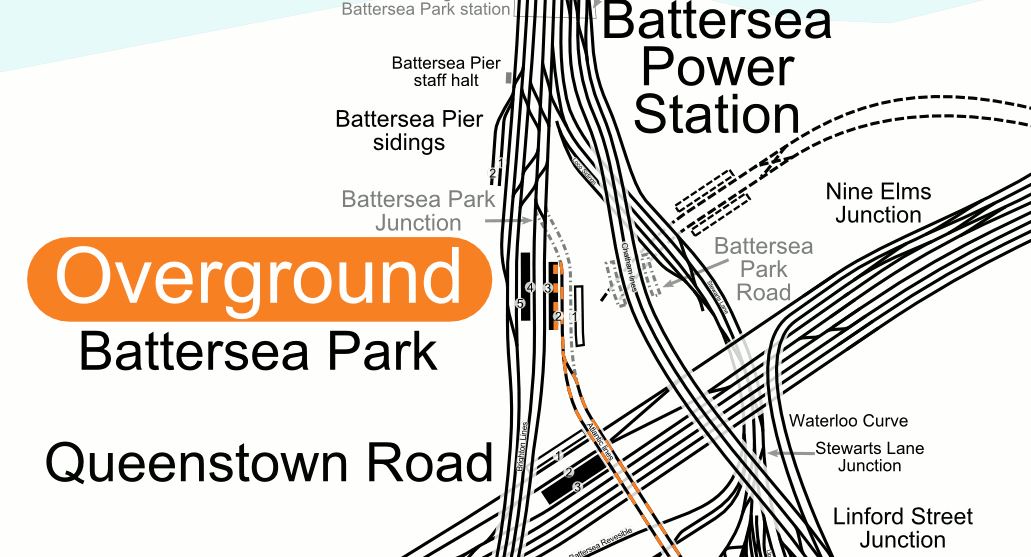
Note.
- The single track going in to Platform 2.
- Platform 1 at Battersea Park station is disused.
- The close proximity of the station to the new Battersea Power Station station, that opens in a few years.
These are some selected pictures of Battersea Park station.
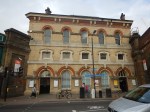
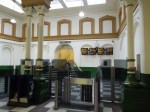
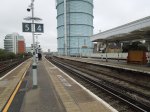
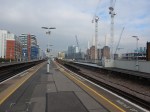
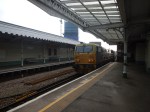
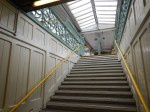
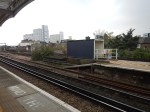
I think it is true to say, that it is a Victorian station, that wasn’t designed for the modern age.
- The station is Grade II Listed.
- The booking hall is a tidy Victorian example.
- There is a lot of excellent Victorian detailing.
- Platform 2 and 3 is wide with sensible stairs.
- Platform 2 is a well laid out terminal platform.
- Platform 4 and 5 is narrow with terrible stairs.
- Plstforms 3 and 4 seem to be long enough for ten-car trains.
It could be turned into what Roy Brooks would have called something better than a ruin. For those of you born since 1960, check the link to a memory of one of the world’s late great honest estate agents.
I’m sure Londoners used to buy the Sunday Times, just to read his adverts.
I can remember my late wife sitting on the sofa, laughing loudly, as she read aloud an advert about a flat, that wouldn’t suit an owner with a cat,.
Battersea Park station and a two tph service from Dalston Junction across South London have a lot going for them.
- I’m sure a budding Lord Foster or Zaha Hadid could come up with a scheme to fix the platform access and make the station passenger friendly and their name.
- The station is a short walk from Battersea Power Station station and must open up routes across London.
- Battersea Park station could easily handle two tph on a single platform.
- In A New Station For Battersea, I talked about a proposal to create a station at Battersea that linked the new tube station to the Southeastern lines into Victoria.
- In Four Trains Per Hour Between Dalston Junction And Battersea Park Stations, I write about how on the 6th November 2017, because of a track fault, London Overground ran a four tph shuttle between the two terminals.
Will all of this be tied together?
Train Requirements On The East London Line
Doing a quick calculation, I think that each of the four branches need the following number of trains for four tph.
- Dalston Junction to Clapham Junction – 8 trains
- Highbury and Islington to Crystal Palace- 8 trains
- Dalston Junction to New Cross – 2 trains
- Highbury and Islington to West Croydon – 8 trains
Which gives a total requirement of 26 trains.
Up the frequency to six tph on each branch or one train every 2½ minutes, which would be 24 tph through the Thames Tunnel and you get the following.
- Dalston Junction to Clapham Junction – 12 trains
- Highbury and Islington to Crystal Palace- 12 trains
- Dalston Junction to New Cross – 3 trains
- Highbury and Islington to West Croydon – 12 trains
Which gives a total requirement of 39 trains.
If you just have an increase to six tph on just the Clapham Junction and Crystal Palace routes as London Overground are proposing for 2020, you get the following.
- Dalston Junction to Clapham Junction – 12 trains
- Highbury and Islington to Crystal Palace- 12 trains
- Dalston Junction to New Cross – 2 trains
- Highbury and Islington to West Croydon – 8 trains
Which gives a total requirement of 34 trains, providing a service of one train every 3 minutes, which would be 20 tph through the Thames Tunnel.
This is eight more trains than at the present time.
It’s all rather impressive for the Thames Tunnel, which was built between 1825 and 1843, by the Brunels.
The Ultimate Capacity Of The East London Line
If we look perhaps ten years into the future, the following will have happened.
- Signalling will have improved.
- Crossrail will be running more than 24 tph through Whitechapel.
- Automatic Train Operation (ATO) will be driving the trains, with the driver keeping a vigilant watch, just as happens on the Victoria Line now!
- Passenger information and management will have improved and passengers will be able to handle the increased frequency of trains easily.
So if Dear Old Vicky can manage thirty-six tph in a 1960’s tunnel, will the East London Line be able to manage the same frequency in an 1840’s tunnel?
The Brunels would have made sure it happened and if it is needed, so will their engineering successors!
Let’s cut it back a bit and aim for 32 tph through the Thames Tunnel, as that was the sort of target engineers were looking at, for the Victoria Line in the 2000s, when the East London Line was being proposed.
How many trains will be needed to run the eight tph on the four routes, that would comprise thirty-two tph through the Thames Tunnel?
- Dalston Junction to Clapham Junction – 16 trains
- Highbury and Islington to Crystal Palace- 16 trains
- Dalston Junction to New Cross – 4 trains
- Highbury and Islington to West Croydon – 16 trains
Which gives a total requirement of 52 trains.
The London Overground has fifty-seven Class 378 trains. I can’t believe that the original fleet was sized on eight tph in operation through the tunnel and a few as hot spares and in maintenance!
But surely eight tph is impossible, as turning the trains at the terminal platforms would be too much!
Think again!
- The Victoria Line at Brixton and Walthamstow Central stations handles 36 tph using two platforms or 18 tph per platform.
- The Northern Line is targeting 36 tph on both lines, when it has been split into two.
With ATO, I’m sure each terminal platform can handle more than eight tph.
More Trains On The East London Line
According to the LR article, the planned new services on the East London Line will require another eight trains. This fits with my calculation.
- These trains have to be Class 378 trains, due to evacuation issues in the Thames Tunnel.
- These trains have to be able to work on lines with third-rail electrification.
London Overground has ordered six five-car Class 710 trains and they will be run on the North London Line and West London Line, where they will displace some five-car Class 378 trains for running on the East London Line.
Some five-car Class 378 trains on the Watford DC Line will also be replaced by four-car Class 710 trains.
So it would look like the East London Line will get some of the eight Class 378 trains that it needs.
Improvements To The North London Line/West London Line
The LR article says this.
London Overground have a long-held desire to increase the frequency on the WLL from 4tph to 6tph. They also aspire to another 2tph (at least) from Clapham Junction continuing to Stratford, to further increase the frequency on the North London Line (NLL). This would enable 10tph on eastern end of the North London line. This is due to be implemented with with main order of the new Class 710 stock.
The article also suspects that London Overground want to run the following services.
- 6 tph – Stratford to Richmond
- 6 tph – Stratford to Clapham Junction
This would deliver a twelve tph service between Stratford and Willesden Junction.
Living about halfway between those two stations, I’m not complaining.
But the article concludes, that London Overground’s objective can’t be achieved until some freight is moved to the Gospel Oak to Barking Line after the electrification of that line is completed.
As I said earlier, the pair of lines will get six extra five-car Class 710 trains and displace some Class 378 trains to the East London Line.
So will London Overground stick with a mixed fleet on these lines? Or will they perhaps run one class on each route?
I have no idea, but there are quite a few Class 378 trains, that could be displaced by new Class 710 trains to allow the East London Line frequency to be increased.
The Watford DC Line
Currently the Watford DC Line has a three tph service and I suspect that this needs six five-car Class 378 trains to run it.
The LR article says that London Overground want to run four tph on this line and I calculate this will need eight four-car Class 710 trains.
The new trains will probably be a few minutes faster and they will offer an hourly capacity increase of six percent.
But they will release six five-car Class 378 trains to strengthen services on the North, East and West London Lines.
Step-Free Access
Step-free access from platform to train is not good on the Watford DC Line.
You step up into a Class 378 train and step down into a Bakerloo Line 1972 Stock train.
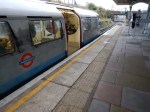
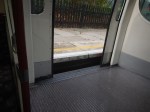
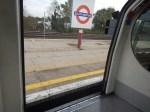
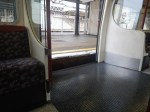
These pictures show the problem with the Class 1972 trains. When I got off one of these trains at Willesden today it was a jump.
It is some of the worst step-free access on the Underground.
On my short trip on the Bakerloo Line today, I deliberately sat in the last carriage. On most stations the the last carriage was aligned with the end of the platform, which leads me to the conclusion, that most stations are about as long as the trains, which are over 110 metres long.
Can a step-free platform be designed, that will work with the following trains?
- The current Class 378 trains
- The future Class 710 trains
- The current Underground 1972 Stock.
- Any future deep-level Underground trains
The latter could make design more difficult, if the train is built for Unattended Train Operation (UTO) and if platform edge doors are needed at all stations with UTO.
The only solution I can think of, is one that is used in Karlsruhe in Germany and is now being used at Rotherham Central station to accommodate main line trains and Class 399 tram-trains.
The platform is long enough to have two sections, with different platform heights.
- A high section is used with the main line trains.
- A low section is used with the Underground trains.
- Platform edge doors could be fitted to the low section.
- A gentle slope would connect the two sections.
- Entry to the combined platform could be near where the two sections join.
Also, consider the following.
- Given that the length of a Class 710 train is around 80 metres and that of a 1972 stock is in excess of 110 metres, it will be a long platform.
- Selective door opening will be installed on all trains.
- I do wonder, if the new trains for the Watford DC Line are only four cars to ease the problem of step-free access. The reduced length could knock twenty metres off every platform.
- Could we even see the new Underground trains built to a shorter length?
I’m sure that a workable platform design is possible.
The Bakerloo Line And The Watford DC Line
The Bakerloo Line is being extended to the South, but nothing has been said about how it will be changed in the North.
Possibilities for Northern terminals for the line could include.
- Queen’s Park
- Stonebridge Park
- Harrow and Wealdstone
- Watford Junction
It’s also complicated because the depot is at Stonebridge Patk.
I wouldn’t rule out extending the of the Bakerloo Line to Watford Junction, as is talked about in Wikipedia under Re-extension to Watford Junction.
What would be the consequences, if the following were to be done?
- An extended Bakerloo Line has an increased frequency of at least twenty tph between Watford Junction and Lewisham.
- The new trains for the Bakerloo Line are faster.
- The new Bakerloo Line trains had a capacity increase from the current 700, so they carried about the same as the five-car Class 378 trains.
The increased frequency of Bakerloo Line service, would probably result in London Overground’s Euston to Watford service to be discontinued.
The benefits would be as follows.
- Stations from Queen’s Park to Watford Junction would get a more frequent service, of possibly a train every three minutes.
- The problems of step-free access and platform-edge doors would be solved, as all trains would be on the Bakerloo Line.
- London Overground would not need any platforms at Euston, which could help in the rebuilding of Euston for HS2.
It would also mean that London Underground got another high-frequency Underground Line without any junctions, that could be run very efficiently.
But it would mean Kilburn High Road and South Hampstead stations would lose their connection to Euston.
A Willesden Junction To Stratford Via Kilburn High Road, South Hampstead and Primrose Hill Service
Reopening Primrose Hill station has been mooted in the past. This is said in the Wikipedia entry for the station.
It has been proposed to re-open Primrose Hill station by bringing the short stretch of line between South Hampstead and Camden Road stations back into the regular passenger service by incorporating it into the London Overground network.
A reopened Primrose Hill station, would only be a short walk to Chalk Farm station.
At Willesden junction station, there is even a convenient South-facing bay platform, that is numbered 2 and could handle four tph.
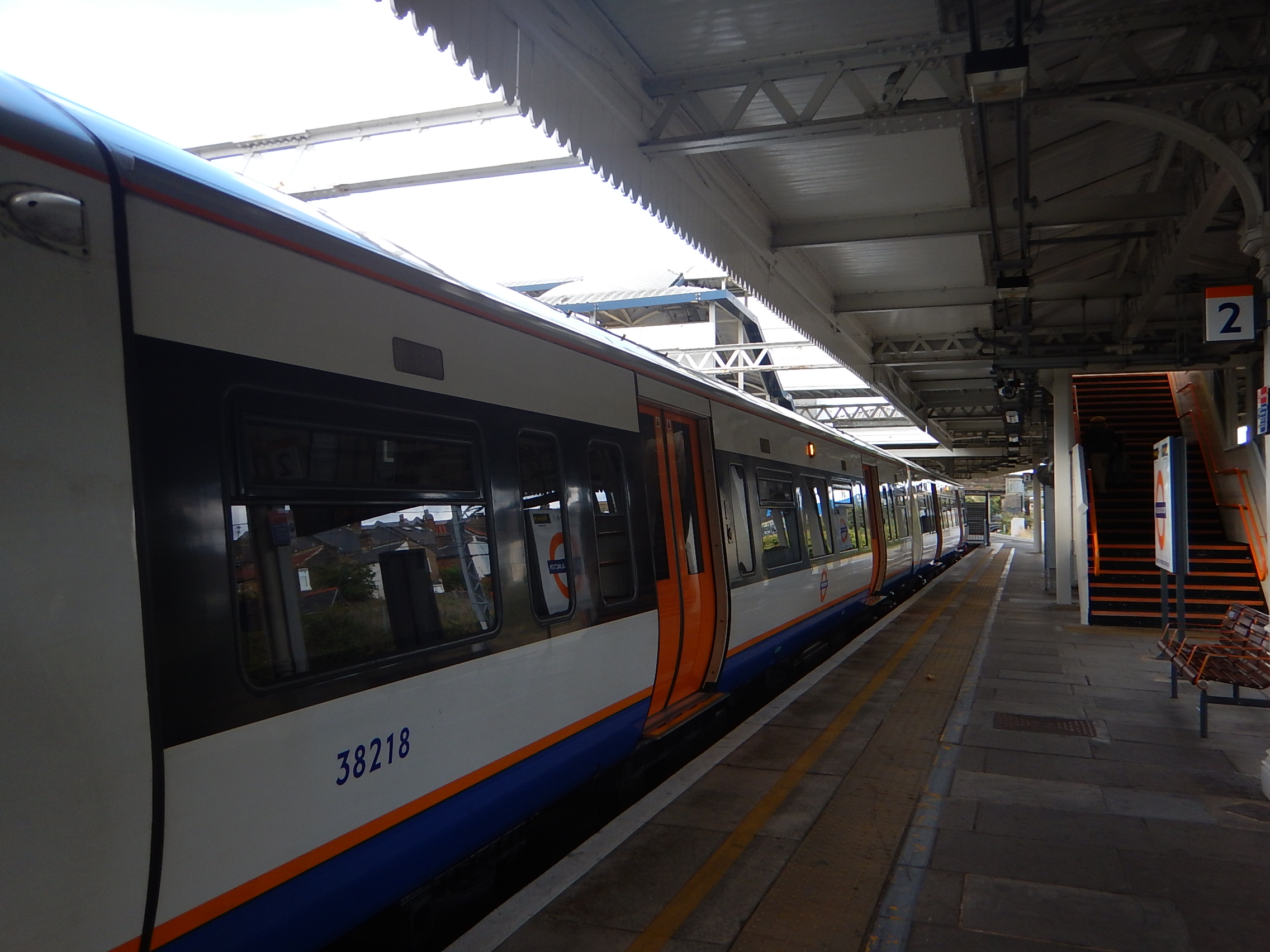
The picture shows a Class 378 train in Platform 2 at Willesden Junction station, was taken on Sunday, the 2nd of October 2016, during engineering works, when a Rail Replacement Train was run between Willesden Junction and Stratford stations.
But there are problems.
- Where would you terminate the service at its Eastern end? Highbury and Islington, Stratford or somewhere else, like perhaps a reopened Maiden Lane station?
- Kilburn High Road and South Hampstead stations sill lose their srtvoce to Euston and they would have to change at Highbury and Islington.
- Organising the time-table might be difficult.
- I also think, it would mean that Kensal Green station would be very difficult to make step-free, if it had to be served by both Overground and Bakerloo Line trains.
On the other hand, Queen’s Park station is an excellent example of a step-free cross-platform interchange between the two types of trains and Willesden Junction station could be equally good.
Crossrail, The Bakerloo Line And The Watford DC Line
All these three lines either serve Watford Junction or it has been suggested that they do.
- Plans to extend Crossrail up the West Coast Main Line would probably include a stop at Watford Junction, if they materialise.
- Extending the Bakerloo to Watford Junction is suggested from time-to-time.
- The Watford DC Line already serves Watford Junction station.
Given that a high-frequency efficient extended Bakerloo Line running between Watford Junction and Lewisham would serve the smaller stations on the way to Watford very capably, I suspect that whatever happens to Crossrail and the Watford DC services, the Bakerloo Line will be extended to Watford Junction.
The extended Bakerloo Line would have the following characteristics.
- Probably all trains running between Watford Junction and Lewisham.
- A frequency of upwards of 20 tph
- No junctions and end-to-end running like the Victoria and Jubilee Lines.
- Full step-free access at all stations.
- New faster, walk-through trains with wi-fi and 4G.
- An efficient connection to Crossrail at Paddington will be opened in December 2018.
- National Rail connections at Charing Cross, Elephant and Castle, Lreisham, Marylebone, Paddington, Waterloo and Watford Junction
It may be London’s forgotten line, but once extended, it could be a new star. Especially, if it gets to be linked directly into Old Oak Common station for all the services including HS2, that will be available there.
The Watford DC Line doesn’t connect to Crossrail, which makes me feel, that when everything gets decided about the extended Bakerloo Line and the new station at Old Oak Common, then the Watford DC Line could miss out.
Through Running Between North And East London Lines
I seem to remember reading in Modern Railways about ten years ago, that there was an ambition in TfL to extend some East London Line trains to Willesden Junction.
Look at this map from carto.metro.free.fr, which shows the lines at Highbury and Islington station.
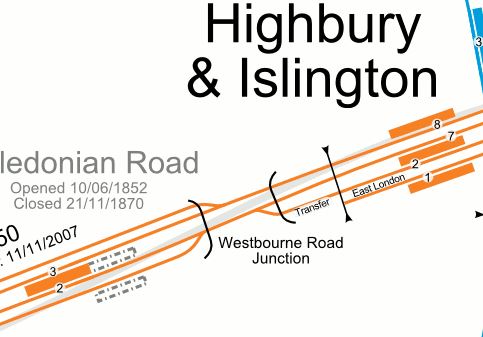
Note the single line labelled Transfer, that connects Platform 2 at Highbury and Islington station to the Westbound North London Line, that runs through Platform 7.
I think it would be possible to make Platform 2 into a bi-directional through platform.
- All Westbound trains on the Westbound North London Line would leave from the island platform between platforms 2 and 7.
- Voltage changeover between 750 VDC and 25 KVAC would take place in Platform 2.
- A four tph service in both directions would mean a train every 7-8 minutes.
- The four-track section of the North London Line between Highbury and Islington and Camden Road stations, includes two reversible lines.
Was this all future-proofing to allow services to run between the North London and East London Lines?
It is interesting to note, that Platform 2 is used for services to and from West Croydon station.
These services take around 51-55 minutes and currently need eight trains for a four tph service.
This screen capture shows the train timetable, when I rode between Highbury and Islington and Willesden Junction stations.
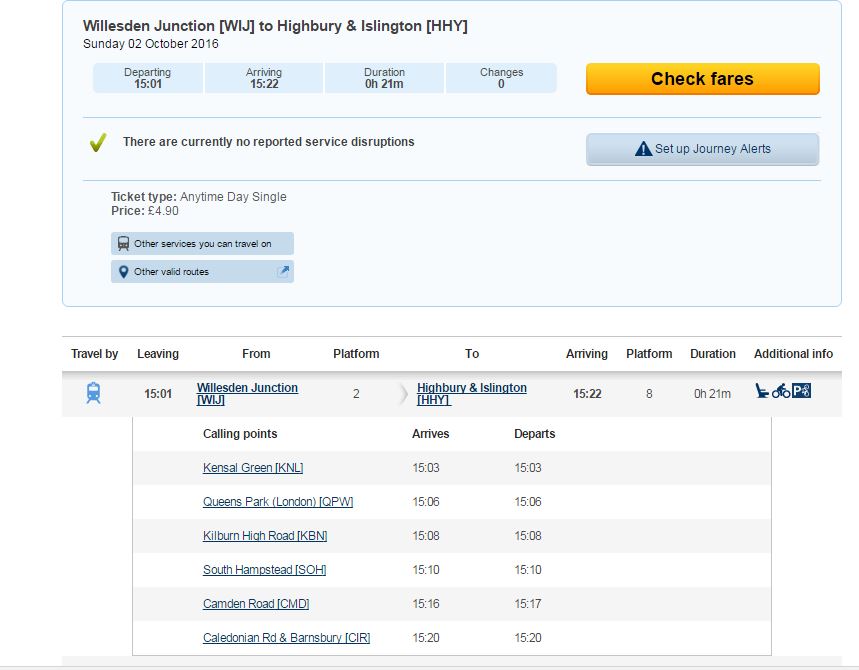
Note that the journey takes 22 minutes.
I am led to the conclusion, that it would be possible to run a service between West Croydon and Willesden Junction stations.
The service would run via Kilburn High Road, South Hampstead and and a reopened Primrose Hill stations.
It would have a frequency of four tph.
Trains would change voltage at Highbury and Islington station.
I would certainly like the service for these reasons.
- I regularly travel along the North London Line from the West to Dalston Junction station. The change between the North and East London Lines at Highbury and Islington can be very busy.
- Going West along the North London Line from Dalston Junction can involve a lot of walking up and down at Highbury and Islington station.
- Using Dalston Kingsland station to go East can be difficult, as there are masses of passengers changing between rge two Dalston stations.
- I like to go to Primrose Hill and London Zoo.
- Could the service also ease the pressure on Camden Town station, until the upgrade is complete?
I have no idea if London Overground would do this, but if there was a vote, I’d say yes!
The Gospel Oak To Barking Line
I have never seen a detailed analysis of running trains on the Gospel Oak to Barking Line (GOBLin).
Currently, eight Class 172 trains provide the four tph service. Consider this round trip.
- Leave Gospel Oak station at 09:05
- Arrive Barking station at 09:42
- Leave Barking station at 10.03
- Arrive Gospel Oak station at 10.45
Note.
- It is a very generous timetable.
- There is a twenty minute turn-round time at both ends of the route, which is good for recovering the timetable after a delay.
- The Class 710 trains could save time at every one of the ten stops, as they accelerate faster, have smooth regenerative braking and should have a better platform-train interface.
This leads me to the conclusion, that the Class 710 trains could run a faster service on the line.
Extending Services To Barking Riverside
Barking Riverside station will only be a short distance from Barking station and I suspect, it would only add ten minutes at most to the end-to-end journey time.
As there is a twenty minute turn-round time, I suspect that a train will be able to go from Gospel Oak to Barking Riverside and back again in under two hours.
This would mean that the current service of four tph could be possible on the extended route, with the same fleet of eight trains.
This is said in the MR article about the Class 710 trains.
The remaining two additional four-car units would support the extension of Gospel Oak to Barking services to Barking Riverside.
This leads me to one of these conclusions.
- The service is going to be extended somewhere else.
- The frequency on the route is going to be increased to five tph.
The next few sections deal with the various options.
Extending To The West Along The North London Line From Gospel Oak
I sometimes change between the GOBLin and the North London Line, as I can get a convenient bus from my house to Harringay Green Lanes station.
Allowing GOBLin services to continue along the North London Line would need extensive and expensive remodelling of Gospel Oak station to create an Eastbound plstform for the GOBLin.
The tracks to the West of the station, would probably need to remodelled to allow efficient operation.
The GOBLin trains would also be four-car trains, as opposed to the five-car trains on the North London Line.
Extending To The North Along The Midland Main Line
By using the Carlton Road Junction after Upper Holloway station, GOBLin trains could access the Thameslink tracks and go North to a convenient station.
Unfortunately, the track layout is such, that crossing to the Dudding Hill Line is difficult.
But continuing to the proposed Brent Cross Thameslink station is surely a possibility.
Although, I can’t see anything happening until plans for the West London Orbital Railway are agreed and Brent Cross Thameslink station is opened.
So it can probably be discounted for a few years yet!
Extending Across The Thames From Barking Riverside
Barking Riverside station is being built so that an extension under the Thames is possible.
But as a tunnel would be involved, I can’t see this extension being started or even planned fully for several years.
Five tph On The GOBLin
If two extra trains are added to the GOBLin fleet, this would mean that there are ten trains, which would be enough to run a five tph service between Gospel Oak and Barking Riverside stations.
I think this will be the most likely use of the two extra trains on the GOBlin.
Romford To Upminster
The Romford To Upminster Line is slated to get a brand-new Class 710 train to work the two tph shuttle.
The DR article says that it is possible that this line could be served by a Class 315 train, held back from the scrapyard.
This would mean a new Class 710 train could be deployed elsewhere, where its performance and comfort levels would be more needed.
Surely, this would be enough capacity for the line and a lot cheaper than a new Class 710 train! Provided of course, that it was reliable, comfortable and could maintain the current two tph service.
I discuss this in detail in A Heritage Class 315 Train For The Romford-Upminster Line.
Conclusion
It looks like Transport for London are planning for a large increase in services on the East London Line.
Transport for London Warns Crossrail 2 Could Be Delayed By Decade
The title of this post is the same as that of an article in the Financial Times.
It’s all about funding and probably the Government not wanting to finance all of the large rail projects.
- HS2
- Crossrail 2
- Northern Powerhouse Rail
- East West Rail
HS2 is funded and underway and the last two projects are being sorted, but the cost of Crossrail 2 is too much to digest.
I have believed for some time, that Crossrail 2 is a number of separate projects.
- Increasing capacity on the Waterloo suburban lines
- Increasing capacity on the Lea Valley Lines
- Creation of the mega-station at Euston-St. Pancras
- New trains
- The high capacity central tunnel
I will now look at each in detail.
Increasing Capacity On The Waterloo Suburban Lines
In An Analysis Of Waterloo Suburban Services Proposed To Move To Crossrail 2, I showed that it would be possible to run a service with Crossrail 2’s characteristics terminating in Waterloo.
I said the following were needed.
- More platform capacity in Waterloo.
- Modern high-performance 100 mph trains like Class 707 trains or Aventras.
- Some improvements to track and signals between Waterloo and Wimbledon stations.
- Wimbledon station would only need minor modifications.
- A measure of ATO between Waterloo and Wimbledon stations.
Much of the infrastructure works have been completed as I reported in It’s All Over Now, Waterloo!.
All it needs is Bombardier to build the new Class 701 trains for South Western Railway.
Increasing Capacity On The Lea Valley Lines
In Could A Lea Valley Metro Be Created?, I looked at the possibility of creating a Lea Valley Metro with the following characteristics.
- Four-tracks between Tottenham Hale and Broxbourne stations.
- Step-free stations.
- Termination in the unused loop at Stratford.
- 10-15 trains per hour.
- Links to Crossrail, the Underground and Southeastern Highspeed services at Stratford.
I came to the conclusion it was very much possible.
Creation Of The Mega-Station At Euston-St. Pancras
In Should A Mega-Station Be Created At Kings Cross-St. Pancras-Euston?, I looked at this mega station project for Crossrail 2.
I came to these conclusions.
- If Crossrail 2 is built, there will obviously be a mega station at Euston St. Pancras.
- But I believe that all the other improvements that will happen before HS2 opens may well be enough to cope with the extra capacity needed.
- Obviously though, any improvements must not compromise the building of Crossrail’s mega-station.
In Should A Mega-Station Be Created At Kings Cross-St. Pancras-Euston?, I proposed a four-level mega-station.
- Surface level – National Rail and HS2
- Sub-surface level – Circle, Hammersmith and City and Metropolitan Lines
- Deep level – Northern, Piccadilly and Victoria Lines.
- Very deep level – Crossrail 2
Lines would be connected by escalators, travelators and lifts going all over the place.
It would not be that different to the double-ended Crossrail station at Moorgate-Liverpool Street station, which I described in London’s First Underground Roller Coaster, except that it connects three stations instead of two.
This would enable Crossrail 2 to be bored through at a deeper level after Euston station had been rebuilt for HS2.
In terms of Crossrail 2, the creation of the mega station at Euston St. Pancras could be the last project to be completed.
New Trains
This should be the easy bit, as surely using the same Class 345 trains on Crossrail and Crossrail 2, would be an objective, if it were possible.
The High Capacity Central Tunnel
I’ve never built a tunnel, although my software; Artemis helped to build the Channel Tunnel, but I would suspect that building the central tunnel for Crossrail 2 will be easier than building that for Crossrail.
So many things like riding a bike or sex are a lot easier the second time.
There must be so many lessons from Crossrail that can be applied to Crossrail 2.
If all of the central stations on the tunnel, from Dalston to Wimbledon, where there is interchange with Crossrail 2 can be made tunnel-ready, then I don’t see why boring the central tunnel can’t be one of the last jobs to be started.
The tunnel boring machines would then just pass through the stations to link them all together.
It’s probably not as simple as that, but it is going to be a lot easier job than Crossrail.
The Importance Of The Victoria Line
I’ve never seen this said before, but one of the keys to building Crossrail 2 is the Victoria Line or Dear Old Vicky.
I believe the Victoria Line should be updated as follows to be as near the standard of Crossrail as possible, by using the existing trains, track and signalling and by updating the stations.
- Addition of the missing escalators and other features left out to save money in the 1960s..
- Full step-free access at all stations.
- Addition of new entrances at Oxford Circus, Highbury and Islington and Walthamstow Central.
- Better interchange with the Overground at Blackhorse Road and Walthamstow Central.
- Better interchange with National Rail at Brixton, Vauxhall, Finsbury Park, Seven Sisters and Tottengham Hale.
- Forty tph between Brixton and Walthamstow Central.
Forty tph may need a reversing loop at Brixton and an extra one-platform station at Herne Hill.
I believe that an update of this type and scale could be applied to the Victoria Line without causing too much grief for passengers. The work on the stations is necessary to cope with the current and increased passenger numbers and could be carried out in much the same way as the upgrade at Victoria station has been done in the last few years.
The Victoria Line would then offer a high capacity link between Tottenham Hale and Vauxhall prior to the building of Crossrail 2’s central tunnel.
Passengers from say Broxbourne to Hampton Court would take the following route.
- Lea Valley Line from Broxbourne to Tottenham Hale – (10 tph)
- Victoria Line from Tottenham Hale to Vauxhall – (>30 tph)
- South Western Railway from Vauxhall to Hampton Court – (4 tph)
Two changes (both hopefully step-free) would be needed, but with improvement to the National Rail routes at both ends, it would be faster than now.
The Importance Of The Bakerloo Line
Ask TfL’s Journey Planner, which is the quickest way from Tottenham Hale to Waterloo and it gives the following route.
- Victoria Line from Tottenham Hale to Oxford Circus
- Bakerloo Line from Oxford Circus to Waterloo
There is a simple cross-platform interchange at Oxford Circus, with the two legs taking 16 and 8 minutes respectively.
Currently, the Bakerloo Line has a frequency of twenty-two tph and plans have been mooted, that will see this going to twenty-seven tph by 2033.
It looks like when combining an updated Victoria Line with the current Bakerloo Line, you get a excellent connection that can stand-in for the Crossrail 2 central tunnel between Tottenham Hale and Waterloo.
But the Bakerloo Line might be extended to Lewisham, so will this extension make the combined Victoria/Bakerloo route more important.
The extended Bakerloo Line is not planned to have a connection with Crossrail 2, so using the Victoria Line across Central London will probably be the fastest way from say Lewisham to Enfield Lock.
It looks to me, that the cross-platform interchange at Oxford Circus between the Bakerloo and Victoria Lines is more important than anybody thinks and will continue to be so.
The Splitting Of The Northern Line
TfL would like to split the Northern Line into two branches, but this can’t be done until Camden Town station is rebuilt around 2024.
The only effect this split will have on Crossrail 2, is it will give extra routes to Euston station, which may probably make it less important that Crossrail 2 is completed before HS2.
A Possible Timetable
This is very much speculation on my part.
- 2020 – Improved Overground services to Cheshunt, Chingford and Enfield Town using new Class 710 trains.
- 2021 – Increased Greater Anglia services on the Lea Valley Lines using new Class 720 trains.
- 2021 – Waterloo suburban branches running at four tph using new Class 701 trains.
- 2024 – Extended Camden Town station opens.
- 2024 – Splitting of the Northern Line
- 2024 – More capacity on the Victoria Line
- 2025 – Increased services on the Lea Valley Line after four-tracking.
- 2025 – Upgraded Euston station opens with better connection to the Underground.
- 2026 – Old Oak Common statio opens
- 2026 – HS2 opens to Birmingham
The Crossrail 2 central tunnel could be built, when traffic levels are predicted to be too much for the Victoria Line.
Conclusion
This analysis says to me that Crossrail 2 could be planned as a series of much smaller projects, that would give passengers benefits from the early-2020s and also ease the funding problems for the line.
But the analysis also says that if the central tunnel is not built before the 2040s, then the Victoria Line must be upgraded to create a high capacity link between Tottenham Hale and Vauxhall or Waterloo using the Bakerloo Line.
Could A Lea Valley Metro Be Created?
Crossrail 2 envisages these developments and level of service North along the Lea Valley.
- A four-track West Anglia Main Line between Tottenham Hale and Broxbourne stations.
- Step-free stations
- A service running between Tottenham Hale and Broxbourne stations.
- 10-15 trains per hour (tph)
Crossrail 2 also envisages that at Tottenham Hale station, the line will enter a tunnel for Central and South West London.
But there is an unused alternative terminal, that could handle perhaps 16 tph with modern signalling.
Look at this map from carto.metro.free.fr of the lines at Stratford.
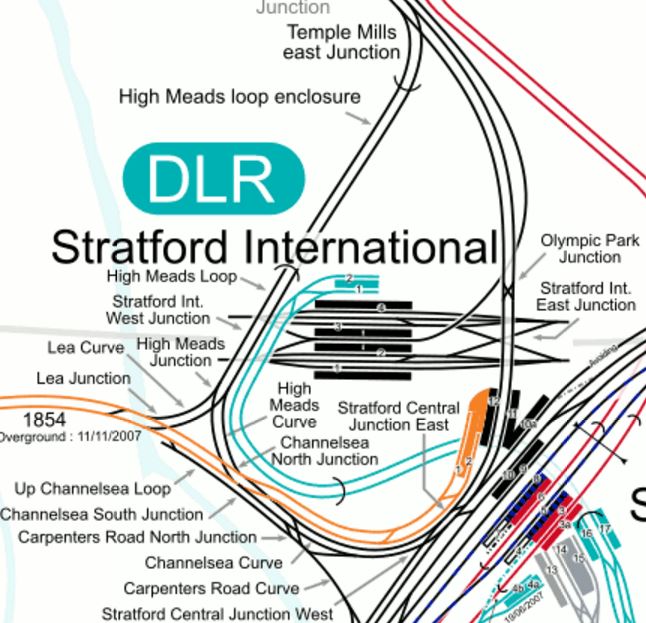
Note the double-track loop that encircles Stratford International station and goes through Platforms 11 and 12 at Stratford station.
Consider.
- Loops like this can easily handle 12 tph, as they do in Liverpool with the Wirral Line.
- Stratford is well-connected to the Central, Great Eastern Main, Jubilee and North London Lines, Crossrail and the Docklands Light Railway.
- The Loop could be connected to Stratford International station for Southeastern Highspeed services.
- There’s probably enough capacity to allow a couple of Stansted services to terminate in the loop.
- There is a massive development going on at Meridian Water, where a new station is being built.
- Liverpool Street station lacks capacity.
I can’t believe that a viable 12 tph service is not possible.
The major works would be as follows.
- Four-tracking the West Anglia Main Line into two fast and two slow lines.
- Making all stations step-free.
- Removing the level crossings.
- Creating a flyover at Coppermill Junction to connect the fast lines to Liverpool Street and prepare for Crossrail 2.
If Crossrail 2 is built in the future, the Metro service would be diverted into the central tunnel at Tottenham Hale station.
Integration With The London Overground
The Chingford, Cheshunt and Enfield Town services of the London Overground will not only offer alternative routes during the four-tracking of the West Anglia Main Line, but they could be better connected to a Lea Valley Metro.
- Tne Class 710 trains could enable four tph on each branch.
- The Class 710 trains will enable faster services on each branch.
- A reinstated Hall Farm Curve would connect Chingford and Walthamstow to Stratford.
- Creation of a step-free Cheshunt station would ease transfer between the London Overground and the Lea Valley Metro.
The new trains will be key and may open up more possibilities.
Note too, that moving services to Stratford from Liverpool Street will release capacity at Liverpool Street, that will be well-used by Greater Anglia and London Overground.
Dear Old Vicky
She’s always there when you need her and engineers keep coming up with ways to keep the Victoria Line giving more.
Currently, the frequency of trains between Walthamstow Central and Brixton is 36 tph.
I can’t believe that the engineers working on the line, don’t want to squeeze another four tph out of her, to achieve the fabulous forty.
This might be possible with the trains, tracks and signalling, but the problem is the capacity of some of the 1960s-built stations.
- Many stations have an empty space, where a third escalator could be.
- Lifts are few and far between.
- Some stations don’t have ceilings in the platform tunnels.
These stations could be improved.
Walthamstow Central Station
Walthamstow Central station gets desperate in the Peak, but it could be given a third escalator, a second entrance at the other end of the platforms and a much better step-free connection to the Chingford Branch of the Overground.
Blackhorse Road Station
Blackhorse Road station could be finished and given a third escalator to cope with the extra passengers that will transfer to and from an electrified Gospel Oak to Barking Line.
Tottenham Hale Station
Tottenham Hale station is being rebuilt to increase capacity. Will it get the missing third escalator and ceilings?
Seven Sisters Station
Seven Sisters station will be a Crossrail 2 station and will need updating to cope with an expected eight tph on the Overground. Expect a major project here.
Finsbury Park Station
Finsbury Park station is one of London’s stations designed by Topsy. Improvements are underway to cope with the extra passengers from Thameslink and an upgraded Northern City Line.
Highbury and Islington Station
Highbury and Islington station suffered worst at the hands of the Nazis and 1960s cost cutting, when the Victoria Line was built. This made it one of London’s worst stations.
However help is at hand.
- Plans are being prepared for a second entrance to the station on the other side of the Holloway Road.
- The frequency on the Northern City Line is being upgraded to twelve tph with new larger capacity Class 717 trains.
- There is space for a third escalator to be added to connect the Overgriound with the deep-level Victoria and Northern City Lines.
It should be born in mind, that Highbury and Islington station is busier than either Manchester Piccadilly or Edinburgh Waverley stations.
But with an upgrade, because it has cross-platform interchange between the Victoria and Northern City Lines, it could be an upgrade that increases the passenger capacity of the Victoria Line.
Euston Station
Euston station will be upgrqaded for HS2.
Oxford Circus Station
Oxford Circus station is desperately in need of more capacity, especially as there will be an upgrade to the Bakerloo Line in the future.
The opportunity at Oxford Circus is that some of the buildings around the junction are tired and some probably need to be replaced.
So will we see a development like Bloomberg Place, that will create a new entrance to Bank station, at Oxford Circus?
Could it also have an subterranean connection to Crossrail’s Hanover Square entrance for Bond Street station?
Victoria Station
Victoria station is in the process of being upgraded.
It certainly appears to be a case of so far so good!
South Of The River
Vauxhall and Brixton stations have rather undeveloped interchanges with the National Rail lines and these could surely be improved.
Under Possible Future Projects in the Wikipedia entry for the Victoria Line, this is said.
For many years there have been proposals to extend the line one stop southwards from Brixton to Herne Hill. Herne Hill station would be on a large reversing loop with one platform. This would remove a critical capacity restriction by eliminating the need for trains to reverse at Brixton. The Mayor of London’s 2020 Vision, published in 2013, proposed extending the Victoria line “out beyond Brixton” by 2030.
This would surely be the last upgrade to squeeze even more out of Dear Old Vicky.
Conclusion
A Lea Valley Metro can be created and eventually, it can be the Northern leg of Crossrail 2, when and if that line is built.
Before Crossrail 2 is completed, it will have great help in the following ways.
- In North East London from the London Overground.
- Across London from the Victoria Line.
Don’t underestimate how Crossrail and an updated Northern City Line will also contribute.
Mathematics Of The Lea Valley Lines
The mixture of Class 315 and Class 317 trains on the Lea Valley Lines are being replaced by new Class 710 trains.
Train For Train Replacement
London Overground currently has the following fleet, which work the Lea Valley Lines.
- 17 x Class 315 trains – 75 mph
- 8 x Class 317/7 trains – 100 mph
- 6 x Class 317/8 trains – 100 mph
All these trains are being replaced by thirty-one Class 710 trains, which are 100 mph trains with a shorter dwell time at stations.
Time savings of over a minute, are claimed for each station stop, by other train manufacturers for their new generation of trains.
As one train is used on the Romford to Upminster Line, that leaves thirty trains to work from Liverpool Street to Cheshunt, Chingford and Enfield Town stations.
The Current Lea Valley Services
The current Lea Valley services can be considered to be two separate four trains per hour (tph) services to the following destinations.
- Chingford
- Edmonton Green with 2 tph extended to each of Cheshunt and Enfield Town.
Journey times are as follows from Liverpool Street.
- Cheshunt – 39 minutes
- Chingford – 27 minutes
- Ednonton Green – 31 minutes
- Enfield Town – 34 minutes
As an illustration of the slowness of some of these times, the fastest Cheshunt services take around twenty-five minutes, but they use the West Anglia Main Line, which has a higher speed limit.
Improving Journey Times
So how can journey times be improved?
The following factors will apply.
The Aventra Advantage
The Aventra and other modern trains will have the following advantages.
- 100 mph operating speed.
- Powerful acceleration and smooth regenerative braking.
- Driver assistance systems to optimise train speed.
- Level access from train to platform.
The last three factors will minimise the dwell time, when stopping at a station. Savings of up to three minutes have been claimed by some train manufacturers.
All Passenger Trains On The Routes Will Be Aventras
How much time this will save will probably be decided in practice.
Track, Station And Signalling Improvements
The operating speed of the routes is 40-75 mph , which could surely be improved.
Obvious problems include.
- Level crossings at Bush Hill Park, Highams Park and Theobalds Grove.
- Platform-train interface.
- Provision of Harrington Humps.
A detailed analysis will probably be done to iron out any small time delays in running the routes.
Rewrite The Timetables For Aventras
Currently, the timetables are written so that they can be reliably run by the 75 mph Class 315 trains and also to allow for their possible presence on the routes.
How Much Can Be Saved?
This is a bit like asking how long is a piece of string, but assuming savings of a minute a station gives the following times.
- Cheshunt – 24 minutes
- Chingford – 20 minutes
- Ednonton Green – 20 minutes
- Enfield Town – 21 minutes
I would not be surprised if substantial time savings could be saved,
Liverpool Street Station
The pair of four tph services will mean that there will be a train arriving in Liverpool Street station every seven and a half minutes.
This should be no problem on two platforms, especially as all trains will be identical and designed for a fast turn-round.
Will they arrive and depart from a pair of platforms at Liverpool Street stations, like 2/3 or 4/5, so that passengers would know that their Lea Valley Line train always left from the same gates at the station?
This would surely make it easier for the train presentation teams!
Hopefully, by analysing the turning of trains, minutes can be saved.
Each Route In Detail
I shall now look at each individual route.
Liverpool Street To Edmonton Green
North of Hackney Downs station, in the Off Peak, the only trains on the route will be the following services.
- Two tph between Liverpool Street and Cheshunt
- Two tph between Liverpool Street and Enfield Town
These will be augmented in the Peak by some Greater Anglia limited-stop services stopping at Edmonton Green, Seven Sisters and Hackney Downs stations.
Current timings on this route are.
- London Overground – 31 minutes with eleven stops using a 75 mph Class 315 train.
- Greater Anglia – 23 minutes with two stops using a 100 mph Class 317 train.
As the distance between Liverpool Street and Edmonton Green stations is 8.6 miles, these timings give speeds of 16.6 and 22.4 mph respectively.
The following will speed up services on this route.
- All trains on the route will be 100 mph Aventras.
- The performance of the Aventras
- Track, station and signalling improvements.
- Driver assistance systems.
I suspect that my initial crude estimate of twenty minutes between Liverpool Street and Edmonton Green will be high.
Cheshunt Services
North of Edmonton Green station, the only service on the route will be the two tph service between Liverpool Street and Cheshunt.
As the route between Edmonton Green and Cheshunt is only 5.5 miles long, with just three stops, I wonder if when combined with the time between Liverpool Street and Edmonton Green, that the round trip time could be reduced to under an hour, including the turn-round at both ends.
The current two tph service takes a few minutes over an hour-and-a half for a round trip from Liverpool Street, so three trains will be needed to run the service.
But if it could be done in an hour, then only two trains would be needed.
This level of speed improvement may seem ambitious, but the next generation of trains appear to be being built with it in mind.
Chingford Services
If the Chingford trains can do the trip reliably in twenty minutes, this would mean that a train could do a round trip from Liverpool Street to Chingford in under an hour, whereas now they take nearly an hour-and-a-half.
This means that four tph from Liverpool Street to Chingford needs either of the following trains.
- 4 x Class 710 trains
- 6 x Class 315/317 trains.
I doubt London Overground will park the spare trains in a siding.
It might even be possible to increase the frequency between Liverpool Street and Chingford. But this would probably need the removal of the level crossing at Highams Park station.
Enfield Town Services
North of Edmonton Green station, the only service on the route will be the two tph service between Liverpool Street and Enfield Town.
This is likely to be a route, where the return trip to Liverpool Street could be under an hour.
This means that two tph from Liverpool Street to Enfield Town needs the following trains.
- 2 x Class 710 trains
- 3 x Class 315/317 trains.
Conclusion
It does appear that on a rough look, the number of trains required to provide the current service will be less.
I think the three routes will need the following numbers of Class 710 trains to provide current services.
- Cheshunt – 2 trains
- Chingford – 4 trains
- Enfield – 2 trains
As each train is usually eight-cars, then sixteen trains could be a minimum number to provide the current service.
But to do this, trains on each route must be able to do an out-and-back trip within an hour.
I think this could be possible and the extra trains will obviously be used to provide extra services.
How Long Will It Take Bombardier To Fulfil Their Aventra Orders?
I was reading this article in The Guardian, which is entitled Full speed ahead for train builders as minister pulls plug on electrification, when I found this useful nugget of information, from the General Manager of Bombardier’s Derby plant.
Building trains in an “ergonomically correct” fashion, he says, means completing and testing the carriage’s constituent parts, then assembling them, rather than wiring them up afterwards – and also takes the risk away from a production line which boasts a rate of 25 carriages per week.
It sounds like Bombardier’s engineers have been drinking and swapping ideas, with Toyota’s production engineers a few miles down the road at Burnaston.
But even so 25 carriages a week is an impressive figure, as that is almost three Class 345 trains for Crossrail in a week.
Bombardier have not been producing at that rate until now, as if they had, there would be Aventras in sidings all over the place. In The Class 345 Trains Are More Numerous, I described how I saw four yesterday and Transport for London have said they will have they will have eleven in service by September.
But this is all consistent with not going into full production, until you are sure, that you’ve got everything right, as any prudent company would do!
The Trains On Order
Bombardier have the following orders for Aventras.
- Crossrail – Class 345 – 70 x nine-car – 630 cars – To be delivered in 2015-2018
- London Overground – Class 710 – 45 x four-car – 180 cars – To be delivered in 2017-2018
- Greater Anglia – Class 720 – 89 x five-car – 445 cars – To be delivered in 2018-2020
- Greater Anglia – Class 720 – 22 x ten-car – 220 cars – To be delivered in 2018-2020
- South Western Railways – Class xxx – 30 x five-car – 150 cars – To be delivered in 2019-2020
- South Western Railways – Class xxx – 60 x ten-car – 600 cars – – To be delivered in 2019-2020
- West Midlands Trains – Class xxx – 36 x three-car – 108 cars – To be delivered from 2020
- West Midlands Trains – Class xxx – 45 x five-car – 225 cars – To be delivered from 2021
- c2c – Class xxx – 10 x six-car – 60 cars – To be delivered from 2021
This gives a total of 2,618 cars to be built.
The Building Schedule
Orders 1 and 2 are both directly or indirectly for Transport for London, with Wikipedia stating that the Class 710 trains for the Lea Valley Lines are being stabled at Ilford TMD, where the current Class 345 trains are also stabled, whilst they are being tested between Liverpool Street and |Shenfield stations.
I suspect that this close relationship between the orders means that Bombardier and Transport for London have agreed a delivery schedule, that brings in trains as they are needed. There’s not much point in building Class 345 trains for Crossrail, when some won’t be needed until 2019, if there is a more urgent need for Class 710 trains for the Overground.
To improve matters for Bombardier, Orders 3 and 4 for Greater Anglia, will probably be stabled in part at Ilford TMD.
Bombardier have not only got four substantial initial orders, but because they can all be introduced into service from Ilford TMD, they must have a tremendous advantage in terms of testing, introduction into service, manpower and costs.
So it looks to me that the two London orders will be built first, followed by the Greater Anglia and then the South Western Railways.
The London orders total 810 cars, which would take 32 weeks using Bombardier’s figure of 25 cars per week in The Guardian.
But assuming they started full production on the 1st of August, that gives them seventy-two weeks until the end of 2018, which gives a equired production rate of under twelve cars a week.
Surely, given their past history of building around a couple of thousand Electrostar cars, that must be achievable. Especially, as the modular structure of the Aventra, which has been developed with suppliers, must make building quicker.
The Greater Anglia and South Western Railways orders, which total 1,415 cars, would need to be built in 2019-2020 or lets say a hundred weeks.
So the build rate would be 14 cars a week, which is well below Bombardier’s figure.
The Body Shells
It should also be stated that Bombardier make their body shells at Derby, whereas Hitachi make their’s in Japan and ship them to Newton Aycliffe. This must ease having a high production rate for Bombardier, as for this you must have timely and reliable deliveries.
The Class 345 and 710 trains seem to have different car lengths, so it would appear that their production of body shells is flexible.
Little can be discerned about the production process from the Internet, as articles like this one on Global Rail News, which is entitled Bombardier completes first Crossrail body shell, are short on production details.
If they have a capacity to produce twenty-five body shells a week, I don’t believe that this can be done without the use of sophisticated designs assisted by large amounts of automation, as used in most car and van body production.
I have found this picture of a number of Aventra car body sides on the Internet.
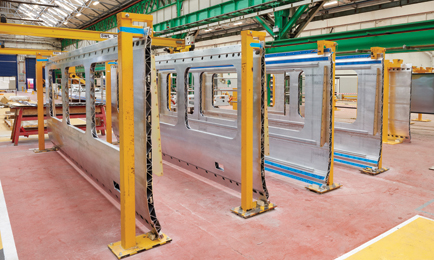
Note the double-skinned nature of the body sides, with reinforcing ribs inside, which must have great strength, light weight and a minimum number of components. I have read somewhere, that Bombardier are extruding aluminium for body components.
All of the holes could then be automatically cut by robots.
The joys of modern manufacturing!
Final Assembley
Modern manufacturing methods, as employed by car companies for years doesn’t mean you have to produce a sequence of identical vehicles on the line. Computer systems make sure all the components to build each car arrive at the right time.
A Class 345 train might have four or five different types of car, so similar methods would be used to speed production of the individual cars.
West Midlands Trains
Abellio, who own Greater Anglia, have decided they want to use Aventras on their new West Midlands Trains franchise.
According to Wikipedia, the new franchise is proposing to introduce the following trains
- 333 new Aventra carriages in three and five-car trains.
- 80 new CAF Civity carriages in two and four-car trains.
Some of the trains are direct replacements for other trains.
- The 36 x three-car Aventras will replace the 26 x three-car Class 323 trains.
- The CAF Civity trains will replace various diesel multiple units around Birmingham.
In some ways the puzzle is that there are 29 x five-car Aventras on order for electrified suburban lines.
Adding up the current and future number of electrified carriages on Birmingham suburban routes, shows that the number of carriages to be used will increase by three times.
New electrification is on the way.
- Chase Line to Rugeley Trent Valley.
- Cross-City Line to Bromsgrove.
But these short schemes won’t need all those trains, unless West Midlands Trains are going to run ten-car trains across Birmingham.
But possibilities exist.
- Electrification further towards places like Nuneaton and Worcester.
- Electrification of the Camp Hill Line across the City Centre.
- Aventras will be using batteries to reach places without electrification.
- Some Aventras could be bi-mode. I discuss the concept of a bi-mode Aventra in Is A Bi-Mode Aventra A Silly Idea?.
All will become clear in the next couple of years.
The West Midlands Trains orders for Aventras total 333 new carriages, which will all be pretty similar to previous orders, except in details like car length, number of cars, top speed and the interiors.
At Bombardier’s quoted production rate of 25 cars per week,l that means they would take jus fourteen weeks to build them, after the design was finalised.
That sounds unbelievable!
c2c
This order is for just sixty carriages, which will be delivered as six x ten-car trains.
This is an extract from c2c’s Press Release.
The Aventra is one of the fastest-selling trains in the UK rail industry, and these new trains will be manufactured at Bombardier’s factory in Derby. Each new train, which will operate in a fixed set of 10-carriages, will include over 900 seats, plus air-conditioning, wifi, plug sockets and three toilets onboard. Each new carriage is larger and contains more seats than on c2c’s current trains, so each 10-carriage new train provides capacity for 15% more passengers onboard compared to a current 12-carriage c2c train.
So three x four-car trains working as a twelve-car train are replaced by one ten-car train, which results in.
- A modern instead of a twenty-year-old train.
- 15% more capacity.
- Wi-fi and plug sockets.
- Better passenger experience.
- Two cabs instead of six.
- Fixed-formation trains don’t have end gangways.
- Twenty bogies instead of twenty-four.
Revenue per train will surely increase, but electricity and maintenance costs will also decrease.
So the accountants get a double dose of pleasure!
c2c also hint that more new trains are on thew way.
But as they are also reported to have extended the lease on their Class 387 trains, they have excellent cover whilst waiting for delivery of new Aventras.
Currently, they have the equivalent of 25 x twelve-car trains with a few spares.
So a complete train replacement if they like the Aventras, will probably be something like another twenty to thirty trains.
This would seem to be a very low-risk plan!
The New South Eastern Franchise
The needs of the current South Eastern and West Midlands franchises are surprisingly similar.
- High speed running on HS1 and the West Coast Main Line.
- Suburban services in city networks; London and Birmingham.
- A few short branch lines.
- Some lines without electrification.
- An ageing fleet without wi-fi.
So could we be seeing a mass fleet replacement with Aventras, as in West Midlands Trains.
Note that one of the bidders for this franchise is the same consortium of Abellio, East Japan Railway Company and Mitsui, who successfully bid for West Midlands Trains.
Abellio bought a large number of Aventras for Greater Anglia and helped develop battery power for the trains.
So could we be seeing a large number of Aventras added to the fleet for the South Eastern franchise?
Currently, the franchise runs 824 Electrostar and 674 Networker carriages.
To replace the Networkers would be 27 weeks of production at Bombardier’s rate of 25 carriages a day.
The South Eastern franchise also needs more high speed trains for HS1. I can’t believe that Bombardier couldn’t achieve a top speed of 140 mph with an Aventra. They probably will have a solution for covering the line between Ashford and Hastings. My money’s is on some form of energy storage.
Conclusion
Bombardier would not quote the capability of being able to make 25 trains per week to a newspaper like the Guardian, if they didn’t know it was possible.
But to meet the deliveries needed by the four initial customers, probably needs about half the quoted production rate, which is the sort of conservative thinking I like.
This gives Bombardier the float to sort out production problems or non-delivery of sub-assemblies outside of their control.
But it would also give them the capacity to fit in other orders. Suppose Crossrail decided to extend to Gravesend or Southend and needed another five Class 345 trains, then in theory, that is only two days production, provided the suppliers can deliver.
The UK’s railways are going to be full of Aventras.
Could The Romford To Upminster Line Handle Four Trains Per Hour?
If you look at the current version of this page on Transport for London’s web site, which is entitled Track Closures Six Month Ahead, you will notice that there are the following closures on the Romford to Upminster Line.
- Sunday May 28th to Monday May 29th 2017.
- Sunday Aug 27th to Monday August 28th 2017.
- Saturday Oct 21st to Sunday October 22nd 2017.
It could be a periodic closure for track or station maintenance as the three closures are three months apart, but I’ve noticed closures on this line before.
I’ve also searched the Internet and can find no references to any ongoing work or improvements on the line or the intermediate station at Emerson Park..
But the entries got me thinking about whether services could be improved on this line.
Various factors will come into play.
The Crossrail Affect
From May 22nd 2017, the new Class 345 trains will start running through Romford station on Crossrail‘s initial service between Liverpool Street and Shenfield stations.
How will Crossrail affect usage of the Romford to Upminster Line?
A lot of journeys from c2c territory in South East Essex will be quicker or easier using Crossrail and the Romford to Upminster Line.
I’ll give Southend to Heathrow as an example.
c2c’s Ambitions
It should also be pointed out that c2c are an ambitious company with new Italian owners and I think they will add new destinations and routes to their network.
I can see a lot of commercial and residential property being built along the North Bank of the Thames at Tilbury and London Gateway.
But if c2c have a problem, it is that it has good connections to the City of London at Fenchurch Street station, but getting to some parts of London like Euston, Kings Cross, the West End and Heathrow Airport is not easy.
There are good onward connections across the City at Barking, Limehouse and West Ham stations, which will be improved with the electrification of the Gospel Oak to Barking Line.
c2c To Liverpool Street
c2c use Liverpool Street station at occasions on Saturdays and Sundays and I have read that they would like to open a second London terminal at Liverpool Street, as this would also allow services to serve Stratford station with the Eastfield Shopping Centre and the Olympic Park.
But I can’t see Greater Anglia and London Overground allowing another operator into the crowded Liverpool Street station.
Could c2c Have Direct Access To Romford?
In an ideal world, where the Romford to Upminster Line would be double-tracked feeding into adequate bay platform or platforms at Romford station, c2c would be able to run a direct service between Romford and Grays stations via Upminster, Ockendon and Chafford Hundred Lakeside, if they felt the service would be worthwhile.
It is one thing to run a four-car shuttle between Romford and Upminster, but look at this Google Map of Upminster station.

Note.
- The c2c lines are South of the District Lines.
- The Romford to Upminster Line goes off to the North-West.
A c2c train going between Romford and Grays would have to cross the busy District Lines, that terminate at Upminster station.
It would probably be possible, but only with the great expense of a massive fly-over or dive-under.
c2c’s Best Access To Crossrail
I would think that c2c’s best access to Crossrail would lie in a frequent service along the Romford to Upminster Line. The current two trains per hour is not enough, so could the branch handle three or even four trains per hour?
The Current Service On the Romford To Upminster Line
The single Class 315 train, that I saw today trundles along at 60 kph and takes a total of nine minutes to go between Romford and Upminster. Turnroumnd at Romford and Upminster take eight and four minutes respectively.
The single train does a round trip in thirty minutes, so it easily does two round trips in an hour.
Emerson Park Station
I went to Emerson Park station this afternoon to see if there was any evidence of improvements.
I found the following.
- The catenary appears to have been given a good refurbishment.
- The station has been tidied up.
- The station is now staffed.
- CCTV is being installed.
- An office is being built.
- New hand-rails are being fitted.
- The station couldn’t accept a train longer than four-cars.
I got the overall impression that London Overground are expecting a lot more passengers to be using Emerson Park station. Wikipedia says this about passenger usage at the station.
It has relatively low but fast-growing patronage for a suburban railway station, with 260,000 passenger entries/exits in 2015/16, compared to 82,000 five years prior and just 32,000 ten years prior.
Given the platform length restriction and the convenience of passengers, I am led to the conclusion that a higher frequency of trains would be beneficial to passengers and operator alike.
How Fast Could An Aventra Travel Between Romford And Upminster?
If you look at a typical three station run on the Overground, such as Dalston Junction-Haggerston-Hoxton, it can tqke between three and five minutes in a Class 378 train, which is probably marginally slower than the new Aventra.
But that is only part of the time, as the driver of the train has to change ends between trips. I walked the length of a Class 378 train today and it took me a minute, so with a well-designed cab and some degree of automation, I suspect that a driver could safely change ends in under two minutes.
As the Aventra will be optimised for fast trips like these, I can see no reason, why a train can’t travel between Romford and Upminster in seven minutes.
Conclusion
A seven minute trip would mean the train could perform the required four trips per hour.
One major problem would be if say there was an incident on the train, like a passenger becoming seriously unwell. The driver would call the emergency services and proceed to the next station. After dealing with the emergency and perhaps seeing the passenger safely in the care of paramedics, the driver would resume the timetable. As there is only one train on the line at all times, service recovery is just a matter of restarting.
Class 710 Trains And Regenerative Braking
The new Class 710 trains for the London Overground, will be a next generation train, which could set new standards of energy efficiency. This is from a Bombardier Press release, that the company released when they received the order from London Overground.
The new trains will have similar features to the existing London Overground fleet (also manufactured by Bombardier), including walk-through carriages, air-conditioning and improved accessibility. These next-generation AVENTRA trains will feature an innovative design with optimised performance, including reduced weight, energy consumption, maintenance costs and high reliability, providing substantial benefits to both TfL and its passengers traveling on key London Overground routes, including the newly acquired West Anglia Inner Metro Service.
Note that there is no mention of regenerative braking, but this is mentioned in relation to the other Aventra trains on order; the Class 345 trains for Crossrail.
The Aventra has a slightly unusual and innovative electrical layout.
This article in Global Rail News from 2011, which is entitled Bombardier’s AVENTRA – A new era in train performance, gives some details of the Aventra’s electrical systems. This is said.
AVENTRA can run on both 25kV AC and 750V DC power – the high-efficiency transformers being another area where a heavier component was chosen because, in the long term, it’s cheaper to run. Pairs of cars will run off a common power bus with a converter on one car powering both. The other car can be fitted with power storage devices such as super-capacitors or Lithium-Iron batteries if required.
This was published six years ago, so I suspect Bombardier have improved the concept.
Could it be that the Class 710 trains consists of a two-car power unit sandwiched between two indentical driving cars.
The train could have a formation defined by something like.
DMSO+PMSO+TSO+DMSO or DTSO+PMSO+MSO+DTSO
The cars are as follows.
- DMSO – Driving Motor Standard Open
- PMSO – Pantograph Motor Standard Open
- DTSO – Driving Trailer Standard Open
- TSO – Trailer Standard Open
I’ve assumed there are a lot of powered axles as there are with the Class 345 train, but an appropriate number of trailer instead of motor cars can be used according to the demands of the route.
Search the Internet for “Class 710 train regenerative braking” and you find nothing official of with provenance.
I don’t believe that the Class 710 trains are not fitted with regenerative braking, as if you want to save energy on an electric train, it is one of the must-have features in the design.
But you need to be able to handle the electrical energy generated under braking.
Normally, the electricity is fed back into the overhead wires or third rail, so that it can be used by another train nearby. This technique is used extensively on the London Underground and third-rail electrification systems. Although, it is used on some 25 KVAC overhead systems like c2c, it means that the braking energy has to be converted to a high voltage to feed the electricity back.
So on the Aventra are Bombardier taking an alternative approach of using onboard energy storage to handle the energy generated by the braking?
Consider.
- Braking energy generated at a station stop, is immediately available to accelerate the train back to line speed.
- The onboard energy storage is designed to work with the traction motors.
- It is irrelevant to the drive system, if power comes from 25 KVAC overhead or 750 VDC third-rail.
- The overhead or third-rail power supply doesn’t need to be able to handle return currents.
- The train probably has enough onboard power to get to the next station at all times, should the power supply fail.
But the biggest factor is the amount of energy needed to be handled.
In How Big Would Batteries Need To Be On A Train For Regenerative Braking?, I calculated that the energy of a fully-loaded Class 710 train travelling at 100 kph is around 15 KwH.
So when a train stops, this energy will be released.
To get a better handle on how much energy is involved let’s look at these specifications for a Nissan Leaf car.
Nissan talks about 24 and 30 kWH versions of the car, So if this is the battery size, then one of Nissan’s batteries could store all the braking energy of a four-car Class 710 train.
This sounds absolutely unbelievable, but you can’t argue with the Laws of Physics. or the performance of modern automotive battery technology.
There are five lines, where the new Class 710 trains will run.
- Gospel Oak to Barking
- Chingford Branch
- Liverpool Street to Cheshunt
- Romford to Upminster
- Watford DC Line
How many of these lines are setup with the capability of accepting the return currents of regenerative braking?
The question is irrelevant if the Class 710 trains handle their own braking energy.
Conclusion
As the energy of a laden Class 710 train going at line speed is around 15 kWh, which is well within the capability of an automotive battery from a quality electric vehicle, I feel very strongly, that the Class 710 trains will handle regenerative braking using onboard energy storage.
Is The Croxley Rail Link To Be Given Lower Priority?
Although, I have covered the Croxley Rail Link or Metropolitan Line Extension, on this blog, including in Looking For The Croxley Rail Link, which I wrote after walking the route in November 2014, it is not a project that will have a great deal of affect on my life.
In the last few days, after the publication of the London Mayor’s transport strategy, two newspaper reports have been published.
- This article in the Watford Observer entitled Have plans to extend the Metropolitan Line derailed?
- This article in Rail Technology Magazine entitled DfT refuses to provide extra funding for over-budget Croxley rail link
So is everybody getting more lukewarm about the project?
The Watford Observer article also contains these paragraphs.
Save Watford Met campaign group opposes the plans, which would see Watford underground close.
Speaking on their behalf, Lester Wagman said: “While it would be a shame if the [unconfirmed] inference that the Metropolitan Line Extension to Watford Junction may have been dropped as a business plan priority for TfL, we would not really be surprised if this is not such a priority for London and that its Mayor, Sadiq Khan, may have concluded this from reviewing the somewhat contrived and shaky business case.
So perhaps, there is a problem with finances and the people of Watford are not all in favour.
I think that it is time to take a short time of reflection to look at this project and see, if other developments in the future, can improve rail links to Watford sufficiently.
Maps Of The Croxley Rail Link
This map from carto.metro.free.fr shows the link.

The Croxley Rail Link
I don’t think that they are able to show anything more definitive.
This first Google Map shows the Western End of the Croxley Rail Link.

The Western End Of The Croxley Rail Link
Note.
- Croxley station in the bottom left corner and Watford station in the top right, with the Metropolitan Line between them.
- In the middle is the A412 with its two roundabouts.
- The scar of the old railway can be seen above the green space in the bottom right corner.
This second Google Map shows the Eastern End of the Croxley Rail Link.

The Eastern End Of The Croxley Rail Link
Note.
- Watford High Street station, where the Croxley Rail Link joins the Watford DC Line is in the top right corner of the map.
- The line goes in a wide curve South of Vicarage Road Stadium and the large Watford Hospital site.
This Google Map shows the area, where the Croxley Rail Link joins the Watford DC Line.

Croxley Rail Link And The Watford DC Line
Note.
- Watford High Street station is at the top right.
- It looks like the original junction was a full triangular one.
- The road being built is Thomas Sawyer Way, which is a link to open up the area. It opened on the 16th November 2016, as this article on the Watford Council web site announces.
This map shows the site of the proposed Watford Vicarage Road station.
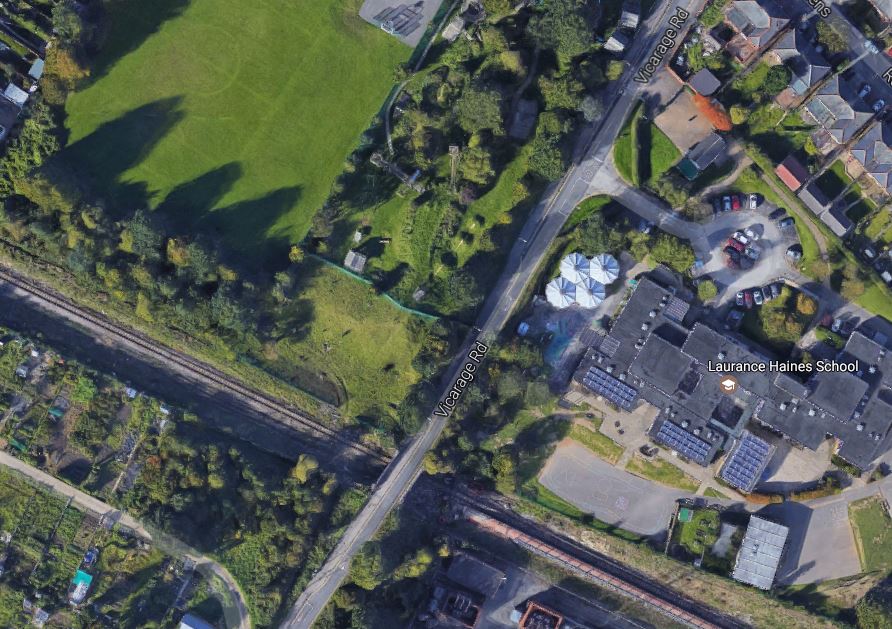
The Site Of Watford Vicarage Road Station
This description of the station is from Wikipedia.
Watford Vicarage Road is to be a newly constructed station on a re-opened section of the former LNWR Watford and Rickmansworth Railway line which was closed by British Rail in 1996. The station is to be located to the west of Vicarage Road, adjacent to Holywell allotments, with the platforms in the railway cutting below the road
The hospital and stadium are to the North on Vicarage Road.
This Google Map shows the site of the proposed Cassiobridge station.
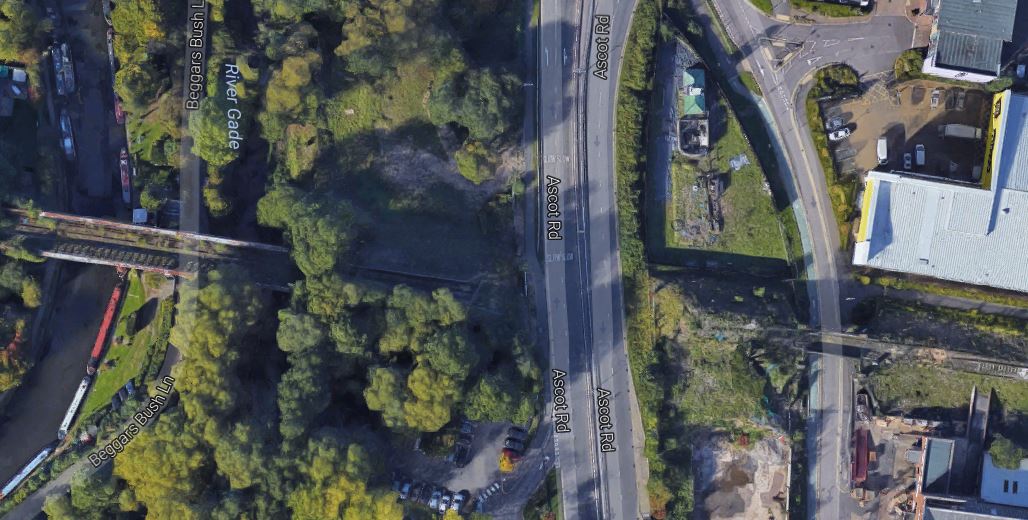
The Site Of Cassiobridge Station
Note.
- The Grand Union Canal running down the left hand side of the map, with the route of the old railway across it clearly visible.
- The station is on the single-carriageway branch of Ascot Road.
Wikipedia says it will be a fairly simple station.
Reasons For The Croxley Rail Link.
The Croxley Rail Link or the Metropolitan line Extension has a page on the Transport for London web site.
This is their summary.
The Metropolitan Line extension will re-route and extend the Metropolitan line to Watford Junction. The aim is for the project (formerly the Croxley Rail Link) to be completed in 2020.
The extension will divert Metropolitan line trains to serve the existing Watford Junction and Watford High Street stations.Two new stations will be created at Cassiobridge and Watford Vicarage Road. The existing Watford station will close after the new stations open.
TfL list the benefits as follows.
- Improve access to public transport for local residents
- Create new links to Watford General Hospital, Croxley Business Park and Cardiff Road Industrial Estate, increasing employment opportunities
- Provide access for Metropolitan line passengers to West Coast mainline National Rail links from Watford Junction station
The case for the line was obviously good enough to raise the finance for the line, but now it appears that the Department for Transport are having second thoughts.
Perhaps some of the other projects are influencing their decision.
The Bakerloo Line Extension
The Bakerloo Line Extension is mainly about South of the Thames, but if the line is running the proposed 27 trains per hour (tph) , these trains will have to terminate somewhere in the North.
There have been various proposals for the Bakerloo Line to take over the Watford DC Line and trains to terminate at Watford Junction station.
Some trains would probably terminate at Queen’s Park, Stonebridge Park and Harrow and Wealdstone stations, but perhaps eight to ten tph might go all the way, calling at both Watford High Street and Watford Junction stations.
The London Overground
Currently, the London Overground runs three tph to Watford Junction from Euston via the Watford DC Line.
The trains are currently five-car Class 378 trains and in a couple of years, they will be replaced by four-car Class 710 trains.
It is rare that the capacity of a route is ever decreased.
So do Transport for London have a cunning plan?
In Platform Height Issues On The Watford DC Line I suggested that the shorter Class 710 trains, might fit better with the 1972 Stock of the Bakerloo Line, thus allowing the current stations on the line to be converted to very customer-friendly step-free stations.
So working an extended Bakerloo Line to Watford Junction station with an appropriate number of Euston to Watford Junction services on the Watford DC Line could be an easier way of increasing capacity to Watford’s main station, without degrading the service of any other passengers.
Crossrail
It has been suggested that Crossrail with its herds of jumbo Class 345 trains should be extended to the West Coast Main Line. Wikipedia says this.
In August 2014, a statement by the transport secretary Patrick McLoughlin indicated that the government was actively evaluating the extension of Crossrail as far as Tring, with potential Crossrail stops at Wembley Central, Harrow & Wealdstone, Bushey, Watford Junction, Kings Langley, Apsley, Hemel Hempstead and Berkhamsted.
Plans change, but if Crossrail goes up the West Coast Main Line, it would surely stop at Watford Junction station.
If it stopped at the stations listed above, it would have good connections to the Bakerloo Line and London Overground, in addition to all the connections at Old Oak Common.
Southern
With all Southern‘s current troubles, I don’t think that their Milton Keynes to East Croydon service is a priority.
It is also a route that in a few years time will be a route, where there could be better alternatives.
Once Old Oak Common station is a reality, passengers from Milton Keynes to South London, would possibly use this type of route.
- London Midland to Old Oak Common
- Crossrail to Farringdon
- Thameslink to East Croydon, Gatwick Airport, Kent, Surrey, Sussex and Wimbledon.
As an alternative, they could also take the West London Line from Old Oak Common to Clapham Junction for all the connections there.
If Crossrail extends up the West Coast Main Line from a fully-developed Old Oak Common station, the reasons for Southern’s service will diminish.
It might be a good idea to replace this service with more London Overground services between Stratford and Clapham Junction via the North and West London Lines!
After all, London Overground will have several five-car Class 378 trains from the Watford DC Line.
London Midland
London Midland‘s franchise comes to an end soon and what goodies will companies propose to keep it?
I think the only new service we will see from London Midland or its successor, is trains calling at the new hub at Old Oak Common.
Metropolitan Line Upgrade
Transport for London are implementing, what they call the Four Lines Modernisation, on the Circle, District, Hammersmith and City and Metropolitan Lines.
TfL give these benefits.
- A new fleet of air-conditioned trains, with brighter more spacious interiors, low floors and dedicated spaces for wheelchair users, CCTV and other improved features
- Space for more customers
- Faster journeys and reduced waiting times
- Fewer delays as safe but obsolete equipment – dating back to the 1920s in some places – is replaced with modern, computerised signalling and control systems
- Better live customer information on platforms and to smart devices
It will all be finished by 2023, when 32 tph could be running in the Peak.
The Croxley Rail Link is not mentioned in connection with this modernisation.
This upgrade must benefit services to and from existing Metropolitan Line stations to the West of Watford, but it does nothing to meet the benefits stated for the Croxley Rail Link.
- Improve access to public transport for local residents
- Create new links to Watford General Hospital, Croxley Business Park and Cardiff Road Industrial Estate, increasing employment opportunities
- Provide access for Metropolitan line passengers to West Coast mainline National Rail links from Watford Junction station.
Two additional benefits could be added.
- Access to the upgraded Vicarage Road Stadium
- The possibility of services between Amersham and Watford Junction.
Others could also surface, if say a substantial housing or commercial development is proposed.
Chiltern Railways
Never underestimate Chiltern Railways!
The Croxley Rail Link would connect to their Aylesbury Line, which is going to be extended to Milton Keynes.
Once the link is a reality, I’m sure Chiltern will find a way to make use of the line.
Even a well-thought out two tph shuttle to Amersham could probably provide valuable connectivity.
Chiltern will also have an effect on thinking, in that they have opened a similar railway to the Croxley Rail Link, in their extension to Bicester and Oxford.
The Opening Of HS2
HS2 will have one major effect on Watford, in that it will free up paths on the West Coast Main Line.
These could be used to improve services between Watford Junction and Euston.
Could A Lower-Cost Link Be Built?
I ask this question, specifically because of the report that TfL had said no, because the project is over-budget.
Ideally, the link would be built as a double track line from Watford High Street station, to where it joins the double-track branch to the current Watford station.
I have flown my helicopter over the route and there would appear to be a fair bit of space for a double -track line.
But there might be a couple of problems.
This picture, which I took going South, shows the bridge, where the Croxley Rail Link will join the Watford DC Line.

The A4178 Goes Over The Croxley Rail Link
It looks fairly sound, but is it large enough for two tracks? I could see the next bridge and that was a modern structure with a lot more space.
Note too, the evidence of clearing up decades of tree growth.
But look at this Google Map of where the Croxley Rail Link will connect to the branch to Watford station.
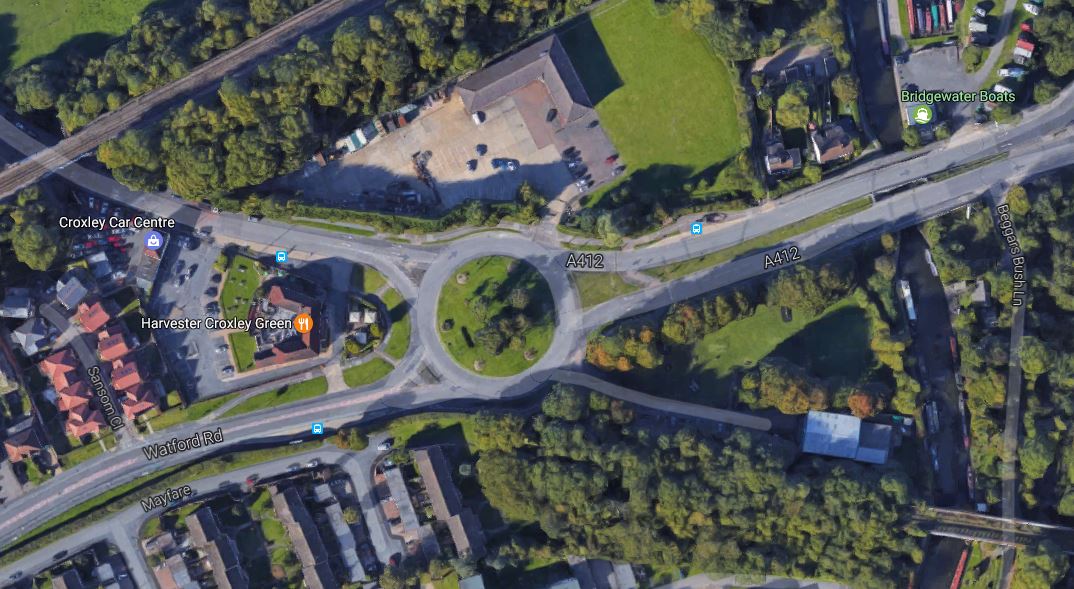
Over The A412 At Croxley Green
Note the branch to Watford station at the top left of the map and the remains of the old railway in the bottom-right, which can also be seen in the map of Cassiobridge station.
It could be difficult to thread a double-track viaduct through the area.
This visualisation from the Watford Observer shows current thinking.
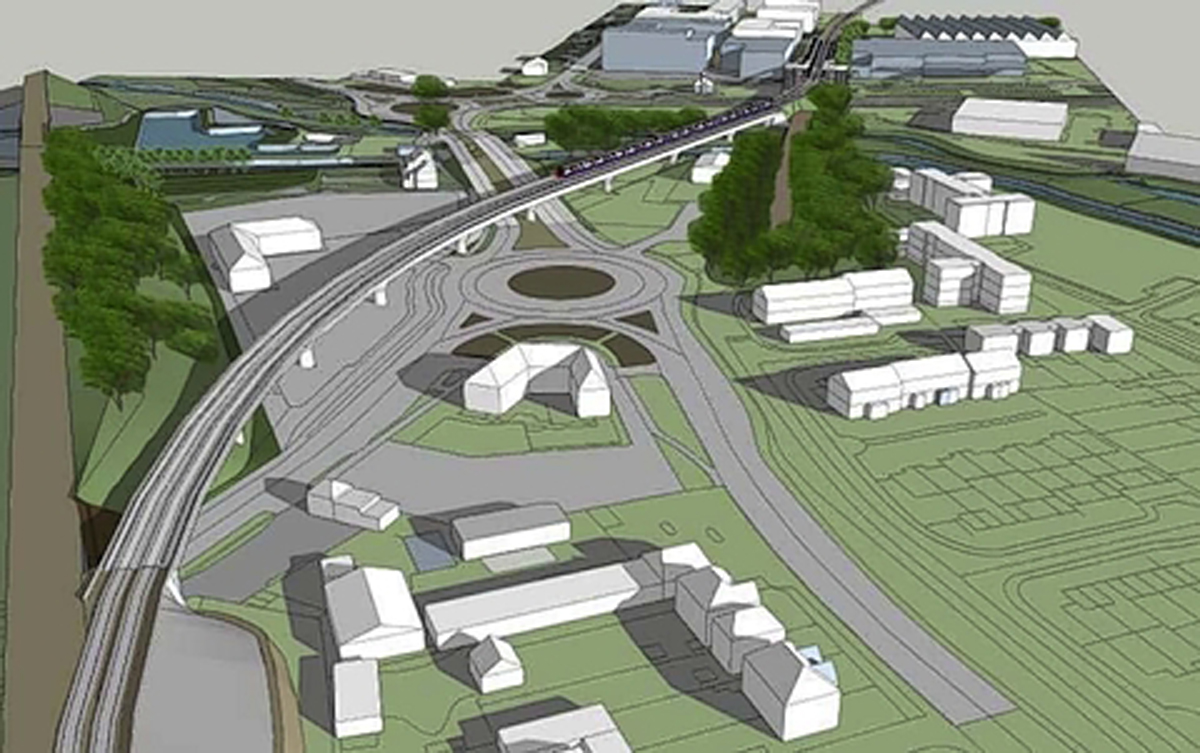
Croxley Link Viaduct
So would money be saved and perhaps a better design be possible?
- Could the viaduct be built with only a single-track between its junction with the branch to Watford station and the proposed Cassiobridge station? The route could revert to double track just to the East of Cassiobridge station.
- A single-track design of Cassiobridge station could also save money, but it would probably rule out too many future options.
As most of the route will be double-track, I doubt that a few hundred metres of single-track would have much impact on the operation of the link. It’s not as if, the Croxley Rail Link will be handling 24 tph.
I suspect that engineers and architects are working hard both to cut costs and make the link better.
A Watford Junction To Amersham Service
I think that if there is a good service between Watford Junction and Amersham, this might offer an alternative solution.
It would connect to London trains as follows.
- Watford Junction – Bakerloo, London Midland, Southewrn, Watford DC and possible West Coast Main Line services.
- Watford High Street – Cross-platform connection to Watford DC services.
- Croxley – Same platform connection to Metropolitan services to the existing Watford station.
- Rickmanswoth – Chiltern for both London and all stations to Milton Keynes.
I believe that a train like London Overground’s new Class 710 train, which will be running on the Watford DC Line might be able to run the service without any new electrification, it it were to use onboard energy storage between say Watford High Street and Croxley stations.
Conclusion
I believe that Watford will get a better train service, whether the Croxley Rail Link is built or not.
Politics will decide the priority of the Croxley Rail Link, with the left-leaning South Londoner Sadiq Khan on one side and right-leaning Bucks-raised Chris Grayling on the other. In some ways, Watford is a piggy-in-the-middle.
My feeling is that on a Londonwide basis, that the Bakerloo Line Extension to Watford, solves or enables the solution of a lot of wider problems and the Croxley Rail Link is much more a local solution.
I think it could turn out to be.
- A mainly double-track route from Watford Junction to Amersham, but with portions of single track.
- No new electrification.
- Stations at Watford High Street, Watford Vicarage Road, Cassiobridge, Croxley and then all stations to Amersham.
- Four Class 710 trains per hour (tph), running on existing electrification and batteries between Watford Junction and Amersham.
- A redeveloped Watford station keeps its four tph to London.
It might even be simpler.
 The Anonymous Widower