Alstom Hydrogen Trains Complete Trials
The title of this post, is the same as that of this article on H2 View.
The introductory paragraph says this.
After 530 days and more than 18,000 driven kilometres, the trials of two Alstom Coradia iLint models, the world’s first two hydrogen trains, are complete.
It is now over a year since I took this picture of the Alstom Coradia iLint at Buxtehude in Germany.

It is time to move on to full series production. Another fourteen Coradia iLint trains will be manufactured and start service in 2022.
According to Wikipedia, a second order for 27 trains for the Rhine-Main region will be delivered by December 2022.
The Definitive Hydrogen Train
There is only one hydrogen-powered train in service and that is the Alstom Coradia iLint, which is running in Germany.
I feel it is very much an interim design, as Alstom has taken a diesel-mechanical Lint train and swapped the diesel for a hydrogen-powered electricity generator and an electric motor.
Alstom are converting electric Class 321 trains into a hydrogen-powered version called Breeze.
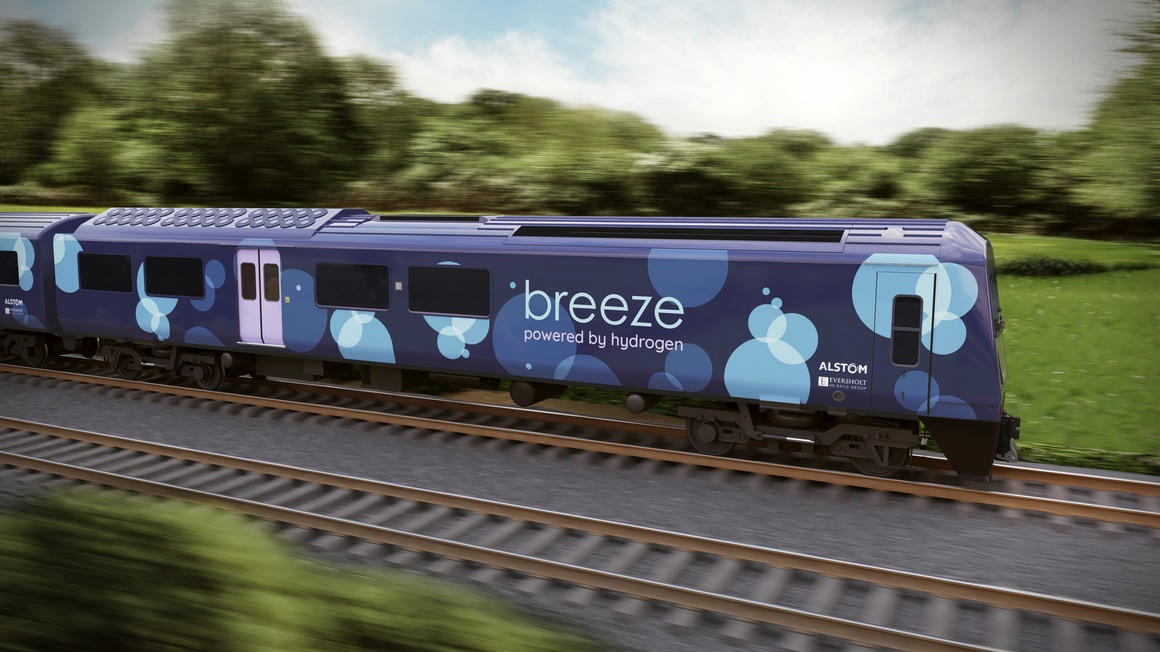
A typical train would be three cars. The visualisation shows one of the two driver cars, that contain a large hydrogen tank behind the cab.
Between the two driver cars would be a trailer car.
Using Electrification
Nothing has been disclosed yet, but it would surely be easy to allow this hydrogen train to keep its pantograph on the trailer car and be able to use electrification if it is installed.
This would increase the range of the train and might allow a version with a smaller hydrogen tank and a greater passenger capacity.
Charging Batteries
In a definitive hydrogen-powered train, which had been designed from scratch to use hydrogen, I could envisage, that the batteries could also be charged, when the train is connected to either electrification or a charging station.
A Smart Computer
The train would have a very smart computer, which would do the following.
- Manage the various power sources.
- Choose the appropriate source for the route, weather, passenger load, fuel and battery levels.
- Raise and lower the pantograph automatically.
- Control the trains systems to minimise electricity use.
This is little different to many trains, built in the last few years.
Conclusion
The definitive hydrogen-powered train will be a battery-electric-hydrogen hybrid train.
Dutch Test Hydrogen Train As EU Alliance Set To Launch
The title of this post is the same as that of this article on Euractiv.
This is the introductory paragraph.
The Netherlands wrapped up testing on its first foray into hydrogen train technology at the weekend, as the European Commission readies a strategy for the clean fuel that will debut on Tuesday (10 March).
I shall be interested to see what the European Commission says tomorrow.
I indicated in Alstom Coradia iLint Passes Tests, that hydrogen-powered trains could run through The Netherlands all the way to Germany.
Alstom Coradia iLint Passes Tests
The title of this post is the same as that of this article on Railway Age.
This is the first paragraph.
Alstom has performed 10 days of tests of the Coradia iLint hydrogen fuel cell train—the world’s first passenger train powered by hydrogen fuel cells—on the 65-kilometer line between Groningen and Leeuwarden to the north of the Netherlands.
These details of the tests were given.
- No passengers were carried.
- The tests were done at night.
- A mobile filling station was used.
- The train ran up to a speed of 140 kph.
As green hydrogen was used, the tests were zero carbon.
The Test Route
This map clipped from Wikipedia, shows the Groningen and Leeuwarden route, used for the tests.
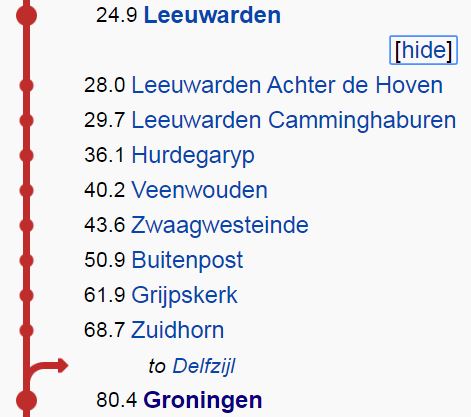
Note.
- It appears to be only single-track.
- It is roughly 65 kilometres long.
- There are eight intermediate stops.
Checking the timetable, the service seems to be two or three trains per hour (tph)
Hydrogen Trains Could Go All The Way To Germany
In From Groningen To Leer By Train, I took a train and a bus from Groningen in The Netherlands to Leer in Germany and eventually on to Bremen Hbf. The route is not complete at the moment, as a freighter demolished the rail bridge.
Once the bridge is rebuilt, a hydrogen-powered train, which could also use the catenary in the area could travel from West of Leeuwarden to possibly as far as Bremen and Hamburg.
It is interesting to note, that Alstom’s hydrogen-powered trains for the UK, which are called Breeze and are currently being converted from British Rail-era Class 321 electric trains, will not lose their ability to use the overhead electrification.
A train with that dual capability would be ideal for the Dutch and German rail network in this area, which is partially electrified.l
Alstom’s Hydrogen-Powered Train Undergoes Tests On Dutch Tracks
The title of this post is the same as that on this article of Renewables Now.
Hydrogen trains are certainly coming to Europe.
ÖBB To Test Hydrogen Multiple-Units
The title of this post is the same as that of this article on Railway Gazette.
This is the introductory paragraph.
The national operator’s passenger business ÖBB Personenverkehr has awarded sole bidder Alstom a contract to provide two hydrogen fuel cell multiple-units for trials.
The trial should start in April.
Next Stop, Hydrogen-Powered Trains
The title of this post is the same as that as this article on the BBC’s Future Platet web site.
This is the introductory paragraph.
As old diesel trains are phased out of rail networks around the world, the UK is about to test a new type of engine that could help to decarbonise railways – hydrogen-powered trains.
The article then goes on to summarise the current developments in hydrogen grains.
Northern’s Hydrogen Plans
The title of this post, is half of the title of an article in the March 2020 Edition of Modern Railways.
I discussed Northern’s possible hydrogen trains in Fuelling The Change On Teesside Rails.
This new article gives a lot more detail in this paragraph.
Northern has submitted planning documents, with the preferred site for a maintenance and fuelling facility understood to be at Lackenby. As hydrogen units would have a more limited operating range than DMUs (around 600 miles), they would likely need to return to the depot every night. Northern believes the routes radiating from Middlesbrough to Nunthorpe, Bishop Auckland and Saltburn are ideal candidates for the operation, as they are unlikely to be electrified and can be operated as a self contained network using hydrogen trains. A fleet of around a dozen Breeze units is planned, with the possibility they could also operate services to Whitby and on the Durham Coast Line to Newcastle. Planning documentation suggested the first hydrogen train would be ready for testing in June 2021, but this was based on construction of the depot facility beginning in January this year.
It all sounds very comprehensive.
Capacity Comparison With The iLint
The Modern Railways article says this about the capacity of the Breeze.
A three-car Breeze is expected to have a similar passenger capacity to a two-car DMU.
A two-car Class 156 train, which currently work the lines around Middlesbrough, was built with 163 seats and the Lint 54, on which the iLint is based, has between 150 and 180 seats.
It will be interesting to see how actual seat numbers compare between the Breeze and iLint.
First Hydrogen Train Arrives In The Netherlands
The title of this post is the same as that on this article of Railway News.
This is the introductory paragraph.
On 26 February the first hydrogen train arrived in the Netherlands. The Dutch rail infrastructure manager ProRail led the train into the country from Germany via Oldenzaal and then ran it on track to its provisional parking facility in Leeuwarden.
The article also says this.
The public will also have the chance to view the hydrogen train on 7 March, when it will be at Groningen Station between noon and 4pm.
I won’t be going, as I’ve ridden the train in Germany as I reported in My First Ride In An Alstom Coradia iLint.
These trains are technology demonstrators at best and greenwash at worst.
Hydrogen power needs a radical new design of train and not a quick rehash of an existing design.
The problem is that the Coradia iLint is based on a diesel mechanical train and it has a lot of transmission noise.
You get less noise and vibration in the average British-Rail era diesel multiple unit like a Class 156 train. But then these are diesel hydraulic, have steel-bodies and built thirty years ago.
When I first saw the iLint, I looked for the pantograph, as these trains run on partially-electrified lines and hydrogen-powered trains are effectively electric trains with a different source of electricity.
To be fair to Alstom, their development of the hydrogen-powered Class 321 Breeze, will also be able to use a pantograph, but as this visualisation shows, the hydrogen tanks take up a lot of space.
Hydrogen might find itself a place on the railways, but I suspect that battery-electric will always be better for passenger trains.
- Battery technology will improve faster than hydrogen technology.
- Innovators will find better ways of fast-charging trains.
- A battery-electric train will match the daily range of a hydrogen-powered train, using innovative dynamic charging.
- Many modern electric trains can be converted into battery-electric ones.
- As the Class 379 BEMU trial, this conversion can be relatively easy, quick and successful.
I suspect though, the mathematics will be different for freight locomotives.
Fuel Cell Train To Be Tested In The Netherlands
The title of this post, is the same as that of this article on Railway Gazette.
This is the introductory paragraph.
A Coradia iLint hydrogen fuel-cell multiple-unit is to be tested on the Groningen – Leeuwarden line after an agreement was signed at the Klimaattop Noord NL climate summit by manufacturer Alstom, the province of Groningen, local operator Arriva, infrastructure manager ProRail and energy company Engie.
You can get a flavour of some of the Dutch railways in the area from The Train Station At The Northern End Of The Netherlands.
Hydrogen powered trains are also part of the future plans for the use of hydrogen, which I wrote about in The Dutch Plan For Hydrogen.
The Railway Gazette article gives more details on how they will be introducing low carbon trains in the network around Groningen and the wider Netherlands.
These general points are made.
- The Netherlands has nearly a thousand kilometres of lines without electrification.
- Alstom has forty-one orders for their hydrogen-powered Coradia iLints.
They will also be refurbishing the 51 Stadler GTW trains in the area.
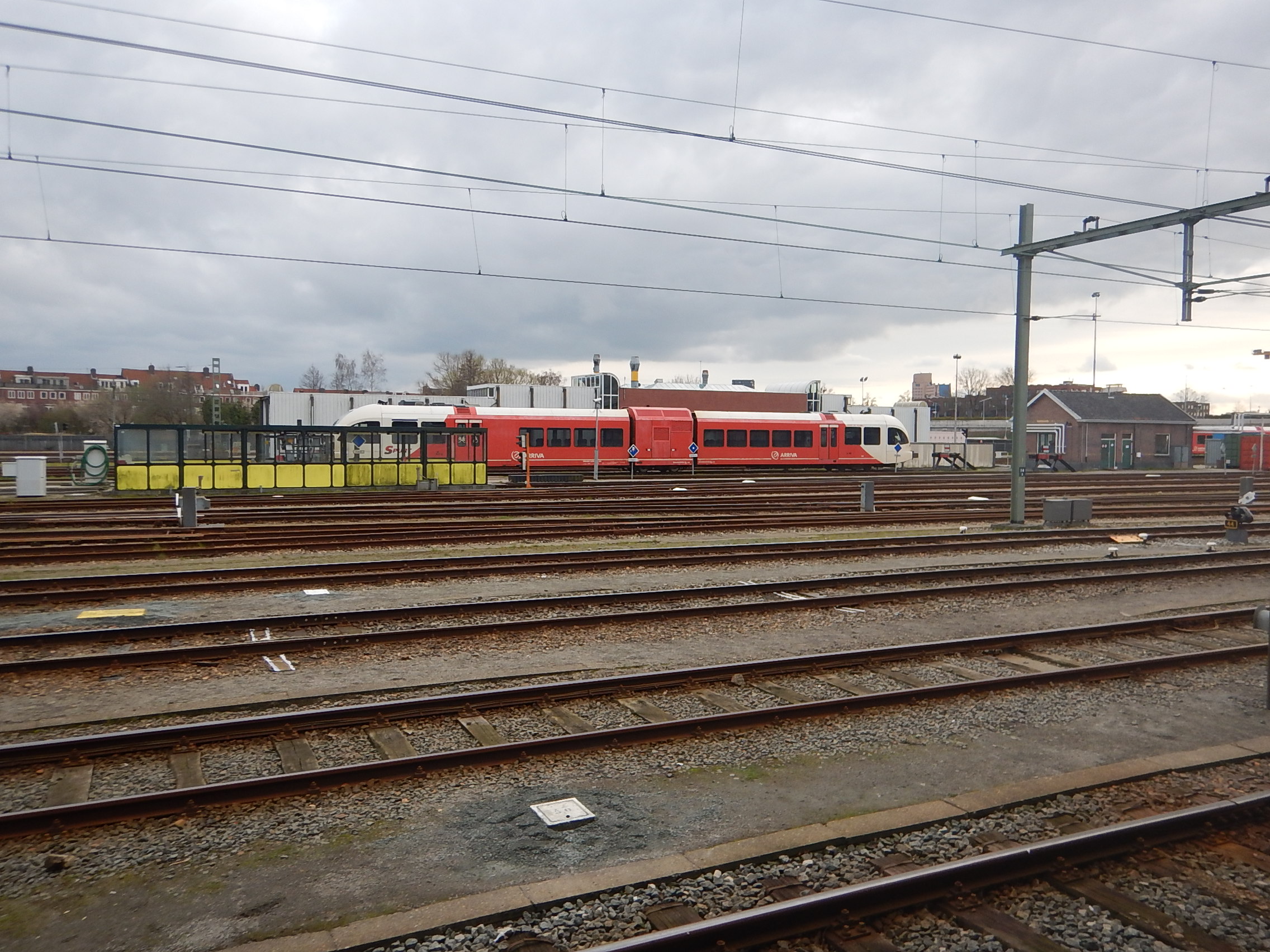
The main improvement, is that they will be fitted with batteries to handle regenerative braking and cut their carbon footprint.
The Railway Gazette article also says this.
A further 18 new Stadler Wink trainsets have been ordered which will be able use overhead electrification or hydrotreated vegetable oil fuel, with batteries for regenerated braking energy. These will be designed so that their engines can be replaced with larger batteries when the planned 1·5 kV DC discontinuous electrification of the routes is completed.
The Stadler Wink appears to be the another train from the Flirt family, which is the successor to the GTW.
The Dutch seem to be moving very firmly towards a zero-carbon railway in the North.
Collateral Benefits For The UK
What areas of the UK would be ideal places to adopt a similar philosophy to that which the Dutch are using in the North of the Netherlands?
I think they will be areas, where there are lots of zero carbon electricity, railways without electrification and terrain that’s not to challenging.
These areas come to mind.
- East Anglia
- Lincolnshire
- East Yorkshire
- Far North and North East Scotland.
Note.
-
- The only electrification in these areas is the main lines to Norwich and Cambridge in East Anglia.
- All areas have Gigawatts of offshore wind farms either operating or under development.
- Vivarail are proposing to run battery-electric trains between Wick and Turso, as I wrote about in Is This The Most Unusual Idea For A New Railway Service in The UK?
- With the exception of East Yorkshire, the train operating company is Abellio, who are Dutch railways, by another name.
- East Anglia is already using Stadler Flirt Class 755 trains, that can be fitted with batteries.
I also believe that Hitachi will soon be providing battery-electric versions of their AT300 trains. I wrote about this in Thoughts On The Next Generation Of Hitachi High Speed Trains.
Battery electric AT300 trains could provide long distance services to the areas I listed.
Conclusion
What is happening in the North of the Netherlands, will be watched with interest in the UK.
 The Anonymous Widower