Northern’s Hydrogen Plans
The title of this post, is half of the title of an article in the March 2020 Edition of Modern Railways.
I discussed Northern’s possible hydrogen trains in Fuelling The Change On Teesside Rails.
This new article gives a lot more detail in this paragraph.
Northern has submitted planning documents, with the preferred site for a maintenance and fuelling facility understood to be at Lackenby. As hydrogen units would have a more limited operating range than DMUs (around 600 miles), they would likely need to return to the depot every night. Northern believes the routes radiating from Middlesbrough to Nunthorpe, Bishop Auckland and Saltburn are ideal candidates for the operation, as they are unlikely to be electrified and can be operated as a self contained network using hydrogen trains. A fleet of around a dozen Breeze units is planned, with the possibility they could also operate services to Whitby and on the Durham Coast Line to Newcastle. Planning documentation suggested the first hydrogen train would be ready for testing in June 2021, but this was based on construction of the depot facility beginning in January this year.
It all sounds very comprehensive.
Capacity Comparison With The iLint
The Modern Railways article says this about the capacity of the Breeze.
A three-car Breeze is expected to have a similar passenger capacity to a two-car DMU.
A two-car Class 156 train, which currently work the lines around Middlesbrough, was built with 163 seats and the Lint 54, on which the iLint is based, has between 150 and 180 seats.
It will be interesting to see how actual seat numbers compare between the Breeze and iLint.
First Hydrogen Train Arrives In The Netherlands
The title of this post is the same as that on this article of Railway News.
This is the introductory paragraph.
On 26 February the first hydrogen train arrived in the Netherlands. The Dutch rail infrastructure manager ProRail led the train into the country from Germany via Oldenzaal and then ran it on track to its provisional parking facility in Leeuwarden.
The article also says this.
The public will also have the chance to view the hydrogen train on 7 March, when it will be at Groningen Station between noon and 4pm.
I won’t be going, as I’ve ridden the train in Germany as I reported in My First Ride In An Alstom Coradia iLint.

These trains are technology demonstrators at best and greenwash at worst.
Hydrogen power needs a radical new design of train and not a quick rehash of an existing design.
The problem is that the Coradia iLint is based on a diesel mechanical train and it has a lot of transmission noise.
You get less noise and vibration in the average British-Rail era diesel multiple unit like a Class 156 train. But then these are diesel hydraulic, have steel-bodies and built thirty years ago.
When I first saw the iLint, I looked for the pantograph, as these trains run on partially-electrified lines and hydrogen-powered trains are effectively electric trains with a different source of electricity.
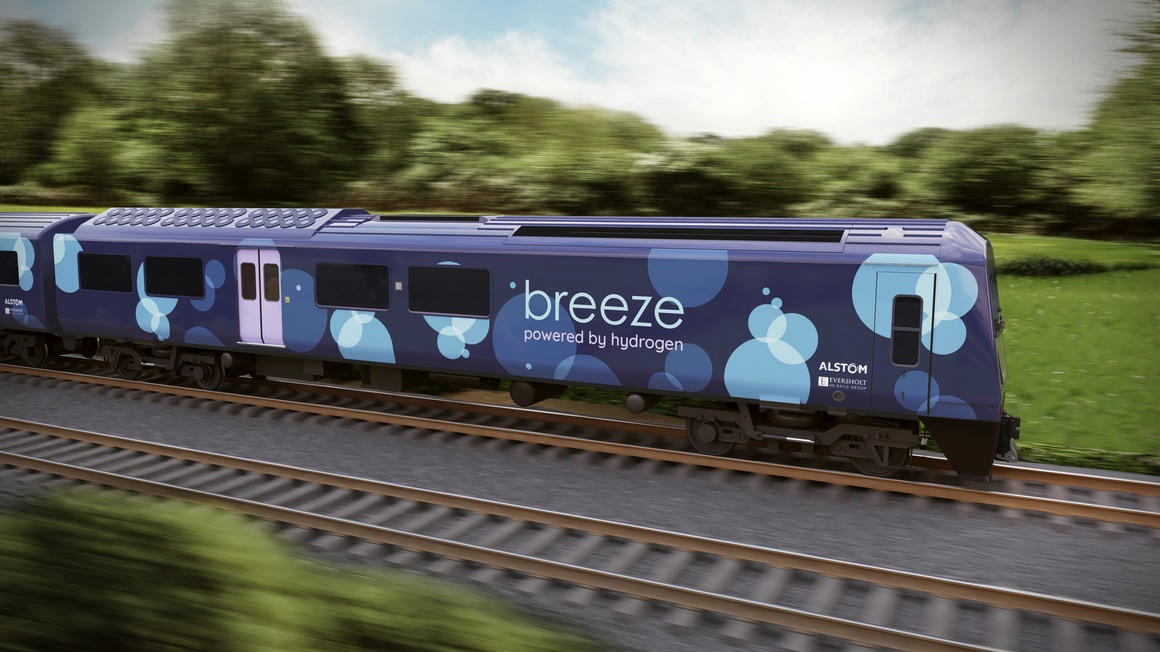
To be fair to Alstom, their development of the hydrogen-powered Class 321 Breeze, will also be able to use a pantograph, but as this visualisation shows, the hydrogen tanks take up a lot of space.
Hydrogen might find itself a place on the railways, but I suspect that battery-electric will always be better for passenger trains.
- Battery technology will improve faster than hydrogen technology.
- Innovators will find better ways of fast-charging trains.
- A battery-electric train will match the daily range of a hydrogen-powered train, using innovative dynamic charging.
- Many modern electric trains can be converted into battery-electric ones.
- As the Class 379 BEMU trial, this conversion can be relatively easy, quick and successful.
I suspect though, the mathematics will be different for freight locomotives.
Fuel Cell Train To Be Tested In The Netherlands
The title of this post, is the same as that of this article on Railway Gazette.
This is the introductory paragraph.
A Coradia iLint hydrogen fuel-cell multiple-unit is to be tested on the Groningen – Leeuwarden line after an agreement was signed at the Klimaattop Noord NL climate summit by manufacturer Alstom, the province of Groningen, local operator Arriva, infrastructure manager ProRail and energy company Engie.
You can get a flavour of some of the Dutch railways in the area from The Train Station At The Northern End Of The Netherlands.
Hydrogen powered trains are also part of the future plans for the use of hydrogen, which I wrote about in The Dutch Plan For Hydrogen.
The Railway Gazette article gives more details on how they will be introducing low carbon trains in the network around Groningen and the wider Netherlands.
These general points are made.
- The Netherlands has nearly a thousand kilometres of lines without electrification.
- Alstom has forty-one orders for their hydrogen-powered Coradia iLints.
They will also be refurbishing the 51 Stadler GTW trains in the area.
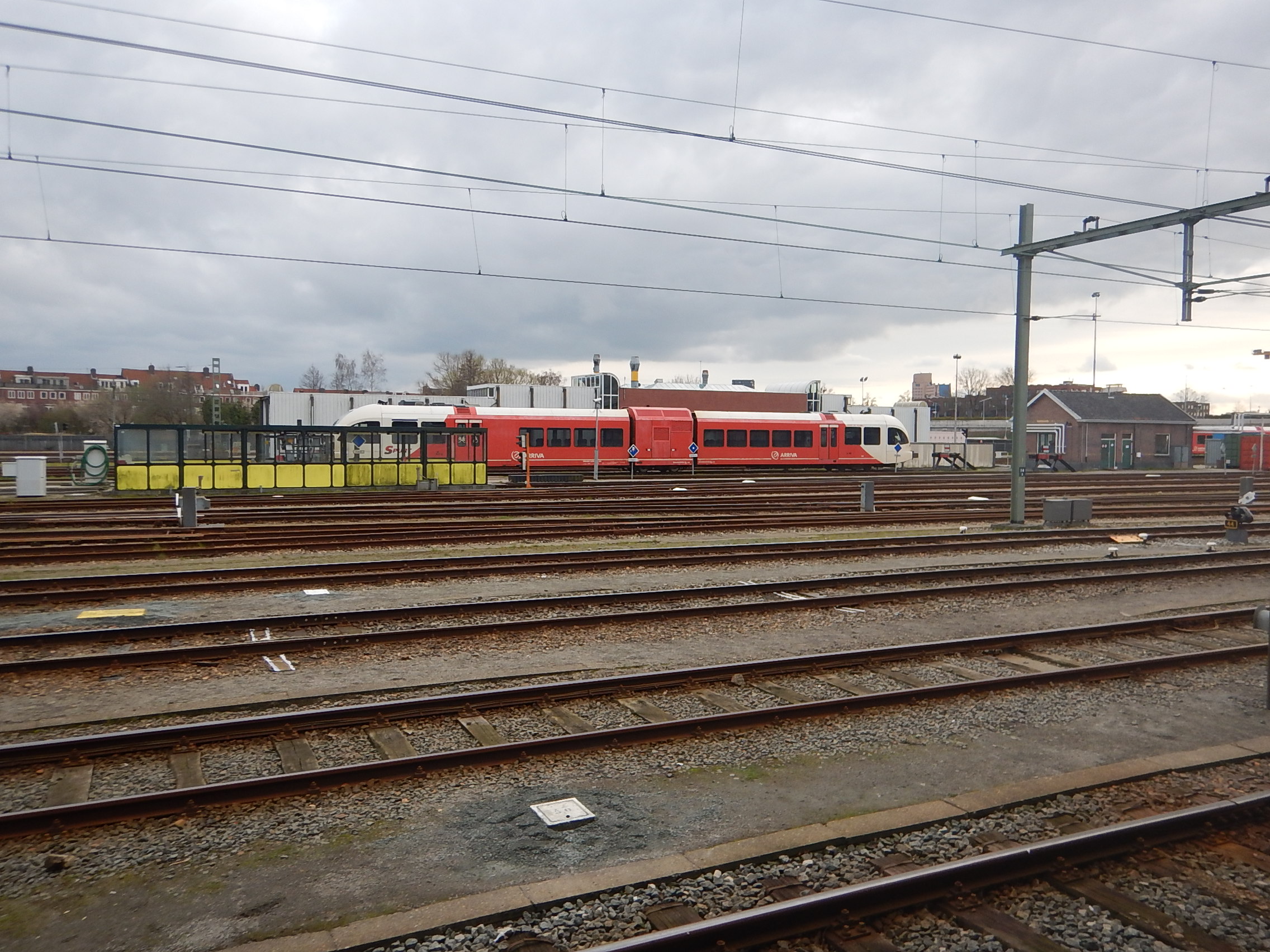
The main improvement, is that they will be fitted with batteries to handle regenerative braking and cut their carbon footprint.
The Railway Gazette article also says this.
A further 18 new Stadler Wink trainsets have been ordered which will be able use overhead electrification or hydrotreated vegetable oil fuel, with batteries for regenerated braking energy. These will be designed so that their engines can be replaced with larger batteries when the planned 1·5 kV DC discontinuous electrification of the routes is completed.
The Stadler Wink appears to be the another train from the Flirt family, which is the successor to the GTW.
The Dutch seem to be moving very firmly towards a zero-carbon railway in the North.
Collateral Benefits For The UK
What areas of the UK would be ideal places to adopt a similar philosophy to that which the Dutch are using in the North of the Netherlands?
I think they will be areas, where there are lots of zero carbon electricity, railways without electrification and terrain that’s not to challenging.
These areas come to mind.
- East Anglia
- Lincolnshire
- East Yorkshire
- Far North and North East Scotland.
Note.
-
- The only electrification in these areas is the main lines to Norwich and Cambridge in East Anglia.
- All areas have Gigawatts of offshore wind farms either operating or under development.
- Vivarail are proposing to run battery-electric trains between Wick and Turso, as I wrote about in Is This The Most Unusual Idea For A New Railway Service in The UK?
- With the exception of East Yorkshire, the train operating company is Abellio, who are Dutch railways, by another name.
- East Anglia is already using Stadler Flirt Class 755 trains, that can be fitted with batteries.
I also believe that Hitachi will soon be providing battery-electric versions of their AT300 trains. I wrote about this in Thoughts On The Next Generation Of Hitachi High Speed Trains.
Battery electric AT300 trains could provide long distance services to the areas I listed.
Conclusion
What is happening in the North of the Netherlands, will be watched with interest in the UK.
Shapps Wants ‘Earlier Extinction Of Diesel Trains’
The title of this post, is the same as that of this article on the East London and West Essex Guardian.
This is the first two paragraphs of the article.
The phasing out of diesel trains from Britain’s railways could be intensified as part of the Government’s bid to cut carbon emissions.
Transport Secretary Grant Shapps told MPs he is “hugely concerned” that the current policy means diesel trains will continue to operate until 2040.
In some ways the positioning of the article in a newspaper serving East London and West Essex is a bit strange.
- The only diesel trains in the area are freight trains, after the electrification of the Gospel Oak and Barking Line.
- Grant Schapps constituency is Welwyn and Hatfield, which is twenty or so miles North of London.
It looks to me to be a syndicated story picked up by the paper.
But as it reports what he said to the Transport Select Committee, there is a strong chance that it is not fake news.
How Feasible Would It Be To Bring Forward The 2040 Diesel Extinction Date?
Government policy of an extinction date of 2040 was first mentioned by Jo Johnson, when he was Rail Minister in February 2018.
This article on Politics Home is entitled Rail Minister Announces Diesel Trains To Be Phased Out By 2040, gives more details about what Jo said.
Since then several developments have happened in the intervening nearly two years.
Scores Of Class 800 Trains Are In Service
Class 800 trains and their similar siblings can honestly be said to have arrived.
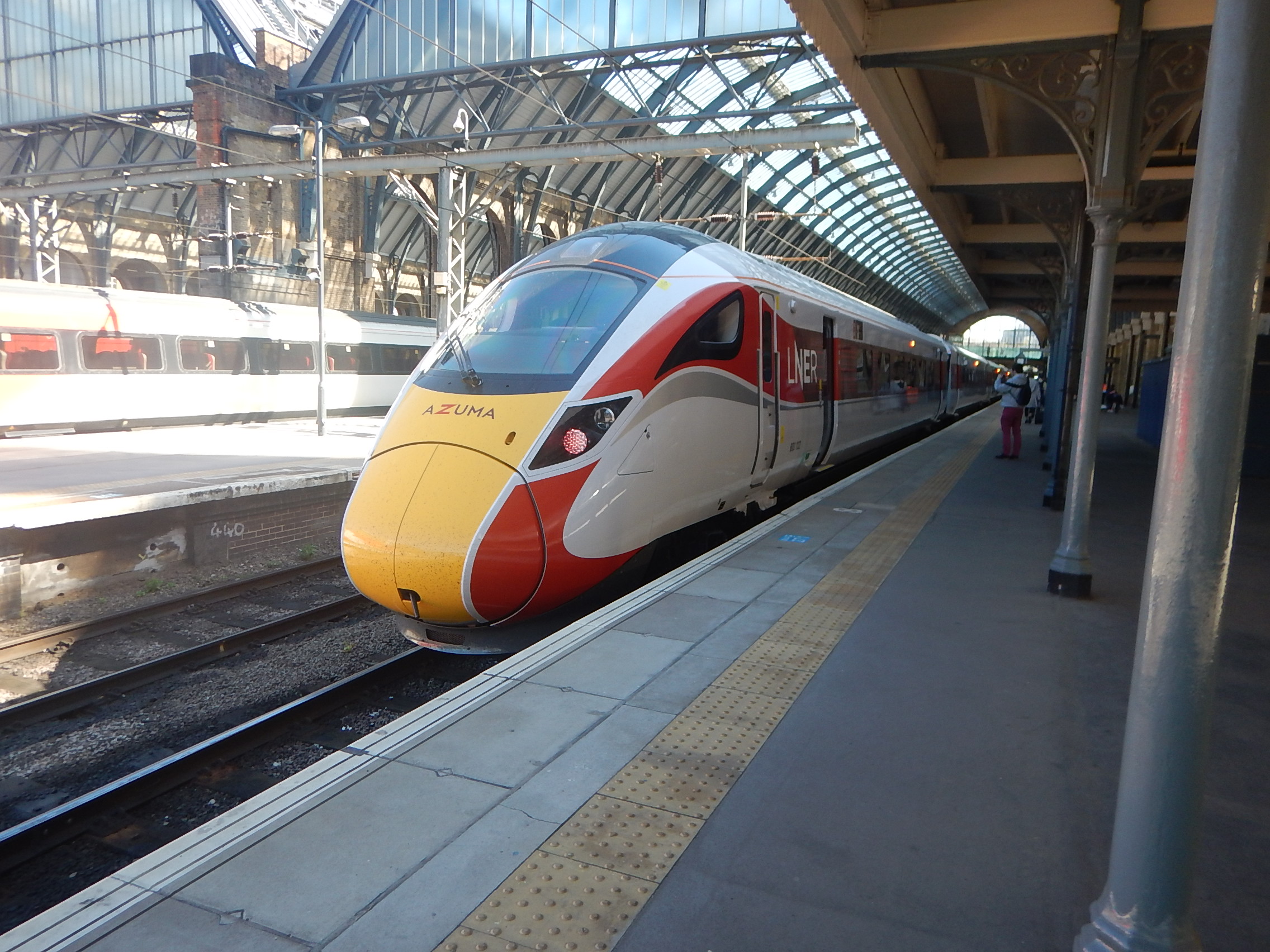
Currently, there appear to be over two hundred of these trains either delivered or on order.
Many have replaced diesel trains on Great Western Railway and LNER and stations like Kings Cross, Paddington and Reading are becoming over ninety percent diesel-free.
It should be noted that over half of these trains have diesel engines, so they can run on lines without electrification.
But the diesel engines are designed to be removed, to convert the trains into pure electric trains, when more electrification is installed.
Midland Main Line Upgrade
This line will be the next to be treated to the Hitachi effect, with thirsty-three of the second generation of Hitachi’s 125 mph trains.
- The Hitachi trains will use electrification South of Melton Mowbray and diesel power to the North.
- The trains will have a redesigned nose and I am sure, this is to make the trains more aerodynamically efficient.
- The introduction of the trains will mean, that, all passenger trains on the Midland Main Line will be electric South of Melton Mowbray.
- St. Pancras will become a diesel-free station.
Whether High Speed Two is built as planned or in a reduced form, I can see electrification creeping up the Midland Main Line to Derby, Nottingham and Sheffield and eventually on to Leeds.
Other Main Line Routes
The Midland Main Line will have joined a group of routes, that are run partly by diesel and partly by electricity.
- London and Aberdeen
- London and Bradford
- London and Cheltenham
- London and Harrogate
- London and Hull
- London and Inverness
- London and Lincoln
- London and Middlesbrough
- London and Penzance via Exeter and Plymouth.
- London and Sunderland
- London and Swansea
- London and Worcester and Hereford
Once the Midland Main Line is upgraded, these main routes will only be these routes that use pure diesel for passenger routes.
- TransPennine Routes
- Chiltern Route
- London and Exeter via Basingstoke
- London and Holyhead
Plans already exist from West Coast Rail to use bi-mode on the Holyhead route and the Basingstoke route could also be a bi-mode route.
TransPennine and Chiltern will need bespoke solutions.
Some Electrification Has Happened
Electrification has continued at a slow pace and these schemes have been completed or progressed.
- Chase Line
- Between Birmingham and Bromsgrove
- North West England
- Between Edinbugh, Glasgow, Alloa, Dunblane and Stirling.
- Gospel Oak to Barking Line
- Between St. Pancras and Corby.
- Crossrail
In addition London and Cardiff will soon be electrified and a lot of electrification designed by the Treasury in the past fifty years has been updated to a modern standard.
Battery Trains Have Been Developed And Orders Have Been Received Or Promised
Stadler bi-mode Class 755 trains have been delivered to Greater Anglia and these will be delivered as electric-diesel-battery trains to South Wales.
Stadler also have orders for battery-electric trains for Germany, which are a version of the Flirt called an Akku.
In the Wikipedia entry for the Stadler Flirt, this is a paragraph.
In July 2019, Schleswig-Holstein rail authority NAH.SH awarded Stadler a €600m order for 55 battery-powered Flirt Akku multiple unit trains along with maintenance for 30 years. The trains will start entering service in 2022 and replace DMUs on non-electrified routes.
55 trains at €600 million is not a small order.
Alstom, Bombardier, CAF, Hitacxhi and Siemens all seem to be involved in the development of battery-electric trains.
I think, if a train operator wanted to buy a fleet of battery trains for delivery in 2023, they wouldn’t have too much difficulty finding a manmufacturer.
Quite A Few Recently-Built Electric Trains Are Being Replaced And Could Be Converted To Battery-Electric Trains
In 2015 Bombardier converted a Class 379 train, into a battery-electric demonstrator.
The project showed a lot more than battery-electric trains were possible.
- Range could be up to fifty miles.
- The trains could be reliable.
- Passengers liked the concept.
Judging by the elapsed time, that Bombardier spent on the demonstrator, I would be very surprised to be told that adding batteries to a reasonably modern electric train, is the most difficult of projects.
The Class 379 trains are being replaced by by brand-new Class 745 trains and at the time of writing, no-one wants the currents fleet of thirty trains, that were only built in 2010-2011.
In addition to the Class 379 trains, the following electric trains are being replaced and could be suitable for conversion to battery-electric trains.
- Thirty Class 707 trains from South Western Railway.
- Thirty-seven Class 350/2 trains from West Miidlands Railway.
- Perhaps twenty Class 387 trains from various sources.
There also may be other trains frm Heathrow Express and Heathrow Connect.
All of these trains are too good for the scrapyard and the leasing companies that own them, will want to find profitable uses for them.
Porterbrook are already looking at converting some Class 350 trains to Battery-electric operation.
Vivarail And Others Are Developing Fast Charging Systems For Trains
Battery trains are not much use, unless they can be reliably charged in a short time.
Vivarail and others are developing various systems to charge trains.
Hydrogen-Powered Trains Have Entered Service In Germany
Hydrogen-powered Alstom Coradia Lint trains are now operating in Germany.
Alstom are developing a Class 321 train powered by hydrogen for the UK.
Stadler’s Bi-Mode Class 755 Train
The Class 755 train is the other successful bi-mode train in service on UK railways.
I would be very surprised if Grant Schapps hasn’t had good reports about these trains.
They may be diesel-electric trains, but Stadler have made no secret of the fact that these trains can be battery electric.
Like the Class 800 train, the Class 755 train must now be an off-the-shelf solution to use on UK railways to avoid the need for full electrification.
Class 93 Locomotives
Stadler’s new Class 93 locomotive is a tri-mode locomotive, that is capable of running on electric, diesel or battery power.
This locomotive could be the best option for hauling freight, with a lighter carbon footprint.
As an example of the usability of this locomotive, London Gateway has around fifty freights trains per day, that use the port.
- That is an average of two tph in and two tph out all day.
- All trains thread their way through London using either the North London or Gospel Oak to Barking Lines.
- Most trains run run substantially on electrified tracks.
- All services seem to go to freight terminals.
With perhaps a few of miles of electrification, at some freight terminals could most, if not all services to and from London Gateway be handled by Class 93 locomotives or similar? Diesel and/or battery power would only be used to move the train into, out of and around the freight terminals.
And then there’s Felixstowe!
How much electrification would be needed on the Felixstowe Branch to enable a Class 93 locomotive to take trains into and out of Felixstowe Port?
I have a feeling that we’ll be seeing a lot of these tri-mode freight locomotives.
Heavy Freight Locomotives
One of the major uses of diesel heavy freight locomotives,, like Class 59 and Class 70 locomotives is to move cargoes like coal, biomass, stone and aggregate. Coal traffic is declining, but the others are increasing.
Other countries also use these heavy freight locomotives and like the UK, would like to see a zero-carbon replacement.
I also believe that the current diesel locomotives will become targets of politicians and environmentalists, which will increase the need for a replacement.
There could be a sizeable world-wide market, if say a company could develop a powerful low-carbon locomotive.
A Class 93 locomotive has the following power outputs.
- 1,300 kW on hybrid power
- 4,055 kW on electric
It also has a very useful operating speed on 110 mph on electric power.
Compare these figures with the power output of a Class 70 locomotive at 2,750 kW on diesel.
I wonder if Stadler have ideas for a locomotive design, that can give 4,000 kW on electric and 3,000 kW on diesel/battery hybrid power.
A few thoughts.
- It might be a two-section locomotive.
- Features and components could be borrowed from UKLight locomotives.
- It would have a similar axle loading to the current UKLight locomotives.
- There are 54 UKLight locomotives in service or on order for the UK.
- Stadler will have details of all routes run by Class 59, Class 66 and Class 70 locomotives, in the UK.
- Stadler will have the experience of certifying locomotives for the UK.
Stadler also have a reputation for innovation and being a bit different.
Conclusion
All pf the developments I have listed mean that a large selection of efficient zero carbon passenger trains are easier to procure,than they were when Jo Johnson set 2040 as the diesel extinction date.
The one area, where zero carbon operation is difficult is the heavy freight sector.
For freight to be zero-carbon, we probably need a lot more electrification and more electric locomotives.
Romania Could Buy Hydrogen-Fueled Trains
The title of this post, is the same as that of this article on Romania Insider.
This is the first two paragraphs.
Romania could become the first country in Central and Eastern Europe to buy hydrogen-fueled trains for passenger rail transport, according to Club Feroviar online publication quoted by Economica.net.
Five such trains might be purchased to serve the new North Railway Station – Bucharest Airport line in the country’s capital city, a route that might be opened in 2020, the source said.
It looks like the trains could be off-the-shelf Alstom Coradia iLint trains, like the one in this picture at Buxtehude.
The article says that because the trains are non-polluting, European funding might be available.
Battery Answer To Schleswig-Holstein’s Diesel Replacement Question
The title of this post, is the same as that of this article on Railway Gazette International.
It is a good explanation of why there is so much interest in battery-powered trains.
This paragraph from the article, describes how the trains will operate in Schleswig-Holstein.
They will have range of 150 km under optimal conditions, although the longest non-electrified route they will operate on is around 80 km. The batteries will be recharged from the existing 15 kV 16·7 Hz overhead electrification at Kiel, Neumünster, Flensburg, Lübeck and Lüneburg stations and on the Osterrönfeld – Jübek line. Charging facilities will also be provided in other locations, and there will be some extensions to the existing overhead power supply.
Consider.
- These trains can run on routes of up to eighty kilometres or around fifty miles.
- Greater Anglia and Transport for Wales will be running the UK versions of the Stadler Flirts, that will be used in Schleswig-Holstein.
- Transport for Wales will also be running a tri-mode Flirt with electric, diesel and battery power.
- The Continental loading gauge, probably allows more batteries than the smaller UK loading gauge.
I think it could be reasonable to assume, that a UK-sized battery-electric Stadler Flirt could have a range of forty miles on batteries.
These could be possible routes for Greater Anglia.
- Norwich and Sheringham – 30 miles
- Norwich and Lowestoft – 23.5 miles
- Norwich and Great Yarmouth – 18 miles
- Ipswich and Felixstowe – 16 miles
- Colchester Town and Sudbury – 20 miles
In addition some partially-electrified routes have gaps less than forty miles. Think Cambridge and Ipswich!
I would not be surprised to see battery trains, quietly gliding around East Anglia.
Would they attract passengers and tourists?
Perhaps Germany and Stadler will give us the Schleswig-Holstein Answer, which will be much more interesting than the Schleswig-Holstein Question.
Economics Of Battery Trains
The article also has this quote from the CEO of Stadler Germany about the economics of battery trains.
It makes us very proud that with the battery-powered Flirt we have not only managed to find an ecological and innovative solution, but have also enabled a clear economic improvement. If we consider the average life of a rail vehicle of around 30 years, battery-operated vehicles are more cost-effective than diesel’.
I think it can also be said, that battery technology will improve continuously in the next thirty years and we should see a corresponding improvement in range and performance.
You don’t get that with diesel.
Hydrogen Or Battery Power?
I would think that Alstom are not happy about this order for battery-powered trains.
- Only a hundred kilometres or so to the West, they are supplying Alstom Coradia iLint trains for a similar network.
- These trains are working well.
- They have teamed up with Linde to supply the hydrogen.
I wouldn’t have been surprised if Schleswig-Holstein had chosen hydrogen trains.
So why did Schleswig-Holstein, choose battery rather than hydrogen trains?
- Provided, the driver or a computer, raises and lowers the pantograph appropriately, there is no difference between an electric train and its battery-electric sibling.
- Systems to charge battery trains can be installed anywhere, there is an electricity supply.
- The electricity supply could be local wind or solar.
- Charging battery trains could be automatic and require no more action from the driver, than checking everything is as it should be and perhaps pushing a button or two. On a bleak miserable day, the driver would remain in the warm and comfortable cab.
- Hydrogen would need to be loaded on the train at a depot or another place with the necessary safety clearance.
- The iLint seats 160 and the Flirt Akku seats 124, so I suspect capacity isn’t much of a problem.
- The Flirt Akku is a train designed for battery-electric operation, whereas the iLint is a modified diesel train, with a noisy and harsh mechanical transmission. It’s like comparing Class 710 trains, with their predecessors on the Gospel Oak to Barking Line; the Class 172 trains.
- I suspect most Germans have talked to a relative or older person, who remembers the Hindenburg.
There is probably little to choose between the two trains, but I believe that the operation of the hydrogen-powered train will be more complicated.
I also don’t know the cost of each train.
As I said earlier, Stadler claim long-term ownership of battery-powered trains is more economic than diesel. Does the same apply to battery against hydrogen power.
Conclusion
I believe we’ll see lots more battery trains.
Is There Nothing A Class 319 Train Can’t Do?
If a train every goes into orbit round the world, it will be highly-likely that it will be a Class 319 train!
Electric Trains In North-West England
The fleet of eighty-six trains entered service in 1987 on Thameslink and now twenty-seven are plying their trade on the electrified routes around the North-West of England.
- You don’t hear many complaints about them being called London’s cast-offs.
- Passengers fill them up in Blackpool, Liverpool, Manchester and Preston.
- They still do 100 mph where possible.
- They seem to be reliable.
- They are not the most attractive of trains.
But handsome is as handsome does!
Drivers have told me, that although the suspension may be a bit soft for the bumpy route across Chat Moss, the trains do have superb brakes.
Bi-Mode Class 769 Trains
Nearly thirty of the trains are being converted into bi-mode Class 769 trains for working partially-electrifired routes and although these are running late, they should be in service this year.
Rail Operations Group
Two Class 769 trains have been ordered to be fast logistics trains by Rail Operations Group.
Wikipedia says the trains will be used to transport mail.
But if you read the history of the Rail Operations Group, they make the assets sweat and I’ve read the trains will still have seats, so they might do some other rail operations.
The Hydrogen-Powered Class 799 Train
And now comes the Class 799 train!
This is a demonstrator to prove the concept of conversion to hydrogen power.
The fact that the train now has it’s own number must be of some significance.
Alstom are converting Class 321 trains into Class 321 Breeze trains.
- The conversion will reduce passenger capacity, due to the large hydrogen tank
- It will have a 1,000 km range.
- It will have regenerative breaking.
- It will have a new AC traction package
- It will probably have the interior of a Class 321 Renatus train.
The conversion will obviously build on Alstom’s experience with the Alstom Coradia iLint train and Eversholt’s experience with the Renatus.
When it comes to the Class 799 train, the following will apply.
- Porterbrook have all the experience of creating the bi-mode and dual-voltage Class 769 train.
- Birmingham University’s Birmingham Centre For Railway Research And Education (BCRRE) are providing the expertise to design and convert the Class 319 train to hydrogen power.
- I also wouldn’t be surprised to find out, that the BCRRE has applied some very extensive mathematical modelling to find out the performance of a hydrogen-powered Class 319 train or HydroFLEX train.
- The conversion could be based closely on Class 769 experience and sub-systems,
Could the main purpose be to demonstrate the technology and ascertain the views of train operators and passengers on hydrogen power?
The most important question, is whether the Class 799 train, will have the same passenger capacity as the original Class 319 train?
If it does, then BCRRE must have found a way to store the hydrogen in the roof or under the floor.
It should be noted, that it was only in September 2018, that the contract to develop the Class 799 train was signed and yet less than a year later BCRRE and Porterbrook will be demonstrating the train at a trade show.
This short development time, must mean that there is not enough time to modify the structure of the train to fit a large hydrphen tank inside, as Alstom are proposing.
A smaller hydrogen tank could be placed in one of three places.
- Underneath the train.
- On the roof.
- Inside the train, if it is small enough to fit through the train’s doors.
Note.
- I doubt that anybody would put the tank inside the train for perceived safety reasons from passengers.
- On the roof, would require substantial structural modifications. Is there enough time?
So how do you reduce the size of the hydrogen tank and still store enough hydrogen in it to give the train a useful range?
In Better Storage Might Give Hydrogen The Edge As Renewable Car Fuel, I indicated technology from Lancaster University, that could store four times as much hydrogen in a given size of tank.
This reduced tank size would make the following possible.
- The hydrogen tank, the fuel cell and the batteries could be located underneath the four-cars of the Class 319 train.
- The seating capacity of the Class 799 train could be the same as that of a Class 319 train.
Clever electronics would link everything together.
If BCRRE succeed in their development and produce a working hydrogen-powered Class 799 train, how would the technology be used?
Personally, I don’t think we’ll see too many hydrogen-powered Class 799 trains, running passengers on the UK network.
- The trains are based on a thirty-year-old train.
- The interiors are rather utilitarian and would need a lot of improvement, to satisfy what passengers expect.
- Their market can probably be filled in the short-term by more Class 769 trains.
But I do believe that the technology could be applied to more modern trains.
A Hydrogen-Powered Electrostar
Porterbrook own at least twenty four-car Electrostar trains, which have been built in recent years.
Six Class 387 trains, currently used by c2c, may come off lease in the next few years.
Could these trains be converted into a train with the following specification?
- Modern train interior, with lots of tables and everything passengers want.
- No reduction in passenger capacity.
- 110 mph operating speed using electrification.
- Useful speed and range on hydrogen power.
- ERTMS capability, which Porterbrook are fitting to the Class 387 trains to be used by Heathrow Express.
It should be born in mind, that a closely-related Class 379 train proved the concept of a UK battery train.
- The train was converted by Bombardier.
- It ran successfully for three months between Manningtree and Harwich.
- The interior of the train was untouched.
But what was impressive was that the train was converted to battery operation and back to normal operation in a very short time.
This leads me to think, that adding new power sources to an Electrostar, is not a complicated rebuild of the train’s electrical system.
If the smaller hydrogen tank, fuel cell and batteries can be fitted under a Class 319 train, I suspect that fitting them under an Electrostar will be no more difficult.
I believe that once the technology is proven with the Class 799 train, then there is no reason, why later Electrostars couldn’t be converted to hydrogen power.
- Class 387 trains from c2c, Great Northern and Great Western Railway.
- Class 379 trains, that will be released from Greater Anglia by new Class 745 trains.
- Class 377 trains from Southeastern could be released by the new franchise holder.
In addition, some Class 378 trains on the London Overground could be converted for service on the proposed West London Orbital Railway.
A Hydrogen-Powered Aventra
If the Electrostar can be converted, I don’t see why an Aventra couldn’t be fitted with a similar system.
Conclusion
A smaller hydrogen tank, holding hydrogen at a high-density would enable trains to be converted without major structural modifications or reducing the passenger capacity.
The development of a more efficient method of hydrogen storage, would open up the possibilities for the conversion of trains to electric-hydrogen hybrid trains.
World’s Largest Fleet Of Fuel Cell Trains’ Ordered
The title of this post, is the same as that of this article on Railway Gazette.
This is the first paragraph.
Following a European tender, the Fahma rolling stock subsidiary of Rhein-Main transport authority RMV has awarded Alstom a contract to supply and support a fleet of 27 fuel cell multiple-units.
These are a few points from the rest of the article.
- The trains are Alstom Coradia iLint.
- Range on hydrogen is up to 500 miles with a top speed of 87 mph.
- Each train will have 160 seats.
- The order is worth around €500million.
- 25 years of maintenance is included.
- Hydrogen will be supplied by Höchst KG.
- The trains will be delivered in time for the December 2022 timetable change.
This is said about the refuelling.
The refuelling point will be located at the Höchst industrial park. ‘With its existing hydrogen infrastructure, Industriepark Höchst is an ideal filling station location for fuel cell vehicles’, said Dr Joachim Kreysing, Managing Director of Infraserv Höchst. ‘The operation of the hydrogen filling station for trains as a supplement to the tanking facilities for buses and trucks fits in perfectly with our concept’.
These routes will be converted from diesel to hydrogen.
- RB11 Frankfurt-Höchst – Bad Soden, – 25 minutes
- RB12 Frankfurt – Königstein, – 36 minutes
- RB15 Frankfurt – Bad Homburg – Brandoberndorf – 83 minutes
- RB16 Friedrichsdorf – Friedberg – 23 minutes
Services look to be half-hourly.
Only one is a longer route.
A Simple Plan
It is a fairly simple plan with probably a low risk.
This Google Map shows Industriepark Höchst.
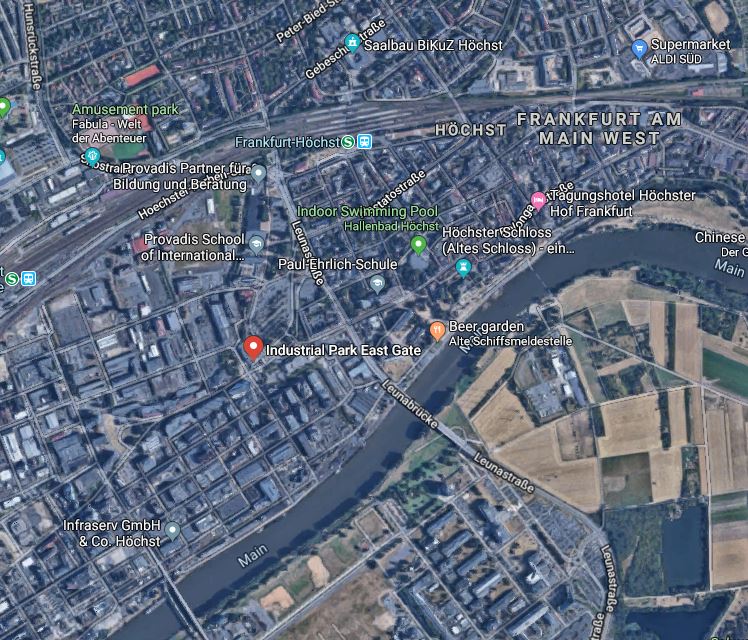
Note the Frankfurt Höchst station and Infraserv Höchst.
It seems to be all very convenient.
Alstom Coradia iLint Hydrogen-Powered Train Video
I’ve just found this video from Alstom.
Intriguingly, the video was filmed at Braunschweig Hauptbahnhof, which is in another part of Germany, about two hundred kilometres to the South-East of Hamburg.
There does seem to be several local services radiating from the City on lines without electrification.
My First Ride In An Alstom Coradia iLint
I’m finally, riding in a hydrogen-powered Alstom Coradia iLint train through the German countryside.
Not as quiet as the two battery trains, I’ve ridden, but that’s because It feels to me that the traction motors are crudely under the passengers and cardan shafts are used to drive the wheels!
Battery electric trains with regenerative braking should be virtually free of any mechanical noise. Both the Class 379 and Class 230 battery demonstrators were almost silent. As electricity generated from hydrogen doesn’t appear to generate much noise, then a hydrogen-powered train can also be almost silent.
From talking to fellow passengers, it would appear that the train has been very reliable in service.
Alstom are proving hydrogen would work well in a train designed for that purpose, but updating a DMU with a mechanical transmission, possibly isn’t the way to go.
Class 321 Breeze Train
I think that the Class 321 Breeze train will be quieter and faster.
It appears too, that if Alstom’s conversion follows the design of the Class 321 Renatus, the train will have a totally flat floor.
Come to think of it, I can’t think of a train running in the UK, that doesn’t have a totally flat floor!
The iLint, like the Lint has several sets of steps.
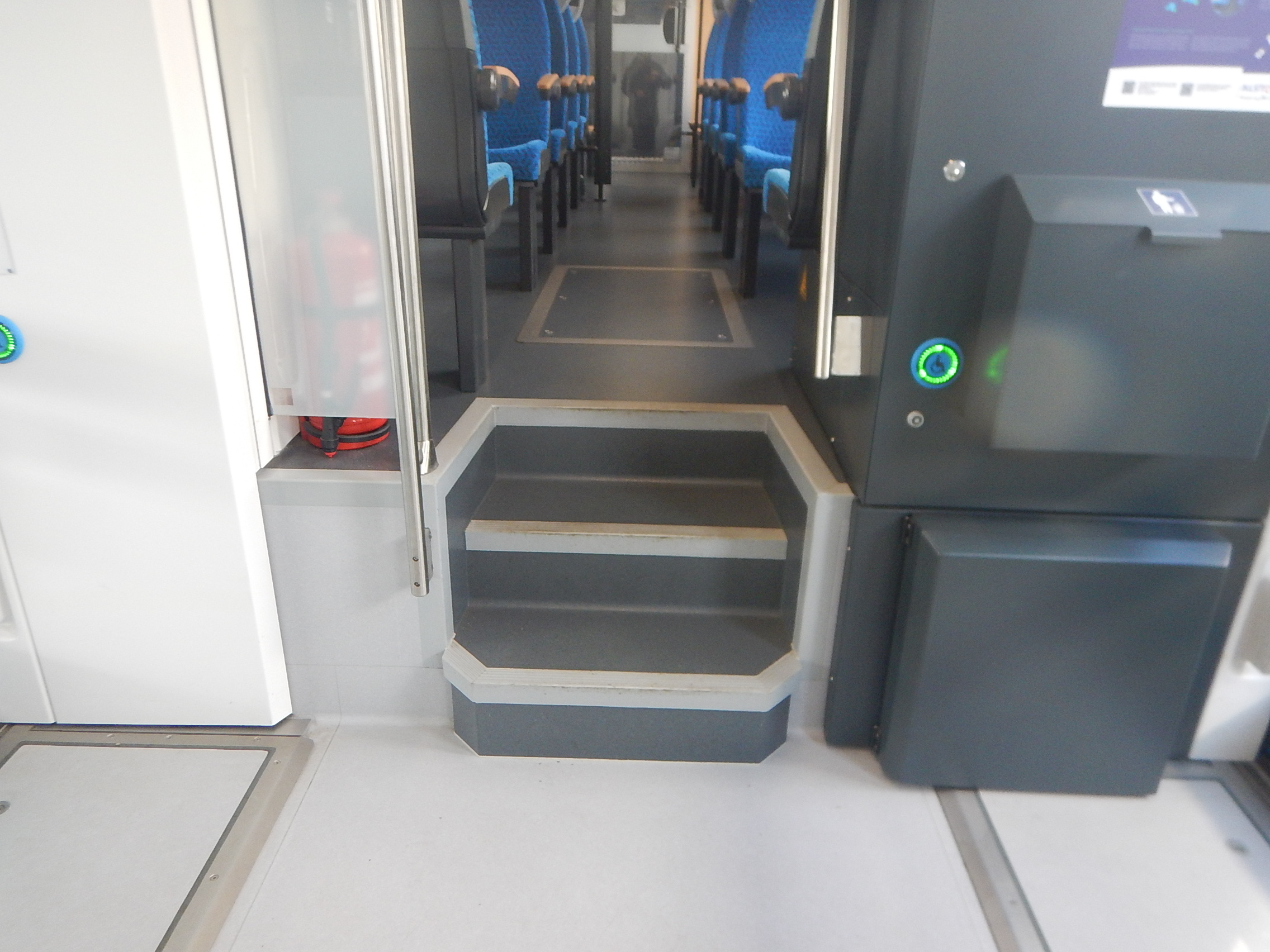
These are not acceptable in a modern train, bus or tram.
Lint 41 And iLint Compared
It is interesting to compare the iLint with the current diesel Lint 41s on the route.
- The iLint is faster and may accelerate better.
- The iLint is based on the bigger Lint 54, so it has more seats and two doors instead of one on each side of the cars.
- The newer iLint appears to have a higher quality interior.
I feel that the iLint will be quicker on a real.route.
The Future Of Buxtehude And Cuxhaven
Currently, to go between Buxtehude and Cuxhaven and back to Buxtehude takes around five hours. So that means the current hourly service needs five trains.
But if the iLint could do a round trip in four hours, the number of trains would be teduced to four.
If to increase capacity, all trains were pairs of iLints, the number of trains required would be eight.
Supposing it was required to double frequency, this would mean sixteen trains would be needed!
And how many trains have been ordered? Sixteen!
Coincidence or good planning?
Publicising The Achievement
When Bombardier created the Class 379 IPEMU, they made certain that there was a lot of local publicity including a report on BBC Look East.
I made a point of asking local residents about the train and no-one had heard of it. Although, I must say that students who regularly used the train, were very much in favour.
This was the only information, I found about the train.
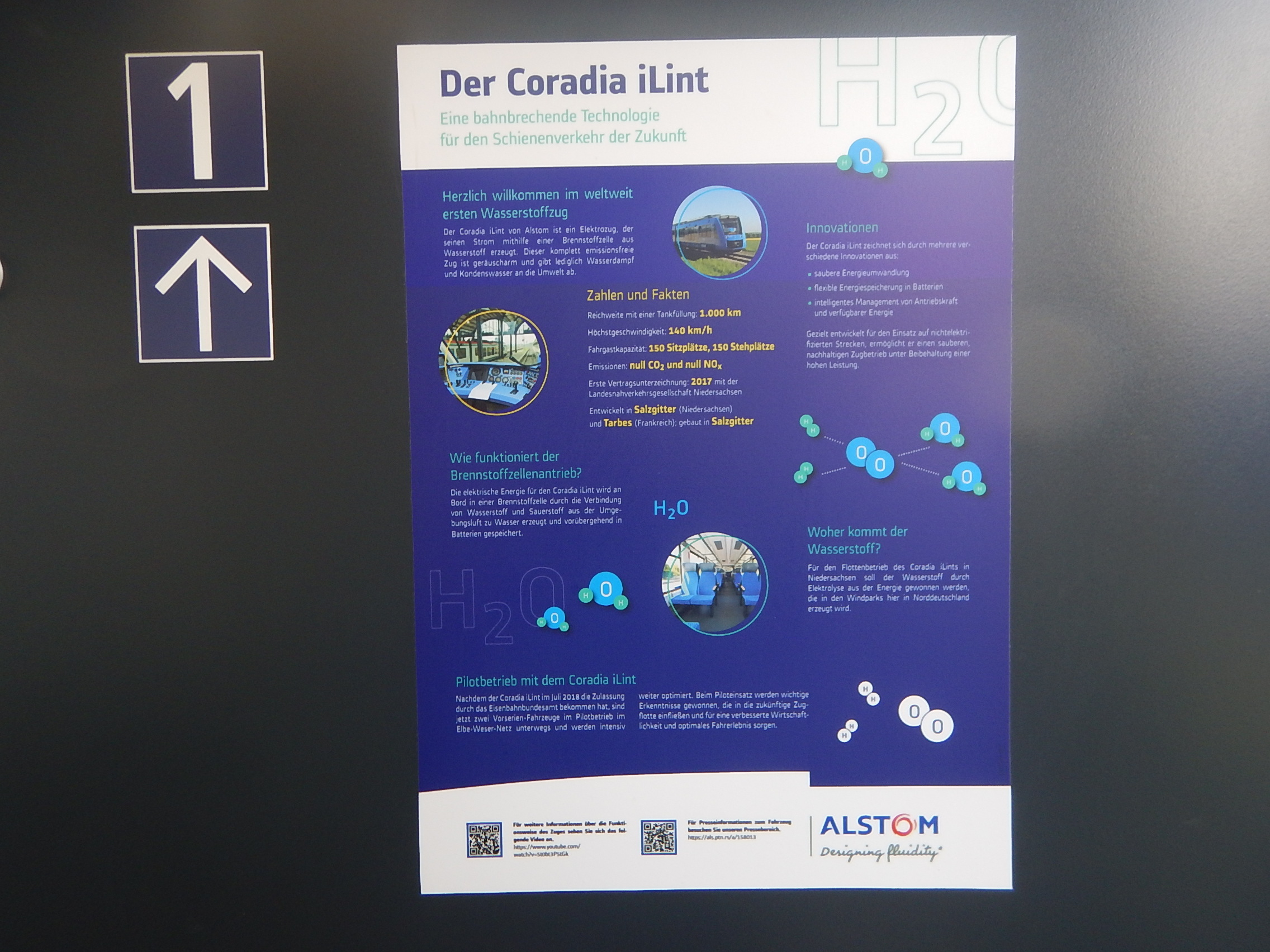
It was only in German, which I can read,. But surely, such an important achievement deserves better publicity and explanation in perhaps German, English and French.
Conclusion
Alstom have proved that hydrogen-power is possible in a smaller train, suitable for regional routes.
My reservations are totally about the Lint, which is an inferior train compared to many others that I’ve ridden in the UK and Europe.
I wouldn’t like to use the train in a wheel-chair!
The next generation of purpose-built trains with hydrogen power will be much better!

