From Mitre Bridge To Ladbroke Grove – 16th July 2015
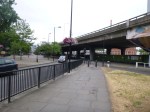
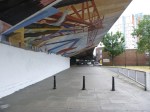
I walked from Mitre Bridge to Ladbroke Grove along the |Grand Union Canal.
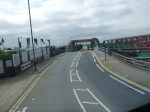
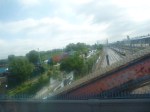
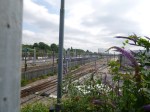

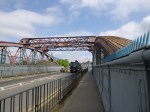
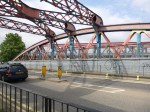
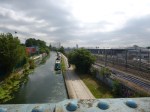
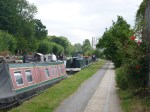
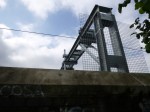

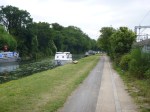

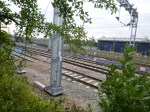

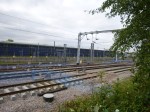
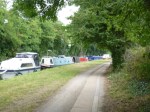
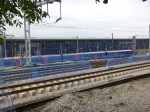
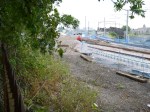
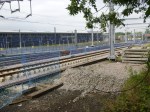
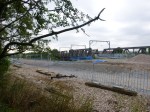


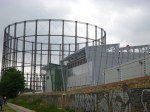
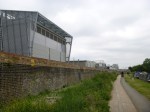
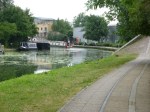
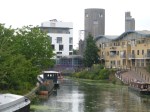

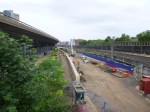
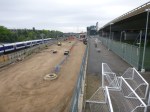
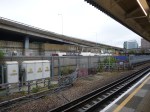
One aim was to see if I could get decent pictures of North Pole Depot, the Crossrail works and the flyover to the East of the depot.
I am endebted to this article on London Reconnections entitled Old Oak Common Part 2 – Putting the pieces together for this description of what happens in this area.
The track layout below is derived from the Context Reports produced in 2009 by Crossrail for each local authority, and then checked where possible against the HS2 plans. Among other features this shows a new ramp joining the existing GWML empty stock flyover just east of OOC. This new ramp gives a clear route to the Crossrail depot independent of the GWML depot lines, and the plans show it being built across the finger of land at the west end of the ex-Kensal Green Gas Works development site. It will be double track, and the alignment on the incline back down towards Old Oak Common will be widened so that the GWML empty stock has a segregated track down from the flyover.
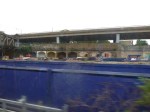
So the flyover is so that empty stock can get between the depots at Old Oak Common and Paddington.
Note that some of the new Crossrail tracks can be seen in the foreground of the pictures of North Pole Depot, which will be used for the Hitachi Class 800/801 trains for First Great Western. The tracks closest to the fence are the tracks leading to Crossrail’s depot. The two actual running tracks are further over and hidden by the ramp up to the flyover. They can be seen in this post in front of the retaining wall.
I’m not sure where actually Crossrail’s depot will be, but Wikipedia states that it will be at Old Oak Common. The article goes on to indicate that all will change again, when HS2 runs through the area.
Whitechapel Station – 13th July 2015
A week ago, it looked like they were preparing to create the concrete retaining walls.
These pictures show the progress.


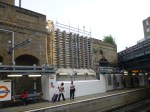
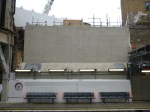
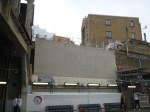
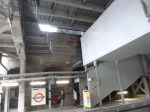
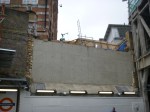
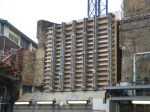
Whitechapel station seems to be coming on fast.
Note the following in the pictures.
1. The concourse between the two platforms of the District and Metropolitan Lines, which currently hosts a couple of cranes is starting to show its large size. I think that the escalators to the Crossrail platforms will be in the middle.
2. The emergency stairs from the Crossrail platforms.
3. It would appear there are bearing plates in the concrete retaining walls to perhaps support the walkway over the London Overground lines.
The next line closure through Whitechapel would appear to be on the 25th and 26th of July according to this Underground Planned Works Calendar. So take a look in the week of Monday the 27th of July. According to this list of Underground and Overground track closures, it looks like a busy weekend.
It’s fascinating being able to walk through a station being rebuilt around you.
Crossrail’s Shedule Of Improvements For Western Surface Stations.
I’m always looking for this page, which has a schedule of improvident for the station on the Western surface section of Crossrail.So I’ve put the link here, so I can find it.
The page finishes with this summary of the work.
The scope and timing of any work needed at Twyford and Reading stations has yet to be determined.
New station buildings are proposed at Acton Main Line, West Ealing, Southall and Hayes & Harlington stations with new footbridges providing step-free access to the platforms and new bay platforms at West Ealing and Hayes & Harlington. A new footbridge is being built at West Drayton station to provide step-free access to platforms 2-5.
Platforms will be extended at Ealing Broadway, West Ealing, Southall, Hayes & Harlington, West Drayton, Slough and Maidenhead stations. All stations will benefit from new signage, help points, customer information screens and CCTV.
It also gives expected completion dates.
Crossrail’s pages for the North-East and South-East surface sections are not so informative.
From Westbourne Park To Old Oak Common – 4th July 2015
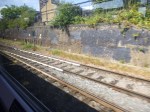
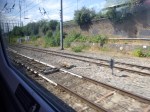
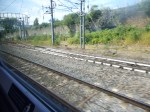
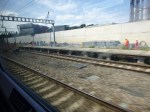
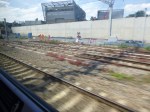
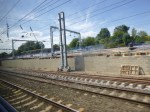
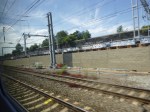
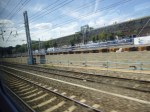
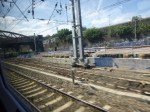
I took these pictures a few days ago as my train went along the Great Western Main Line to Southall and West Ealing.

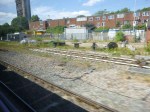




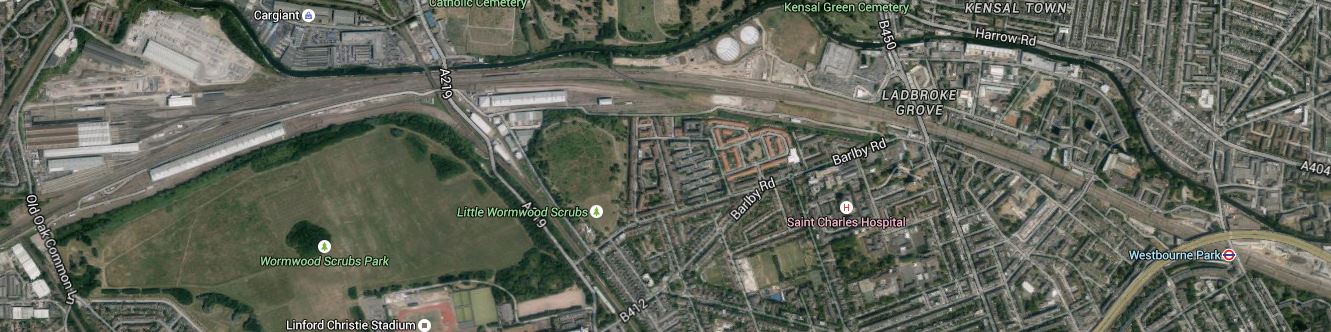
This is a Google Map of the area.
Along The Great Western
Old Oak Common and the various train depots are at the left (West) and Westbourne Park Bus Garage is at the right under the Westway, where it crosses the railway.
The Sainsburys at Ladbroke Grove was built on the site of the old Ladbroke Grove Gas Works. (You can still pick out the two gas holders by the canal.) I found this good page with lots of pictures on a blog maintained by the Royal Borough of Kensington and Chelsea. It says this about the site.
Where the Grand Junction Canal and the main line railway to Paddington diverge from their parallel course there is a teardrop shaped patch of land bounded on the east by Ladbroke Grove. In 1845 the Western Gas Company built a gas works there facing All Souls Cemetery on the other side of the canal. When North Kensington was developed for housing in the second half of the 19th century the Gas Works sat waiting at its northern edge. And there it stayed as London grew around it. In 1936 the Gas and Light Company built a progressive housing development on the Ladbroke Grove edge of the site powered by the wonder of gas, Kensal House, but more of that another day.
Today only a couple of gasometers remain overlooking the cemetery. Most of the site is taken up by a Sainsbury’s super store. But in 1970 although gas production had ceased the owners seem to have been wondering what to do with the gas works, and denying rumours that the whole site would be given over to housing.
It would appear that they are completely remodelling the North side of the railway opposite the North Pole Depot. This Google Map shows the area from Mitre Bridge to the flyover that crosses the railway.
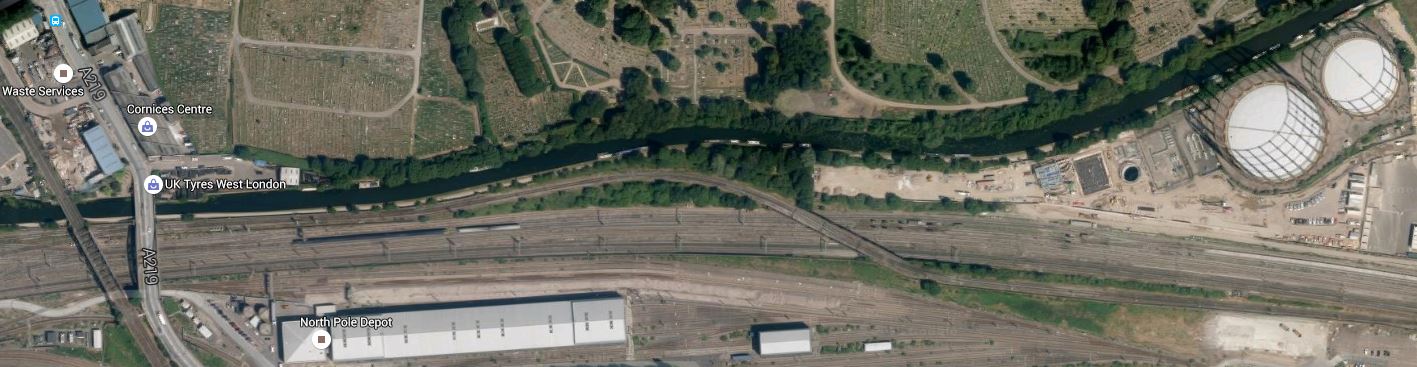
North Pole Depot And The Flyover
The two bridges at the left carry the West London Line and Scrubs Lane (Mitre Bridge) over the railway.The two circular structures at the right are the gas holders in the former Ladbroke Grove Gas Works.
The pictures in the gallery certainly show an impressive retaining wall is being built.
The last few pictures in the gallery were taken as the train ran past the train depots at Old Oak Common TMD, that I talked about in this post.
Bennetts Associated Designs For The Western Crossrail Surface Stations
I’ve put this link to a downloadable project sheet on the Bennetts Associates web site on this blog, as it gives an insight into the upgrading of the thirteen surface stations west of the central core.
Whitechapel Station – 6th July 2015
Whitechapel station always offers photo opportunities.
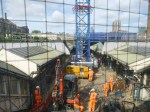
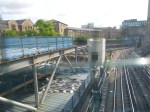

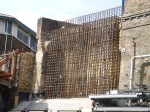
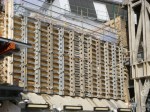
It would appear that they will be creating the retaining walls on the Overground platforms soon.
Crossrail Station Index
My post on Custom House station got me asking the question – In how many Crossrail stations, will there be a central island platform with two platform faces or a shared area possibly with platform edge doors serving both lines, rather than two separate platforms with the tracks together in the middle?
Crossrail is effectively a two-track railway and only a few stations have more than two platforms that will be used by Crossrail trains.
This is an index of all Crossrail stations, with links to their page on the Crossrail web site and Wikipedia.
Note that at present not all stations, have their own page on the Crossrail web site.
Abbey Wood Station – An existing station with two new Crossrail platforms. – Crossrail Wikipedia
Acton Main Line – An existing station with two separate Crossrail platforms and bridge transfer. Wikipedia
Bond Street – A new two-platform station with possibly a shared area between them. – Crossrail Wikipedia
Brentwood – An existing station with two separate Crossrail platforms and bridge transfer. Wikipedia
Burnham – An existing two-platform station with an island platform. Crossrail Wikipedia
Canary Wharf – A new two-platform station with a shared area between them. – Crossrail Wikipedia
Chadwell Heath – An existing station with two separate Crossrail platforms and bridge transfer. Wikipedia
Custom House – A new two-platform station with a shared area between them. – Crossrail Wikipedia
Ealing Broadway Station – An existing station with two separate Crossrail platforms and bridge transfer, that will be rebuilt. Crossrail Wikipedia
Farringdon – A new two-platform station with a shared area between them. – Crossrail Wikipedia
Forest Gate – An existing station with two separate Crossrail platforms and bridge transfer. Wikipedia
Gidea Park – An existing station with two separate Crossrail platforms and bridge transfer. Wikipedia
Goodmayes – An existing station with two separate Crossrail platforms and bridge transfer. Wikipedia
Hanwell – An existing station with two separate Crossrail platforms and subway transfer. Wikipedia
Harold Wood – An existing station with two separate Crossrail platforms and bridge transfer. Wikipedia
Hayes and Harlington – An existing station with two separate Crossrail platforms and bridge transfer, that will be rebuilt. Crossrail Wikipedia
Ilford – An existing station with two separate Crossrail platforms and bridge transfer. Wikipedia
Iver – An existing station with two separate Crossrail platforms and bridge transfer. Wikipedia
Langley – An existing station with two separate Crossrail platforms and bridge transfer. Crossrail Wikipedia
Liverpool Street – A new two-platform station with a shared area between them. – Crossrail Wikipedia
Maidenhead – An existing station with two separate Crossrail platforms and subway transfer. Wikipedia
Manor Park – An existing station with two separate Crossrail platforms and bridge transfer. Wikipedia
Maryland – An existing station with two separate Crossrail platforms and bridge transfer. Wikipedia
Old Oak Common – A new station to be designed and built after Crossrail is completed. Wikipedia
Paddington – A new two-platform station with a shared area between them. – Crossrail Wikipedia
Reading – A large existing station, which has been future-proofed to act as a terminal for Crossrail. Wikipedia
Romford – An existing station with two separate Crossrail platforms and bridge transfer. Wikipedia
Seven Kings – An existing station with two separate Crossrail platforms and bridge transfer. Wikipedia
Shenfield – An existing station with three separate Crossrail platforms and subway transfer. Wikipedia
Slough – A large existing station with two separate Crossrail platforms and bridge transfer. Wikipedia
Southall – An existing station with two separate Crossrail platforms and bridge transfer, that will be rebuilt. Wikipedia
Stratford – A large existing station with two separate Crossrail platforms and subway transfer. Wikipedia
Taplow – An existing station with two separate Crossrail platforms and bridge transfer. Crossrail Wikipedia
Tottenham Court Road – A new two-platform station with possibly a shared area between them. Crossrail Wikipedia
Twyford – An existing station with two separate Crossrail platforms and bridge transfer. Wikipedia
West Drayton – An existing station with two/three separate Crossrail platforms and bridge/subway transfer. Crossrail Wikipedia
West Ealing – An existing station with two separate Crossrail platforms and bridge transfer, that will be rebuilt. Wikipedia
Whitechapel – A new two-platform station with a shared area between them. – Crossrail Wikipedia
Woolwich – A new two-platform station with a shared area between them. – Crossrail Wikipedia
Custom House Station – 5th July 2015
Custom House station has been progressing and now even has some glass in the windows.
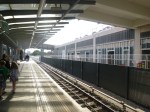
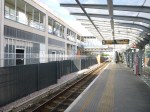
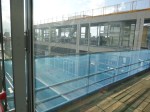
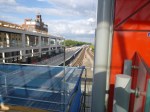


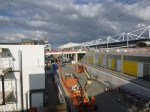
You can also see that the Crossrail trains will go either side of the central building. It now appears that this is the preferred way to design a new station.
At Custom House station it will mean that passengers arriving at the station from Excel or on the DLR, would appear to go to the same platform, which will have two faces; one for Central London and one for Kent.
When you consider that London Underground deep-level stations since the 1930s have been designed this way with a central platform, it puzzles me, why we have such uninspiring recent station designs like the Thameslink platforms at St. Pancras.
Where you have a two-track railway, the layout must be more affordable, as you only need one set of lifts/escalators/stairs and other services.
On the other hand, you need a bridge over the tracks or a subway beneath them, where the railway is on the surface. Obviously in some places the geography of the area, will make this easier. For example if a station is in a cutting or there is a road bridge.
At Custom House a large proportion of passengers will arrive at First Floor level either from Excel or after taking a short escalator up from the DLR, so there will only need to be access from the street up to the First Floor circulation area, from where I took these pictures. At present the DLR uses steps and a lift. I’m sure the completed station will use an elegant solution with probably escalators instead of stairs.
A Circular Walk From Royal Oak Station
When I wrote about my last visit to Royal Oak and the Westbourne Park Footbridge in October last year, I said this.
It will be fascinating to go back here, to see the area, as the railway and its infrastructure progresses.
So this morning, I went back and took these pictures, to see if they could add to what I saw yesterday.
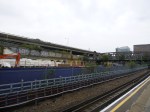
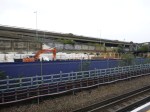
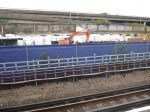
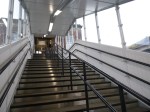
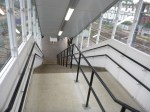

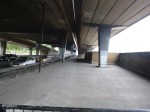
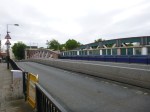


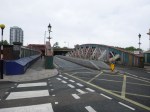
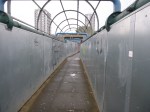
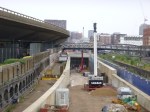
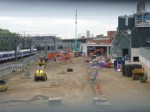
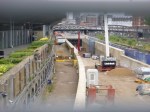
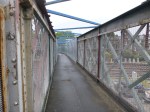
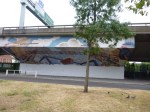



Things have moved on apace.
1. Royal Oak station is no longer the rusting ruin it was last year and all of the glass is now clear and immaculate.
2. Crossrail has also dropped the height of the blue security fence, which means tall people can get good pictures of the Crossrail site from the platform of Royal Oak station.
3. It is now clear that the arches support the slip road up to the Westway and that they may have once supported an old railway line.
4. I was pleased to see the lith-style information displayed in a poster. It must help with putting information in places, which are too small or not suitable for a full size lith. It all goes to show how good, Legible London is.
According to Wikipedia, it is now the world’s largest pedestrian wayfinding project. So if Ipswich can have one, why can’t any number of important capital and tourist cities.
5. Crossrail’s Royal Oak Portal is now clearly visible from the Westbourne Park Footbridge and the pictures show what a tight squeeze the double-track railway is between the Westway and the Metropolitan Line.
6. I don’t think it will be long before they start laying track, as this will make it easier to get men and materials in and out of the tunnels.
7. I have read that between the portal and the existing bus garage, the area will be used to store trains and also turn back those running to Paddington. The bus garage extension is being built over the sidings.
Crossrail is certainly coming together in Westbourne Park, where it squeezes between the Westway and the Great Western Main Line.
Crossrail’s Royal Oak Portal
Unlike the Crossrail tunnel portals at Abbey Wood and Stratford, the portal at Royal Oak is rather hidden away under the Westway, with no suitable vantage point to see the site. This Google Map shows the tunnel portal from Royal Oak station to the footbridge at Westbourne Park, where I took these pictures.
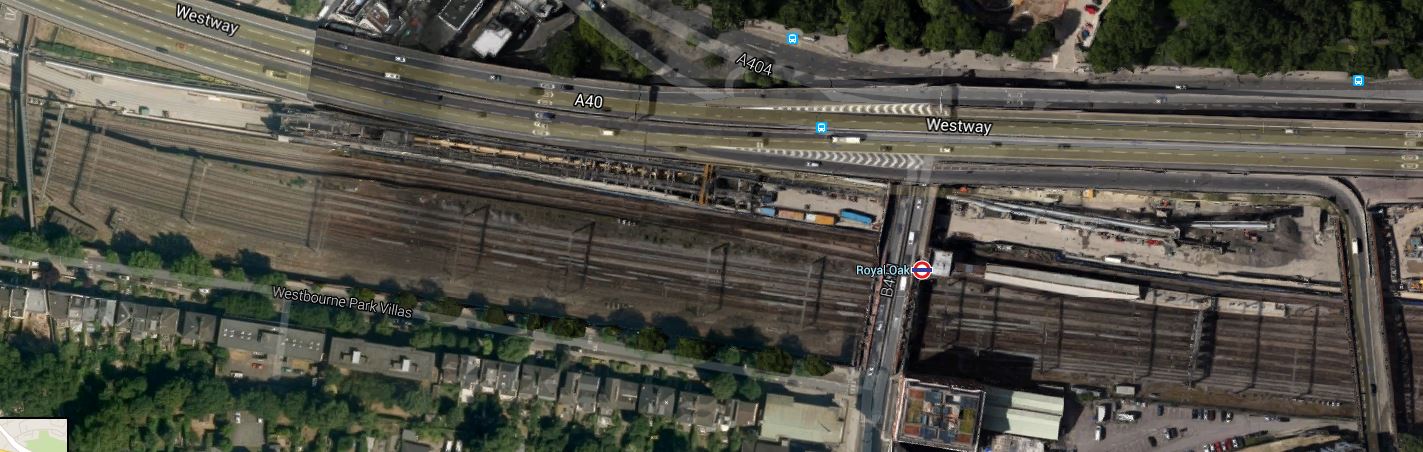
Royal Oak Tunnel Portal
It shows the cramped nature of the site, which is just 21m. wide. This is an enlarged image of the ramp leading down to the start of the tunnel under London.
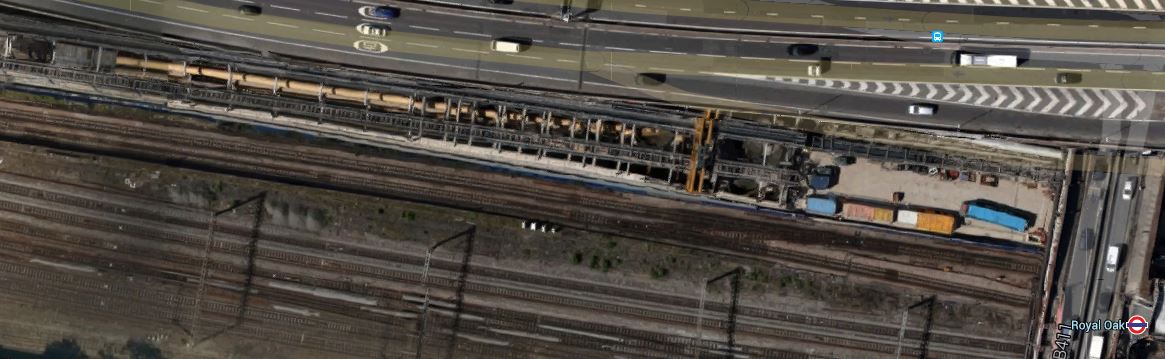
An Enlarged View
The only pictures I can find on the web with a proper explanation are in this article on the London Reconnections web site. In that article a picture is labelled as the remains of the arches and they are shown under the Westway and facing South. They are probably the arches in these pictures I took from the train.

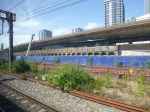
I am not sure, but it looks like the arches support the access ramp that lead up to the Westway. But they are not shown in this architectural drawing from Acanthus, which shows the area around the Ventilation shaft they have designed for Crossrail.
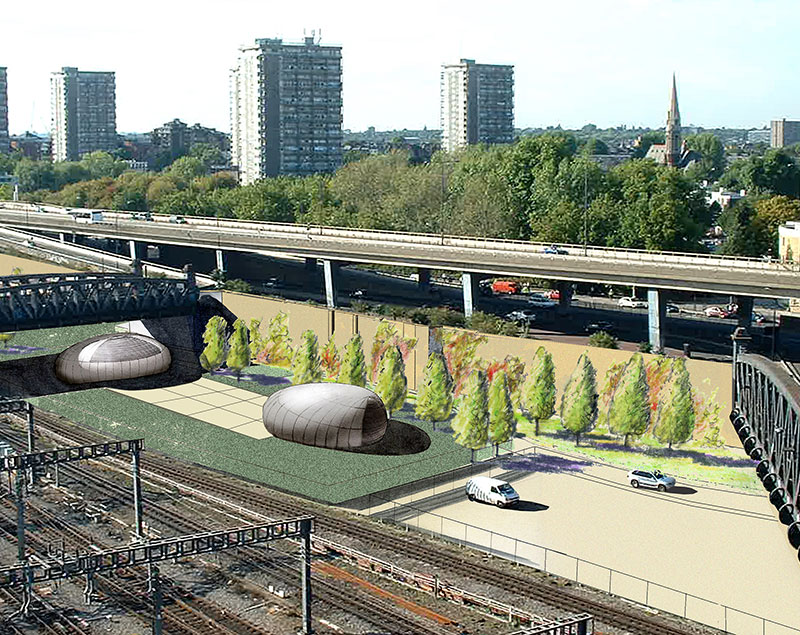
Crossrail Ventilation Shaft By Acanthus
This Google Map shows the current access with relation to the two bridges and Royal Oak station.
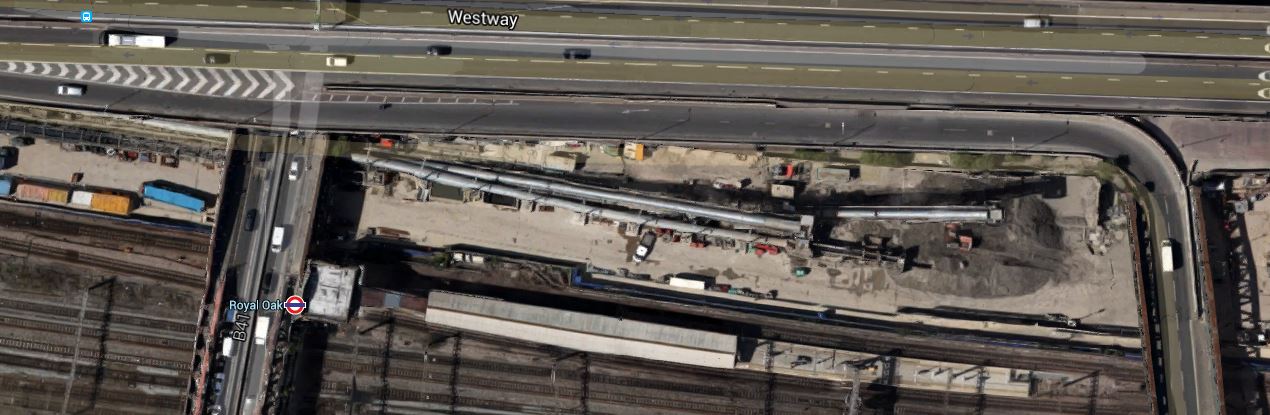
Access To The Westway
Note the long pipes, which I assume are either covering conveyors that remove the spoil for the tunnels or are to there to pump fresh air into the tunnels.
The station has recently been renovated, but once Crossrail is complete to the North of the station, are we going to see a comprehensive redevelopment of the area.
All will be revealed in time.
 The Anonymous Widower