Getting Emotional
Since the last stroke, I sometimes get a bit emotional. When people ask how I am and they say nice things, sometimes it can make me cry. But then I’ve been through a lot with the death of C and our youngest son and the strokes haven’t helped.
But then I’ve always been a bit like that. This piece is from the book I wrote about life with C.
There are quite a few people, places and events that have radically altered the way that I think and how I conduct my life. One event was the death of Jan Palach in Czechoslovakia. He committed suicide by setting himself on fire in Wenceslas Square on January the nineteenth, 1969, as a protest against the Soviet invasion.
I swore to C that one day, I would stand in Wenceslas Square in a totally free and liberated Czechoslovakia.
With the coming of Go, British Airways low-cost airline started by Barbara Cassani, Prague was suddenly a short flight away from Stansted. I should have gone earlier, as the Velvet Revolution that had ousted the Soviet-backed Communist regime had been ten years before.
But I hadn’t and I regret that.
We stayed at the Hoffmeister, which has all the charm and service expected of a Relais & Châteaux hotel. It was seriously good and from reading reports on the Internet, it still appears to be.
The weekend was our thirty-third wedding anniversary, but I have no recollection of where or what we ate on the seventh. All I do know is that the food and wine was excellent throughout the time we were in Prague.
But it was to stand in Wenceslas Square that was one of the main reasons that we had gone to Prague.
I cried!
And I cried buckets!
Will I ever be able to do the same in Harare, Rangoon and the many other places in this world, where people are oppressed and murdered by the state?
I wrote that in probably about January 2008 soon after C died. Do I feel the same now? Perhaps, I actually feel stronger about the last statement, as there are other places I could add to the list.
I sometimes wonder how C felt about Jan Palach! She booked that trip and she knew how I felt. But remember too, than he was only 15 days older than she was!
Perhaps I should return to Prague? I will only do that, when there are no more demons in my mind, dragons to slay and goals to fulfil.
In other words, I never will return!
Why Do We Honour Thugs?
The reaction on Facebook and other places to the death of Raoul Moat has been astonishing, almost to the point of being sick. David Cameron was absolutely right in Prime Minister’s Questions, yesterday. Facebook’s refusal to take pages down that make Moat a hero is typical of them, as they believe all publicity is good publicity. Moat has truly found his five minutes of fame, albeit posthumously.
From what I have read about Moat, he was the sort of man, that I would normally avoid like the plague. He had problems and had actually asked for help, but the system failed him and the people he shot, by not doing more to help him. This seems a familiar tale and could it not be said that the Cumbrian gunman, Derick Bird, had similar problems and no-one took action with disastrous consequences.
It would take a fortune to check up on everyone, who is a potential serial killer, but there are things we can do like better gun control and door-staff licencing, that might find these characters and try to sort them out in a positive way!
Between Life and Death
This program on BBC1 last night, was not the sort of television I usually watch, as I jokily say I’m allergic to hospitals. I suppose, that as I’ve seen the inside of them so much in recent years, what with the death of C and our youngest son, and now my strokes, it is quite understandable.
But for some reason, I didn’t turn the program off last night. Partly because it was Addenbrookes, I suppose and I do have a respect for the place after what they have done for my family. I’ve also played tennis with several of the doctors and know the cutting-edge ethos of the hospital, which is pushing the boundaries of what is possible.
In the end I found it very uplifting and almost supportive of my recovery, albeit from a very minor problem to those shown in the program. I could relate to all the people in the program on various levels, as a scientist, a father and a patient.
If there is one lesson we should all learn from last night’s program, it is that we shouldn’t stop funding units, such as this at Addenbrookes, in these times of austerity. You can’t put a price on human life and with this units, there must be much they are learning that can be applied across the NHS and the wider world. There are also other lessons to be learned by us all and let’s hope that someone, who watched the program last night, is moved to improve his behaviour or driving skills, so that he avoids the need for going to hospital. That would be a positive benfit for everyone and everything.
We might all learn that human life is precious!
The Kettleburgh Chequers
Yesterday, we went for a trip to East Suffolk, an area I know well, as I used to live at Debach. It was also an area, in which I followed hounds for seventeen seasons with The Easton Harriers. If you want to read more about those days in the 1970s and 1980s, read Tony Harvey’s book, Not a Penny in the Post. Hunting in that part of Suffolk, was as much about the community as it was about the hunting. Everybody, and I do mean everybody was totally welcome. It has to said that in those yeas, I learned more about the countryside, famring and wildlife, than at any other time in my life.
We passed the Kettleburgh Chequers.
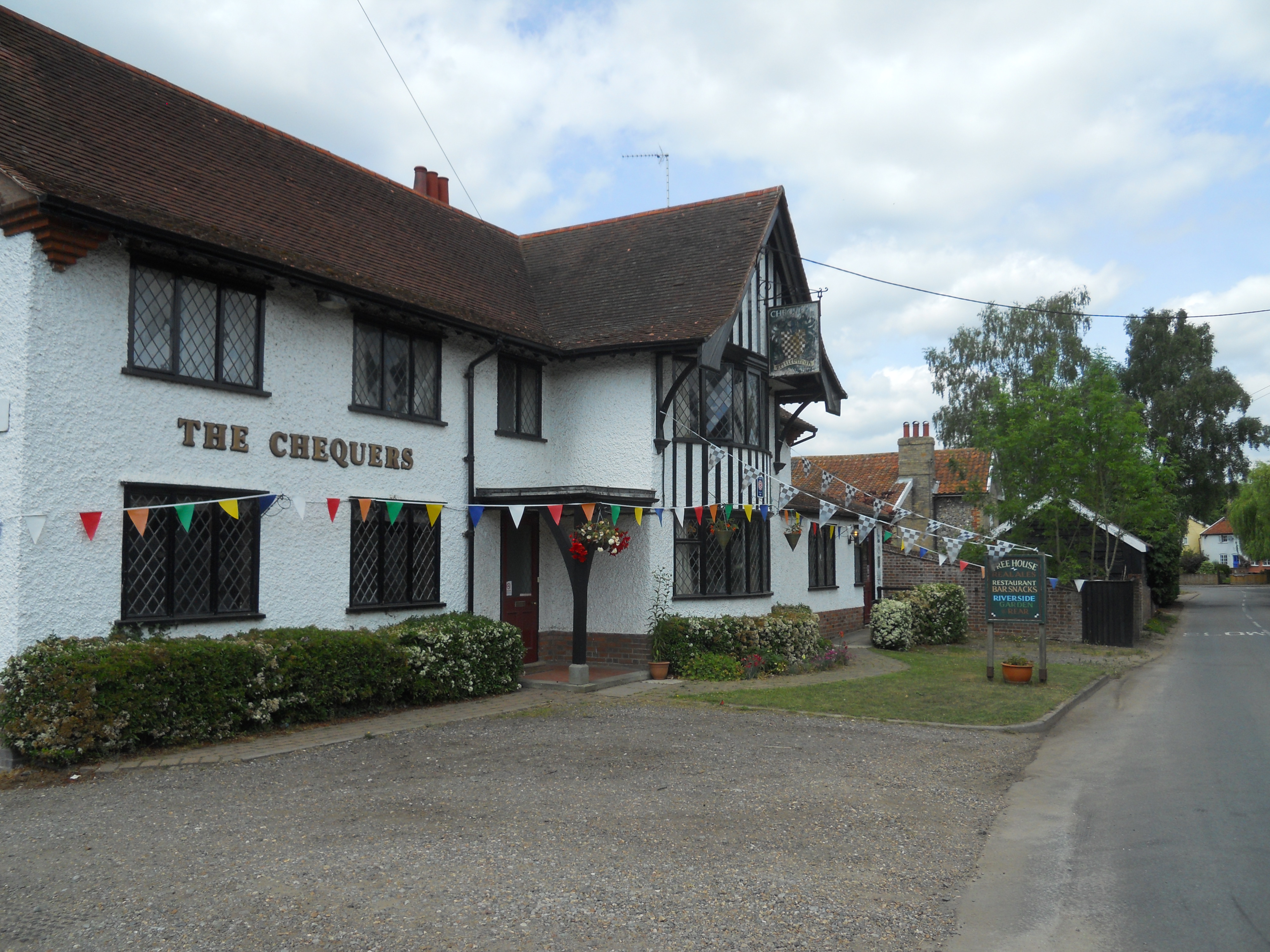
The Kettleburgh Chequers
On the 10th of February in 1981, we held a gentlemen’s day in this pub to raise money for hunt funds. We met at the Kettleburgh Chequers at eleven and started hunting at about three, after quite a few drinks. C had dropped me and my horse at the meet and in the end, I hacked home to Debach, so there was no danger of drinking and driving. But when you hunted, it wasn’t always like that, but I can’t ever remember anyone getting into trouble, except from falling off a horse.
That day for a bet before hunting, Jimmy Wickham, the kennel-huntsman, actually brought the hounds into the bar.
As Tony says in the book, it wasn’t the best days hunting, but after a meal at Snape in the evening, it will be one of those days I’ll always remember.
For those who criticise hunting remember this. The hunts in those days used to collect and often humanely destroy all those animals that had died or needed to be put down in the countryside. We all come to our time in the end.
I always remember Tony Harvey once saying after a day, when we had hunted three packs of hare hounds in one day; harriers on horseback before breakfast, bassets in the morning on foot and beagles, again on foot, in the afternoon, the following. “We’ve had a very good day, but we haven’t caught anything. Ask a shooting man, if he’s had a good day, when he hasn’t shot anything.” That is the difference between hunting and shooting. I am passionately anti-anything to do with guns, as they kill people. It needs skill and in some cases courage to ride to hounds.
The last epitaph on hunting, is that on my stud since the hunting ban, I never see or even smell a fox. The ban has done nothing for the fox. All sorts of things can be postulated, but remember our foxes are rabies free, so have they been trapped by those who don’t value the countryside for their fur. I don’t know, but they have all disappeared. Or perhaps they’ve all gone to London, where they are a true menace.
Note that in Suffolk, you always name a pub with both the village and it’s actual name. This avoids mistakes, as there are numerous White Horses for example.
Farewell to a Brave Man
I’m not the greatest fan of rugby union, but I can remember Andy Ripley in his pomp. Andy has just died after a long and valiant battle against prostate cancer. He will be remembered for a long time.
Liverpool Reborn
Stephen Bayley wrote an article in The Times yesterday about how inspiring architecture is creating wealth, health and happiness.
Cities are living organisms. This means sometimes they die. Pompeii is one example, although no one saw it coming. Detroit’s fate was more predictable, possibly even inevitable: Motor City is stuck in reverse and headed for oblivion.
Liverpool nearly died. Like Detroit, it fell at great speed from economic and social grace. Unesco World Heritage credentials describe old Liverpool as “the supreme example of a commercial port at the time of Britain’s greatest global influence”. It was the New York of Europe.
He talks about how good architects have rebuilt the city and made it fit for the twenty-first century, but observes that politicians in London haven’t noticed. London to me is a city of good modern architecture, but save for a couple of nice buildings, those bridges and Grainger Town, Newcastle doesn’t seem to have been improved. Surely now, in the depths of a recession, we should be encouraging good building to leave a legacy to the future and also provide the jobs and homes we need. I’m not sure you need that many more shops and offices, though.
He ends the article by asking what makes a good building. He believes it is one that makes you feel better. He is absolutely right and having created a few in my time, I like to think I know how to create them. I shall create another when I return to London. Somewhere to live and somewhere where I will probably eventually die.
But then Liverpool in the 1960s turned me from a shy young boy with ideas into a shy young man with ambition, drive and a strong belief in myself. It does that to people. Even now, I go back occasionally to make sure that I know what life is about. It is still the second city of the UK despite what others say.
I shall be buying his book. If nothing else it will give me the faith to carry on in this world.
Chimpanzees Grieve
There have been a lot of reports on the BBC about the death of a female chimpanzee in a safari park.
It shows how closely we are related to them and like us they have feelings too.
The interesting thing is that the chimpanzee who died was probably about sixty. That is older than my late wife.
Stupid Letter of the Week
This is from Private Eye, but it is worth repeating here.
Spot the flaw in this letter to Eye reader Carl Mungal, who wrote to Sky to cancel his late mother’s account.
“I’m sorry to hear about your loss and would like to offer my condolences. As this account is not registered in your name, I;m unable to process your cancellation request. To be able to cancel the above account, we’ll need the account holder to contact us.”
It’s not the first time an organisation got their bereavement process wrong! Every one should have a simple set of rules that they apply. They might even get more business, as it would show them to be someone who cares.
An Undertaker’s Tea Party
The headline in The Times today compares Prudence’s launch of his campaign to an undertaker’s tea party.
It was a no-frills launch, positively Presbyterian in its austerity. Some said that Gordon Brown and his Cabinet looked just plain grim, like undertakers on a tea break. And it must be said, as they trooped out of the gleaming black door of No 10 at 10.48am, they did look as solemn as a sermon. The only thing sunny was above us, in the sky, on this lovely spring day that was troubled only by a soft breeze.
The launch cost nothing, a price Gordon can afford. The PM spoke through a mike hidden in the lapel of his Sunday best suit. His hair was (suitably) grey and newly cut, as perfect as a bowling lawn. The look of pure concentration on his face as he stood before us, the Cabinet fanned out on each side, looking like the Politburo but not as much fun, was that of a little boy desperately trying to remember his lines.
Certainly, he and his cabinet all look grim in the photo. But then the threat of redundancy affects people like that.
I do think though this article is rather a slur on undertakers. I met a quite few lately and I would never call them grim. Professional and serious, maybe, but then you would expect that.
German Practicality
Two women have been arrested at Liverpool Airport trying to smuggle the body a dead 91-year-old German home.
Here’s the first couple of paragraphs from the BBC report.
Police have arrested two women after they tried to take the body of a dead relative onto a plane at Liverpool John Lennon Airport.
Staff at the airport became suspicious when the women tried to check the man in for a flight to Berlin on Saturday.
The 91-year-old man from Germany is thought to have died the previous day, and had been put into a wheelchair.
But they should have realised that because we’re not in the Shengen area, that passports would have to be checked.
It reminds of the story of the family in the early 1960s or so, who went on holiday to the South or France with an elderly grandmother. Sadly, she died in somewhere exotic like Cannes and they wondered what to do. They didn’t have any insurance to bring the body home, so they wrapped granny up in a blanket and tied her to the roof-rack.
When they got to Dover, they did what every dutiful Briton would do and reported it all to Immigration. The Officer just looked calmly and said that the roof-rack was empty.
 The Anonymous Widower