Has The Possibility Been Created For A Pedestrian Tunnel Between Bank And Moorgate Stations?
This visualisation shows the Bank Station Upgrade at Bank station, which is now underway to sort out the station’s problems of capacity and poor step-free access.
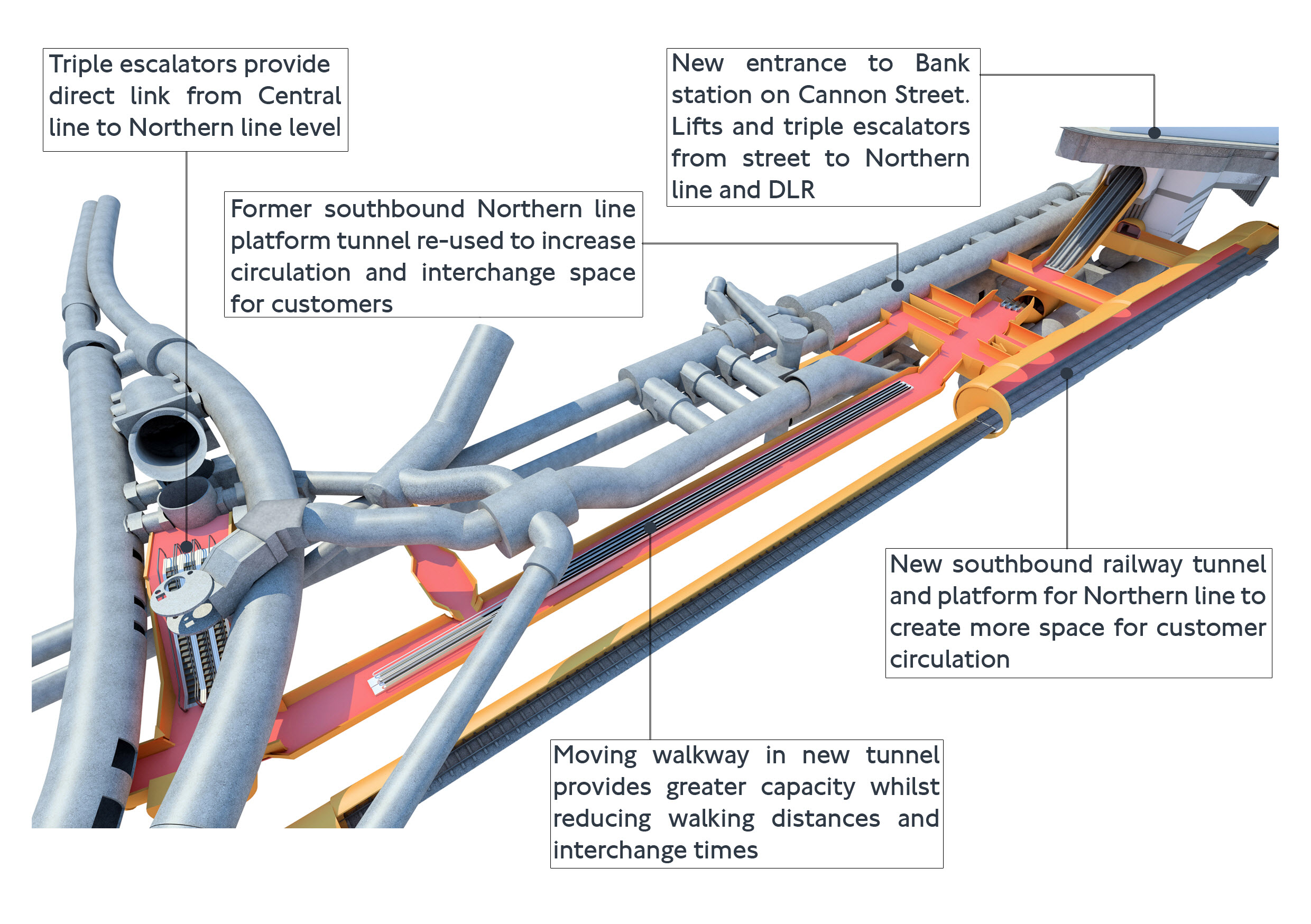
This is the bottom-left corner of the visualisation.
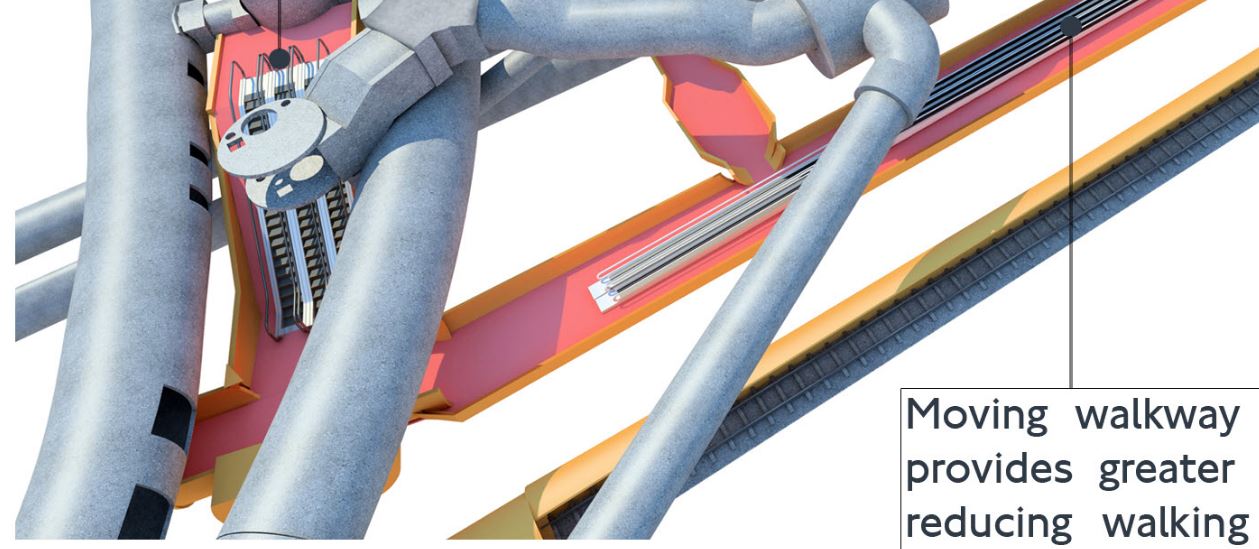
Notice that there are two fat tunnels running top to Bottom across the visualisation, which are the Central Line tunnels, with the Eastbound on the left and the Westbound on the right.
There are also four tunnels running left to right across the visualisation.
The top two, which are sticking out to the left of the Eastbound Central Line tunnel, are the current Northern Line running tunnels
- The top one is the Northbound tunnel going to Moorgate station.
- The other one is the current Southbound tunnel, which under the plans for Bank station will be closed to trains and used to improve passenger access to the Northbound platform. If you go to the Northern Line platforms, there are tell-tale blue hoardings, indicating where better access will be created.
These pictures show the current state of the current Southbound tunnel.
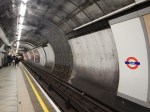
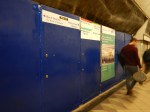
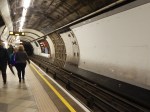
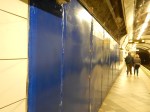
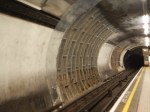
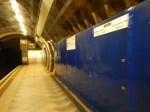
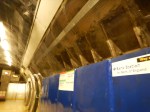
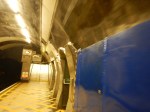
It looks like at least three sections of the wall between the two platforms will be removed.
The third tunnel, which is shown pink in the visualisations is the connecting tunnel between the Central Line and the new entrance to the station on Cannon Street.
Note the following.
- It has a travelator.
- it connects to a lobby, where there are triple escalators to the Central Line.
- It appears to come to a stop under the Eastbound Central Line platform.
What lies at the Northern end of this tunnel?
The fourth tunnel, which is the new Southbound running tunnel for the Northern Line, has been helpfully drawn with a rail track inside.
This is the top-right corner of the visualisation.
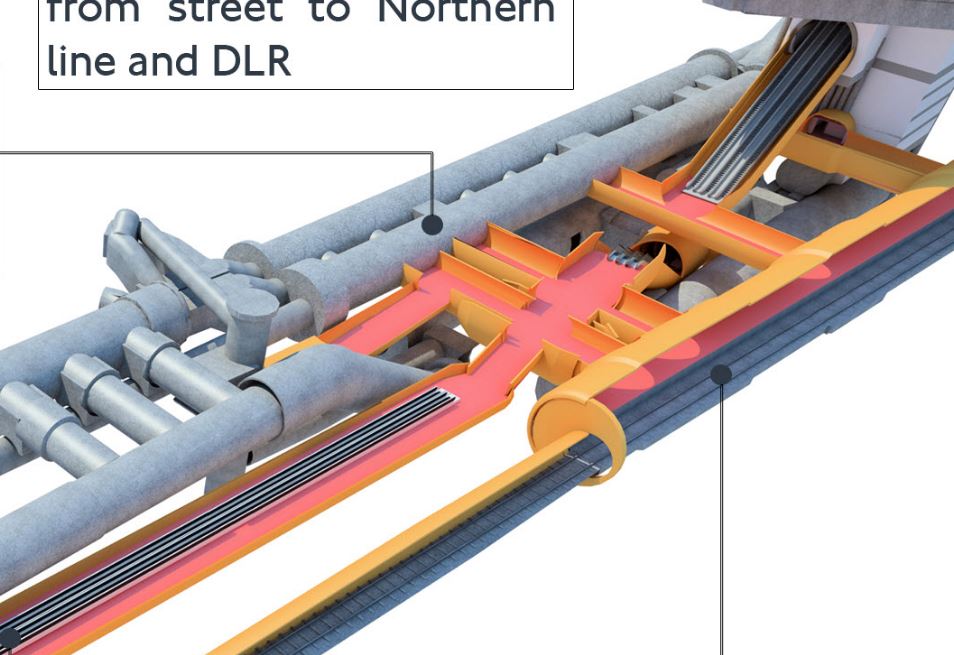
Note.
- There are three cross passages between the two running tunnels, just as there appears to be three blue hoardings in the existing Southbound running tunnel.
- The Northbound running tunnel now has a wide platform, which has been built inside the existing Southbound tunnel.
- The new Southbound running tunnel will be built with a wide platform.
- There are three escalators leading to the new Cannon Street entrance.
- There are three escalators leading down to the Docklands Light Railway (DLR) platforms
This map from carto.metro.free.fr, shows the layout of lines at Bank station and between Bank and Moorgate stations.
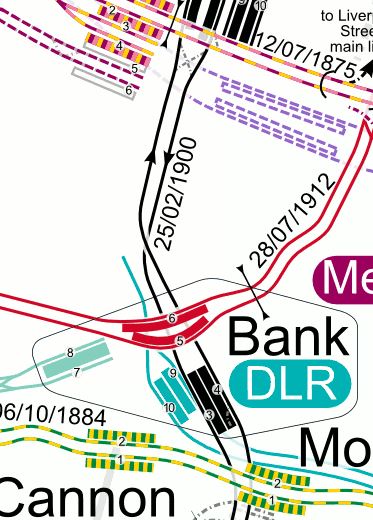
Note.
- The Central Line is shown in red.
- The Northern Line is shown in black.
- The DLR is shown in turquoise.
- The two Northern Line tracks cross to the North of Bank station.
- The lines at Moorgate station are shown at the top of the map.
- Crossrail is shown in violet.
The new Southbound tunnel will be created to the West of the DLR platforms.
This article on IanVisits is entitled Behind The Scenes At London Underground’s Bank Tube Station upgrade.
I suggest you read the article and I feel, you will get the impression the Bank Station Upgrade is a very difficult project, that is being achieved in an innovative manner by the contractors.
In one section, the article describes how they are actually building the new Southbound tunnel, through the piled foundations of existing buildings.
A Travelator Between Bank and Moorgate Stations
I now feel I can answer the question in the title of this post.
The Route
If the route started at the Northern end of the long connection tunnel with the travelator at Bank station, a route could probably be found on the West side of the Northern Line to break-in to the basement of the Crossrail station at Moorgate station.
This image shows a cross-section through the Moorgate Crossrail station.
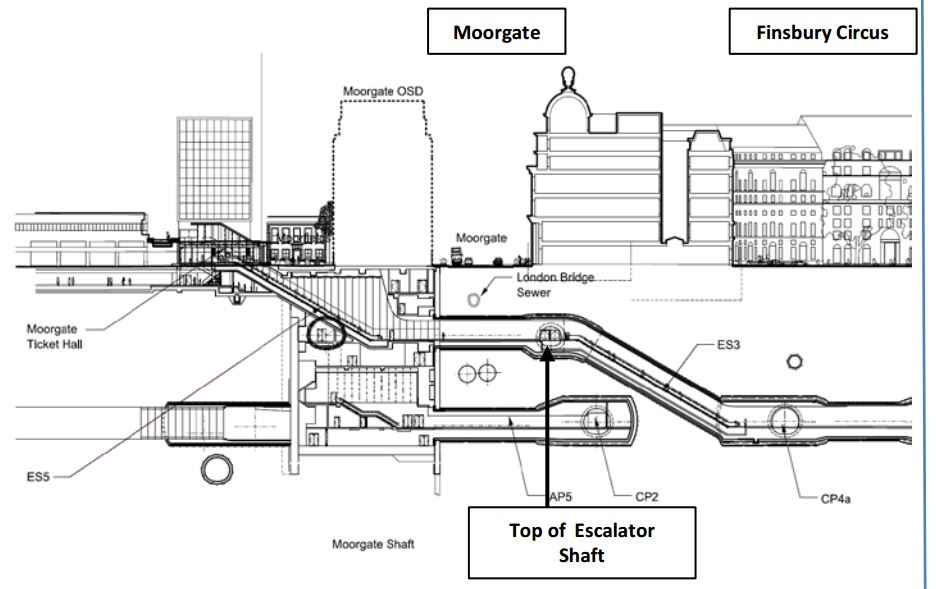
Note that under the escalators leading down from the Moorgate Ticket Hall to Crossrail, are a pair of circles.
- These are the Northern Line running tunnels.
- A travelator tunnel would be at this level but perhaps twenty or more metres to the West (left in the cross-section).
With modern design and construction techniques, I would expect that a connection could be made.
The Length
I estimate that the travelator would be between three and four hundred metres long.
As there are longer travelators either built or in planning in the world, I suspect, the length wouldn’t be a problem.
By comparison, these are example travelators in London.
- Jubilee to Northern/Bakerloo Lines at Waterloo – 140 metres.
- Sloping travelators to Waterloo and City Line at Bank – 76 metres
- Proposed Central to Northern Lines at Bank – 94 metres
A travelator between Bank and Moorgate stations would probably be, the longest in London.
Building The Tunnel
If you read the IanVisits article, it details how the new Northern Line and travelator tunnels at Bank station were excavated.
I suspect similar techniques could be used to build the new tunnel.
The biggest problem would be removing the tunnel spoil and I suspect that if the tunnel were to be built, when a building on the route needed to be replaced, this would make construction a lot easier.
Why The Tunnel Should Be Built
The main argument for building the tunnel is that it would connect Bank station directly to Crossrail.
Why The Tunnel May Not Be Needed
There are various reasons, why the travelator may not be needed.
Pedestrianisation
The City of London is in favour of pedestrianisation and has already disclosed plans to make Bishopsgate, which is one of the most important North-South arteries through the Square Mile, much more pedestrian friendly.
I would expect more initiatives like this to follow.
So many travellers will use their feet on the surface, between Crossrail and Bank, when the two stations are completed.
Improved Northern Line Connections
The connections to the Northern Line will be improved at both Moorgate and Bank stations, when Crossrail and the Bank Station Upgrade are completed.
So those travellers needing or wishing to do a one-stop transfer, will find it easy.
Connectivity between Crossrail And The Central Line
Crossrail and the Central Line have good connectivity.
- Stratford – A cross-platform interchange.
- Liverpool Street – A step-free connection
- Tottenham Court Road – A step-free connection
- Bond Street – A step-free connection
- Ealing Broadway – A step-free connection.
If travellers need Bank and they are coming from either direction on Crossrail, they can change at a convenient station.
Given that Bank station will have a large number of step-free entrances after the Bank Station Upgrade is completed, I suspect many Crossrail passengers will transfer to the Central Line to avoid the walk from Moorgate or Liverpool Street stations.
Conclusion
It may be feasible to build a trevelator between Bank and Moorgate stations, but developments already in hand, may give the project a very bad financial case.
Station Dwell Times On The London Overground
This afternoon, I had to go to Walthamstow for lunch, so on the way out, I checked how long it was between brakes on at James Street station and the Class 315 train was moving again.
The dwell time was a very respectable thirty seconds, which is probably more down to the driver and the signalling, than the nearly-forty-year-old train.
Coming back, I took the Gospel Oak to Barking Line to Gospel Oak station..
The driver gave a display of precision driving a Class 172 train, with the intermediate stops, all taking thirty seconds or less.
From Gospel Oak, I switched to the North London Line and took a Class 378 train to Canonbury station, from where I walked home.
The dwell times on this line were more variable, with two times at thirty seconds or less, two at nearly two minutes and the rest in-between.
From these small number of observations, it would appear that the minimum dwell time on the London Overground is thirty seconds.
Various factors will determine the actual dwell time.
- Trains must not leave early, as passengers don’t like this.
- Trains must not leave, before the driver has ascertained it is safe to do so.
- If a train arrives early, then the dwell time might be lengthened, even if the train leaves on time.
- Large numbers of passengers or a passenger in a wheelchair, who needs a ramp will lengthen the dwell time.
I should say that today, the trains were not full and there were plenty of empty seats.
Conclusions
If trains and drivers can handle thirty second dwell times, then everything else associated with a station stop, must be capable of the same fast response.
This thirty-second dwell time may have repercussions for rapid charging of battery/electric trains, that I wrote about in Charging A Battery-Powered Class 230 Train.
I think there are three options for charging a train at a station stop.
Plug the Train Into A Power Socket
Can you plug you mobile phone into the mains, give it a reasonable charge and then disconnect it and store all leads in thirty seconds?
Use a Pantograph To Connect To 25 KVAC Overhead Electrification
Even if a driver or automation is very fast at raising and lowering the pantograph, I don’t believe that in a total time of thirty seconds, enough electricity can be passed to the train.
This method might work well in longer stop at a terminal station, but it is unlikely, it could be used successfully at an intermediate stop.
Use 750 VDC Third-Rail Electrification
750 VDC third-rail electrification has a very big advantage, in that, trains can connect and disconnect to the electrification automatically, without any driver intervention.
Look at this picture of a train going over a level-crossing.

The ends of the third-rails on either side or the crossing are sloped so that the contact shoes on the train can disconnect and connect smoothly.
As you have to design the system for a possible thirty-second stop and don’t have the time available for the first two options, I am fairly certain, that the only way a worthwhile amount of electricity can be transferred to the train’s battery, is to use some form of system based on tried-and-tested 750 VDC third rail electrification.
There may also be advantages in using a longer length of third-rail, so that the connection time is increased and more than one contact shoe can connect at the same time.
Automation would control the power to the third-rail, so that no live rail is exposed to passengers and staff.
After all a train on top, is a pretty comprehensive safety guard.
.
Bi-Mode Good, Tri-Mode Better
The title of this post, is the same as that of this article on Rail Engineer.
It is an informative article about the creation of the Class 769 trains.
These are some points.
Class 150 Performance
Class 769 performance on diesel is likely to be as good as that of a Class 150 train, if not better.
When running on electric power, they will still be capable of 100 mph.
Extensive Route And Performance Modelling
Extensive computer modelling has been carried out to make sure the train performs.
Access To The Original Designers
It appears that they were able to call in some of the original designers and that at least some of the iriginal drawings were available.
An Extensive Project
The article quotes these figures on the resources used to design the conversion.
- 60 engineers
- 45,000 engineering hours
- 2,500 drawings
- 3,500 detailed components
I suspect that this could account for the late running of the project.
Approvals
There is a large section on approvals, which is well worth a read. It looks to me, that they are making sure, that these trains fit all regulations and not those that apply to upgrades and improvements.
Noise
They are also going for better noise than a Class 15x train, which must be a good thing.
Raiding The Class 150 Parts Bin
They obviously needed exhausts for the two diesel engines, so in true Colin Chapman fashion, they looked round for something that was readily available and would do the job.
As Class 319 and 150 trains share a lot of components like bogies, the exhausts for the converted trains are from a Class 150 train.
Maintenance Costs
The new trains will obviously cost more to maintain than a Class 319 train, but will probably be cheaper to run than a Class 150 train.
The Ultimate Class 769 train.
The article indicates what could be possible.
- Air cooling
- CCTV – both saloon and forward facing
- At seat USB and power sockets
- Ethernet backbone to support engine control and Wi-Fi
- Interior and exterior rebranding
- Guard’s door control panels.
Not a bad specification for a thirty-year-old train.
Orders
There may be more orders in the pipeline.
Conclusion
I think that these trains will do what they are intended to do in a reliable and quality manner.
Tailpiece – Class 455 Flex
The article finishes with a disclosure about what might happen to the Class 455 trains.
These have been extensively refurbished and have been retrofitted with three-phase AC traction systems incorporating regenerative braking. There would be space on the intermediate trailer coach for batteries that could be charged by the regenerated energy and by the diesel engines. Such a feature could have several benefits such as being able to stop the diesel engines in terminal stations and to supplement diesel engine power when accelerating.
Could this be a four-car efficient runabout for branch lines, as they are only 75 mph trains?
A Swiss-Style Wheelchair Ramp
I took this picture of a wheelchair ramp at Interlaken Ost station
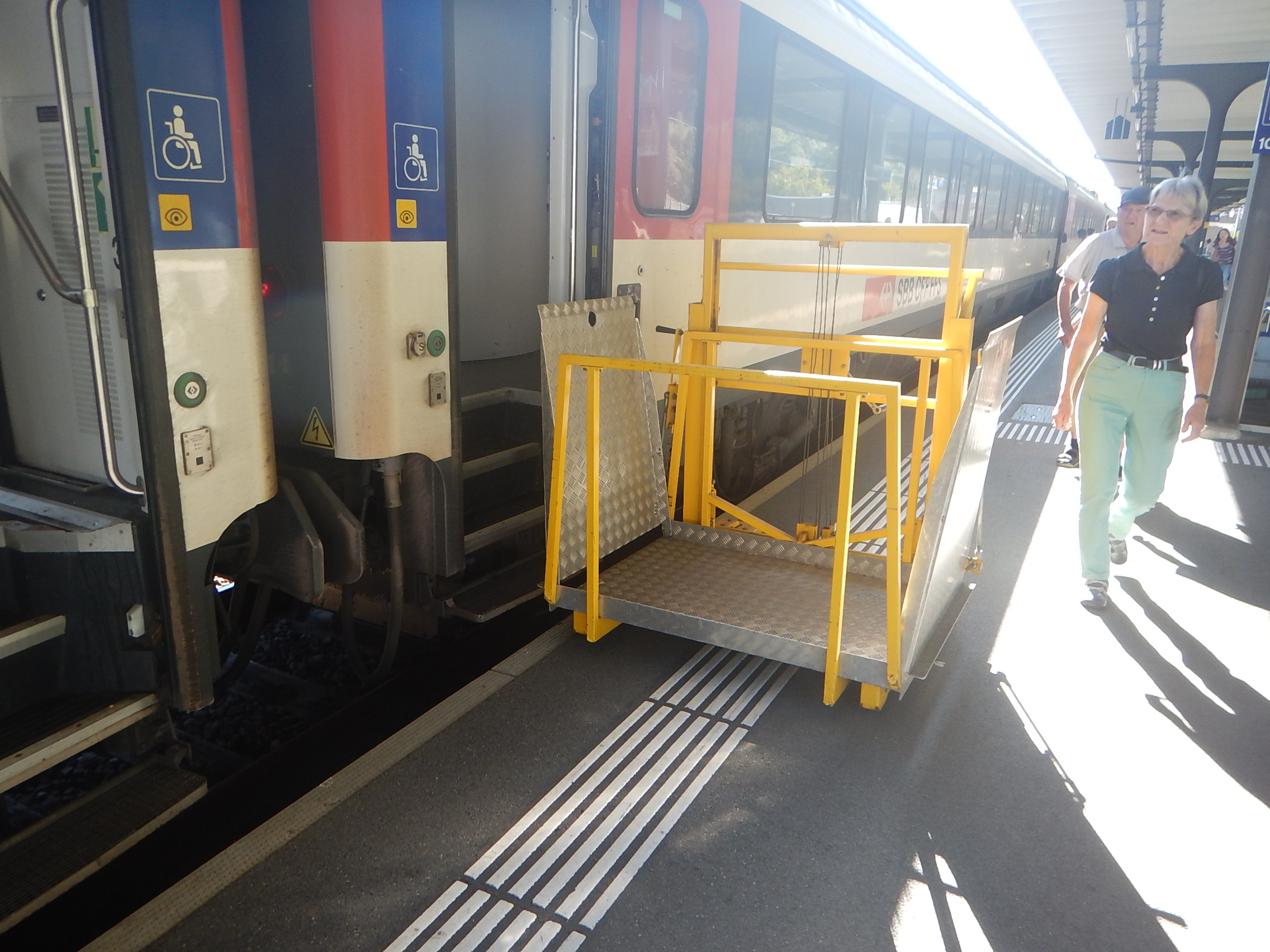
At least I noticed several low-floor trains with gap fillers.


I think most of these pictures were taken of trains built by Swiss train manufacturer; Stadler.
I think that this is the way to go.
Stadler are using gap fillers on their Class 777 trains for Merseyrail. This is said in Wikipedia about the design of the trains.
The trains will also have platform gap fillers so wheelchair users will not have to use ramps to board the train.
Will there be step-free access on Greater Anglia’s Class 745 and Class 755 trains?
It’s obviously good for passengers, but what’s in it for train operators?
It’s all about making the dwell time in a station as short as possible.
The Naming Of Swiss Trains
Unlike most countries, a high proportion of Swiss trains seemed to have names.
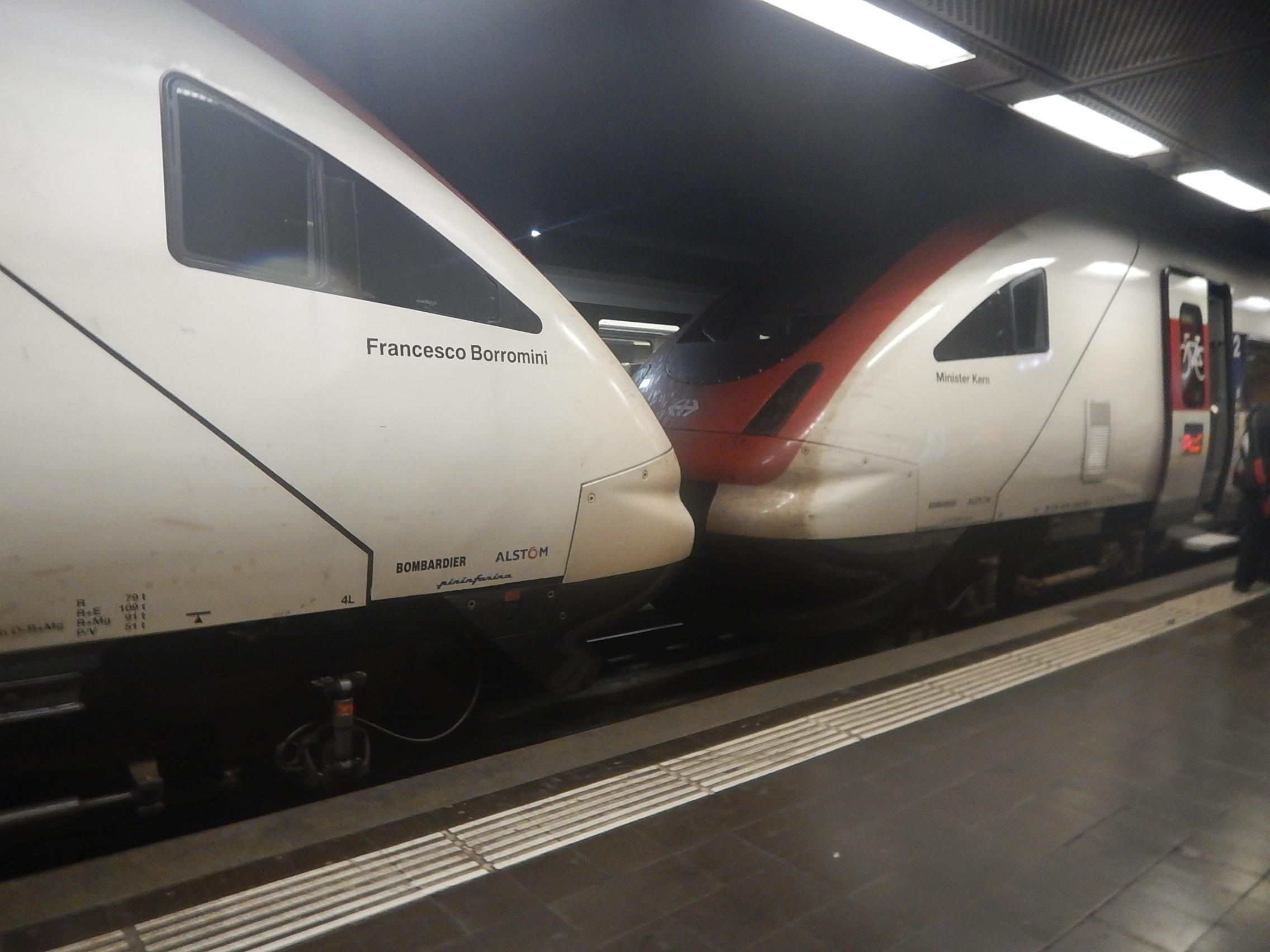
I like the idea, but there was no explanation on the trains, as to who these people are or were.
Between Lucerne And Interlaken Ost Stations On Die Zentralbahn
The Zentralbahn is the scenic railway, that connects Lucerne and Interlaken Ost stations along the Brünig Line. Wikipedia says this about the ownership of the railway.
The Zentralbahn is a Swiss railway company that owns and operates two connecting railway lines in Central Switzerland and the Bernese Oberland. It was created on January 1, 2005, with the acquisition of the independently owned Luzern–Stans–Engelberg line, and the Brünig line of the Swiss Federal Railways.
I don’t know, but as the railway is metre rather than standard gauge, I do wonder, if it was to Swiss Federal Railways, a bit like the Settle-Carlisle Line was to British Rail; Expensive to run, loved by locals and tourists and in need of new investment.
These pictures show the railway.
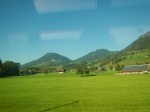
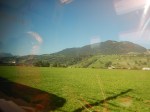
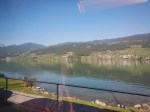
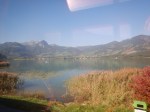
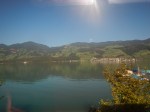
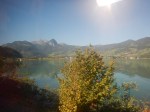
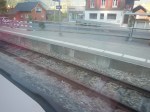
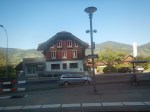
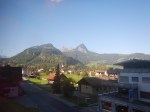
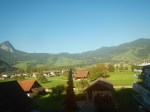
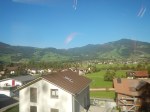
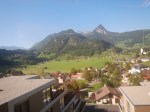
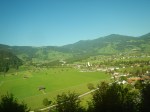
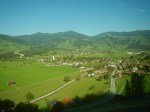
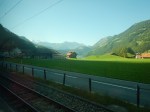
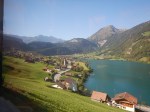
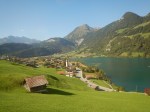
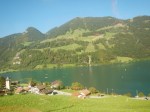
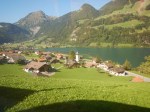
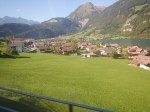
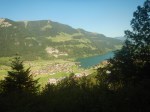
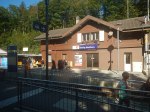
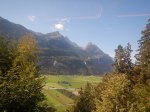
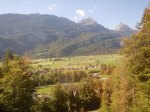
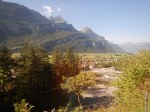
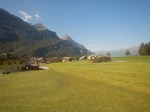
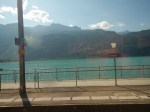
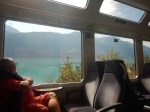
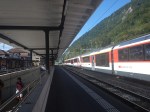
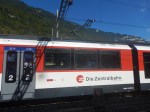
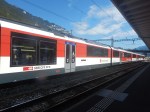
As some of the pictures show, the line was busy in places. and judging by the number of Asian groups on the train, a lot were tourists.
The trains are modern Stadler SPATZ trains.
- Fully-electric.
- Metre gauge.
- They are able to use sections of the line which have a rack to assist climbing.
- Large panoramic windows for good views.
It appears that the three-car train has been designed with all the electrical gubbings in the middle car, with the end sections similar to the Stadler GTW.
Stadler seem to be able to shuffle their ideas and especially, the central power-pack to produce trains for all purposes.
Greater Anglia’s Class 755 trains, and the tri-mode Flirts of the South Wales Metro, will be just more variations on the same theme.
Next Time I Go To The Area
There are two groups of mountain railways grouped at Interlaken and Lucerne, which are linked by the
Brünig Line. The route is not simple and there is a reverse about half-way at Meiringen station.
Searching the web, it appears that there is reasonably-priced accommodation in and around Meiringen.
With a Swiss Pass, which gives a worthwhile discount on the expensive mountain trains, I shall be staying around there on my next trip to Switzerland.
Consider.
- You could fly in to Zurich Airport and buy your Swiss Pass there.
- Lucerne and Interlaken are about an hour away on the scenic Brünig Line.
- Bern and Zurich are close enough for a day trip.
I didn’t explore Meiringen, so check the guides first. But it looked OK from the train.
I Don’t Like The Colour
Lamborghinis should be in a stand-out colour.

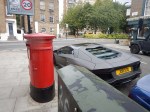
I remember a friend had a car in a similar colour and it was always getting damaged, as other drivers didn’t see it.
A First Ride In A Class 385 Train
Yesterday, I finally got a ride in a Class 385 train between Linlithgow and Glasgow Queen Street stations.
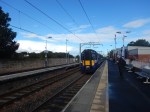
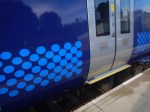
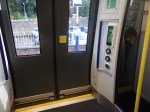
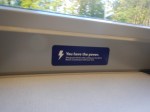

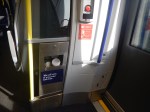
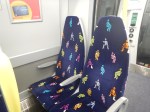
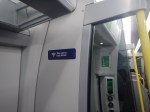
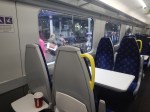
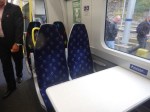
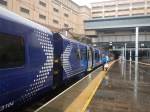
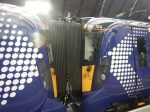
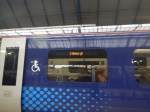
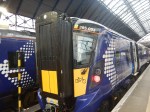
These are my observations.
Ride, Seats And Tables
I have written in many commuter trains all over Europe and these trains are very much towards the top in these important three areas.
Ride seemed to my innocent and not-so-well-padded posterior to be fine and very similar to the closely-related Class 800 trains.
It certainly didn’t pose any problems to this well-balanced stroke survivor, when I walked around.
Seats were certainly better than some other trains.
It was also pleasing to see lots of tables, which is very much a British tradition, that seems to have really kicked-off in the InterCity 125s.
In some ways sitting there, it reminded me of Great Western Railway’s Class 387 trains.
Both are certainly a very good standard for a commuter train with a journey up to perhaps ninety minutes.
Large Windows
The trains seem to follow Bombardier’s Aventras, Stadler’s Flirts and some other new trains in having large windows.
It would be very difficult to prove, but I wonder, when trains have big windows aligned with the seats, it increases ridership amongst occasional travellers. Anything that improves the experience must increase the change of repeat journeys.
Quirky But Good Interior Design
Some of the design details are quite quirky.
- The priority seat covers are different and make a bold statement.
- There are labels everywhere, advertising the features.
And there are good features too.
- Plenty of bins for the rubbish, that commuters discard.
- Sensible sized luggage racks.
- Wide lobbies and doors.
- There might be space between and under the seats for medium-sized cases.
The design is not bland and boring like a Class 700 train.
Spacious Trains
Someone described the trains, as having more space. I think that’s down to generous lobbies and large windows.
I also don’t think, the trains have not been designed for a maximum number of people, but for a maximum return on investment.
These are different things.
I suspect that a maximum return on investment is obtained, with a comfortably-full train, operating like that all day.
Overcrowded trains do the following.
- Encourage passenger to use other modes of transport.
- Lengthen station dwell times, which make trains late.
- Make it difficult for less able passengers to use the trains.
But getting the balance right between train capacity and route is a complex problem.
Step-Free Access
Hitachi don’t seem to do good step-free access, where wheel-chairs, buggies and wheeled-cases can just roll in and out.
These trains are no exception Although, it could be that ScotRail has so many different types of trains, that the standard platform height hasn’t been defined yet!
Stadler have said, that all their trains used by Greater Anglia and Merseyrail will have this property, so I would have thought that other manufacturers would follow.
Passengers will demand it!
Train Formations
There is a document on the Hitachi web site, which is entitled Development of Class 385 Semi-customised/Standard Commuter Rolling Stock for Global Markets, which gives insights into Hitachi’s thinking.
This is the introduction.
The Class 385 is based on the AT-200, which was developed for global markets with the aim of providing flexibility of configuration while making maximum use of standardisation. It is a semi-customised model of a type common in global markets, with fewer components and greater standardisation of components achieved by adopting the “mother design” developed for the AT-300 (a typical example of which is the Class 800) and competitive lead times achieved by shortening the specification-setting process.
Note the close relationship between the Class 385 and Class 800 trains.
The document gives a detailed graphic and states that the four-car units have the following formation.
- DMCLw – Driver Motor Composite Lavatory with 20 First Class seats, 15 Standard Class seats, a Universal Access Toilet and Wheelchair Space
- TPS – Trailer Pantograoh Standard with 80 Standard Class seats
- TS – Trailer Standard with 80 Standard Class seats
- DMSL – Driver Motor Standard Lavatory with 62 Standard Class seats and a space-saving toilet.
Note.
- The coach designations on the delivered trains has been taken from this page on scot-rail.co.uk.
- This gives a total of 257 seats as against 273 seats in Wikipedia.
- The difference of 16 seats is twice the number of doors, so it could be that Hitachi have squeezed in a few more seats, between the provisional and final design.
The three-car trains would appear to have the following formation.
- DMSLw – Driver Motor Standard Lavatory with about 50 Standard Class seats, a Universal Access Toilet and Wheelchair Space
- TPS – Trailer Pantograoh Standard with 80 Standard Class seats
- DMSL – Driver Motor Standard Lavatory with 62 Standard Class seats and a space-saving toilet.
Note.
- This article in Rail Magazine, says that all trains have Universal Access Toilets and two wheelchair spaces.
- This gives a total of 192 seats as against 206 seats in Wikipedia.
- Add in two seats for each of the six doors and the difference is two seats.
I should have read the numbers from the side of the train on my visit to Scotland.
If you type “Class 800 regenerative braking” into Google, you will find this document on the Hitachi Rail web site, which is entitled Development of Class 800/801 High-speed Rolling Stock for UK Intercity Express Programme.
This is a paragraph.
Trains have a unit configuration of up to 12 cars,
including the ability to add or remove standardized
intermediate cars and the generator units (GUs)
(generators with diesel engines) needed to operate
commercial services on non-electrified lines. Along
with the A-train concept, developed in Japan, the
new rolling stock is also based on technology from the
Class 395 rolling stock developed by Hitachi for the
UK High Speed 1 that entered commercial operation
in 2009, providing compatibility with UK railway
systems together with high reliability.
This is also said about the Automatic Train Identification Function.
To simplify the rearrangement and management
of train configurations, functions are provided for
identifying the train (Class 800/801), for automatically
determining the cars in the trainset and its total length,
and for coupling and uncoupling up to 12 cars in
normal and 24 cars in rescue or emergency mode.
It’s all very Plug-and-Play.
Although, these two extracts come from a document describing the Class 800 trains, both these trains and the Class 385 trains are members of the Hitachi A-Train family.
If you look at the train formations of Class 800 trains, Wikipedia gives them as.
5-car: DPTS-MS-MS-MC-DPTF
9-car: DPTS-MS-MS-TS-MS-TS-MC-MF-DPTF
Note.
- DPTS and DPTF are Driver Pantograph Trailer cars, with Standard and First Class seats respectively
- MS, MF and MC are Motored cars with Standard, First and Composite(mixed Standard and First Class), seats respectively.
- TS is a Trailer car with Standard Class seats.
Trains use two standard Driver cars and then add a number number of Motored and Trailer cars in between, to get the required train length and capacity.
I would be very surprised, if the formations of the Class 385 train were to be very different.
There appear to be the following Driver cars.
- DMCLw – Driver Motor Composite Lavatory with 20 First Class seats, 15 Standard Class seats, a Universal Access Toilet and Wheelchair Space – Used in four-car trains
- DMSLw – Driver Motor Standard Lavatory with about 50 Standard Class seats, a Universal Access Toilet and Wheelchair Space – Used in three-car trains
- DMSL – Driver Motor Standard Lavatory with 62 Standard Class seats and a space-saving toilet – Used in both three- and four-car trains.
As with the Class 800 trains, I suspect you can create a train of the required length and capacity by adding the appropriate number of trailer cars between the two driver cars.
According to this page on the Hitachi web site, the AT200 trains have an operating speed of up to 125 mph. So perhaps for the greaster power, that might be needed for higher speeds, motored cars can be added as well.
I am puzzled about the length of the current trains.
At the present time, the Glasgow Queen Street to Edinburgh Waverley route can accept seven-car trains, which are formed from a three-car and a four-car working together.
But when platform extensions are complete at Glasgow, eight-car trains will be possible, which will be formed of two-four-car trains.
So why didn’t Abellio ScotRail use a Crossrail-like solution, where seven-car trains were ordered and these were then lengthened by an extra car, after the extension of the platforms?
- The current train formations waste space with two unused drivers cabs in every train.
- Do trains running on the half-hour journey across Scotland need two Universal Access and two space-saving toilets?
By comparison Abellio Greater Anglia‘s ten-car Class 720 trains have one Universal Access and two space-saving toilets for 1,145 seats. The seats/toilet for the three trains are as follows.
- 10-car Class 720 train – 382
- 3-car Class 385 train – 103
- 4-car Class 385 train – 137
ScotRail obviously need both three- and four-car Class 385 trains to replace some of the older trains on other routes.
I do find it strange, that two divisions of Abellio have gone for such different solutions.
Gangways
The pictures show that the train has end gangways.
I intended to walk through between the two trains, but the train was full and I couldn’t get near the door.
If the trains were the correct length for the route, then you have to wonder, if the complication of gangways between trains is worth the extra weight, expense and driver’s visibility problems.
But the gangway does aid staff access between different trains.
But I do wonder, if the ability to add and remove cars that seems to be a feature of Class 385 trains, means that gangways between trains may be an unnecessary feature.
Consider these other train orders.
- Most Aventra orders do not have gangways.
- All Siemens Desiro City orders do not have fixed gangways, although the Class 717 train has a rather ingenious emergency end gangway.
- CAF Civity Class 397 trains and Class 331 trains do not have end gangways.
Gangways seem to be going out of fashion, unless they are needed fpr emergency use.
If some of ScotRail’s services need trains with gangways, these could always be run by the current Class 380 trains.
Conclusions
The Class 385 trains appear to be a well-designed train, that should do an excellent job.
But I do question the need for the gangways between trains.
It should also be born in mind, that Scotland is planning more electrification, which will need more trains.
By perhaps converting pairs of four-car sets into eight-car trains, by replacing two Driver cars with appropriate Trailer or Motored cars, two more complicated Driver cars would be liberated, which could form the basis of the extra trains.
There are probably endless combinations, one of which will give ScotRail, the optimal fleet, that will deliver the required services for the best price.
Should There Be A Lea Bridge Road Entrance To Lea Bridge Station?
This Google Map shows Lea Bridge station and the access routes to the station.
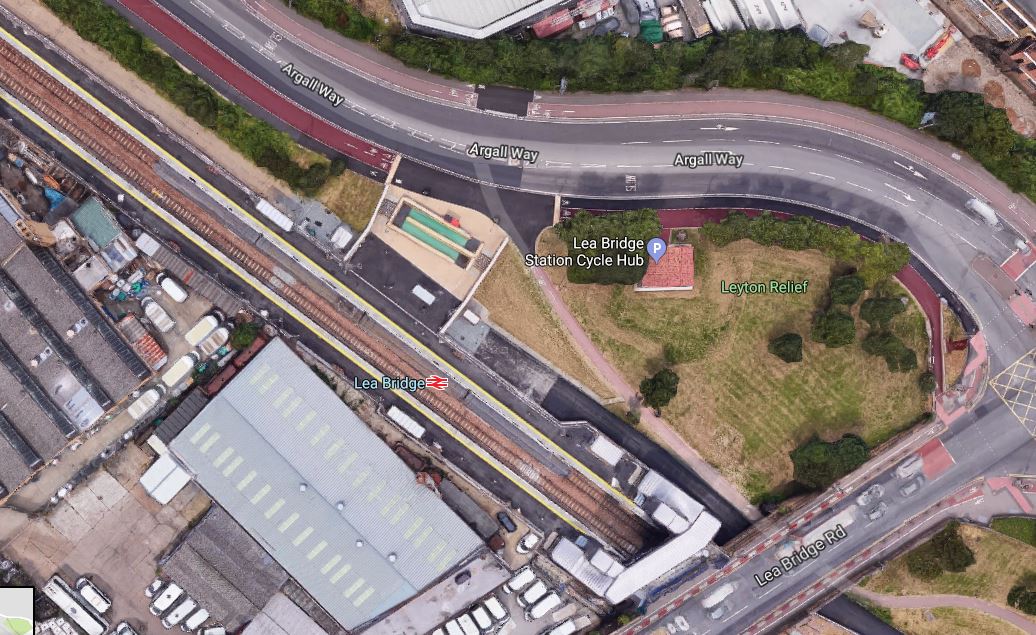
The entrance to the station is from Argall Way, which means that passengers walking to the station from the West along Lea Bridge Roasd have to walk in a circular route to get to the entrance.
It must be very galling to see the step-free footbridge, within a metre, as you cross the road bridge over the railway.
The road bridge has recently been refurbished and now has a cycleway, as these pictures show.
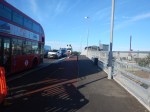
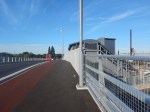
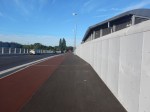
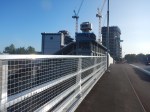
There used to be a bus stop on the road bridge, but that too has been removed and you now have to walk back to the station.
 The Anonymous Widower