How Will Virgin Trains East Coast Use Class 800/801 Trains?
The following two sections give Virgin Trains East Coast (VTEC) current and future fleets.
Current Fleet
VTEC have a current fleet comprising the following locomotives and coaches.
- 32 – Class 43 locomotives
- 117 – Mark 3 coaches
- 31 – Class 91 locomotives
- 302 – Mark 4 coaches
- 31 – Driving van trailers
The Class 43 locomotives and the Mark 3 coaches are formed into InterCity 125 trains.
- Two locomotives and nine coaches per set.
- 125 mph capability
- Diesel-powered
Which gives thirteen diesel trains.
The Class 91 locomotives and Mark 4 coaches are formed into InterCity 225 trains.
- One locomotive, one driving van trailer and nine coaches per set.
- 140 mph capability
- Electric-powered.
- Ability to run London to Edinburgh in under four hours.
Which gives thirty-one electric trains.
Adding the two figures together gives a total of forty-four nine-car trains.
Future Fleet
VTEC’s future fleet will include.
- 10 – Five-car Class 800 electro-diesel trains.
- 13 – Nine-car Class 800 electro-diesel trains.
- 12 – Five-car Class 801 electric trains.
- 30 – Nine-car Class 801 electric trains.
Adding these together counting the five-car trains as half gives fifty-four nine-car trains.
Or ten more nine-car trains!
In addition six to eight InterCity225 trains could be retained in service to run limited stop trains between London and Edinburgh.
This increase in capacity can only me good for passengers, with more services and destinations.
Questions About Class 800/801 Trains
What is the capacity of a nine-car Class 800/801 train?
I can’t find this on the Internet and I suspect it hasn’t been decided.
Wikipedia gives the capacity of an InterCity 225 train as 406 Standard and 129 First Class seats.
It should also be noted that the car length in a Class 800/801 is twenty-six metres, as opposed to the twenty-three metres of the InterCity 225.
I would hope good design can make excellent use of this space.
Will two Class 800/801 trains be able to work as a pair?
I suspect the answer to this is yes, as the closely-related Class 395 trains regularly do this.
The most common use would be to run two five-car trains as a ten-car set.
This would be a 260 metre long train, which is perhaps fifteen metres longer than an InterCity 225 train.
Some lengthening of platforms may be necessary, but it probably isn’t a major problem.
Will coupling and uncoupling of a pair of Class 800/801 trains be automatic?
In The Impressive Coupling And Uncoupling Of Class 395 Trains, I linked to videos of the closely-related Class 395 trains, doing just this in under a minute.
I would be very surprised if two Class 800/801 trains couldn’t do the same.
Will a Class 800 train and a Class 801 train be able to work as a pair?
There may be circumstances, where this is needed on electrified lines, so I would be very surprised if this is not possible.
At what station will a Class 800/801 train be able to call?
The nine-car trains are 234 metres long and a pair of five car trains will be 260 metres long, so platform length will mean they can’t call at a lot of smaller stations.
But a five-car train will be only 130 metres long, which will be shorter than a pair of four-car multiple-units working together, which are regularly seen on the UK’s rail network.
So the five-car trains will probably be able to serve a surprising number of stations.
Will Class 800/801 trains have a faster turn-round time?
If you look at the times of trains between London and Leeds, this things happen.
- A few minutes after a train leaves the platform at Leeds and Kings Cross, the next incoming service arrives.
- It then waits in the station for nearly half-an-hour before going back.
Effectively, an hour must be added to each Out and Back journey between London and Leeds.
This time will enable.
- Passengers to unload and load.
- Train to be prepared.
- Crew to be changed if required.
Any delay of a few minutes can hopefully be recovered.
Train preparation time will probably be better with the Class 800/801 trains, as hopefully automation and better design will speed the process.
But cutting this thirty minutes substantially would probably require passengers to be marched around like the Brigade of Guards, which is of course not possible.
Hopefully, the new trains will be designed, so that ingress and egress for all passengers will be easier and faster but at some stations like Leeds, the station layout is more of a bottleneck than the train.
A few minutes reduction in turn-round time might be possible, but nothing that would mean a train doesn’t occupy a platform for half-an-hour.
How long will A Class 801 train take between London and Edinburgh?
Currently the fastest journey time using an InterCity 225 is around four hours and twenty minutes, but they have done it in under four hours in test runs.
For marketing reasons, I suspect that VTEC would like to dip under four hours with the fastest trains.
As the Class 800/801 trains have a similar 140 mph performance to the InterCity 225, I suspect that four hours will also be possible.
But the big difference will be that the Class 800/801 trains will probably have faster stop times at any intermediate stations.
So I suspect that the average journey time between London and Edinburgh will drop.
How Will VTEC Use Class 800/801 Trains?
Returning to my original question, I’ll now attempt to answer it in the next few sections.
London-Edinburgh Services
I think we can assume the following.
- There will be at least two trains per hour (tph)
- Trains will usually be nine-car trains.
- Class 800 trains will not normally use diesel power on the route.
- Some trains could be two five-car trains running as a pair.
- A proportion of trains will do the trip in under four hours.
- Intermediate stops as now will be optimised to the passenger traffic.
- Intermediate stops will be faster.
I also think, that the InterCity 225 sets will be improved, so they can match the times of the Class 800/801 trains.
I think that once improved signalling on the East Coast Main Line is working and allowing running faster than 125 mph, we could be seeing trains being able to go from London to Edinburgh and back in under nine hours, assuming a thirty minute turn-round at both ends of the route.
This would mean that a dedicated London to Edinburgh fleet of just eighteen trains would be required to run a two tph service. Three tph would need another nine trains.
Speed up the trains so, that a round trip can be done in eight hours and sixteen trains are needed for the two tph service, with eight more trains needed to up the service to three tph.
Under Future in the Wikipedia entry for Virgin Trains East Coast, this is said.
If VTEC’s application to operate extra limited stops services to Edinburgh is successful, it is proposing to operate these by retaining six to eight InterCity 225 sets.
Interesting! So will some or all hours see a third train between London and Edinburgh.
Are the thirty-year-old InterCity 225 trains, showing the same survival instincts of their ten-year-older predecessors; the InterCity 125s?
London-Aberdeen And London-Inverness Services
Currently times on these routes from London are as follows.
- London-Aberdeen – seven hours and four minutes – three trains per day
- London-Inverness- eight hours and four minutes – one train per day
So what times could a Class 800 achieve on these routes?
Times North of Edinburgh with an InterCity 125 are as follows.
- Edinburgh to Aberdeen takes two hours and thirty-six minutes – Fastest ScotRail takes two hours sixteen minutes.
- Edinburgh to Inverness takes three hours and thirty-one minutes – Fastest ScotRail takes three hours nineteen minutes.
I suspect that a Class 800 train running on diesel power could match the InterCity 125 times and approach the ScotRail times.
But as they would be running on electric power to and from London in four hours, times could be as follows.
- London-Aberdeen – six hours and sixteen minutes
- London-Inverness – seven hours and nineteen minutes
So over half-an-hour could be saved on both routes.
Currently trains leave London at these times.
- 10:00 – Aberdeen
- 12:00 – Inverness
- 14:00 – Aberdeen
- 16:00 – Aberdeen
Note that there is probably no 18:00 train, as that would arrive in Aberdeen at 0110.
That is probably too late, but a well-driven Class 800 train, might get to Aberdeen around 00:30, which could be acceptable.
There is also the possibility of running a pair of five-car Class 800 trains to |Edinburgh, where they split with one train going to Aberdeen and the other to Inverness.
If the 16:00 train were to split, the Inverness portion would finish its journey before midnight.
A schedule like this from London could be possible.
- 10:00 – Aberdeen and Inverness
- 12:00 – Inverness
- 14:00 – Aberdeen and Inverness
- 16:00 – Aberdeen and Inverness
- 18:00 – Aberdeen
Both Northern cities would get four trains per day from London, because of two factors.
- The ability to run on electric power between London and Edinburgh, which knocks time off that section of the route.
- The ability to split and join trains at Edinburgh, which saves paths on the East Coast Main Line.
It should be noted that any electrification North from Edinburgh will help.
Stirling to Edinburgh and Glasgow could be electrified by 2019 or 2020.
- Trains would run to the South of Stirling on electric power.
- Any splitting going North and joining going South would take place at Stirling.
- Trains would still stop at Edinburgh to load and unload passengers.
- Crew change currently takes place at Edinburgh, but that could happen at Stirling.
With a well-executed stop at Stirling, electric power between Stirling and Edinburgh and a few other improvements could we see the following?
- London-Aberdeen – six hours
- London-Inverness – seven hours
It would certainly please VTEC’s Marketing Department.
Services To St. Andrews
The Open Championship was last held at St. Andrews in 2015, so by the next time it is held at the Home of Golf, it is likely that a station will have been built for the town.
This new station must be able to accept Class 800/801 trains, which during a major event might need to run to the area.
This reasoning must apply to lots of places either on or within fifty miles of the East Coast Main Line.
London-Leeds Services
Leeds is generally served by 2 tph from London in around two hours ten minutes.
These are usually nine-car InterCity 225 trains, with a couple of InterCity 125 trains, that go to places like Harrogate, which are not electrified.
As the speed limits on the East Coast Main Line are increased as trains are fitted with in-can signalling, I suspect that VTEC’s Marketing Department will be pushing for times between London and Leeds to be under two hours.
I can’t believe that VTEC will not extend services from Leeds by making use of five-car trains running to Leeds as a pair, where they would divide and join.
I am assuming that Class 800/801 trains can join as well as the closely-related Class 395 trains, which do so it in under a minute.
Places that could be served include.
- Bradford
- Harrogate
- Horsforth
- Huddersfield
- Ilkley
- Keighley
- Shipley
- Skipton
Note.
- Some stations like Harrogate and Horsforth are not electrified, so would need Class 800 electro-diesel trains.
- Five-car trains could serve a lot of stations on the Leeds-Bradford Metro network, thus opening up the possibility of services to places like Headingley for the cricket and rugby and Saltaire for the culture.
- Could a five-car Class 800 electro-diesel train run over the Settle and Carlisle Line to Carlisle and Scotland?
- Extending some services from Leeds may mean that platform space is released at the station.
I think that the possibilities to extend services from Leeds using the five-car Class 800/801 trains are large.
London-Edinburgh Via Leeds
On the West Coast Main Line, some Scottish services from London, go via Birmingham and Wolverhampton.
So if there was a fully electrified route from Leeds to York, then some Scottish trains could go via Leeds.
At present, I don’t think this is possible with an electric train, as part of the route from Leeds to York is not electrified.
The electrification should be well underway by now, but there is no sign of it.
Other Extended Services
What can be done at Leeds can surely be done at other places.
If the two trains can couple and uncouple within a minute, that means that a pair of trains can arrive in a station and go through the following sequence.
- 00:00 -A joined pair of Class 800/801 trains arrive in the station and load and unload passengers.
- 00:03 – Close the train doors
- 00:04 – Start the automatic decoupling process.
- 00:05 – The first train leaves the platform.
- 00:08 – After three minutes the second train leaves the platform.
I believe that the stop could be under ten minutes and the trains would be a safe three minutes apart, as they left the station.
So where could trains be split?
- Newark or Peterborough for Lincoln and Nottingham
- Doncaster for Hull and Sheffield
- York for Scarborough and Harrogate
- York for Middlesbrough and Sunderland
- Newcastle for Ashington and Sunderland
Note.
- Trains could go in a loop to serve several stations.
- Sunderland could be on such a loop.
- As trains would only be five cars, they could stop at most stations in need of a service.
- Stations like Peterborough, Doncaster, York and Newcastle with more than one through platform in each direction would probably be preferred stations for split and join.
- No electrification is needed away from the East Coast Main Line.
Obviously, passenger needs and traffic patterns will decide, where the trains split and join.
Conclusions
The big conclusion will be that more places will receive long distance services to London and the places in between.
But these trains will really put the squeeze on smaller operators like Hull Trains and Grand Central Trains, as VTEC will be serving their station.
A Station At Doncaster Sheffield Airport
This article on the Doncaster Free Press is entitled Plans for £150m train station for Doncaster Sheffield Airport.
To say the plans put forward by the Peel Group, who are the owners of Doncaster Sheffield Airport are ambitious would be an understatement, but they do seem sound.
The plan would see the East Coast Main Line diverted closer to the Airport, where a station would be provide. Kings Cross would be within 90 minutes.
This Google Map shows Doncaster Sheffield Airport.
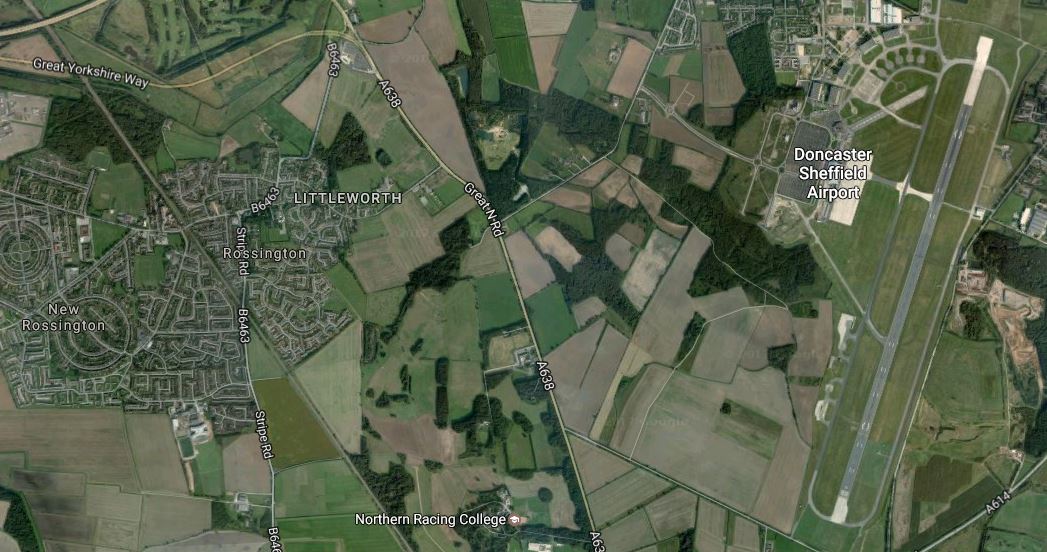
Note that the East Coast Main Line crosses the map starting in the North-West corner and then going through the village of Rossington and past the Northern Racing College.
I suspect that the Airport have done their homework and that the plan is well-thought out and feasible.
- It would create a well-connected Airport for everybody between Stevenage and Newcastle.
- The East Coast Main Line between Doncaster and Retford has a lot of double-track. A loop must give scope for separating freight and slow traffic from high speed trains.
- With modern trains like the Class 801 trains, a stop at the Airport will not slow services like a stop of an InterCity 125 would.
- As in the future, we’re looking at up to four trains per hour between London and Newcastle, surely, a high speed line through Doncaster without any other traffic would be an advantage.
In some ways, the fact that all this is possible, is down to the foresight of the Victorian engineers of the Great Northern Railway, who designed a route for high speed.
It should also be stated that Doncaster Sheffield Airport has air cargo ambitions.
Consider.
- It has a massive runway, that was able to accept the Space Shuttle in an emergency.
- The airport has lots of space for cargo terminals.
- The largest cargo planes, that exist only in the minds of Airbus and Boeing engineers would be welcome.
- The Great Northern and Great Eastern Joint Railway, which is a major freight route between the South East and the North passes the airport.
- Plans exist to create a network of high speed package carrying trains. I’d use Doncaster Shjeffield Airport as a hub.
- Amazon already fly freight to and from the Airport. Deliveries could leave the United States in the evening and be in Edinburgh, Glasgow, Liverpool, London and Manchester for a morning delivery.
It looks like the Peel Group have a plan to create a transport interchange for both passengers and freight for a cost of millions, not billions. But it were to be worth spending billions, I’m certain that they can obtain it.
Improvements To The East Coast Main Line Through West Yorkshire
This article in Rail Technology Magazine is entitled West Yorkshire to agree £3bn ‘whole route ethos’ investment in ECML.
The article doesn’t go into much detail, but it does explain how a lot of work is needed not only to improve London to Newcastle and |Edinburgh times, but to accommodate high speed services across the North of England.
Looking at the East Coast Main Line on Wikipedia, throws up these improvements.
- Creation of a platform 0 at Doncaster station, which was completed in December 2016.
- Improvements through York station.
- South of Newcastle to Northallerton (which is also predominately double track), leading to proposals to reopen the Leamside line to passenger and freight traffic.
- Electrification of Northallerton to Middlesbrough.
- Electrification the line between Leeds and York (Neville Hill Depot to Colton Junction) as a diversionary route and a route for Liverpool to Newcastle services via Manchester and Leeds.
- Upgrade the line for 140 mph running under ERMTS.
I also think that the Treasury-specified economy electrification should be upgraded to a modern standard. They didn’t make much of a saving as upgrading the line to a modern standard will cost £1.3billion.
Hopefully, these improvements will allow London to Edinburgh in four hours.
Also helping with this goal is the project announced in this article on the Rail Magazine web site, which is entitled NR seeks fourth track north of Huntingdon. The article indicates that this work together with improvements at Werrington Junction, which I wrote about in To Dive Or Fly At Werrington, would improve capacity on the East Coast Main Line.
Seamless Interchangeability
At several places on the UK rail network, two trains running as a pair will split, with one train going to one destination and another going to another.
I wrote about trains splitting and joining in Trains Uncoupling and Coupling at Cambridge.
In the past, UK railways used to use the concept of slip coaches, so that coaches could be dropped from an express without stopping. But the last time it was used in the UK was in September 1960 at Bicester North station.
I have just read this article on the Rail Engineer web site, which is entitled Seamless Interchangeability.
The article talks about a concept of dynamic coupling, where trains are automatically coupled and uncoupled at line speed.
It also talks about the issues this would raise.
As a Control Engineer, I’m fairly certain, that it would be very easy to create a system, where say an eight-car Kings Lynn train could split just before Cambridge station, with the front four-car train going to Kings Lynn and the other four-car train stopping in Cambridge station.
It could either be done using two drivers or by driver-less trains. Although the unions would have a lot to say about the latter.
I also believe that if the trains could uncouple, then coupling at line speed would also be possible.
So what is the point?
An Example From The Brighton Main Line
To make full use of the capacity available, Southern serve Littlehampton and Ore, with a train that divides at Haywards Heath. It is a well-proven technique that has been used for decades.
Automatically splitting the two trains at line-speed, can give journey time advantages.
Take the 19:47 from Victoria, which arrives at Haywards Heath at 20:30 as an example.
The following is taken from the timetable.
- The front portion to Ore leaves at 20:34.
- The rear portion to Littlehampton leaves at 20:36.
- Stops at East Croydon and Gatwick Airport take about a minute.
This leads to the following, if the two trains split immediately after stopping at Haywards Heath and before the trains take different directions after Keymer Junction where the East Coastway Line divides from the Brighton Main Line, a few miles South.
- The Ore train performs a one-minute stop instead of one of four minutes, thus saving three minutes.
- The Littlehampton train performs a one-minute stop instead of one of six minutes, thus saving five minutes.
- The platform at Haywards Heath is only occupied for a minute, as opposed to six.
- The Littlehampton and Ore portions must be capable of providing enough capacity for their route.
For those worried about driver-less trains, the driver of the second train for Littlehampton, would probably step up at the previous stop at Gatwick Airport or at Haywards Heath.
But the outcome would be a small increase in capacity on the line, due to the platform at Haywards Heath being occupied for five minutes less.
Coming North, take the 09:47 from Littlehampton as an example.
The following is taken from the timetable.
- The first train arrives at Haywards Heath at 10:35 and leaves at 10:45.
- The second train arrives at Haywards Heath at 10:41.
The pattern of the trains would be different.
- Whatever was the front portion of the train would go through Keymer Junction first
- The train forming the rear portion would be the next train through the junction.
- The rear portion could catch the front portion and the two trains would be automatically coupled together before Haywards Heath.
- The joined train would stop at Haywards Heath for a minute.
- The driver of the second train could step-down at Gatwick Airport or Haywards Heath.
In some ways the mathematics involved in the coupling, are not unlike those for a fighter jet connecting with a tanker aircraft. Except that speeds are a lot lower and there is no need to control direction only closing speed.
Haywards Heath station would be occupied for up to nine minutes less, thus creating capacity.
This simplistic analysis, shows how automatically coupling and uncoupling trains at line speed can create capacity and decrease journey times.
- Journey time from Victoria to Ore would be reduced by three minutes.
- Journey time from Victoria to Littlehampton would be reduced by five minutes.
- In the Down direction the platform at Haywards Heath station would be occupied for just one minute instead of six.
- Journey time from Littlehampton to Victoria would be reduced by nine minutes.
- Journey time from Ore to Victoria would be reduced by three minutes.
- In the Up direction the platform at Haywards Heath station would be occupied for just one minute instead of ten.
Obviously strategies would have to be developed for various eventualities including.
- Unsuccessful coupling or uncoupling.
- Late trains.
- Signalling and train failures.
- Leaves on the line.
- Extreme weather.
But as during all coupling and uncoupling operations, both trains would have a driver in the cab, keeping an expert eye over the procedure and each train could be driven independently, I think all safety issues could be overcome, to the satisfaction of all parties.
If you read the full article, you’ll see that there are some much more exciting possibilities, than the simple ones I have outlined here.
But I do believe that line speed uncoupling and coupling of trains with a driver in the cab of both trains involved, can be a very powerful tool in creating capacity on the UK’s railways.
The Great Eastern Main Line
I know the Great Eastern Main Line well and several trains are coupled and uncoupled regularly on this line.
As Greater Anglia has ordered new five-car Aventra trains and nearly all platforms can take 12 -car trains, running these trains in pairs and coupling and uncoupling appropriately, is probably in their plans for the line.
As on the Brighton Main Line, could coupling and uncoupling at line speed, unlock capacity on the line?
A few weeks ago, I caught a train from Chelmsford to Manningtree, that divided at Colchester, with the front four-car train going to Clacton and the rear four-car train going to Harwich.
The 16:44 from Liverpool street is a train that divides at Colchester, when it arrives at 17:40. These timinings are from the timetable.
- The Clacton portion of the train leaves at 16:44.
- The Harwich portion of the train leaves at 16:47.
As the Sunshine Coast Line for Clacton leaves the Great Eastern Main Line immediately after Colchester station, it would appear that the two trains must uncouple during the stop at Colchester.
Surely, an improved and well-designed automatic uncoupling system could separate the trains faster, saving minutes on both services.
Towards London, two trains leave Harwich and Clacton at 07:16. The timetable shows.
- The Harwich train arrives at Colchester at 07:47 and leaves at 07:54.
- The Clacton train arrives at Colchester at 07:50 and leaves at 07:54.
Surely, an improved coupling system, could join the trains faster, saving minutes on both services.
The time savings will not be as great as those at Haywards Heath, but automatic coupling and uncoupling must be a worthwhile feature of the new trains.
|As Bombardier are adding automation to the Aventra, could they be adding the ability to automatically couple and uncouple trains, both in the station and at line speed?
The West Coast Main Line
I have seen Class 221 Trains, join at Crewe, but I don’t think this is done any more.
However, with the need for direct services from London to places like Blackpool, Burnley and Huddersfield, the ability to be to couple and uncouple trains quickly must be something that would be useful to make optimal use of the valuable train paths on the line.
The East Coast Main Line, Midland Main Line, Great Western Main Line And South West Main Line
If the West Coast Main Line could benefit, then surely these lines could as well.
Class 800/801 Trains
The Class 395 train is very much related to the Class 800 and Class 801 trains, that are being built by Hitachi for the East Coast Main Line, Great Western Railway and other routes.
In The Impressive Coupling And Uncoupling Of Class 395 Trains, I talked about the design of the coupling system for the Class 395 trains.
I would be very surprised if this feature was not incorporated in the Class 800 and Class 801 trains.
So will we be seeing two five-car Class 800/801 trains dividing and joining at a convenient station and then running as a ten-car train to and from London?
Class 385 Trains
What about the Class 385 trains for Scotland?
- These are another version of Hitachi’s A-Train, like 395s, 800s and 801s.
- These will come in two lengths; three-car and four-car.
- Edinburgh-Glasgow services will need at least two units to be coupled together.
- The trains are being introduced from Autumn next year.
It seems to me, that Scotrail are acquiring a very flexible fleet that can run in various lengths.
Will they have the ability of the 395s to couple and uncouple in under a minute?
And if they do, will Scotrail use this ability to adjust train formation to the traffic?
Aventras
There are three definite orders for Bombardier’s new Aventra train at the present time.
- Class 345 trains for Crossrail.
- Class 710 trains for London Overground.
- Five and ten car units for Greater Anglia.
All trains are fixed formations in a mixture of lengths.
Will Aventras have similar coupling and uncoupling performance to Hitachi’s Class 395 trains?
I suspect normally, the Crossrail trains will never be coupled together, as where are platforms for a four-hundred metre long train?
But suppose a train fails in the central tunnel, will the quickest way to remove it, be to attach it to another train and drag it out?
The routes where the London Overground trains will run, are currently served by a mixture of four-car and eight-car trains. So will London Overground, adjust train length to the known traffic patterns?
Greater Anglia do couple and uncouple trains at present to serve Harwich. So I suspect, we’ll see use of an automatic and fast coupling and uncoupling feature to create a more efficient timetable.
Cross City Lines
There are several cross-city lines in the UK.
- Cross-City Line – Birmingham
- Crossrail
- North Berwick Line – Edinburgh
- Northern Line – Merseyrail
- Snow Hill Lines – Birmingham
- Thameslink
One of the characteristics of cross-city lines, is they are busiest in the centre of the city, where passengers tend to use the trains for short hops , as well as longer distances. Then in the suburbs, outside of Peak hours the trains could run almost empty.
Crossrail’s trains are designed so that hopefully they could cope with the variable traffic, but would it be possible to have half trains, which join and split at outer stations.
Thameslink
I think that Thameslink could be the line that might benefit most, as it would probably want to serve more places.
In All Change On Thameslink, I detailed the current proposed schedule of trains.
- 4 trains per hour (tph) – Sutton to St. Albans (2 tph via Wimbledon, 2tph via Mitcham)
- 2tph – Brighton to Bedford
- 2 tph – Three Bridges/Gatwick Airport to Bedford
- 2 tph – Brighton to Cambridge North
- 2 tph – Horsham to Peterborough
- 2 tph – Maidstone East to Cambridge
- 2 tph – Sevenoaks to Blackfriars
- 2 tph -Orpington to Kentish Town/West Hampstead
- 2 tph – Rainham to Luton (via Dartford and Greenwich)
- 2 tph – East Grinstead to Bedford
- 2 tph – Littlehampton to Bedford
This makes a total of twenty-four tph, which is the design limit for the central tunnel.
In this schedule 4 tph go to Cambridge and 2 tph go to Peterborough. Suppose, it was decided that Peterborough needed 4 tph.
The path limit of 24 tph through the central tunnel makes this impossible, but if Peterborough and Cambridge services joined and split at perhaps Stevenage, then both Cambridge and Peterborough would get 6 tph through the core tunnel.
It would need new six-car trains, that could couple and uncouple quickly.
Conclusion
I believe that improving the coupling and uncoupling of all modern trains to the standard of that of the Class 395 trains could be very beneficial, to train operators, staff and customers.
If coupling and uncoupling could be done at line speed, this might bring extra benefits.
Will The Hertford Loop Line Be Upgraded?
In All Change On Thameslink, I said this about the Hertford Loop Line.
In the future, don’t discount improvements to the Hertford Loop Line, to get more trains through the area.
The Current Hertford Loop Line
So what are the characteristics of the Hertford Loop Line? Wikipedia introduces it like this.
The Hertford Line (also known colloquially as the Hertford Loop) is a branch of the East Coast Main Line, providing a commuter route to London for Hertford and other Hertfordshire towns and an occasional diversion route for the main line. The line is part of the Network Rail Strategic Route 8, SRS 08.03 and is classified as a London and South East Commuter line.
Riding on the line is an experience like many of the commuter lines in North London, that were electrified in the thirty years after the Second World War.
- It is double track throughout.
- It is electrified at 25 KVAC using overhead wires.
- It has a speed limit of 121 kph.
- It has eleven intermediate stations, most of which have two platforms.
- Hertford North station has two through platforms and a bay platform.
- The trains are elderly Class 313 trains, which usually run in six-car formations along the Northern City Line into Moorgate.
- It is connected to the East Coast Main Line using grade-separated junctions at both ends.
- According to the History in the Wikipedia entry for the Line, it was built to relieve pressure on the Digswell Viaduct.
I don’t know the condition of the line, the electrification and the signalling, but the line was used for the testing of ERTMS, so it can’t be too bad.
New Class 717 Trains
But changes are happening in that the Class 313 trains are being replaced with new six-car Class 717 trains, which are cousins of the Class 700 trains used by Thameslink.
Yesterday I was at Stevenage station and there were problems on the fast line North of the station, which meant that my train directly into Kings Cross was swapped from the slow to the fast line to get it out of the way and into Kings Cross as soon as possible
Obviously, this is probably not an unusual action, but you wouldn’t be wanting to put 121 kph trains like the Class 313 trains onto the fast lines, as they’d slow everything down.
The speeds of the various local and Cambridge trains that use the East Coast Main Line are.
- Class 365 trains – 160 kph (100 mph)
- Class 387 trains – 175 kph (110 mph)
- Class 700 trains – 160 kph
- Class 717 trains – To Be Confirmed
I would suspect that because of the need to occasionally run on the fast lines, that the Class 717 trains may well be 160 kph units. This would also mean that all the trains running on the Cambridge Line would be 160 kph trains or faster.
There is a factor about the order for the Class 717 trains, that doesn’t seem to have been noticed. At present there are effectively twenty-two six-car elderly Class 313 trains working the suburban services. These are being replaced with a fleet of twenty-five six-car modern Class 717 trains.
Consider.
- The Class 717 trains could be substantially faster, than the Class 313 trains.
- The Class 717 trains will handle stops faster.
- The Class 717 trains will be more passenger-friendly, probably like the Class 700 train, I wrote about in A First Ride In A Class 700 train.
- The Class 717 trains will have lots of gizmos and automation to aid staff and to inform and entertain passengers.
- Wi-fi could even be fast and free on the Class 717 trains.
Add all of these factors together and I believe that there is going to be a massive increase in capacity on the services out of Moorgate. Unless of course, they park some of the extra new trains in sidings.
I suspect too, that Govia Thameslink Railway are hoping thast new trains on the Northern City and Hertford Loop ines will increase ridership and poach customers from rival services.
Voltage Changeover At Drayton Park
In the previous section, I noted that automation on the new Class 717 trains will assist staff.
One problem is the AC/DC changeover at Drayton Park. This may not be exactly the same as the similar voltage changeover at Farringdon on Thameslink, that will be performed hundreds of times a day by Class 700 trains. But it surely won’t be much different.
As a Control Engineer, who has experience in industrial automation, I can’t believe that a modern train won’t change power pick-up automatically, much faster and in a more reliable way, than a forty year old train.
As the electrical systems on the two trains must be virtually identical, by the time the Class 717 trains enter service, any power change on the Class 700 trains, will surely be fully debugged.
I’m sure Siemens will get this changeover to work smoothly, but on the Northern City Line, I’ve felt since I rode the of Bombardier’s Class 379 IPEMU prototype at Manningtree, that the line should be run using onboard energy storage, so that the tunnels are electrically dead.
The other alternative would be to use an overhead rail at 25 KVAC, which is what the Germans or Swiss would do.
Local And Cambridge Branch Trains On The East Coast Main Line
What local and Cambridge Branch trains will be running on the East Coast Main Line, between Hitchin and Kings Cross?
- Thameslink – 2 tph Peterborough to Horsham – |Stopping Pattern Unknown
- Thameslink – 2 tph Cambridge North to Brighton – Stopping Pattern Unknown
- Thameslink – 2 tph Cambridge to Maidstone East – Stopping Pattern Unknown
- Great Northern – 1 tph Peterborough to Kings Cross – Semi-Fast including stop at Welwyn North
- Great Northern – 1 tph Peterborough to Kings Cross – Stopping including stop at Welwyn North
- Great Northern – 2 tph Cambridge to Kings Cross – Non-Stop
- Great Northern – 1 tph Cambridge to Kings Cross – Semi-Fast
- Great Northern – 1 tph Cambridge to Kings Cross – Stopping
- Northern City – 3 tph Moorgate to Welwyn Garden City – Stopping
- Northern City – 2 tph Moorgate to Hertford North – Stopping via Hertford Loop
- Northern City – 1 tph Moorgate to Letchworth Garden City – Stopping via Hertford Loop
So we get the following totals.
- 6 tph between St. Pancras and Finsbury Park
- 6 tph between Kings Cross and Finsbury Park
- 6 tph between Moorgate and Finsbury Park
- 18 tph between Finsbury Park and Alexandra Palace
- 3 tph between Alexandra Palace and Hertford North via Hertford Loop
- 15 tph between Alexandra Palace and Welwyn Garden City
- 12 tph between Welwyn Garden City and Stevenage – 2 stop at Welwyn North
- 1 tph between Hertford North and Stevenage via Hertfood Loop
- 13 tph between Stevenage and Hitchin
- 4 tph bertween Hitchin and Peterborough
- 9 tph bertween Hitchin and Letchworth Garden City
- 8 tph between Letchworth Garden City and Cambridge
Obviously on the East Coast Main Line, there is a mixture of fast, semi-fast and stopping trains, but as the whole route is quadruple track between Finsbury Park and Hitchin, this service pattern could probably be easily handled.
Simple Cross-Platform And Same-Platform interchanges
There are three different London end destinations for local services on the Southern section the East Coast Main Line.
- St. Pancras and the South, through the Canal Tunnels.
- Kings Cross, using the East Coast Main Line.
- Moorgate using the Northern City Line.
Passengers to and from these stations, will need to get to and from any station on the following routes.
- The East Coast Main Line to Peterborough.
- The Cambridge Line to Cambridge
- The Hertford Loop Line
Quite a number of stations will be ideal places to change if you can’t get a direct train. These stations and some others might become recommended interchanges.
- Finsbury Park
- Alexandra Palace
- Potters Bar
- Welwyn Garden City
- Stevenage
- Hitchin
Will these stations be given a platform layout, where interchange between different services entails just getting off one train and then getting another train from the same platform face or one at the other side of the platform?
Some stations like Finsbury Park, Alexandra Palace and Stevenage already have this layout or it has been substantially implemented.
But I think it essential, that all recommended interchange stations have simple step-free changes.
Passengers Will Duck And Dive
In a few years time, passengers will be very savvy and armed to the teeth with apps, cards and electronic devices to use the network in the fastest and most cost efficient way possible.
So the passenger wanting to go from say Ashwell and Morden to say Gillingham will be guided through the Thameslink network according to how the trains are running, by their large number of intelligent friends.
I do this now, often using National Rail’s information web site from my phone, to check routes and make sure, I don’t get stuck in Croydon, Scunthorpe or Manchester.
This passenger freedom and flexibility, will not be bad for train companies, as how long before an app is developed, that sends passengers on less crowded routes.
looking at the Hertford Loop Line, no passenger is going to mind being recommended to take a Hertford Loop Line train one day and a main line train another, provided the cost is acceptable for both journeys.
Could More Trains Run On The Hertford Loop Line?
It is interesting to compare the 15 tph between Alexandra Palace and Welwyn Garden City and the 3 tph between Alexandra Palace and Hertford North on the Hertford Loop.
As the line is self-contained with grade-separated junctions at both ends and a bay platform at Hertford North and Gordon Hill stations, running 3 tph on the line, must be way under the maximum capacity, when there are double track electrified lines with lots of stations, like the East London Line that can handle 16-20 tph.
I think we’ll see the line improved in the following way.
- An upgraded speed limit of perhaps 120 kph.
- Longer platforms if needed
- Perhaps a couple of reopened or new stations.
- Better interchange at Alexandra Palace and Stevenage stations.
I am certain, this would enable some extra trains to serve the line to perhaps Stevenage, Peterborough or Cambridge.
Before I look at the train services on the Hertford Loop Line in detail, I’ll look at other issues for local and Cambridge Line trains on the two Northern branches of the Thameslink Great Northern network.
Upgrade Of The Slow Lines Between Finsbury Park and Alexandra Palace Stations
I found this statement in a Network Rail document posted on the web.
The section is entitled Upgrade to down slow 2 and creation of up slow 2 line between Finsbury Park and Alexandra Palace.
This is said.
Up slow 2 and down slow 2 lines available for passenger use with increased linespeeds with a new platform provided at Finsbury Park in the up direction. No platform faces are provided at Harringay and Hornsey. The scheme allows some Hertford North/Gordon Hill to Moorgate inner suburban services to operate independently of outer suburban services and long distance high speed (LDHS) services, which removes a timetable constraint.
I would assume it means that there are two slow lines in both directions, one of which leads directly to the Hertford Loop Line. This is also said.
Due to the focus on the off peak timetable, the line upgrades between Finsbury Park and Alexandra Palace have a smaller impact, as the majority of services call at intermediate stations on this section. However, provision of platform faces on the upgraded lines has the potential to ease timetabling constraints on the busy Alexandra Palace – Welwyn section.
The only stations without platform faces on the upgraded lines in this section are Harringay and Hornsey.
It would appear to me, that this could be a half-finished job.
The ability to separate Hertford Loop Line services from those on the East Coast Main Line has been enabled, but no provision has been made to allow separated Hertford Loop Line services at Harringay and Hornsey stations. It’s not that the two intermediate stations are lightly used, as these are the usage statistics for 2014-2015.
- Bowes Park – 0.96 million
- New Southgate – 0.69 million
- Alexandra Palace – 1.42 million
- Hornsey – 1.35 million
- Harringay – 1.26 million
- Finsbury Park – 6.26 million
It’s not as though Hornsey and Harringay hardly see any passengers.
So for the present time, all passenger services must share the same slow lines between Finsbury Park and Alexandra Palace.
Have Network Rail got the planning of this section right?
Finsbury Park Station
Three routes come together at Finsbury Park station.
- Thameslink – 6 tph between St. Pancras and Finsbury Park
- Great Northern – 6 tph between Kings Cross and Finsbury Park
- Northern City – 6 tph between Moorgate and Finsbury Park
I wonder if we’ll see a simple cross- and same-platform interchange, so that Northbound passengers can get off their train from Kings Cross, Moorgate or St. Pancras at Finsbury Park and without changing platforms get a train to any station towards Cambridge or Peterborough, either up the East Coast Main Line or the Hertford Loop Line. Obviously going South, passengers will need to reverse the process.
To complicate matters, Finsbury Park station will be one of the main interchanges between the Thameslink Great Northern network and the Piccadilly and Victoria Lines.
This map from carto.metro.free.fr, shows the lines at Finsbury Park station.
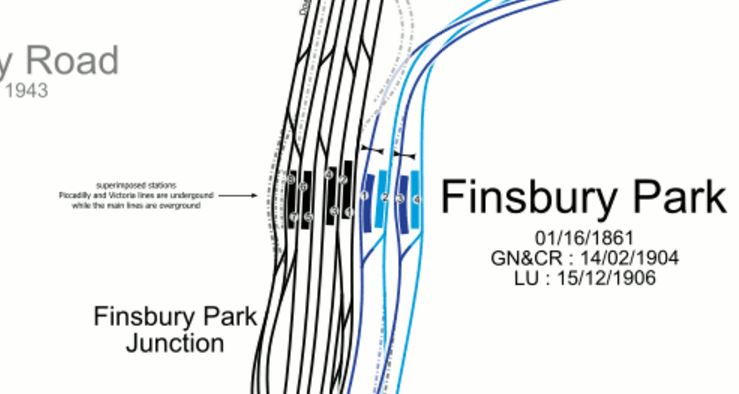
Lines At Finsbury Park Station
Finsbury Park station certainly has a lot of platforms and crossovers and it strikes me that given the current work at the station, that Network Rail has an acceptable solution.
I took these pictures at the station.



There is plenty of work to do and questions to answer before the station is ready for Thameslink.
- Will Northern City Line services to use platforms 1 and 8?
- Will Kings Cross services continue to use platforms 2 and 7?
- Platforms 2 and 3 and Platforms 6 and 7 are either side of a single track, although Platforms 3 and 6 don’t seem to be currently used.
- Is the work outside of platform 8, creating two new platforms 9 and 10?
- Will the spiral staircases to the Underground be adequate?
There has been no indication as to which platforms Thameslink will use, although all platforms at the stations are probably long enough for the two-hundred metre long Thameslink trains.
But our French friends at carto.metro.free.fr have a map, which shows the routes between the Canal Tunnels, that take Thameslink trains between St. Pancras and the East Coast Main Line.
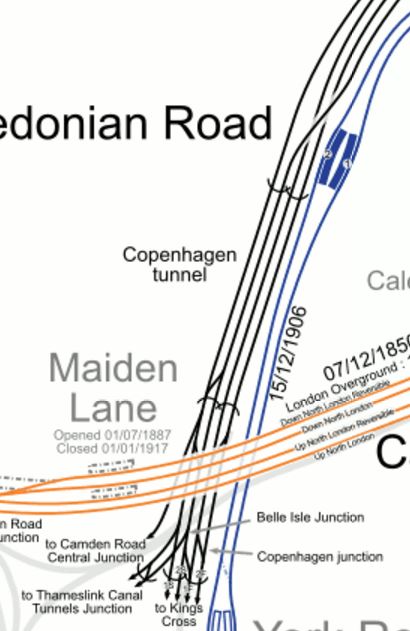
It would appear that the lines through the Canal Tunnels connect directly to the slow lines, that go through Finsbury Park.
- The Canal Tunnel lines are shown at the bottom left of the map.
- There is even a convenient flyover taking the up slow lines to the correct side of the main lines for Thameslink.
So it would appear that the Thameslink lines South of Finsbury Park will take the same route as local services out of Kings Cross do now.
Remember that between Finsbury Park and Alexandra Palace stations, there are two slow lines both ways, which will have to accommodate 18 tph, empty stock movements and some freight trains.
I feel this means that at Finsbury Park, there is sufficient capacity to adopt a logical strategy, that will be easily understood and remembered by passengers.
I suspect that the platform allocations will be as follows.
- Platform 1 – Services to Moorgate – 6 tph
- Platform 2 – Services to Kings Cross and Thameslink – 12 tph
- Platform 7 – Services up the East Coast Main Line – 15 tph
- Platform 8 – Services on the Hertford Loop Line – 3 tph
Given all the advanced signalling in the area and on the trains, I don’t think these frequencies are unreasonable.
Could we also see Thameslink trains on Platforms 2 and 7 opening doors on both sides?
Possibly, as there may be advantages in this!
Whilst at Finsbury Park this morning, I saw an outer suburban train stop in Platform 4 and quite a few passengers got off to continue their journey on the Underground. After Thameslink opens, would there be any value in having a cross platform interchange to Platform 3, where Thameslink trains would open their doors on both sides, so giving extra connections?
Obviously, if it would work going into London, it would work going out of the capital.
But these are only my speculation.
Moorgate Station
Moorgate station is one of those outposts of the UK rail network, that has had a sorry and tragic history.
At Moorgate, the Northern City Line tunnels are above those of the Northern Line, in an unusual double-decker station design.
This map from carto.metro.free.fr shows the two lines.
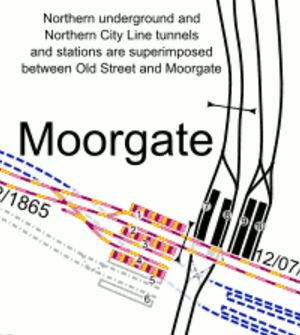
Lines At Moorgate Station
The caption says this.
Northern Underground and Northern City Line tunnels and stations are superimposed between Old Street and Moorgate.
These are pictures that I took of the Northern City Line station.

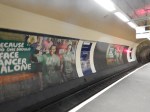

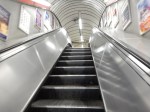
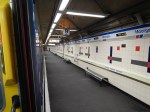
Note.
- The two platforms are not spacious by modern standards.
- Two escalators connect the Northern City Line platforms to the ticket hall.
- Two fairly long escalators lead between the Northern City Line and Northern Line platforms.
- The platforms could do with a well-designed makeover.
In addition, the two Northern Line platforms have a pair of escalators connecting them to the booking hall.
The four platforms are certainly well connected to each other and to the surface by escalators. The only thing lacking is a lift for step-free access to connect the booking hall to both levels of platforms.
The current Underground ticket hall will be extended and become the new Western ticket hall for the double-ended Liverpool Street Crossrail station.
On this page of the Crossrail web site, this is said.
The Moorgate worksite also incorporates a 42m deep shaft that provides ventilation and emergency access to the new ticket hall. The Moorgate shaft is currently being used by our station tunnelling contractor to build an access passage linking the Crossrail platforms to the Northern line. Later this year our Eastern Running Tunnels contractor will use the shaft to carry out out concrete works to form the foundation slab that will support the trackwork in the tunnels.
I have to ask if this access passage linking the Crossrail platforms to the Northern Line, will link to the Northern City Line as well. If it does it will probably be step-free and have a high-capacity as well.
But even if it doesn’t, access to and from the Northern City Line, will still be by two escalators from the ticket hall and two from the Northern Line platforms.
I suspect that as the Northern City and Northern Lines are superimposed on each other, I do wonder if a large enough corner has been identified, where a lift can serve all levels of the station.
If we have Crossrail going through a short distance away, where forty-eight (2 x 24) massive trains per hour will be stopping, even if only a small proportion of passengers, wanted to use the Northern City services out of Moorgate to explore the delights of North London and Hertfordshire, the current 6 tph out of Moorgate will be seriously inadequate.
But the Northern City Line is getting new Class 717 trains and as I said earlier, these trains will bring in a large increase in capacity.
So how many trains per hour could work the lines into the two-platform terminus at Moorgate?
At present Moorgate handles 6 tph most of the day, but during the peaks the line handles at least 9 tph.
But even 9 tph is very small compared to the upwards of thirty tph handled at both the two-platform Brixton and Walthamstow Central termini on the Victoria Line.
Given that the Class 717 trains are versions of the Class 700 Thameslink trains, that are planned to run at 24 tph under London, with a voltage change at Farringdon, I suspect that the theoretical limit for the number of trains per hour into Moorgate is higher than the 9 tph achieved by the scrapyard specials in the peak.
So is London going to get a new high-capacity route from the City to North London and Hertfordshire, that links to both Crossrail and Thameslink?
You bet it is!
Consider.
- Moorgate can probably handle up to fifteen to twenty Class 717 trains per hour, with signalling and operational improvements.
- The Class 717 trains will hold more passengers than the Class 313 trains.
- The greater performance of the Class 717 trains will probably speed up the services.
- Finsbury Park station should be ready to accept the higher frequency and give same platform interchange to Thameslink.
- The doubling and improvement to the slow lines between Finsbury Park and Alexandra Palace will allow the increased frequency to be handled.
If twelve trains per hour ran into Moorgate and they split equally between Welwyn Garden City and the Hertford Loop Line as they do now, that would give a ten minute interval on both routes, which is twice as many trains as the current time.
I think the biggest problem will be to persuade the RMT, that running say twelve trains or more per hour into Moorgate, is safe.
Harringay Station
Harringay station has two platforms, with one for each direction.
This Google Map shows Harringay station.
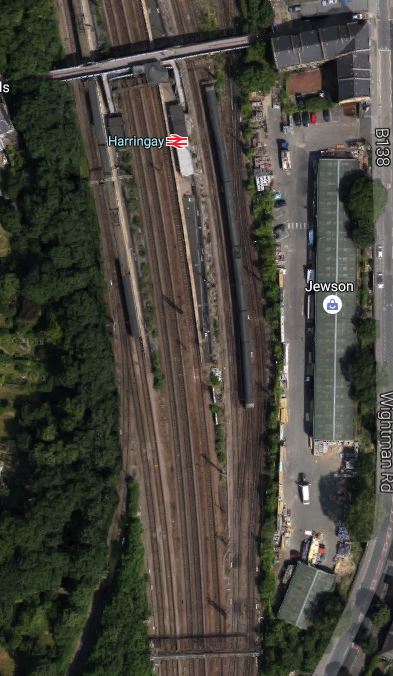
Harringay Station
Note.
- The bridge across the tracks with steps leading down to the two platforms.
- The station is not step-free, with steep staircases.
- There is no platform faces on the newly-created second pair of slow lines.
To be fair, Harringay is a dump and one of the worst stations on the line, but an architect with flair could make it work, with cross platform interchange between trains on both pairs of slow lines.
These pictures show Haringay station.

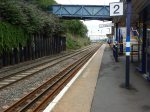

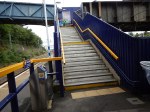


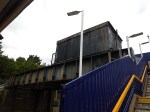
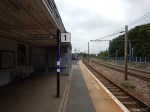
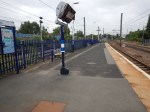
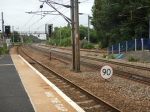
Note.
- The station certainly is a dump.
- The two down slow lines lie between platform 2 and the retaining wall.
- In a couple of pictures, you can see the Harringay Curve that connects the Gospel Oak to Barking and East Coast Main Lines.
- Platform 1 actually lies between the two slow lines.
The station obviously needs a rebuild.
- This would incorporate acceptable passenger access and customer services.
- There appears to be space to create a double-sided up platform 1.
- Platform 2 is probably easier to move between the two slow lines.
But rebuilding would probably mean complete closure of the lines through the station and a large degree of inconvenience.
I doubt we’ll see little more than a general tidying up in the near future, with the station handling all of the stopping traffic and all other services, like freight and empty stock movements using the two lines without platform faces.
One advantage of the current layout, is that non-passenger services are kept away from the platforms.
Hornsey Station
Hornsey station has two platforms, with one for each direction.
This Google Map shows Hornsey station.
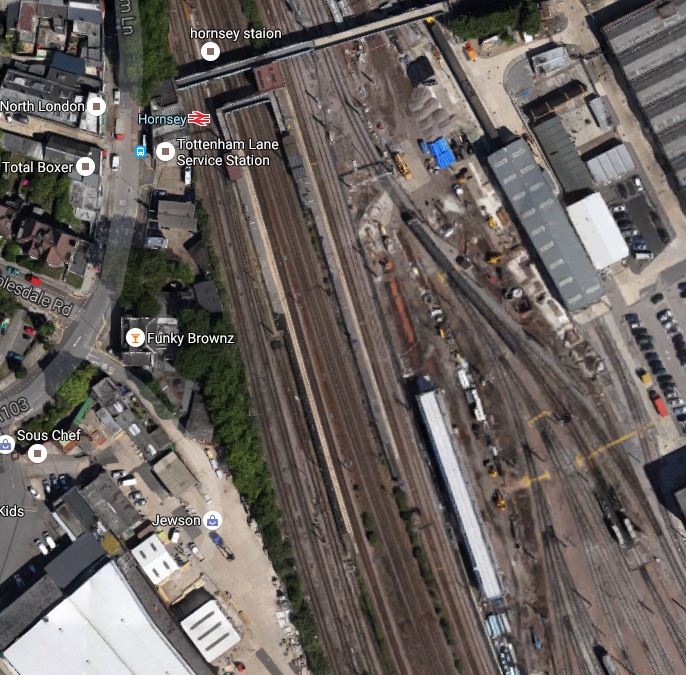
Hornsey Station
These pictures show Hornsey station.



Note.
- The two fast lines go between the two platforms.
- The current down platform is on the inner of the two slow lines and is actually between the two slow lines.
Like Harringay, Hornsey can be improved with respect to passenger access and customer services.
Building an island down platform looks possible, but as at Harringay, the current layout works safely.
Alexandra Palace Station
Alexandra Palace station has four platforms, but the station has the air of a work-in-progress as although there is some easy interchange between services, it’s not perfect or step-free.
This Google Map shows the station.
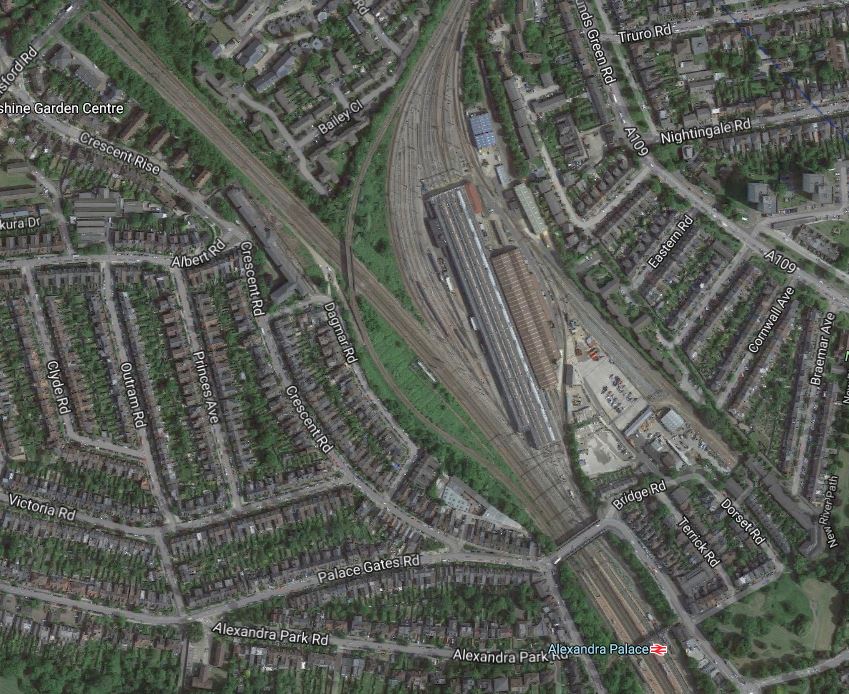
Alexandra Palace Station
Note.
- The Hertford Loop Line curves across the East Coast Main Line.
- Train stabling for the East Coast Main Line sits to the North of the station.
- Hertford Loop Line services have to stop at the two outer platforms in the station.
- Crossrail 2 might serve this station.
Knowing the station well, I feel that a good station can be created here, where Thameslink, Great Northern to Cambridge and Peterborough, and Hertford Loop Line services have a simple cross- or same-platform interchange in the Northerly direction.
These are pictures of the station.

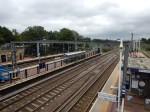
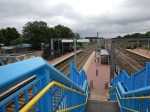
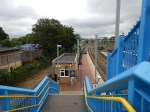


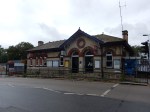
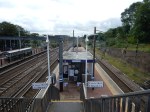
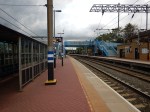
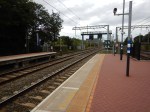
Note.
- If you are going North and you’re on the wrong train, you have a cross-platform interchange on Platforms 2 and 4 at Alexandra Palace station.
- Trains for the South can stop at either platforms 1 or 2.
- The station is not step-free, but lifts could probably be added to the existing bridge.
- The Yard cafe at the station is excellent and I had a very good gluten-free frittata.
I never would have thought when I used to use the station in the 1950s and 1960s, that it would grow up to be a very capable station.
Other Stations Between Alexandra Palace And Welwyn Garden City
The stations on the Main Line are a bit of a mixed bunch.
- Some have four platforms and some have just two.
- Some are step-free and some are not.
- Some are modern and some are fairly old and need updating.
These pictures give a flavour of the stations.
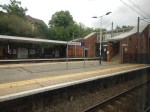
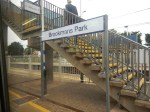
Welwyn Garden City station is unique, as it is one corner of a shopping centre, called the Howard Centre





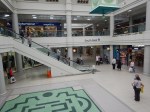
Is it the only station in the UK, with a Boots, a large proper Marks and Spencer, a Next and a Monsoon, with John Lewis not far away?
Trains terminating at Welwyn Grden City seem to use platforms 3 and 4 by the Howard Centre, using the sidings to the North of the station if required. On leaving the station, the trains cross the main lines and get to the up slow line using a flyover.
Welwyn Garden City is certainly a well-designed station to return trains to London.
Gordon Hill Station
Gordon Hill station must be the only station with the same name as a footballer.
I’d never been until I visited a few days ago and I’d rather expected a typical bog-standard, rather poor two-platform suburban station.
This Google Map of the station gives a few clues about the station.
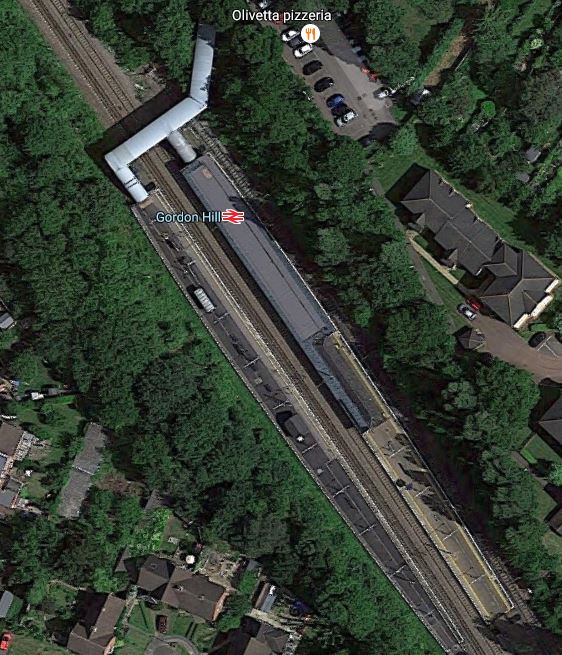
Note that it appears that the station could have once had four platform faces and these could easily be long enough for eight car trains.
What I did find was a charming early twentieth-century station as these pictures show.
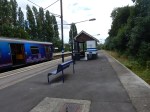
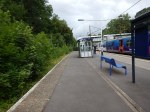
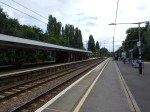
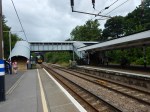
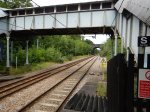

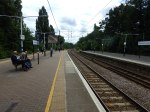
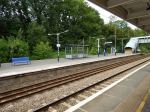
Note.
- The station has three working platform faces; two through and a bay one on the Eastern side.
- There would appear to be space on the Western side to create a fourth platform.
- The bridge is of no architectural merit and probably should be replaced by one giving full step free access.
I believe that the station could play a major port in an upgraded Hertford Loop Line, in that if the station was to be converted to a full four-through platform station, then it would create a passing loop that the line needs to increase capacity.
In some ways Gordon Hill station, shows how truly bad our planning was in the first half of the twentieth century. The station opened in 1910, so was well established when Chase Farm Hospital opened just after the Second World War, just a short distance to the North. Hopefully, these days, it would be hoped that when a new hospital is built, that it is connected properly to the local transport network. Since it was built the hospital has had a chequered history and with the way healthcare is changing and perhaps requiring smaller and more specialised hospitals, I can see a time, when the hospital site becomes housing, which to increase its green credentials could be connected by a footpath and cycleway to Gordon Hill station.
If the hospital stays operational, it should surely have a sensible modern connection to the station and not just the odd bus every hour or so.
This Google Map shows the hospital and the station.

Chase Farm Hospital And Gordon Hill Station
We should think more holistically and not assume that everybody has a car.
Hertford North Station
Hertford North station is one of the busiest stations on the Hertford Loop Line and one of only two stations with more than two platforms.
This Google Map shows the station.
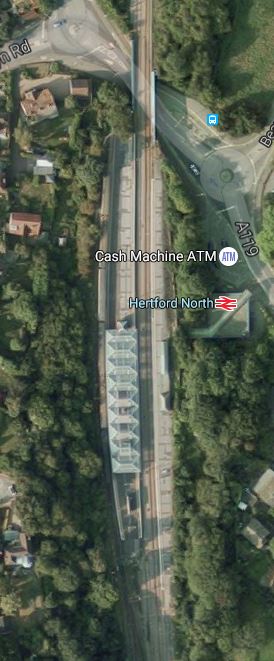
Hertford North Station
These are some pictures of the station.
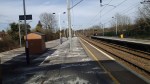

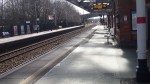
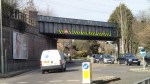
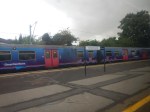
I feel that with some clever engineering that Hertford North station can be upgraded into a four-platform station with two passing loops.
Other Stations On The Hertford Loop Line
All the other stations seem to be two platform stations, with minimal facilities and little or no parking.
With more and better trains, increased links to the stations and perhaps some better parking, I wouldn’t think it unfeasible to increase the passengers using the stations on the loop.
There might possibly be a case for reopening Stapleford station.
The Digswell Viaduct And Welwyn North Station
The two-track section over the Digswell Viaduct and through Welwyn North station is a major bottleneck on the East Coast Main Line.
The Wikipedia entry for the viaduct says this.
The viaduct carries the East Coast Main Line, which has to narrow from four tracks to two to cross the viaduct, making it a bottleneck restraining capacity over this strategic transport route.. This problem is exacerbated by Welwyn North railway station situated at the northern end of the viaduct, which blocks the line while trains are stationary and two tunnels to the north. Several ideas to overcome the limitations of the viaduct and station without damaging the viaduct’s essential historic character and rhythmic design are periodically discussed.
In some ways, the station is more of a problem than the viaduct. Every stop at the station and there are just two trains per hour in both directions, effectively blocks the main line for a few minutes. It’s a bit like having a level crossing on a motorway.
If the viaduct were to be rebuilt to four tracks, which these days with modern construction methods is probably a very expensive possibility, this would still leave the problem of the station, which is on a very restricted site. Wikipedia also says this about the station.
The station is a rare survival of architecture from the early days of the GNR and this is now recognised with listed building status. The main station building, the footbridge, the tunnel portal to the north and Digswell Viaduct to the south are all Grade 2 listed.
This leads me to a very extreme solution to the problem.
Welwyn North station should lose most or all of its train services.
This Google Map shows the station and the viaduct.
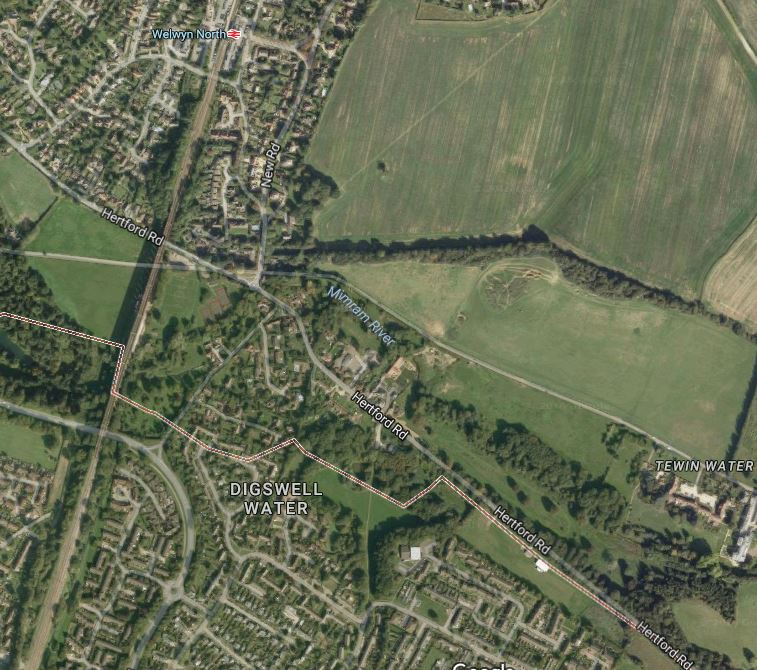
Digswell Viaduct And Welwyn North Station
Perhaps, a better solution would be a mixture of road and rail improvements .
- Improve the traffic routes from the area to other stations at Knebworth and Welwyn Garden City.
- Provide more car parking at Welwyn Garden City and Stevenage stations.
- Provide a free and frequent shuttle bus between Stevenage and Welwyn Garden City stations calling at Welwyn North and Knebworth stations.
- Build a new station at Stapleford on the Hertford Loop Line.
Perhaps a parkway station could be built in the South of Stevenage on the Hertford Loop Line.
Elimination of the stopping of trains at Welwyn North would lead to the following.
- Extra paths in both directions through the station.
- Services like Thameslink and the Great Northern services to Cambridge would save a few minutes.
- The expresses to and from the North would be able to provide a faster and more reliable service.
In my view, we should go the whole way and close Welwyn North station.
A South Stevenage Parkway Station
This Google Map shows the area between Stevenage and Watton-At-Stone stations.
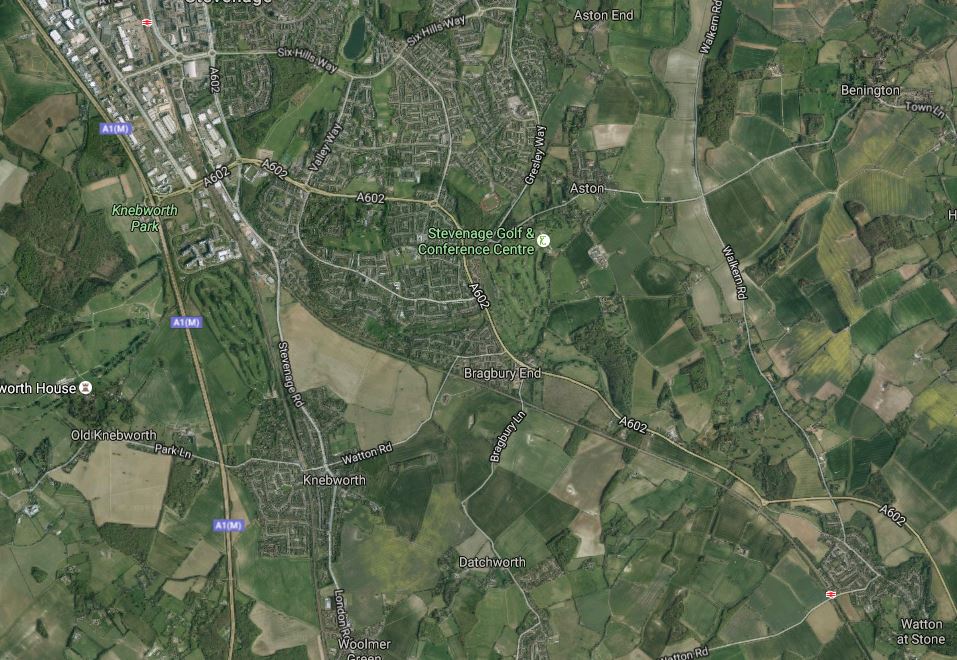
South Stevenage
If Stevenage expands southwards, I wonder if a South Stevenage Parkway station could be built on the Hertford Loop Line with good connections to the A1M and lots of parking.
I would estimate the station would be around six kilometres from Welwyn North station.
It would be another carrot for the closure of Welwyn North station.
Stevenage Station
Stevenage station is a modern station, but it could probably be extended and improved.
- The station has four platforms and is step-free.
- Some long-distance services to the North and Scotland stop at the station.
- The station is the only one between Kings Cross and Peterborough, where long distance trains stop.
- It is first station, North of where the Northern end of the Hertford Loop Line joins the East Coast Main Line in grade-separated junction.
- There are also plans to upgrade the station with extra platforms.
I think it is true to say, that the station is not a bottleneck on the East Coast Main Line, but that an improved Stevenage station could do the following.
- Improve the flow of fast expresses, by ending the practice of trains stopping on the fast lines.
- Give better services to the North and Scotland for passengers living between Stevenage and Kings Cross.
- The station will probably be served by six Thameslink trains per hour.
- Provide a better interchange for those coming South needing to go on the Hertford Loop Line.
- The station could turnback some trains on the Hertford Loop Line.
- Note that Hertford North to Stevenage takes just 13 minutes in the current Class 313 trains.
The question has to be asked if Stevenage would be a better terminus for the Hertford Loop line, than Hertford North?
Operationally, this would probably be easier than turning the trains at Hertford North, especially, if other fast services were to be diverted to the Hertford Loop Line.
Assuming 12 trains per hour, were going into Moorgate and these split equally between the main line and Hertford Loop routes, turning trains at Stevenage wsould give a service with a ten minute interval to Moorgate.
As this is the same as the Thameslink frequency I believe a pattern of trains could be developed
At present one-in-three trains on the Hertford Loop Line, go on to Letchworth Garden City, so if the current policy prevailed Letchworth would get 2 tph to Moorgate.
There are certainly lots of ways to use an upgraded Stevenage station.
Hitchin To Peterborough
This is a line with capacity problems as there is sections of twin and triple track in the mainly quadruple track, between Huntingdon and Peterborough.
The trains on this section are.
- Thameslink – 2 tph Peterborough to Horsham – Stopping Pattern Unknown
- Great Northern – 1 tph Peterborough to Kings Cross – Semi-Fast – London King’s Cross and Peterborough calling at Finsbury Park, Stevenage and then all stations.
- Great Northern – 1 tph Peterborough to Kings Cross – Stopping – London King’s Cross and Peterborough calling at Finsbury Park, Potters Bar, Hatfield, Welwyn Garden City and then all stations.
If there were continuous slow lines, then you could have an optimised stopping pattern, but as trains have to use the fast lines to progress in places, you can’t interfere with speeding Virgins.
I suspect that there’s a very unusual pattern of trains, as they sneak through.
The line definitely needs quadrupling where there are only two and three tracks.
You could probably argue that between Stevenage and Peterborough, there needs to be a service with a pattern like this.
- 2-4 tph stopping at all stations.
- 2-4 tph stopping at important stations with four platforms.
I wouldn’t be surprised that Network Rail and Thameslink have a plan to remove this bottleneck.
Htchin To Cambridge
The trains on this section are.
- Thameslink – 2 tph Cambridge North to Brighton – Stopping Pattern Unknown
- Thameslink – 2 tph Cambridge to Maidstone East – Stopping Pattern Unknown
- Great Northern – 2 tph Cambridge to Kings Cross – Non-Stop
- Great Northern – 1 tph Cambridge to Kings Cross – Semi-Fast -London King’s Cross and Cambridge calling at Finsbury Park, Stevenage, Hitchin, Letchworth, Baldock and Royston.
- Great Northern – 1 tph Cambridge to Kings Cross – Stopping – London King’s Cross and Cambridge calling at Finsbury Park, Potters Bar, Hatfield, Welwyn Garden City and then all stations
- Northern City – 1 tph Moorgate to Letchworth Garden City – Stopping via Hertford Loop
So this gives 8 tph to Cambridge and an extra one to Letchworth Garden City. All are currently run by various parts of Govia Thameslink Railway.
Wikipedia says this about the infrastructure of the Cambridge Line.
The line is double track throughout. Traction current is supplied at 25 kV AC using overhead line equipment overseen by York Electrical Control Room, with Neutral Sections at Cambridge junction, Litlington and Shepreth Branch junction. It has a loading gauge of W8 and a maximum line speed of 90 mph
Note
- If after all the new 160 kph trains are delivered, it could be an efficient line to run, possibly even at a slightly higher speed.
- At present, stations like Shepreth and Meldreth often only get an hourly service.
- In a few years time, a new station will possibly be built for the East West Rail Link near Addenbrookes Hospital.
The big problem on the Cambridge Line was solved by the Hitchin Flyover, which allowed trains for Cambridge to leave the East Coast Main Line without delaying fast trains.
I think extending the Letchworth Garden City service to Cambridge North would give a lot of benefits.
- Cambridge would now have three destinations in London; Kings Cross, Liverpool Street and Moorgate.
- It would connect with the Kings Cross stopping train, a 2 tph, high class local service into both Cambridge stations.
- A Cambridge North to Moorgate service would connect the Cambridge Science Park to Silicon Rundabout.
- If the service connected to a 2 tph service across Suffolk to Bury St. Edmunds, it would greatly improve Suffolk’s links to London.
I suspect there are other factors and they will lead to an improved service pattern on this line and the other ones radiating from Cambridge.
The Kings Cross To Peterborough Fast Lines
If as I believe, you can do the following.
- Eliminate stopping at Welwyn North station, by enticing passengers to use other means.
- Remodel Stevenage station, so that trains do not stop on the fast lines.
- Create a four-track railway between Huntingdon and Peterborough.
You would then create an unbroken pair of fast lines from between Kings Cross and Peterborough, with slow lines on either side and two slow lines as far as Alexandra Palace.
The limiting factor of the number of trains on the line would probably be determined, by the number of platforms at Kings Cross.
It would be some railway for one mostly built in the mid-nineteenth century.
The Thameslink Trains To Cambridge And Peterborough
There are of four of these to Cambridge and two to Peterborough in each hour.
The stopping pattern has not been announced, except that they will be semi-fast.
So could they have a pattern similar to the current semi-fast trains of only stops at Finsbury Park, Stevenage and Hitchin, South of where the Cambridge Line joins at Hitchin?
The other major stations, where they might stop are Alexandra Palace, Potters Bar, Hstfield and Welwyn Garden City.
They would probably swap between fast and slow lines as they progressed, as there are restrictions, due to the platform and track layout.
- The trains would be on the slow lines at Finsbury Park to access the Canal Tunnels.
- Alexandra Palace station has no fast line platform.
- Over the Digswell Viaduct and through Welwyn North station, trains would be on the fast lines.
- Hitchin station has no fast line platform.
- Trains need to be on the slow line through Hitchin, to access the Cambridge Line.
If it was desired, that there was no fast line stopping, this would mean trains would be on the slow lines, except through Digswell and Welwyn North.
Surely, that would be one preferred scenario, as it has advantages.
- Stopping trains fit in well and would deliver extra passengers to Finsbury Park, Welwyn Garden City and Stevenage.
- Stops at other stations with slow line platforms could be easily added.
It should be noted, that step-free access at some of the important stations isn’t perfect.
The Non-Stop Kings Cross To Cambridge Trains
If they continue after Thameslink starts, these would probably be run by 175 kph Class 387 trains, so they would be totally capable of running with the expresses, which would use the fast lines between Kings Cross and Hitchin.
As the new trains are generally faster than those currently on the line past Hitchin, we may even see a few seconds off the current forty-five minutes.
So it looks like these services would require two paths in every hour on the fast lines.
The Semi-Fast Trains To Cambridge And Peterborough
These trains, which would probably be run using 175 kph Class 387 trains, seem to stop at only Finsbury Park, Stevenage and Hitchin, South of where the Cambridge Line joins at Hitchin.
Although the Cambridge Line is only double-track, as all trains will be capable of at least 160 kmh, if the line was upgraded to run at this speed, with perhaps the removal of the level crossings, I suspect an efficient and fast service could be run to Cambridge.
On the route to Peterborough, it would be much better, if the line were to be four-tracked.
Again, it looks like these services would require two paths in every hour on the fast lines.
But after Thameslink opens, would these services be needed?
The Stopping Trains To Cambridge And Peterborough
Both services have similar patterns calling at Finsbury Park, Potters Bar, Hatfield, Welwyn Garden City and then all stations.
These trains are the two troublemakers that currently call at Welwyn North.
If the decision is made to stop most services at Welwyn North, then there are various possibilities.
- The stopping train could just use the fast lines between the Southern end of the Digswell Viaduct and Knebworth station.
- The stopping trains go via the Hertford Loop and rejoin their current route at Stevenage.
- The stopping trains are replaced by another semi-fast service.
- The stopping trains are discontinued South of Stevenage.
There might even be a case to put these stopping trains into Moorgate rather than Kings Cross, thus separating Thameslink, fast and slow services.
It should also be born in mind that there will be six Thameslink services on the route, which will probably stop at Finsbury Park, Potters Bar, Hatfield, Welwyn Garden City, Stevenage and Hitchin, so the stopping train won’t be as important as it is now, unless you want to go to an intermediate station.
How Would Times On The Hertford Loop Line Compare With The Main Line?
Currently the fastest Finsbury Park to Stevenage trains take eighteen minutes without a stop on the main line and fifty minutes on the Hertford Loop Line.
That is quite a difference.
I wouldn’t speculate on how much a Class 717 train would knock off the current time, but.
- They are faster than the Class 313 trains.
- There are eleven stations on the loop and modern trains are good at stopping and getting going again.
- We must assume the line is improved.
I also think that increasing the number of trains on the Hertford Loop Line, would not be a bad thing, for passengers, the areas served by the line and train operators.
Conclusions
As I write this I’m getting more and more convinced, that the best solution to the problem of the two track section of the East Coast Main Line over the Digswell Viaduct and through Welwyn North station, is the following.
- Close Welwyn North station to nost if not all trains.
- Improve road connections in the Welwyn North area, as a more affordable and easier alternative to rebuilding the viaduct and station.
- Improve the Hertford Loop Line with higher speeds and passing loops at Gordon Hill and Hertford North.
- Possibly build a parkway station on the Hertford Loop Line, South of Stevenage.
Other improvements are also likely and would help services.
- Improvements to Stevenage station.
- Four-tracking between Hitchin and Peterborough.
- Upgrading the Cambridge Line to a 160 kph line.
- Full step-free access at all stations. Or at least where Thameslink calls.
This would give the operator a railway that could provide the services passengers want.
I can see a Thameslink Great Northern network that looks like this.
- Thameslink services from St. Pancras and the South serving destinations of Cambridge, Peterborough and possibly Welwyn Garden City.
- A possible fast Kings Cross to Cambridge/Kings Lynn service.
- Suburban services from Moorgate serving the Hertford Loop Line and Welwyn Garden City, with possible extensions to Cambridge, Peterborough and Stevenage.
This would certainly free up platforms at Kings Cross and high speed paths on the fast line.
Could We Just Double The Width Of The Digswell Viaduct?
The Digswell Viaduct and the associated double-track railway through Welwyn North station at its northern end, on the East Coast Main Line is probably one of the biggest bottlenecks on railways in the UK. Wikipedia says this about the Grade II* Listed viaduct.
The viaduct carries the East Coast Main Line, which has to narrow from four tracks to two to cross the viaduct, making it a bottleneck restraining capacity over this strategic transport route. This problem is exacerbated by Welwyn North railway station situated at the northern end of the viaduct, which blocks the line while trains are stationary and two tunnels to the north. Several ideas to overcome the limitations of the viaduct and station without damaging the viaduct’s essential historic character and rhythmic design are periodically discussed. The line was electrified in the 1970s.
Various plans have been put forward to remove the bottleneck cause by this masterpiece of Victorian engineering.
The Current Capacity
Network Rail have published this report, which is entitled The Capacity Of The Welwyn Viaduct. This is said about the capacity of the twin-track section.
The two track section between Woolmer Green Junction and Digswell contains both Welwyn Viaduct and Welwyn Tunnel and is approximately 2.5 miles in length.
In pure theoretical terms the capacity of the viaduct is dictated by the headway over the section.
There is a planning headway of 3 minutes over the two track section which therefore results in a theoretical maximum capacity of 20 trains per hour. To achieve this capacity would require a fully homogeneous service (for example same rolling stock and calling patterns) and 100% use of planning capacity.
The usable capacity is below the theoretical and is determined by the service specification which needs to use the capacity. The current and future specifications for the section require calls at Welwyn North Station which is on the two track section. This reduces the number of paths that can be achieved in a single hour over the viaduct. The usable capacity is also determined by the fast line capacity between Finsbury Park and Digswell and the difference in speed of rolling stock approaching the two track section which will determine whether trains can be flighted over the viaduct at 3 minute slots to achieve the theoretical capacity.
There is no defined permitted number of paths on the viaduct as the capacity available is a function of demand and therefore the type and number of services which need to use it.
Network Rail concludes that eighteen trains per hour is a theoretical maximum on the current track layout.
Reason For Removal Of The Bottleneck
Whether or not HS2 is built, the East Coast Main Line must be improved to handle the large and ever growing traffic between London and Leeds, Newcastle and Edinburgh.
If more of the line was four-track, it would make the train companies aim of a frequent four-hour service to Edinburgh achievable. It could be even faster, if a lot of the line could handle trains at one hundred and forty mph, rather than the current one hundred and twenty-five.
Proposed developments are detailed in Wikpedia.
One of the most important is removing the bottleneck at Welwyn.
One Problem Or Two?
I think that when outsiders look at this bottleneck, they see one problem, but I think it is fair to describe it as two.
- Welwyn North station and the tunnels to the North.
- The Digswell Viaduct itself
In my view both problems need their own solutions.
We shouldn’t also forget other smaller changes, that can take the pressure of the area.
- More and better use of an upgraded Hertford Loop Line.
- More precise and better timetabling of trains.
- As Thameslink beds down, we’ll see other improvements.
I also wonder, if a fully-electrified freight route could be created between Peterborough and London, through March, Ely and Cambridge, that used the extra capacity of a four-tracked West Anglia Main Line.
Welwyn North Station
In some ways the station is as big a bottleneck as the viaduct, as the two trains an hour that stop in the station, effectively block the line for a few minutes.
It is also one of those heritage problems, that Network Rail love so much. This is said in the Wikipedia entry for the station.
The station is a rare survival of architecture from the early days of the GNR and this is now recognised with listed building status. The main station building, the footbridge, the tunnel portal to the north and Welwyn Viaduct to the south are all Grade 2 listed.
So I doubt that modifying the station will be easy.
This Google Map shows the lines through the station.
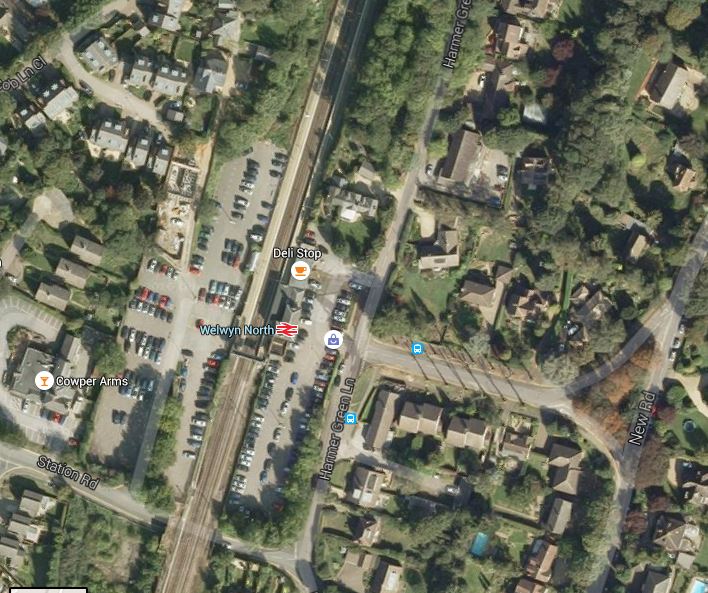
Welwyn North Station
These are some pictures of Welwyn North station taken on another day.






The images, probably shows another problem in that four-tracking the line through Welwyn North station would probably close the car parks.
The Digswell Viaduct
The Digswell Viaduct is an iconic structure and if the views of the viaduct and the valley it crosses were to be altered in any negative way, there would be a battle that would make the protests over HS2 look like a child’s tea party.
Around 1890, they had a similar capacity problem at the Stockport Viaduct, which was successfully widened from two tracks to four.
It is my view, that with major advances in structural engineering and construction methods, that widening the viaduct would be one of the better methods to improving the capacity through the area, without changing the look of the viaduct.
Intriguingly, if the East Coast Main Line was not already electrified, with the recent development of IPEMU-technology, I suspect now that Network Rail would think seriously about not electrifying the viaduct.
Trains would cross using their on-board energy storage, raising and lowering their pantographs appropriately.
Knebworth Station
This Google Map shows Knebworth station, a few miles to the North of Welwyn North.
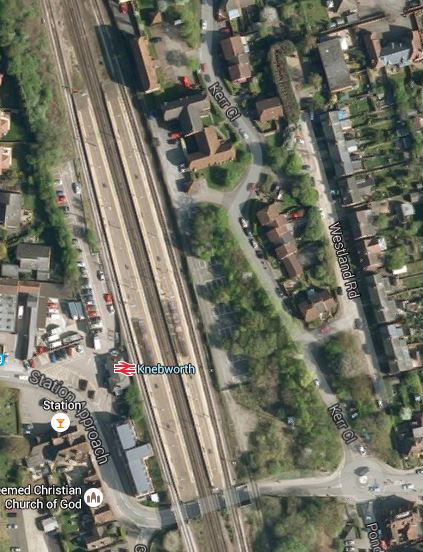
This station has four platforms arranged on two islands.
For comparison, this is an image of Welwyn North station to the same scale.
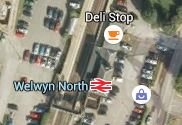
I think that four-tracking Welwyn North station will be a tight fit.
Comclusion
At some point, I feel that Network Rail will bite the bullet on four-tracking this section of line and the fight will be a big one.
One of North London’s Forgotten Lines Is Awakening
Four of the nearest stations to my house are Moorgate, Old Street, Essex Road and Highbury and Islington. which all lie in an arc on the Northern City Line to Finsbury Park and on to North London and Hertfordshire, where it terminates at Hertford North, Letchworth, Stevenage and Welwyn Garden City.
Traditionally, the line has always only run on a five day-a-week basis, with no service at weekends. As it serves Arsenal’s past and future stadia, I’ve always thought this was a bit short-sighted.
But then I’ve always felt that British Rail considered it was a railway, that they didn’t really want after they acquired it from London Underground following the Moorgate Tube Crash.
So when this month, when they decided to run a weekend service and the weekday service until 23:59, I did not notice any announcement. I use Highbury and Islington station several times a week and I certainly didn’t see a poster.
This is one of those things that should be filed under At Last! Especially, as the southern end of the line in a few years time will connect a large number of lines together.
- Moorgate – Northern, Metropolitan and District Lines and Crossrail (2019)
- Old Street – Northern Line
- Essex Road
- Highbury and Islington – East London, North London and Victoria Lines
- Drayton Park
- Finsbury Park – Piccadilly and Victoria Lines and Thameslink (2019)
If Crossrail 2 ever gets built, it will connect to this line too!
The forgotten nature of the Northern City Line is illustrated, by the elderly Class 313 trains on the line. There are currently forty-four three-car sets on the line, usually working as six car services, so giving effectively twenty-two trains.
But the days of the Class 313 are numbered as according to this article on Rail Magazine, the operator; Govia Thameslink Railway has just ordered twenty-five six car Class 700 trains from Siemens. This is said about the trains.
The new trains will be Class 700s, and will be a variant of the 1,140 vehicles currently being delivered by Siemens to GTR for Thameslink. They will run on routes from Moorgate and London King’s Cross to Welwyn, Hertford, Stevenage and Letchworth. They will be fixed length with full width inter-vehicle gangways, air-conditioning, real time information and power points.
Of all the lines in London that could benefit from a fleet of new trains, this must be one of those routes, where they will give the greatest improvement.
Especially, as for the operator, it is just more of the same trains, they will be using on Thameslink.
But will they be exactly the same?
This is said in the Wikipedia entry for Class 313 trains.
Since they were designed for use on Great Northern Suburban Inner Suburban services from Moorgate to Welwyn Garden City or Hertford North, Letchworth Garden City which included a section of ‘tube’ line built to take standard size trains between Drayton Park and Moorgate, they are built to a slightly smaller loading gauge than conventional trains. They are standard length and width, but the roof is lower, most noticeable due to the lack of a “well” for the Stone Faiveley AMBR pantograph on the centre coach. They have to comply with regulations for underground trains, such as having doors at each end of the train for evacuation onto the tracks, and when on 750 V DC supply the traction supply for each motor coach is separate, whereas on conventional 750 V DC trains each coach in a unit is linked by a 750 V bus line. Due to this, each motor coach has shoe gear on both bogies, whereas normally it would only be on the leading bogie. They are fitted with trip-cocks that are struck by a raised train-stop arm at red signals and will apply the brakes if the train passes one.
I suspect there will be some intensive work to make the Class 700 trains meet the regulations for underground trains.
To say some of the stations at the southern end of the route are tired and/or difficult for those who need step-free access, would be an understatement.
Moorgate is getting improved for Crossrail and Finsbury Park is getting a much-needed redevelopment. This will only increase the pressure to rebuild stations like Old Street, Essex Road, Highbury and Islington and Drayton Park.
As it goes further north, I do wonder if we’ll see new stations to serve future housing developments, especially on the Hertford Loop Line.
The other possibility of improving services from Moorgate is that the top speed of the new Class 700 trains is 100 mph, whereas the speed limit on the Hertford Loop is only 75 mph.
So will we see the extra three trains available used to move services off the crowded section of the East Coast Main Line over the Digswell Viaduct onto the Hertford Loop Line.
With some clever rescheduling, this might create a path or two on the East Coast Main Line.
The operator is not going to spend those millions on a new set of trains and not make them sweat!
I certainly think, that we’ll see good connectivity between trains on the Northern City and Hertford Loop Lines with Thameslink services to Peterborough and Cambridge.
It will be interesting to see their plans, when they are revealed.
My one worry is that all those new trains will tempt a lot of passengers out of the woodwork!
But one of London’s railways will not be forgotten for very long!
From Nottingham To Peterborough
I took an East Midlands Trains service to Norwich to get to Peterborough. I wanted to look at the Allington Chord. Wikipedia says this about the chord under its entry for the East Coast Main Line.
The Allington Chord was constructed near Grantham in 2006, allowing services between Nottingham and Skegness to call at Grantham without having to use the ECML, trains now passing under the line. This provided sufficient extra capacity for 12 additional services between Leeds and London each day.
This certainly illustrates the improvements gained, when these crossings of the East Coast Main Line are sorted. Could similar improvements be gained when the Newark Crossing is eliminated.
I took these pictures on the journey.













My problems then started as I reported here in The Curse of the Coeliac Traveller.
The Problems Of Upgrading Railways
The East Coast Main Line from Kings Cross to Newcastle and Edinburgh via Peterborough, Doncaster and York may be a High Speed Line that allows trains to run at 200 kph. The trouble with the line is that it doesn’t have enough capacity for all the passenger and freight trains that want to use the line.
The French or Spanish would have probably built a new line, but we don’t have the space they do, and it is questionable in this country, if high speed trains are popular with the general public.
But on the East Coast Main Line, there was already a decrepit bypass called the Great Northern Great Eastern Joint Line from Peterborough to Doncaster. I’ve talked about this line before in Project Managers Have Fun In The East.
This article in the Rail Engineer is the story of upgrading that line, so that in particular freight trains can be diverted to free up space on the East Coast Main Line.
The line has been virtually rebuilt, resignalled, level crossing have been removed and stations have been improved, at a cost of around three hundred million pounds.
There is still work to do and in a few years time, the following could have happened.
1. A better connection at the Northern end at Doncaster.
2. A diveunder or flyover at Werrington Junction near Peterborough, to remove a bottleneck.
3. There might even be a direct link across the Fens from Spalding to March. This would allow freight trains between Felixstowe and the North to join or cross the East Coast Main Line at Doncaster.
4. The line might even be electrified, in part to cut the noise of the dreaded Class 66 diesel locomotives.
George Osborne Sets Out His Vision Of Yorkshire
This article in the Huddersfield Examiner is entitled Chancellor George Osborne to set out long term economic plan for Yorkshire during visit to West Yorkshire.
Read it and there are some interesting snippets, that he believes will be part of a long term plan for Yorkshire.
One of them is this.
We will also increase speeds on the East Coast Mainline to 140 mph
It is already planned and if and when it happens it will significantly reduce journey times all the way up the line between London and Edinburgh.
George is not actually promising anything for which funds have not been allocated, but his words show he understands the value of infrastructure, something that can’t be said for all Chancellors of the Exchequer since the Second World War.
The one thing that George or any future Chancellor can ensure, is that by not cutting funds they will get this valuable project carried out!
 The Anonymous Widower