East London Line And Thameslink
If say you want to go between Dalston Junction and Purley, you will certainly have to change trains.
Currently, it takes between fifty and sixty minutes and you sometimes change at New Cross Gate and at other times the suggested change is Norwood Junction.
It’s alright for me and others who know how to use the various journey calculators or apps, but what about people like my late wife, who never ever owned a smart phone or even sent a text message.
The full simple rule for Dalston Junction to Purley, seems to be something like take a West Croydon train from Dalston Junction to Norwood Junction and then get the first train to Purley from there.
Different rules apply to different stations
Thameslink is going to bring major changes to how we go places along the East London Line and especially, if we venture into any Thameslink territory.
My simple example of Dalston Junction to Purley might get a lot more complicated, as some documents and web pages, say that Thameslink services between London Bridge and East Croydon will not stop. So how do passengers on the East London Line catch these trains to places like Purley, Gatwick and Brighton.
To get to Thameslink, those on the East London Line, will have to go to Whitechapel and get a train to Farringdon or St. Pancras
That will be a pain for anybody, whose local station is anywhere on the East London Line and very much a degradation of the current service.
Those living near Norwood Junction have already lodged a petition with the London Assembly called Norwood Junction wants Thaneslink.
An Ideal Oxted Line
This post was suggested by a comment by Ben H on my post called Untangling The Brighton Main Line. He said this about Oxted Line services.
Cease all services between the Oxted lines and Victoria (fast lines). All Oxted line services should go to London Bridge and (excluding diesels) become part of Thameslink.
Oxted services should operate single-line working between Norwood Junction and Sanderstead, with East Croydon’s easternmost platform island acting as the passing loop.
In one way, what he says is a no-no. If Oxted services were switched from Victoria to London Bridge, all the commuters would be up in arms and would challenge the change of London terminal in every way possible. Remember what happened when Network Rail proposed terminating all Sutton Loop services at Blackfriars. This is from Wikipedia in Political Developments under Thameslink Program.
Network Rail had planned to terminate Sutton Loop Thameslink trains at Blackfriars station, rather than have them continue through central London as at present. This upset many residents in South London and their local politicians, who saw it as a reduction in services rather than an improvement. In response to pressure, government has ordered Network Rail to reverse the decision.
So Oxted services will have to go into Victoria, until something so much better comes along, they forget about it. Bribery is a powerful tool.
The Current Oxted Line Service
So what services go down the two branches of the Oxted Line?
In the Off Peak the following services run.
- Two trains per hour go between Victoria and East Grinstead
- One train per hour between London Bridge and Uckfield.
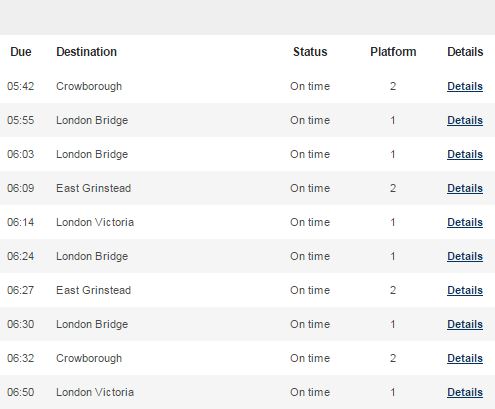
There are extra trains in the peak, as this Departures display at Oxted station shows.
Trains From Oxted
But compared to say the Chingford Branch into Liverpool Street, which has at least four trains per hour all day, it is a very sick joke of a service. And a lot of the Chingford Branch services are eight cars!
Four Trains Per Hour To East Grinstead And Uckfield?
I strongly believe that services need to be four trains an hour, as they are on the East London Line to the four Southern terminals of Clapham Junction, Crystal Palace, New Cross and West Croydon.
So the question has to be asked if East Grinstead and Uckfield should have a four trains per hour service?
My view is that they do, if you want to have a turn-up-and-go service!
Fifteen minutes may seem a long wait, but if you can get a coffee and a paper, it can be quite a short time.
So what frequencies do other places in Sussex have to and from London?
- Bognor Regis – 2 trains per hour.
- Eastbourne – 2 trains per hour.
- Hastings – 3 trains per hour.
- Hove – 2 trains per hour.
- Littlehampton – 2 trains per hour.
- Worthing – 2 trains per hour.
These are better than Uckfield and just about on a par with East Grinstead.
Thameslink Will Be A Game-Changer
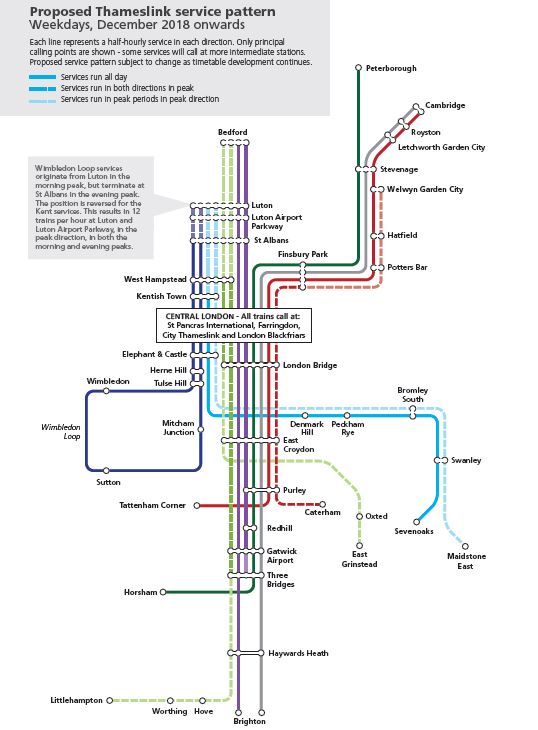
The completion of the Thameslink Programme will bring an increase in capacity all the way from Brighton and Gatwick Airport to London and beyond.
This a map of Thameslink Programme.
ThamesLink Programme Map
Brighton and Gatwick Airport after the upgrade will have frequencies of upwards of eight and twenty trains per hour respectively and a choice of destinations including.
- Blackfriars
- Cambridge
- Farringdon for Crossrail
- London Bridge
- Luton
- Peterborough
- St. Pancras
- Victoria
I also think that if passengers were prepared to change at Brighton, Gatwick or East Croydon, there could be substantial increases in faster services to London and beyond from places on the Coastway Lines like Bognor Regis, Eastbourne, Hastings and Worthing etc.
There is possibly an argument to build some south-facing bay platforms at Gatwick, so that additional services can be run from there down the two Coastways. Thus a passenger from Hastings to London say, would have in addition to the direct service perhaps two or three with a step-free change at Gatwick, where they could choose either a Victoria or a Thameslink service.
What happens in the future will depend on how passengers use the improved Thameslink and what Gatwick decides to do to gain more passengers.
It will be interesting to see how the pattern of commuters changes in the next few years.
Have Thameslink Got Their Act Together?
One thing that puzzles me, is that I can’t find anything on the Internet, which talks about speeded up services on Thameslink after improvement. So am I right to assume that they’re spending all this money to provide more trains with larger capacity to more destinations in the same time as now?
There is no journey time calculator on the Thameslink Programme web site like there is on the Crossrail web site.
Obviously, it isn’t provided as the truth may be at odds with how wonderful the PR guys believe Thameslink is going to be.
Thameslink To Uckfield and East Grinstead
It might seem logical to run Thameslink trains down the Oxted Line to Uckfield and East Grinstead.
In fact, it is planned to run an eight-car service between West Hampstead Thameslink and East Grinstead in the Peak.
So why not run two four-car Class 700 trains that join and split at Oxted?
- The trains only come in fixed formations of eight and twelve cars.
- A sixteen-car train would probably be too long for the tunnels and the trains don’t have the end gangways needed for tunnels.
- The Uckfield Branch is not electrified.
- It would probably not be a good decision to build four-car trains for one branch of Thameslink.
Given the chequered history of the birth of Thameslink and the design of the trains, I think that four-car trains that could run in pairs, were discarded from the design of the railway. As it’s also common for trains to be split and joined all over southern England, I wouldn’t be surprised to see some shorter trains in the future on Thameslink.
Services Not Serving Gatwick Airport At East Croydon Station
If consolidation of services can take place at Brighton and Gatwick Airport, would it be possible to do the same at East Croydon station. These are the services south from East Croydon, that don’t terminate at Three Bridges and Brighton or pass through Gatwick Airport.
- 2 trains per hour from Victoria to Caterham
- 2 trains per hour from London Bridge to Caterham
- 2 trains per hour from London Bridge to Tattenham Corner, which when the Thameslink Programme is complete will start from Cambridge.
- 2 trains per our from Victoria to East Grinstead
- 1 train per hour from London Bridge to Uckfield
- 1 train per hour from Victoria to Tonbridge via Redhill
- 1 train per hour from Victoria to Reigate via Redhill
To summarise there are eleven trains an hour of which six go to Victoria and five to London Bridge. I assume it’s all for historic reasons and nothing to do with any serious railway planning.
Thankfully, the Tattenham Corner services are being taken out of the mix and will become part of Thameslink.
Another Gatwick Express Route
An interesting point is that Reigate and Tonbridge are both on the East West Route that connects Reading to Ashford International, via Guildford, Reigate, Redhill, Gatwick Airport and Tonbridge.
I believe that this could be a second Gatwick Express route to link the Airport to Wales and the West, and Continental rail services. So a four trains per hour service from Reading to Ashford international via Gatwick could benefit a lot more than those going to and from the Airport.
Platforms 5 And 6 At East Croydon Station
Intriguingly, all of these non-Gatwick services from London, seem to go south from Platform 6 at East Croydon station and go North from Platform 5.
There are also some other services like London Bridge to Horsham, that also use these platforms.
So do the savvy passengers coming from the South wanting to go to London Bridge, but from a station served by Victoria , change at East Croydon for the alternative destination?
Interestingly, if you use the National Rail’s Journey Planner to look at services from Victoria to Uckfield or London Bridge to East Grinstead, it sends you via a change at East Croydon.
So I would suspect that regular travellers know how to use East Croydon as an optimal interchange to get to their correct destination.
These pictures show Platform 5 and 6 at East Croydon station.
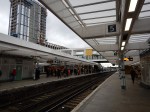
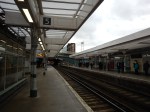
It is a well-equipped island platform, with coffee and food stalls, a waiting room, an information booth and toilets. The bridge at the Northern end and the ramp at the Southern end give step-free access to the two entrances and the other platforms.
Compared to some draughty, unwelcoming and scruffy places, where I’ve changed trains, it is one of the best single-platform interchanges.
The only thing that the island platform lacks is an Oyster reader, so that those like me, who need to touch-out and touch-in again, as they are changing from a Zone 6 ticket to contactless for Gatwick Airport, don’t have to walk up and through the barrier. I wrote about this in Contactless Between East Croydon And Gatwick Airport, which showed that at present contactless cards may be cheaper!
Increasing Capacity on the Oxted Line Is Not That Simple
Various factors come into play when providing extra capacity on the Oxted Line and I’ll discuss them in the next few sections.
Extra Services Through Platforms 5 And 6 At East Croydon
I’ve looked at an hour in the rush hour and a dozen trains have travelled South through platforms 5 and 6, with some gaps between trains being as low as two or three minutes.
Many platforms in London handle upwards of sixteen to twenty trains an hour. Londoners and visitors, also know how to use platforms like these as interchanges, by getting off one train and then getting another one a few minutes later.
When Thameslink is fully upgraded, passengers from Peterborough, Cambridge and Bedford, will change to their ultimate southern Thameslink destination at stations like St.Pancras Thameslink, Farringdon, City Thameslink, Blackfriars and London Bridge.
So on a brief analysis, it would appear that Platforms 5 and 6 at East Croydon are not the limiting factor, provided that signalling, track, trains and staff are all working as they should. The platforms also offer valuable interchange opportunities to set up the journey you need.
It gives a simple rule for getting to any of the stations on the various inner branch lines to Caterham, Uckfield, East Grinstead and others not served by Thameslink.
You get any train on either of these branches to East Croydon and then wait on Platform 5/6 for the next train to your ultimate destination.
Thameslink to Tattenham Corner And Horsham
When I went to Gatwick Airport to write about the contactless ticketing, I arrived on Platform 5 at East Croydon on a Horsham train, that had started from London Bridge, that I’d caught at New Cross Gate. These services run twice every hour, as does a service from London Bridge to Tattenham Corner.
When Thameslink is completed, two services to Horsham and two to Tattenham Corner will become all day twelve-car services as follows.
- Peterborough to Horsham. – Currently this service stops at New Cross Gate and Norwood Junction between London Bridge and East Croydon.
- Cambridge to Tattenham Corner – Currently some services stop at Norwood Junction between London Bridge and East Croydon.
Incidentally, I do wonder if the person, who devised the Thameslink schedule was a horse racing enthusiast. A twelve car train from Cambridge to Tattenham Corner would be ideal for getting between the two important racing centres of Newmarket and Epsom.
Will these four services continue to use Platforms 5/6 at East Croydon?
I think they should as it would give all of those places like East Grinstead, Purley, Uckfield and all the other stations currently connected to Platform 5/6, a same-platform interchange to a four trains per hour Thameslink service to the East Coast Main Line.
If passengers want the other northern branch to Luton and Bedfird, they would change in the core.
Will these Thameslink services still continue to stop between East Croydon and London Bridge?
Judging by some of the chatter on the Internet, it looks like there’s a good chance they won’t!
Extra Northbound Destinations From Platform 5 And 6 At East Croydon
East Croydon station frustrates me, in that to get there from my closest station at Dalston Junction is not simple.
- Change at New Cross Gate or Norwood Junction stations.
- Travel to West Croydon station and get the Tramlink.
So could a third northbound destination be added to platform 5 and 6 at East Croydon?
I believe that the answer is yes, especially as there is spare capacity on the East London Line to the North of Surrey Quays station. Although, I doubt that Southern’s trains could run north of that station.
- Personally, I would find a Dalston Junction service to East Croydon, much more useful than the current one to West Croydon.
- Crystal Palace possibly has the space.
- It would be very handy, if it were possible to have a terminal platform somewhere in the Shoreditch High Street/Whitechapel area.
- Transport for London are also thinking about a station in the Penge area, where the East London Line and the Chatham Main Line cross.
What is done in the end will depend on the travel statistics. I suspect that the new Penge station and swapping the West Croydon service to East Croydon are the most likely options.
Gatwick Express To Old Oak Common And Milton Keynes
Platform 5/6 At East Croydon is the Southern terminus of a service to Milton Keynes that uses the West London Line.
I believe that this service could be upgraded to be part of Gatwick Express.
- It would use the same trains as the other Gatwick Expresses.
- Hopefully, it could run more than once an hour.
- It would create a simple link from Gatwick Airport to the Midlands and the North.
- It would serve the new Old Oak Common station for HS2, the West Coast Main Line and the North London Line.
- It would terminate at Milton Keynes on the East West Rail Link.
I certainly think, that this is a third route for Gatwick Express.
The Tattenham Corner Paths Won’t Always Be Released
After Thameslink is fully open, two of the services from Tattenham Corner to London Bridge, will become Thameslink services to Cambridge.
But as some Caterham and Tattenham Corner services to Victoria join and split at Purley, this might not mean that two extra paths an hour are available to London Bridge.
I have one question about this Thameslink Tatterham Corner to Cambridge service. Which platforms will it use at
Can South Croydon Help Sort Things Out?
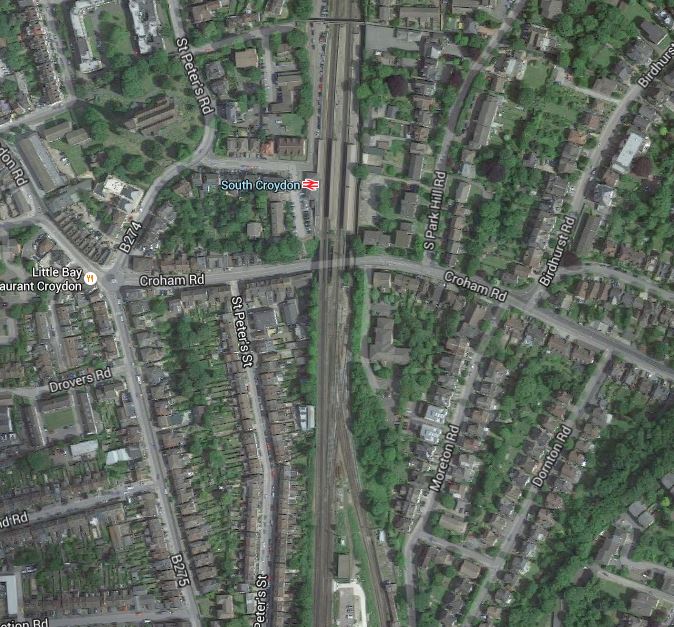
South Croydon station could be a key to providing better services through East Croydon. Look at this Google Map of the station and the junction to the South.
South Croydon Station And Junction
Note.
- The station currently has five platforms, but I don’t think it could be called a modern station in terms of facilities.
- The junction south of the station, is where the Oxted Line for Uckfield and East Grinstead leaves the Brighton Main Line.
- The Southern service from Milton Keynes to East Croydon, used to terminate at South Croydon.
Many of the services that use Plstforms 5 and 6 at East Croydon pass through South Croydon and I feel that a properly remodelled station could be an alternative interchange.
I think that South Croydon could also be an alternative terminus for East London Line services that currently go to West Croydon.
Norwood Junction Station
I also find Norwood Junction station frustrating and judging by the calls for some Thameslink services to call at the station, I suspect others do too.
If I’m going south on the East London Line, I can change to various services to places like East Croydon, Horsham and Tattenham Corner, by just walking across the island platform 5/4.
But going north, you have to dive into a subway to get to platform 1, rather than using the other side of the island platform 2/3.
There will be a lot of Thameslink services passing through the station and if some stopped, it would be possible to have simple cross-platform access between the East London Line and Thameslink.
A New Penge Station
Transport for London have proposed a Penge Interchange station in the Transport Infrastructure Plan for 2050, If it were to be built it would link the East London Line and the \Chatham Main Line, where they crossed just North of Penge West station. I wrote about the station in An Exploration At Penge.
This station could be an interchange between the following services.
- Chatham Main Line
- East London Line
- London Bridge to East Croydon Services
- Thameslink
As the site is quite large, there is also space for some terminal platforms facing South.
Conclusion
I have no idea what will happen, but it would seem to be possible to increase the services on the Oxted Line towards the ultimate aim of one every fifteen minutes to both termini.
The simplest solution would see the Oxted Line relegated to a branch line, where some services terminated at a rebuilt and rejuvenated South Croydon station with cross-platform access to Victoria, London Bridge and Thameslink services.
But I do doubt that four services an hour on both branches can be accommodated in the main London termini.
I do think though that there is so much flexibility, that what happens in the end will be a pleasant surprise. And probably totally acceptable to everybody except Disgusted in Tunbridge Wells!
.
Connectivity Around Clapham
I’ve talked a lot lately about improving the rail lines and especially their connectivity in South London in quite a few posts lately.
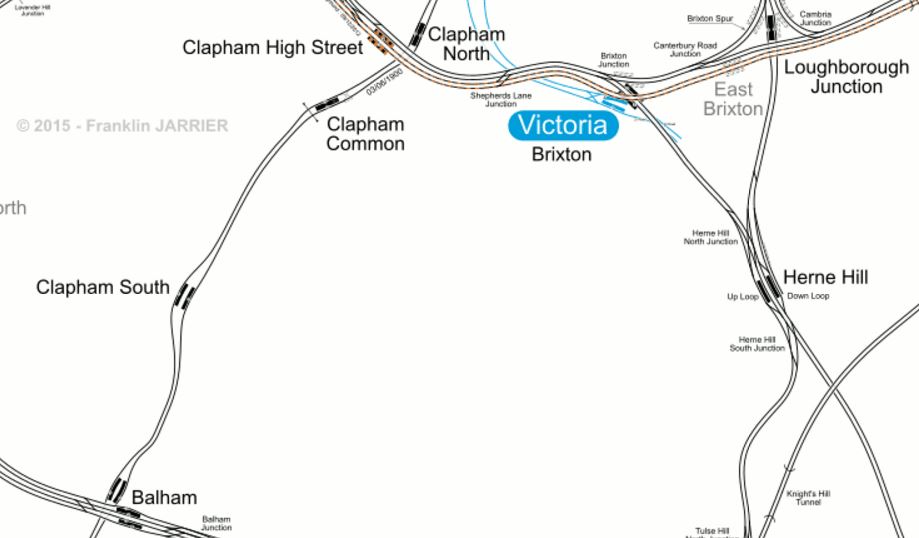
So I extracted this map from carto.metro.free.fr
Clapham Lines
I think we have to congratulate the French behind these accurate metro maps.
Note the following.
- In a few years time, there will be two high-capacity North-South routes through the area; Thameslink and the Northern Line, which meet with the Bakerloo Line at Elephant and Castle station.
- Thameslink at Farringdon station and the Northern Line at Moorgate and Tottenham Court Road will have excellent connections to Crossrail.
- Thameslink goes through Herne Hill and Loughborough Junction and will have at least six eight-car trains all day, with extra services in the peak.
- Herne Hill is a big railway bottleneck, with as yet no sensible proposal to solve it.
- The Northern Line will have at least twenty trains per hour all day, between Morden and Kennington stations.
- The Victoria Line is also important to the area, as it will provide a thirty trains per hour service to from Brixton to Walthamstow Central via Stockwell on the Northern Line.
- The East London Line connects Clapham Junction in the west via Clapham High Street and Surrey Quays to Highbury and Islington in the north-east.
- The East London Line is getting crowded and increased frequencies will happen in 2019.
- The Law of New Routes, Stations and Trains will mean that Thameslink will attract traffic and the trains will quickly get busy.
- In the future Balham station could be served by Crossrail 2.
I believe that expecting Crossrail 2 to solve South London’s transport problems, is a bit like waiting for the United States to help the beleaguered good guys out in the First and Second World Wars.
Like the Americans, Crossrail 2 will arrive, but we have to make the best of what we’ve got in the meantime.
Perhaps these projects will help.
More And Better Designed Stations
Transport for London (TfL) have very sophisticated train and passenger modelling systems, which enable them to propose where improvements to stations should be made.
Sometimes this type of analysis, gives surprising results, that are counter-intuitive.
For example, I pointed out in Faster London Trains Could Make Your Commute Even Longer, how French research had shown this premise, to sometimes be true.
But the research also showed that in certain cases, extra stations could make journeys faster.
From my personal observations at Angel station, I sometimes think that trains arrive and depart faster on the wider southbound platform, rather than the narrow northbound one.
Camberwell Station On Thameslink
A couple of miles north of Loughborough Junction station is the disused Camberwell station, which Transport for London are proposing to reopen.
In their report on the Bakerloo Line Extension, TfL give this concise summary on reopening Camberwell station.
A new station at Camberwell would be a significantly lower cost option to a Tube extension, whilst serving the same catchment area. Investigations show significant journey time improvements could accrue to Camberwell passengers and that operationally there may be scope to integrate re-opening of the station into the launch of the completed Thameslink programme.
We will therefore undertake further planning work with Network Rail and the London Borough of Southwark to assess the proposal.
From their statement, it would appear that TfL have done an extensive analysis.
I would not be surprised, if this enthusiastic statement wasn’t followed through.
Northern Line Stations
Several of the Northern Line stations are relics of the line’s Victorian past and stations are slated for major improvements over the next few years.
- Bank – A big development has just been announced.
- Camden Town – I wrote about the proposed development of Camden Town station in The Camden Town Upgrade Exhibition.
- Elephant and Castle – A big property development is planned, which incorporates a new Northern Line station.
- Moorgate – Crossrail will improve the station.
- Old Street – Developments are planned in the area, which could result in an improved station.
These developments will probably mean that after the Northern Line Extension to Battersea is completed, most major stations between Camden Town and Kennington will have been upgraded.
Only the two Northern branches and the Morden branch will have not received a substantial number of upgraded stations with complete step-free access, wide safe platforms and escalators.
I think we’ll see other improvements to stations, especially an upgrading of the two island platform stations at Clapham North and Clapham Common.
The Herne Hill Loop On The Victoria Line
One constraint on the efficiency of the Victoria Line, is reversing the trains at Brixton station. There have been proposals in the past to crete a reversing loop with another station on the loop at Herne Hill station. I wrote about it in detail in Will The Victoria Line Go To Herne Hill?
This extension will only be built, if it is value-for-money in improving the Victoria line, despite the positive secondary effects it might have in the Herne Hill area!
An Interchange Hub At Streatham Common Station
Transport for London has recently proposed a interchange hub at Streatham Common, which I wrote about in Puzzled Over Streatham Common Station.
In my article, I showed that a well-designed hub could connect the following lines.
- The Sutton Loop Line Of Thameslink – Linking To Wimbledon and Sutton
- The Brighton Main Line
- Tramlink – With the possible use of tram-trains.
- East London Line – Linking to East London, Kent and Essex
- West London Line – Linking to Old Oak Common for HS2 and the West Coast Main Line
I very much think that the idea of an interchange hub at Streatham Common is a masterstroke.
Especially, as it will take the pressure off Wimbledon and East Croydon!
Another Branch Of The East London Line
The East London Line currently has four trains per hour in both directions across South London to and from Clapham Junction station.
This branch is getting very busy and from 2019, an extra two trains per hour will use this route.
But will Clapham Junction be able to cope with the extra services?
If it can’t, a possible alternative would be to run some trains from Peckham Rye via Tulse Hill to a terminus at Streatham Common.
Clapham High Street, Brixton And Brockley Interchanges
These are three possible interchanges with the Easst London Line in South London.
- Clapham High Street and Clapham North stations could be connected, if it was decided to improve the Northern Line through Clapham.
- Interchange between all the lines at Brixton station has been mentioned by TfL and I wrote about it in Could The Various Lines At Brixton Be Connected?
- TfL have also suggested that Brockley station could be a potential interchange hub and I wrote about it in A Report On The Bakerloo Line Extension
Each will have advantages and disadvantages.
Conclusion
There are a lot of possible projecs to improve the train services in the Clapham area.
What TfL have in their traffic database will decide the pattern of trains the area.
Increased Frequencies On The East London Line
This article from the South London Press is entitled More Trains For The London Overground. The article says Transport for London (TfL) wants to make two service improvements are on the East London Line.
- From 2018, there will be an extra two trains per hour (tph) between Dalston Junction and Crystal Palace.
- From 2019, there will be four additional trains between Dalston Junction and Clapham Junction, making the frequency 8 tph.
I found the source of the report on TfL’s web site. This is a handy summary from the Appendix.
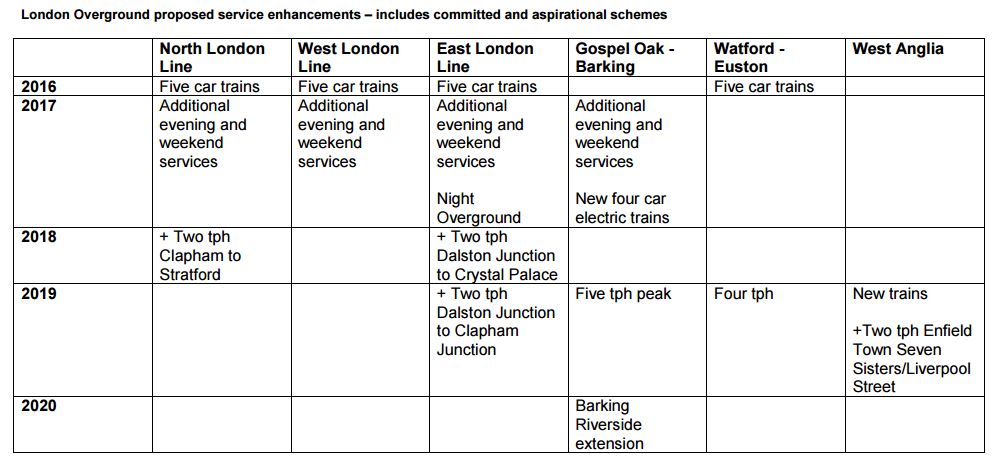
LO Improvements
It looks like the pattern of extra trains is as follows.
- From 2018, there will be an extra two trains per hour (tph) between Dalston Junction and Crystal Palace.
- From 2019, there will be an extra 2 tph between Dalston Junction and Clapham Junction, making the frequency 6 tph.
Currently both these services go to Highbury and Islington.
It’s interesting that these increased services are starting in 2018-2019! This times them to start just as Crossrail and Thameslink are opening, which probably means that TfL are expecting that a lot of Crossrail passengers will change to and from the East London Line at Whitechapel. As I will, no doubt!
Buried in TfL’s Transport Plan for 2050 says are possible plans on improving the service on the East London Line.
- Better late night and overnight services on the Overground.
- Automatic Train Operation on the core of the line from Dalston Junction to Surrey Quays to increase service frequency from 16 tph to possibly as high as 24 tph.
- Six car trains on the Overground.
At the moment the East London Line has 16 four-car trains an hour in the core route, so 24 six-car trains will mean an increase of capacity of 2.25.
The announced service improvements will mean that 20 tph will be passing Whitechapel and Canada Water.
So will we see other services started to bring the line up to the 24 tph capacity?
This would give London three almost-new 24 tph lines crossing the city; Crossrail, Thameslink and the East London Line, in an H-shape.
TfL don’t sem to be planning it yet!
The increase in frequency from Dalston Junction to Clapham Junction station is very welcome to me, as I often take a train to Clapham Junction to go south to Brighton, Gatwick or other places.
Increasing the frequency to Clapham Junction may also be needed, as extra stations and other changes are added to this branch of the East London Line.
- New Bermondsey station will be opened to take advantage of the six services per hour between Dalston Junction and Clapham Junction.
- Clapham Junction might be served by the Northern Line Extension some time in the early 2020s.
- Clapham Junction may well be served with other services to take the pressure off Victoria and Waterloo. It always strikes me as a station, that since its latest improvements could handle more services.
- Camberwell station, which has been promised for some time, could finally be under way, to connect the East London Line to Thameslink at Loughborough Junction station. A design based on the split-level principles of Smethwick Galton Bridge station may solve the connection problem.
The only difficulty of this frequency could be that there might need to be upgrades at Clapham Junction to turnback more trains.
Increasing the frequency to Crystal Palace station will be of less use to me, as I’ve rarely used that service.
If it linked to Tramlink, I might use it more, but that extension to Tramlink was dropped by Boris and there seems to be no enthusiasm on anybody’s part to build it.
I do wonder if Transport for London have other plans for Crystal Palace in their mind.
Look at this Google Map showing Crystal Palace, Penge West and Penge East stations.
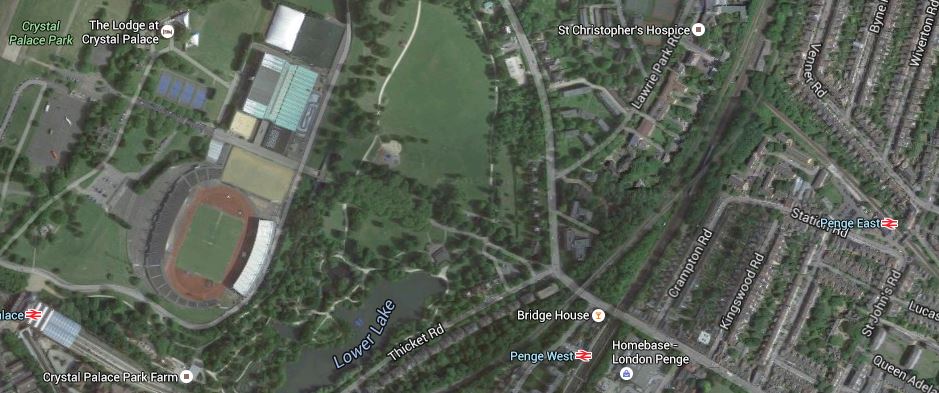
Crystal Palace And Penge
Crystal Palace is a fully modernised and accessible station with lifts, a cafe and lots of platforms, so it makes an ideal terminus for trains on the East London Line.
Penge West is not the best appointed of stations and I suspect if a much better alternative was provided nearby, no-one would miss the station.
Penge East is on the Victoria to Orpington Line and needs upgrading for step-free access. But it has the problem of a Listed footbridge, that should be burnt. I wrote about it in An Exploration At Penge.
Buried in TfL’s Plan for 2050, is the one-word; Penge, as a possible new station. The line through Penge East passes under both the Brighton Main Line and the branch to Crystal Palace, in an area of railway land.
After looking at Smethwick Galton Bridge station or as I called it, Birmingham’s Four-Poster station, I do feel that a good architect could design a station, that solved the challenging problem of the difference in height and created a fully-accessible interchange. This station could have a lot going for it, as services passing through the station would include.
- 4 tph between Victoria and Orpington on the Victoria to Orpington Line
- 6 tph between Dalston Junction and Crystal Palace and 4 tph between Dalston Junction and West Croydon on the East London Line.
- A selection of the East London Line services would go to Highbury and Islington.
- 2 tph between London Bridge and Caterham on the Brighton Main Line.
- Services between Bedford/St. Albans/St. Pancras and Beckenham Junction on the Victoria to Orpington Line
It would increase connectivity greatly all over East London, both North and South of the river.
I suspect too, that the station would open up the brownfield land around the railway for property development.
I think there is a strong case to watch that area of Penge!
Haggerston – A Simple Viaduct Station
Haggerston station is on the East London Line. It sits on top of the Kingsland Viaduct that used to take the line between Dalston Junction and Broad Street.
The platforms and the access are about as simple as you can get, but they are not of a low quality and standard.

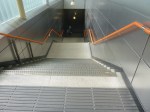
Hoxton station which is the next one south on the line is similar.
I must have gone through the old Hoxton and Haggerston stations several times, when in the 1980s, I took the East and North London Lines to get to Stonebridge Park, where Metier’s offices were situated.
I can remember slam-door trains smelling of urine, but that could have been from earlier times.
Orpington Station – 3rd August 2015
After An Exploration At Penge, took a train from Penge East station to Orpington station.
These pictures I took, show a well-appointed station with full step-free access and a selection of long through and bay platforms.
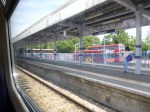
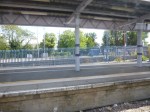
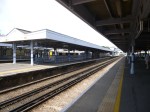


Could Orpington be one of the extra destinations that are needed by the East London Line?
It takes thirty four minutes of travelling time to get to Whitechapel changing at New Cross at the moment, so it is actually closer than West Croydon, which takes forty minutes.
The route passes through a series of important and busy stations like New Cross, Lewisham and Petts Wood. It could either be via Beckenham Junction and Bromley South or via Hither Green and Chislehurst.
Using Opington as a destination for the East London Line would appear to connect a lot of South East London to Crossrail at Whitechapel and the Jubilee Line at Canada Water.
It would also fit in well with Transport for London’s desire to take over services in South East London. The Wikipedia entry says this.
However, since taking over the West Anglia services, TfL have once again proposed to take over the suburban routes, currently operated by Southeastern after their franchise ends. The opposition to TfL taking over routes from Kent County Council have softened after a London Assembly meeting, which Kent County Council attended. Kent have set out “red lines” to its support, stating no Southeastern Mainline service should be negatively affected by a take over by TfL.
So bringing an uprated East London Line to Orpington might appear on the surface to fit in well with TfL’s ambitions.
It certainly seems that they have big ambitions in South East London.
Could it be Borough Jealousy?
Councils like Bromley have seen the improvements in transport and the related benefits in Northern boroughs like Hackney, Islington and Brent and want a piece of Orange action themselves.
Improving The East London Line
I make no apologies for returning to this subject, but I use the East London Line of the Overground virtually every day and it is very much part of my daily life.
What also prompted me to think about this topic, was coming back from Birmingham into Marylebone and thinking how I would get home in the aftermath of a Friday rush-hour. At the time I was passing Dollis Hill station, where the Chiltern Line runs alongside the Jubilee And Metropolitan Lines.
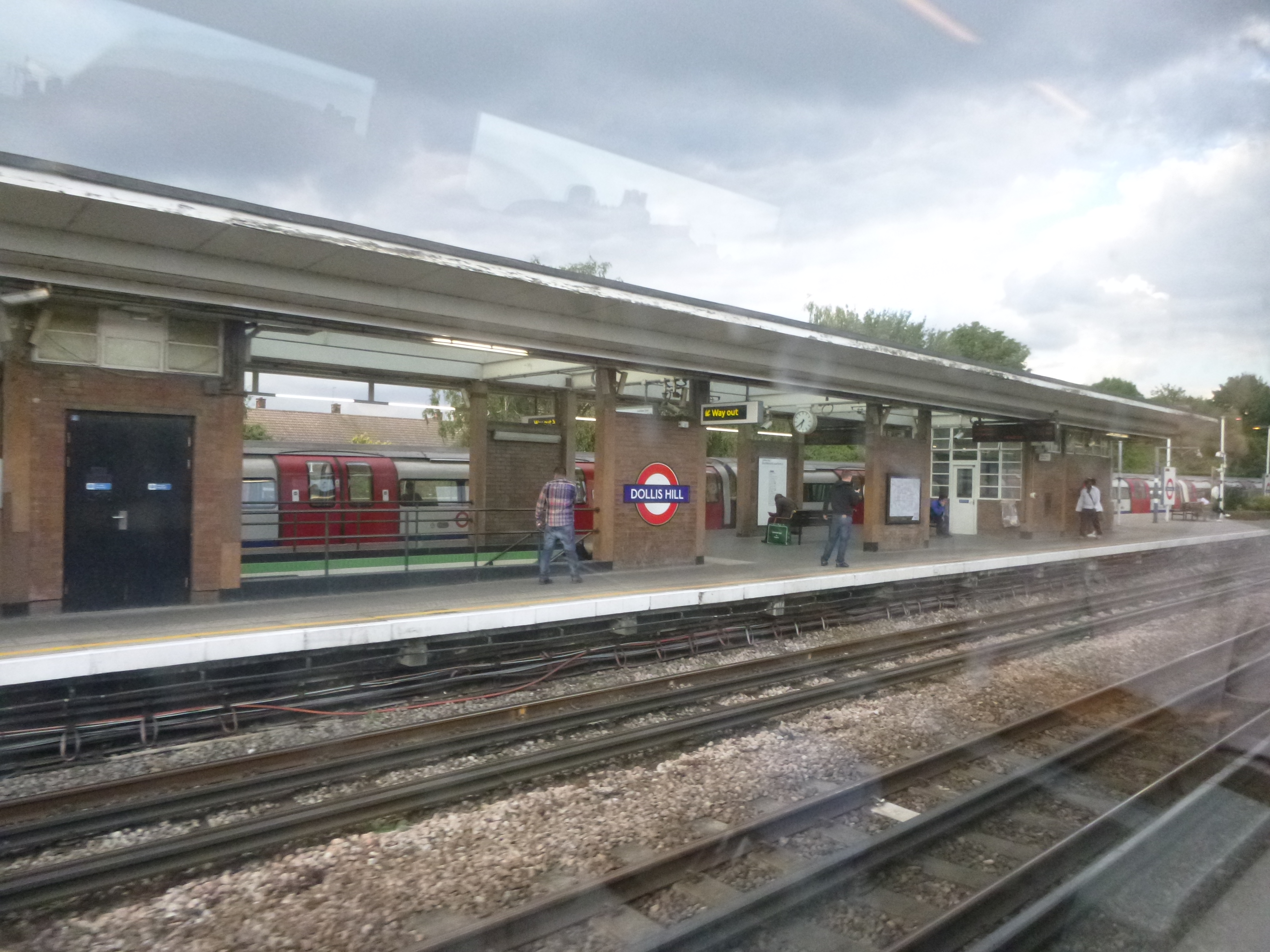
Dollis Hill Station From A Marylebone-Bound Train
It reminded me of the plan to create a proper Interchange between all of lines at West Hampstead. But I can’t expect all trains into Marylebone to stop there, so that I can get easily to Dalston on the North London Line.
So in the end, when I got to Marylebone, I took one stop to Baker Street to get the Metropolitan line to Whitechapel for the East London Line. But usually the Metropolitan was a disaster with no trains and no information, so in the end I took the Jubilee Line to London Bridge from where I got a bus home.
To put it mildly, I’d hit the usual problem. – Getting to and from the Bakerloo Line from East London. It just doesn’t interchange with anything useful within a couple of stops from say Whitechapel or Dalston Junction.
There are two major developments that will happen in the next few years to the East London Line. As the Eastern end of the North London Line from Highbury & Islington to Stratford is closely tied to the East London Line, related improvements to that line will also be covered.
1. Six-car trains
As I indicated in this earlier post on improving the Overground, the East London Line could be easily upgraded to take twenty-four six-car trains in each direction. I said this in that post.
At the moment the East London Line has 16 four-car trains an hour in the core route, so 24 six-car trains will mean an increase of capacity of 2.25.
But the East London Line already has five-car trains, so the improvement in capacity will be just a factor of 1.8.
The history of the Overground and their Class 378 trains has been one of continuously adding new carriages, ever since they were introduced. I feel that by the end of this decade plans will be in place for a sixth carriage on the East London Line.
There are documents from Network Rail and Transport for London, that also show that six-car trains and higher frequencies will be operating on the North London Line.
I don’t know the economics of building trains, but I suspect that Bombardier would like all new trains to be Aventras, so that they only have one type in production. After all the next order from London Overground is for Aventras for the Lea Valley Lines.
So we might see an early order for sixth carriages or London Overground may go for a fleet that was 100% Aventras. The latter wouldn’t be a waste of a fleet of Class 378 trains, as Birmingham, Cardiff, Glasgow, Leeds and Liverpool, would probably like to acquire a fleet of trains less than a decade old.
2. Crossrail
Crossrail will also interface to the East London Line at Whitechapel station and who can predict accurately how much the new line will increase passengers on the East London Line? I suspect that Transport for London’s forecasts will be wrong, just because you are dealing with East Londoners, who have all the flexibility and cunning in their transport plans of little furry animals, who want to enter your property. I think this is due to the legacy of East London having pretty terrible Underground and rail lines until the last few years.
All of these extra passengers travelling on the East London Line will generate a series of actions that will need to be taken, which fall vaguely into two groups.
1. Extra Terminal Platforms At Both The North And South Ends
For operational reasons, it is probably better to have the same number of North and South terminal platforms at both end of the line.
At present the East London Line operates four separate services with one train every fifteen minutes in both directions.
- Dalston Junction to West Croydon
- Dalston Junction to New Cross
- Highbury & Islington to Crystal Palace
- Highbury & Islington to Clapham Junction
Which gives the current sixteen trains per hour, so if they keep to the current balancing rule and a four trains per hour, they’ll need two extra terminal platforms in both North and South.
I think it is probably right to assume that the terminus shouldn’t be too far away from Whitechapel. Currently, West Croydon and Clapham Junction take about 40 minutes, so much longer than this is probably not possible.
I suspect that the planners of Transport for London have some surprising ideas, when they have a few drinks on a Friday night.
2. New Stations And Interchanges
The Overground and the East London Line in particular always seems to have someone pushing for a new station or better interchange with other lines.
Current interfaces beween Overground and Underground lines are as follows.
Bakerloo Line – Harrow & Wealdstone, Queen’s Park, Wembley Central and Willesden Junction
Central Line – Shepherds Bush and Stratford
District Line – Gunnersbury, Kew, Richmond, West Brompton and Whitechapel
Hammersmith And City – Whitechapel
Jubilee Line – Canada Water, Stratford And West Hampstead
Metropolitan
Northern Line – Camden Road-Camden Town
Piccadilly Line – None
Victoria Line – Highbury & Islington
I think, that there is scope for a lot more connections.
So what has been suggested and what would I like to see?
In alphabetical order we have.
Bakerloo Line Extension
The route of the Bakerloo Line Extension has not been decided yet, although TfL have received overwhelming support for the extension.
The three options for the extension all interchange with the East London Line.
Option 1 via Burgess Park, east to Peckham Rye and Catford Bridge,with the option of taking over the Hayes Line to terminate at Hayes, interchanges at Peckham Rye and Honor Oak Park.
Option 2 south to Camberwell Green, and then on to Herne Hill and Streatham Hill, with a branch at Tulse Hill which would take over the National Rail line to Beckenham Junction, interchanges at Crystal Palace and Norwood Junction
Option 3 a similar route to option 1, but after Burgess Park running via the Old Kent Road and New Cross before joining the Hayes line at Lewisham and terminating at Hayes, interchanges at New Cross.
So whatever option is chosen will effectively create a circular route round Central London with this route.
- Highbury & Islington
- Whitechapel
- Surrey Quays
- Crystal Palace, Honor Oak Park, Lewisham, New Cross, Norwood Junction or Peckham Rye
- Elephant & Castle
- Waterloo
- Charing Cross
- Piccadilly Circus
- Oxford Circus
- Baker Street
- Marylebone
- Paddington
- Queen’s Park
- Willesden Junction
- Harrow & Wealdstone
The line could follow its old route and end up in Watford.
It would appear that this route is more useful than the current truncated one to Elephant & Castle.
Hopefully, it would go some way to making it easier to get from East London to Marylebone and other awkward to access places in North West London.
Beckenham Junction As A New Southern Terminal
Beckenham Junction station has a lot going for it as a southern terminal. It has rail and tram services and it even has a bay platform, which is clearly shown in this Google Map.
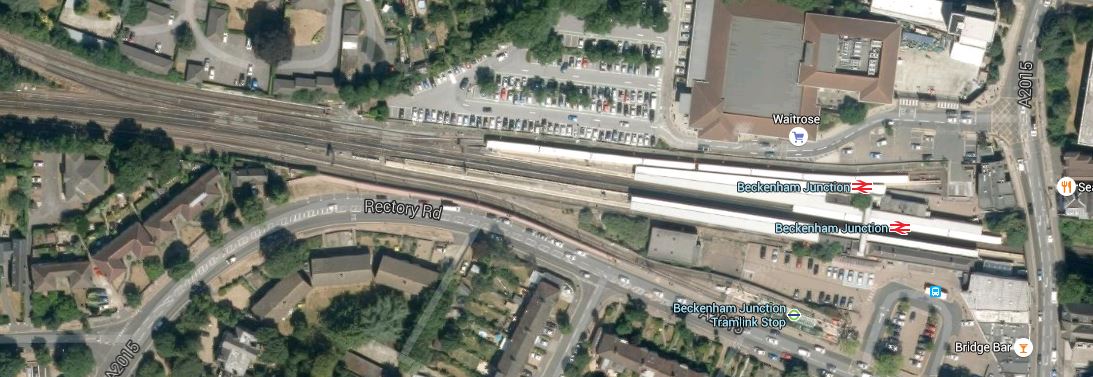
Beckenham Junction Station
As Beckenham Junction is probably less than forty minutes from Whitechapel, it may be a possibility, provided passenger statistics show it can generate enough revenue.
If as seems a possibility, the Hayes Line gets to become part of the Bakerloo Line, how will this effect Beckenham Junction.
It’s all very complicated as to how the Bakerloo Line Extension will fit in with the East London Line.
Brixton High Level Station
In their Transport Infrastructure Plan for 2050, Transport for London are proposing a Brixton High Level station.
The connection of a Brixton High Level station to the existing Brixton station and the Victoria Line will be difficult. Before the Overground opened to Brixton, I visited and wrote Could the London Overground Call at Brixton? This is a picture from that article from May 2012.
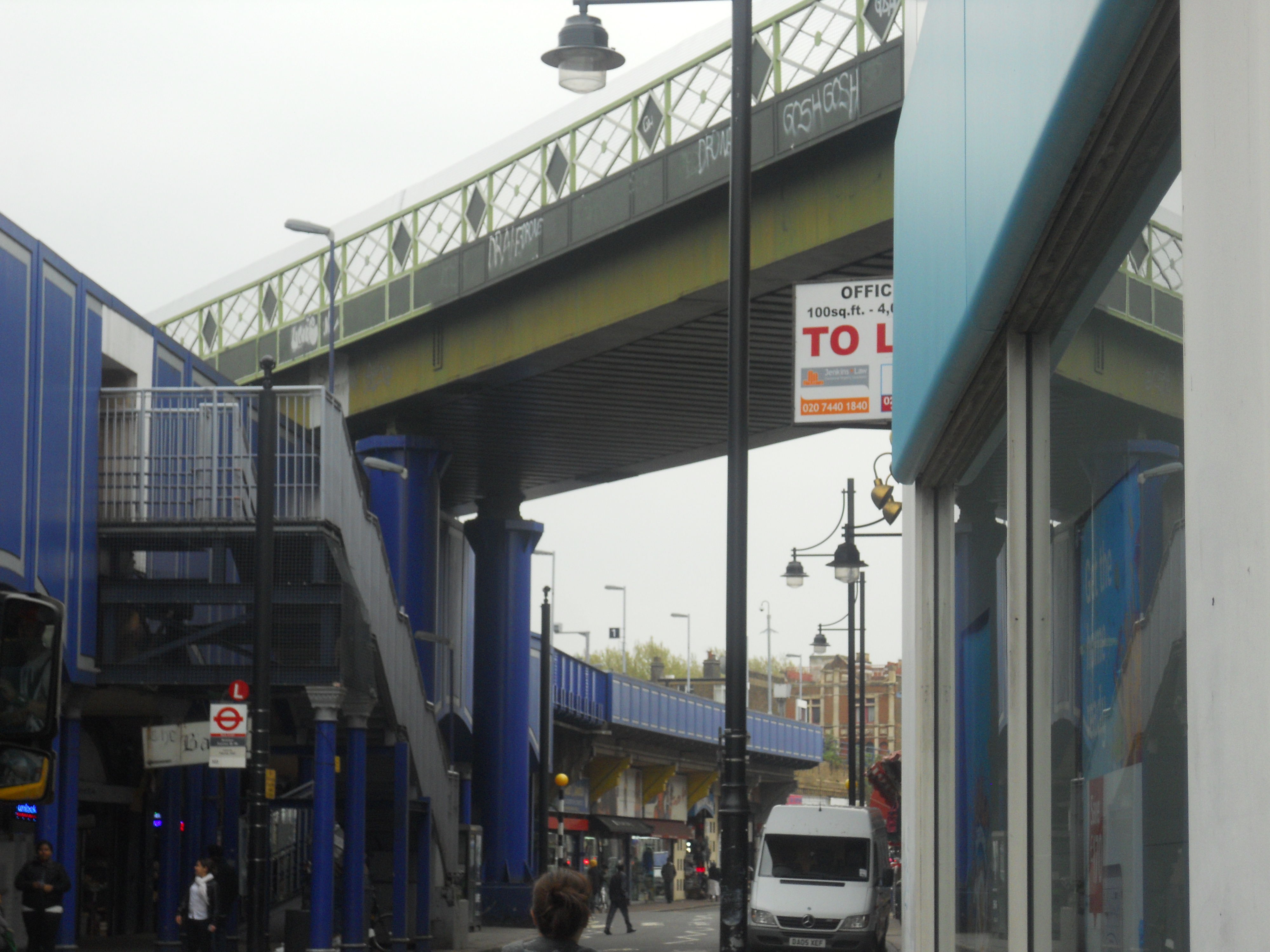
The Overground Flies Over Brixton Station
Either a high climb or a big set of lifts or escalators.
I said this in the article.
I tend to think that the only solution would be to spend millions to create a proper interchange station, that connects all of the three lines; Victoria, East London and main line together. But in the present financial climate that is impossible.
Perhaps with the current upgrading of the Victoria Line to allow 36 trains per hour on the full line and London’s growing population, the economic rules have changed Or a big property developer needs to get a Planning Application through?
I wonder if when they are upgrade the Victoria Line at Brixton, they will also extend the southern end of the line to Herne Hill, as is described here in Wikipedia.This is said.
For many years there have been proposals to extend the line one stop southwards from Brixton to Herne Hill. Herne Hill station would be on a large reversing loop with one platform. This would remove a critical capacity restriction by eliminating the need for trains to reverse at Brixton.[48] The Mayor of London’s 2020 Vision, published in 2013, proposed extending the Victoria line “out beyond Brixton” by 2030.
There’s an interesting article from London Reconnections, which describes the problems at Herne Hill.
If they got their contracts and project management right, they might even be able to use one of the tunnel boring machines bought for the Northern Line Extension.
Brockley High Level Station
In their Transport Infrastructure Plan for 2050, Transport for London are proposing a Brockley High Level station.
Brockley station sits underneath and is crossed by the Bexleyheath Line as this Google Map shows.
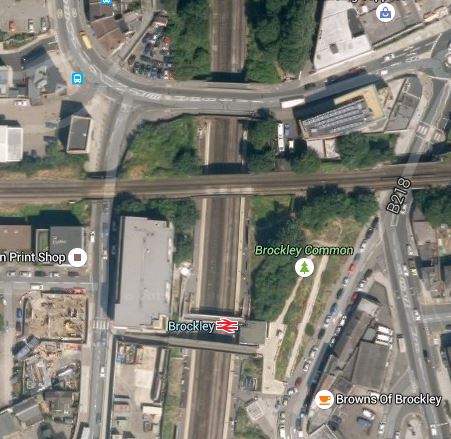
Brockley Station
There was a station called Brockley Lane on the Bexleyheath Line, but it closed in 1917.
After the complicated nature of the problem at Hackney, I wouldn’t think creating a Brockley High Level station would be that difficult.
TfL would just have to make sure it was worth doing.
Camden Road Station Connection To The Northern Line
In their Transport Infrastructure Plan for 2050, Transport for London are proposing a link between Camden Road and Camden Town stations.
Having walked between the two stations several times, I wouldn’t have thought they were close enough. However this railway map of the two stations, shows that they are closer than they appear on the surface and it might be possible to create perhaps an escalator connection. This Google Map shows the area.
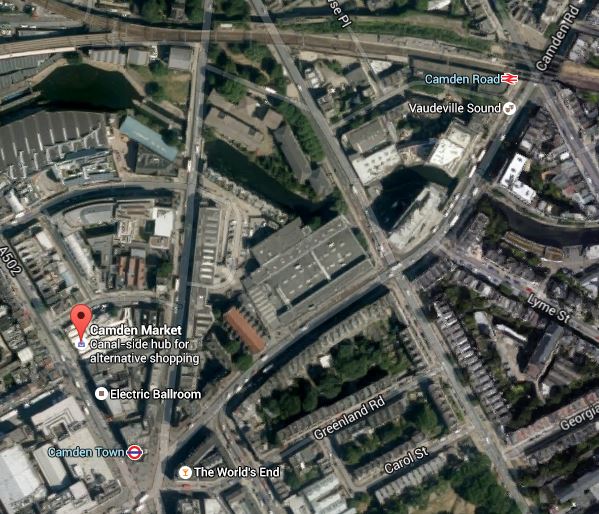
Camden Town And Camden Road Stations
Camden Town station is going to be rebuilt to relieve the chronic overcrowding. It is a project that will take several years and I suspect Transport for London will want to get as many other issues, like the interchange to the North London Line out of the way for ever.
Chingford As A New Northern Terminal
Chingford station is a possible new northern terminal if the Dalston Eastern Curve is reinstated. Trains would go via the High Meads Loop at Stratford, the new Lea Bridge station and the Hall Farm Curve. This would mean that a new station could be created within easy walking distance of Stratford International station, which would also serve the Northern part of the Olympic Park. This Google Map shows how the High Meads Loop curves between Stratford International station and the Olympic Park.
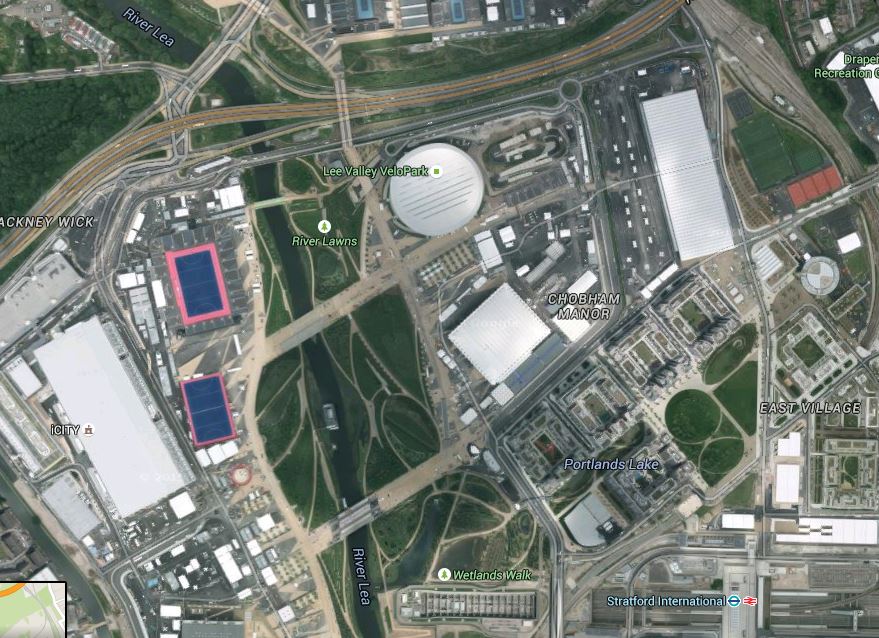
Olympic Park And Stratford International Station
An East London Line station at Stratford International would certainly ease problems getting to events at the Velopark.
Lea Bridge station could also connect to services up the Lea Valley, Bishops Stortford, Cambridge and Stansted Airport.
Chingford is a well-appointed station, linked to a bus station, that could probably be reached in forty minutes from Whitechapel.
Using Chingford as a terminal would also directly link much of the boroughs of Waltham Forest and Hackney on a single line and then link the stations directly to South London.
But Chingford has big advantages in that it is already run by London Overground and it has three platforms and some sidings to park trains. This Google Map shows the station.
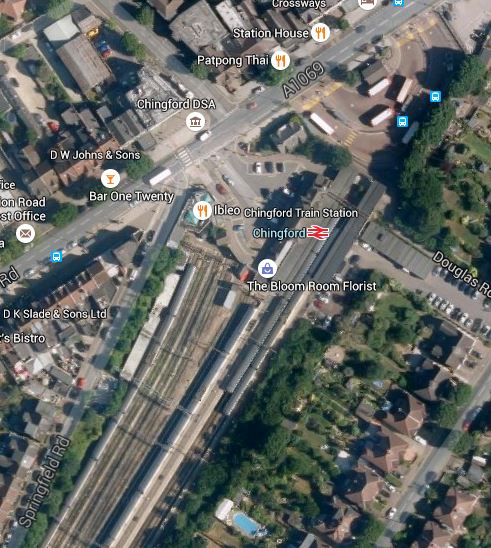
Chingford Station
Note the bus station to the North-East of the station and the extensive sidings on the approach to the station.
Using Chingford as a new northern terminal, would also intertwine the two sections of the Overground together, with direct same platform interchange at Hackney Central, Homerton, Hackney Wick and all stations after St. James Street on the Chingford branch.
Dalston Eastern Curve
In my view the Dalston Eastern Curve could be important, as it would enable direct services between the Eastern terminal of the North London Line at Stratford and any of the South London destinations.
Also, if the Hall Farm Curve were to be rebuilt to give the Chingford Branch a direct connection to Stratford, services could run between Chingford and Walthamstow Central, and South London, by using the High Meads Loop.
There will be opposition to rebuilding the curve, but the number of passengers, will decide the issue.
I have a feeling that because the Kingsland Shopping Centre is going to be upgraded and the owners of that have rights over the land, that we might see a decision one way or the other on this fairly soon. Although on the contrary, this article in the Hackney Citizen seems to be all about various delays and problems, with redevelopment of the Shopping Centre.
I would also think that a lot of the arguments in the Hackney Citizen article about development and car parking, are getting to be more and more irrelevant, as Eastfield is probably taking a lot of the business of the Dalston Kingsland Shopping Centre. In my mind, the sort of people moving into the flats being developed around Dalston Kingsland are probably not the sort of people, who would shop in the Centre. Unless of course, it was substantially upgraded! Could this be, why the proposed development incorporates quite a few residential properties?
The other thing that could kickstart work in this area, would be a decision to proceed with either Dalston Kingsland station or Crossrail 2.
An interesting point, is that if Transport for London believed that rebuilding the Dalston Eastern Curve is essential to handle the traffic on the East London Line, they would probably get their way and the Shopping Centre would have to be redeveloped.
I think there is a lot of horse trading going on in dark corners of various offices of Hackney Council, Transport for London, the developers; Criterion Capital and hopefully a decent architect.
Whatever happens, when and if Crossrail 2 is given the go aged, Criterion Capital won’t be taking a loss.
What the outcome will be, is anybody’s guess!
I know nothing that hasn’t been published on the Internet, but I have this feeling that the Dalston Eastern Curve will be reinstated. Or at least it won’t be compromised! No Project Manager worth his salt would do the latter!
Dalston Station For Crossrail 2
In this article called Crossrail 2 Through East London, I said this when I was discussing the Dalston stations.
I have heard from Michele Dix of Crossrail 2, that they are looking at a double-ended station to serve both Dalston Kingsland and Junction stations. This was said.
We have been working closely with the London borough of Hackney on the early development of the proposals for how Crossrail 2 could ultimately serve Dalston. The work to date has been based around delivering a double-ended station, with one end being at Dalston Junction, and the other at Dalston Kingsland, thereby allowing the Crossrail 2 station to link to both existing stations. As Mr. Miller rightly points out, the distance between the existing stations is well suited to the 250m long platforms that will be required for the Crossrail 2 station, and the greater interchange opportunities to London Overground services also deliver significant benefits.
I believe that there is an opportunity to create a world class station that subtly brings together all the good elements of the area. The only necessary demolition would be the unloved Dalston Kingsland station. TfL have told me off the record, that Kingsland station will be replaced fairly soon.
Hayes As A New Southern Terminal
The Hayes Line and its terminal at Hayes, would seem to be a line that Network Rail doesn’t want, but TfL do, if you read this section in Wikipedia. Here’s a short extract.
The driving force for this change is that Network Rail would like the train paths freed up for services mainly from the South Eastern Main Line. Transport for London prefer this route due to its largely self-contained after Lewisham.
You also have the passenger reaction to being told they are going on smaller Underground trains to a different part of Central London.
Hayes though is just over forty minutes from Whitechapel and there are two terminal platforms at the station, so it could be used as a southern terminal.
But on balance, I think it is unlikely that Hayes will be chosen as a southern terminal.
Herne Hill Congestion
Herne Hill station may well be Grade II Listed, but read the Future section in its Wikipedia entry.
It has problems, as it would appear a gallon is being squeezed into a gill pot! If you read this article in London Reconnections, you’ll see that it is not just a serious problem, but an almost impossible one. Take this paragraph, which is one of many in a similar vein.
There are also specific local issues arising from land ownership and planning. Aside from being in a Conservation Area, where buildings and trees are protected, the Dulwich Estate retains significant planning powers and is probably the freeholder of the rail lines alongside the estate. Network Rail will be cognisant of the potential level of opposition from local residents in this affluent part of south London, as well as the likely difficulties in negotiating with the Estate, including any legal wrangling which may necessitate revisiting the 1870 Act of Parliament curtailing the Estate’s powers. This probably explains why the default position is to keep this project firmly in the pending tray ― something needs to be done, but not right now.
The report was written in 2012, so let’s hope that some of the problems have gone away.
I’ve never scheduled trains, but I’ve scheduled things that are just as difficult and the solution to the congestion at Herne Hill station needs either more capacity or less passengers wanting to use the line. Taking this direct from Wikipedia illustrates the problem.
Network Rail, in its July 2011 London & South East route utilisation strategy, recommended that all services from Herne Hill towards Blackfriars should terminate in the bay platforms at Blackfriars after London Bridge’s redevelopment is completed in 2018 and the diverted Thameslink trains return there. Passengers from Herne Hill would then have had to change at Blackfriars to travel further north. Network Rail made this recommendation because more services will be using the route between St Pancras and London Bridge from 2018; sending trains from Herne Hill to the terminating platforms on the western side of Blackfriars (instead of the through tracks on the eastern side of the station) would have removed the need for them to cross in front of trains to/from Denmark Hill and trains to/from London Bridge at junctions south of Blackfriars.
In January 2013, the Department for Transport (DfT) announced that trains serving the Sutton Loop Line (also known as the Wimbledon Loop) will continue to travel across London after 2018. The number of trains calling at Herne Hill on the route will remain unchanged, with four trains per hour. The DfT has also decided the Sutton/Wimbledon Loop will remain part of the Thameslink franchise until at least late 2020; as such, the route will eventually be served by the new Thameslink trains.
Network Rail have a solution and then the politicians kill it.
So is there anything that the Overground and the East London Lines in particular can do to help?
Probably not!
But longer trains on the Clapham Junction branch may persuade passengers to take a different route. On the other hand, commuters are very conservative.
Hopefully, three other developments will help.
1. The opening of Crossrail, which might mean that some commuters travel via Abbey Wood. Crossrail’s opening will also improve the East London Line’s access to Central London, with a single change at Whitechapel.
2. If Crossrail were to be extended to Ebbsfleet International, as has been safeguarded, then this could help.
3. The completion of Thameslink with the new Class 700 trains, may increase capacity and persuade passengers to go via a reopened London Bridge station, rather than Victoria.
But it very much looks like Transport for London is pedalling hard to stand still.
Highbury & Islington Needs Rebuilding
Highbury & Islington station has needed rebuilding ever since British Rail’s cheapskate design produced the inadequate Underground station, that came with the Victoria Line.
When the East and North London Lines get more and bigger services through Highbury & Islington, this can only result in more and more passengers using the inadequate escalators and tunnels to access the Victoria and Northern City Lines. The station won’t be able to cope, just as it can’t now when Arsenal play at home.
The first stage of the rebuilding has started, as contractors are replacing the ageing bridge that carries the road over the Overground lines. No firm plans have been published yet for the station, but it needs a large increase in both capacity and accessibility.
I have a feeling though, that this station has a lot of potential possibilities, that could be used to create a top-notch station. For instance, there is a second building and entrance on the other side of the road, which has been used for signalling equipment for the Victoria Line.
Lewisham As A New Southern Terminal
Lewisham station is a possible choice for an extra southern terminal, as it has lots of rail and bus connections. This a Google Map of the station.
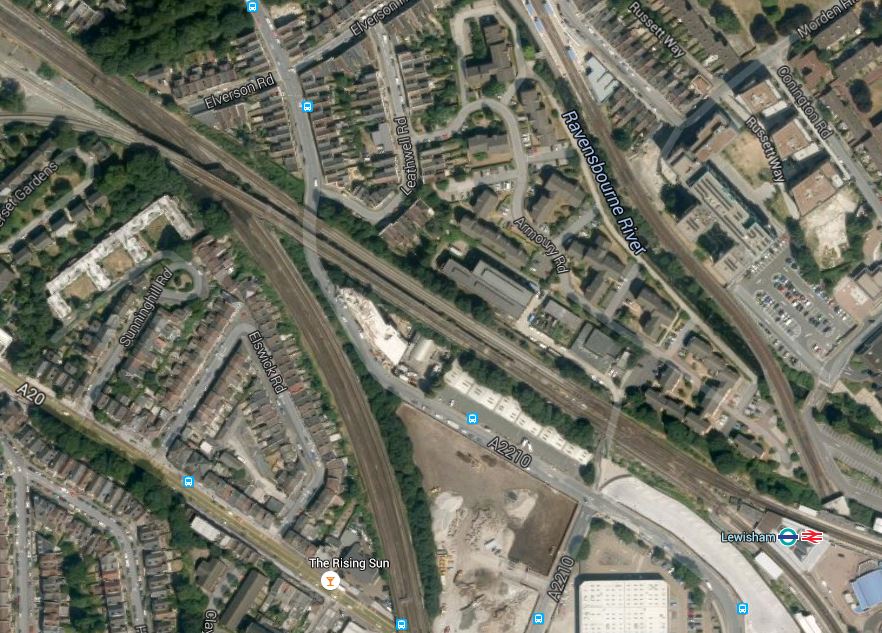
Lewisham Station
It shows a possible problem, in that there appears to be no easy place for a terminal platform. As it’s also only four or five minutes away from the existing terminus at New Cross, I think that Lewisham can be discarded as a terminal.
Maiden Lane Station
Maiden Lane station is an aspiration for Camden Council to serve the Kings Cross Central developments.
I discussed Maiden Lane station in this article in January and came to the conclusion, that the station might only be built as part of one the large developments in the area.
Using the station as a way of getting to Kings Cross and St. Pancras stations is probably not a possibility due to the distances involved.
Meridian Water As A New Northern Terminal
Angel Road station which will be renamed to serve the Meridian Water development, would be the most unlikely choice for a new northern terminal if the Dalston Eastern Curve is reinstated. Trains would go via the High Meads Loop at Stratford, the new Lea Bridge station and could possibly interface with a future Crossrail 2 at Tottenham Hale, Northumberland Park and Meridian Water itself.
New Entrances And Stations
Over the last few years, London has been going through a quiet ticketing revolution.
People are rarely using cash in a station to buy tickets and if rumours are right, the proportion of those using contactless bank cards for tickets is increasing rapidly. Over the last week or two, signs are up everywhere on the Underground, saying that ApplePay is now accepted.
I’ve not really seen an article anywhere discussing the effects of this cashless and booking office free ticketing.
I recently used the new entrance at Shepherds Bush station and it was just a gate line with a shelter over the top and a refuge for staff. Obviously, as that entrance has been built to serve the Westfield Shopping Centre, There is also a similar entrance at Harold Wood station, serving the car park.
I think we’ll be seeing more of these short-cut entrance/exits at several stations. I proposed this for Highbury & Islington in this article in March 2013 and personally, I’d like one at Hackney Central on the Westbound platform, to give access to the buses on Graham Road.
The technology could also mean that complete stations could be built much more easily and quickly.
It will be interesting to see how architects use their imagination in the freer environment created by the new ticketing technology, to design exciting, practical and very passenger and staff friendly.
New Interchanges
The new ticketing technology may also open up opportunities to create new interchanges between lines.
Obviously, this will probably be more to do with interchanges between two surface railways, as anything where digging is involved will be very expensive and probably rules out most linking with the Underground.
With the recent building of the walkway between Hackney Downs and Hackney Central stations, Transport for London have shown that they won’t rule out connecting lines by any affordble and sensible method.
So are there any possibilities for new interchanges, made possible by the new technology linked to some imaginative thinking?
I think there are stations that could be improved in this way and they are in the text in their alphabetical position.
North Acton Station Connection To The Central Line
Development at North Acton station on the Central Line has for a long time talked about linking to the North London Line.
Just a few years ago, it would have needed a lot of expensive construction, but with the development of new ideas in ticketing, station architecture and the successful introduction of the walkway at Hackney, the cost will have been considerably reduced. This Google Map shows the area around North Acton station.
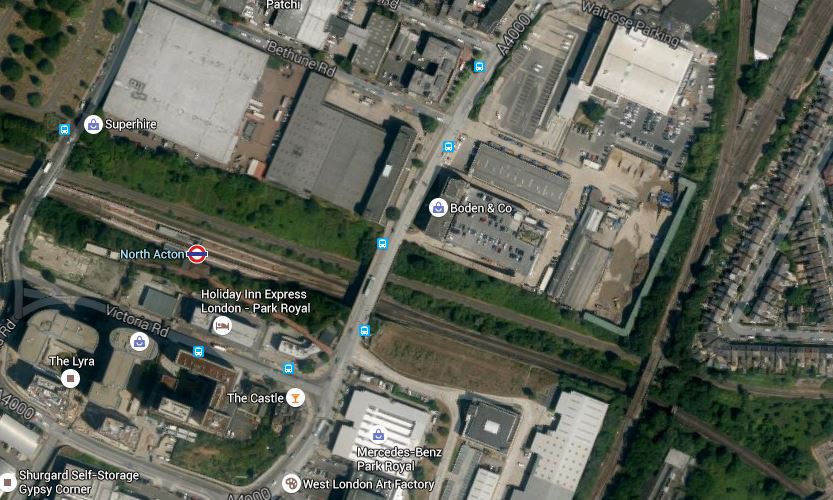
North Acton Station
The North London Line is at the right of the image and at the top is the junction where the Dudding Hill Line branches off.
Whether it is now a station and interchange worth building is up to Transport for London, but modern techniques have opened up possibilities.
Old Oak Common As A New Northern Terminal
The yet to be developed, Old Oak Common station is a possible new northern terminal. As a completely new station, hopefully you’d get a perfect solution.
But I don’t think you’d want to have both Old Oak Common and Willesden Junction stations as terminals, but a lot of the reasoning, that applies to Willesden also applies to Old Oak Common.
There is not much point in predicting what will happen at Old Oak Common, but I suspect whatever is proposed will be worth waiting for.
Orpington As A New Southern Terminal
Orpington station is a possible choice for an extra southern terminal, as it has lots of rail and bus connections.
This a Google Map of the station.

Orpington Station
Orpington would be reached by way of New Cross, Lewisham and Beckhenham Junction is around 35 minutes, so it is actually closer than West Croydon and only just five ,minutes longer than Crystal Palace. It also has several terminal platforms, that could easily accommodate the six-car trains.
An extension to Orpington would appear to connect a lot of places in South East London to Crossrail at Whitechapel and the Jubilee Line at Canada Water.
Penge
In their Transport Infrastructure Plan for 2050, Transport for London mention a new interchange at Penge. This is a Google Map showing both stations.
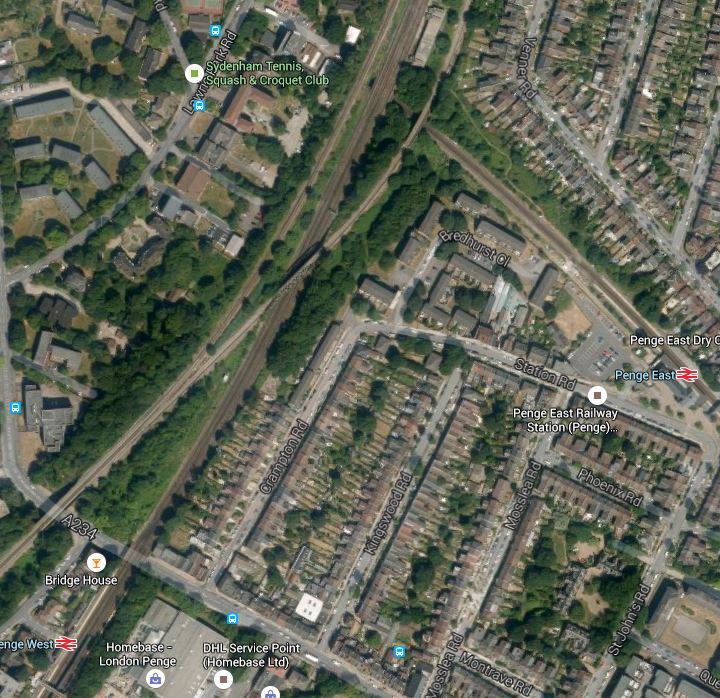
Penge East station has services between Victoria and Orpington and on Thameslink.
Penge West Station has services on the East London Line and the Brighton Main Line.
This small mention in the TfL report is the only thing I can find about an interchange at Penge.
But could it be a dastardly plot to overcome the Great Anomaly in South London’s suburban services, where many services to Kent and the South East tend to terminate at Victoria?
Look at this enlarged Google Map, where the line through Penge West cross over the line through Penge East.
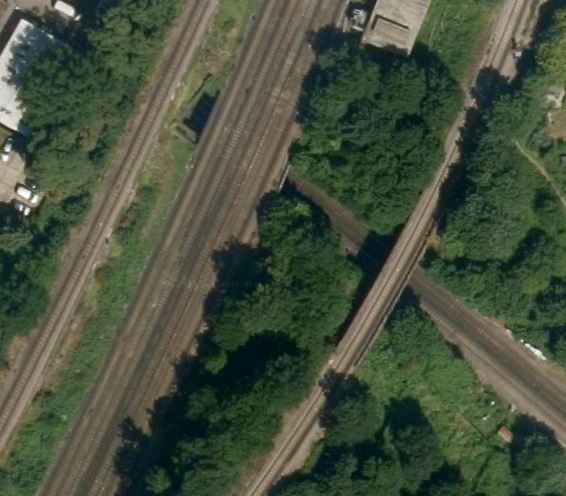
A Place For Penge Station?
Note the isolated line a short distance to the East of the main lines to London Bridge. This is the line that carries East London Line services to Crystal Palace
TfL must think there is a need for an interchange between East London Line and London Bridge services and those Victoria and Thameslink services.
Shoreditch High Street Station Connection To The Central Line
Shoreditch High Street station sits on top of the Central Line and Wikipedia in a section on plans for the station, says this about creating a connection between the two lines.
There have also been discussions of creating an interchange with the Central line between Liverpool Street and Bethnal Green which runs almost underneath the station. However, this would not be able to happen until after the Crossrail 1 project is complete, due to extreme crowding on the Central line during peak times.
It would appear from this detailed map of the London Underground and around Liverpool Street in particular, that trains can be turned back at both Liverpool Street and Bethnal Green stations, so as there are depots at both ends of the Central Line, once Crossrail was providing a bypass, construction might be possible, if the link was actually needed.
The Shoreditch area has also been talked about for some more platforms for Liverpool Street station. I found this article in the Architect’s Journal.
I put forward my idea in this article called An Idea For A New Station At Shoreditch High Street.
My idea is probably total crap, but who’d have thought the rickety North London Line and the orphaned branch of the Metropolitan Line, through the Thames Tunnel would have morphed from forgotten, crumbling and dirty assets into one of the best urban railways in Europe?
One thing I said in the previous post, when talking about a new station to handle traffic for Liverpool Street was this.
I think if a station gets built alongside or under Shoreditch High Street station, it will be nothing like any ideas, that might get talked about in the media now. One of the Foster/Farrell/Rogers fraternity could probably do something extraordinary here.
I think we’ll see something spectacular at Shoreditch High Street, with the Overground and possibly the Central Line in the thick of it.
Stratford As A New Northern Terminal
Stratford station is a possible new northern terminal if the Dalston Eastern Curve is reinstated.
It is a well-appointed station, linked to Crossrail and long distance services, buses and the shops at Eastfield, that could probably be reached in thirty minutes from Whitechapel.
I think that a platform could be found to terminate services, but using Stratford offers nothing that isn’t also solved by the opening of Crossrail. Also it doesn’t solve one of the main problems of the Stratford stations, which is the difficulty of getting to Stratford International. On the other hand, using Chingford as a terminal gives the possibility of a connection to the high speed station.
Willesden Junction As A New Northern Terminal
Willesden Junction station is a possible new northern terminal.
When the original plans for the East London Line were published a few years ago, I’m sure Willesden Junction was mentioned as a possible terminal.
It is a well-appointed station, linked to the Bakerloo and Watford DC Lines, that could be reached from Whitechapel in under forty minutes.
It already has a bay platform, which lies between the two North and South platforms, that could be used as a terminal, as it has been recently lengthened and upgraded. There is also another disused bay platform that might be reinstated. This Google Map show the station.

Willesden Junction Station
If Willesden Junction is made a terminal, this has other advantages, especially if it gets the standard service of four trains per hour.
As now there are effectively three Northern branches going to Highbury & Islington instead of two, there will be a fifty percent increase in services between Highbury & Islington and Whitechapel and South London, with an extra destination served directly.
The four trains an hour to Willesden Junction, would increase the service frequency on the section of the North London Line between Dalston and Willesden. Various pronouncements from Transport for London have said that the frequency of trains on the North London Line should be increased.
If the Dalston Eastern Curve were to be reopened and four trains per hour went to either Chingford, Meridian Water or Stratford, this would effectively put an extra four trains per hour between Stratford and Willesden Junction.
New Cross Station Is Finished
In a post last September, where I went up and down the East London Line, I took a few pictures of New Cross station. I changed trains at the station today and took these pictures.


It certainly looks a lot better. The sun helped too!
My only problem with the station is that changing trains to go south after travelling from Dalston Junction is a walk across a platform and very easy, but return journeys mean a platform change over the bridge.
Perhaps one day, they’ll extend the East London Line trains to a proper terminal at another station. like Hayes as I suggested in this post, so northwards changes would be simpler.
The New Stairs at Whitechapel Station
In a few weeks time, the main entrance at Whitechapel station will be closed and all entry will be from Durward Street at the other end of the East London Line platforms. At present there is just an Emergency Exit there. These pictures show the current stairs and the half-assembled new ones.
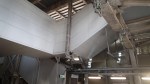

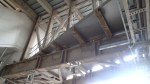
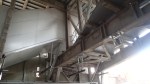
It looks like the stairs will lead up to the walkway, which goes across the line.
 The Anonymous Widower