Does A New Service Start Between Wigan North Western And Alderley Edge Stations Using Class 769 Trains On May 20th?
On the Wikipedia entry for Class 769 trains, this is said about the introduction into service of the trains by Northern.
Scheduled to begin entering service in May 2018, Northern plans to deploy its Class 769 units on the Windermere branch line and also their Manchester Airport to Windermere, Wigan North Western to Alderley Edge and Wigan North Western to Stalybridge services
I have looked at the National Rail timetable for the 19th of May and looked up getting between Wigan North Western and Alderley Edge station involves a change at Manchester Piccadilly station.
But look at the journey on the 21st of May and there is an hourly direct train.
- First train – 08:50
- Last train – 19:50
- Journey time – 78 minutes
The train will stop at Hindley, Westhoughton, Bolton, Salford Crescent, Deansgate, Manchester Oxford Road, Manchester Piccadilly, Levenshulme, Heaton Chapel, Stockport, Cheadle Hulme, Handforth and Wilmslow.
In the other direction, the service is as follows.
- Hourly
- First train – 06:49
- Last train – 19:48
- Journey time – 70 minutes
It is an ideal route for a Class 769 train.
- Between Wigan North Western and Bolton is not electrified.
- I also suspect that Bolton and Salford Crescent won’t have the wires completed by the 20th of May.
Manchester will be getting another cross-city service courtesy of a thirty-year-old electric train, with a couple of diesel engines slung underneath.
Wigan North Western And Stalybridge
An hourly service from Wigan North Western to Stalybridge also appears to be in the timetable from the 21st of May.
- First train – 08:08
- Last train – 22:50
- Journey time – 59 minutes
The trains will stop at Hindley, Westhoughton, Bolton, Moses Gate, Farnworth, Kearsley (Manchester), Salford Crescent, Salford Central, Manchester Victoria and Ashton-under-Lyne.
In the other direction, the service is as follows.
- First train – 06:30
- Last train – 21:29
- Journey time – 63-66 minutes
It is another ideal route for a Class 769 train.
- Between Wigan North Western and Salford Central not fully electrified.
As the current service between Wigan Wallgate and Stalybridge seems to have been discontinued, it looks like Pacers and elderly diesels are being replaced by electric trains.
Conclusion
It looks to me, that as the electrification through Bolton and Salford Crescent, that Northern are doing the best they can with what they have available.
I estimate that Northern will need around six trains to run these two services, one of which is new and the other a change of terminus from Wallgate to North Western at Wigan.
NR Set To Reach Major Shotts Electrification Milestone Over Easter
The title of this post is the same as that of this article in Rail Technology Magazine.
I’m not totally sure, but it looks like they will complete the overhead wires between Edinburgh and Glasgow along the Shotts Line.
They certainly seem to be moving on apace with electrification in Scotland, unlike around the North West of England.
Charting An Electric Freight Future
The title of this post, is the same as the title of an informative article in the April 2018 Edition of Modern Railways, which was written by Julian Worth, who has many years experience of the rail freight industry.
This is a very comprehensive article looking at the future of motive power for freight trains.
These are points from the article, with some added comments of my own.
2040 And A Diesel-Free Rail System
Government ministers have said that by 2040, the UK will have a diesel-free railway, which will reduce emissions and especially particulates.
This page on the Government web site is entitled Let’s Raise Our Ambitions For A Cleaner, Greener Railway, which gives the text of a speech by the Rail Minister; Jo Johnson.
This is part of what he said.
And that’s why I am today announcing a new ambition.
I would like to see us take all diesel-only trains off the track by 2040.
If that seems like an ambitious goal – it should be and I make no apology for that.
After all, we’re committed to ending sales of petrol and diesel cars by 2040.
If we can achieve that, then why can’t the railway aspire to a similar objective?
Rail may be less carbon intensive than road transport.
That’s why modal shift’s so important.
As an engineer. I feel it is a challenge that is acceptable.
The Diesel Locomotives Are Getting Old!
The ubiquitous Class 66 locomotives, don’t meet the latest emission standards, but in addition, by the late 2020s, they will be getting to thirty years old.
Other locomotives like Class 59 locomotives will be even older.
Replacement locomotives will be needed, as maintenance costs will be getting too high.
The Last-Mile Electric Locomotive
Electric locomotives with a last-mile capability away from electrification like the Class 88 locomotive could be favoured.
- They could be used for terminal work and short-distance movements.
- They would have a 25 KVAC capability.
- They could possibly have a 750 VDC capability, to work on the third-rail network.
- They would meet all the emission standards, when running on diesel.
Julian Worth suggests that the last-mile capability could be provided by a battery.
Although, this would be environmentally-friendly and better in urban areas, I think that any onboard power, should be able to take a train into and out of the Port of Felixstowe, London Gateway and the other major ports.
I met a manager of the Port of Felixstowe a few years ago and they don’t like 25 KVAC wires in a dock, as containers do occasionally get dropped.
Most lines into ports and inland terminals, don’t appear to be too challenging and I’m sure that an uprated Class 88 locomotive could be built, that would handle entry and exit to all the ports and terminals in the UK.
Do We Need A Freight Electrification Strategy?
Julian Worth suggests we need one for the next couple of decades.
He makes some good points.
- Electric traction current is cheaper than diesel fuel.
- Availability of modern electric locomotives should be better than a diesel.
- Diesels may be restricted in urban areas. It could be a vote winner in Mayoral elections in the large Metropolitan areas.
He finishes this with this statement.
Crucially, switching to electric locos from around 2030 would not entail premature replacement of the current fleet and would represent necessary asset renewal in modern equivalent form.
Just imagine the outcry from the Green Movement, if these ageing diesels were to be replaced with modern diesel locomotives..
Undoubtedly, we need a well-thought out freight strategy.
GB Railfreight
This article in Rail Magazine is entitled GB Railfreight In ‘Locomotive Acquisition’ Talks.
So at least one freight company is looking for new motive power. GB Railfreight has a fleet of seventy-eight Class 66 locomotives with other locomotives in the ageing category. Some of their work like hauling the Caledonian Sleeper needs well-presented reliable locomotives, so perhaps they need to update their image.
It will be interesting to see what type and class of locomotive they buy.
Rail Freight Has Changed
Coal to power stations used to be the dominant freight on UK railways.
But n0t any more! Thank goodness!
The major freight on UK railways is intermodal or trains of containers from port to inland terminal and vice versa.
There is also a large growth in construction materials, miuch of it going from quarries in the West Country and the Peak District to the South East of England. To send this any other way than by train, would surely be madness.
There also seems to be an increasing number of trains carrying new vehicles to and from the Continent. More will surely start to use the Channel Tunnel.
Julian Worth says this, after summarising the freight flows.
This suggests modest extensions of electrification might permit much of the construction and intermodal businesses, together with most automotive traffic, to be electrically hauled throughout.
He then goes on to say that the big gap is Felixstowe to Peterborough, Nuneaton and Birmingham.
The Port of Felixstowe
I partly grew up in the town and never thought the port would grow to the size, it is today.
I also remember in the 1980s, when only the odd intermodal train was to be seen on the Felixstowe Branch Line.
- Now, a dozen trains in each direction on every day take the route between Felixstowe and the Midlands.
- The Felixstowe Branch Line is being upgraded to raise the number of trains from the port from 33 to 48.
- The Great Eastern Main Line and the routes through North London are close to capacity.
- The direct route via Peterborough is a lot shorter than the London route.
Julian Worth states, that the number of trains between Felixstowe and the Midlands could rise to as high as fifty every day.
Routes That Should Be Electrified For Freight
Julian Worth suggests that the following routes should be electrified.
Route 1 – London Gateway to Thames Haven Junction
If you electrify Felixstowe to the Midlands, this will remove some diesel freight trains from London.
It would be stupid to replace them with diesel freight trains from London Gateway. So it would be fairly logical to electrify the connecting route to London Gateway.
This Google Map shows London Gateway and the rail connection to the electrified London, Tilbury and Southend Railway.
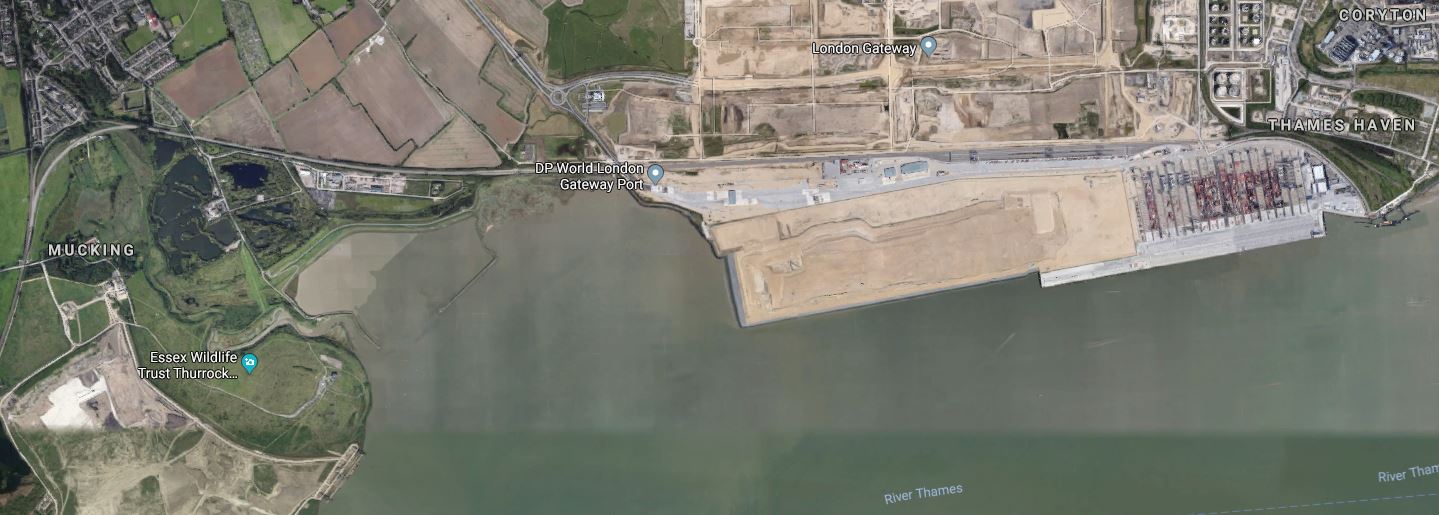
Note.
- The electrified London, Tilbury and Southend Railway, runs North-South at the extreme left of the map.
- The connecting spur curves East on what appears to be a new chord before accessing sidings on the North side of London Gateway.
- There would appear to be a lot of space to expand the port.
- The rail spur to the port is double track.
- It looks like their are sat least five sidings for handling freight trains.
- The sidings are double-ended, so last-mile capable electric locomotives could run round trains, without the need for electrification.
It would have appeared to have been designed for electrification.
Full details on London Gateway’s plans for rail access are given here in the Wikipedia entry for London Gateway, under Rail Terminal.
This is a quick summary.
- Freight trains will use the newly-electrified Gospel Oak to Barking Line to access the West Coast Main Line.
- Freight trains have a route to the Channel Tunnel.
- London Gateway has planning permission for a second rail terminal.
In other places Wikipedia says the port is highly-automated.
I am led to the conclusion, that the Gospel Oak to Barking Line will see a high number of electric freight trains in the future.
I’m not surprised that Julian Worth says the spur currently handles sixteen trains per day and is set to grow significantly.
I certainly wouldn’t buy a house on the Gospel Oak to Barking Line.
Route 2 – Nuneaton To Birmingham Lawley Street
If Felixstowe to Nuneaton is electrified, then this extends the electrification to the massive Lawley Street Freightliner Terminal, which is in central Birmingham.
This diagram from Wikipedia shows the route.
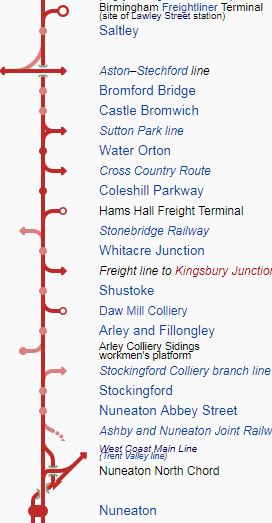
Note.
- Lawley Street Freightliner Terminal, is on the short spur at the top of the diagram.
- iThis electrification would also complete a fully-electrified route between Birmingham New Street station and Sansted Airport, so CrossCountry could use electric trains on that route, instead of the current Class 170 train, which is often overcrowded.
- Would the electrification open up opportunities for more electrified local services in Birmingham?
Julian Worth says that this twenty miles carries thirty-two trains per day.
Would electrifying this route also have environmental benefits in terms of pollution?
Route 3 – Basingstoke To Southcote Junction and Oxford to Denbigh Hall Junction
This route, which connects the Port of Southampton with the West Coast Main Line, would require forty-two miles of electrification.
Consider.
- It would create a fully-electrified route from Southampton to the West Coast Main Line.
- Julian Worth says it carries forty-eight trains per day.
- I also think, he is assuming that the Great Western Electrification extends to Oxford, which surely it will do in the next few years.
- Dual voltage locomotives would be needed.
- It would require electrification of part of the East West Railway.
The East West Railway is to be built as a privatised railway and I’m sure if the sums were right, they would electrify the route from Oxford to Denbigh Hall Junction.
If the Western end of the East West Railway were to be electrified, this must increase the options and operating speed for passenger trains on the route.
Route 4 – Merehead/Whatley to Newbury
Consider.
- Merehead and Whatley are both Quarries of the Mendip Hills.
- The line is double-track and seventy-two miles long.
- Julian Worth says that this route carries twenty-eight stone trains per day.
- Many trains are double-size.
- In a four hour period, using Real Time Trains I found,three stone trains that weighed 4,800 tonnes and had a maximum speed of 45 mph and four stone trains that weighed 2,000 tonnes and had a maximum speed of 60 mph, using the route from the Mendips to London.
With all that heavy traffic, it strikes me that their are only two ways to power these trains on the route.
- Very powerful diesel locomotives, possibly working in pairs.
- Very powerful 25 KVAC electric locomotives, which would need electrification, able to supply lots of amps.
Mendip Rail currently run these services using Class 59 locomotives, which have the following characteristics.
- Built in North America between 1985 and 1995.
- They were the first privately-owned locomotives on the UK main line.
- They have the ability to creep to shift heavy loads on gradients.
- They have a maximim speed of 60-75 mph.
- They are towered by a 2.5 MW diesel engine.
This extract from Wikipedia illustrates their power.
On 26 May 1991 Kenneth J Painter (59005) (with assistance from Yeoman Endeavour) set the European haulage record, with a stone train weighing 11,982 tonnes and 5,415 feet (1,650 m) long. However the so-called ‘mega train’ experiment was not very successful, as a coupling in the centre of the train broke.
It would appear, there was nothing wrong with the locomotives.
By the late 2020s, these locomotives will be over forty years old and although they could probably soldier on for another ten or even twenty years, the cost of maintenance will increase and reliability could decrease. You don’t want a 4,800 tonne stone train blocking the Reading to Taumton Line.
I suspect too, that it is unlikely that this important stone traffic will decrease. This is said in the Wikipedia entry for Mendip Rail.
Mendip Rail’s class 59s work services between various destinations which have changed over time according to demand and specific contracts. They have worked regularly over southern railway tracks, for example to the former Foster Yeoman terminals at Eastleigh and Botley, as well as delivery aggregates for construction work on the Thames Barrier, Second Severn Crossing, Channel Tunnel and most recently Heathrow Terminal 5, which required 3 million tonnes of stone.
Mendip Rail hauls about 4.5 million tonnes of stone from Torr Works each year, and about 2.5 million tonnes from Whatley Quarry.
I suspect that these stone flows will continue and there will come a time in the not-to-distant future, where new locomotives will be required.
- The Class 59 locomotives were built for these stone trains and have a maximum tractive effort of 507 kN at just 7 mph.
- A large electric Class 92 locomotive has a maximum tractive effort of only 400 kN.
But I suspect that engineers can design an electric locomotive, that can handle these trains either by themselves or working in a pair.
So there will be a choice between a very powerful diesel locomotive or a very powerful electric one.
- Will those that live by the railway and environmentalists accept new diesel locomotives?
- Electric locomotives would require the line to be electrified.
- Electrification would allow Great Western Railway to run their Class 800 trains more efficiently using the wires.
- Would those who live by the railway, accept the electrification of the line?
It’s a difficult choice.
Route 5 – Felixstowe to Ipswich. Haughley Junction to Peterborough and Helpston to Nuneaton
Consider
- This would be a big project, as it would require 146 miles of new electrification.
- But the return could be worthwhile, as currently the route handles twenty trains per day and once the Felixstowe Branch Line has more double track, this figure could rise to fifty-six trains per day.
- At Ipswich, Peterborough and Nuneaton, the route connects to fully-electrified lines.
My project management knowledge tends to electrifying this line from East to West as almost three separate projects.
- Felixstowe to Ipswich
- Haughley Junction to Peterborough
- Helpston to Nuneaton
It could even be five, if Helpston to Nuneaton was split into two at either Leicester or the Midland Main Line.
I have three general questions.
- When the gauge clearance was undertaken a few years ago, were bridges raised to accommodate wires as well?
- Will the natives object to fifty trains per day?
- Will the line be resignalled to handle the greater number of trains?
Once the full route is electrified, the number of trains to and from Felixstowe , that used the Great Eastern Main Line and the routes through London would drop. Obviously, some trains like those between Felixstowe and Wales and the West Country would still need to use the London routes.
But overall, this would allow a mixture of the following.
- Higher passenger train frequencies on the North London Line
- Higher passenger train frequencies on the Gospel Oak To Barking Line
- More freight trains to and from London Gateway could use the cross-London routes.
The last point would mean, that electric locomotives would need to have access to London Gateway.
I will detail my thoughts on Felixstowe to the Midlands electrification in the next three sub-sections.
Route 5A – Felixstowe to Ipswich
Electrifying between Felixstowe and Ipswich shouldn’t be the most challenging of projects.
- The route is fairly flat.
- The route is double track, except for part of the Felixstowe Branch Line.
- The line was cleared for the largest containers a few years ago.
- Doubling of the Felixstowe Branch Line around Trimley and the removal of some level crossings should start this year.
- There should be an adequate 25 KVAC power supply at Ipswich.
I have two extra questions.
- Will the partial doubling of the Felixstowe Branch, prepare the line for electrification?
- Has a scheme been designed to take electrification to the port?
But there will be benefits.
- Some freight trains that use the Great Eastern Main Line and the electrified routes through London, could be hauled all the way. by electric locomotives.
- If Felixstowe station was to be electrified, Greater Anglia could run five-car Class 720 electric trains instead of Class 755 bi-mode trains on the branch, if required.
- Class 755 bi-mode trains on the Ipswich to Lowestoft service, would be able to use the electrification between Westerfield and Ipswich stations.
- Noise and vibration could be reduced.
It is just over a dozen miles of elwctrification, so isn’t the largest of projects.
Route 5B – Haughley Junction to Peterborough
Like the first section between Felixstowe and Ipswich, this section is also not very challenging.
- The route is fairly flat.
- The route is double track.
- The line was cleared for the largest containers a few years ago.
- Ely is being remodelled to remove a bottleneck.
- Ely to Soham improvements seem to have been dropped, but will surely happen.
- Haughley Junction needs to be remodelled.
- Network Rail are already removing level crossings.
- There should be an adequate 25 KVAC power supply at Haughley and Peterborough.
I have an extra question.
- Will the route between Cambridge and Chippenham Junction be electrified?
But there will be benefits.
- Electric freight between Felixstowe And The East Coast Main Line as far as Scotland.
- Greater Anglia could run their service between Colchester and Peterborough with a Class 720 electric train.
- Greater Anglia’s service between Ipswich and Cambridge would do more running under wires.
The electrification might even enable some useful electrified diversion routes.
Route 5C -Helpston to Nuneaton
I don’t know this section of the route, as well as I know the two other sections.
- The route is double track.
- There is a busy level crossing in the middle of Oakham.
- There should be an adequate 25 KVAC power supply at both ends of the route.
It would appear that the route goes through Leicester station on the Midland Main Line.
As the electrification of the Midland Main Line has been postponed, how will this section of the route be handled?
But there will be benefits.
- Electric freight between Felixstowe And The Midlands
- Fewer freight trains would need to go via London
- Some passenger services, like Birmingham-Stansted Airport, could be run using electric trains.
Completing all three sections will open up new possibilities for both freight and passenger services.
Route 6 – Hare Park Junction to Leeds Stourton
This is a freight route , which can be followed this way.
- It leaves the electrified Wakefield Line at Hare Park Junction, which is South of Sandal and Agbrigg station.
- It passes Wakefield Kirkgate and Normanton stations and there appears to be a connection to Wakefield Europort.
- It then joins the Hallam Line and goes to the Stourton Freightliner Terminal.
Electrification of this eighteen mile route, would allow freight trains with electric traction to reach the Stourton terminal.
The electrification could also be extended to Leeds station, so that passenger services on the Hallam Line, run by bi-mode trains would have an electrified route into Leeds.
Route 7 – Mountsorrel to Syston Junction and Manton Junction to Corby
Mountsorrel Quarry is one of the biggest granite quarries in Europe. It is not on the railway anymore, but is connected to the Midland Main Line at
Barton upon Soar, by a mineral conveyor.
These two short lengths of electrification connect Mountsorrel to the electrified portion of the Midland Main Line to London and by using the Felixstowe to Nuneaton route, there is access to the East and West Coast Main Lines.
Julian Worth says that thirty trains per day use the route.
Looking on Real Time Trains, they are not the mega-trains of the Mendips, but they seem to go all over England.
Route 8 – Whitacre Junction to Birch Coppice
Birch Coppice is a freight terminal and it is connected to the Birmingham Lawley Street to Nuneaton Line at Whitacre Junction, by a six mile rail link.
As in Julian Worth’s plan, the Birmingham Lawley Street to Nuneaton Line will have been electrified, it will be an logical section of wires to install.
Summarising The Routes
Summarising the routes, you get the following, once all the proposals are added to the UK’s electrified network.
- There is a major East-West route from Felixstowe to Birmingham, that connects to the two major North-South routes; East and West Coast Main Lines and East Anglia’s Great Eastern Main Line.
- The Reading to Taunton Line now provides an route to the South-West for electric trains.
- The massive quarries in the Mendips and at Mountsorrel are connected to the main electrified network.
- The ports of Felixstowe, London Gateway and Southampton are connected to the main electrified network.
- The inland depots of Birch Coppice, Birmingham Lawley Street and Leeds Stourton are connected to the main electrified network.
Others may well be added.
For instance, an electrified connection to Liverpool2 along the Canada Dock Branch, which runs in places through densely-packing housing and has been looked at for a passenger service by Merseyrail.
Installing The Electrification
Traditionally, electrification schemes have been done using money directly from the Treasury.
To say, performance in recent years has been mixed would be an understatement!
With my experience of project management, I have my theories about the poor performance, but as I have no serious data to back them up, I will not put most of them in this post.
I will say however, that my observations of the electrification of the Gospel Oak to Barking Line have led me to the conclusion, that there are not enough competent engineers, surveyors and technicians to install the current low-level of new electrification.
However, recent statements and documents from Chris Grayling about how the Southern rail access to Heathrow is to be financed, might suggest a model for electrification.
This Press Release on the Department of Transport web site, starts with these two paragraphs.
Private companies have been asked to come forward with ideas to deliver a new southern rail link to Heathrow Airport.
The link will be one of the first projects under government plans to invite third parties – such as local authorities and private sector companies – to invest in the rail network, over and above the £47 billion the government is already planning for the next 5 years.
The idea is that a private consortium would do the following.
- Design, build and finance a new line, station or other piece of railway infrastructure.
- Maintain it for a number of years.
- Charge train operators a charge for using the infrastructure, in much the same way as Network Rail charge every train for track access.
If the sums add up, I suspect it is model that will work for electrification.
I will take the Felixstowe Branch Line, that I know well as an example.
The benefits of electrification on this line could be as follows.
- Freight trains from the Port of Felixstowe using electrified lines from Ipswich, could be able to use electric haulage, which might be more affordable.
- Greater Anglia could run Ipswich to Felixstowe services using trains running solely on electricity.
- There would be less pollution and possibly less noise and vibration.
- Electrification might allow faster operating speeds on the branch, which in turn would allow more freight and passenger trains.
- The hourly passenger service between Ipswich and Felixstowe might be able to be doubled in frequency.
Currently, after the dualling at Trimley has been finished, the branch is planned to handle an hourly passenger train and around fifty freight trains per day.
It strikes me that if the contracts and charges have the right balance, that a deal could be struck with a competent consortium.
It would have the following parts.
- The consortium would design, finance and install the electrification.
- Installing the electrification would be done, without disturbing the passenger and freight traffic.
- The consortium would maintain the electrification for an agreed number of years.
- Electrification access charges would be modelled on track access charges and agreed with a regulator, such as the Office of Road and Rail.
- Failure to provide a working electrified railway, would incur penalty charges to operators.
I feel the model could work.
- The consortium would use best practice from around the world.
- The consortium might encourage innovative design and working.
- The consortium would make sure it had the best engineers, technicians and equipment to keep the electrification in tip-top condition, as that is the best way to maximise return on capital, against a fixed income.
- The Office of Road and Rail would ensure safety, quality and reliability.
I also feel, that one of the ways to get the electrification installed in a professional manner and then operational at an agreed date, is to get the project management right.
Too much of what I’ve seen on electrification in the UK, reminds me of the phrase – It’ll be alright on the night!
A consortium, which has to raise and justify the money it needs, can’t rely on this mantra and must be sure that if a scheme is going to cost £100 million, then.
- The initial budget must be correct.
- The electrification can be installed for that sum.
- Sufficient contingency is included.
Get the first project, seriously wrong and they won’t get another of the many electrification projects in the pipeline.
New Heathrow Rail Link To Lead The Way For Future Transport Funding Schemes
The title of this post, is the same as that of this Press Release on the Department of Transport web site.
This is the opening two paragraphs.
Private companies have been asked to come forward with ideas to deliver a new southern rail link to Heathrow Airport.
The link will be one of the first projects under government plans to invite third parties – such as local authorities and private sector companies – to invest in the rail network, over and above the £47 billion the government is already planning for the next 5 years.
In the past, I have talked about two privately-funded schemes for access from the South to Heathrow.
The Times is saying today, that it could be the second scheme.
But Heathrow can be such a money-earner, you do wonder if other schemes to serve the airport will be put forward.
How Would A Scheme Work In Practice?
A consortium consisting of engineering, financial and railway interests would put forward a scheme.
They would do the following.
- Design the scheme and ensure it was acceptable to all stakeholders, including Network Rail, the Office of Rail and Road, local authorities, train operating companies, passengers, residents and in the case of Heathrow, the airport itself.
- Raise the finance to build the scheme from appropriate institutions like insurance companies, banks and pension funds.
- Build the scheme and get it approved by the appropriate companies, authorities and regulators.
- Once the scheme is commissioned, trains using the scheme would pay appropriate track access charges, in the same way, that they do now, when they use Network Rail’s tracks.
- Maintenance would be the responsibility of the consortium, that built the scheme.
In some ways the consortium functions like a mini-Network Rail, as it obeys all the same standards with regards to engineering and safety.
But.
- The finance is not provided by taxpayers.
- Any profits go to those, who conceived, built or financed the project.
- Risks associated with the project are not borne by the Government or taxpayers.
If say in ten years time, the consortium goes bust, then I suspect that the assets would be bought on the cheap, by either Network Rail or another investor, who would learn from the original consortium’s mistakes.
Not that I think that will happen!
Has Anything Similar Been Done Before In The UK?
I think it is true to say, that various innovative ways have been found to fund railways in the UK.
The article from the Independent, which was written in 1992 is entitled Canary Wharf Banks Agree Funding For Jubilee Line.
This is a paragraph from the article.
The Government has always insisted that the scheme will not go ahead without private funding. In return for the financing, the banks are believed to be insisting that the Government chooses Canary Wharf as the site for the relocation of about 3,000 civil servants from the Department of Environment and the Department of Transport. It is also considering three other sites in the area.
So it looks like relocating three thousand civil servants got the Jubilee Line built!
Chiltern Railways have expanded by leaps and bounds over the years and some of their methods have been professional and innovative.
Project Evergreen with three phases has expanded and improved their passenger services.
This is an extract from the section of Wikipedia, that talks about the project.
Chiltern Railways former chairman Adrian Shooter said, “This is the biggest passenger rail project for several generations not to call on the taxpayer for support. Working closely with Network Rail, we are going to create a new main-line railway for the people of Oxfordshire and the Midlands. This deal demonstrates that real improvements to rail services can be paid for without public subsidy by attracting people out of their cars and on to trains.”
I don’t know whether this relates to all of Project Evergreen or just one part.
This is also said.
Network Rail provided the capital for the upgrade and will recover this through a facility charge over the subsequent 30 years, initially payable by Chiltern until its franchise expires, and then by the next franchisee. The infrastructure upgrade was carried out by main contractor BAM Nuttall, in partnership with Jarvis and WS Atkins.
It may all sound complicated, but Chiltern Railways is a train operating company that commuters don’t seem to complain about.
Could Any Other Schemes Be Funded Using The Department for Transport’s New Model?
Building the southern access into Heathrow Airport will be a large project costing more than a billion pounds.
But that doesn’t that all projects need to be that size!
I suspect, that the DfT’s model will be applied to some projects, as small as a hundred million pounds.
These are my thoughts on future projects, which I have split into various sections.
Airports
If a scheme like the Heathrow scheme gets the go-ahead, then I think this could lead to other airport links being designed, funded and built using a similar model.
At present, Aberdeen, Bristol, Doncaster-Sheffield, East Midlands, Glasgow, Leeds and Liverpool airports are looking to improve rail access and the DfT’s model may be a way to build some, if the demand is there.
Network Extensions
The proposed Heathrow Southern Railway is effectively a well-thought out extension to three networks; Crossrail, Heathrow Express and South Western Railway to all of their mutual benefit.
I doubt there’ll be such big extensions, but there are some useful ones being planned.
- Bramley Line -The track-bed of this route is still there and connecting March to Wisbech could create a new commuter route for Cambridge.
- Fawley Branch Line – This would provide a passenger service and serve new housing developmemts in Hythe and Fawley.
- Ivanhoe Line – Proposals to improve this service in Leicestershire with new stations.
- Merseyrail Northern Line Extensions – The £300 million extension to Skelmersdale is being planned and another from Ormskirk to Preston is proposed using battery trains.
- North Downs Line – This line could be updated to provide an improbred Reading- Gatwick. Would it make a freight route for Minis from Oxford to the Channel Tunnel?
- Skipton To Colne Reinstatement – This project of just a dozen miles is high profile amongst Conservative politicians and would provide another route across the Pennines.
- West London Orbital – This £264 million extension to the London Overground would create two new lines in North West London.
This is by no means a complete list, but it shows how many routes could benefit with reinstatement or improvement.
Electrification
Why shouldn’t electrification be privately funded, with the builders and investors getting their returns, through an electrification access charge, which would be similar to a track access charge.
I discuss possible electrification schemes in Charting An Electric Freight Future.
The linked article is mainly about freight, but I suspect there are examples, where some shortish stretches of electrification could be privately-funded.
If electrification experts identified the problems of the past few years and how to solve them, there must be a case to formulate a business that merged engineering, finance and construction, that was able to install electrification on time and on budget.
Depots
Greater Anglia has commissioned a new depot at Brampton on a design, finance and build basis and it’s not the only depot built this way.
But that is more traditional financing.
Stations
The financing of some stations has been extraordinarily innovative.
I suspect that that some deals will get even more so.
Some will even charge for passengers per day.
Conclusion
One of the reasons, I like the DfT’s proposal of mixing design, finance and build with a good helping of innovation, is that this closely follows the model that we used with Metier Management Systems, when we started the company in the 1970s, to develop our Project Management system called Artemis.
- We designed the systems.
- We financed the systems.
- We installed the systems
- We maintained the systems.
- The customers wanted the systems.
- Customers paid so much a month.
The cream on top was the lashings of innovation.
There might be a lot of extra finance flowing into UK railways!
,
Overhead Third Rail In Berlin Hauptbahnhof
Increasingly, railway engineers are turning to overhead third rail to carry the train power.


The pictures show the installation in the Berlin Hauptbahnhof.
Funding Gives Weight To Idea For Storing Electricity
The title of this post, is the same as that of an article on Page 45 of today’s copy of The Times.
It talks of a company called Gravitricity, which has used the same principle as every weight-operated clock to store energy and especially energy generaed from intermittent sources like wind and solar power.
The company has just secured a £650,000 grant from Innovate UK.
In Solar Power Could Make Up “Significant Share” Of Railway’s Energy Demand, I looked at how solar farms and batteries could be used to power third-rail railway electrification.
Because of energy losses, third-rail electrification needs to be fed with power every three miles or so. This gives a problem, as connection of all these feeder points to the National Grid can be an expensive business.
A series of solar farms, wind turbines and batteries, controlled by an intelligent control system, is an alternative way of providing the power.
In an article in the October 2017 Edition of Modern Railways, which is entitled Celling England By The Pound, Ian Walmsley says this in relation to trains running on the Uckfield Branch.
A modern EMU needs between 3 and 5 kWh per vehicle mile for this sort of service.
If I assume that trains are five cars and will be efficient enough to need only 3 kWh per vehicle mile, then to power a train along a ten mile section of track will take 150 kWh.
As the control system, only powers the track, when a train needs it, the whole system can be very efficient.
So why will Gravitricity battery ideas be ideal in this application?
Appropriate Size
By choosing the right weight and depth for the Gravitricity battery , appropriate energy storage can be provided at different points on a line.
Some parts of a journey, like accelerating away from stations will need more electricity than others, where trains are cruising along level ground.
Supposing my five-car example train is travelling at 60 mph, then to cover ten miles will take 10 minutes, with 15 kW being supplied in every minute.
If the train weighs 200 tonnes, then accelerating the train to 60 mph will need about 20 kWh.
I’m sure that a Gravitricity battery could handle this.
I would suspect that batteries of the order of 100 kWh would store enough power for the average third-rail electrified line.
A proper dynamic simulation would need to be done. I could have done this calculation in the 1960s, but I don’t have the software now!
Response Time
For safety and energy-efficiency reasons, you don’t want lines to be switched on, when there is no train present.
I suspect that if there is energy in the battery, response would be fast enough.
Energy Efficiency
The system should have a high efficiency.
How Big Would A 100 kWh Gravitricity Battery Be?
A quick calculation shows the weight would be 400 tonnes and the depth would be 100 metres.
Installing the batteries
Each battery will need a 100 metre deep hole of an appropriate diameter.
This sequence of operations would be performed.
- A rail-mounted drilling rig would drill the hole.
- The heavy weight of the battery would arrive by train and would be lifted into position using a rail-mounted crane.
As the equipment will generally be heavy, doing all operations from the railway will be a great help.
Slow Progress On Manchester-Preston Electrification
These pictures show the current state of the electrification of the Manchester-Preston Line at Bolton and Horwich Parkway stations.

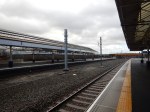
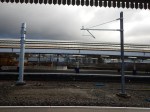

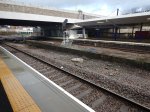
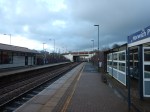
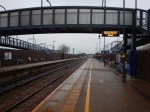
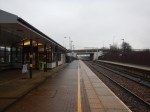
It is a sad sight, that I have seen repeated all over England, where electrification is being installed.
As on the Gospel Oak to Barking Line progress has been slow. Except that this scheme is much slower.
It also appears that something like this is happening on electrification.
- A team come along and install the foundations for the gantries.
- Then everybody takes a long break, whilst it is worked out how to install the foundations that couldn’t be installed or had just been forgotten.
- A team then comes along and puts up the gantries.
- Then everybody takes a long break, whilst they chase up the gntries that don’t fit or haven’t been delivered.
- A team then comes along and decorates the gantries with the various fitments for the overhead wires.
- Then everybody takes a long break, whilst they chase up the faults needed to be fixed before the wires to go up.
- Finally, the wires are installed.
Only now,the testing can begin!
On the Gospel Oak to Barking Line, they’ve finally got all the way to Stage 7, but it has meant two major closures of the line.
On the Manchester-Preston Line, they’re still blundering around in Stage 1.
Years ago, I used to work with the Greater London Council on various projects. The Head of the Construction Branch told me, to beware of sub-contractors, who had their fingers in lots of projects, as it inevitably led to all projects being late.
Could it be, that the electrification woes all over the UK, is that there aren’t enough competent engineers and fitters to design and erect the overhead gantries?
As the Manchester to Preston electrification was being carried out by Carillion, that wouldn’t have helped either! This probably explains the very slow progress on this project.
The competent staff are going, where they know they’ll get paid.
Network Rail’s chronic Project Management and forward planning hasn’t helped either. Crossrail has highlighted the poor state of the wires on the Great Eastern Main Line and with all the new trains due to thunder along the line in a few years time, they seem to have decided to replace all the unreliable wiring in East Anglia.
About time too!
But, this job should have been planned, resourced and carried out earlier.
So all the competent engineers and fitters are flocking to better jobs!
Conclusion
Network Rail needs to do the following.
- Have access to a competent team of engineers and fitters, either in-house or with a reliable engineering firm.
- Create a plan of new electrification and renewals for the next few years.
- Stick to it.
But politicians will not allow this!
It should be noted that if the train companies use more bi-mode, hydrogen and battery-powered trains, this will increase the need for small electrification schemes to allow the new trains to run efficiently.
Hopefully, these small schemes will be of vaguely similar natures, so installation won’t be the large scale farces, we’ve seen in recent years.
Rail Engineer On Hydrogen Trains
This article on Rail Engineer is entitled Hydrail Comes Of Age.
It is a serious look at hydrogen-powered trains.
This is typical information-packed paragraph.
Instead of diesel engines, the iLint has underframe-mounted traction motors driven by a traction inverter. Also mounted on the underframe is a lithium-ion battery pack supplied by Akasol and an auxiliary converter to power the train’s systems. On the roof is a Hydrogenics HD200-AT power pack which packages six HyPMTM HD30 fuel cells, with common manifolds and controls, and X-STORE hydrogen tanks supplied by Hexagon xperion which store 89kg of hydrogen on each car at 350 bar. These lightweight tanks have a polymer inner liner, covered with carbon fibres soaked in resin and wrapped in fibreglass.
They have interesting things to say about the trains and the production and delivery of the hydrogen, which can be what they call green hydrogen produced by electricity generated by wind power.
This is said about supplying the hydrogen.
It takes 15 minutes to refuel the iLint, which holds 178kg of hydrogen supplied at a pressure 350 bar. It consumes this at the rate of 0.3kg per kilometre. Thus, Lower Saxony’s fleet of 14 trains, covering, say, 600 kilometres a day, will require 2.5 tonnes of hydrogen per day. If this was produced by electrolysis, a wind farm of 10MW generating capacity would be required to power the required electrolysis plant with suitable back up. This, and sufficient hydrogen storage, will be required to ensure resilience of supply.
These are the concluding paragraphs.
With all these benefits, a long-term future in which all DMUs have been replaced by HMUs is a realistic goal. However, the replacement, or retrofitting, of 3,000 DMUs and the provision of the required hydrogen infrastructure would be a costly investment taking many years.
Germany has already taken its first steps towards this goal.
For myself, I am not sceptical about the technology that creates electricity from pure hydrogen, but I think there are design issues with hydrogen-powered trains in the UK.
The German trains, which are built by Alsthom and should start test runs in 2018, take advantage of the space above the train in the loading gauge to place the tanks for the hydrogen.
Our smaller loading gauge would probably preclude this and the tanks might need to take up some of the passenger space.
But in my view, we have another much more serious problem.
Over the last twenty years, a large number of high quality trains like electric Desiros, Electrostars and Junipers, and diesel Turbostars have been delivered and are still running on the UK network.
It could be that these trains couldn’t be converted to hydrogen, without perhaps devoting a carriage to the hydrogen tank, the electricity generator and the battery needed to support the hydrogen power.
It is for this reason, that I believe that if we use hydrogen power, it should be used with traditional electrification and virtually unmodified trains.
A Typical Modern Electric Train
Well! Perhaps not yet, but my view of what a typical electric multiple unit, will look like in ten years is as follows.
- Ability to work with 25 KVAC overhead or 750 VDC third-rail electrification or onboard battery power.
- Ability to switch power source automatically.
- Batteries would handle regenerative braking.
- Energy-efficient train design.
- Good aerodynamics.
- Most axles would be powered for fast acceleration and smooth braking.
- Efficient interior design to maximise passenger numbers that can be carried in comfort.
- A sophisticated computer with route and weather profiles, passenger numbers would optimise the train.
The battery would be sized, such that it gave a range, that was appropriate to the route.
In an article in the October 2017 Edition of Modern Railways, which is entitled Celling England By The Pound, Ian Walmsley says this in relation to trains running on the Uckfield Branch.
A modern EMU needs between 3 and 5 kWh per vehicle mile for this sort of service.
As I’m talking about a train that has taken energy efficiency to the ultimate, I think it would be reasonable to assume that 3 kWh per vehicle mile is attainable.
As I believe that most axles would be powered, I feel that it would be electrically efficient for a battery to be fitted into each car.
Suppose we had a five-car train with a 30 kWh battery in each car.
This would give a total installed battery capacity of 150 kWh. Divide by five and three and this gives a useful emergency range of ten miles.
These facts put the battery size into perspective.
- , 30 kWh is the size of the larger battery available for a Nissan Leaf.
- A New Routemaster bus has a battery of 75 kWh.
Where will improved battery technology take us in the next decade?
Use Of Hydrogen Power With 750 VDC Third-Rail Electrification
This extract from the Wikipedia entry for third-rail, explains the working of third-rail electrification.
The trains have metal contact blocks called shoes (or contact shoes or pickup shoes) which make contact with the conductor rail. The traction current is returned to the generating station through the running rails. The conductor rail is usually made of high conductivity steel, and the running rails are electrically connected using wire bonds or other devices, to minimize resistance in the electric circuit. Contact shoes can be positioned below, above, or beside the third rail, depending on the type of third rail used; these third rails are referred to as bottom-contact, top-contact, or side-contact, respectively.
If a line is powered by third-rail electrification, it needs to be fed with power every two miles or so, due to the losses incurred in electricity passing along the steel conductor rail.
I suspect that Network Rail and our world-leading rail manufacturers have done as much as they can to reduce electrical losses.
Or have they? Wikipedia says this.
One method for reducing current losses (and thus increase the spacing of feeder/sub stations, a major cost in third rail electrification) is to use a composite conductor rail of a hybrid aluminium/steel design. The aluminium is a better conductor of electricity, and a running face of stainless steel gives better wear.
Suppose instead of having continuous third-rail electrification, lengths of electrification with the following characteristic were to be installed.
- Hybrid aluminium/steel rails.
- Power is supplied at the middle.
- Power is only supplied when a train is in contact with the rail.
All trains would need to have batteries to run between electrified sections.
The length and frequency of the electrified sections would vary.
- If a section was centred on a station, then the length must be such, that a train accelerating away can use third-rail power to get to operating speed.
- Sections could be installed on uphill parts of the line.
- On long level sections of line without junctions, the electrified sections could be more widely spaced.
- Battery power could be used to take trains through complicated junctions and crossovers, to cut costs and the difficulties of electrification.
- Electrified section woulds generally be placed , where power was easy to provide.
So where does hydrogen-power come in?
Obtaining the power for the track will not always be easy, so some form of distributed power will be needed.
- A small solar farm could be used.
- A couple of wind turbines might be appropriate.
- In some places, small-scale hydro-electric power could even be used.
Hydrogen power and especially green hydrogen power could be a viable alternative.
- It would comprise a hydrogen tank, an electricity generator and a battery to store energy.
- The tank could be buried for safety reasons.
- The installation would be placed at trackside to allow easy replenishment by tanker-train.
- It could also be used in conjunction with intermittent solar and wind power.
The tanker-train would have these characteristics.
- It could be a converted electrical multiple unit like a four-car Class 319 train.
- Both 750 VDC and 25 KVAC operating capability would be retained.
- One car would have a large hydrogen tank.
- A hydrogen-powered electricity generator would be fitted to allow running on non-electrified lines and give a go-anywhere capability.
- A battery would probably be needed, to handle discontinuous electrification efficiently.
- It might even have facilities for a workshop, so checks could be performed on the trackside power system
Modern digital signalling, which is being installed across the UK, may will certainly have a part to play in the operation of the trackside power systems.
The position of all trains will be accurately known, so the trackside power system would switch itself on, as the train approached, if it was a train that could use the power.
Use Of Hydrogen Power With 25 KVAC Overhead |Electrification
The big difference between installation of 25 KVAC overhead electrification and 750 VDC third-rail electrification, is that the the overhead installation is more complicated.
- Installing the piling for the gantries seems to have a tremendous propensity to go wrong.
- Documentation of what lies around tracks installed in the Victorian Age can be scant.
- The Victorians used to like digging tunnels.
- Bridges and other structures need to be raised to give clearance for the overhead wires.
- There are also those, who don’t like the visual impact of overhead electrification.
On the plus side though, getting power to 25 KVAC overhead electrification often needs just a connection at one or both ends.
The electrification in the Crossrail tunnel for instance, is only fed with electricity from the ends.
So how could hydrogen help with overhead electrification?
Electrifying some routes like those through the Pennines are challenging to say the least.
- Long tunnels are common.
- There are stations like Hebden Bridge in remote locations, that are Listed Victorian gems.
- There are also those, who object to the wires and gantries.
- Some areas have severe weather in the winter that is capable of bringing down the wires.
In some ways, the Government’s decision not to electrify, but use bi-mode trains is not only a cost-saving one, but a prudent one too.
Bi-mode trains across the Pennines would have the advantage, that they could use short lengths of electrification to avoid the use of environmentally-unfriendly diesel.
I have read and lost an article, where Greater Anglia have said, that they would take advantage of short lengths of electrification with their new Class 755 trains.
Electrifying Tunnels
If there is one place, where Network Rail have not had any electrification problems, it is in tunnels, where Crossrail and the Severn Tunnel have been electrified without any major problems being reported.
Tunnels could be developed as islands of electrification, that allow the next generation of trains to run on electricity and charge their batteries.
But they would need to have a reliable power source.
As with third-rail electrification, wind and solar power, backed by hydrogen could be a reliable source of power.
Electrifying Stations With Third Rail
It should be noted, that the current generation of new trains like Aventra, Desiro Cities and Hitachi’s A-trains can all work on both 25 KVAC overhead or 750 VDC third-rail systems, when the appropriate methods of current collection are fitted.
Network Rail have shown recently over Christmas, where they installed several short lengths of new third-rail electrification South of London, that installing third-rail electrification, is not a challenging process, provided you can find the power.
If the power supply to the third-rail is intelligent and is only switched on, when a train is on top, the railway will be no more a safety risk, than a route run by diesel.
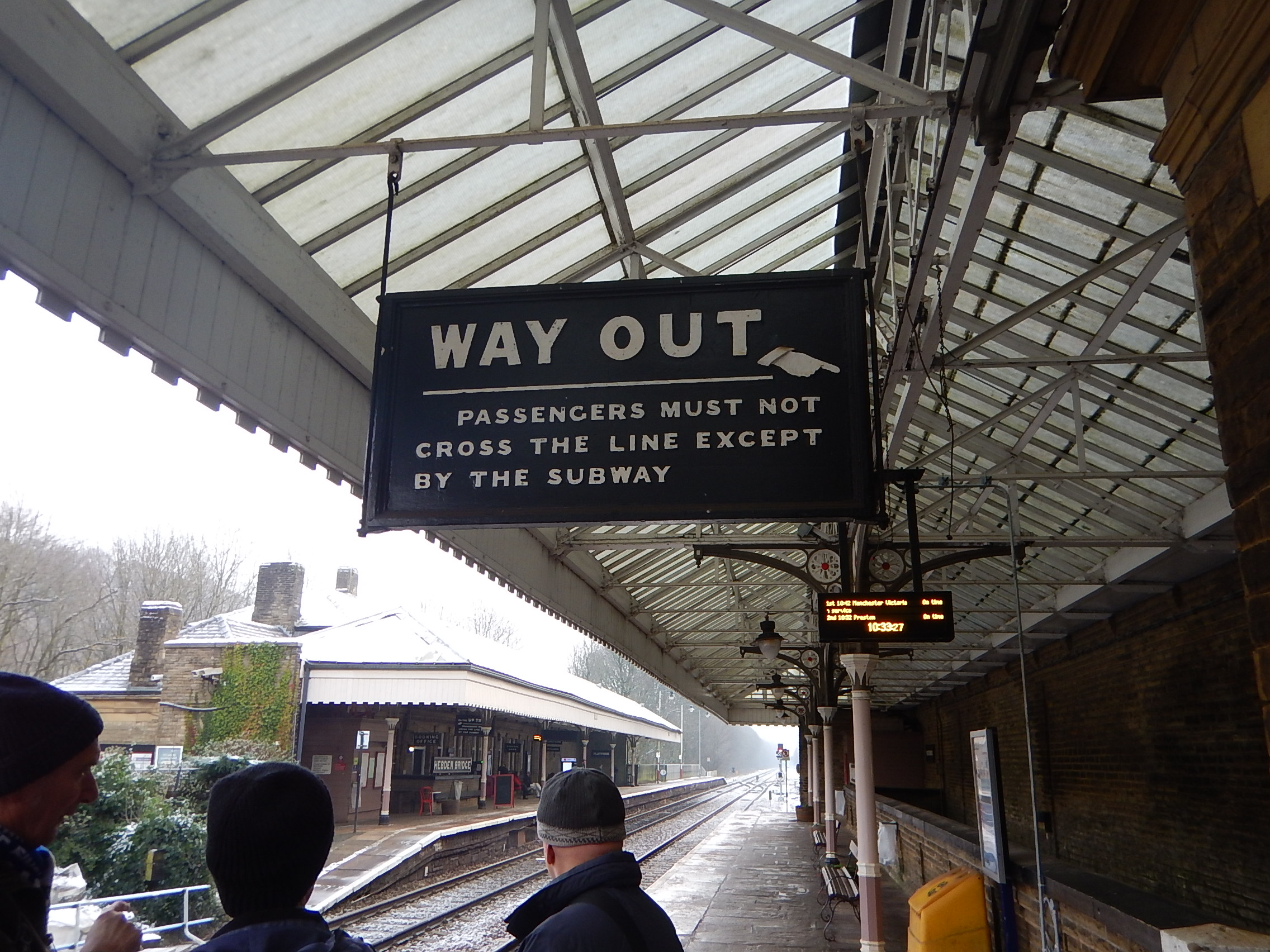
The picture shows the Grade II Listed Hebden Bridge station.
Third-rail electrification with an independent reliable power supply could be a way of speeding hybrid trains on their way.
Power Supply In Remote Places
Communications are essential to the modern railway.
Trains and train operators need to be able to have good radio connections to signalling and control systems.
Passengers want to access wi-fi and 4G mobile phone networks.
More base stations for communication networks will be needed in remote locations.
Wind, solar and hydrogen will all play their part.
I believe in the future, that remote routes in places like Wales, Scotland and parts of England, will see increasing numbers of trains and consequently passengers., many of whom will be walking in the countryside.
Could this lead to upgrading of remote stations and the need for reliable independent power supplies?
Conclusion
I am very much coming to the conclusion, that because of the small UK loading gauge, hydrogen-powered trains would only have limited applications in the UK. Unless the train manufacturers come up with a really special design.
But using hydrogen as an environmentally-friendly power source for UK railways to power electrification, perhaps in combination with wind and solar is a definite possibility!
.
Hitachi Battery Trains On The Great Western Railway
The slow pace of the electrification on the Great Western Main Line has become a big stick with which to beat Network Rail.
But are rolling stock engineers going to pull Network Rail out of their hole?
On page 79 of the January 2018 Edition of Modern Railways, Nick Hughes, who is the Sales Director of Hitachi Rail Europe outlines how the manufacturer is embracing the development of battery technology.
He is remarkably open.
I discuss what he says in detail in Hitachi’s Thoughts On Battery Trains.
But here’s an extract.
Nick Hughes follows his description of the DENCHA; a Japanese battery train, with this prediction.
I can picture a future when these sorts of trains are carrying out similar types of journeys in the UK, perhaps by installing battery technology in our Class 395s to connect to Hastings via the non-electrified Marshlink Line from Ashford for example.
This would massively slice the journey time and heklp overcome the issue of electrification and infrastructure cases not stacking up. There are a large number of similar routes like this all across the country.
It is a prediction, with which I could agree.
I conclude the post with this conclusion.
It is the most positive article about battery trains, that I have read so far!
As it comes direct from one of the train manufacturers in a respected journal, I would rate it high on quality reporting.
Hitachi Battery Train Technology And Their UK-Built Trains
The section without electrification on the Marshlink Line between Ashford International and Ore stations has the following characteristics.
- It is under twenty-five miles long.
- It is a mixture of double and single-track railway.
- It has nine stations.
- It has a sixty mph operating speed.
As the line is across the flat terrain of Romney Marsh, I don’t think that the power requirements would be excessive.
In the Modern Railway article, Nick Hughes suggests that battery technology could be installed in Class 395 trains.
The Class 395 train is part of a family of trains, Hitachi calls A-trains. The family includes.
- Class 800 trains as ordered by GWR and Virgin Trains East Coast.
- Class 801 trains as ordered by GWR and Virgin Trains East Coast
- Class 802 trains as ordered by GWR, Hull Trains and TransPennine Express
- Class 385 trains as ordered by ScotRail.
In Japan, another member of the family is the BEC819, which is the DENCHA, that is mentioned in the Modern Railways article.
As a time-expired electrical engineer, I would think, that if Hitachi’s engineers have done their jobs to a reasonable standard, that it would not be impossible to fit batteries to all of the A-train family of trains, which would include all train types, built at Newton Aycliffe for the UK.
In Japan the DENCHAs run on the Chikuhō Main Line, which has three sections.
- Wakamatsu Line – Wakamatsu–Orio, 10.8 km
- Fukuhoku Yutaka Line – Orio–Keisen, 34.5 km
- Haruda Line – Keisen–Haruda, 20.8 km
Only the middle section is electrified.
It looks to me, that the Japanese have chosen a very simple route, where they can run on electrification for a lot of the way and just use batteries at each end.
Bombardier used a similar low-risk test in their BEMU Trial with a Class 379 train in 2015.
So How Will Battery Trains Be used On the Great Western?
On the Great Western Main Line, all long distance trains and some shorter-distance ones will be Class 80x trains.
The size of battery in the DENCHA can be estimated using a rule, given by Ian Walmsley.
In an article in the October 2017 Edition of Modern Railways, which is entitled Celling England By The Pound, Ian Walmsley says this in relation to trains running on the Uckfield Branch.
A modern EMU needs between 3 and 5 kWh per vehicle mile for this sort of service.
So the energy needed to power the DENCHA, which is a two-car battery train on the just under twenty miles without electrification of the Chikuhō Main Line in a one way trip would be between 112 and 187 kWh.
A Battery-Powered Class 801 Train
The Class 801 train is Hitachi’s all-electric train, of which Great Western Railway have ordered thirty-six of the closely-related five-car Class 800 train and twenty-one of the nine-car units.
The difference between the two classes of train, is only the number of generator units fitted.
- Trains can be converted from Class 800 to Class 801 by removing generator units.
- Bi-mode Class 800 trains have a generator unit for each powered car.
- The all-electric Class 801 train has a single generator unit, in case of electrical power failure.
- When trains couple and uncouple, the train’s computer system determines the formation of the new train and drives and manages the train accordingly.
If I was designing the train, I would design a battery module, that replaced a generator unit
This leads me to think, that a five-car Class 801 train, could have one generator unit and up to four battery modules.
- The computer would decide what it’s got and control the train accordingly.
- The generator unit and battery power could be used together to accelerate the train or at other times where high power is needed.
- If the batteries failed, the generator unit would limp the train to a safe place.
- The number of battery units would depend on the needs of the route.
It would be a true tri-mode train; electric, diesel and battery.
I will now look at some routes, that could see possible applications of a battery version of Class 80x trains.
Cardiff To Swansea
I’ll start with the most controversial and political of the cutbacks in electrification.
At present plans exist to take the electrification on the Great Western as far as Cardiff Central station, by the end of 2018.
The distance between Cardiff Central and Swansea stations is forty-six miles, so applying the Ian Walmsley formula and assuming the train is five-cars, we have an energy usage for a one-way trip between the two cities of between 690 and 1150 kWh.
As the Class 80x trains are a modern efficient design, I suspect that a figure towards the lower end of the range will apply.
But various techniques can be used to stretch the range of the train on battery power.
- From London to Cardiff, the line will be fully-electrified, so on arrival in the Welsh capital, the batteries could be fully charged.
- The electrification can be continued for a few miles past Cardiff Central station, so that acceleration to line speed can be achieved using overhead wires.
- Electrification could also be installed on the short stretch of track between Swansea station and the South Wales Main Line.
- There are three stops between Cardiff and Swansea and regenerative braking can be used to charge the batteries.
- The single generator unit could be used to help accelerate the train if necessary.
- There are only two tph on the route, so efficient driving and signalling could probably smooth the path and save energy.
- Less necessary equipment can be switched off, when running on batteries.
Note. that the power/weight and power/size ratios of batteries will also increase, as engineers find better ways to build batteries.
The trains would need to be charged at Swansea, but Hitachi are building a depot in the city, which is shown in these pictures.


It looks like they are electrifying the depot.
Surely, enough electrification can be put up at Swansea to charge the trains and help them back to the South Wales Main Line..
The mathematics show what is possible.
Suppose the following.
- Hitachi can reduce the train’s average energy consumption to 2 kWh per carriage-mile, when running on battery power.
- Electrification at Cardiff and Swansea reduces the length of battery use to forty miles.
This would reduce the battery size needed to 400 kWh, which could mean that on a five-car train with four battery modules, each battery module would be just 100 kWh. This compares well with the 75 kWh battery in a New Routemaster bus.
Will it happen?
We are probably not talking about any serious risk to passengers, as the worst that can happen to any train, is that it breaks down or runs out of power in the middle of nowhere. But then using the single generator unit, the train will limp to the nearest station.
But think of all the wonderful publicity for Hitachi and everybody involved, if the world’s first battery high speed train, runs twice an hour between Paddington and Swansea.
Surely, that is an example of the Can-Do attitude of Isambard Kingdom Brunel?
Paddington To Oxford
The route between Paddington and Oxford stations is electrified as far as Didcot Parkway station.
The distance between Didcot Parkway and Oxford stations is about ten miles, so applying the Ian Walmsley formula and assuming the train is five-cars, we have an energy usage for the return trip to Oxford from Didcot of between 300 and 500 kWh.
If the five-car train has one generator unit,four battery modules and has an energy usage to the low end, then each battery module would need to handle under 100 kWh.
There are plans to develop a South-facing bay platform at Oxford station and to save wasting energy reversing the train by running up and down to sidings North of the station, I suspect that this platform must be built before battery trains can be introduced to Oxford.
If it’s not, the train could use the diesel generator to change platforms.
The platform could also be fitted with a system to charge the battery during turnround.
Paddington To Bedwyn
The route between Paddington and Bedwyn is electrified as far as Reading station, but there are plans to electrify as far as Newbury station.
The distance between Newbury and Bedwyn stations is about thirteen miles, so applying the Ian Walmsley formula and assuming the train is five-cars, we have an energy usage for the return trip to Bedwyn from Newbury of between 390 and 520 kWh.
As with Paddington to Oxford, the required battery size wouldn’t be excessive.
Paddington To Henley-on-Thames
The route between Paddington and Henley-on-Thames station is probably one of those routes, where electric trains must be run for political reasons.
The Henley Branch Line is only four miles long.
It would probably only require one battery module and would be a superb test route for the new train.
Paddington To Weston-super-Mare
Some Paddington to Bristol trains extend to Weston-super-Mare station.
Weston-super-Mare to the soon-to-be-electrified Bristol Temple Meads station is less than twenty miles, so if Swansea can be reached on battery power, then I’m certain that Weston can be reached in a similar way.
Other Routes
Most of the other routes don’t have enough electrification to benefit from trains with a battery capability.
One possibility though is Paddington to Cheltenham and Gloucester along the Golden Valley Line. The length of the section without electrification is forty-two miles, but unless a means to charge the train quickly at Cheltenham station is found, it is probably not feasible.
It could be possible though to create a real tri-mode train with a mix of diesel generator units and battery modules.
This train might have the following characteristics.
- Five cars.
- A mix of generator units and battery modules.
- Enough generator units to power the train on the stiffest lines without electrification.
- Ability to collect power from 25 KVAC overhead electrification
- Ability to collect power from 750 VDC third-rail electrification.
Note.
- The battery modules would be used for regenerative braking in all power modes.
- The ability to use third rail electrification would be useful when running to Brighton, Exeter, Portsmouth and Weymouth.
The train could also have a sophisticated computer system, that would choose power source according to route,timetable, train loading, traffic conditions and battery energy level.
The objective would be to run routes like Paddington to Cheltenham, Gloucester to Weymouth and Cardiff to Portsmouth Harbour, as efficiently as possible.
Collateral Advantages
Several of the routes out of Paddington could easily be worked using bi-mode Class 800 trains.
- But using battery trains to places like Bedwyn, Henley, Oxford and Weston-super-Mare is obviously better for the environment and probably for ticket sales too!
- If places like Bedwyn, Henley and Oxford are served by Class 801 trains with a battery option, it could mean that they could just join the throng of 125 mph trains going in and out of London.
- Battery trains would save money on electrification.
I also suspect, that the running costs of a battery train are less than those of using a bi-mode or diesel trains.
Conclusion
Hitachi seem to have the technology, whereby their A-train family can be fitted with batteries, as they have done it in Japan and their Sales Director in the UK, has said it can be done on a Class 395 train to use the Marshlink Line.
We may not see Hitachi trains using batteries for a couple of years, but it certainly isn’t fantasy.
Great Western Railway certainly need them!
 The Anonymous Widower