Hot Air From The Underground
This article on IanVisits is entitled London Railway Upgrades – A Progress Report.
These are three entries from a long list.
Northern Line
- The pump house steelwork on Islington’s Bunhill scheme has been completed. When working, waste heat from the Northern line will be piped into nearby homes.
Piccadilly Line
The York Road disused station is being studied for a possible heat extraction upgrade, with low grade heat then supplied to a nearby user.
Victoria Line
Work on a feasibility study into a heat extraction scheme at Forest Road vent shaft at the northern end of the Victoria line to reuse the heat for local homes is under way.
It is good to see waste heat from the Underground being used for a serious purpose.
I would hope that extracting heat, also cools the tunnels!
Where The Queen Gets Her Energy
Yesterday’s edition of Countryfile on BBC1, was entitled Royal Special: Windsor.
In the program, they shows how Windsor Castle and the surrounding estate, use an Archimedes screw in the River Thames to generate electricity.
I found this video on the Internet.
There is also this document on the Internet.
It may look crazy, but after reading the document, it would appear to be cost effective.
This Google Map gives aerial view of the weir and the installed screws.

The two screws are installed in two sections of the weir at the right end.
It may look crazy, but after reading the document, it would appear to be cost effective.
- At peak flow the two units generate a total of 320kW/hour.
- There is a six year return on investment.
- The design life is fifteen years..
- The owner of the generators has a forty year lease on the site.
I suspect, we could see more units like this!
Artificial Photosynthesis Offers Clean Source Of Hydrogen
The title of this post, is the same as that of this article on The Engineer.
This is the first paragraph.
Devices made using conventional semiconductor technologies could make hydrogen using just fresh or saltwater and sunlight.
It would appear to be an interesting concept, but after reading the article, there is still a lot of research and development to be done before it is an affordable proposition.
But I do feel, it could be one of those technologies that are commonplace in a few decades.
Britain Powers On Without Coal For Three Days
The title of this post, as the same as that on this article on the BBC.
This is the first paragraph.
Britain has not generated electricity from coal for more than three days – the longest streak since the 1880s.
Let’s hope we keep out our commitment to phase out coal completely by 2025!
OVO Energy Drops 4 Product Bombshells, Including New Vehicle-to-Grid Charger
The title of this post, is the same as that of this article on Clean Technica.
This is the first paragraph.
n London yesterday, OVO Energy took to the stage and dropped not one new product but four product bombshells that are aimed at creating a new energy ecosystem that is accessible to residential energy consumers.
The products are.
- A Vehicle-to-Grid Charger for the Masses
- 7kW Smart Charger
- One Ring To Rule Them All
- Residential Energy Stoage
The article discusses them in detail.
If I still drove, I’d be very interested in the vehicle-to-grid charger, as I’d fit one in my garage.
The amount of car use, I would have would probably be fairly minimal, so most of the time the car would be sitting in the garage, acting as a storage battery for the National Grid.
Suppose ten million homes in the UK, had a vehicle-to-grid charger and an electric car with a 30 kWh battery. that would be 300 MWh of energy storage, which would be ideal for storing wind energy generated at night.
Steam Methane Reforming
In The Liverpool Manchester Hydrogen Clusters Project, I used an extract that describes the project.
This was a paragraph from the extract.
It proposes converting natural gas into clean-burning hydrogen gas, using a process called steam methane reforming. The process also removes CO2 from the gas, which can then be captured using existing carbon and capture storage technology and stored in depleted offshore gas reservoirs.
So what is steam methane reforming?
Methane is a chemical compound consisting of one carbon and four hydrogen atoms, that is the major component of natural gas.
This first paragraph is from the Wikipedia entry for steam reforming.
Steam reforming is a method for producing hydrogen, carbon monoxide, or other useful products from hydrocarbon fuels such as natural gas. This is achieved in a processing device called a reformer which reacts steam at high temperature with the fossil fuel. The steam methane reformer is widely used in industry to make hydrogen. There is also interest in the development of much smaller units based on similar technology to produce hydrogen as a feedstock for fuel cells. Small-scale steam reforming units to supply fuel cells are currently the subject of research and development, typically involving the reforming of methanol, but other fuels are also being considered such as propane, gasoline, autogas, diesel fuel, and ethanol.
If the process has a problem, it is that is produces carbon dioxide, which in the case of the Liverpool Manchester Hydrogen Clusters Project is captured and will be stored depleted gas reservoirs.
Large Scale Electricity Interconnection
We have several related problems with electricity.
- We are using more and more.
- Electric cars, buses and trucks will mean, that we’ll use even more.
- A lot of electricity will be produced in the wrong place and at the wrong time.
- Not everybody uses the same local voltages as our 250 VAC.
- We need ways of storing electricity.
- Some methods of generating electricity, emit a large amount of green-house gases.
In the UK, we have a very sophisticated energy grid, which includes a certain amount of energy storage, that moves energy around from where it is generated to where it is needed.
As an example, I’m sure we’ll see industries that need a lot of electricity, taking advantage of wind energy generated at night.
In my lifetime, I can only remember two periods of severe power shortages.
- In the 1950s, as people bought more electrical equipment like fridges, cookers, kettles and TVs, there was sometimes power cuts at Christmas.
- In theb1970s, shortages were caused by industrial action.
But in recent decades the National Grid has generally kept the electricity flowing.
Most power cuts have been local equipment failure or weather-related.
As the future unfolds, the grid will get better and of a higher capacity to handle all the extra needs of our lifestyle.
Countries, states, towns and cities will develop their own sophisticated networks to look after their people, industry and transport.
Regional Electricity Networks
These smaller networks are now increasingly being connected together to create larger networks.
One of the first interconnectors was the HVDC Cross-Channel between England and France. Wikipedia gives this history.
The first Cross-Channel link was a 160 MW link completed in 1961 and decommissioned in 1984, while the second was a 2000 MW link completed in 1986.
The current 2000 MW link, like the original link, is bi-directional and France and Britain can import/export depending upon market demands.
I’ve read that in recent years, we’ve been using French nuclear power and they’ve been using our wind power.
According to this page on UtilityWise, there are.
- Four operational interconnectors are operational.
- Four interconnectors are being constructed.
- Seven interconnectors are being planned.
They also have this diagrammatic map.
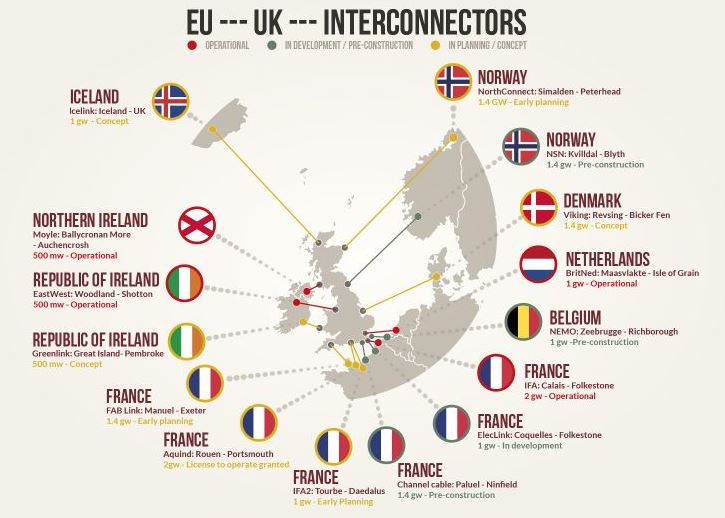
Note.
- If the Icelandic interconnector gets built, it could be a big source of zero-carbon power for the UK and Europe and a large income for Iceland.
- Two big interconnectors to Norway are planned, where there is lots of hydro-electric power.
- A big interconnector is being built between Germany and Norway, which is not shown.
- There will be seven links to France to tap into their nuclear network.
- Our contribution to Western Europe’s power will be mainly from our extensive wind farms, which will soon contribute twenty percent of our power needs.
It will all grow like a gigantic spider’s web, connecting excess power in one place to users, who need it, in another.
Large Scale Electricity Interconnection
This document on the International Energy Agency web site, gives a lot more information about Large Scale Electricity Interconnection.
HVDC Connections
Although, domestic connections have used alternating current (AC) for over a hundred years, these interconnectors use High Voltage Direct Current (HVDC)
This means the following.
- Terminal costs at the end of a link are more expensive.
- The cost of the cable is less per kilometre.
- Longer interconnectors have a cheaper cost per kilometre over about 600-800 km.
- Current technologies give a break-even distance of about 600-800 km.
The article says this about future projects.
With the increase in demand for long-distance interconnection, a number of projects have been envisioned that would greatly improve upon the current status. Projects in the pipeline include the undersea North Sea Network (NSN) link between the Nordic zone and the United Kingdom, which will deliver up to 1.4 GW of power through an undersea cable 730 km in length.
This entry in Wikipedia gives more details on the Norway-UK Interconnector.
Connecting Asynchronous Grids
The document says this.
When AC systems are to be connected, they must be synchronised.
This means that they should operate at the same voltage and frequency, which can be difficult to achieve. Since HVDC is asynchronous it can adapt to any rated voltage and frequency it receives. Hence, HVDC is used to connect large AC systems in many parts of the world.
This may seem technical, but it is important.
Connecting Large Energy Resources And Loads
As the voltage in the interconnector increases, it makes it more economic to connect remote energy resources to where the power is needed.
It gives these examples from around the world.
- Distant hydro resources in the Chilean Patagonia or in Brazil
- Hydro power in Western China
- Solar power in the Rajasthan desert in India.
In the Uk, we ae developing two long interconnectors to Norway and one to Iceland.
Acommodating Variable Renewable Electricity
The document says this.
Variable renewable energy (VRE) deployment requires flexible transmission links. One of the key drivers behind HVDC lines and interconnectors is the ability to shift intermittent renewables to areas of high demand when conditions would otherwise lead to curtailment.
Hopefully, the wind will be blowing somewhere, when the sun isn’t shining somewhere else.
Conclusion
Interconnectors will become a massive part of our distributed electricity system.
I must also say something about energy storage.
Electric vehicles could eventually turn out to be a large part of our mechanism to store excess energy.
Suppose there is excess energy at night, perhaps from wind, waves and tides and it is used to charge the batteries of electric vehicles. It has not gone to waste and is now stored for use when required.
The corollary of this will be, that every parking space or garage, where vehicles are left overnight will have to have a charging point for an electric car.
The Joy Of Physics
On the One Show on BBC television, yesterday there was a report about a man called Ian Tansley, who has invented a vaccine fridge for use in places like Africa, where the electricity is not reliable.
This Wikipedia entry for Sure Chill Technology describes the technology and this report on the BBC, describes how the invention has been backed by the Bill and Melinda Gates Foundation.
Physics to many is a dull subject at school, but to me, it’s the key to so many interesting inventions and ideas that will shape our lives in a better way.
Is A Cap On Energy Prices A Good Idea?
All political parties including the Motherhood and Apple Pie Tendency think this is a good idea, but I’m not sure.
I changed to OVO Energy, one of the smaller companies a couple of years ago, so I looked up on a comparison site to see if I could make a big saving by changing supplier.
Sixty-three suppliers would give me a saving of up to four pounds a month.
As my solar panels haven’t been installed for a year and I don’t know the full affect on my bill yet and I would be changing with solar panels, I shall not be changing my supplier now.
But the interesting figure is that sixty-three different deals were offered. That says to me that competition is working in the energy field.
An Ideal Energy Market
Most consumers would prefer a fixed low price.
But surely, that is impossible as there has to be an equilibrium between the price energy companies pay for their energy and the price they charge consumers.
What happens if there is a global crisis and energy prices are universally high?
The other problem with a low energy price, is that doesn’t encourage consumers to save energy.
The UK’s Energy System
The energy system and market is a constantly changing dynamic system and since energy privatisation in the UK, there have been massive changes to the generation, supply and use of electricity.
- A nnetwork of interconnectors is starting to stretch over Western Europe to allow interchange of electricity.
- Wind and solar power generation are increasing dramatically.
- Coal is dead for generating electricity.
- Consumers have invested in low-energy appliances.
There will be more developments in the next few years.
- A planned interconnector to Iceland could be a game changer.
- Solar panels and energy storage will increasingly be fitted to homes.
- Millions of electric cars will be sold.
- Some high-priced nuclear energy will come on stream.
All of these developments have and will continue to move the energy price up and down.
As a Control Engineer, I know that the best way to get a dynamic system like this to a stable point acceptable to all parties, is to apply as few restrictions as possible.
An energy price cap will impose a condition, that will distort the equilibrium and it might not be in the way that politicians want.
Politicians would be better to concentrate on actions that helped the current system find an equilibrium acceptable to all.
- Make it as easy as possible for consumers to change energy supplier.
- Avoid backing high-priced energy generation like Hinckley Point C.
- Promote lower-cost generation and energy storage systems.
- Fund energy research at universities.
- Build more interconnectors.
But above all they should not distort the market.
As an aside here, I don’t object to Nicola Sturgeon setting up a tax-payer funded energy company in Scotland. In a free market, it will only promote more competition and possibly lower prices.
But it might lose Scotland a lot of money!
Checking My Electricity Direct Debit
With the news this morning, that there is going to be a price cap on energy tariffs, I thought I’d look at mine.
I was paying £114 a month, but my supplier; OVO were recommended that I pay just £89.
The difference, is probably explained, as this has just been the first summer, when my solar panels have been installed.
So their charge calculating algorithm has only just caught up and I am now saving money.
Do you trust, your energy supplier to give you a an accurate estimate about what you should pay?
Interestingly, this morning, I’ve just found this web page detailing a link-up between OVO and Nissan concening the charging of electric cars.
The electricity market is changing very much for the better.
 The Anonymous Widower