The Private Thoughts of Engineers and Scientists
Some years ago there was an attack on the Tokyo Metro using sarin gas. Although it killed a number of people and injured many more, it could easily have been a lot worse.
At the time, I knew a guy who was and hopefully still is a world class chemical engineer, who worked in the pharmaceutical industry. I asked him, just how easy it was to make Sarin gas. He said it was fairly easy, but in most cases, sarin will kill you before you use it, unless you can get the proper protection, which is the most difficult part.
He did however tell me a much more easy way to paralyse a city and cause a lot of damage. I will not repeat it here, but judging what I don’t see in London, other people have had the same thought and made the carrying out of such an attack impossible.
What worries me now, is if we had a jokey conversation in a chat room on the Internet about an attack similar to that in Tokyo, would our doors be kicked in?
How To Show Off Technology
On the dockside they were showing off an old electric crane.
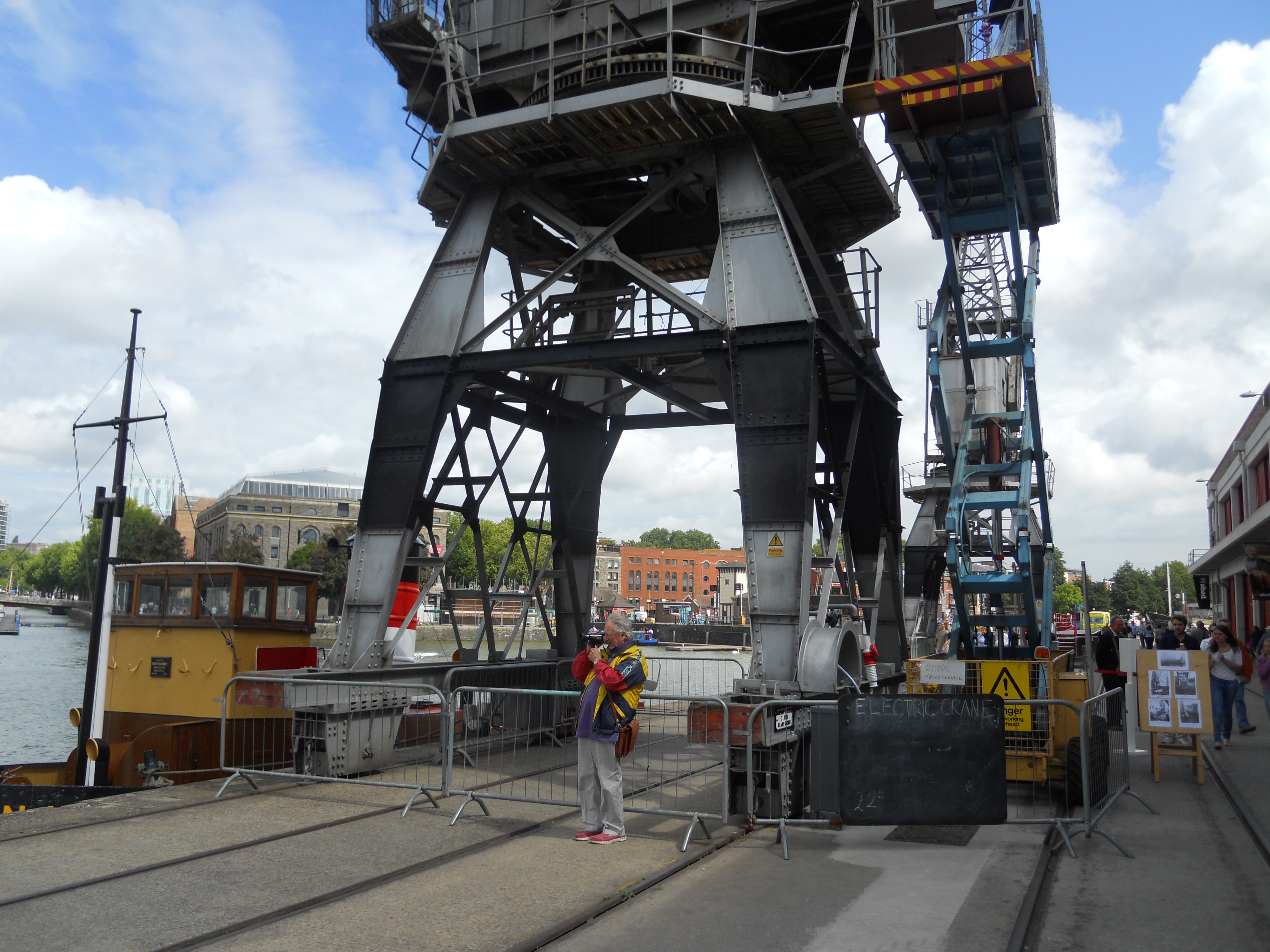
Electric Crane on Bristol Docks
Note the scissor lift at the right to give access to visitors.
And here’s a steam one too!
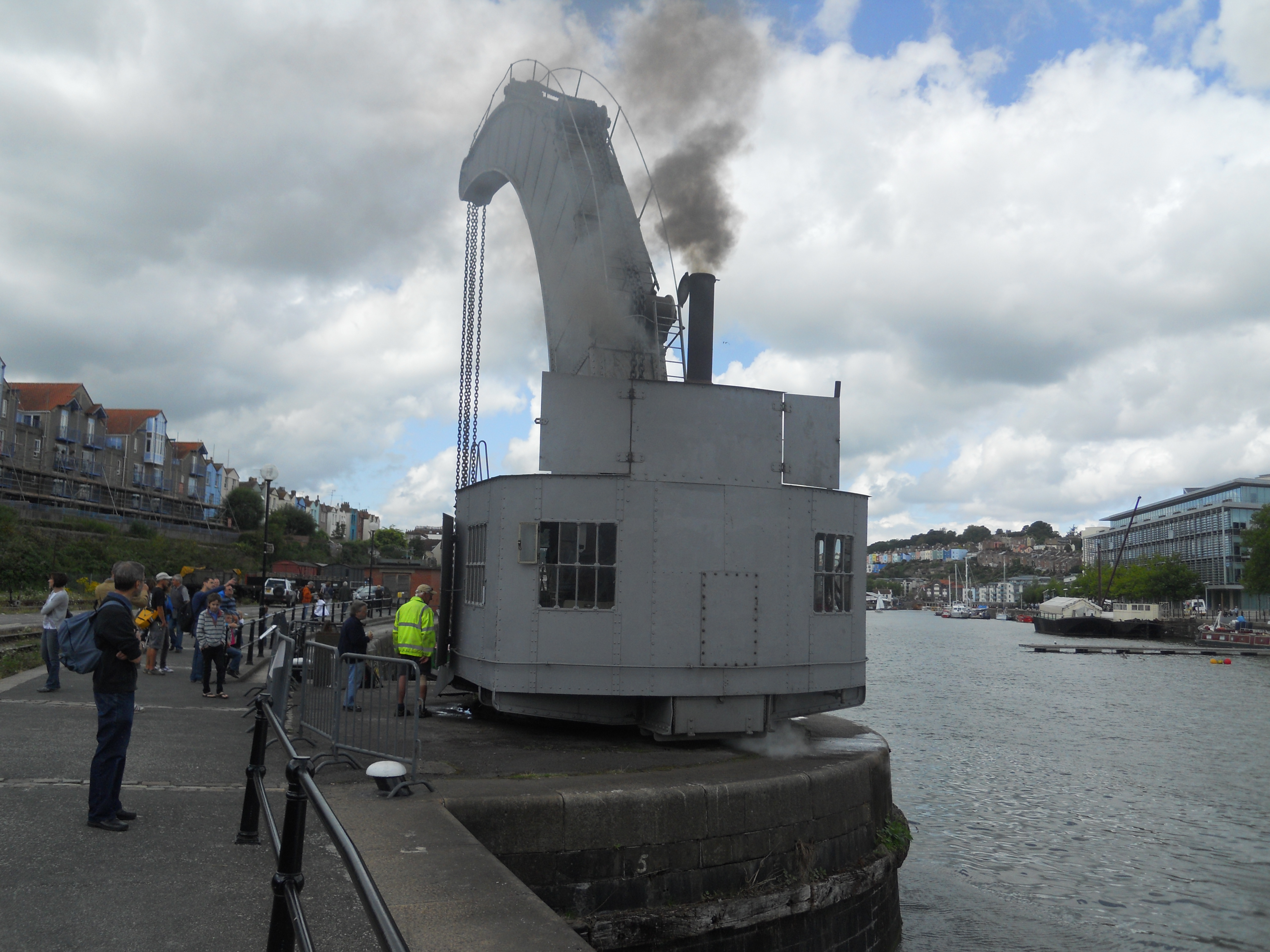
Steam Crane on Bristol Docks
I suppose some might think the smoke was a bit excessive.
Where are London’s working cranes?
Thames Water Can’t Win
There is a big row brewing in London about the Super Sewer that will run down the middle of the Thames.
The problem isn’t about foul water, but mainly about heavy rain causing problems, when it overloads the current system, which then causes foul water to be forced out onto the streets and into the Thames.
When I went down the sewers, I was given a presentation on the Super Sewer and totally understand that something must be done.
The question is what.
Some things don’t help.
London had 55,000 sewage blockages last year. Many are caused by inappropriate things, like chip fat, disposable nappies and general rubbish being put down the toilet. I’ve been told and not by Thames Water, I should add, that in tower blocks some residents are too lazy to walk down with their rubbish and use the toilet instead. There was also the notorious fatberg in Leicester Square outside a fast food restaurant.
Thames Water has launched a Bin it – Don’t Block it campaign.
There are also lots of people who have concreted over their front garden, which means that the water now runs off immediately.
You could argue that if you have a concreted front garden, then you should pay an extra drainage rate. I have a small patio between my front door and the road and wouldn’t mind paying a charge on a pro-rata basis. I also have a mature tree, which I think is a hornbeam, between the patio and the road, which might be bad for my hay fever, but it soaks up an awful load of water.

My Roadside Tree – A Hornbeam?
On a similar tack, new buildings should have plenty of green space and trees. But often this restricts the places to park cars and other vehicles.
Those that object to the Super Sewer use two main arguments.
The first is that it might not work and the second is that it will cost too much.
But most of the opposition is just the usual Nimbys, who don’t want construction near them. How many of these peple use disposable nappies on their babies? We never did in London, as in those days of the 1970s, there was still an affordable nappy service, where clean nappies were delivered regularly and the dirty ones taken away. The trouble is today’s parents are seduced by advertising. They may be all for saving the whale and the tiger, but when it comes to stopping sewage blockages, then that is not their problem.
So what do I think should be done?
Obviously, we first need to stop the blockages. This is mainly a publicity problem to get people to change their bad habits. If they won’t then more draconian solutions like the banning of disposable nappies and extra water taxes on fast food restaurants will be pushed for and might have to come in.
One idea I’d like to see tried is a SewerCam on the Greenway, showing what was going on beneath their feet in the Northern Outfall Sewer.
Thames Water have the start of a private museum at the old Abbey Mills Pumping Station, but where is the London Museum of Water and Sewage?
New technology has a part to play too.
On the Olympic Park all of the toilets and grass watering is going to be fed from recycled water, in part taken from the Northern Outfall Sewer.
Are London’s many parks kept green in the same way. I suspect many just use mains water, which just adds to the problem.
Surely someone could come up with a small water purification plant, that uses water collected from say housing estates to water the nearby parks.
We should also stop the covering of gardens with concrete and decking and make sure that all new buildings reuse all of the water they collect on their roofs.
But I’m afraid that if we use all the tricks we have available, we will probably need to put a Super Sewer under the Thames.
Top Gear on the New Lamborghini
Don’t shout it, but they felt it was rather boring.
Years ago we had a Porsche 911. At the time I tried out one of the new 911 Turbos. That was so good it was boring.
In those days Porsche 911 Turbos only had four gears, as Porsche decreed the engine was so good, it didn’t need the fifth one.
Unfortunatelty marketing takes precedence over engineering!
The Future of Very Long Distance Trains in the UK
We may be a small island, but it is possible to do some of the longer train journeys in Europe in the UK, where you don’t have to change trains. The longest trip I did in Europe was Nice to Lille.
We have several major long distance routes starting or finishing in London. Some include.
- London (Kings Cross) to Inverness via Edinburgh
- London (Kings Cross) to Aberdeen via Edinburgh
- London (Euston) to Holyhead
- London (Paddington) to Fishguard
- London (Paddington) to Penzance
I should note that the longest route is actually Penzance to Aberdeen.
At present all of the routes use IC125s or other diesel trains, but for a lot of the journey some will be under wires used by high speed electric trains. It is probably for this reason that when civil servants specified the replacement for the incomparable IC125, they came up with the idea of a bi-mode train, that was electric, but hauled a diesel around for where there was no power supply. Just as with people obesity is not to be tolerated as it wastes fuel, causes more carbon dioxide to be emitted and probably causes all sorts of track problems because of the weight. As an engineer, I just don’t like it! But that’s my prejudice and what do I know about trains?
However, Ian Walmsley, a man who does know about trains, has proposed in the August edition of Modern Railways, that the ageing Class 90 electric locomotives and Mark 3 coaches on the London to Norwich line be replaced with Bombasrdier TRAXX electric locomotives, refurbished and modern styled Mark 3 coaches and perhaps a new set of driving van trailers. The article showed some impressive interiors proposed by a company called Dg8.
Would this concept work on say London to Inverness? I’ve travelled the northermost part of this line in the driver’s cab and it is a truly spectacular line, but it is unlikely that it will ever be able to be electrified further than Stirling. But there are diesel versions of TRAXX, so could an engine change be performed before the electricity runs out. If Bombardier has the engineering correct, which I suspect they do, I doubt that an engine change would take more than a few minutes. It would certainly be less hassle for the passengers than a train change.
As you are running engine facing London as trains do on the northern routes out of Kings Cross, there would be no need for any special operating procedures in London, but you would need to provide for perhaps a small amount of track work at the engine changeover. This point would have to be chosen with respect to driver availability, so perhaps on services via Edinburgh, this might be the point. But of course it would be a simple matter for the train company to work out the best place for the changeover.
In his article, Ian proposed new driving van trailers. When I went to Inverness on the IC125, the driver had no access to train services, so he had to disembark to use the toilet. So should the DVTs be provided with various facilities for the driver?
It should also be noted that the current trains on the route have no room for heavy luggage, so could they be used for such items as bicycles, surfboards for Cornwall and large cases.
If these long routes have more than just distance in common; many passengers will want an at-seat meal and many will be leisure passengers who would want to admire the view.
So should in some ways a retrograde step be taken and make sure everyone has a full table and that seats align with windows, just like they originally did when the Mark 3 coaches were built. In some ways all of the routes are premium routes, where many will book well in advance for a holiday or an event, so the extra cost of the trains would probably be affordable.
An idea I thought of was an observation car, but although it might be possible, it might make train operation difficult. But surely someone like Dg8 could come up with a Cafe Bar Car with large windows that sat in the middle of the train.
As the journey length could be up to about nine hours, it would probably need innovative entertainment systems. How about a front and back camera to show views.
I may be talking out of my backside. But as John Lennon said. Imagine!
Vauxhall Pinch An Idea From Bombardier
Others may have too, but I was intrigued to see the review of the new Vauhall Ampera; which is probably best described as a bi-mode car. Or an electric one, with a small petrol engine that cuts in to get you home.
At first sight it looks like a solution to the range problem of an electric car, when you can’t find a means to recharge. The idea is not unique and the Bombardier TRAXX electric locomotive has an auxiliary diesel engine for use when the electricity has failed or is not available.
What We’re Good At!
I was very pleased when I read the third leader in The Times today, entitled Capital Idea.
This was the first paragraph.
After the on-time and underbudget Olympic Stadium, yesterday brought the opening of the Hindhead Tunnel on the A3, on the main route between London and Portsmouth, on time, on budget and garlanded with awards for its safety record. Britain is in danger of getting a reputation for being good at large infrastructure projects.
I could add another couple of projects like the London Overground, where the engineers delivered quality at a price well under the budget.
The Balaena Lives
Not quite, but there is a lot of Balaena thinking behind Shell’s new FLNG.
So what was the design I worked upon in Cambridge for Balaena Structures all those years ago like?
The problem with offshore oil platforms is that they are very expensive and once they’ve extracted all the oil from the oilfield on which they sit, they are very difficult to take down.
In the mid-1970s, some very clever structural engineers from Cambridge University came up with a design for a reuseable platform, that could be built in a ship yard, that would normally build supertankers.
The design was simply a steel cylinder, perhaps about a hundred metres long and thirty or so in diameter. I can’t be sure of the size as it is nearly forty years ago and I have kept no records. The idea was that it would be built horizontally and then towed into position, where it would be turned through ninety degrees to sit on the ocean floor above the oilfield.
So the eventual bottom end was closed off and would have had a skirt that sat in the ocean floor and held the platform in position by a sort of gum boot principle. The other end was also closed and supported a square working deck about twenty metres high on a stem about the same length.
My part was to do the calculations on the upending, which would have been accomplished by letting sea water into the enormous tank under control.
The calculations were not that simple, but because of my dynamic simulation experience, they were well within my compass and I was able to do them on a simple time-shared computer.
I did prove that because of the vast weight of steel and the not inconsiderable weight of sea water, that the Balaena would install itself as designed. Sadly it was one of those projects that after a considerable amount of effort never came to fruition.
Some other points about the design should be noted.
- The tank could be used to store the oil extracted and this could then be pumped to a waiting tanker.
- When it needed to be moved, the tank would be emptied and at the appropriate point, the Balaena would float vertically. It could then be towed still upright to a new position.
All of this might seem rather fanciful, but I suspect that some of the ideas in the Balaena have been used successfully in the other designs.
I started talking about the Balaena, when the Deepwater Horizon blew up in the Gulf of Mexico. At the time I was lying on a bed after a serious stroke in Hong Kong. I imagined an empty Balaena ready and waiting floating horizontally in the sea within a few hundred miles of the clusters of oil platforms. It would differ from the 1970s platform design, in that the working deck would be much simpler and probably only there to control the pumping. It would also not have a complete bottom to allow the oil to enter the tank.
Could it have been towed to the site and upended over the leaking well, as a crude but effective cap? The oil would still float to the surface, but inside the tank of the Balaena, from where it could be pumped out.
The idea may still be fanciful, but I can guarantee that the structure would upend as required, just by adding sea water to the tank. I did the calculations to prove it in the early 1970s.
CrossRail Isn’t All New
You’d expect that a modern project like CrossRail would be all new tunnels.
But it’s not!
An article in Modern Railways describes how the old Connaught Tunnel from the long-abandoned North Woolwich to Palace Gates line is being opened up to take the new railway. There is an article on the tunnels and some pictures here of the tunnel. You’ll have to page down a bit.
I like this from the introduction to the MR article.
On paper, reusing this existing link, which runs beneath the intersection of the Royal Victoria and Albert Docks, is cheaper and less disruptive than boring a new tunnel. In practice, the work required to bring the route up to scratch is anything but simple which, from an engineering point of view at least, means there’s a lot of fun to be had.
A lot is not good clean fun too, as they will probably have to lay a 1,000 cubic metre concrete slab under water.
Don’t ever say engineering is boring! Even where tunnels are involved.
The Engineering and Architecture of CrossRail
My previous post about CrossRail may give the impression, that I’m rather against the project.
I’m not, as I believe it will really open up London to residents, commuters and tourists. The only problem is it won’t be fully open until 2018 or so.
Railways should always go through a major city, rather than have expensive stations on the ends of two radial lines. It’s cheaper in terms of capital cost and ensures that the expensive trains work harder. Thameslink does this on a North-South basis and CrossRail will do it on an East-West basis, with an major interchange between the two lines at Farringdon station.
Modern Railways this month has a major section on the CrossRail project. It is a fascinating read, which describes how the railway is being threaded from one side of the London to the other and the designs of the various stations on the route.
The biggest conclusion I get after reading the report, is that this a project that although built to a tight budget, will be something of which London will be proud and will be something that can grow and grow as the City demands more transport links. From the pictures in the article it would appear that the visible face of the railway will be impressive and not like the rather utilitarian Victoria line. On the other hand a lot of the design is more on the side of the practical and well-thought, rather than the spectacular, such as seen on some parts of the Jubilee line.
I also feel that particular attention is being paid to the management of the whole project and this has allowed the cost to be reduced by a billion pounds or so, by taking slightly longer. Hopefully, this will also enable the project to be built on time, but these days, we are getting a much better record at completing large projects on time, so I wouldn’t be suprised if the engineers adjusted the project to increase the certainty of an on-time completion.
But that is good project management!
With my history in the field of project management, CrossRail seems to be a project, I’d have enjoyed getting my teeth into.
 The Anonymous Widower