Vauxhall Pinch An Idea From Bombardier
Others may have too, but I was intrigued to see the review of the new Vauhall Ampera; which is probably best described as a bi-mode car. Or an electric one, with a small petrol engine that cuts in to get you home.
At first sight it looks like a solution to the range problem of an electric car, when you can’t find a means to recharge. The idea is not unique and the Bombardier TRAXX electric locomotive has an auxiliary diesel engine for use when the electricity has failed or is not available.
What We’re Good At!
I was very pleased when I read the third leader in The Times today, entitled Capital Idea.
This was the first paragraph.
After the on-time and underbudget Olympic Stadium, yesterday brought the opening of the Hindhead Tunnel on the A3, on the main route between London and Portsmouth, on time, on budget and garlanded with awards for its safety record. Britain is in danger of getting a reputation for being good at large infrastructure projects.
I could add another couple of projects like the London Overground, where the engineers delivered quality at a price well under the budget.
The Balaena Lives
Not quite, but there is a lot of Balaena thinking behind Shell’s new FLNG.
So what was the design I worked upon in Cambridge for Balaena Structures all those years ago like?
The problem with offshore oil platforms is that they are very expensive and once they’ve extracted all the oil from the oilfield on which they sit, they are very difficult to take down.
In the mid-1970s, some very clever structural engineers from Cambridge University came up with a design for a reuseable platform, that could be built in a ship yard, that would normally build supertankers.
The design was simply a steel cylinder, perhaps about a hundred metres long and thirty or so in diameter. I can’t be sure of the size as it is nearly forty years ago and I have kept no records. The idea was that it would be built horizontally and then towed into position, where it would be turned through ninety degrees to sit on the ocean floor above the oilfield.
So the eventual bottom end was closed off and would have had a skirt that sat in the ocean floor and held the platform in position by a sort of gum boot principle. The other end was also closed and supported a square working deck about twenty metres high on a stem about the same length.
My part was to do the calculations on the upending, which would have been accomplished by letting sea water into the enormous tank under control.
The calculations were not that simple, but because of my dynamic simulation experience, they were well within my compass and I was able to do them on a simple time-shared computer.
I did prove that because of the vast weight of steel and the not inconsiderable weight of sea water, that the Balaena would install itself as designed. Sadly it was one of those projects that after a considerable amount of effort never came to fruition.
Some other points about the design should be noted.
- The tank could be used to store the oil extracted and this could then be pumped to a waiting tanker.
- When it needed to be moved, the tank would be emptied and at the appropriate point, the Balaena would float vertically. It could then be towed still upright to a new position.
All of this might seem rather fanciful, but I suspect that some of the ideas in the Balaena have been used successfully in the other designs.
I started talking about the Balaena, when the Deepwater Horizon blew up in the Gulf of Mexico. At the time I was lying on a bed after a serious stroke in Hong Kong. I imagined an empty Balaena ready and waiting floating horizontally in the sea within a few hundred miles of the clusters of oil platforms. It would differ from the 1970s platform design, in that the working deck would be much simpler and probably only there to control the pumping. It would also not have a complete bottom to allow the oil to enter the tank.
Could it have been towed to the site and upended over the leaking well, as a crude but effective cap? The oil would still float to the surface, but inside the tank of the Balaena, from where it could be pumped out.
The idea may still be fanciful, but I can guarantee that the structure would upend as required, just by adding sea water to the tank. I did the calculations to prove it in the early 1970s.
CrossRail Isn’t All New
You’d expect that a modern project like CrossRail would be all new tunnels.
But it’s not!
An article in Modern Railways describes how the old Connaught Tunnel from the long-abandoned North Woolwich to Palace Gates line is being opened up to take the new railway. There is an article on the tunnels and some pictures here of the tunnel. You’ll have to page down a bit.
I like this from the introduction to the MR article.
On paper, reusing this existing link, which runs beneath the intersection of the Royal Victoria and Albert Docks, is cheaper and less disruptive than boring a new tunnel. In practice, the work required to bring the route up to scratch is anything but simple which, from an engineering point of view at least, means there’s a lot of fun to be had.
A lot is not good clean fun too, as they will probably have to lay a 1,000 cubic metre concrete slab under water.
Don’t ever say engineering is boring! Even where tunnels are involved.
The Engineering and Architecture of CrossRail
My previous post about CrossRail may give the impression, that I’m rather against the project.
I’m not, as I believe it will really open up London to residents, commuters and tourists. The only problem is it won’t be fully open until 2018 or so.
Railways should always go through a major city, rather than have expensive stations on the ends of two radial lines. It’s cheaper in terms of capital cost and ensures that the expensive trains work harder. Thameslink does this on a North-South basis and CrossRail will do it on an East-West basis, with an major interchange between the two lines at Farringdon station.
Modern Railways this month has a major section on the CrossRail project. It is a fascinating read, which describes how the railway is being threaded from one side of the London to the other and the designs of the various stations on the route.
The biggest conclusion I get after reading the report, is that this a project that although built to a tight budget, will be something of which London will be proud and will be something that can grow and grow as the City demands more transport links. From the pictures in the article it would appear that the visible face of the railway will be impressive and not like the rather utilitarian Victoria line. On the other hand a lot of the design is more on the side of the practical and well-thought, rather than the spectacular, such as seen on some parts of the Jubilee line.
I also feel that particular attention is being paid to the management of the whole project and this has allowed the cost to be reduced by a billion pounds or so, by taking slightly longer. Hopefully, this will also enable the project to be built on time, but these days, we are getting a much better record at completing large projects on time, so I wouldn’t be suprised if the engineers adjusted the project to increase the certainty of an on-time completion.
But that is good project management!
With my history in the field of project management, CrossRail seems to be a project, I’d have enjoyed getting my teeth into.
The Value of Research
Companies are always being castigated for not doing enough research, but in this month’s Modern Railways, an example is given which shows how valuable research can be to both the company’s balance sheet and the man on the Dalston train.
When I worked in simulation using the PACE 231-R at ICI, I seem to remember reading in the literature about the problems British Rail were having with freight trains derailing as the speeds got higher. To try to solve the problems, BR Research Centre at Derby, did extensive computer simulations of wheel dynamics and probably became those with the greatest knowledge in the subject in the world. According to Modern Railways, they were then asked to design a bogie for passenger trains, that was lighter, stronger and required less maintenance.
With all of the privatisation and selling off of the railways in the 1980s and 1990s, the design could have got lost, but it ended up being commercialised and fitted to quite a few trains , including the Networkers and CapitalStars for the London Overground. The deasign team is based in Doncaster and is now part of Bombadier.
If that was the end of the story, that would have been good.
But it gets better in that the next generation of German ICE trains will be using this technology.
This article in Rail Engineer explains a bit more. under advanced bogie design, there is this section.
Whilst ELECTROSTAR is the lightest EMU in the market, weighing in at an average of just 42 tonnes per car, AVENTRA promises to be 20% lighter. This is achieved in no small part thanks to the introduction of Bombardier’s FLEXX Eco inside-frame bogie. It was designed for the UK market as part of the pioneering ‘Advanced Suburban Bogie’ project in the early 1990s. Initially tested in prototype form for two years under Class 320 vehicles (in 1991-92 using trailer bogies) and subsequently under Class 466s using motor bogies, it remains the only lightweight high-performance bogie in the world on main line passenger services.The FLEXX Eco has an extremely credible track record, having travelled 1.5 billion kilometres in the UK under Voyager, Meridian and, more recently, TURBOSTAR units. It has also been exported to Norway, with 122 bogies supplied to state operator NSB. In reducing overall vehicle weight, the bogie makes a significant contribution to the energy saving advantages of the AVENTRA. It is particularly stable at high speed – it has been tested to 275kph under a Japanese Shinkansen and 392kph beneath an ICE2 – and delivers excellent performance through curves.
So a little trumpeted small amount of money invested by British Rail has become a true success story, albeit totally hidden from the man on the Dalston train, unless he cares to look underneath a train in the station.
Sad though, that although design is still in the UK, the bogies are now made in Germany. Here‘s the brochure.
And here’s one of the bogies under a CapitalStar at Highbury and Islington Station.
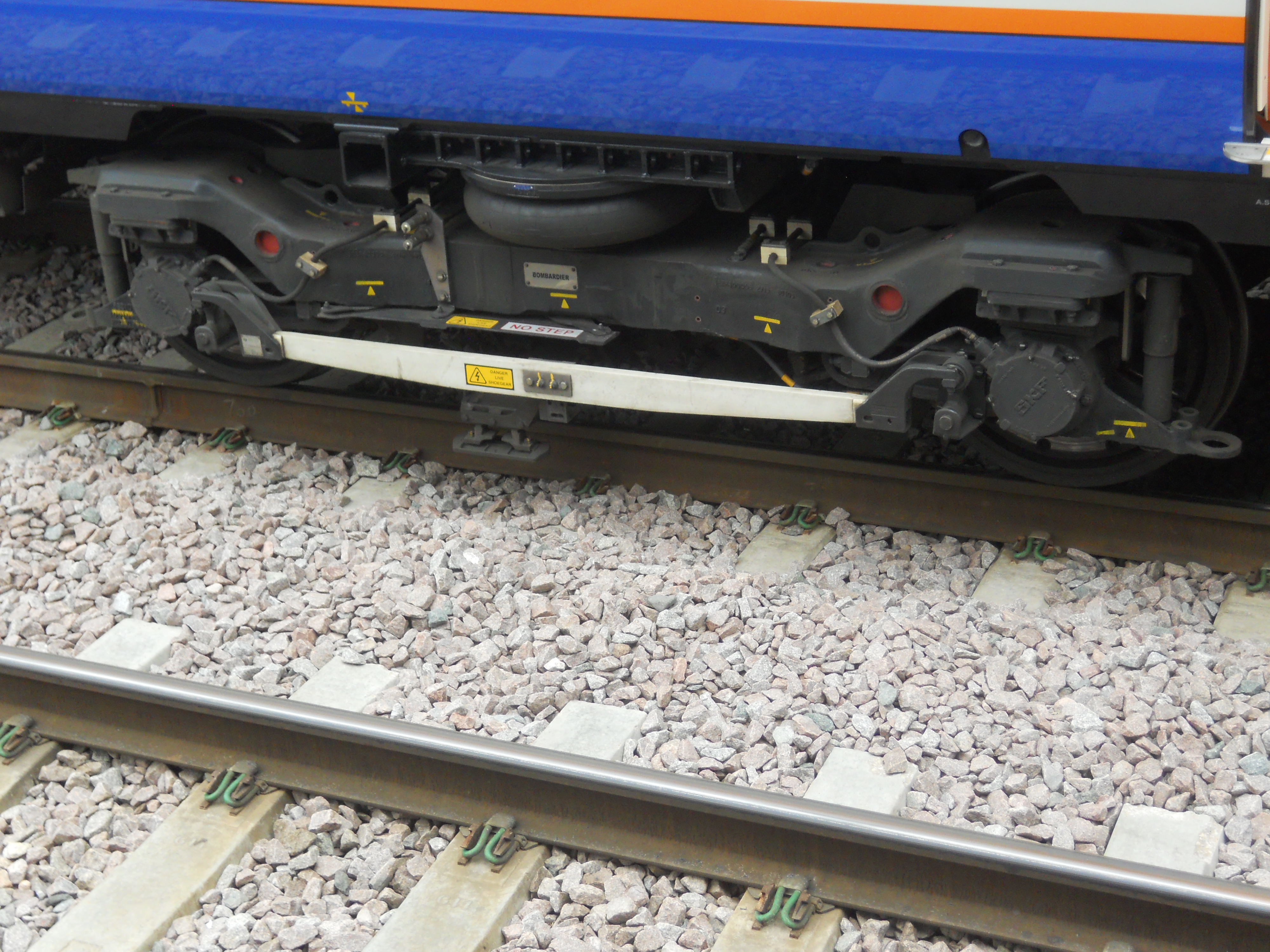
FLEXX Eco Bogie Under a Capitalstar
I use these trains a lot and can confirm that the ride quality is up with the best.
Faking It!
Jerry had a way with building; cheap and nasty.
Take this little gem of a cover over the hole where he should probably have put a bolt to secure the beam.

Another Examp;le of Jerry's Handiwork
Underneath was a hole filled with some sort of mastic. To match the nuts and bolts on the staircase, I needed to create a dome headed bolt that could be screwed or fixed into the hole.
Just as I did when I created the dome-headed bolts, I cut a small length of studding. In this case though I just cut the head off of a brass bolt.
Off With Its Head
That way, I won’t get any electrolytic effects because of dissimilar metals.
A Completed Bolt
The picture shows a completed bolt.
It was then a simple matter of gluing the bolt into the hole using No More Nails.

The Installed Bolt
I suppose I could have used just an ordinary brass bolt, but felt I needed to use the dome-headed theme of the staircase.
The 400th Anniversary of the Opening of London’s New River
You don’t get too many four hundredth anniversaries in the world, but in 2013, there will be an important one for London.
Melvin Bragg did a program on the 400th anniversary of the King James Bible this year and he has been on television talking about it. But where is the program about the New River, which brings fresh water to London? And has done since 1613!
I was brought up in Southgate and cycling around the area as a child it was something you couldn’t avoid. I now live near its southern end and every time I go to the Angel, I see the statue of Hugh Myddelton on Islington Green.
The story of this great undertaking gets a good mention in Wikipedia, but surely the 400th anniversary deserves something more.
For a start, how many schools along the river are doing projects or having parties to celebrate the anniversary?
In some ways, the history of the river has lessons for the modern world, where water is such a precious commodity.
Surely, this anniversary is something that should interest someone like Griff Rhys Jones or Adam Hart Davis.
A Plaque on a Bridge
This picture shows a plaque on the bridge that carries the Northern Outfall Sewer over the River Lee Navigation .

A Plaque on a Bridge
It is the only evidence in the area, that Joseph Bazalgette was responsible for the massive works, that still handle all of the sweage from north of the Thames.
Pinky and Perky in Front of the Olympic Stadium
I took this picture yesterday as the train slowed to pass the Olympic Stadium.
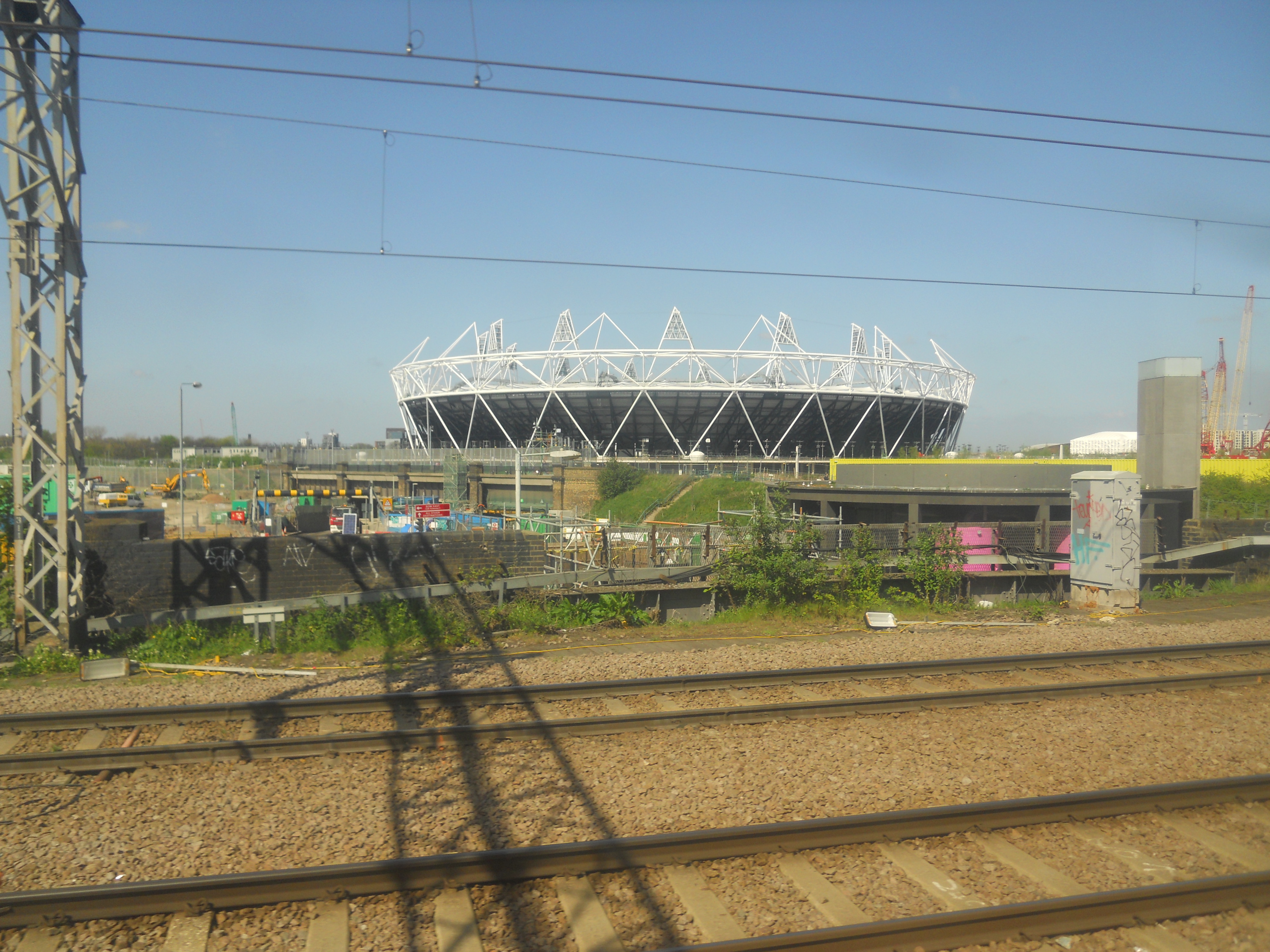
The Sewage Pumping Station at the Olympic Park
Note the two pink cylinders, nicknamed Pinky and Perky, in the pumping station, at the right of the picture. If you enlarge the picture you’ll see that the right cylinder is partly obscured by a graffiti covered signalling cable box. I hope that graffiti isn’t goig to be a problem on the Olympic site!

