The ZEROe Demonstrator Has Arrived
The title of this post, is the same as that of this press release from Airbus.
This is the introductory paragraph.
2022 marks a new and exciting phase for ZEROe – Airbus’ ambition to develop the world’s first zero-emission commercial aircraft by 2035. The multi-year demonstrator programme has officially been launched with the objective to test a variety of hydrogen technologies both on the ground and in the air.
The ZEROe demonstrator will be the first Airbus A 380 aircraft and it is shown in this Airbus visualisation.
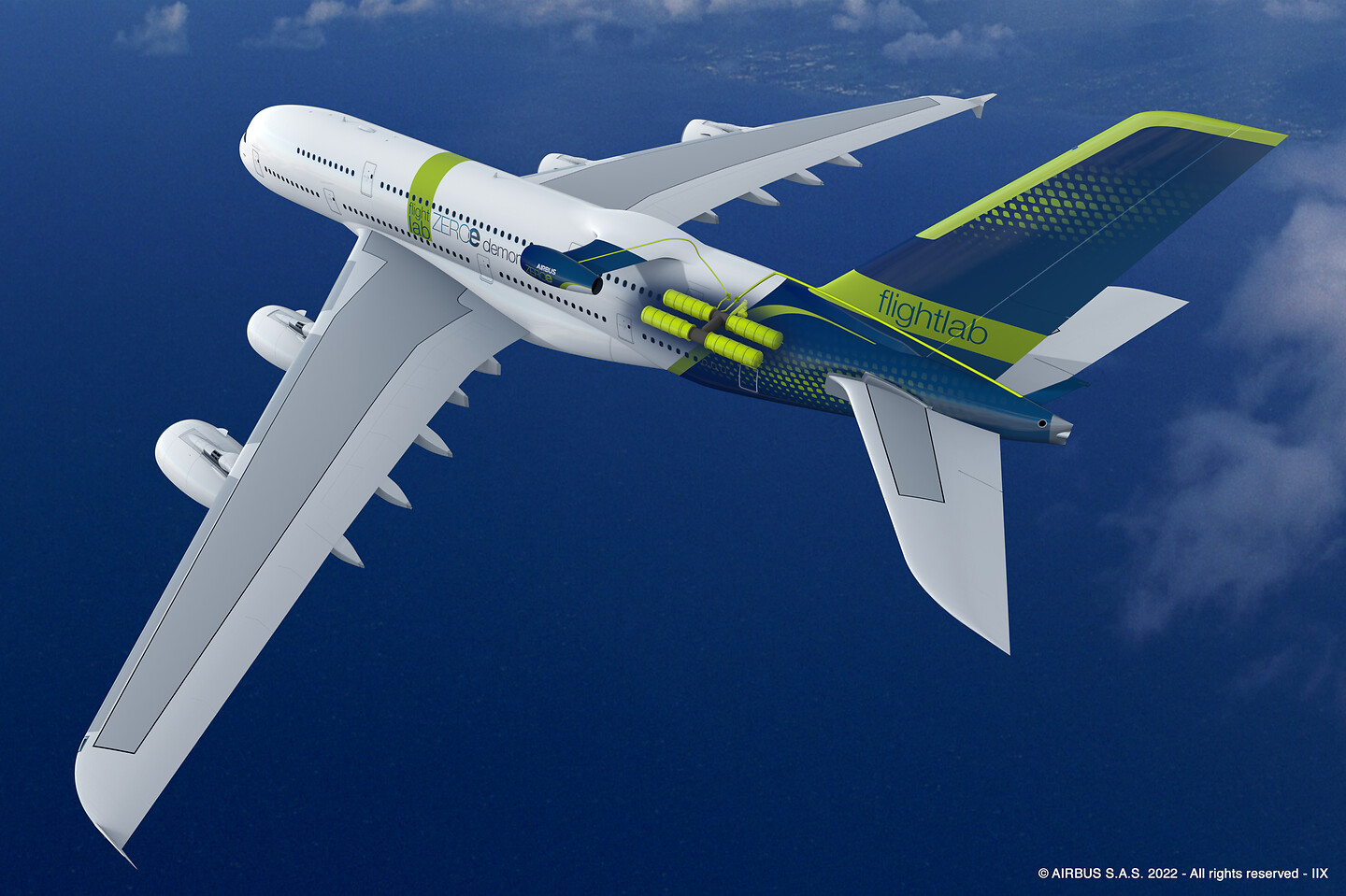
Note.
- The four hydrogen tanks in the fuselage.
- The fifth engine mounted in a pod on the fuselage.
- There’s certainly lots of space inside the fuselage for more hydrogen tanks and test and monitoring equipment.
I have a few thoughts.
This Aircraft Will Be A Superb Demonstrator
The press release says this about the use of an A 380 as a demonstrator.
The A380 is the world’s largest and most spacious passenger jet ever built – a size that makes it ideally suited to the role of test platform.
Today, the A380 MSN1 test aircraft is earmarked for a new role: to take the lead on testing the technologies that will be vital to bringing the world’s first zero-emission aircraft to market by 2035.
“The A380 MSN1 is an excellent flight laboratory platform for new hydrogen technologies,” says Mathias Andriamisaina, Airbus ZEROe Demonstrator Leader. “It’s a safe and reliable platform that is highly versatile to test a wide range of zero-emission technologies. In addition, the platform can comfortably accommodate the large flight test instrumentation that will be needed to analyse the performance of the hydrogen in the hydrogen-propulsion system.”
Initially, I suspect the aircraft will fly as a four-engined turbofan aircraft running on standard or sustainable aviation fuel.
The performance of the hydrogen engine will be tested in all phases of operation and at different altitudes.
What Size Is The Fifth Engine?
This layout is clever.
If Airbus want to test a smaller hydrogen engine for say an Airbus A 320-sized hydrogen aircraft like the ZEROe Turbofan shown in this Airbus visualisation, they fit it to the fifth pylon.
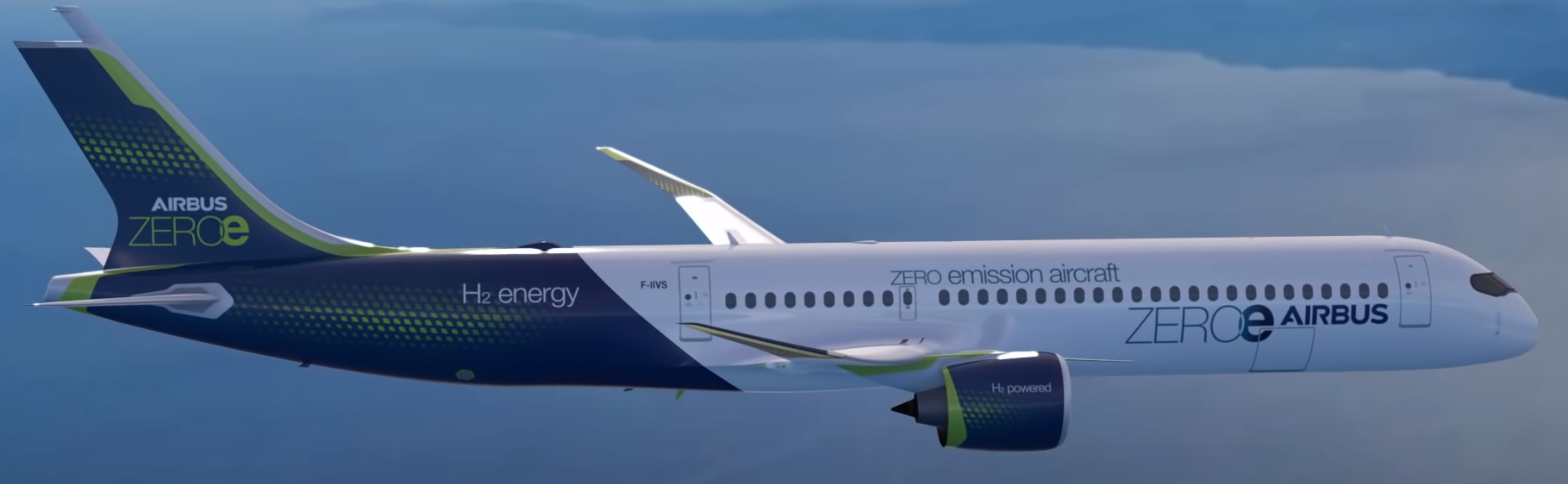
Note.
- The fifth pylon on the ZEROe Demonstrator could be the proposed pylon for the ZEROe Turbofan.
- The ZEROe Demonstrator could probably carry a lot of hydrogen to test out the hydrogen engine over a long duration.
- The hydrogen engine could be tested out over the full flight envelop of an Airbus A 380.
I would suspect that the tests on the hydrogen engine would be some of the most comprehensive ever carried out on a new engine.
If Airbus want to test a larger hydrogen engine for say an Airbus A 350-sized hydrogen aircraft, they would probably replace one of the four main engines with the hydrogen engine.
It looks like Airbus will be able to test hydrogen engines for all sizes of plane in their current range.
What Will Happen To Current A 380s?
Consider.
- The production of the A 380 has been stopped.
- There are 251 aircraft in service.
- They appear to be a reliable and safe aircraft.
- The aircraft can run on sustainable aviation fuel.
- The oldest aircraft are only thirteen years old.
- They are still reasonably modern aircraft, that if they needed to be updated to the latest standards could probably be easily done so.
- The aircraft have a lot of volume, which can hold over 500 passengers in a typical configuration.
- The flying characteristics and structure of the aircraft is well known.
I suspect there are a lot of aircraft leasing companies, who feel these aircraft are too good to scrap, just because they are not zero-carbon.
Could Hydrogen Be Stored In The Wing Of An A 380?
Hydrogen storage will get more capable in the next few years and we will see hydrogen stored in strange places in vehicles and aircraft using the gas as a fuel.
The A 380 may well have an advantage in that its wing is relatively thick compared to that of other airliners.
- The A 380 has a wing aspect ratio of 7.53.
- The Boeing 787 has a wing aspect ratio of 11.
- Gliders have wing aspect ratios as upwards of 30.
High aspect ratios are generally more economical on fuel.
But this relatively thick wing, may make it possible to store hydrogen in the wing of an A 380.
Could There Be A Hydrogen-Powered A 380?
I suspect part of the Airbus ZEROe progam will be to investigate the possibility of converting existing A 380 aircraft into a capable hydrogen-powered aircraft.
In Could An A320 neo Be Rebuilt As A ZEROe Turbofan?, I looked at the possibility of turning an existing Airbus A 320 neo into a ZEROe Turbofan running on hydrogen.
This was my conclusion.
I very much feel that there will be a route to convert some or all of the A 320 neo aircraft to hydrogen power.
So what will a ZEROe A 380 look like if it follows the same design route as an A 320 neo to a ZEROe Turbofan?
- There would be a large hydrogen tank in the rear fuselage.
- As I explained earlier, there may be a possibility for some hydrogen to be stored in the wing.
- Both passenger decks would be shortened and perhaps be able to hold the 350-410 passengers of the Airbus A350-1000.
- The cockpit, front part of the fuselage, wings, tailplane and landing gear would be unchanged.
- The aircraft would fit existing jetways at any airport, that can handle an existing A 380.
I believe that converting an existing Airbus A380 to a hydrogen-powered aircraft is possible and the conversion falls within Barnes Wallis‘s rule of problem solving.
There is no greater thrill in life, that proving something is impossible and then showing how it can be done.
The quote comes from a BBC program, where he was interviewed by Chris Brasher, who was another for whom impossible was just a minor hurdle in the way of meeting objectives.
Could There Be A Hydrogen-Powered A 380 Freighter?
Consider.
- I think it is likely, that companies like Amazon will come under pressure over their carbon footprint, as they transport increasing numbers of packages around the world.
- In DHL Express Shapes Future For Sustainable Aviation With First Order Of All-Electric Cargo Planes From Eviation, I talk about how DHL Express have ordered twelve Eviation Alice aircraft to create a zero-carbon service. DHL must feel this would be good for their image. So would they like an intercontinental zero-carbon freighter?
- Some people worry about the air-miles on their food!
There could be a worthwhile niche market for a high capacity intercontinental zero-carbon freighter.
Because it has such a large internal volume, an Airbus A 380 might make an ideal aircraft to convert.
Conclusion
Airbus will learn a lot from the ZEROe Demonstrator.
They may even learn how to develop, a long-range hydrogen-powered zero-carbon A 380 variant that could carry four hundred passengers between Europe and Australia.
Alice, The First All-Electric Passenger Airplane, Prepares To Fly
The title of this post, is the same as this article on CNN.
It looks like the first flight is just weeks away.
This paragraph describes the aircraft and compares it to a Boeing 737.
With battery technology similar to that of an electric car or a cell phone and 30 minutes of charging, the nine-passenger Alice will be able to fly for one hour, and about 440 nautical miles. The plane has a max cruise speed of 250 kts, or 287 miles per hour. For reference, a Boeing 737 has a max cruise speed of 588 miles per hour. The company, focused exclusively on electric air travel, hopes that electric planes that can fit 20 to 40 passengers will be a reality in seven to 10 years.
Fully electric flight on short routes is a lot closer than we think.
Note, that 440 nautical miles will give sufficient range from London to Amsterdam, Belfast, Cork, Frankfurt, Inverness and Paris.
CEO: Alice Electric Commuter Airplane’s First Flight Days Away
The title of this post, is the same as that of this article on Flying Magazine.
The Eviation Alice prototype has certainly been spotted taxiing on the runway and the CEO has said it won’t be long before the first flight.
I have a feeling that this aircraft is going to be a winner.
- It’s got a lightweight structure.
- The aerodynamics look to be right.
- It has received firm orders from quality companies, like Cape Air, DHL and United Airlines.
- It would be the ideal corporate aircraft for the green billionaire who wants a toy!
- It looks sexy like Concorde.
I also think that the range, performance and capacity could fit travel patterns well in the UK and Ireland.
Conclusion
I’m looking forward to my first flight.
Budget 2021: Rishi Sunak Defends Lowering Domestic Air Duty
The title of this post, is the same as that of this article on the BBC.
These are the first two paragraphs.
The chancellor has said his Budget – including tax cuts to air tax – will help the government meet its net zero carbon targets.
Rishi Sunak used his Budget to slash taxes on domestic flights, which is forecast to lead to 400,000 extra air journeys a year.
I think he could have gone further.
It is my belief that the first area of aviation to decarbonise will be the short-haul sector.
We are seeing electric aircraft being developed like the Cessna Electric Caravan, Eviation Alice and Project Fresson.
Perhaps, domestic flights in true zero-carbon aircraft like these should be free of Air Passenger Duty?
It might even speed their introduction.
Israeli All-Electric Plane Maker Readies For 1st Flight, New ‘Age Of Aviation’
The title of this post, is the same as that of this article on the Times of Israel.
It is a comprehensive progress report on the Eviation Alice.
The big news is that the first flight is expected before the end of the year.
DHL Express Shapes Future For Sustainable Aviation With First Order Of All-Electric Cargo Planes From Eviation
The title of this post, is the same as that of this press release from DHL Express.
They have ordered twelve cargo versions of the Eviation Alice.
- Planes will be flown by a single pilot.
- Each plane will be able to carry 1,200 Kg of cargo.
- Maximum range is up to 815 km.
- Each flight hour will require thirty minutes of charging.
When you consider Stansted and Charles de Gaulle Airports are 260 kilometres apart, these planes would be able to handle a lot of routes.
Eviation Alice Has Changed Shape
This article on Flying Magazine gives the latest status of the Eviation Alice.
If you look at the picture in the Flying Magazine article and an earlier one taken at the 2019 Paris Air Show in this article in The Times, you are looking at two different aircraft.
- The earlier aircraft has three engines; two in the wingtips and one in the tail, a V-tail and a taildragger undercarriage.
- The latest aircraft has two engines in pods alongside the rear fuselage, a T-tail and a tricycle undercarriage.
The latest aircraft is much more conventional. This quote from the Flying Magazine article talks about the design.
The production configuration was optimized from real-world lessons learned and customer feedback.
My feedback, as a private pilot with many hours in command of a big piston twin, would have questioned the use of a taildragger configuration with three engines and I certainly prefer the new more-conventional configuration.
Every pilot’s nightmare in a twin-engined aircraft, is an engine-failure on take-off, as it sets up forces that are difficult to control. So you make sure you can cope in that situation. With three engines, there are more difficult situations to handle.
I suspect any pilot, who did their twin training on an aircraft like a Piper Seneca, could be easily and quickly converted to the later version of the Eviation Alice. But few pilots these days learn how to fly taildraggers and this configuration with three engines in the earlier aircraft, could require a longer and more demanding conversion process.
I haven’t piloted an aircraft for twenty years, but even so, in an emergency, I would feel I could take over the current Alice, but the original configuration would have been beyond my experience.
The new more conventional configuration will probably be easier to certify.
Conclusion
I very much agree with the change of configuration.
I hope I get a chance to fly in this aircraft soon after its planned entry into service in 2024.
Alice and other similar electric aircraft will change short-haul aviation very much for the better.
Air Passengers Can Beat Queues With Uber-Style Private Jet Service
The title of this post, is the same as that of this article on The Times.
Hyer Aviation are starting a service that uses similar technology to Uber to share seats on private jets around Europe.
Their modus operandi is laid out in this press release on their web site.
This paragraph is from the press release.
The concept works like an extra-comfortable UberPool with wings. Passengers can initiate their own flight or join flights proposed by others. This allows them to fly on private aircraft for a fraction of the cost while offsetting the carbon emission of their flights. From London, routes are available to some of Britain’s favourite holiday destinations such as Ibiza, Cannes, Malaga, Amalfi Coast and Amsterdam. From Amsterdam, it is also possible to find flights proposed by other passengers to Nice and Ibiza.
think this business model could fly.
Years ago, I owned a twin piston-engined six seater aircraft and I flew it all over Europe. I don’t fly now, as my medical history would probably stop that, but the experience showed there are many quiet airports all over the UK and Europe, that could be destinations for a 6-9 seater aircraft.
To me the interesting thing about this business model, is that there are several zero-carbon 6-9 seater aircraft under development.
Two are electric developments of the widely-used Cessna Caravan and the Britten-Norman Islander and others are clean-sheet developments like the Eviation Alice or the Faradair BEHA.
ZeroAvia are also experimenting with a hydrogen-powered Piper Malibu.
An electric or zero-carbon future for aviation is closer than many think.
But it will start at the smaller end with ranges of up to 500 miles.
France’s Aura Aero Unveils 19-Seat Electric Aircraft Development Plan
The title of this post is the same as that of this article on Flight Global.
This is the introductory paragraph.
French aerospace firm Aura Aero is intending to develop a 19-seat electric-powered regional aircraft, as it looks to certify its two-seat Integral R light single.
For a better picture and more information, look at this article in The Times, which is entitled French Electric Airliner Will Take To The Skies In Five Years.
Some clues as to the specification from the article and around the web.
- Nineteen seats.
- Maiden flight by 2024 and in service entry in 2026.
- It has six electric engines.
- Three hundred mile range.
- Hybrid power will be used to extend the range to 500 miles.
- A freighter version will be available.
This paragraph is from The Times article.
This week the company began production of a new two-seater plane made of carbon-wood, a lightweight composite material. It is confident that it can meet its ambitious timetable in a race to beat rivals in Europe, the US and Israel and overcome the formidable weight and range barriers to commercial electric passenger flight.
A carbon-wood airframe hints at possibly the world’s most successful composite aircraft; the wooden De Havilland Mosquito, which was light, strong and very fast.
- In fact, it was so fast, one aircraft could bomb Germany twice in one night, with two crews and a refuelling and a rearming in between.
- It could also carry a bomb load not far short of that of a Boeing B17 Flying Fortress.
Sadly, we didn’t realise the full potential of this aircraft in World War II, but if we had, fewer aircrew and civilians on the ground would have died, as waves of Mosquitos could have knocked out important targets with precision and surprise. I wrote about one of their precision raids in The Kunstzaal Kleizkamp Raid.
Conclusion
I think the mathematics and regulations point to an aircraft with the following specification, being the right plane to develop.
- Nineteen seats
- 300 mile range
- Versatile interior
- Sustainable aviation fuel range extender
It appears that both the Aura Aero Era and the Faradair BEHA are aimed at this market, with the Cessna eCaravan and the Eviation Alice aimed at a smaller number of passengers.
Note.
- Sustainable aviation fuel doesn’t need any specialist handling and can be delivered to the aircraft in a normal bowser.
- I suspect that one electric aircraft manufacturer or electric vehicle support company will develop a charging system, for the batteries, that is based on a vehicle that just plugs into the aircraft during loading.
I think this segment of the aviation market could be a big one and I wouldn’t be surprised to see other companies bringing forward 19 seat/300 miles aircraft.
Although, the market could be a bit squashed from the top. Airbus have proposed a ZEROe Turboprop, which I wrote about in ZEROe – Towards The World’s First Zero-Emission Commercial Aircraft.
This would be capable of carrying up to a hundred passengers over a thousand nautical miles, with no emissions except water.
Rolls-Royce And Tecnam Join Forces With Widerøe To Deliver An All-Electric Passenger Aircraft Ready For Service In 2026
The title of this post, is the same as that of this press release from Rolls-Royce.
This is the first paragraph.
Rolls-Royce and airframer Tecnam are joining forces with Widerøe – the largest regional airline in Scandinavia, to deliver an all-electric passenger aircraft for the commuter market, ready for revenue service in 2026. The project expands on the successful research programme between Rolls-Royce and Widerøe on sustainable aviation and the existing partnership between Rolls-Royce and Tecnam on powering the all-electric P-Volt aircraft.
This picture from Rolls-Royce shows the proposed aircraft.

The P-Volt aircraft is based on the Tecnam P2012 Traveller.
The specification of this aircraft is as follows.
- Crew – 1 or 2
- Capacity – 9 passengers
- Powerplant – 2 x 280 jW piston engines.
- Cruise speed – 200 mph
- Range – 1090 miles
- Service ceiling – 19,500 ft.
The aim is to have an aircraft in service by 2026.
Use By Widerøe
This paragraph from the press release, outlines Widerøe‘s planned use of the aircraft.
The collaboration offers an opportunity to develop an exciting solution to the commuter aircraft market. Before the pandemic, Widerøe offered around 400 flights per day using a network of 44 airports, where 74% of the flights have distances less than 275 km. The shortest flight durations are between seven and fifteen minutes. Developing all-electric aircraft will enable people to be connected in a sustainable way and will fulfill Wideroe’s ambition to make its first all-electric flight by 2026. The all-electric P-Volt aircraft, which is based on the 11-seat Tecnam P2012 Traveller aircraft is ideal for the short take-off and landing as well as for routes in the North and the West Coast of Norway.
Conclusion
There are now five electric or low-carbon aircraft in the sub-nineteen passenger segment.
- The Cessna eCaravan, which I wrote about in Watch First Electric Caravan Fly.
- The Eviation Alice, which I wrote about in Orders For A New All-Electric Airplane Now Top 150.
- The Faradair BEHA, which I wrote about in Faradair’s BEHA Hybrid Aircraft Boosted By Partnerships.
- Project Fresson, which is an electric version of a Britten-Norman Islander.
Note.
- The Slice and the Faradair are new designs.
- The Faradair is hybrid and all the others are fully electric.
- The Faradair can carry eighteen passengers and all the others are smaller.
- I suspect there are others under development.
Conclusion
The Tecnam P-Volt must have a high chance of success.
- It’s designed for a purpose in a particular airline.
- The Widerøe model would apply to large number of small feeder and commuter airlines.
- Rolls-Royce are well-respected in aviation.
- An existing airframe is being used, which shortens certification.
- Norway is not short of a few bob.
- Cape Air have ordered 93 of the piston engined variant.
I will look forward to flying this aircraft.

