Multi-Turbine Windcatcher Secures More Funding
The title of this post, is the same as that of this article on offshoreWIND.biz.
This is the sub-heading.
Norway’s Wind Catching Systems AS, the developer of the Windcatcher floating offshore wind technology, has secured a pre-project grant of NOK 9.3 million (USD 0.9 Million) from ENOVA.
The Windcatcher certainly looks impressive on the home page of the Wind Catching Systems AS web site.
This image is of the over-station development at Moorgate station.
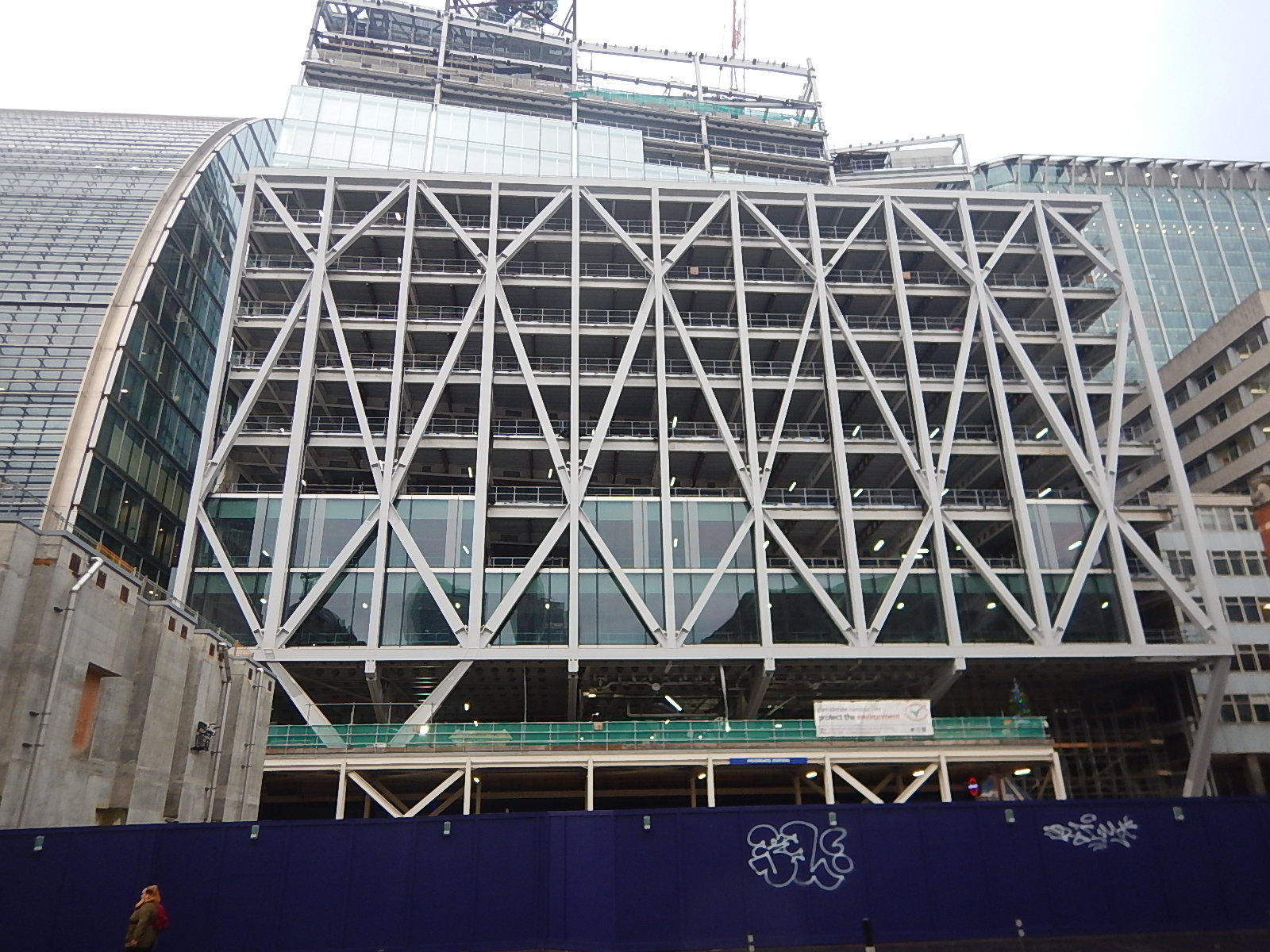
If this structure is strong enough to hold up an eight floor building, surely a system can be designed to hold up a number of small wind turbines.
But will it work well in practice or is it just something that looks good in a visualisation?
Note that aerodynamics and fluid flow are difficult subjects to model on a computer, as I say from experience of getting nowhere, when I tried to mathematically model a plastic extruder at ICI in the early 1970s.
But I did successfully invest in two guys, who went on to develop the Respimat inhaler for Boehringer Ingelheim.
So I have had mixed success in dealing with these tricky subjects.
When I look at the Windcatcher, I think there’s a fifty-percent chance, that it will be a success and a lot depends on the investors.
I do wish the company well and I feel it in my bones, that a couple of weird turbine designs will be runaway successes.
So Many Floating Wind Designs, So Few Test Sites – Norwegian METCentre Sold Out
The title of this post, is the same as that of this article on offshoreWIND.biz.
This is the sub-heading.
There are currently more than 80 floating wind technology concepts and designs worldwide, and testing even a certain number of these could prove to be an endeavour since there are not many test sites dedicated to floating wind technology in Europe.
It strikes me that we need more test centres.
As UK waters will in the next couple of decades be home to a lot more GW of wind farms, perhaps we should develop a test centre.
I wonder, if South Wales would be the place for a test centre.
- There is a lot of sea, which isn’t cluttered with oil and gas rigs, and wind farms.
- There are a lot of wind farms planned in the area.
- There are at least two good technology universities.
- There are some deep water ports.
- Electricity connections and power generation are good.
- There is good train connections to the rest of England and Wales.
- A train testing centre is being built at Nant Helen. Some tests needed to be done could be the same.
Some innovative designs for wind turbines are also being developed in South Wales.
An Elegant Solution
There’s an old English expression about couples lying in bed like spoons.
I wonder, if this analogy is used in other languages like Swedish.
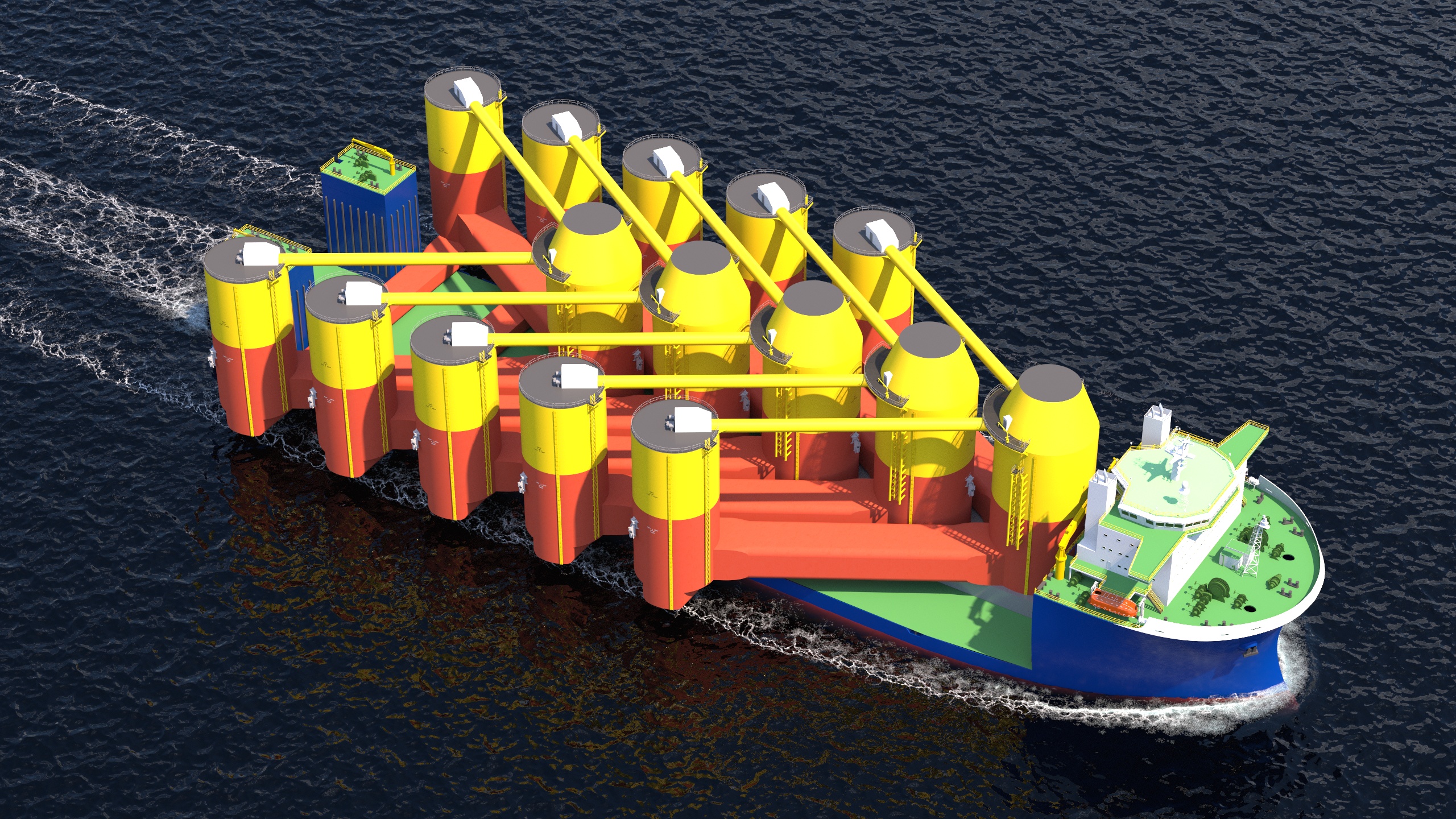
Swedish company; Bassoe Technology have certainly used the stacking technique of spoons or bodies in the design of their innovative wind-turbine floats, which they call D-Floaters.
This visualisation shows five D-floaters being transported on a ship.
Note.
- The D-Floaters do look strong and sturdy.
- There are several competing floats for wind turbines based on triangles.
- There is probably an optimal cost between transporter ships and D-Floaters.
Given that these structures may be moved thousands of miles before installation, this method of transportation must be economic.
The loaded ship does remind me of one of the bath toys my kids had in the 1970s.
MPS Floating Platform To Feature FibreMax Tendons
The title of this post, is the same as that of this article on offshoreWIND.biz.
This is the sub-heading.
Welsh company Marine Power Systems (MPS) has joined forces with FibreMax to provide integrated floating foundation and tendon solutions to the growing floating offshore wind sector.
And these three paragraphs outline the design.
The tendon solution will be used in the anchoring and moorings of MPS’ tension leg platform (TLP), called PelaFlex, to deliver the highest system stability and zero tilt, the partners said.
It will be the “world’s first” TLP with FibreMax tendons, made with Twaron fiber from Japan-headquartered Teijin.
Compared to traditional steel moorings synthetic cable offers a much better strength-to-weight ratio, longer operational life, and lower levels of maintenance, according to the partners.
Note.
- PelaFlex tension leg platforms are used in the project I wrote about in Simply Blue Group And Marine Power Systems To Pursue INTOG Innovation Project Opportunity.
- Wikipedia is a good source of information on tension leg platforms, where there is a large section on how they could be used for wind turbines.
- Twaron has an informative product page.
- There is more about PelaFlex on the PelaFlex web page including a video.
- The press release for the joint Simply Blue/MPS project talks of six turbines totalling up to 100 MW, which is probably around 17 MW per wind turbine.
It looks to me, that the PelaFlex design is getting better by the simple process of adding lightness and therefore being able to have a higher energy density in a deep area of the sea.
The amount of innovation involved probably makes PelaFlex an ideal component for the upcoming INTOG leasing round.
World’s First Semi-Submersible Floating Offshore Wind Farm Exceeds Expectations
The title of this post, is the same as that of this article on offshoreWIND.biz.
The article is based on this news item from WindFloat Atlantic, which is entitled WindFloat Atlantic Closes 2022, Reaching 78GWh.
These are the first three paragraphs of the news item.
WindFloat Atlantic, world’s first semi-submersible floating offshore wind farm, that was connected to the grid by the end of 2019 and commissioned in 2020, now finishes its full second year in operation.
After nearly 2 years and a half in fully operation, WindFloat Atlantic closes 2022 with an electricity production of 78GWh (+5% more than its first year). This production enables the supply of green energy to more than 25,000 households, as well as the avoidance of 33,000 tones of CO2.
These favourable data show Portugal’s potential on offshore wind energy, which is reflected in the annual availability of the wind farm, which was between 93-94%, as well as showing the success of WindFloat Atlantic’s innovative technology, being a benchmark within the offshore sector.
These points are from the news item.
- The wind farm is only 25 MW. So it is only a small wind farm.
- There were no lost time accidents in the last year of operation.
- It produced more electricity in 2022 than 2021.
- I have calculated the capacity factor at 36 %.
It certainly looks to be a successful application of floating wind power.
Norwegian Companies To Explore Using Aluminium In Floating Offshore Wind Turbines
This is based on this press release from World Wide Wind, which is entitled WORLD WIDE WIND AS and HYDRO ASA Signs Letter Of Intent Aiming At Using Aluminium In Offshore Floating Wind Turbines.
This is the first paragraph.
Hydro, the world leading Norwegian aluminium and energy company and World Wide Wind AS, a Norwegian company developing a floating wind turbine, have signed a Letter of Intent (LoI) to explore the use of aluminium in the renewable wind industry. The two Norwegian companies are partnering up to develop floating wind turbines with a design specifically meant for offshore conditions. The goal is to use sustainable and recyclable materials in the construction, including aluminium.
In Do All Wind Turbines Have To Be Similar?, I said this about the radically different turbines of World Wide Wind.
I’ll let the images on the World Wide Wind web site do the talking.
But who would have thought, that contrarotating wind turbines, set at an angle in the sea would work?
This is so unusual, it might just work very well.
As aluminium is lighter, it might be a factor in the success of the design.
This is the last paragraph of the press release.
World Wide Wind’s integrated floating wind turbines are scalable up to 40MW – 2,5 times current wind turbines – and will use less materials and have a smaller CO2 footprint than conventional turbines. It is World Wide Wind’s ambition that these turbines will represent future design for floating wind turbine design.
40 MW is a very large turbine. This is definitely a case of handsome is as handsome does!
World’s First Floating Offshore Wind Farm Celebrates Five Years Of Operation
The title of this post, is the same as that of this article on offshoreWIND.biz.
This is the sub-heading.
Hywind Scotland, the first floating offshore wind farm in the world, has passed five years in operation since its commissioning in 2017.
And this is the first paragraph.
According to Equinor, Hywind Scotland is the world’s best-performing offshore wind farm, achieving a capacity factor of 54 per cent over its five years of operations.
Note.
- Hywind Scotland is a 30 MW wind farm with five turbines.
- The capacity faction is much higher than a windfarm with fixed foundations.
- The water depth is between 95 and120 metres.
- The wind farm is 30 km. off Peterhead.
There is at least 15 GW of floating wind farms being planned in UK waters before 2030.
Conclusion
The wind farm has made a good start for the first floating wind farm.
ERM To Lead EIA For Salamander Floating Project Offshore Scotland
The title of this post, is the same as that of this article on offshoreWIND.biz.
This is the sub-heading.
A joint venture (JV) between Simply Blue Group, Ørsted, and Subsea7 has selected ERM Group company MarineSpace to lead the environmental impact assessment (EIA) for its Salamander floating offshore wind project in Scotland.
Note.
- The Salamander floating offshore wind farm is going to be a 100 MW wind farm 35 km. North of Peterhead.
- It is likely to be a pathfinder, in the development of new facilities to build wind farm structures and components in the North of Scotland.
- I talked about the floaters in Ocergy Floaters Selected For 100 MW Project Off Scotland.
- I suspect that it could be an INTOG project.
Salamander seems to be progressing at a decent pace.
NET9 Open Ocean Aquaculture Demonstrator Design Unveiled
The title of this post, is the same as that of this news item on the Impact9 web site.
Metocean, Wind Measurement Campaigns Starting At Two More ScotWind Sites
The title of this post, is the same as that of this article on offshoreWIND.biz.
 The Anonymous Widower