Equinor Sets Sights On Gigawatt-Scale Floating Offshore Wind Projects In Celtic Sea
The title of this post, is the same as that of this article on offshoreWIND.biz.
This is the opening paragraph of the article.
Equinor has disclosed its interest in developing gigawatt-scale floating offshore wind in the Celtic Sea, with the upcoming Celtic Sea floating wind seabed leasing round in view.
These are some other points from the article.
- The Crown Estate is planning a seabed leasing round in the Celtic Sea in 2023.
- As the developer and soon-to-be operator of two of the world’s first floating offshore wind farms, Equinor said it views new floating opportunities in the Celtic Sea with great interest.
- Project development areas are being prepared by The Crown Estate for the development of gigawatt-scale floating offshore wind projects.
Equinor could move into the Celtic Sea in a big way.
On the Projects page of the Blue Gem website, this is said about floating wind in the Celtic Sea.
Floating wind is set to become a key technology in the fight against climate change with over 80% of the worlds wind resource in water deeper than 60 metres. Independent studies have suggested there could be as much as 50GW of electricity capacity available in the Celtic Sea waters of the UK and Ireland. This renewable energy resource could play a key role in the UK meeting the 2050 Net-Zero target required to mitigate climate change. Floating wind will provide new low carbon supply chain opportunities, support coastal communities and create long-term benefits for the region.
How much of this possible 50 GW of offshore wind in the Celtic Sea will be leased by the Crown Estate in 2023?
Odfjell Oceanwind and Source Galileo Norge Forge Floating Offshore Wind Alliance
The title of this post, is the same as that of this article on offshoreWIND.biz.
The first highlighted paragraph outlines the possible deal.
Odfjell Oceanwind and renewable energy developer Source Galileo’s Norwegian branch, Source Galileo Norge, have signed a memorandum of understanding (MoU) to cooperate on developing floating offshore wind farms using Odfjell Oceanwind’s technology.
Note.
- Odfjell is a Norwegian shipping company, with this web site.
- Odfjell Oceanwind has a web site, with a mission statement of We are shaping the future of floating offshore wind power.
- Source Galileo style themselves as a Developer of Large-Scale Renewable Projects on their web site.
These three paragraph outline the cooperation’s plans.
- The cooperation will target wind farms for the electrification of oil and gas installations, the Utsira Nord seabed development, and selected floating wind parks in Europe.
- According to the partners, they also plan to apply for a seabed lease on Utsira Nord where the project, named UtsiraVIND, will use Odfjell Oceanwind’s proprietary solutions for cost-competitive, industrial production of floating offshore wind units.
- Odfjell Oceanwind is developing the Deepsea Semi floating wind foundation design which could be used in floating wind farms and for off-grid applications including temporary electrification of oil and gas installations in harsh environments.
They seem to have large ambitions, but then the money is available to fulfil the ones that work in Norway.
This Google Map shows area of Norway, that includes Utsira, Haugesund and Stavanger.
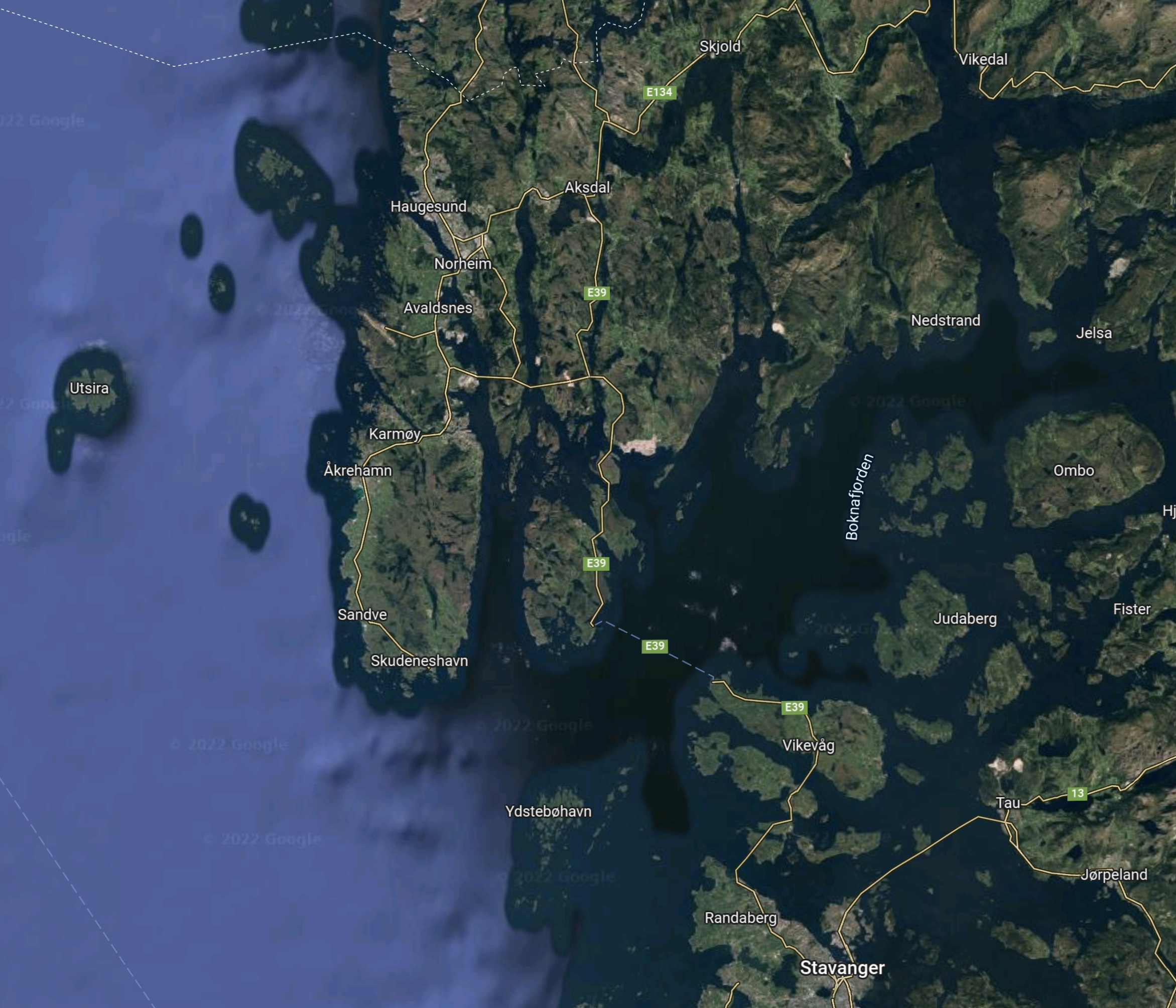
Note.
- Utsira is the largest island at the West of the map.
- Haugesund is on the coast to the North-East of Utsira.
- Stavanger is the fourth largest city in Norway and is at the bottom of the map.
There would appear to be plenty of space to place floating wind turbines between all the islands and the coast.
These are some other points from the article.
- Odfjell Oceanwind floats appear to be able to handle 15 MW turbines.
- In May, Norway initiated an investment plan to reach 30 GW of offshore capacity by 2040.
- Work has started to prepare Norway for floating offshore wind.
- Norway’s next offshore wind auction is in 2025.
Norway’s going large for wind!
Shannon Estuary Could Support Build-Out of 30 GW Of Floating Wind, House 2 GW of Electrolysis Capacity
The title of this post, is the same as that of this article from offshoreWIND.biz.
This is the opening paragraph.
The Shannon Estuary in Ireland can support the build-out of up to 1.8 GW of floating wind per year and up to 30 GW by 2050. In addition, it could accommodate a 2 GW electrolyser for hydrogen and downstream e-fuels production, according to the US-headquartered company Bechtel, which reviewed the Shannon Foynes Port Company’s Vision 2041 masterplan.
The island of Ireland will truly be going green.
The Turbine Production Figures
The headline talks about rolling out 1800 MW of floating wind turbines per year and in the body of the article it says this.
At peak, up to 120 floating turbines could be installed offshore per year.
This would imply 15 MW turbines, which is entirely feasible.
As all these figures were produced and/or fully checked by Bechtel, I would suspect that they are very sound.
So does this imply that 120 floating wind turbines is a typical production limit of this type of turbine assembled in a custom-built facility in a port?
Ossian Floating Wind Farm Could Have Capacity Of 3.6 GW
The title of this post, is the same as that of this article on offshoreWIND.biz,
This is the first paragraph.
SSE Renewables, Marubeni Corporation, and Copenhagen Infrastructure Partners (CIP) have identified an increase in the potential overall project capacity for their Ossian floating wind project in Scotland from 2.6 GW to up to 3.6 GW.
It appears that surveys have shown that the wind farm can be bigger.
About The Name Ossian
This press release from SSE is entitled New Offshore Wind Farm To Take Name From Scottish Literature.
These three paragraphs explain the name and the partners behind the project.
A new wind farm project in Scotland is to take its name from an historic series of books which depict the epic quests of a third-century Scottish leader, following his adventures across rolling seas.
Ossian (pronounced ‘os-si-un’) from The Poems of Ossian is to be the name for the proposed new offshore wind farm across 858 km2 of seabed in waters off the east coast of Scotland.
The project will be delivered by the partnership of leading Scottish renewable energy developer, SSE Renewables, Japanese conglomerate Marubeni Corporation (Marubeni) and Danish fund management company Copenhagen Infrastructure Partners (CIP).
I don’t think the three partners will have any difficulty raising the extra finance to expand the wind farm.
Where Is The Ossian Wind Farm?
This Crown Estate Scotland map shows the position of each of the Scotwind wind farms.

Note, that the numbers are Scotwind’s lease number in their documents.
The Ossian wind farm is numbered two.
At present, the South Eastern group of wind farms are as follows.
- 1 – BP – Fixed – 2.9 GW
- 2 – SSE – Floating – 2.6 GW
- 3 – Falck – Floating – 1.2 GW
- 4 – Shell – Floating – 2.0 GW
- 5 – Vattenfall – Floating – 0.8 GW
- 6 – DEME – Fixed – 1.0 GW
This totals to 10.5 GW, which would be 11.5 GW, if the capacity of Ossian is increased.
Will Ossian And Nearby Wind Farms Be Developed As A Co-Operation?
The six companies involved in this group of wind farms, are all experienced developers of wind farms or oil and gas fields.
They also come from all around the world, so I can see the best technology being employed on this group of wind farms.
Will Other Wind Farms In The Group Be Expanded?
The surveys at Ossian appear to have shown that the area is ideal for floating wind and this is enabling the expansion of the farm.
I wouldn’t be surprised to see some of the other wind farms be expanded.
I also feel that floating wind farms like Ossian, where it is likely that all the turbines on their floats are connected to a central substation, that could also be floating, may be a lot easier to expand.
Does Ossian Wind Farm Have A Web Site?
Not that Google can find, although ossianwindfarm.com appears to be under construction.
Ocergy Floaters Selected For 100 MW Project Off Scotland
The title of this post, is the same as that of this article on Splash247.com.
These two paragraphs outline Ocergy’s OCG-Wind foundation technology.
The Salamander floating offshore wind project, a joint venture between Simply Blue Group, Ørsted and Subsea 7, has awarded the pre-FEED (front-end engineering design) deal to Ocergy for its OCG-Wind foundation technology.
The US-based Ocergy has developed a novel semisub floater called OCG-Wind, to support turbines larger than 10 MW, designed for the development of large-scale wind farms. It is targeting a levelised cost of energy (LCOE) that can start to drive reductions in floating offshore wind farms to eventually be competitive with fixed offshore wind farms.
Note.
- There is a picture showing two turbines on OCG-Wind floats.
- Salamander is intended to be an INTOG project of 100 MW.
- The floaters are expected to be fabricated at Global Energy Group’s Port of Nigg.
- ERM’s Dolphyn electrolysis, desalination and hydrogen production concept is also planned for the project.
The Salamander project is certainly going for a lot of innovation.
Metocean Measurement Campaign To Start At 1 GW Scottish Floating Wind Farm Site
The title of this post, is the same as that of this article on offshoreWIND.biz.
This is the introductory paragraph.
Partrac will soon deploy a floating LiDAR Buoy at the site of the Buchan floating wind project offshore Scotland, which is being developed by Floating Energy Allyance (FEA), a consortium comprising BW Ideol, Elicio, and BayWa r.e.
It appears, that the Buchan floating wind farm is the first of the floating Scotwind Leasing round of projects to get going in a meaningful way.
The article details some of the design details of the wind farm.
- The site is located some 75 kilometres to the northeast of Fraserburgh on the Aberdeenshire coast,
- The Floating Energy Allyance consortium plans to build a floating offshore wind farm with a capacity of approximately 1 GW, whose wind turbines will be installed on BW Ideol’s Damping Pool floating foundations.
- This page on the BW Ideol web site describes their Damping Pool technology.
- The patented square barge-like floats can be used for offshore wind turbines, substations and hydrogen electrolysers.
BW Ideol appear to be a French company with projects in France, Japan, Taiwan and now Scotland.
The home page of the BW Ideol web site opens with a promotional and explanatory video of their technology.
X1 Wind – Disrupting Offshore Wind
The X1 Wind web site talks about disrupting offshore wind.
On the home page, they have this statement.
Oceans Contain The Largest Energy Resource On The Planet, Which Remains Untapped
They back it up with this reference.
We estimate the total global technical potential of offshore wind as 71 TW (World Bank, 2021), of which 70% is in deep waters, suited to floating wind.
The home page also has a continuous video of their floating wind turbine, which they call a PivotBuoy.
- The wind turbine is mounted on a triangular float.
- The turbine nacelle is supported on a tripod.
- The turbine faces downwind.
- The float is held in place by a single point mooring.
The float and the turbine automatically align with the wind.
This article on offshoreWIND.biz is entitled X1 Wind Installs Downwind Floating Prototype and gives more details of the turbine.
It’s certainly different.
Rishi Sunak To Reimpose Fracking Ban
The title of this post, is the same as that of this article on The Telegraph.
This is the first paragraph.
The new PM made the commitment during his first session of PMQs on Wednesday, reversing Liz Truss’s controversial decision to overturn it.
I think it is the right call.
Here’s why!
Cerulean Winds Massive Decarbonisation Project
Consider.
- At present ten percent of our gas is used to power the oil and gas rigs in the seas around our coasts. The gas is fed into gas-turbines to generate electricity.
- One simple way to increase gas production by this ten percent, would be to decarbonise the rigs by powering them from nearby wind farms with green electricity and green hydrogen as the Norwegians are proposing to do.
- A British company; Cerulean Winds has proposed under the Crown Estate INTOG program to decarbonise a significant part of the oil and gas rigs, by building four 1.5 GW wind farms amongst the rigs.
- The majority of the energy will be sold to the rig owners and any spare electricity and hydrogen will be brought ashore for industrial and domestic users.
- This massive project will be a privately-funded £30 billion project.
- And when the oil and gas is no longer needed, the UK will get another 6 GW of offshore wind.
We need more of this type of engineering boldness.
This page on the Cerulean Winds web site gives more details.
INTOG
This document on the Crown Estate web site outlines INTOG.
Other Projects
Decarbonisation has also attracted the attention of other developers.
I can see Rishi Sunak being offered several projects, that will increase our oil and gas security, by some of the world’s best engineers and most successful oil companies.
Rishi Sunak’s ban on fracking will only increase the rate of project development.
We live in extremely interesting times.
Floating Wind Farms At Sea To Create 29,000 Jobs – Crown Estate
The title of this post, is the same as that of this article on the BBC.
These three paragraphs introduce the article.
Plans to generate electricity through floating wind farms off the south Wales coast could create thousands of new jobs, according to the Crown Estate.
The property business owned by the monarch but run independently said the new industry could create about 29,000 jobs, including 10,000 in Wales.
It is leasing the space to generate enough power for four million homes.
Will Wales be the world’s next offshore wind powerhouse?
Wind power experts have said there is a potential for 50 GW of offshore wind power in the Celtic Sea and the BBC article talks of an investment of £43.6 billion by 2050.
The process has started, but will the engineers be able to tame the dragons?
Q&A: What does ‘Subsidy-Free’ Renewables Actually Mean?
The title of this post, is the same as that of this article on Carbon Brief.
This is the first paragraph.
Recent announcements in the UK and across the rest of Europe seem to be ushering in a new era of “subsidy-free” renewables, which can be deployed without government support.
The article gives a detailed explanation and is a must-read.
 The Anonymous Widower