First Qatar Airways Flight From Doha Lands In Cardiff
The title of this post is the same as that of this article on the BBC.
The story is also reported in the Business section of The Times under a title of Direction Of Travel Brings Qatar Airways To Cardiff Airport.
This is the first paragraph from the latter article.
Trade winds from the Middle East have brought a whiff of what a successful Brexit might look like: a 300-seat, state-of-the-art Qatar Airways jetliner carrying a full business-class cabin and several tonnes of freight that has travelled from the 35C of Persian Gulf heat to 10C of Welsh drizzle.
To some it might seem to be a surprising new route.
As a former private pilot, who knew many of the UK’s airports pretty well, Cardiff Airport has many advantages.
- It has a long runway.
- It is not very busy.
- Air traffic control and other services are top class.
- It has a terminal capable of handling a large number of planes.
- British Airways have a large maintenance centre at the Airport.
- Ground transport to Cardiff includes buses and a railway station at Rhoose Cardiff International Airport station.
It could be an airport, that just needs more airlines and passengers to take advantage of its facilities.
The two articles suggest various reasons, why Qatar are going to run a service, that will be daily by July.
- It gives Cardiff a direct link to the world’s fastest growing hub airport at Doha.
- Qatar have lots of investments all over the UK.
- Doha gives direct access flights to to Australia, China, India, Japan, Korea and New Zealand, to give six examples.
- Cardiff Airport wants to develop as a warehousing hub and Qatar Airways is big in freight.
- The export market for Welsh food and other perishables could be transformed.
- The Times reminds us there are nine million sheep in Wales.
The Times also has this memorable phrase.
Quite why the flights have been launched has as much to do with Welsh lamb as it does with not being Bristol.
But I think there are other reasons.
New Routes For Qatar Airways To North America
Look at Qatar Airways routes to North America.
- They serve mostly Eastern seaboard destinations from Doha.
- Chicago and Los Angeles are also served from Doha, but they are long flights of over sixteen hours.
- San Francisco, Seattle and Vancouver are not served.
So would Cardiff with its top-class facilities make an excellent hub for Qatar Airways?
Would a pos-Brexit UK be free to allow Qatar Airways to run services from Cardiff to selected destinations in North America?
Remember, it’s also about freight!
Improved Rail Access
This Google Map shows the Airport.
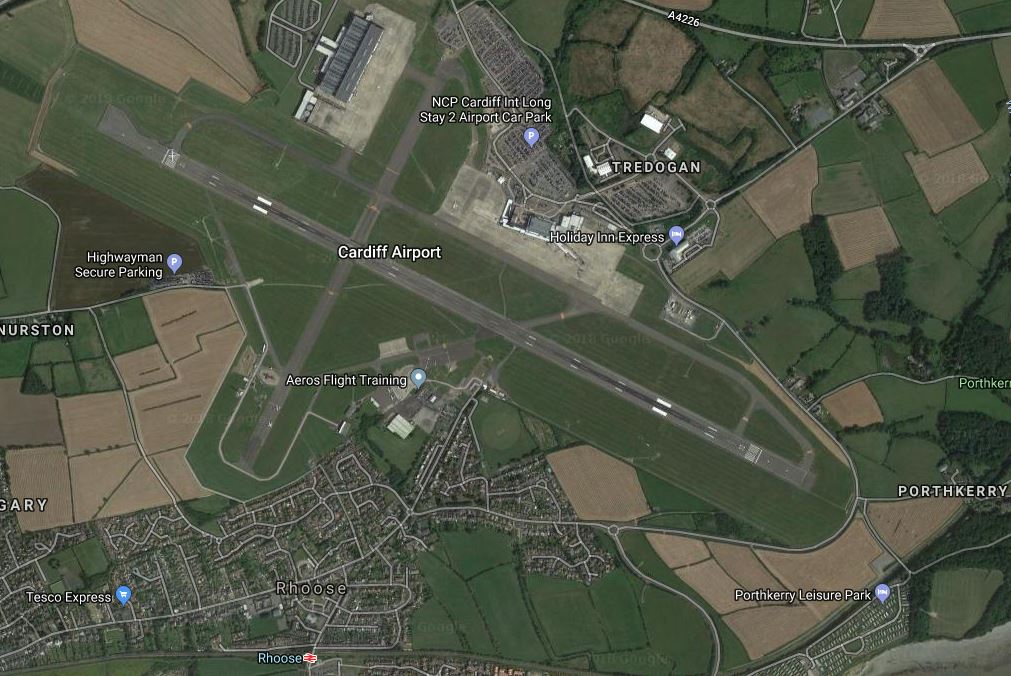
Note.
- Rhoose Cardiff International station is South of the Airport at the bottom of the map.
- The main terminal is on the North side of the Airport.
- The Vale of Glamorgan Line through the station and then skirts past the Eastern end of the runway on its way to Cardiff.
- The Vale of Glamorgan Line is double-track with sections of single-track.
- The Vale of Glamorgan Line was scheduled to be electrified.
It would appear that providing better passenger and freight access would not be the most challenging of problems, if they were to become needed in the future.
Improved Passenger Services
The current service at Rhoose Cardiff International station is as follows.
- An hourly service to Bridgend.
- An hourly service to Cardiff Central, Cardiff Queen Street and Aberdare.
- On Sundays the service is only two-hourly.
The service needs to be improved.
It would be possible to run a service from Cardiff to Swansea along the Vale of Glamorgan Line.
- The service would call at Rhoose Cardiff International station.
- The service could be run by trains designed for an airport service.
- The service would connect to all the Cardiff Valley Lines at Cardiff Central station.
- The service could be extended at the Western end to Llanelli and Fishguard.
- The service could be extended at the Eastern end to Newport, Bristol Parkway and Bristol Temple Meads.
If bi-mode or diesel trains were to be used no new infrastructure would be needed.
Two trains per hour are needed and may be possible, but it might be necessary to find a solution to the two single-trac sections of line.
Freight Services
After reading, the two articles, I’m convinced that both Cardiff Airport and Qatar Airways are backing the use of the airport as a freight hub.
But all freight would have to leave the airport by truck, as there is no rail connection.
Because of the closeness of the Vale of Glamorgan Line to the airport, it would be possible to create a high-quality cargo-handling facility, with rail access.
In The Go-Anywhere Express Parcel And Pallet Carrier (HSPT), I proposed using four-car Class 321 trains as parcel and pallet carriers.
- These could serve anywhere in the UK from Cardiff Airport.
- If from the Airport to Cardiff were to be electrified, electric freight could go fast to London and the South East.
- Cardiff could be used as an alternative freight hub,, for an over-crowded Heathrow.
I shall be interested to see how Cardiff Airport develops a cargo terminal..
Conclusion
Qatar Airways may have more money than Croesus, but they seem to be spending it wisely, in developing a route to Cardiff.
Government Must Commit To Investment In Rail Freight Connections To Ports
The title of this post, as the same as that, of this article in Rail Technology Magazine.
This is the first two paragraphs.
etter connections between English ports could boost the nation’s economy, a new study has shown.
The study of England’s port connectivity found that improved rail links could provide more effective freight journeys between key economic areas and ports, which would in turn boost productivity, provide lower costs and give access to international markets.
The study, as might be expected is comprehensive, and is this document on the Government web site.
If you need to know more about road and rail projects to the ports of England, it is a good place to start.
Charting An Electric Freight Future
The title of this post, is the same as the title of an informative article in the April 2018 Edition of Modern Railways, which was written by Julian Worth, who has many years experience of the rail freight industry.
This is a very comprehensive article looking at the future of motive power for freight trains.
These are points from the article, with some added comments of my own.
2040 And A Diesel-Free Rail System
Government ministers have said that by 2040, the UK will have a diesel-free railway, which will reduce emissions and especially particulates.
This page on the Government web site is entitled Let’s Raise Our Ambitions For A Cleaner, Greener Railway, which gives the text of a speech by the Rail Minister; Jo Johnson.
This is part of what he said.
And that’s why I am today announcing a new ambition.
I would like to see us take all diesel-only trains off the track by 2040.
If that seems like an ambitious goal – it should be and I make no apology for that.
After all, we’re committed to ending sales of petrol and diesel cars by 2040.
If we can achieve that, then why can’t the railway aspire to a similar objective?
Rail may be less carbon intensive than road transport.
That’s why modal shift’s so important.
As an engineer. I feel it is a challenge that is acceptable.
The Diesel Locomotives Are Getting Old!
The ubiquitous Class 66 locomotives, don’t meet the latest emission standards, but in addition, by the late 2020s, they will be getting to thirty years old.
Other locomotives like Class 59 locomotives will be even older.
Replacement locomotives will be needed, as maintenance costs will be getting too high.
The Last-Mile Electric Locomotive
Electric locomotives with a last-mile capability away from electrification like the Class 88 locomotive could be favoured.
- They could be used for terminal work and short-distance movements.
- They would have a 25 KVAC capability.
- They could possibly have a 750 VDC capability, to work on the third-rail network.
- They would meet all the emission standards, when running on diesel.
Julian Worth suggests that the last-mile capability could be provided by a battery.
Although, this would be environmentally-friendly and better in urban areas, I think that any onboard power, should be able to take a train into and out of the Port of Felixstowe, London Gateway and the other major ports.
I met a manager of the Port of Felixstowe a few years ago and they don’t like 25 KVAC wires in a dock, as containers do occasionally get dropped.
Most lines into ports and inland terminals, don’t appear to be too challenging and I’m sure that an uprated Class 88 locomotive could be built, that would handle entry and exit to all the ports and terminals in the UK.
Do We Need A Freight Electrification Strategy?
Julian Worth suggests we need one for the next couple of decades.
He makes some good points.
- Electric traction current is cheaper than diesel fuel.
- Availability of modern electric locomotives should be better than a diesel.
- Diesels may be restricted in urban areas. It could be a vote winner in Mayoral elections in the large Metropolitan areas.
He finishes this with this statement.
Crucially, switching to electric locos from around 2030 would not entail premature replacement of the current fleet and would represent necessary asset renewal in modern equivalent form.
Just imagine the outcry from the Green Movement, if these ageing diesels were to be replaced with modern diesel locomotives..
Undoubtedly, we need a well-thought out freight strategy.
GB Railfreight
This article in Rail Magazine is entitled GB Railfreight In ‘Locomotive Acquisition’ Talks.
So at least one freight company is looking for new motive power. GB Railfreight has a fleet of seventy-eight Class 66 locomotives with other locomotives in the ageing category. Some of their work like hauling the Caledonian Sleeper needs well-presented reliable locomotives, so perhaps they need to update their image.
It will be interesting to see what type and class of locomotive they buy.
Rail Freight Has Changed
Coal to power stations used to be the dominant freight on UK railways.
But n0t any more! Thank goodness!
The major freight on UK railways is intermodal or trains of containers from port to inland terminal and vice versa.
There is also a large growth in construction materials, miuch of it going from quarries in the West Country and the Peak District to the South East of England. To send this any other way than by train, would surely be madness.
There also seems to be an increasing number of trains carrying new vehicles to and from the Continent. More will surely start to use the Channel Tunnel.
Julian Worth says this, after summarising the freight flows.
This suggests modest extensions of electrification might permit much of the construction and intermodal businesses, together with most automotive traffic, to be electrically hauled throughout.
He then goes on to say that the big gap is Felixstowe to Peterborough, Nuneaton and Birmingham.
The Port of Felixstowe
I partly grew up in the town and never thought the port would grow to the size, it is today.
I also remember in the 1980s, when only the odd intermodal train was to be seen on the Felixstowe Branch Line.
- Now, a dozen trains in each direction on every day take the route between Felixstowe and the Midlands.
- The Felixstowe Branch Line is being upgraded to raise the number of trains from the port from 33 to 48.
- The Great Eastern Main Line and the routes through North London are close to capacity.
- The direct route via Peterborough is a lot shorter than the London route.
Julian Worth states, that the number of trains between Felixstowe and the Midlands could rise to as high as fifty every day.
Routes That Should Be Electrified For Freight
Julian Worth suggests that the following routes should be electrified.
Route 1 – London Gateway to Thames Haven Junction
If you electrify Felixstowe to the Midlands, this will remove some diesel freight trains from London.
It would be stupid to replace them with diesel freight trains from London Gateway. So it would be fairly logical to electrify the connecting route to London Gateway.
This Google Map shows London Gateway and the rail connection to the electrified London, Tilbury and Southend Railway.
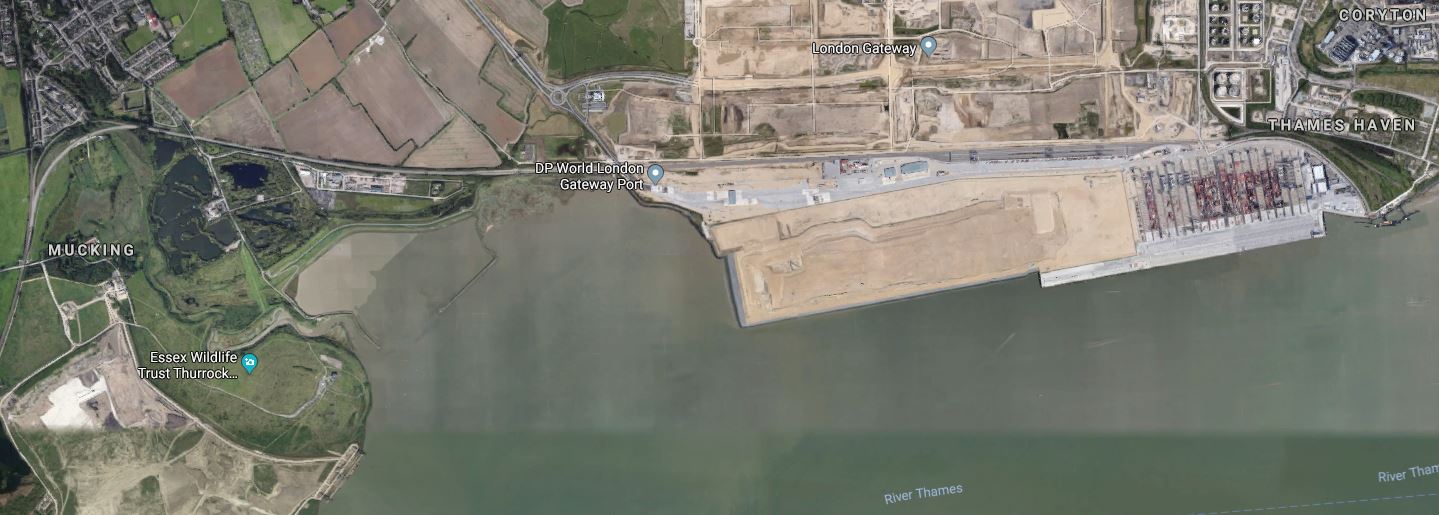
Note.
- The electrified London, Tilbury and Southend Railway, runs North-South at the extreme left of the map.
- The connecting spur curves East on what appears to be a new chord before accessing sidings on the North side of London Gateway.
- There would appear to be a lot of space to expand the port.
- The rail spur to the port is double track.
- It looks like their are sat least five sidings for handling freight trains.
- The sidings are double-ended, so last-mile capable electric locomotives could run round trains, without the need for electrification.
It would have appeared to have been designed for electrification.
Full details on London Gateway’s plans for rail access are given here in the Wikipedia entry for London Gateway, under Rail Terminal.
This is a quick summary.
- Freight trains will use the newly-electrified Gospel Oak to Barking Line to access the West Coast Main Line.
- Freight trains have a route to the Channel Tunnel.
- London Gateway has planning permission for a second rail terminal.
In other places Wikipedia says the port is highly-automated.
I am led to the conclusion, that the Gospel Oak to Barking Line will see a high number of electric freight trains in the future.
I’m not surprised that Julian Worth says the spur currently handles sixteen trains per day and is set to grow significantly.
I certainly wouldn’t buy a house on the Gospel Oak to Barking Line.
Route 2 – Nuneaton To Birmingham Lawley Street
If Felixstowe to Nuneaton is electrified, then this extends the electrification to the massive Lawley Street Freightliner Terminal, which is in central Birmingham.
This diagram from Wikipedia shows the route.
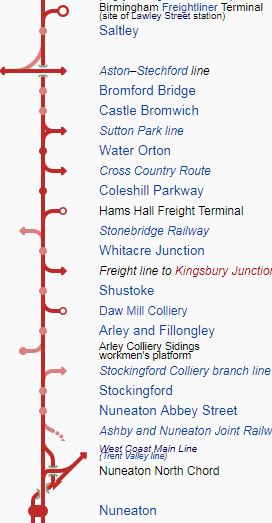
Note.
- Lawley Street Freightliner Terminal, is on the short spur at the top of the diagram.
- iThis electrification would also complete a fully-electrified route between Birmingham New Street station and Sansted Airport, so CrossCountry could use electric trains on that route, instead of the current Class 170 train, which is often overcrowded.
- Would the electrification open up opportunities for more electrified local services in Birmingham?
Julian Worth says that this twenty miles carries thirty-two trains per day.
Would electrifying this route also have environmental benefits in terms of pollution?
Route 3 – Basingstoke To Southcote Junction and Oxford to Denbigh Hall Junction
This route, which connects the Port of Southampton with the West Coast Main Line, would require forty-two miles of electrification.
Consider.
- It would create a fully-electrified route from Southampton to the West Coast Main Line.
- Julian Worth says it carries forty-eight trains per day.
- I also think, he is assuming that the Great Western Electrification extends to Oxford, which surely it will do in the next few years.
- Dual voltage locomotives would be needed.
- It would require electrification of part of the East West Railway.
The East West Railway is to be built as a privatised railway and I’m sure if the sums were right, they would electrify the route from Oxford to Denbigh Hall Junction.
If the Western end of the East West Railway were to be electrified, this must increase the options and operating speed for passenger trains on the route.
Route 4 – Merehead/Whatley to Newbury
Consider.
- Merehead and Whatley are both Quarries of the Mendip Hills.
- The line is double-track and seventy-two miles long.
- Julian Worth says that this route carries twenty-eight stone trains per day.
- Many trains are double-size.
- In a four hour period, using Real Time Trains I found,three stone trains that weighed 4,800 tonnes and had a maximum speed of 45 mph and four stone trains that weighed 2,000 tonnes and had a maximum speed of 60 mph, using the route from the Mendips to London.
With all that heavy traffic, it strikes me that their are only two ways to power these trains on the route.
- Very powerful diesel locomotives, possibly working in pairs.
- Very powerful 25 KVAC electric locomotives, which would need electrification, able to supply lots of amps.
Mendip Rail currently run these services using Class 59 locomotives, which have the following characteristics.
- Built in North America between 1985 and 1995.
- They were the first privately-owned locomotives on the UK main line.
- They have the ability to creep to shift heavy loads on gradients.
- They have a maximim speed of 60-75 mph.
- They are towered by a 2.5 MW diesel engine.
This extract from Wikipedia illustrates their power.
On 26 May 1991 Kenneth J Painter (59005) (with assistance from Yeoman Endeavour) set the European haulage record, with a stone train weighing 11,982 tonnes and 5,415 feet (1,650 m) long. However the so-called ‘mega train’ experiment was not very successful, as a coupling in the centre of the train broke.
It would appear, there was nothing wrong with the locomotives.
By the late 2020s, these locomotives will be over forty years old and although they could probably soldier on for another ten or even twenty years, the cost of maintenance will increase and reliability could decrease. You don’t want a 4,800 tonne stone train blocking the Reading to Taumton Line.
I suspect too, that it is unlikely that this important stone traffic will decrease. This is said in the Wikipedia entry for Mendip Rail.
Mendip Rail’s class 59s work services between various destinations which have changed over time according to demand and specific contracts. They have worked regularly over southern railway tracks, for example to the former Foster Yeoman terminals at Eastleigh and Botley, as well as delivery aggregates for construction work on the Thames Barrier, Second Severn Crossing, Channel Tunnel and most recently Heathrow Terminal 5, which required 3 million tonnes of stone.
Mendip Rail hauls about 4.5 million tonnes of stone from Torr Works each year, and about 2.5 million tonnes from Whatley Quarry.
I suspect that these stone flows will continue and there will come a time in the not-to-distant future, where new locomotives will be required.
- The Class 59 locomotives were built for these stone trains and have a maximum tractive effort of 507 kN at just 7 mph.
- A large electric Class 92 locomotive has a maximum tractive effort of only 400 kN.
But I suspect that engineers can design an electric locomotive, that can handle these trains either by themselves or working in a pair.
So there will be a choice between a very powerful diesel locomotive or a very powerful electric one.
- Will those that live by the railway and environmentalists accept new diesel locomotives?
- Electric locomotives would require the line to be electrified.
- Electrification would allow Great Western Railway to run their Class 800 trains more efficiently using the wires.
- Would those who live by the railway, accept the electrification of the line?
It’s a difficult choice.
Route 5 – Felixstowe to Ipswich. Haughley Junction to Peterborough and Helpston to Nuneaton
Consider
- This would be a big project, as it would require 146 miles of new electrification.
- But the return could be worthwhile, as currently the route handles twenty trains per day and once the Felixstowe Branch Line has more double track, this figure could rise to fifty-six trains per day.
- At Ipswich, Peterborough and Nuneaton, the route connects to fully-electrified lines.
My project management knowledge tends to electrifying this line from East to West as almost three separate projects.
- Felixstowe to Ipswich
- Haughley Junction to Peterborough
- Helpston to Nuneaton
It could even be five, if Helpston to Nuneaton was split into two at either Leicester or the Midland Main Line.
I have three general questions.
- When the gauge clearance was undertaken a few years ago, were bridges raised to accommodate wires as well?
- Will the natives object to fifty trains per day?
- Will the line be resignalled to handle the greater number of trains?
Once the full route is electrified, the number of trains to and from Felixstowe , that used the Great Eastern Main Line and the routes through London would drop. Obviously, some trains like those between Felixstowe and Wales and the West Country would still need to use the London routes.
But overall, this would allow a mixture of the following.
- Higher passenger train frequencies on the North London Line
- Higher passenger train frequencies on the Gospel Oak To Barking Line
- More freight trains to and from London Gateway could use the cross-London routes.
The last point would mean, that electric locomotives would need to have access to London Gateway.
I will detail my thoughts on Felixstowe to the Midlands electrification in the next three sub-sections.
Route 5A – Felixstowe to Ipswich
Electrifying between Felixstowe and Ipswich shouldn’t be the most challenging of projects.
- The route is fairly flat.
- The route is double track, except for part of the Felixstowe Branch Line.
- The line was cleared for the largest containers a few years ago.
- Doubling of the Felixstowe Branch Line around Trimley and the removal of some level crossings should start this year.
- There should be an adequate 25 KVAC power supply at Ipswich.
I have two extra questions.
- Will the partial doubling of the Felixstowe Branch, prepare the line for electrification?
- Has a scheme been designed to take electrification to the port?
But there will be benefits.
- Some freight trains that use the Great Eastern Main Line and the electrified routes through London, could be hauled all the way. by electric locomotives.
- If Felixstowe station was to be electrified, Greater Anglia could run five-car Class 720 electric trains instead of Class 755 bi-mode trains on the branch, if required.
- Class 755 bi-mode trains on the Ipswich to Lowestoft service, would be able to use the electrification between Westerfield and Ipswich stations.
- Noise and vibration could be reduced.
It is just over a dozen miles of elwctrification, so isn’t the largest of projects.
Route 5B – Haughley Junction to Peterborough
Like the first section between Felixstowe and Ipswich, this section is also not very challenging.
- The route is fairly flat.
- The route is double track.
- The line was cleared for the largest containers a few years ago.
- Ely is being remodelled to remove a bottleneck.
- Ely to Soham improvements seem to have been dropped, but will surely happen.
- Haughley Junction needs to be remodelled.
- Network Rail are already removing level crossings.
- There should be an adequate 25 KVAC power supply at Haughley and Peterborough.
I have an extra question.
- Will the route between Cambridge and Chippenham Junction be electrified?
But there will be benefits.
- Electric freight between Felixstowe And The East Coast Main Line as far as Scotland.
- Greater Anglia could run their service between Colchester and Peterborough with a Class 720 electric train.
- Greater Anglia’s service between Ipswich and Cambridge would do more running under wires.
The electrification might even enable some useful electrified diversion routes.
Route 5C -Helpston to Nuneaton
I don’t know this section of the route, as well as I know the two other sections.
- The route is double track.
- There is a busy level crossing in the middle of Oakham.
- There should be an adequate 25 KVAC power supply at both ends of the route.
It would appear that the route goes through Leicester station on the Midland Main Line.
As the electrification of the Midland Main Line has been postponed, how will this section of the route be handled?
But there will be benefits.
- Electric freight between Felixstowe And The Midlands
- Fewer freight trains would need to go via London
- Some passenger services, like Birmingham-Stansted Airport, could be run using electric trains.
Completing all three sections will open up new possibilities for both freight and passenger services.
Route 6 – Hare Park Junction to Leeds Stourton
This is a freight route , which can be followed this way.
- It leaves the electrified Wakefield Line at Hare Park Junction, which is South of Sandal and Agbrigg station.
- It passes Wakefield Kirkgate and Normanton stations and there appears to be a connection to Wakefield Europort.
- It then joins the Hallam Line and goes to the Stourton Freightliner Terminal.
Electrification of this eighteen mile route, would allow freight trains with electric traction to reach the Stourton terminal.
The electrification could also be extended to Leeds station, so that passenger services on the Hallam Line, run by bi-mode trains would have an electrified route into Leeds.
Route 7 – Mountsorrel to Syston Junction and Manton Junction to Corby
Mountsorrel Quarry is one of the biggest granite quarries in Europe. It is not on the railway anymore, but is connected to the Midland Main Line at
Barton upon Soar, by a mineral conveyor.
These two short lengths of electrification connect Mountsorrel to the electrified portion of the Midland Main Line to London and by using the Felixstowe to Nuneaton route, there is access to the East and West Coast Main Lines.
Julian Worth says that thirty trains per day use the route.
Looking on Real Time Trains, they are not the mega-trains of the Mendips, but they seem to go all over England.
Route 8 – Whitacre Junction to Birch Coppice
Birch Coppice is a freight terminal and it is connected to the Birmingham Lawley Street to Nuneaton Line at Whitacre Junction, by a six mile rail link.
As in Julian Worth’s plan, the Birmingham Lawley Street to Nuneaton Line will have been electrified, it will be an logical section of wires to install.
Summarising The Routes
Summarising the routes, you get the following, once all the proposals are added to the UK’s electrified network.
- There is a major East-West route from Felixstowe to Birmingham, that connects to the two major North-South routes; East and West Coast Main Lines and East Anglia’s Great Eastern Main Line.
- The Reading to Taunton Line now provides an route to the South-West for electric trains.
- The massive quarries in the Mendips and at Mountsorrel are connected to the main electrified network.
- The ports of Felixstowe, London Gateway and Southampton are connected to the main electrified network.
- The inland depots of Birch Coppice, Birmingham Lawley Street and Leeds Stourton are connected to the main electrified network.
Others may well be added.
For instance, an electrified connection to Liverpool2 along the Canada Dock Branch, which runs in places through densely-packing housing and has been looked at for a passenger service by Merseyrail.
Installing The Electrification
Traditionally, electrification schemes have been done using money directly from the Treasury.
To say, performance in recent years has been mixed would be an understatement!
With my experience of project management, I have my theories about the poor performance, but as I have no serious data to back them up, I will not put most of them in this post.
I will say however, that my observations of the electrification of the Gospel Oak to Barking Line have led me to the conclusion, that there are not enough competent engineers, surveyors and technicians to install the current low-level of new electrification.
However, recent statements and documents from Chris Grayling about how the Southern rail access to Heathrow is to be financed, might suggest a model for electrification.
This Press Release on the Department of Transport web site, starts with these two paragraphs.
Private companies have been asked to come forward with ideas to deliver a new southern rail link to Heathrow Airport.
The link will be one of the first projects under government plans to invite third parties – such as local authorities and private sector companies – to invest in the rail network, over and above the £47 billion the government is already planning for the next 5 years.
The idea is that a private consortium would do the following.
- Design, build and finance a new line, station or other piece of railway infrastructure.
- Maintain it for a number of years.
- Charge train operators a charge for using the infrastructure, in much the same way as Network Rail charge every train for track access.
If the sums add up, I suspect it is model that will work for electrification.
I will take the Felixstowe Branch Line, that I know well as an example.
The benefits of electrification on this line could be as follows.
- Freight trains from the Port of Felixstowe using electrified lines from Ipswich, could be able to use electric haulage, which might be more affordable.
- Greater Anglia could run Ipswich to Felixstowe services using trains running solely on electricity.
- There would be less pollution and possibly less noise and vibration.
- Electrification might allow faster operating speeds on the branch, which in turn would allow more freight and passenger trains.
- The hourly passenger service between Ipswich and Felixstowe might be able to be doubled in frequency.
Currently, after the dualling at Trimley has been finished, the branch is planned to handle an hourly passenger train and around fifty freight trains per day.
It strikes me that if the contracts and charges have the right balance, that a deal could be struck with a competent consortium.
It would have the following parts.
- The consortium would design, finance and install the electrification.
- Installing the electrification would be done, without disturbing the passenger and freight traffic.
- The consortium would maintain the electrification for an agreed number of years.
- Electrification access charges would be modelled on track access charges and agreed with a regulator, such as the Office of Road and Rail.
- Failure to provide a working electrified railway, would incur penalty charges to operators.
I feel the model could work.
- The consortium would use best practice from around the world.
- The consortium might encourage innovative design and working.
- The consortium would make sure it had the best engineers, technicians and equipment to keep the electrification in tip-top condition, as that is the best way to maximise return on capital, against a fixed income.
- The Office of Road and Rail would ensure safety, quality and reliability.
I also feel, that one of the ways to get the electrification installed in a professional manner and then operational at an agreed date, is to get the project management right.
Too much of what I’ve seen on electrification in the UK, reminds me of the phrase – It’ll be alright on the night!
A consortium, which has to raise and justify the money it needs, can’t rely on this mantra and must be sure that if a scheme is going to cost £100 million, then.
- The initial budget must be correct.
- The electrification can be installed for that sum.
- Sufficient contingency is included.
Get the first project, seriously wrong and they won’t get another of the many electrification projects in the pipeline.
Will Heathrow Southern Railway Make Heathrow’s Cargo More Efficient?
This page on the Heathrow web site talks about the future for cargo at the Airport.
It starts with this paragraph.
Heathrow is the largest UK port by value and our ambition is to become one of Europe’s best airports for cargo. We have listened to our customers and developed a cargo strategy that will take us there.
The airport sums up its plan for cargo with these bullet points.
- Halve current throughput times to be more efficient
- Make cargo throughput times predictable to reduce costs
- Grow cargo capacity at the airport to generate additional cargo volumes for our airline partners
- Work with the cargo community, including through engagement and discussion
- Be 100% e-freight compliant to reduce waste, costs and delays
- Be a great airport of choice for cargo
- Provide a safe working environment.
Nothing is said about being more energy efficient and emitting less carbon dioxide.
This document on Heathrow’s web site is entitled Heathrow’s Blueprint For Reducing Emissions.
They list ten things they are doing.
- Bring in the newest and cleanest aircraft.
- Continue to drive down emissions from aircraft at the gate.
- Improve taxying efficiency.
- Charge forward with electric cars and buses.
- Heathrow cycles.
- Drive sustainable freight operations.
- Plug in more electric airside vehicles.
- Provide a pool of low emission vehicles.
- Efficient driver training and education.
- Host an air quality conference.
This list was from a couple of years ago and there is a certain amount of PR, but there is some thinking in the right way.
To return to cargo, which is on Heathrow’s list of ten things they are improving, the following can be said.
- Heathrow handles a lot of cargo by value.
- Most air cargo from Heathrow goes in the holds of passenger aircraft.
- Very little if any comes into the airport by rail.
This Google Map shows the central part of Heathrow Airport.
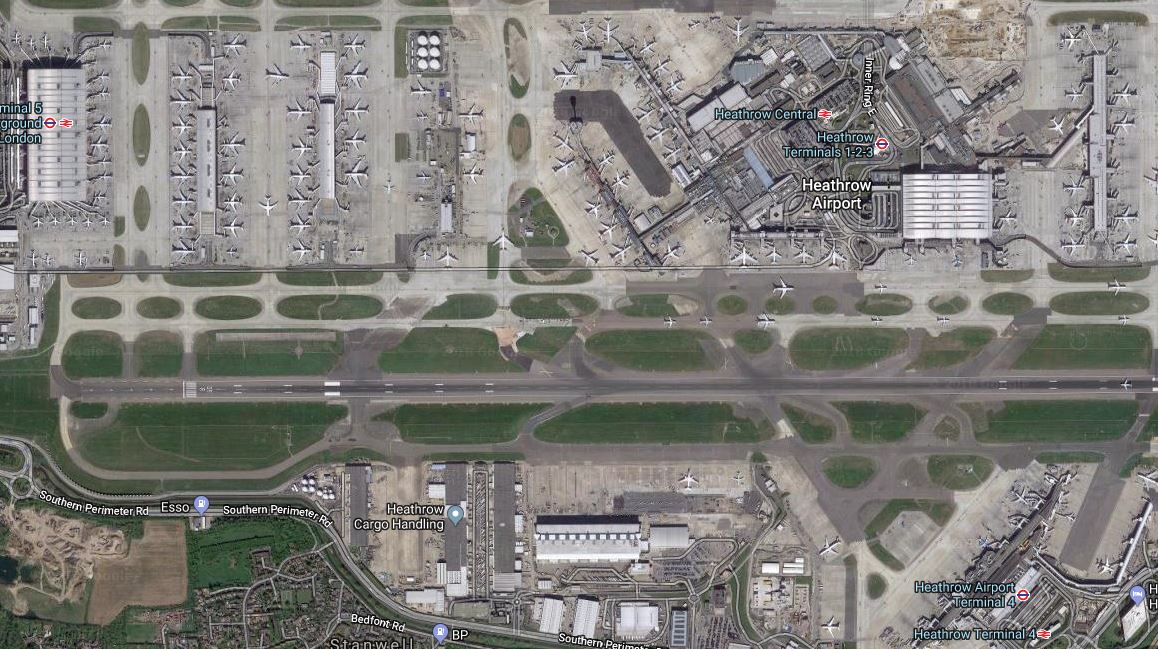
Note Heathrow Cargo Handling towards the South West corner of the Airport.
This map from carto.metro.free.fr shows the rail lines under Heathrow.
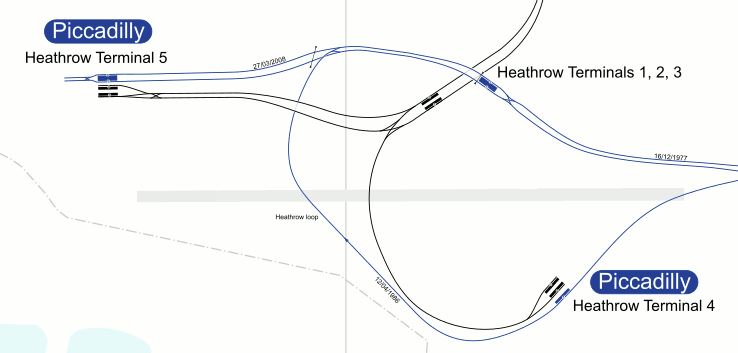
Consider.
- I actually think, that some lines go under the cargo area.
- There must be scope for consolidating cargo outside the airport and bringing in the containers in special trains.
- There would be plenty of capacity on the link into Terminal 5 station.
- Replacing trucks with electric trains would reduce the airport’s carbon footprint.
I am led to the conclusion, that there may be possibilities to bring cargo into and out of Heathrow Airport by train, using the link created by the Heathrow Southern Railway.
Thoughts On The Camden High Line
Last night, I was made aware of the Camden High Line proposal.
On their web site, they say this is their mission.
Our mission is to transform the disused railway into a sustainable green space and transport link that is open for and used by everyone.
Here are my thoughts.
The Railway Line In Question
This map from carto.metro.free.fr shows the disused railway tracks.
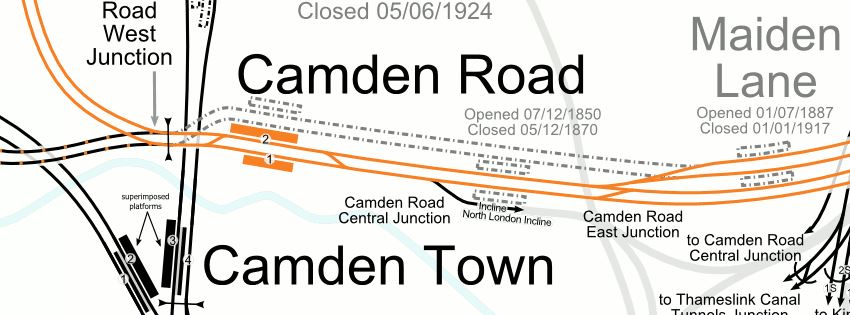
Note.
- The line shown in orange is the North London Line of the London Overground.
- Camden Road is a two-platform station, with full step-free access.
- Maiden Lane is a disused station, that closed a hundred years ago.
I would assume that the two dotted lines between the two stations, will be converted into the Camden High Line.
This Google Map shows the North London Line between Camden Road and Maiden Lane stations.
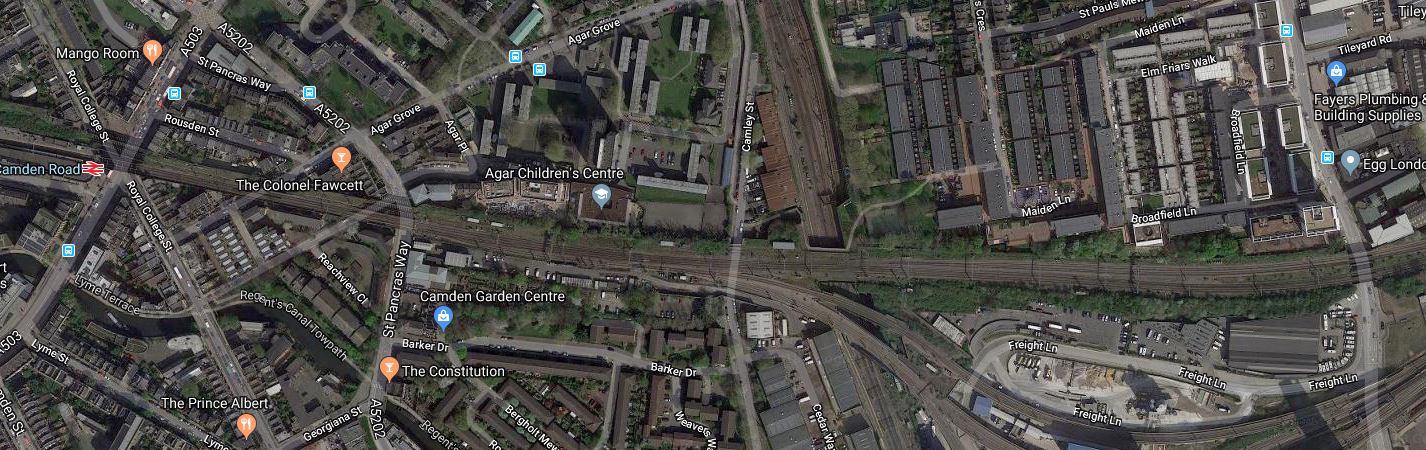
One of the most striking features visible from this map, is the large amount of development going on to the South of the North London Line.
The new residents and workers could probably do with a good walking and cycling route between Camden Town and Kings Cross.
Plans For The North London Line
The North London Line is a heavily-used passenger and freight route and it is unlikely, that traffic levels will drop.
Freight Traffic
There are now two electrified rail routes across North London; the North London Line and the Gospel Oak to Barking Line.
As two of the UK’s main container ports; Felixstowe and London Gateway, are not served by electrified railways, this still means that large numbers of diesel-hauled freight trains have to pass through North London to get to the Midlands, North and Scotland, despite the routes from Ipswich and Tilbury being fully-electrified.
These diesel-freight trains are boosted because the alternative route via Ipswich, Ely and Peterborough is not electrified.
The following needs to be done to seriously cut the number of diesel-hauled freight trains through North London.
- Electrify Ipswich to Felixstowe.
- Electrify to London Gateway.
- Electrify Ipswich to Peterborough.
- Replace a large fleet of polluting diesel Class 66 locomotives with modern electric units.
In some ways, the replacement of the locomotives by private freight companies is the largest stumbling block.
However, I think that the two shorter lengths of electrification will happen, which will mean that less diesel-hauled freight trains will pass through London, as they will go via Peterborough.
On the other hand, the need for freight trains will increase.
- More traffic to and from the ports.
- Freight to and from the Channel Tunnel, which must go through London.
- Trains carrying vehicles seem to be becoming more numerous.
I wouldn’t be surprised to see calls from the rail freight industry for improvements to the two freight routes through London.
One thing that will help freight trains, would be extra passing loops, where freight trains can wait for the passenger trains to overtake.
The double track of the Camden High Line is one of the few places, where another freight loop could possibly be installed.
Passenger Traffic
Sometime this year, two extra passenger trains per hour (tph) will run on the North London Line between Stratford and Clapham Junction stations.
This will bring the frequency to six tph.
On the past history of the London Underground, this will mean more full trains and pressure for longer trains and more services.
Old Oak Common Station
But the biggest changes will come in the next few years with a new Old Oak Common station, which will connect the North London Line to HS2, Crossrail, Chiltern, Great Western Railway and the West Coast Main Line.
Remember too, that the North London Line will be connected to Crossrail at Stratford.
Will these developments create a demand for extra trains on the North London Line?
Camden Town Station
Camden Town station on the Northern Line is being extended, with a new Northern entrance closer to the North London Line.
Will better routes be provided between Camden Road and Camden Town stations?
Interchange Between Camden Town And Camden Road Stations
Camden Town station’s new entrance will be to the North of the current entrance just off Kentish Town Road.
This Google Map, shows the Western end of Camden Road station.
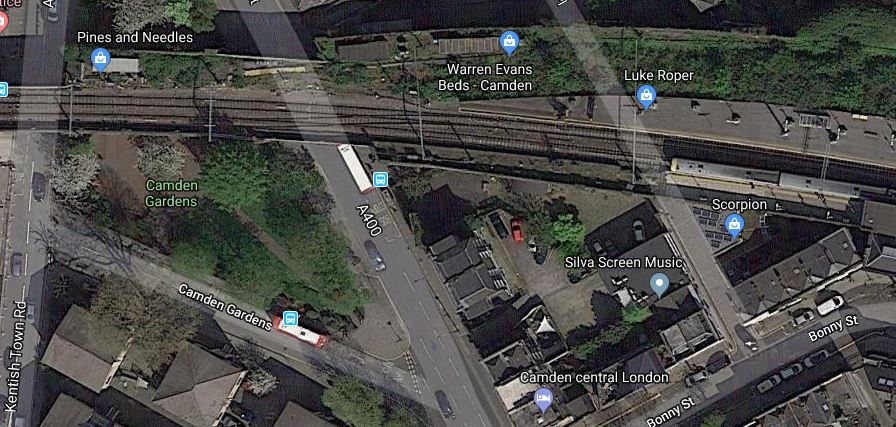
Note.
- There is a train in the Westbound platform.
- Kentish Town Road meets the station by Camden Gardens.
- The overgrown unused tracks to the North of the current station.
- The green space of Camden Gardens, with the 88 bus stand.
Could a second entrance to Camden Road station be built within the viaduct, perhaps with a ground-level entrance in Camden Gardens?
- It would be a short walk to the new entrance to Camden Town station.
- It would be convenient for walking to Camden Lock and the other attractions along the Regents Canal.
If the Camden High Line is created, access to the Eastbound platform could be directly to and from the High Line, which would be a garden to the North of the station.
Maiden Lane Station
Wikipedia says this about the re-opening of Maiden Lane station.
Camden Council has suggested this station could be rebuilt and reopened, in conjunction with the King’s Cross Central redevelopment project.
In June 2017, the Council were talking with Tfl on the possible reopening of Maiden Lane & York Road stations which it wished to reopen with Maiden Lane more likely to reopen then York Road.
I suspect, if the station is reopened, it will be on the Southern pair of lines, currently used by the London Overgr4ound.
One of the problems of reopening Maiden Lane station, is that a stop at the station would decrease capacity on the North London Line, through the area.
Plans For The East London Line
The East London Line is one of the UK’s rail successes of the last few years.
An outpost of the London Underground, through a tunnel, built by the Brunels, was turned into a modern railway with new trains and sixteen tph all day.
But this is only a start!
Plans exist for more new trains, an extra fout tph through the tunnel and a possible uprating of the signalling to handle a frequency to 24 tph.
If the latter should happen, I feel that another Northern terminal will be needed for the East London Line.
The obvious terminal is Willesden Junction station.
- Willesden Junction was certainly mentioned, when the London Overground was opened.
- There is a bay platform at the station.
- ,The station can be reached via Camden Road, Primrose Hill, South Hampstead, Kilburn High Road, Queen’s Park and Kensal Green stations.
- It will have good connections to an extended Bakerloo Line.
It would create another route across North London.
Would it mean extra platforms at Camden Road station?
Conclusion
I think that there will be a very large demand for using the two old tracks for rail purposes.
Finland And Norway To Explore Building Arctic Rail Link
The title of this post is the same as that of this article on the Reuters web site.
This is the first two paragraphs.
Finland and Norway agreed on Friday to explore constructing an Arctic rail link from northern Finland to the Barents Sea coast to develop trade routes and business opportunities in the region.
The proposed link would run from Finland’s northern city of Rovaniemi to Norway’s ice-free deep-water port of Kirkenes, located some 15 km from the border with Russia.
I didn’t know that ports, that far North could still be ice-free.
It is an interesting concept.
My only worry, is what will Vlad think of it all!
But then the Finns have stood up to the Russians before!
Is The Answer To Transport Problems 42?
This article in Rail Magazine is entitled Adaptable Carriage Secures Government funding.
This is the first two paragraphs.
Product development company 42 Technology has secured £350,000 worth of Government funding towards developing a system that can turn passenger carriages into goods vehicles.
The Adaptable Carriage system allows seats and tables to be stowed within three minutes, creating space for cargo that would normally be sent by road. 42 Technology envisages the system being employed on quieter off-peak services to carry low-density, high-value goods. It could also be used to create storage space for wheelchairs and bicycles, if required.
It is an idea that could work.
Take a route like Felixstowe to Ipswich, that I used to know well.
It gets commuter traffic at both ends of the working day.
But if it’s sunny and fine, the service would need extra space for bicycles and buggies for passengers going to enjoy the sea air.
The ability to be able to convert seats to bicycle, buggy and wheel-chair spaces might generate extra traffic.
That is only a simple example, but surely there are possibilities on routes between big cities for high-value traffic.
Red Star Parcels used to work well fifty years ago, so why shouldn’t a high speed parcels service work in this day and age?
During the Peak Hours all carriages would be setup for seats. but at other times, seats would be stowed to allow freight and parcels on wheeled pallets to be carried.
The Hitchhiker’s Guide to the Galaxy
Surely, only a company specialising in unusual designs in Cambridge, Shoreditch or California would call itself 42 Technology.
Railway That Could Bridge Middle East Divide
The title of this post is the same as an article by Roger Boyes in today’s copy of The Times.
The sub-title of the article is.
A new track from Israel to Saudi Arabia offers economic growth and stability in the region.
Read the article!
The Electric Taxis Are Coming
London’s new electric black taxis will soon be seen on the streets.
From the pictures, I’ve seen, they could be an interesting ride.
- There is a panoramic glass roof.
- They are roomier, than the current black cabs and can seat six instead of five.
- Wi-fi and charging points are standard.
- Air-conditioning.
- A small petrol engine is used to boost range up to nearly 400 miles.
I shall search one out for a ride.
The Times though points out an interesting point about the design. This is said.
The bigger story is LEVC will now use the technology behind the TX to build far greater volumes of hybrid electric vans, the sort that deliver all our online shopping.
That certainly is a bigger story.
A few points of my own.
Geo-Fencing
Will geo-fencing be used to ensure that in central and sensitive areas and those with high air pollution, the taxi will run on batteries only.
This would also be particularly useful with the delivery van, where delivery depots tend to be outside the centre of a city.
Wireless Charging
London’s black cabs use rabjs and only yesterday, I picked up one from the rank at the Angel.
Milton Keynes has buses that can be charged using an inductive system.
So why not install inductive charging on taxi ranks?
Online Shopping Delivery
Parcel delivery companies don’t have the best of images. Electric last-mile delivery would certainly help.
For too long, vans have just been a crude metal box, with a couple of seats and an engine at the front.
So why not design a complete system around the taxi chassis?
- If the depot was outside the city centre, charging could be done at both the depot and on the journeys to and from the centre
- The van could also be designed so that containers packed at the depots could be loaded for each delivery.
- The containers could also be brought into the centre of the city at night into the main station by a purpose-designed train.
- A sophisticated onboard computer could control the driver and the deliveries.
There is a wonderful opportunity here to develop parcel delivery systems that are truly efficient and as pollution-free as possible.
Service Vans
If I walk down my road of about 150 houses and a couple of tower blocks on any weekday during working hours, I will probably count around half-a-dozen service vans of various types for small builders, plumbers. Most have not come further than a dozen miles.
If the economics of the electric van are pitched right, I think a large proportion of these vehicles will go electric, as they often sit around for large periods during the working day.
Conclusion
I can’t wait to get a ride in one of these taxis.
Grayling Gives Green Light To Double Track On Part Of Felixstowe Line
The title of this post is the same as that of this article in the East Anglian Daily Times.
This page on the Network Rail web site gives more details.
This is said.
Building the additional track will help increase the capacity of the Felixstowe branch line and take lorries off the road. It will also mean more reliable journeys for passengers traveling between Ipswich and Felixstowe.
There is also this map, which shows where a second track is being added to the Felixstowe Branch Line between Trimley station and Grimston Lane level crossing.
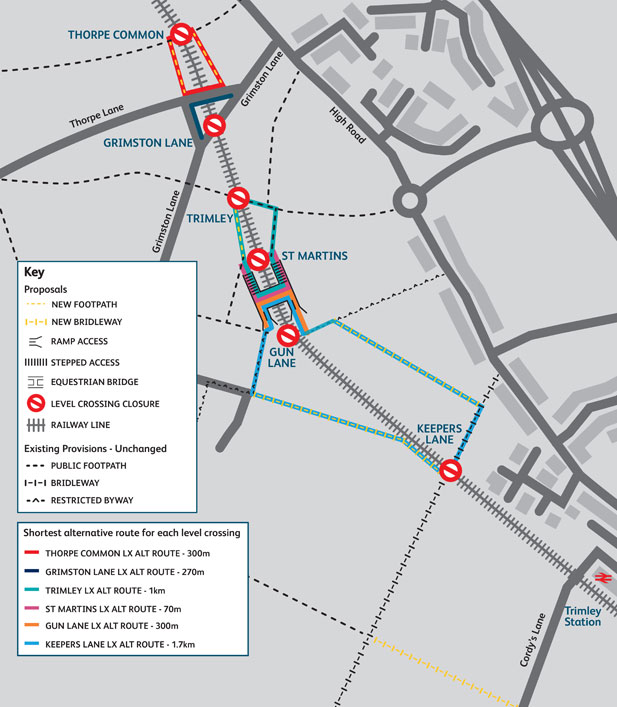
Note that six level crossings are also being removed, with the one at Gun Lane being replaced with a bridge, which seems to be a bit controversial.
Freight Traffic On The Line
The East Anglian Article says this.
This will allow up to 47 freight trains to run per day, 14 more trains than can currently run on the single line. Each train can carry the equivalent of 60 lorry loads, meaning fewer lorries on busy roads such as the A14.
That is quite a lot of freight and a forty-two percent increase in the number of trains.
Trimley Station
Trimley station will be the Southern end of the new track.
This Google Map shows Trimley station.

Note.
- Cordy’s Lane crossing the line at Trimley station.
- The line to Flelixstowe Port (North) going South.
- The line to Felixstowe station going straight on.
Judging by the number of houses on the South side of the track, I would assume that an automatic level crossing is being installed there.
Noise, Smell And Vibration
The Felixstowe Branch Line illustrates one of the problems of the various freight locomotives and especially the ubiquitous Class 66 locomotive. The locomotives are not particularly environmentally-friendly, especially when they are hauling up to forty truck with containers.
I think that some parts of the branch need to have noise mitigation measures installed, otherwise there will be serious levels of complaint.
New Locomotives Are Needed
This article in Rail Magazine is entitled GB Railfreight In ‘Locomotive Acquisition’ Talks, so at least one company thinks so!
In Jumbo Trains Are Arriving, I mused about the type of train required.
I came to this conclusion.
Some more powerful freight locomotives are needed, but the designs should be available.
I would add to that now. The locomotives would need to be dual-mode and a lot more environmentally-friendly/
 The Anonymous Widower