Tendering Begins For German Hydrogen Train Order
The title of this post is the same as that of this article in the International Railway Journal.
This is the first paragraph.
Rhine-Main Vehicle Management (Fahma), a subsidiary of Rhine-Main Transport Authority (RMV), published a tender notice in the Official Journal of the European Union on April 20 for a contract to supply a fleet of hydrogen fuel cell multiple units for regional services on non-electrified lines in the Taunus area of Hessen.
But then the Germans seem to be much easier to use gases of various types to solve problems, than other countries.
I’ve spoken about hydrogen trains to people in Germany and the UK and the Germans are more enthusiastic, whereas the Brits just question hydrogen’s ability to catch fire.
Perhaps, Gemans teach chemistry better?
Who knows? But the orders for hydrogen trains keep coming.
Do We Buy More Trains Than The Germans?
I ask this question with respect to the Germans, but I could ask the question with respect to the French, Italians or Spanish.
On my recent trip to Germany, the frequiency seemed to be less than I could expect in a similar route in the UK.
A a simple example, the frequency on the S-Bahn across Berlin, appeared to be very much inferior to London Overground’s East London Line.
There are possible reasons.
- Our signalling systems have a higher capacity.
- Train dwell times at stations are less.
- We have more trains on the route.
- Politics between Deutsche Bahn and the Local Authority get in the way.
Trains certainly don’t appear to be as frequent in Germany.
Gluten Not Optional
I spent last night in the Ibis hotel at Karlsruhe and had a very good supper in Baden-Baden.
This morning, I’m on my way to Stuttgart, so I thought I’d pick up something at the station.
Usually, on German stations, I can find something like fruit, but here there were nothing gluten-free except a bag of McDonald’s fries, coffee etc and water.
I assume all German coeliacs are stick-thib, as they aren’t allowed to collect snacks on the run!
Germany’s Next Top Model
I found this advert in several cities I visited in Germany.

I’m nopt bothered but, would an advert like this be allowed in the UK?
Gibb Report – Depot Issues
The Gibb Report, looks in detail at GTR’s depot capacity and especially the stabling for Thameslink.
The section on depots starts like this.
The way in which the train fleet has expanded in recent years has resulted in a shortage of stabling facilities. New facilities have been located away from train crew depots (e.g. Hove from Brighton) and are less efficient, involving driver time in taxis. Siemens new depot at Three Bridges is now the main centre for the Thameslink fleet, and overall the depot capacity on Southern is just about sufficient from what I have seen, although it is inflexible and inefficient.
It then goes on to list problems at specific locations.
Ashford
Perhaps the late choice of Maidstone East station, as a terminus, has meant that a site hasn’t really been found for a depot at Ashford.
Bedford
The depot is unsuitable for 12-car fixed formation Class 700 trains, which block the entrance.
Cambridge
The facility is currently unsuitable for 12 car fixed formation trains and the current trains have to be uncoupled to be accommodated.
North Kent
The original plan was to increase stabling facilities at Slade Green, but this has now been established to cost £72m and too expensive. An alternative is urgently needed.
The report sums up the depot issues like this.
All of the above issues need to be finalised before the driver recruitment plans can be commenced, as the driver recruitment strategy must be decided around the stabling locations of the trains, and driver depot facilities, including parking, must be included in the scheme
implementation.
It also goes on to say, that more trains may need to be ordered to increase capacity on the Brighton Main Line and that a new depot will be needed.
Bombardier’s Class 345 Trains For Crossrail
Before I add my fourpennyworth on depot issues, I will look at some of the features of Bombardier’s Class 345 trains.
All Trains Are The Same Length
It is intended that all trains will be the same nine-car length, although at the present time, the trains under test in East London are a couple of cars short of a full train.
This is mainly because the platforms in Liverpool Street, are not long enough for a full train and won’t be lengthened until a year or so.
I suspect too, it enables Bombardier to build the trains in a more efficient manner and test out each type of coach fully.
One of the advantages in having all trains of the same length, is that you maximise the capacity in a depot and as on both routes, the manufacturer pays for the main depots, a correctly-sized depot will reduce costs.
Note that Thameslink’s main depots don’t seem to have issues, so can we assume they were well-designed?
The Class 345 Trains Have No Toilets
There was a bit of a fuss, when this was announced, as I wrote about in Do Crossrail Trains Need Toilets?.
But given that many Crossrail stations have toilets on the platforms and trains are every ten minutes, no toilets on the train gives advantages.
- There is no toilet on the train that needs regular cleaning and fails occasionally.
- Overnight servicing of the train does not need the toilet to be emptied.
I also suspect that the modular nature of the Class 345 train would allow one to be fitted if required.
Class 345 Trains Are Designed For Remote Wake-Up
Remote wake-up is discussed in Do Bombardier Aventras Have Remote Wake-Up?.
So imagine a Class 345 train finishes its last journey of the day in a platform at Shenfield station or a convenient stabling siding.
- The driver checks the train for sleeping bankers, locks up and goes home.
- The train reports to Ilford, that a couple of light bulbs have failed.
- The servicing and cleaning team arrive and get the train pristine for the morning.
- The train shuts down fully and all power is switched off to the overhead wires, so trespassers won’t be electrocuted.
- At an appropriate time, the train is signalled to come to life and warms up ready for the day, using battery power.
- The driver arrives and when signalled joins the main line, raises the pantograph and takes the train on its way.
When I once described this process to a driver from Northern going to pick up a Class 156 train in Halifax, he had a big smile.
In some ways, it’s a bit like parking your car out on the street.
- Except that for trains, you need a convenient piece of track.
- As power will be needed to warm the train up in the morning and you don’t want 25 KVAC live wires about, the only source of power possible is a battery.
- If the train had a toilet, it would be a more complicated process.
What will the devious Derbians think of next?
Solving GTR’s Depot Problems
In my view there is one big difference between Thameslink and Crossrail.
With Crossrail, which was in part a new railway line, every component was designed so it fitted together like a giant three-dimensional jigsaw.
But Thameslink was designed by different teams over a series of decades.
As we can’t go back to square one on Thameslink we have to make the best of what we’ve been left with.
Bombardier’s remote wake-up concept is a straight steal from some upmarket road vehicles, so why haven’t Siemens stolen it? Especially, as the Derby Telegraph article dates from June 2011. Perhaps, their press cuttings agency doesn’t read that newspaper?
If they had developed the technology, it would certainly help with remote stabling of trains, as you can have a much simpler facility.
The Problem Of Cambridge
I discuss this in Cambridge Depot
The Problem Of North Kent
Chris Gibb suggest creating a new depot at Hoo Junction, which I discuss in Hoo Junction Depot
Thameslink’s Mixed Length Fleet
Thameslink also have a curious mix of eight-car and twelve-car trains, whereas Crossrail have sensibly opted for a common length, which as I said, must be much easier to store.
Intriguingly, both Greater Anglia and South Western Railway have ordered mixed fleets of five and ten-car Aventras. But most six-year-olds can tell you that 5+5=10.
The decision to buy a mixed length fleet of twelve and eight-car trains for Thameslink has caused a lot of these depot and a few other problems.
I wrote more about the problem in Has Thameslink Got The Wrong Length Of Train?.
I think in the end, Thameslink will lengthen the eight-car trains to twelve-cars and then lengthen the short platforms on the Sutton loop Line and a few other places.
This would create sixteen per-cent more capacity through the central tunnel, by making all trains twelve-cars.
But that is an expensive way to solve the problem created by not designing Thameslink as a continuous twelve-car railway.
Conclusion
It’s a bloody-great mess.
If you compare depot philosophies at Crossrail, Greater Anglia and Thameslink, the first two companies seem to have developed a comprehensive purchase and maintenance solution for all their new trains, whereas Thameslink have worked on the basis that it will be alright in the end.
These factors don’t help Thameslink.
- The choice of a mix of eight- and twelve-car trains.
- The inability to join two short trains together to make a long train.
- The design of a Class 700 train, which appears to be geared more towards a traditional depot.
I will be accused of being patriotic, but having ridden in both Class 700 and Class 345 trains, I’m coming to the conclusion, that Thameslink should have bought Aventras.
I would also have to ask, if Krefeld in Germany is a better place than Derby, for decision makers to visit.
Hybrid Trains In The Former East Germany
In my travels from Göttingen, most of the local trains were diesel multiple units as local lines like the South Harz Railway are not electrified. On the other hand, the main lines through Göttingen, are all electrified.
In September 2016, I wrote German Trains With Batteries, which indicated a project in Germany to create hybrid trans, based at technical universities in Chemnitz and Dresden.
As some of the journeys I took in diesel trains, were under electrification, it would certainly appear that the German’s approach is sensible.
There would also appear to be lots of lines without electrification and diesel passenger services all over the area.
- Annaberg-Buchholz–Flöha Railway
- Bautzen–Bad Schandau Railway
- Chemnitz–Adorf Railway
- Flöha Valley Railway
- Gera Süd–Weischlitz Railway
- Glauchau–Wurzen Railway
- Heidenau–Kurort Altenberg Railway
- Herlasgrün–Oelsnitz Railway
- Karlovy Vary–Johanngeorgenstadt Railway
- Löbau–Zittau Railway
- Mid-Germany Railway
- Vejprty–Annaberg-Buchholz Railway
- Zwickau–Schwarzenberg Railway
If the universities can come up with an economic and practical solution, there are certainly a lot of places to use these hybrid trains.
I think it is interesting to compare the German approach with that of Porterbrook/Northern with their development of the Class 319 Flex train.
- The Germans are starting with a diesel Desiro Classic, whereas the British are starting with an electric Class 319 train.
- Batteries are an important part of the German solution, but may not be part of the British one.
- The German trains are nowhere near as old as the thirty-years-old British ones.
But the objectives of the two projects are to improve passenger services without doing a lot of expensive electrification.
Level Crossings And Signal Boxes
As I travel around Germany on trains, I am surprised at the number of level crossings and signal boxes.
Level Crossings
On the South Harz Line, there must have been half a dozen between Northeim and Nordhausen.
I don’t know if the Germans have a similar policy to Network Rail of aiming to remove all crossings, but if they do, they have a lot to do.
But the area did suffer the serious Langenweddingen Level Crossing Disaster in 1967.
Signal Boxes
Every station seemed to have a signal box.
Although, I did find this in the Wikipedia entry for the South Harz Railway.
Signalling on the South Harz line will in future use electronic interlockings that are remotely controlled from a centre in Göttingen.
So it does seem there is a certain amount of ongoing modernisation.
Conclusions
I’m very much of the opinion, that there is still a lot of technical modernisation to be done on German railways.
Would I Go Back To The Harz Narrow Gauge Railways?
The Harz Narrow Gauge Railways is not a small system and if I was in the area again, I would certainly pay the railways a visit.
The trip I took from Nordhausen to Wernigerode between two Deutsche Bahn lines is possible on almost an hourly basis througthtout most of the year, although it would be a better trip in sunny weather.
I didn’t do the trip up the Brocken, which is a peak of over a thousand metres high. That is best accessed from Wernigerode, if you only have a short amount of time available.
Wernigerode Station
Wernigerode station is the Northern terminus and main depot of the Harz Narrow Gauge Railways.



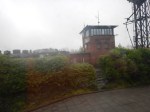
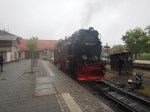
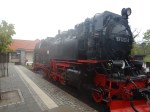

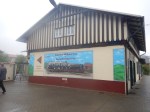




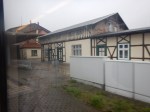
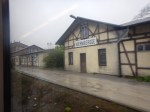
It has an interchange with the Deutsche Bahn, that runs between Goslar and Magdeburg.
This Google Map shows the layout of the station.

It appears to me that the station has a common layout for this part of Germany, where there is a loop that serves the platform closest to the station building.
Trains on Deutsche Bahn seem to be about every hour and although the local diesel services seem to link together fairly well, the information isn’t as good as it might be.
I certainly think that if the weather had been better, it would have been a more interesting town to visit.
Drei Annen Hohne Station
Drei Annen Hohne station is a junction station on the Harz Narrow Gauge Railways.

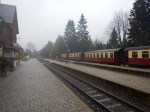
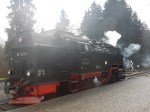
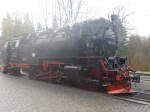
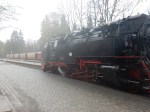
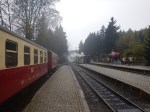
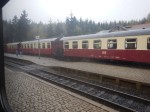
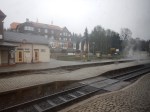
We stopped on our way to Wernigerode to change locomotives, so that our locomotive could be replenished with water.
 The Anonymous Widower