Canal Water To Heat Some Of Liverpool’s Most Famous Buildings In Hi-Tech Carbon-Cutting Scheme
The title of this post is the same as that of this press release from Liverpool City Region.
These five bullet-points act as subheadings.
- Energy generated from Leeds and Liverpool canal by one of the UK’s largest water source heat pumps
- Announcement comes as Mersey Heat Energy Centre officially opens
- Scheme to connect Georges Dock, Cunard and the Museum of Liverpool buildings to Mersey Heat Network
- Joint project between Combined Authority, Liverpool City Council and National Museums Liverpool
- Key part of Combined Authority plan to reach net zero by 2035
These introductory paragraphs add more detail.
Three major public buildings on Liverpool’s waterfront are to slash carbon emissions by joining a heat network driven by energy from canal water.
Under the plan, an extended pipeline will connect Georges Dock building, the Cunard building, and the Museum of Liverpool, part of National Museums Liverpool (NML), to the Mersey Heat network.
The newly opened Mersey Heat Energy Centre is already supplying the Liverpool Waters site, the Titanic Hotel and the Tobacco Warehouse apartments.
It uses one of the UK’s largest water source heat pumps to extract energy from the Leeds and Liverpool Canal to power a network of heating pipes.
The project is the latest in the Liverpool City Region’s five-year carbon action plan and journey to reach net zero. The Combined Authority has recently secured an additional £35m to decarbonise dozens of other public buildings from the Department of Energy Security and Net Zero.
This map of the Liverpool Waterfront shows the canal and some of the buildings mentioned.

Note.
- In the top-left corner is Everton’s new Hill-Dickenson Stadium, which at the time of this map was under construction.
- The pink arrow to its right indicates the Titantic Hotel.
- The Leeds and Liverpool canal passes on the South side of the hotel.
- On the other bank of the canal is the Tobacco Warehouse.
- The canal goes East and then turns North before going all the way to Leeds. The Wikipedia entry gives full details of the canal.
- From the Titanic Hotel, the Leeds and Liverpool Canal also turns South and boats can go along Liverpool’s famous Waterfront to Canning Dock, in front of the Tate Liverpool.
- The red arrow marks the Liver Building.
- Georges Dock building, the Cunard building, and the Museum of Liverpool are just to the South the Liver Building.
- To the East of the Liver building, there is Liverpool City Centre, with beyond it Liverpool Lime Street station, with another collection of important buildings including St. George’s Hall, the Picton Library, World Museum and the Walker Art Gallery.
The Combined Authority will not have a shortage of buildings to decarbonise with the £35m from the Department of Energy Security and Net Zero.
These are my thoughts.
What Is A Water Source Heat Pump?
I asked Google AI this question and received this answer.
A water source heat pump (WSHP) is a highly efficient, low-carbon renewable energy system that extracts heat from a nearby water source like a lake, river, or canal to provide heating and hot water for a building, and can also be used for cooling. It works by using electricity to transfer this thermal energy into the building’s heating system, offering a more efficient alternative to traditional boilers and reducing energy bills. There are two main types: closed-loop systems, which circulate a fluid through pipes submerged in the water, and open-loop systems, which directly pump and then discharge the water.
Is Mersey Heat Energy Centre A Closed Or Open-Loop Water Source Heat Pump?
I asked Google AI this question and received this answer.
The Mersey Energy Heat Centre uses an open-loop water source heat pump system. It abstracts water from the Leeds and Liverpool Canal, extracts heat from it, and then returns the water back to the dock system.
As the Leeds and Liverpool Canal is 127 miles long, and there appears from the map to be a lot of water in the docks at the Liverpool end, I would expect that Liverpool will have more than enough water to extract heat from.
Where Exactly Is The Mersey Heat Energy Centre?
In this article on Place North West, which is entitled Work Begins On Peel’s Mersey Heat Energy Centre, has this image, which is labelled as the Mersey Heat Energy Centre.
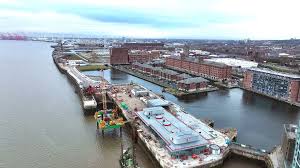
Note the large building in the foreground with the circular objects on the roof. Could these be fans or vents?
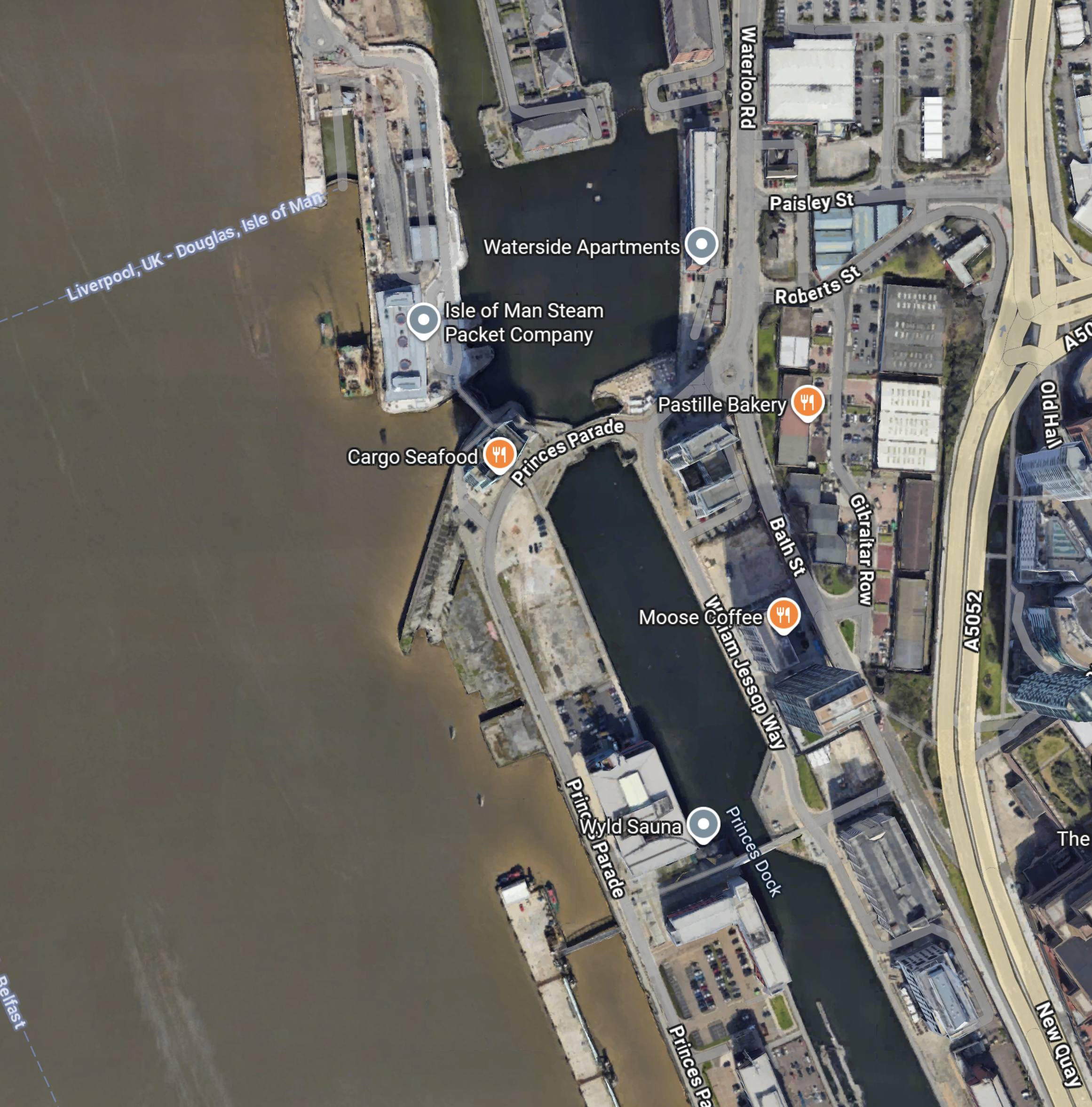
This Google Map shows the area.
Note.
- The two docks at the top of the map can be picked out in the image.
- The main breakwater on the left, which is marked Isle of Man Steam Packet Company, looks very similar to the one shown in the image.
- The bridge between the two docks on the left appears to be the same in both map and image.
I am fairly sure, that the large building on the breakwater with the three circles on the roof, is the Mersey Heat Energy Centre.
It certainly looks to be a building, that could provide a substantial amount of heat and power .
What Is The Output Of The Mersey Heat And Energy Centre?
I asked Google AI this question and received this answer.
The Mersey Heat and Energy Centre produces low-carbon heat for up to 6,700 homes and 1.3 million square feet of commercial space, aiming to deliver around 20GWh of heat per year. The project is also planned to expand to supply around 45GWh annually. This heat is delivered to buildings for their heating and hot water needs through the Mersey Heat network.
This article on Place North West, also has this similar answer.
Led by district heat network specialist Ener-Vate, the Mersey Heat Energy Centre will feature two 3MW water source heat pumps that would work on an ‘open loop’ system to take heat from water from the Leeds-Liverpool canal. This heat would be used to warm surrounding homes and businesses within six kilometres.
Plans form the first phase of Peel NRE’s Mersey Heat network. The initial project could supply 20GWh of heat every year, with planning permission secured to expand to supply around 45GWh – the equivalent of supplying heating and hot water to 17,000 homes.
It looks like we’re getting similar answers from different sources.
Does the Merseyside Area Have Enough Green Electricity To Power A Large Water Source Heat Pump?
In Could Liverpool Develop A Massive Zero-Carbon Data Centre?, I calculated the operational and planned offshore wind power in Liverpool Bay and got these results.
- 2509 MW has been commissioned.
- 3980 MW is being planned.
That is a total of 6489 MW or about twice the output of Hinckley Point C nuclear power station.
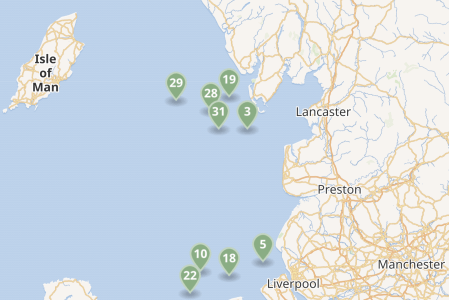
This map shows the existing wind farms in the sea between Liverpool, Lancashire and the Isle of Man.
Note.
- Each green arrow is a wind farm.
- There is the 2452 MW Heysham nuclear power complex near Lancaster.
- The Western HVDC Link is a 2250 MW connection between Hunterston in Western Scotland near Glasgow and Connah’s Quay on the Wirral.
- I also suspect more space in Liverpool Bay could be developed with wind farms.
Spinal Tap turned the power up to 11, Liverpool, being Liverpool, they have enough power to go to at least sixteen.
Will Merseyside Have Lots Of Data Centres?
Consider.
- It has the power.
- It has the water.
- The locals speak a form of English.
- Merseyside will be two hours from London by train.
- There are two Premier League football teams.
- The golf courses are good.
- It is a city that is famous all over the world.
I am sure the number of data centres will grow.
I’m Getting A New Hydrogen-Ready Boiler
The pump in my current nine-year-old boiler has died and it needs to be replaced.
The plumber gave me two solutions.
- Put a new pump in the old boiler.
- Replace the boiler with the current version of the old boiler.
Note.
- The plumber said the new boiler would be hydrogen-ready.
- I seem to remember the same pump failed before.
- The pump had failed because of a water-leak into its electrics.
- Was the previous failure of the pump caused by the same water-leak?
- Fitting a heat pump in my house would probably cost more than I could afford.
- The new boiler would come with a ten-year guarantee.
As an engineer, I can see the following scenarios for heating my house and providing hot water.
1. Keeping Calm And Carrying On
This means that the current arrangements for energy continue.
- There would be no compulsory heat pumps.
- There would be no change to any of my hardware, after installing the new boiler.
- I would continue to get gas for heating and hot water delivered through the mains.
The new boiler solution should give me ten years of reasonably trouble free-running, so long as the gas was natural gas, hydrogen blend or hydrogen.
2. Keeping Calm And Carrying On But My Energy Supplier Switches My Gas To 20 % Hydrogen-Blend
This means that the current arrangements for energy continue.
- There would be no compulsory heat pumps.
- There would be no change to any of my hardware, after installing the new boiler.
- I would continue to get gas for heating and hot water delivered through the mains.
- The gas pipe into my house would have to be checked for compatibility with hydrogen-blend. But then I encountered no problems when switched from coal-gas to North Sea Gas around 1970.
The new boiler solution should give me ten years of reasonably trouble free-running, so long as the gas was natural gas, hydrogen-blend or hydrogen.
3. Keeping Calm And Carrying On But My Energy Supplier Switches My Gas To 100 % Hydrogen
This means that the current arrangements for energy continue.
- There would be no compulsory heat pumps.
- There would be no change to any of my hardware, after installing the new boiler.
- I would continue to get gas for heating and hot water delivered through the mains.
- The gas pipe into my house would have to be checked for compatibility with hydrogen.
The new boiler solution should give me ten years of reasonably trouble free-running, so long as the gas was natural gas, hydrogen blend or hydrogen.
4. Switching To Some Form Of Heat Pump
- This would mean that I would go all electric.
- My house is a concrete lump and a guy I trust, said it would be difficult to fit a heat pump.
- I am suspicious of scientific and technical solutions proposed by politicians.
I’m not saying, I’d never use a heat pump, but I will take a lot of convincing.
5. Switching To Some New Form Of Electric Heating
I have seen two companies, which use the excess heat from a data centre to heat water for central heating and/or hot water for domestic needs.
- heata is a spin out from Centrica, that provides hot water and saves you money on your utility bill.
- thermify is a startup from Wales, that replaces the gas boiler, with an electric one.
There are probably other similar systems under development.
From my knowledge of computing and electrical engineering, I believe devices like this could be new form of cost-efficient electric heating.
Because my house has three-bedrooms, I would need a thermify, for both heating and hot water, but a heata working in tandem with my gas boiler could probably keep me in hot water.
I would feel that large blocks of flats or offices could have a data centre in the basement to provide heat for the building.
I would also suspect, that there are other devices out there, that work on different principles.
My Decision
I’m fitting a new boiler, as that should give me ten years’guarantee-backed and trouble free running and future-proof me for all possible government decisions, except saying that everybody must fit a heat pump.
When, this new boiler pops its clogs, i would hope, that some clever engineers have come up with a plug-compatible electric replacement for the new boiler I am about to have fitted.
UK Government Grants £30 Million For Long Duration Energy Storage Projects
The title of this post, is the same as that of this article on Solar Power Portal.
These two paragraphs outline the grants and their recipients.
The UK Department for Energy Security and Net Zero (DESNZ) is providing £30 million in grants for three long-duration energy storage (LDES) projects using novel energy storage technologies.
The three projects awarded funding are from Synchrostor, Invinity Energy Systems and Cheesecake Energy. Synchrostor and Cheesecake Energy are to receive £9.4 million each to fund thermal energy storage systems and Invinity Energy Systems receiving £11 million to develop a vanadium flow battery.
The UK Government seems to give out a lot of these grants for research and development purposes and from feedback I have received from recipients and also by applying my own experience, I am of the opinion, that they are spending tax-payers money more in a wise, rather than a foolish direction.
Cheesecake Energy
I wrote about Cheesecake Energy’s grant in Cheesecake Energy Collects £9.4m Government Funding.
The Government’s press release says this about Cheesecake’s grant.
Cheesecake Energy Ltd, Nottingham, which will receive £9.4 million to test their FlexiTanker technology which stores electricity using a combination of thermal and compressed air energy storage and uses a reversible air compression / expansion train to charge and discharge. They will then install pilot units at 2 sites within a microgrid development in Colchester.
If this project proves successful, it surely is one that can be duplicated in many places.
I have had my eye on Cheesecake Energy for some time and this could be their breakthrough.
Invinity Energy Systems
I first wrote about Invinity Energy Systems in UK’s Pivot Power Sees First Battery On Line By 2021.
The Government’s press release says this about Invinity’s grant.
Invinity Energy (UK) Limited, Scotland, which will receive £11 million to develop and manufacture their 7MW, 30MWh 4-hour Vanadium Flow Battery (VFB), the largest in the UK. Invinity will manufacture the 30 MWh VFB at the Company’s factory in West Lothian, Scotland. The location of the plant will be confirmed in due course.
In this article on renews.biz, which is entitled Invinity Wins Funds For 30MWh UK Battery, these two paragraphs introduce the project.
Invinity Energy Systems plc has today been awarded £11m in funding by the Department for Energy Security and Net Zero to build what it says is the largest grid-scale battery ever manufactured in the UK.
The £11m in funding will come from the Longer Duration Energy Storage Demonstration (LODES) Competition, with funding matched by Invinity’s, as yet unnamed, project partner.
These are other points from the article.
- It will be a fast-response 30MWh battery.
- The battery will be assembled at Bathgate in Scotland.
- It will operate as a stand-alone energy storage asset.
- It will be connected to the National Grid.
- Invinity’s vanadium flow batteries are an alternative to lithium-ion.
The aim is to go live by 2025.
This paragraph indicates the differences between a vanadium flow battery and a traditional lithium ion one.
Invinity said this battery is safer as they cannot catch fire, more durable as they do not degrade with use and are almost completely recyclable at the end of their 25+ year life, reducing environmental impacts and disposal costs for project owners.
I believe that there will come a point, when fully-developed vanadium flow batteries, will become very attractive for financial reasons to the successful energy storage funds like Gresham House and Gore Street.
If the UK government’s funding hastens the day, when energy storage funds feel that these new-fangled vanadium flow batteries are a safe investment, then it is money well spent.
It is not as though the money is going to an early start-up, as this page on the Invinity Energy Systems web site indicates at least a dozen installations.
This project for an as yet unnamed customer, which has a capacity of 30 MWh, is probably much bigger and the Government help is probably very much welcomed.
SynchroStor
SynchroStor was new to me, today.
The Government’s press release says this about SynchroStor’s grant.
Synchrostor, Edinburgh, Scotland, which will receive £9.4 million to build a Pumped Thermal Energy Storage (PTES) grid-connected demonstration plant operating at 1MW, with the ability to charge and discharge for a period of 10 hours, longer than current battery technology.
This page named Technology on their web site, explains their technology, both with words and diagrams.
It is probably the most complex technologies of the three batteries, but I don’t think that will be a problem.
Conclusion
The Government has given grants to three different storage technologies.
If all goes well three good sizable pilot plants will be created and those companies like Centrica, Gore Street, Gresham House, National Grid, Ørsted, SSE and others, will be able to judge, which system is best for their needs.
Thoughts On The Cambo Oil Field
There is an article in The Times today which is entitled Sturgeon Faces Backlash After Shell Pulls Out Of North Sea Oilfield.
I have been following the technology of Carbon Capture and Use and some very good ideas have come forward in the last couple of years.
- Carbon dioxide is becoming increasingly important in the growing of flowers, salad vegetables, soft fruits and tomatoes in greenhouses.
- At COP26, Australian company, Mineral Carbonation International won an award for their process that turns carbon dioxide into building materials like blocks and plasterboard.
- A big investment was also made recently in an Italian company, who are using the properties of liquid and gaseous carbon dioxide to store energy.
- Carbon dioxide has for years made a good fire extinguisher, which can’t be said for some chemicals currently used.
- I suspect that some clever chemists are working on using carbon dioxide to create sustainable aviation fuel.
If the number of ideas for the use of carbon dioxide continues to increase, I can see gas-fired power stations being built, that are also used to produce much-needed high-quality carbon dioxide.
It should also be noted, that many like me, live in houses that are unsuitable for the fitting of heat pumps at an economical cost.
So we must wait for better technology or for hydrogen to be piped into our houses.
In the meantime, we will have to rely on gas. Or freeze!
I don’t know whether Cambo will produce any gas, but if it doesn’t, I can’t see much point in developing it.
Perhaps, Shell would prefer to develop a gas field.
 The Anonymous Widower