Could Centrica Build An Alternative Grid For The UK?
Andy Burnham’s Speech In Liverpool Introduced The Great British Grid
This extract is what he said on energy and the grid.
One of the biggest barriers to growth in the UK is the cost of energy. British businesses and billpayers pay some of the highest energy costs in Europe.
Within 10 years, I want those costs to be in line with our neighbours.
This means reforming a broken energy market so it better serves the public interest.
We are already taking more control of our electricity prices with a massive expansion of home-grown renewables and nuclear. I have asked Miatta to speed up the breaking of the link between what we pay for power at home and the international gas market, to get bills down.
And we will be pragmatic in relation to the North Sea as we build a bridge to a clean energy future and face the climate crisis.
But it’s not just the price. The system needs to work better too. You would not believe how many businesses complain to me they can’t get going because they can’t get connected to the grid.
It pushes costs up. It drags growth down. And it holds Britain back. We won’t get the growth and inward investment we need if we don’t fix it.
So, for the first time, we will have a national energy plan and we will bring back local democratic control through a stronger role for mayors and local leaders.
But we must go further. Today I can announce our plan for Great British Grid. A new branch of Great British Energy. A publicly-owned company that will challenge the private sector operators.
But is Andy Burnham’s plan realisable?
The Great Grid Upgrade From Norwich To Tilbury
National Grid are aiming to replace the grid between Norwich and Tilbury to add extra capacity and the details of the project are on this web site.
This is a map of the route.

To ascertain the level of objections, I asked Google AI “Norwich to Tilbury grid objections” and received this reply.
Local councils, residents, and organizations object to National Grid’s Norwich to Tilbury Project primarily due to the visual and ecological damage of using 50-meter overhead pylons instead of offshore or underground alternatives.
Key Objections and Concerns
Overhead Pylons vs. Alternatives: Opposition to roughly 100 miles (159–183 km) of towering onshore overground lines. Objectors demand fully costed offshore high-voltage direct current (HVDC) or underground cabling options.
Environmental & Landscape Harm: Severe impact on protected and valued landscapes, including the Dedham Vale national landscape and Waveney Valley, alongside extensive tree loss and disruption to local wildlife habitats.
Heritage & Property Impacts: Damage to the settings of historic buildings and significant property or land devaluation, including negative impacts on planned developments like the Dunton Hills Garden Village in Brentwood.
Unrealistic Delivery Timeline: Concern that the targeted 2030/2031 completion deadline is overly ambitious, forcing rushed implementation without proper scrutiny of cumulative effects from multiple East Anglian energy projects.
Community Disruption: Strain on local highways, disruptive weekend and bank holiday working hours, agricultural disruption, and a lack of adequate community compensation or tangible social value.
The Nimbys don’t seem very keen on more and bigger overhead power lines.
Conclusion
I believe building a second set of power lines across the country will be very difficult, if not impossible.
The Investment Of Centrica And Others In innovative Energy Technology
I think we’ll see innovation from the likes of Centrica, Octopus, National Grid and others, as to how we get our energy delivered.
Centrica and others, who include the UK Government, have backed four British companies, that I’m sure will be used in the grid of 2030.
- Ceres have developed a fuel cell that runs on hydrogen, biomethane or natural gas. It was thought it would be used to power data centres, but it could be used to provide power anywhere there is a gas supply, like a big factory or a new housing estate.
- Heata was developed by British Gas Research and is part of a data centre, which sits in a domestic hot water tank and the waste heat gives you affordable hot water.
- Highview Power make liquid-air batteries up to 300 MW/3.2 GWh. Significantly, Andy Burnham performed the groundbreaking for a 50 MW/300 MWh battery in Manchester, when he was Mayor of Greater Manchester.
- HiiROC from Hull University have a way to make hydrogen that uses only a fifth of the electricity. Cemex are using HiiROC to make low-carbon cement at Rugby. I also think Jim Ratcliffe has plans for HiiROC, as he is an investor with Centrica and others.
Could Centrica build an innovative Great British Grid from their investments?
I don’t think so because of the problem I indicated earlier with Norwich to Tilbury of putting up more overhead cables.
But all of these four companies can provide support and enhancement to the existing grid.
- Ceres could be used to provide extra power, where it is needed, if there is a suitable gas supply.
- Heata could be used to give a large proportion of houses and flats affordable hot water.
- Highview Power could be used to provide energy storage where too much energy is being generated at times and needs to be stored for a number of hours.
- I believe that many large wind farms will be connected to the grid, with a Highview Power battery at the sub-station.
- I also believe that we could see Highview Power batteries installed offshore to smooth wind farm output.
- HiiROC could produce hydrogen when and where it is needed.
The big problem will be that the grid will get more complicated and will be more difficult to control.
In Centrica And Return Partner To Scale Battery Flexibility In Germany, I ask Google AI if Centrica are good at optimising batteries and received this reply.
Yes, Centrica is considered a strong and established player in grid battery (BESS) optimisation.
Centrica Energy leverages over 15 years of flexible asset trading experience and has actively optimised battery energy storage systems since 2018. They currently manage over 950 MW of grid-scale batteries on contract across the UK and Europe.
It may be difficult to manage all these assets, but it does appear that Centrica have the mathematicians and engineers, who are up to the task.
The Future Of Nuclear
Consider.
- The four nuclear stations at Hartlepool, Heysham 1, Heysham 2 and Torness are to be shut down by March 2030, which will lose approximately 5 GW of zero-carbon electricity.
- Hinckley Point C will deliver 3.2 GW from the early 2030s.
- Sizewell C will deliver 3.2 GW at some time in the future.
Can we rely on solar and wind power to power the UK?
It is not a question of can, but we have to.
But Centrica have made a bold move to link up with X-energy of the US to build a fleet of small modular reactors called an Xe-100.
- I wrote about the initial deal in Centrica And X-energy Agree To Deploy UK’s First Advanced Modular Reactors.
- In Hartlepool Nuclear Reactor Moves To UK Regulatory Assessment, I talk about how the first reactor will be built at Hartlepool.
- In Centrica, X-energy Advance Nuclear Plans As UK Regulators To Begin Design Review For Xe-100, I say more about the design and the parners in the Xe-100.
- In With Federal Funding Windfall, X-energy Advances Small Nuclear Reactor, I talk about US Federal funding for X-energy.
- In TRISO-X Completes Vertical Construction Of TX-1 Fuel Fabrication Facility, I describe how they are cracking on with the fuel facility in the US.
It certainly, seems to be a project that has started with a certain degree of momentum, which says to me, they have got the project management right.
But believe that these 80 MW Xe-100 reactors, if strategically placed around the country will keep us going as older nuclear and gas power stations are retired.
The Relationship Between Andy Burnham And Chris O’Shea
I wrote about this in Have Chris O’Shea And Andy Burnham Met?
I will assume its a good relationship, until proven otherwise.
Conclusion
I wonder whether in the end, the Great British Grid is a series of extensions to the current grid we have.
Andy Burnham Set For Clash With MPs Over North Sea Oil And Gas
The title of this post, is the same as that of this article in The Times.
This is the sub-heading.
The prime minister must decide whether to approve the Rosebank oilfield and Jackdaw gasfield but will face opposition from backbenchers if he goes ahead
These are the first three paragraphs.
Andy Burnham faces a potential showdown with Labour MPs after suggesting faster extraction of North Sea oil and gas could help pay for the transition to clean energy.
The prime minister is preparing to decide whether to approve the Rosebank oilfield and Jackdaw gasfield after consultations on both projects closed.
Industry sources have told The Times they believe Burnham will approve Jackdaw but may resist calls to go ahead with Rosebank because of opposition from MPs.
These are my thoughts.
My Boiler, Gas And Jackdaw
Consider.
- This year my boiler died. So I spent several thousand pounds, but I did get a new gas boiler with a 12-year guarantee.
- I am now 79, so can this government, or any for that matter, give me a guarantee, that I will live to 91 to get value from my boiler?
- I know enough about heating, as I have installed a couple of systems for myself, to know that my current house is not suitable for a heat pump.
- But it may be suitable for some type of electric data centre boiler like heata, which was invented by British Gas Research. But, I’m not hopeful yet!
- Meanwhile, Centrica have done a large hand-full of deals to keep the country in enough gas to power us through the winter.
- Some of these are MiQ-certified, which is a bit like Organic for methane, except that emissions are kept to a minimum.
- I covered MiQ-certification in What Is MiQ-Certification?.
So provided we don’t get an extreme-left scientifically-incorrect government, led by someone like the lady with pink hair in Hackney, I should be able to keep myself warm in winter.
But would I vote for any party, that was going to cut off my gas supply?
But Centrica have been clever.
- They have plenty of gas storage at Rough.
- Their press releases show they are buying gas according to MiQ.
- Grain LNG Terminal, which they bought last year has an export facility, so any spare gas they have can be exported to a country to replace coal or Russian gas.
- MiQ-certified gas probably fetches a higher price.
- Centrica would be an obvious purchaser for any North Sea gas.
This gives some dates of the players and Jackdaw
- BG Group and Centrica were demerged from British Gas plc in 1997.
- BG Group discovered Jackdaw in 2005.
- BG Group were taken over by Shell in 2015.
If I was the owner of Jackdaw, I would make sure that my gas had the highest MiQ possible.
If I was energy minister, I’d enforce it.
Will Jackdaw Be A Tie-Back To Shearwater?
I’ve read that it might be, so I asked Google AI and received this answer.
Yes, Jackdaw is designed and developed as a 30-kilometer (approx. 18.5 miles) subsea tie-back to the existing Shearwater platform in the central North Sea.
Project Connection Details
Infrastructure: A multi-phase subsea pipeline links the unstaffed Jackdaw wellhead platform directly to the Shearwater hub.
Processing: Hydrocarbons extracted from Jackdaw will be processed and routed through Shearwater before final export onshore to the St Fergus terminal.
Distance: The subsea pipeline spans roughly 30 kilometers (18.5 miles) northwest from the Jackdaw field to the Shearwater installation.
I also found this detailed article on the Chemical Engineer which is entitled Shell To Invest In Shearwater Gas Infrastructure Hub.
Shell certainly seem to be doing comprehensive planning to bring the gas from Jackdaw to the mainland.
- Currently, gas from the Shearwater hub is sent to Bacton in Norfolk.
- After, Jackdaw is connected to Shearwater, the gas will be sent to St. Fergus, which is North of Aberdeen.
- Google AI says that The Shearwater hub is located approximately 140 miles (225 kilometers) east of Aberdeen in the Central North Sea.
It’s probably all in a day’s work for engineers in the North Sea, but it doesn’t sound to be the easiest project to me.
Will The Jackdaw Gas Field Be Used For CO2 Storage?
I felt this could be a possibility, so I asked Google AI, the question and received this answer.
No, the Jackdaw gas field will not be used for CO2 storage.It is an active natural gas extraction project in the North Sea, though CO2 separated from its extracted gas may eventually be routed to external storage.
Field Status and CO2 Handling
Extraction only: The underground reservoirs at Jackdaw contain natural gas and high-pressure/high-temperature hydrocarbons rather than being purposed for carbon storage.
Onshore processing: Gas from the field comes ashore at St Fergus, where carbon dioxide mixed into the raw gas stream is removed during processing.
Broader CCS links: While Jackdaw itself is a producing asset, its operations tie into Shell’s broader involvement with the regional Acorn Carbon Capture and Storage project, which aims to pipe and sequester CO2 elsewhere.
That was a definite no, that Jackdaw will not be used for Carbon Capture and Storage, but the carbon dioxide in the gas may be stored in the Acorn Carbon Capture and Storage project.
Will Centrica Be Applying Just-in-Time-Delivery To Gas Cargoes?
One of the jobs, I was involved in was scheduling container ships for OCL, in the 1970s.
- I’m fairly certain, that ships were speeded up and slowed down, so that ports weren’t overloaded.
- It was all done with my PERT7 project management software, which ran on Time Sharing at Great Portland Street.
I can envisage a clever programmer at Centrica writing a large simulation of all their natural gas deals and calling off gas cargoes, when required.
- Gas tankers would be constantly sailing between the gas fields in the Americas and LNG Terminals like Grain, where the cargo was needed.
- It would be nice to have a local supply of natural gas to fill in the gaps between cargoes, but delaying and speeding up of deliveries would have the same effect.
- I also suspect cargoes could be diverted to Germany, Poland or the highest bidder, when there is a glut of gas.
It could be a classic example of advanced control engineering, but very similar to what OCL were doing fifty years ago.
By applying just-in-time-delivery to gas cargoes, Centrica would reduce the need for storage in the UK.
At least gas doesn’t have a sell-by date!
How Much Liquid Natural Gas Storage Is There At The Grain LNG Terminal?
Google AI gave me this answer to the question in the title of this section.
The Grain LNG terminal on the Isle of Grain in Kent has a total liquid natural gas (LNG) storage capacity of 1.2 million cubic metres (1,200,000 m³) following recent site expansions.
Terminal Storage Overview
Total Capacity: 1.2 million m³ of cryogenic tank space (increased from the original 1.0 million m³ capacity).
Tank Configuration: Consists of massive full-containment cryogenic storage tanks (such as the 190,000 m³ tanks added in phases).
System Throughput: The facility can process up to 15 million tonnes per annum (mtpa), meeting a significant share of the UK’s total gas demand.
It should be remembered that storing gas as liquid reduces the space needed.
What Is The Capacity Of A Typical LNG Carrier?
Google AI gave me this answer to the question in the title of this section.
A typical modern liquefied natural gas (LNG) carrier has a cargo capacity of approximately 174,000 cubic meters (m³).
This size has become the conventional standard for new builds, balancing port compatibility with transport scale, though global fleet capacities range widely from small-scale vessels to massive ultra-large ships.
Vessel Size Categories
Small-scale carriers: Hold roughly 1,000 m³ to 40,000 m³, used for regional distribution and bunkering.
Medium-scale carriers: Range from 40,000 m³ to 80,000 m³.
Conventional large carriers: Standard modern designs cluster around 140,000 m³ to 180,000 m³, with 174,000 m³ dominating recent ship orders.
Maxi-size carriers (Q-Flex and Q-Max): Specialized ultra-large vessels reach capacities between 210,000 m³ and 266,000 m³, primarily built to service long-distance routes out of Qatar.
Grain LNG Terminal can hold about four cargoes from the largest LNG Carriers.
My extensive experience of writing scheduling algorithms, which go back to one I wrote at ICI Mond in 1968, feels that by scheduling the arrival of the ships, there may well be enough storage at Grain LNG Terminal to keep the UK in gas.
I wonder, if for some time, Centrica have known, that they don’t need Rough for natural gas storage, which is why they have ambitions to turn it into hydrogen storage.
Data Centre In The Shed Reduces Energy Bills To £40
The title of this post, is the same as that of this article on the BBC.
This is the sub-heading.
An Essex couple have become the first people in the country to trial a scheme that sees them heat their home using a data centre in their garden shed.
These three introductory paragraphs add some detail.
Terrence and Lesley Bridges have seen their energy bills drop dramatically, from £375 a month down to as low as £40, since they swapped their gas boiler for a HeatHub – a small data centre containing more than 500 computers.
Data centres are banks of computers which carry out digital tasks. As the computers process data, they generate lots of heat, which is captured by oil and then transferred into the Bridges’ hot water system.
Mr Bridges, 76, says keeping his two-bed bungalow near Braintree warm was a necessity as his wife has spinal stenosis and is in “a lot of pain” when it gets colder.
I think this simple idea is absolutely brilliant and very technically sound.
Here are some further thoughts.
It Would Be Ideal For A House Like Mine
My house is a modern three-bedroomed house with a garage and when I asked Google AI how many UK houses had garages, I received this answer.
Approximately 38% of dwellings in England have a garage, according to a 2020 report. While a specific UK-wide figure is not available, extrapolating this percentage to the total number of UK dwellings suggests there are over 10 million houses with garages, though the actual figure may vary across different regions.
Looking at the picture in the BBC article, I feel that this HeatHub could fit in my house.
I would expect that any house with a garage, a small garden or a big enough boiler space could accommodate a HeatHub.
Obviously, the house would need.
- A boiler, that provides heating and hot water.
- A good broadband connection.
My house has both.
Would My House’s Heating System Need To Be Modified?
It looks like it’s just a boiler replacement, so I don’t think so, but it may need to be moderbnised with digital controllers to get the best out of the system.
Will There Be Other Systems Like Thermify’s Heat Hub?
Some of our electricity suppliers seem very innovative and the market is very competitive.
Would they just sit back and let coompetitors take their customers? I doubt it!
So I suspect there will be other systems, each with their own features.
I have already, written about heata, which uses similar principles to give affordable hot water in British Gas Partners With heata On Trial To Reuse Waste Heat From Data Processing.
The BBC article gives some examples of data centres used to provide heating, so it is worth reading the full article.
The Thoughts Of Chris O’Shea
This article on This Is Money is entitled Centrica boss has bold plans to back British energy projects – but will strategy pay off?.
The article is basically an interview with a reporter and gives O’Shea’s opinions on various topics.
Chris O’Shea is CEO of Centrica and his Wikipedia entry gives more details.
These are his thoughts.
On Investing In Sizewell C
This is a paragraph from the article.
‘Sizewell C will probably run for 100 years,’ O’Shea says. ‘The person who will take the last electron it produces has probably not been born. We are very happy to be the UK’s largest strategic investor.’
Note.
- The paragraph shows a bold attitude.
- I also lived near Sizewell, when Sizewell B was built and the general feeling locally was that the new nuclear station was good for the area.
- It has now been running for thirty years and should be good for another ten.
Both nuclear power stations at Sizewell have had a good safety record. Could this be in part, because of the heavy engineering tradition of the Leiston area?
On Investing In UK Energy Infrastructure
This is a paragraph from the article
‘I just thought: sustainable carbon-free electricity in a country that needs electricity – and we import 20 per cent of ours – why would we look to sell nuclear?’ Backing nuclear power is part of O’Shea’s wider strategy to invest in UK energy infrastructure.
The UK certainly needs investors in UK energy infrastructure.
On Government Support For Sizewell C
This is a paragraph from the article.
Centrica’s 500,000 shareholders include an army of private investors, many of whom came on board during the ‘Tell Sid’ privatisations of the 1980s and all of whom will be hoping he is right. What about the risks that deterred his predecessors? O’Shea argues he will achieve reliable returns thanks to a Government-backed financial model that enables the company to recover capital ploughed into Sizewell C and make a set return.
I have worked with some very innovative accountants and bankers in the past fifty years, including an ex-Chief Accountant of Vickers and usually if there’s a will, there’s a solution to the trickiest of financial problems.
On LNG
These are two paragraphs from the article.
Major moves include a £200 million stake in the LNG terminal at Isle of Grain in Kent.
The belief is that LNG, which produces significantly fewer greenhouse gas emissions than other fossil fuels and is easier and cheaper to transport and store, will be a major source of energy for the UK in the coming years.
Note.
- Centrica are major suppliers of gas-powered Combined Heat and Power units were the carbon dioxide is captured and either used or sold profitably.
- In at least one case, a CHP unit is used to heat a large greenhouse and the carbon dioxide is fed to the plants.
- In another, a the gas-fired Redditch power station, the food-grade carbon dioxide is sold to the food and construction industries.
- Grain LNG Terminal can also export gas and is only a short sea crossing from gas-hungry Germany.
- According to this Centrica press release, Centrica will run low-carbon bunkering services from the Grain LNG Terminal.
I analyse the investment in Grain LNG Terminal in Investment in Grain LNG.
On Rough Gas Storage
These are three paragraphs from the article.
O’Shea remains hopeful for plans to develop the Rough gas storage facility in the North Sea, which he re-opened in 2022.
The idea is that Centrica will invest £2 billion to ‘create the biggest gas storage facility in the world’, along with up to 5,000 jobs.
It could be used to store hydrogen, touted as a major energy source of the future, provided the Government comes up with a supportive regulatory framework as it has for Sizewell.
The German AquaVentus project aims to bring at least 100 GW of green hydrogen to mainland Germany from the North Sea.
This map of the North Sea, which I downloaded from the Hydrogen Scotland web site, shows the co-operation between Hydrogen Scotland and AquaVentus
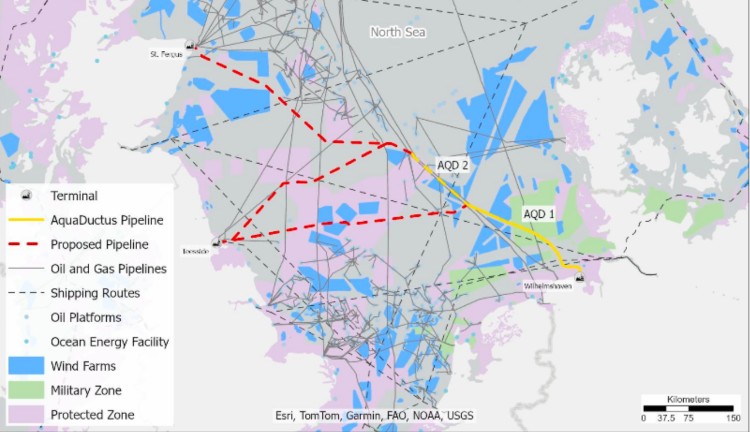
Note.
- The yellow AquaDuctus pipeline connected to the German coast near Wilhelmshaven.
- There appear to be two AquaDuctus sections ; AQD 1 and AQD 2.
- There are appear to be three proposed pipelines, which are shown in a dotted red, that connect the UK to AquaDuctus.
- The Northern proposed pipeline appears to connect to the St. Fergus gas terminal on the North-East tip of Scotland.
- The two Southern proposed pipelines appear to connect to the Easington gas terminal in East Yorkshire.
- Easington gas terminal is within easy reach of the massive gas stores, which are being converted to store hydrogen at Aldbrough and Rough.
- The blue areas are offshore wind farms.
- The blue area straddling the Southernmost proposed pipe line is the Dogger Bank wind farm, is the world’s largest offshore wind farm and could eventually total over 6 GW.
- RWE are developing 7.2 GW of wind farms between Dogger Bank and Norfolk in UK waters, which could generate hydrogen for AquaDuctus.
This cooperation seems to be getting the hydrogen Germany needs to its industry.
It should be noted, that Germany has no sizeable hydrogen stores, but the AquaVentus system gives them access to SSE’s Aldbrough and Centrica’s Rough hydrogen stores.
So will the two hydrogen stores be storing hydrogen for both the UK and Germany?
Storing hydrogen and selling it to the country with the highest need could be a nice little earner.
On X-energy
These are three paragraphs from the article.
He is also backing a £10 billion plan to build the UK’s first advanced modular reactors in a partnership with X-energy of the US.
The project is taking place in Hartlepool, in County Durham, where the existing nuclear power station is due to reach the end of its life in 2028.
As is the nature of these projects, it involves risks around technology, regulation and finance, though the potential rewards are significant. Among them is the prospect of 2,500 jobs in the town, where unemployment is high.
Note.
- This is another bold deal.
- I wrote in detail about this deal in Centrica And X-energy Agree To Deploy UK’s First Advanced Modular Reactors.
- Jobs are mentioned in the This is Money article for the second time.
I also think, if it works to replace the Hartlepool nuclear power station, then it can be used to replace other decommissioned nuclear power stations.
On Getting Your First Job
These are three paragraphs from the article.
His career got off to a slow start when he struggled to secure a training contract with an accountancy firm after leaving Glasgow University.
‘I had about 30, 40 rejection letters. I remember the stress of not having a job when everyone else did – you just feel different,’ he says.
He feels it is ‘a duty’ for bosses to try to give young people a start.
I very much agree with that. I would very much be a hypocrite, if I didn’t, as I was given good starts by two companies.
On Apprenticeships
This is a paragraph from the article.
‘We are committed to creating one new apprenticeship for every day of this decade,’ he points out, sounding genuinely proud.
I very much agree with that. My father only had a small printing business, but he was proud of the apprentices he’d trained.
On Innovation
Centrica have backed three innovative ideas.
- heata, which is a distributed data centre in your hot water tank, which uses the waste heat to give you hot water.
- HiiROC, which is an innovative way to generate affordable hydrogen efficiently.
- Highview Power, which stores energy as liquid air.
I’m surprised that backing innovations like these was not mentioned.
Conclusion
This article is very much a must read.
I’ve Signed Up For A Heata
I’ve now got the new boiler, I said I was getting in I’m Getting A New Hydrogen-Ready Boiler.
But unfortunately, during the fitting, we found that my hot water system had a leak problem and the immersion heater wasn’t working.
So I decided to sign up for a heata, which I wrote about in British Gas Partners With heata On Trial To Reuse Waste Heat From Data Processing.
It was a painless process, but unfortunately, I can’t have one yet, as they told me this.
Thank you for registering interest in being part of the heata network, very much appreciated.
We’ll be in touch when there is an opportunity to be part of a pilot, eg testing our unvented heata unit, or to join the network as it expands.
The heata team.
That is very fair.
They didn’t request anything more than name, e-mail address, broadband speed and my hot water tank type.
They didn’t ask for full address, credit card or even, who was my energy supplier.
In the meantime, I can use the new boiler for hot water.
How Heata Works
This page on the heata web site, describes how the system works.
I’m Getting A New Hydrogen-Ready Boiler
The pump in my current nine-year-old boiler has died and it needs to be replaced.
The plumber gave me two solutions.
- Put a new pump in the old boiler.
- Replace the boiler with the current version of the old boiler.
Note.
- The plumber said the new boiler would be hydrogen-ready.
- I seem to remember the same pump failed before.
- The pump had failed because of a water-leak into its electrics.
- Was the previous failure of the pump caused by the same water-leak?
- Fitting a heat pump in my house would probably cost more than I could afford.
- The new boiler would come with a ten-year guarantee.
As an engineer, I can see the following scenarios for heating my house and providing hot water.
1. Keeping Calm And Carrying On
This means that the current arrangements for energy continue.
- There would be no compulsory heat pumps.
- There would be no change to any of my hardware, after installing the new boiler.
- I would continue to get gas for heating and hot water delivered through the mains.
The new boiler solution should give me ten years of reasonably trouble free-running, so long as the gas was natural gas, hydrogen blend or hydrogen.
2. Keeping Calm And Carrying On But My Energy Supplier Switches My Gas To 20 % Hydrogen-Blend
This means that the current arrangements for energy continue.
- There would be no compulsory heat pumps.
- There would be no change to any of my hardware, after installing the new boiler.
- I would continue to get gas for heating and hot water delivered through the mains.
- The gas pipe into my house would have to be checked for compatibility with hydrogen-blend. But then I encountered no problems when switched from coal-gas to North Sea Gas around 1970.
The new boiler solution should give me ten years of reasonably trouble free-running, so long as the gas was natural gas, hydrogen-blend or hydrogen.
3. Keeping Calm And Carrying On But My Energy Supplier Switches My Gas To 100 % Hydrogen
This means that the current arrangements for energy continue.
- There would be no compulsory heat pumps.
- There would be no change to any of my hardware, after installing the new boiler.
- I would continue to get gas for heating and hot water delivered through the mains.
- The gas pipe into my house would have to be checked for compatibility with hydrogen.
The new boiler solution should give me ten years of reasonably trouble free-running, so long as the gas was natural gas, hydrogen blend or hydrogen.
4. Switching To Some Form Of Heat Pump
- This would mean that I would go all electric.
- My house is a concrete lump and a guy I trust, said it would be difficult to fit a heat pump.
- I am suspicious of scientific and technical solutions proposed by politicians.
I’m not saying, I’d never use a heat pump, but I will take a lot of convincing.
5. Switching To Some New Form Of Electric Heating
I have seen two companies, which use the excess heat from a data centre to heat water for central heating and/or hot water for domestic needs.
- heata is a spin out from Centrica, that provides hot water and saves you money on your utility bill.
- thermify is a startup from Wales, that replaces the gas boiler, with an electric one.
There are probably other similar systems under development.
From my knowledge of computing and electrical engineering, I believe devices like this could be new form of cost-efficient electric heating.
Because my house has three-bedrooms, I would need a thermify, for both heating and hot water, but a heata working in tandem with my gas boiler could probably keep me in hot water.
I would feel that large blocks of flats or offices could have a data centre in the basement to provide heat for the building.
I would also suspect, that there are other devices out there, that work on different principles.
My Decision
I’m fitting a new boiler, as that should give me ten years’guarantee-backed and trouble free running and future-proof me for all possible government decisions, except saying that everybody must fit a heat pump.
When, this new boiler pops its clogs, i would hope, that some clever engineers have come up with a plug-compatible electric replacement for the new boiler I am about to have fitted.
AI Forecast To Fuel Doubling In Data Centre Electricity Demand By 2030
The title of this post, is the same as that as this article in The Times.
This is the sub-heading.
International Energy Agency predicts that artificial intelligence could help reduce total greenhouse gas emissions
These are the first two paragraphs.
Data centres will use more than twice as much electricity by 2030 than they do today as artificial intelligence drives demand, the International Energy Agency predicts.
The agency forecast that all data centres globally will use about 945 terawatt-hours of electricity each year by 2030, roughly three times as much as the UK’s total annual demand of 317 terawatt-hours in 2023.
I am very much an optimist, that here in the UK, we will be able to satisfy demand for the generation and distribution of electricity.
- Our seas can accommodate enough wind turbines to provide the baseload of electricity we will need.
- Roofs and fields will be covered in solar panels.
- SSE seem to be getting their act together with pumped storage hydro in Scotland.
- I am confident, that new energy storage technologies like Highview Power with the packing of companies like Centrica, Goldman Sachs, Rio Tinto and others will come good, in providing power, when the wind doesn’t blow and the sun doesn’t shine.
- Hopefully, Hinckley Point C and Sizewell C will be online and soon to be joined by the first of the new small modular nuclear reactors.
- Hopefully, Mersey Tidal Power will be operating.
- There will be innovative ideas like heata from Centrica’s research. The economical water heater even made BBC’s One Show last week.
The only problem will be the Nimbies.
British Gas Partners With heata On Trial To Reuse Waste Heat From Data Processing
The title of this post, is the same as that of this news item from Centrica.
This is the sub-heading.
British Gas has partnered with sustainable cloud computing provider, heata, on an innovative trial to explore how harnessing waste heat generated by computer servers can save households money on their bills.
These two paragraphs describe heata’s system.
heata’s innovative model distributes cloud computing workloads to servers in homes. In a data centre, the heat generated during processing is a waste product, and energy-intensive cooling systems are required to stop the servers from overheating.
To overcome this, heata has created a ‘virtual data centre’ – a network of servers distributed in people’s homes. Each server is attached to the home’s hot water cylinder, and as they process data, the heat they generate is transferred into the water. This reduces the energy needed to heat water in the home, and as this is typically provided by gas boilers, it reduces the amount of gas used, lowering the carbon impact as a result. heata pays for the electricity the heata unit uses, which means the household pays less to heat their hot water.
Note.
- I would expect that future systems would also heat the house.
- I would be an ideal system for my house, as I have an unusual skin, that is better with a daily bath.
- I also wash my eyes most days with clean warm water, as they are often full of sleep.
- heata has a web site.
- heata has an about page, which describes the company and the technology.
- heata is supported by British Gas, Innovate UK and Sustainable Futures.
- Thermify is a similar system.
These three paragraphs describe the trial.
As part of a three-month trial, 10 heata units will be installed in the homes of British Gas employees, and the energy provider’s computing workloads will be processed on these units. As a result British Gas will be providing free hot water for its own employees as a byproduct of their own cloud compute.
The trial will provide feedback around performance and customer experience, as well as demonstrating the associated CO2 and energy cost savings to further co-develop customer propositions in 2025.
According to heata, the devices can provide up to 4kWh of hot water per day, with the technology expected to save households up to £340 per year when offsetting electrically heated hot water, and up to £120 when offsetting gas heated hot water.
I shall certainly think about fitting one.

