Hunts Cross Station To Go Step-Free
This document on the Government web site is entitled Access for All: 73 Stations Set To Benefit From Additional Funding.
Hunts Cross station is on the list.
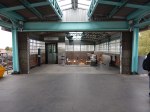
These pictures show the station and the current bridge.
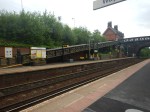
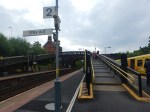
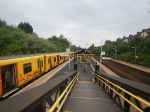
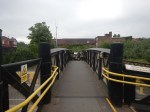
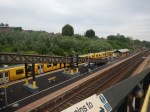
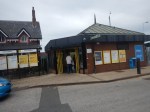
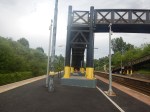
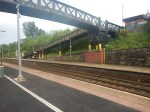
Hunts Cross station, like St. Michaels station, has rather unusual long shallow angle ramps, with steps.
This 3D Google Map shows the station.
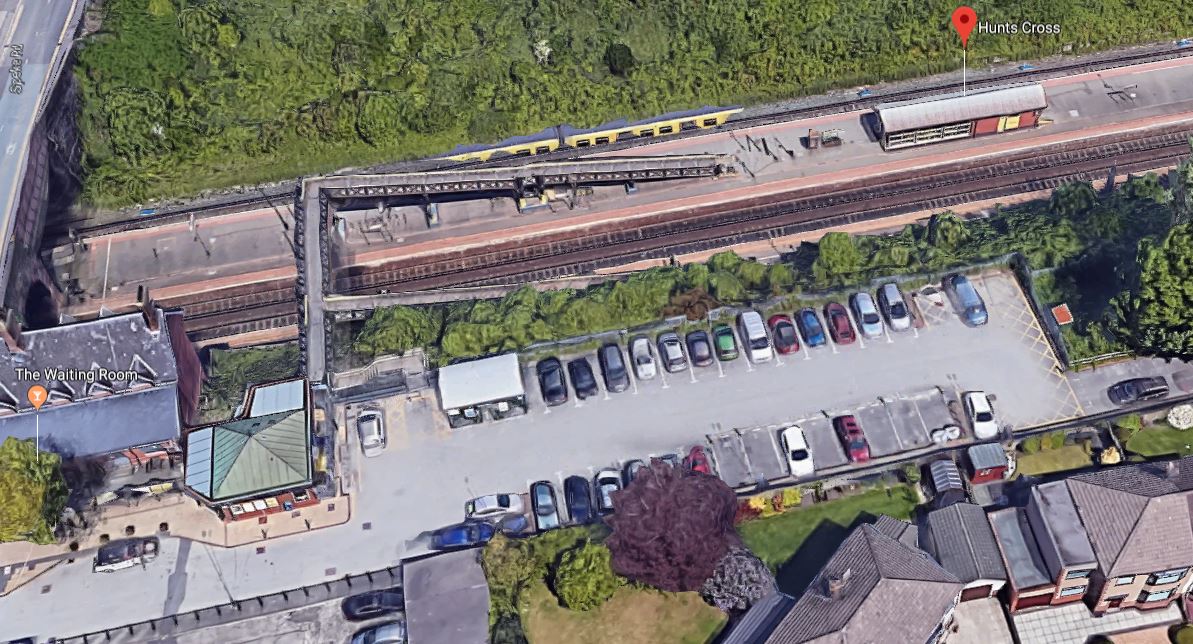
It may be unusual, but I suspect a conventional lift tower on each platform would make the station fully step-free.
Note.
- The station is Grade II Listed and is described as”A good example of the stations built for the Cheshire Lines Committee.”
- The ramps and bridge look to be in excellent condition and could be reasonably recent. Some repainting was actually in progress.
- For those that are in need of a drink, after climbing the ramps, there is a handy pub called the Waiting Room. It was busy, when I went to the station.
- As well as providing step-free entrance and exit to the station, the lifts would provide step-free interchange for passengers from Manchester needing to transfer to Merseyrail.
- Passengers arriving at the station, who need to go to Manchester, would do as they do now and walk across the platform.
- Do the last two pictures in the gallery show that the bridge was built or has been modified for lifts to be added? The bridge seems to have a lower wall, which could be removed.
- There may be some adjustments needed to the path that Links the station entrance to the bridge.
I’m also pretty certain, that the layout of the station, would allow works to be done, whilst the station is in full operation.
Preparation For Class 777 Trains
Unlike most other stations, that I saw on on the Merseyrail network, work appears to be outstanding to create level access between the new Class 777 trains and platform.
Future Electrification
The bridge would appear to be high enough to clear any future 25 KVAC electrification.
Conclusion
This shouldn’t be the most difficult of projects, unless the Heritage Lobby get upset.
The only problem, I can see would be, it might attract more passengers and create a need for a larger car park.
The Steps At Dalston Junction Station
Dalston Junction is a four-platform station and these are the only stairs at the station.

I think the design is excellent.
- They serve all four platforms, so you can’t go the wrong way!
- They are very wide, so have a high capacity.
- There are effectively four handrails for those like me, who want or need to hold on.
- Fit travellers who can lift their case, can use the stairs.
- There is a landing half-way up.
- The stairs are well-lit.
- in 2017-2018, the stairs handled nearly six million passengers.
- The small number of interchange passengers don’t need to use the stairs and walk between platforms on the level.
- The steps are Transport for London’s typical low-slip design.
- At the bottom of the staircase, there is a wide landing area with two train information displays and a 20-30 metre walks to the four platforms.
- At the top of the staircase there is a wide lobby, with the wide gate-line in front of passengers coming up the stairs.
- There is usually, a member of the station staff watching the passenger flows and answering any questions.
But above all there is a single lift about ten-twenty metres from the stairs, so avoiding the stairs is easy and obvious.
I have seen few stairs in stations as well-designed as these.
A few more general observations.
Wide Stairs With A Double Rail In the Middle
This design of stairs is being increasingly seen in London and around Europe.
In Stairs And A Lift At Cannon Street Station, I show a similar installation.
But there are loads like this monstrosity at Bethnal Green station in Before Overground – Stairs Not Fit For Purpose.
How many stations could be improved by widening the staircase?
Probably quite a few, but many staircases are constrained within solid walls.
Handrails
Transport for London generally use round and easy-to-grip handrails.
These are the best I’ve seen, which are on the Amsterdam Metro.

Some on British Rail-era stations are big and square and must be difficult for those with small or frail hands.
An Obvious Lift
At Dalston Junction, the lift is obvious as you approach the stairs.
But in some stations, the lifts are at the other end of the platform.
The Greenford Solution
These pictures show the solution at Greenford station.


Note.
- There is an up-escalator.
- A staircase,which is as wide as possible.
- There are three handrails with a low rail for those who prefer it.
- There is an inclined lift, which saves space.
I think we’ll see more step-free installations of this style.
Safety
I won’t comment on safety, as I don’t want to bring bad luck to the installations.
Conclusion
All those designing staircases and lift systems for stations, should be made to visit Dalston Junction and Greenford stations in the Peak.
New Lifts At Finsbury Park Station
As I passed through Finsbury Park station, I took these pictures of the new lifts to the Piccadilly and Victoria Lines.



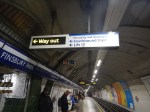
These lifts are particularly needed as there are no escalators between the Underground and the surface and you have to use spiral staircases.
This access is probably one of the worst design crimes on the Victoria Line, which was built on the cheap in the 1960s.
Notice that some of the signage is not complete and finding the lifts isn’t as easy, as it should be.
But then the installation is not fully finished.
An Encounter In A Lift
I don’t use lifts on the trains very often, except when I am lumbered with heavy shopping, or to use a lift is substantially quicker.
This morning my Northern Line train arrived at Kings Cross, so that I alighted right by the lift, in time to see two ladies with babies in buggies, leave the lift and get on the platform.
Now this was a time-saving that was too good to be true, as this lift drops you just by the ticket gates.
I waited to press the button, in case someone else needed the lift.
My only companion turned out to be an attractive tall lady about thirty, who was strikingly dressed, with a very short leather skirt and shoes with the some of the highest heels, I’ve ever seen on the street.
If I do travel in a lift, I like to not be youngest person in the lift, as one has to keep up standards and fight hard against anno domini.
So I said to the lady. “Thanks for coming in the lift, as I make it a rule not to use a lift, unless there’s someone younger than myself on-board!”
She smiled and replied. “I can’t climb the stairs in these f**king shoes!”
Trying to be sympathetic, I said. “Couldn’t you have worn something more comfortable?”
“No!” She replied! “I’m a backing singer going to an audition. One has to impress!”
I hope all her efforts were rewarded!
An Unusual Set Of Steps
These steps currently exist at Moorgate station.

The steps have been closed and it looks like they will be replaced by a lift to the subway.
At least they’re roped off securely!
The Inclined Lift In An Improved Greenford Station
I visited Greenford station in January 2012, just after Transport for London announced that the last wooden escalator would be replaced with an inclined lift.
The lift has now been installed.

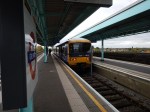
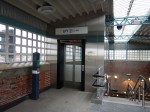
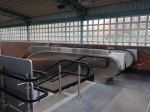
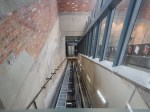


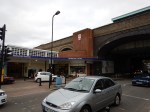
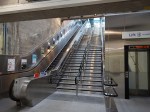

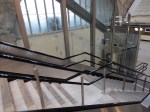
I rode down and then used the escalator up.
It is impressive and you do wonder how many other stations could have this type of lift installed.
This article on the Crossrail web site, entitled Crossrail and TfL to Install First Incline Lifts in UK Public Transport, says this.
Crossrail and Transport for London (TfL) today awarded a major contract to Kone for around 50 lifts for the new Crossrail stations as well as five lifts for Bank, Greenford and Hammersmith Tube stations.
Crossrail will pioneer the use of incline lifts to deliver step-free access at two of the major central London stations. Four innovative incline lifts will run alongside escalators at Farringdon and Liverpool Street Crossrail stations where it is not possible to install vertical lifts. London Underground will also install an incline lift at Greenford station by 2014.
My gateway to the Victoria Line; Highbury and Islington could be a possibility, but one of the station staff told me, that the space at the bottom of the current set of two escalators and a fixed staircase is very small and fitting a third escalator is impossible.
But it might be possible to squeeze in a much needed inclined lift. Note that the lift doesn’t intrude into the circulation space at the top and bottom of the stairs.
I suspect that Transport for London will be watching the Greenford installation with more than a usual interest.
They’ve certainly got several stations with both an up and down escalator and a stairway between that could be possibilities for conversion to fully step-free by the use of an inclined lift.
The station I could have used more times than any other; Southgate has the required space between the escalators, but as it is a Grade 2* Listed building, I can’t see the heritage lobby allowing even a well-designed and tasteful inclined lift into the Jewel of the Piccadilly Line.
But Bounds Green, Manor House, Turnpike Lane, Walthamstow Central and Wood Green could be ones to upgrade.
Around The Barbican
After my visit to the Cheapside Hoard, I walked across the Barbican to do some shopping at the Waitrose there.

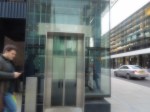

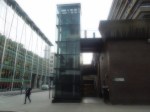

I can’t resist taking pictures of the iconic buildings, where C and myself brought up our young family.
Note the elegant public lift to the podium, which enables a corner to be cut off.
London’s First Inclined Lift Goes In
I went to Greenford station and they were well into the installation of the first inclined lift on the London Underground.

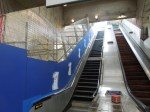

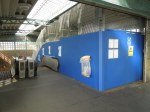
Note that the up escalator has wooden stairs. This post shows a few more pictures from nearly two years ago.
An Inclined Lift
In one of the stations I passed through on the Stockholm Metro, there was an inclined lift.
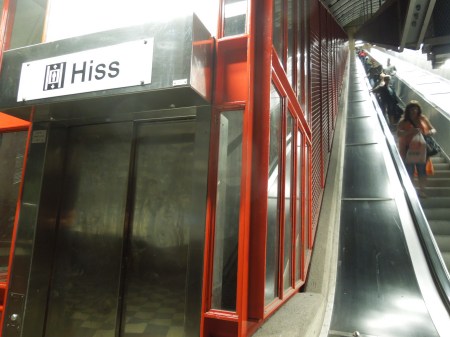
An Inclined Lift
Both Crossrail and the London Underground are installing some in the near future.
Hiss incidentally means lift and is easily remembered, if like me, you need the occasional pick-me-up.
Lisbon’s Unique Lift
Lisbon is one of the few places I know with a lift to raise you up the hill.




Unfortunately, it was so busy, I decided to give a ride a miss. But I did ride it twenty years ago with C.
I do sometimes wonder, why we don’t see more lift systems like this in cities!
 The Anonymous Widower