Can Park-And-Ride Stations Be Used To Increase Motorway Capacity?
This article on the BBC is entitled New Smart Motorway Plans Being Scrapped.
I’ve never driven or even been driven on a smart motorway. But one incident in the 1970s, convinced me that we should have full hard shoulders on motorways and probably some dual carriageway roads.
I was travelling North on the then-two-lane M11 just North of Stansted Airport, doing around seventy in the outside lane of a not very busy motorway.
From nowhere an MGB convertible appeared in my mirrors and I pulled over to let the other car through.
There was a slight bend to the right at that point and the road was in a cutting.
The MGB just went straight on, climbed the banking and then turned over and rolled down and into the middle of the motorway.
A couple of other cars stopped on the hard shoulder and I initially pulled in behind them.
Miraculously, the driver had got out of the upside-down MGB and was standing beside the car.
I noticed that someone was using the emergency telephone by the side of the motorway, but I was worried that someone could come along too fast.
So as I had a large white car, I switched on the hazard lights and reversed down the hard shoulder. It certainly slowed everybody down and there were no more bumps or injuries. But what would have happened if the motorway had been busy?
When I first heard that smart motorways were going to be introduced in 2007, I was immediately against the idea because of that serious incident on the M11.
So what can we do to increase the capacity of our motorway and main road network?
Mathematical Modelling
In the 1970s, my software was used to model water supply in the UK. This piece of software just solved simultaneous differential equations and was used by the Government’s Water Resources Board.
I believe that software like I wrote fifty years ago and other more modern systems can be applied to traffic flows.
This should mean that any solutions put forward should be able to be tested.
Use Of Trains
If people can be encouraged to mode-shift and use trains, that must reduce the number of cars on the motorways.
But to get people out of their cars, there must be more Park-and-Ride stations.
And these new Park-and-Ride stations, must be attractive to motorists.
In Was Baldrick An Essex Man?, I looked at the design of the new Beaulieu Park station.
I feel that this is almost a new type of Park-and-Ride station, so is it part of a cunning plan to attract more passengers to the trains.
- It has a high-quality specification.
- Seven-hundred parking spaces will be built with hopefully an adequate number of chargers for electric vehicles.
- There will be five-hundred bicycle spaces.
- As it appears the station will be surrounded by 14,000 houses, I expect Network Rail are hoping lots of passengers will use the station.
But what is most unusual is that the station has an avoiding line, which should increase capacity and speed on the line through the station.
I also think, that the station is not just about journeys to London and Chelmsford, but also to other places in East Anglia like Cambridge, Ipswich and Norwich.
So have Network Rail designed a station that will maximise the return on their investment?
Only time will tell!
Conclusion
I think that Network Rail are trying to see if there is money to be made in the design of Park-and-Ride stations.
Further Thoughts On BP’s Successful INTOG Bid
I have been searching the web and I feel BP’s successful INTOG bid may be different.
In 13 Offshore Wind Projects Selected In World’s First Innovation And Targeted Oil & Gas Leasing Round, I decided that BP’s bid, which only was for 50 MW of offshore wind would generate hydrogen and send it to shore through the Forties Pipeline System, which is owned by INEOS.
My reasons for feeling that it would generate hydrogen were as follows.
- In the wider picture of wind in the North Sea, BP’s proposed 50 MW wind farm is a miniscule one. SSE Renewables’s Dogger Bank wind farm is over a hundred times as large.
- A cable to the shore and substation for just one 50 MW wind farm would surely be expensive.
- BP Alternative Energy Investments are also developing a 2.9 GW wind farm some sixty miles to the South.
- It would probably be bad financial planning to put large and small wind farms so close together.
I still believe for these and other reasons, that there is no reason to believe that the proposed 50 MW wind farm is a traditional wind farm and most likely it will be paired with an appropriately-sized electrolyser producing around twenty tonnes of hydrogen per day.
But instead of being sent ashore by using the Forties Pipeline System, could this hydrogen be sent directly to the coast near Aberdeen, in its own personal hydrogen pipeline?
- Using a variety of maps, I have estimated the distance at only around twenty miles.
- With all the experience from BP and their suppliers, there must be a solution for a relatively short hydrogen pipeline.
I also found this scientific paper on ScienceDirect, which is entitled Dedicated Large-Scale Floating Offshore Wind To Hydrogen: Assessing Design Variables In Proposed Typologies, which talks about three different layouts.
- Centralised Onshore Electrolysis
- Decentralised Offshore Electrolysis
- Centralised Offshore Electrolysis
All would appear to be feasible.
There is a lot of information in the scientific paper and it leads me to the conclusion, that hydrogen could be generated offshore and transferred by pipeline to storage on the shore.
The paper shows a design for a submarine hydrogen pipeline and schematics of how to design a system.
I believe that BP’s proposed system could deliver around twenty tonnes of hydrogen per day to the shore.
The system could be as simple as this.
- A few large floating wind turbines would be positioned offshore, perhaps twenty miles from shore.
- Perhaps 5 x 10 MW, 4 x 12 MW turbines or 3 x 16 MW could be used. Deciding would be one of those calculations, that combines accountancy, data, engineering and finance, which are great fun.
- The offshore distance would be carefully chosen, so that complaints about seeing them from the shore would be minimised.
- The generated electricity would be collected at a floating electrolyser, where hydrogen would be created.
- The hydrogen would be pumped to the shore.
- The floating electrolyser could also contain hydrogen storage.
I think there is large scope for innovation.
- I can imagine drones and helicopters delivering equipment and personnel to service the electrolyser.
- Underwater hydrogen storage could be developed.
- A standard system could be developed for rolling out anywhere.
- It could be placed in the sea, by a steelworks or other large hydrogen user.
In its own right the concept would develop new markets, which is one of the wind farm’s aims.
Could This Be The Route To Create Affordable Hydrogen For All?
BP would be failing their customers, employees and shareholders, if they weren’t developing a zero-carbon alternative to diesel and petrol.
Offshore hydrogen electrolysers strategically placed along the coastline, could provide a reliable hydrogen supply to a that sizeable proportion of the world’s population, who live near to the coast.
Could The Technology Be Adapted To Motorway And Large Service Stations?
This document on the UK Government web site, gives the mileage statistics of lorries (HGVs) and has this sub-heading.
In 2019 lorries travelled 17.4 billion vehicle miles, remaining broadly stable (increasing slightly by 0.3%) compared with 2018.
It breaks this figure down, by the class of road.
- Motorways – 8.0 – 46 %
- A Roads – 6.3 – 36 %
- Rural Minor Roads – 0.9 – 5 %
- Urban A Roads – 1.5 – 9 %
- Urban Minor Roads – 0.7 – 4 %
Note that 82 % of HGV mileage is on Motorways or A roads. Anybody, who has ever driven a truck bigger than a Ford Transit over a distance of upwards of fifty miles, knows that trucks and vans regularly need to be fuelled up on the road. And that applies to the drivers too, who also by law must take a break, away from the cab.
Charging an electric truck could be a lengthy business and would require service stations to be connected directly to the nation grid and be fitted with a substantial number of heavy duty chargers.
One thing, that would be difficult with an electric truck, would be a Splash-and-Dash, if a truck was nearing the destination and needed a small amount of charging to meet delivery schedules.
Because of the distances involved, the driving rules, the often tight schedules and the fast filling, I am convinced that there will be a large proportion of hydrogen-powered trucks and vans on the road and these will need a network of service stations where hydrogen is available.
Look at these overhead view of South Mimms Services, where the M25 and the A1(M) cross to the North of London.
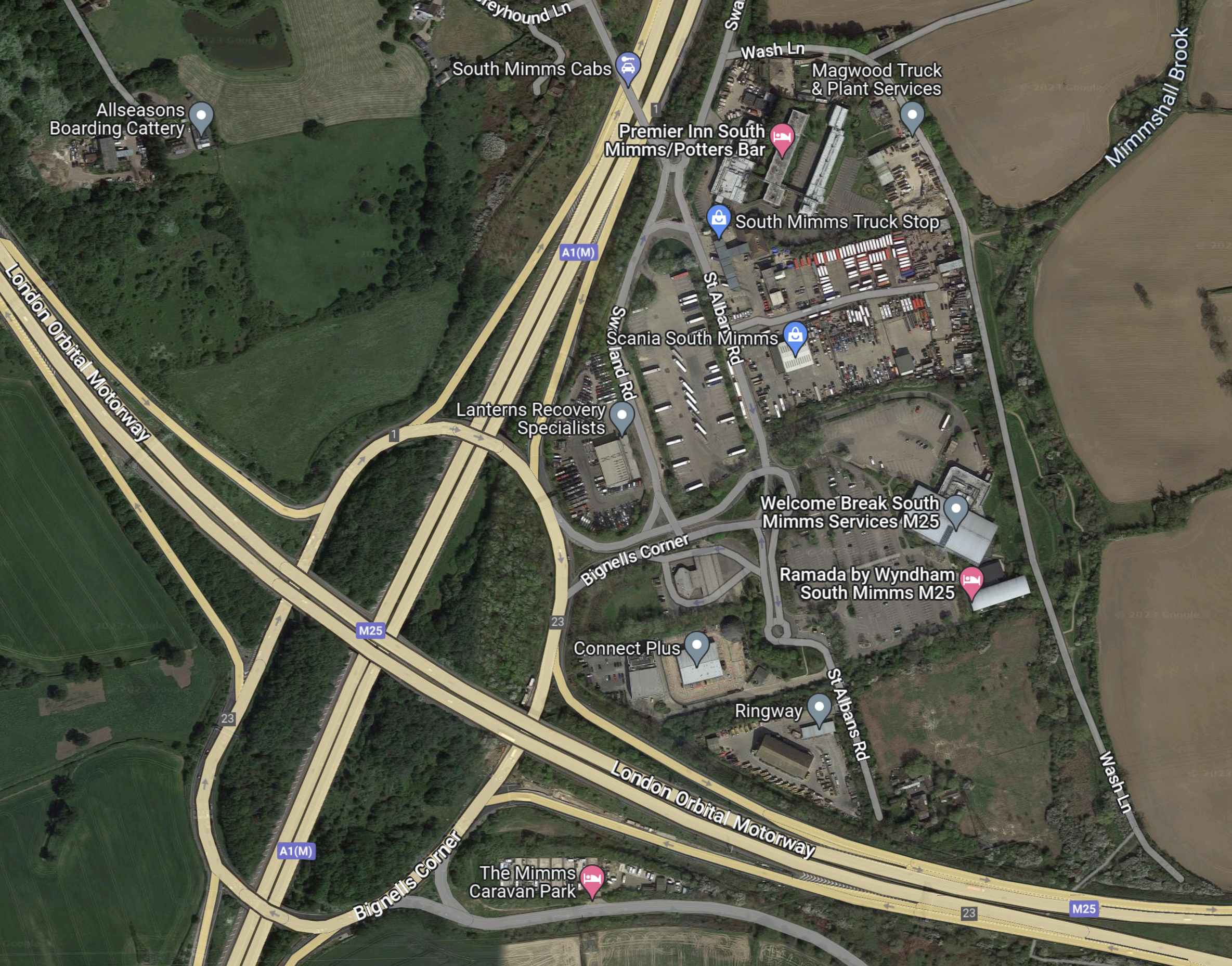
I would envisage that at least four 10 MW wind turbines, which have a rotor diameter of around 160-190 metres could be dotted around and inside the site including inside the roundabout.
- The electrolyser would be slightly smaller than that which would be used at Aberdeen.
- Perhaps fifteen tons per day of hydrogen could be generated.
- No hydrogen needed on the site would ever be brought in by truck.
- Wind-generated electricity could also power the hotels, restaurants and the service station.
- As the percentage of vehicles running on fossil fuels decreased, the air quality in the area of the service station, should increase.
- How many people, who lived locally would switch to a hydrogen-powered runabout and fill it up perhaps once a week, when they passed?
Much of the technology needed to add a hydrogen option to a typical large service station has already been developed and some would also be needed to build BP’s 50 MW offshore wind farm with an electrolyser.
English Motorway Gantries Get New, More Secure Design
The title of this post, is the same as that of this article on The Guardian.
This is the sub-heading.
National Highways hopes design will prove more resilient to trespassers after last year’s Just Stop Oil protests
These two paragraphs outline the design.
National Highways has unveiled a new design for motorway gantries that it hopes will prove harder for protesters to mount and use to cause disruption.
The renovated structures, which are expected to become the standard design in England from 2025, will have their maintenance steps hidden inside their pillars and will be more difficult to gain access to without authorisation.
As a scientifically-correct non-driver, I wouldn’t support Just Stop Oil.
But I do remember a tale from a few years back, when a friend, who was travelling up the M1, towing two horses in a trailer behind his pick-up. A guy was on a motorway gantry, threatening to commit suicide and traffic was stopped for several hours.
At the time he was informed by the police, that increasingly, they were seeing suicide attempts from motorway gantries.
If these new gantries can stop a proportion of suicides, that must be a good thing all round.
Huge Outlay On Motorways Despite Reduction In Traffic
The title of this post, is the same as a small news item in The Times on Friday.
According to the Commission on Travel Demand, individuals used cars and other vehicles fourteen percent less than they did in 2002.
Reasons given include internet shopping, Netflix and flexible working.
They also say that many in their teens and early twenties shunning car ownership altogether.
There is a graph in the article, which shows that the reduction has been largest in Greater London. That seems to fit with my observations.
- I’ve chatted to several youngsters , who have no intention of learning to drive for some years. It’s all just too costlyin the Capital and there are few places to park securely.
- I’m also sure, that my road which is wide and has cars parked on both sides, is less crowded than when I moved here nearly ten years ago. Now, when I get a parcel delivery, there is always space for the van outside.
- In Dalston, we have also benefited from the Overground and lots of new buses, although the frequency of the latter hasn’t increased.
- I wouldn’t underestimate the fact that those of a certain age, like myself, get free public transport in Greater London.
- There has also been a tremendous increase in the use of bicycles for commuting.
I don’t think that all parts of London have seen as much reduction as the North and East.
It always seems that traffic is busy, when I go to Chelsea, Westminster or the West End. But I don’t think we can stop, those with large 4x4s going to the local Waitrose and Harrods.
I also think, that Crossrail will reduce traffic across a whole swathe of London from Ealing to Ilford via Paddington, the West End and the City.
It will be a well-designed stylist railway with trains every few minutes.
According to the article, Metropolitan areas are also seeing a reduction in car use.
Although, they haven’t got as comprehensive, a public transport network as London, over the last ten years, several large metropolitan areas have improved public transport considerably.
Traffic also seems to have reduced slightly in what the report calls shire towns, resort and rural.
I would put this down to the three factors said earlier by the article; internet shopping, Netflix and flexible working.
The only places not showing a less significant decline is districts with industry and new towns.
But a lot of these have been built for car use.
Conclusion
It is a thought-provoking article.
Given that Greater London has shown the biggest decline in traffic and it has the most comprehensive public transport system in the UK, the question has to be asked if more money is spent on public transport, could it reduce the amount of money spent on the roads!
I would do the following.
- Build more welcoming new stations with adequate parking like, Apperley Bridge , Bromsgrove, Cambridge North, Ilkeston, Kenilworth, Kirkstall Forge and Maghull North.
- Update some of the worst stations in the country to a modern standard.
- Put more seats on busy routes.
- Increase train frequency where possible.
- Make certain everybody who wants to, can work flexibly from home.
- Use more sophisticated and better managed home delivery systems.
- Build HS2 as fast as possible.
- Develop more rail-based freight solutions.
- Make it possible to get to most Airports by public transport.
Hopefully, with local mayors and other devolved bodies, we’ll see more areas of the country taking the decisions they need.
 The Anonymous Widower