Electric Freight: A Solution To The WCML Capacity Conundrum
The title of this post is the same as that of this article on Rail Engineer.
These two paragraphs introduce the article.
Network Rail considers the West Coast Main Line (WCML) to be the busiest mixed traffic railway in Europe. It carries 125mph passenger trains from London to the West Midlands, North West, and Scotland and is used by 90% of intermodal UK rail freight which has a maximum speed of 75mph. Traffic on the line has been steadily increasing. In 1994 there were seven daily passenger trains from Glasgow to London. Now there are 26.
In 2006 Network Rail commissioned an in-depth study to find the best way of providing additional capacity as, with increasing traffic, the WCML between London and the North West was forecast to be full by 2020. The study found that the provision of a new high-speed line was the best solution and was the basis for the development of the HS2 project. The 2006 study correctly forecast that the WCML will by now be at full capacity south of Crewe, yet following the curtailment of HS2 two years ago there are no proposals to address the capacity issue between Rugby and Crewe that was identified 20 years ago.
David Shirres, puts forward a solution that involves electric freight locomotives and faster freight wagons.
I can add some knowledge of what British Rail were doing in the 1970s to solve the problem of freight on the West Coast Main Line all those years ago.
This picture shows a PACE 231R.
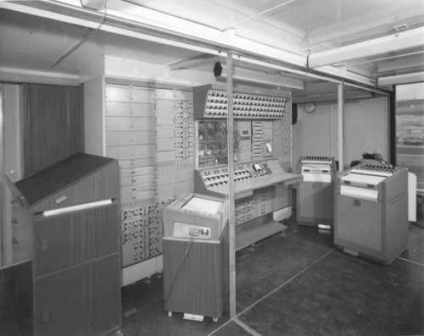
In the early 1970s, I was lucky enough to work with one of these amazing machines. They were probably one of the most powerful analogue computers ever built, that could solve a hundred simultaneous differential equations at once using thermionic valve circuitry. Their most famous application was at NASA, where two of these machines formed the analogue half of the moon-landing simulator.
There were a handful of these powerful beasts in the UK at ICI Plastics, where I worked, British Motor Corporation, Cambridge University and British Rail Research at Derby.
At the time, British Rail were trying to run freight trains faster and the four-wheel freight wagons of the time were derailing with an unwanted regularity. So the problem was given to British Rail Research and the problem was put on the PACE 231R. The problem was solved and the lessons learned were applied to the Mark 3 Coach and the InterCity 125.
After privatisation, the research went to the National Railway Museum and out of curiosity a few years ago, I tried to look at it, but was told it was commercially sensitive to Bombardier. It is my belief, that if this research were to be continued at one of our best universities, that faster freight bogies could be developed, that would help to create the extra freight paths needed on the WCML.
Grand Central Up And East Coast Down
I went up to York on Grand Central in First and came back down in Second on East Coast.

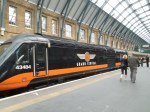

As you can see, both trains were forty-year-old InterCity 125s.
First Class on Grand Central might have been affordable at £49.50 and it was a convenient train in that it got there just before the museum opened, but it was a very poor offering. I got an uncomfortable seat with a narrow table in a group of four and the only refreshment I had was two cups of tea.
Coming back I’d booked an open Off Peak ticket at £32.00, so I could come back at a convenient time.
I managed to get a more comfortable window seat in a group of four, with a bigger table than I had on the way up. The train seemed to be fairly newly refurbished and was probably in better condition, than it had been in all of its long life. The trolley came through twice and I bought just a bottle of water.
Both trains were on time.
It is interesting to compare these two journeys with the Copenhagen to Hamburg trip I did recently in a diesel German ICE TD.
I was in First on the German train and the seat was marginally more comfortable, than that of the seat in Second on my journey home yesterday. I also had a bigger table. But the ride was no better on the newer German train, which incidentally tilts, and there was nothing to choose between the views through the wide windows on both trains.
But the real problem on the German train, was the total lack of a decent drinks service. The trolley on East Coast was much better. But I have feeling that the layout of German ICE trains effectively rules out a trolley. food on all three journeys didn’t include anything that was gluten-free, but that is coming if my taste of Virgin is anything to go by.
I doubt I’ll be travelling on Grand Central again, and certainly never in First. Unless I have no choice!
Multi-Lingual Signs At The NRM
The Keep Off signs were in three languages.
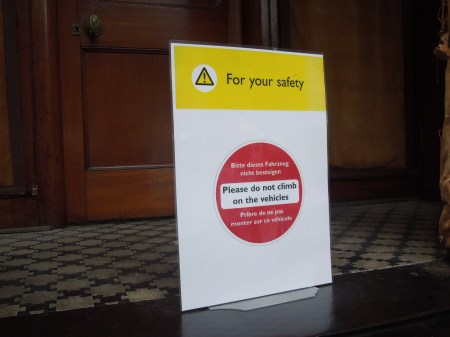
Multi-Lingual Signs At The NRM
But then there seemed to be a lot of foreign visitors. I was talking to a couple of Germans by the two paintings in this post.
A guide told me, that some visitors had come all the way from New Zealand
Going North And Going South
These two paintings were on display in the Nation Railway Museum at York.
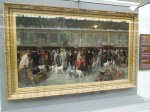


The artist was George Earl and the paintings are mentioned in his Wikipedia entry.
I found the paintings notable, as there were certainly Red Irish, English and Gordon Setters in the paintings. There could also have been Red and White Irish Setters too!
Green Arrow At York
I didn’t know any of the Class V2 were still in existence.
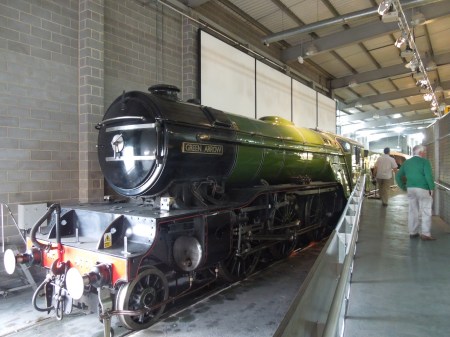
Green Arrow At York
But Green Arrow seemed to be in pretty good condition. I can remember them working out of Kings Cross in the early 1950s to places like Hull and Lincoln.
According to Wikipedia it might be scheduled to be returned to working condition. Although not as glamorous as the A4 Pacifics, it is the sole survivor of a class of locomotive, that proved influential in keeping the railways running during the Second World War.
There Were Crowds At York
To say the crowds at York were big would be an understatement,as you can see from the previous post.


These pictures were taken outside. Bear in mind that I timed my trip to get there as the museum opened.
But at least my only cost was getting to York, as the entry to the National Railway Museum was free.
Engineering Pornography At York
I went to the National Railway Museum today to see the Mallard 75 event or the Great Gathering as it is named by some.
Here are some pictures.









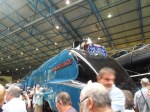




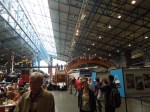
Sadly only three of the six iconic A4 Pacifics designed by Sir Nigel Gresley are still capable of steaming.
 The Anonymous Widower