One Of The Jobs I Did, That I’m Most Proud Of
In the early 1970s, I developed and attempted to market a simultaneous differential equation solving program called SPEED, which stood for Simple Program for the Efficient Evaluations of Differentials or something like that.
It wasn’t very successful, but two companies asked me to write some for them.
- For Time Sharing, I put the central algorithm into their simultaneous differential equation solver to move the program up to the next level.
- WS Atkins, asked me to install it on their computer.
SPEED had a few advantages over typical simultaneous differential equation solvers of the time like IBM/CSMP.
- IBM/CSMP needed at least an IBM 360/50 computer, which I ran it on at ICI in Welwyn Garden City, where I was a general mathematical dogsbody. But SPEED could run on a dial-up line to a time-shared computer like a PDP-10.
- The time-shared computers as used by Time Sharing and WS Atkins, gave the big advantage, that as the size of the computer increased, the size of the problem, that could be tackled in proportion.
- IBM/CSMP and SPEED both had a simple column-oriented report writer, which unsurprisingly ended up in Artemis, which I wrote a few years later.
- I can’t remember, who at ICI gave me the tip, but I used a sophisticated version of the Runga-Kutta algorithm, that everybody used and some probably still do today. The version, I used was called Runga-Kutta-England, where like me England, was a graduate of Liverpool University.
This summary by Google AI described the algorithm.
The England version of the Runge-Kutta method (developed by R. England) is a highly efficient 4th/5th order embedded numerical integration formula. By reusing intermediate slopes across two methods of differing orders, it provides a highly reliable built-in error estimate for adaptive step-size control.
Does anybody still use Runga-Kutta methods? I suspect not!
A breakthrough of sorts came, when WS Atkins asked me to produce a larger system of the SPEED software, that could handle several tens of thousands of equations.
- Atkin’s client was the Water Resources Board and they were modelling the water distribution system for a large part of the UK.
- Prominent in the project was a Dr. David A, Dimeloe and we became friends and had dinner with our wives a couple of times.
- But I never received a copy of the report, that was written or heard any more since about 1975.
- But judging by the fact, that we seem to have adequate supply of water in the UK and problems seem to be all about sewage, politics, management and finance, I feel that David and his team, must have done a good job.
- I was also never asked to fix any bugs in the software.
I did have some trouble getting the money I was owed from the intermediary in the deal, but I eventually retrieved it through the County Court without a solicitor.
How Did South East Water Become Such A Disaster?
The title of this post, is the same as that of this article in The Times.
This is the sub-heading.
As tens of thousands of homes in Kent and Sussex lose supply the company and its well-remunerated boss, David Hinton, face a torrent of anger
These two paragraphs add some detail.
Perhaps the worst moment for South East Water was when it opened a bottled water station in the wrong town. Staff set up in Tonbridge, Kent, and not Tunbridge Wells five miles away, where the company had left some 24,000 properties without drinking water for two weeks.
Or maybe it was when David Hinton, the chief executive, repeatedly called the local MP one evening not to apologise but to berate him about the crisis — not, Hinton later admitted, “my finest moment”. Or it could have been when more properties lost their supply only hours after Hinton had told MPs his company’s response to the incident should score eight out of ten.
It wasn’t exactly the water industry’s finest moment.
I played a small and hopefully professional and a hundred-percent scientifically correct manner in the formation of the modern water industry in the UK.
In the 1970s, I wrote the software, that WS Atkins rented from their time-sharing computer to the Water Resources Board at Reading to model water supply in all or part of the UK.
My differential equation solving software had been designed to handle up to around a million equations and the contact at the WRB was a Dr. David Dimeloe.
I was never given details of their model and the conclusions, but I assume they must have done a good job, as there haven’t been too many problems with actual water supply, but mainly with management, ownership and failure of ancient infrastructure.
In my 79 years in the UK, I’ve never had a problem with water supply.
Searching for the WRB on the Internet finds one in Sri Lanka.
It would be good to get a copy of that report or even talk to one of the engineers on the project.
Electric Freight: A Solution To The WCML Capacity Conundrum
The title of this post is the same as that of this article on Rail Engineer.
These two paragraphs introduce the article.
Network Rail considers the West Coast Main Line (WCML) to be the busiest mixed traffic railway in Europe. It carries 125mph passenger trains from London to the West Midlands, North West, and Scotland and is used by 90% of intermodal UK rail freight which has a maximum speed of 75mph. Traffic on the line has been steadily increasing. In 1994 there were seven daily passenger trains from Glasgow to London. Now there are 26.
In 2006 Network Rail commissioned an in-depth study to find the best way of providing additional capacity as, with increasing traffic, the WCML between London and the North West was forecast to be full by 2020. The study found that the provision of a new high-speed line was the best solution and was the basis for the development of the HS2 project. The 2006 study correctly forecast that the WCML will by now be at full capacity south of Crewe, yet following the curtailment of HS2 two years ago there are no proposals to address the capacity issue between Rugby and Crewe that was identified 20 years ago.
David Shirres, puts forward a solution that involves electric freight locomotives and faster freight wagons.
I can add some knowledge of what British Rail were doing in the 1970s to solve the problem of freight on the West Coast Main Line all those years ago.
This picture shows a PACE 231R.
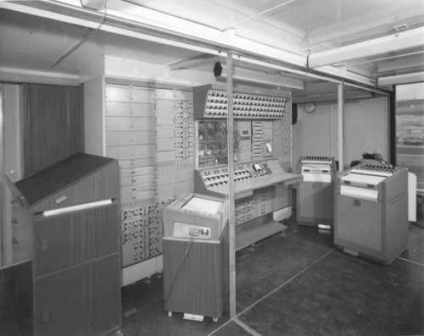
In the early 1970s, I was lucky enough to work with one of these amazing machines. They were probably one of the most powerful analogue computers ever built, that could solve a hundred simultaneous differential equations at once using thermionic valve circuitry. Their most famous application was at NASA, where two of these machines formed the analogue half of the moon-landing simulator.
There were a handful of these powerful beasts in the UK at ICI Plastics, where I worked, British Motor Corporation, Cambridge University and British Rail Research at Derby.
At the time, British Rail were trying to run freight trains faster and the four-wheel freight wagons of the time were derailing with an unwanted regularity. So the problem was given to British Rail Research and the problem was put on the PACE 231R. The problem was solved and the lessons learned were applied to the Mark 3 Coach and the InterCity 125.
After privatisation, the research went to the National Railway Museum and out of curiosity a few years ago, I tried to look at it, but was told it was commercially sensitive to Bombardier. It is my belief, that if this research were to be continued at one of our best universities, that faster freight bogies could be developed, that would help to create the extra freight paths needed on the WCML.

