Two UK Offshore Wind Farm Extension Projects Sign ‘Good Neighbour Agreement’
The title of this post, is the same as that of this article on offshoreWIND.biz.
This is the sub-heading.
The North Falls and Five Estuaries offshore wind projects, both extensions to existing offshore wind farms, have signed what is called a “good neighbour agreement” with regard to their connections to the UK grid.
I have flagged up this article as it shows the benefits that can accrue if infrastructure developers listen to the locals and cooperate with all stakeholders.
This paragraph describes the agreement,
The agreement enables closer liaison, information sharing and joint planning, and is a result of feedback gathered through public consultation, which has shown a preference for more cooperation and coordination between the two projects on the landfall location, onshore corridor route, substation location and stakeholder engagement.
It is probably helpful that RWE is involved in both projects.
North Falls wind farm is a 504 MW wind farm being developed by SSE Renewables and RWE.
Five Estuaries wind farm is under development by RWE and the size doesn’t seem to have been decided yet.
This is all good project management.
Let’s hope ur all goes well!
WES Starts Testing Combined Floating Wind And Wave Energy Models
The title of this post, is the same as that of this article on offshoreWIND.biz.
This is the sub-heading.
Wave Energy Scotland (WES) has started a series of tank tests of floating wind and wave energy structures at the University of Edinburgh’s FloWave facility to explore the potential benefits the synergy between the two technologies could bring.
These two paragraphs introduce the technology.
The tank tests currently being completed by WES use sea states which are representative of one of the future floating wind lease sites on the west coast of Scotland, leased through the ScotWind program and which has an appropriate water depth and wave resource for large-scale wave energy exploitation.
The physical model used for the testing incorporates multiple identical wave energy absorbers mounted onto a semi-submerged, triangular floating platform.
Have we got enough research facilities to test devices like these?
I can find these.
With Edinburgh, that makes five.
First Turbines Up At World’s Biggest Offshore Wind Farm
The title of this post, is the same as that of this article on offshoreWIND.biz.
This is the sub-heading.
The first two wind turbines have been installed at Dogger Bank A, the first of the three phases of the UK’s 3.6 GW Dogger Bank Wind Farm, the world’s biggest offshore wind farm under construction.
It is a good article that documents how a fixed-foundation wind farm is assembled.
The Dogger Bank wind farm will contain these separate wind farms.
- Dogger Bank A – 1235 MW – 95 x 13 MW – Under Construction – Commission in 2023
- Dogger Bank B – 1235 MW – 95 x 13 MW – Pre-Construction – Commission in 2024
- Dogger Bank C – 1218 MW – 87 x 14 MW – Pre-Construction – Commission in 2025
- Dogger Bank D – 1320 MW – Early Planning
- Dogger Bank South – 3000 MW – Early Planning
Note.
- The Dogger Bank wind farms are currently planned to be a shade over 8 GW.
- I have used data from Wikipedia’s List of offshore wind farms in the United Kingdom.
This family of wind farms could provide almost a third of our electricity or as I showed in The Mathematics Of Blending Twenty Percent Of Hydrogen Into The UK Gas Grid, it could provide enough hydrogen to blend 20 % of hydrogen into the UK gas grid.
Conclusion
Dogger Bank will have moved from a joke in the Shipping Forecast to one of our most important natural resources.
SSE And RWE Tweak North Falls Project Following Public Input, DCO Application Now Expected In 2024
The title of this post, is the same as that of this article on offshoreWIND.biz.
This is the sub-heading.
RWE and SSE Renewables have made a number of changes to the North Falls offshore wind project in the UK, a proposed extension to the existing 504 MW Greater Gabbard, whose implementation will likely move the planned date for filing a development consent order (DCO) application into 2024. The most significant changes to the project plans include removing the northern array area and reducing the number and height of wind turbines.
These two paragraphs introduce the article.
The developers are tweaking the project following a review of the feedback received from the North Falls statutory consultation held during the summer.
Initially, North Falls comprised two offshore array areas totalling 150 square kilometres and will now have a single array occupying 95 square kilometres. This also moves the wind farm farther offshore, with its closest point to shore now being 42 kilometres, 20 kilometres farther out at sea than proposed originally.
It looks like RWE and SSE Renewables have listened to the public and acted.
But then the developers are two of the most experienced in the UK.
Offshore Wind Could Secure Scottish Green Hydrogen Potential – Report
The title of this post, is the same as that of this article on offshoreWIND.biz.
This is the sub-heading.
New and existing offshore wind farms could help generate large amounts of green hydrogen and support the UK and EU meet their net zero targets, if the necessary infrastructure can be put in place, according to a new report commissioned by Crown Estate Scotland.
This page on the Crown Estate Scotland gives the full report.
The report contains a lot of interesting information.
Malta Months Away from First Offshore Wind Tender, Identifies Six Floating Wind Areas
The title of this post, is the same as that of this article on offshoreWIND.biz.
This is the sub-heading.
Malta’s Ministry for the Environment, Energy and Enterprise has issued a draft National Policy for the Deployment of Offshore Renewable Energy for public consultation and has demarcated six floating offshore wind development areas located beyond the country’s 12-nautical-mile territorial waters and into its potential Exclusive Economic Zone (EEZ).
These are the first three paragraphs.
According to the Ministry, an international call for expressions of interest will be launched after the public consultation and the subsequent updating of the policy document, while a Strategic Environmental Assessment (SEA) will be prepared at the same time. The completion of a plan-level SEA will help further narrow down the preliminary areas and pinpoint the preferred locations for offshore renewable installations.
The six areas, as well as the rest of Malta’s potential EEZ, have been deemed most suitable for floating offshore wind and solar technologies and, according to the policy, the government has taken into account the possibility of having projects that combine the two technologies.
Looking at other offshore and marine renewables, the government has determined that, although not precluded, wave and tidal energy potential for Malta is considered very limited.
Note.
- Malta has no domestic resource of fossil fuels and no gas distribution network.
- Renewable energy on Malta has one of the lowest shares in the European Union.
- Malta has four operational electricity plants , with a total capacity of 537.8 MW.
- There is a 200 MW interconnector to Sicily.
- Malta has run a pilot project to assess floating solar power.
- The article embraces solar power, but dismisses wave and tidal power.
As the article says that Malta has 25 GW of offshore wind potential, I suspect that Malta will attract bids for the offshore wind licences around the island from some of the world’s largest, experienced and most well-respected offshore wind companies.
I do have a few thoughts.
A Large Generation Capacity
If Malta develops its full 25 GW of offshore wind potential, it will have more than enough electricity for its normal use.
This could mean.
- Malta could have all the electricity needed to run air-conditioners everywhere.
- Malta could export electricity to Sicily.
- Malta could become a hydrogen production centre.
- I also suspect, it could mean that Malta would need some energy storage.
I’ll look at the last two points, in the next two sections.
Hydrogen Production
In the last year or so I’ve written several posts about Offshore Hydrogen Production and Malta would it seems be an ideal location to develop this industry.
- Hydrogen could be used for transport on the island.
- Hydrogen could replace imports of gas.
- Hydrogen could be exported by tanker.
- Lhyfe and other companies are developing offshore hydrogen production.
I don’t think, there would be a problem recruiting engineers to develop the industry.
Energy Storage
Because of the large generation capacity around Malta, even with substantial hydrogen production, I am sure there will be a need for some energy storage around the island.
In UK Cleantech Consortium Awarded Funding For Energy Storage Technology Integrated With Floating Wind, I described a technique called Marine Pumped Hydro, which is being developed by the STORE Consortium.
- Energy is stored as pressurised water in 3D-printed hollow concrete spheres fitted with a hydraulic turbine and pump.
- The spheres sit on the sea-bed.
- This page on the STORE Consortium web site, describes the technology in detail.
- The technology is has all been used before, but not together.
I think it is excellent technology and the UK government has backed it with £150,000 of taxpayers’ money.
I also believe that Marine Pumped Hydro or something like it, could be the solution to the intermittency of wind farms.
It could be ideal to use in the seas around Malta.
Conclusion
Malta could be a renewable energy hub in the middle of the Mediterranean.
I think the Malta renewable energy developments, will show how various technologies can work together.
Artemis Technologies Unveils All-Electric CTV Design
The title of this post, is the same as that of this article on offshoreWIND.biz.
This is the sub-heading.
UK-based Artemis Technologies has unveiled the design of its 100 per cent electric high-speed crew transfer vessel (CTV) for the offshore wind industry.
These are the first two paragraphs.
The Artemis EF-24 CTV has a maximum speed of 36 knots and a foiling range of 87 nautical miles.
The vessel is intended to transport up to 24 industrial personnel and the incorporation of the company’s Artemis eFoiler system should ensure a smooth and comfortable ride as well as reduce passenger and crew susceptibility to seasickness, Artemis said.
The Artemis Technologies web site has a home page with a video showing one of their hydrofoil workboats at speed in Belfast Harbour.
Conclusion
This looks to be viable technology.
The last two paragraphs, indicate how the vessels could be charged in the future.
Artemis Technologies, together with its partners, is developing offshore charging points for electric vessels.
The goal of the project is to design, build, and test an electric charge point situated on a wind turbine. This approach will access the infrastructure already in place such as a turbine platform and electrical cables, to provide renewable electricity to vessels.
Artemis Technologies is certainly a company that appears to be going places.
Support For Offshore Wind In New Jersey Drops, Industry Points To Effect Of Misinformation
The title of this post, is the same as that of this article on offshoreWIND.biz.
This is the sub-heading.
The number of New Jersey residents who support offshore wind fell by more than 20 per cent since 2019, from 76 per cent four years ago to just over half (54 per cent) now, and the number of those opposing offshore wind has climbed from 15 per cent to 40 per cent since 2019.
These are the first two paragraphs.
This is according to the results of a poll performed earlier this month by the Monmouth University Polling Institute, which found that 40 per cent of New Jerseyans think offshore wind farms could hurt the state’s summer tourism economy and 45 per cent see a connection between wind energy development and the recent beached whale phenomenon in New Jersey.
Furthermore, only 22 per cent expect the offshore wind industry to create a lot of jobs for the state, with most (55 per cent) saying that a few new jobs would be created and 15 per cent expecting that the industry would not create any new jobs.
It would appear that much of the drop in support has been down to Republicans.
The article is definitely a must-read.
Amprion Reveals Energy Corridor Project To Bring 8 GW of Offshore Wind To North Rhine-Westphalia
The title of this post, is the same as that of this article on offshoreWIND.biz.
This is the sub-heading.
Amprion Offshore has started working on an energy corridor project that would bring electricity produced by up to 8 GW of offshore wind farms in the North Sea directly to the German state of North Rhine-Westphalia.
This is the first paragraph.
Named Windader West, the energy corridor involves building four offshore grid connection systems that would use the new-generation 2 GW offshore grid technology. Each of the four connections (NOR-15-1, NOR-17-1, NOR-19-1 and NOR-21-1) would have a transmission capacity of 2 GW and, together, the grid connections would transmit enough electricity to cover the energy needs of eight million households in North Rhine-Westphalia.
The linked article has an excellent large scale map.
What Are The UK Doing?
There is a Wikipedia entry for Eastern HVDC, where these are the opening paragraphs.
Eastern HVDC and Eastern HVDC projects are the names used by Ofgem for two planned HVDC submarine power cables from the East coast of Scotland to Northeast England to strengthen the National Grid. The two links combined will deliver 4 GW of renewable energy from Scottish wind farms to England.
Ofgem state that “At an estimated cost of £3.4 billion for the two links, the Eastern HVDC projects would be the largest electricity transmission investment project in the recent history of Great Britain.”
The two links are called.
Note.
- SEGL1 will run from Torness in Southeast Scotland to Hawthorn Pit substation in Northeast England.
- EGL2 will run from Sandford Bay, at Peterhead in Scotland, to the Drax Power Station in Yorkshire, England.
- Both links have a capacity of 2 MW and the DC voltage will be +/-525 kV.
National Grid are also developing Eastern Green Links 3 and 4 and this is the web site.
These paragraphs describe EGL3 and EGL4.
The EGL 3 project will be a new offshore High Voltage Direct Current (HVDC) electrical link from Peterhead to the south Lincolnshire area.
EGL4 will be a new offshore HVDC electrical link from east Scotland, also to the south Lincolnshire area.
Where offshore projects such as these connect with the land, we also have to build onshore infrastructure to enable the clean energy to be transported, to homes and businesses. The onshore infrastructure required for each of these projects will include new converter stations and substations (in both Scotland and England), as well as underground cables to connect everything together.
Together, these projects will transfer 4GW of electricity between Scotland and England. This means that once operational, these projects will provide enough energy to power around 3 million homes.
Note.
- As with the German cables, each carries 2 MW.
- Consultation for EGL3 and EGL4 starts in early 2024.
- Both cables terminate in South Lincolnshire.
In The Lincolnshire Wind Powerhouse, I publish this map of the wind farms in the South of Lincolnshire.
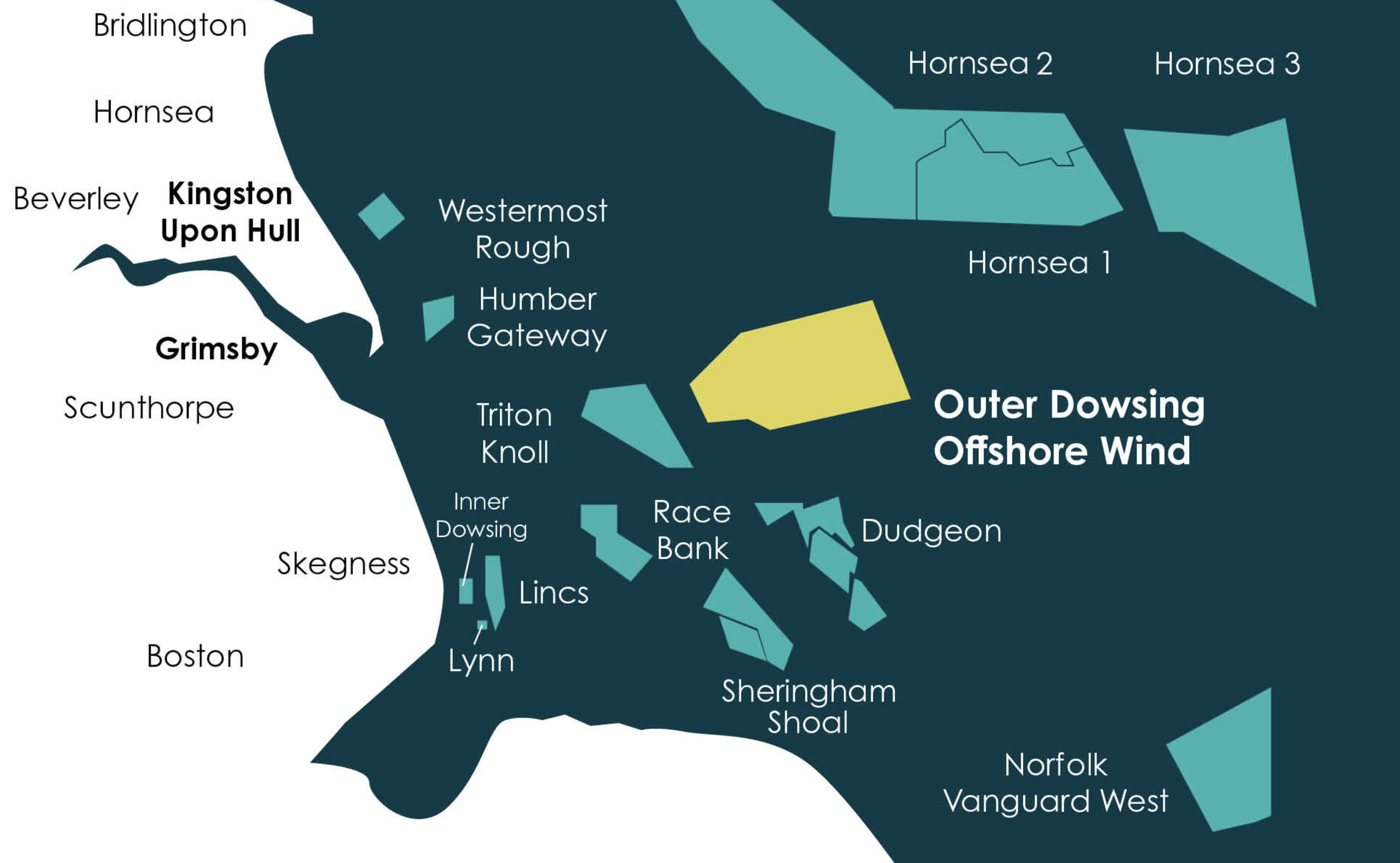
Note.
- The completed Hornsea wind farm will be over 6 MW.
- The future of Norfolk Vanguard is uncertain.
- These wind farms total up to 13524 MW, but without Norfolk Vanguard the total is 11724 MW.
- According to Wikipedia, the Viking Link to Denmark will open on the 1st of January 2024.
I wrote about the Viking Link in Work Begins On New Substation For World’s Longest Electricity Cable Between Denmark and Lincolnshire.
The German And UK Cables Compared
Consider.
- Both have 4 x 2 MW capacity.
- SEGL1 and EGL2 have a cost of £3.4 billion.
- The four German cables are quoted at a total of €16-18 billion here.
- The first two UK cables have planned completion dates of 2027 and 2029.
- German completion dates are given as 2032-2036.
This leads me to this conclusion.
Building interconnectors in the sea is quicker and more affordable than building them on land.
Fire On Scroby Sands Wind Turbine Self-Extinguishes, Incident Under Investigation
The title of this post, is the same as that of this article on offshoreWIND.biz.
This is the sub-heading.
A wind turbine at the Scroby Sands offshore wind farm in the UK caught fire yesterday morning (15 August). The cause of the fire, which self-extinguished later the same day, is now being investigated.
This sort of incident doesn’t seem to be reported very often, although this one was shown prominently in this article on the BBC, which contains a video.
 The Anonymous Widower