How To Protect The UK Population From Future Pandemics
The Times today has an article, which is entitled Flu Jab: Single-Shot Vaccine ‘Within Five Years’ Could Stop Future Pandemic.
This is the introductory paragraph of The Times article.
A single-shot vaccine against flu that would provide a lifetime of protection even against future mutations could be available in “five years or less”, scientists have said after making a breakthrough.
The article is very much a must-read, but I believe if used alongside a simple proven medical test, it could be even more effective.
Since 1997, when I was diagnosed as coeliac and started eating gluten-free food exclusively, I have never had a dose of flu.
I may have had one very mild dose of Covid-19, but I have never had a serious dose.
Research At The University Of Padua
This partial immunity to Covid-19 has been shown in a peer-reviewed scientific paper, by the University of Padua in Italy.
I discuss the Padua research in Risk Of COVID-19 In Celiac Disease Patients.
Mathematical Modelling Of Pandemics
As a control engineer, mathematical modeller and statistician, I believe that our herd immunity to future pandemics could be increased, if all new entries to the UK population, like babies and migrants, were tested for coeliac disease.
These days the coeliac test is just a blood test, that costs just a few pounds and I believe that a high percentage of gluten-free coeliacs in the UK population, because of their low susceptibility to flu pandemics, would slow the spread of the pandemic.
In a nuclear reactor non-radioactive carbon rods are often used to control the speed of the reaction.
I believe that non-susceptible coeliacs on gluten-free diets would perform the same function in the UK population.
Should Diagnosed Coeliacs Be Forced To Be Gluten-Free?
I would not force coeliacs to go gluten-free.
They would have to face up to the consequences, if they didn’t.
My son was an undiagnosed coeliac, who refused to get tested.
He died at 37 of pancreatic cancer, as his immune system was useless.
Coeliac disease and a gluten-free diet is a good wingman, but undiagnosed it can kill you!
Why Should Migrants Be Tested?
I hope they are, as some might have something nasty.
But if everyone was tested for a wide range of health and genetic conditions, could it act as a deterrent to come to the UK?
Oxford And Cambridge Compared On COVID-19
In Oxford And Cambridge Compared On COVID-19, I compared the COVID-19 rates of the two University cities.
- Oxford and Cambridge are very similar-sized cities and both ae surrounded by similar counties and countryside.
- During the pandemic, Oxford had a much higher COVID-19 rate than Cambridge.
From my experiences and observations in Cambridge, I believe that the city has a high level of coeliacs.
Why Does Cambridge Have A High Level Of Coeliacs?
I doubt, it is due to the genetics of the local population, as if it was, my coeliac disease would have been picked up earlier.
The two most likely causes are.
- Someone in the Health Authority decided to have a Whack-a-Coeliac policy.
- Addenbrooke’s Hospital, in conjunction with Cambridge University and the Sanger Centre were testing the accuracy of the newly-develop genetic test for coeliac disease.
Note.
- Both routes would have needed a streamlined endoscopy unit to test all those thought to be coeliac.
- I was tested twice in such a unit to prove that I was coeliac, after the genetic test showed, I probably was.
- Fit, younger patients were pushed to have the endoscopy without a sedative, which cut the number and cost of recovery beds and staff.
- My endoscopies were performed without a sedative, by a doctor working alone.
- I was able to drive home, a few minutes after the procedure.
It was a classic case of applying good old-fashioned time-and-motion to a test that would have to be applied to a large number of patients.
If Cambridge’s army of coeliacs helped the city take the edge of the pandemic, what would a Whack-a-Coeliac policy, do for other cities?
Hospital Pioneers Cancer Service For Over 70s That Saves Lives And Money
The title of this post, is the same as that of this article in The Times.
This is the sub-heading.
Treatment is adapted to take into account age-related illnesses, such as heart disease, diabetes and dementia.
These three paragraphs outline, what the Christie Hospital is doing.
The Christie Hospital in Manchester is pioneering a specialist cancer service for elderly patients under plans to tackle a “silver tsunami” of cases.
More than 200 patients have been treated by the new team, which was set up to meet the more complex care needs of an ageing population.
The service has nearly halved the number of unplanned hospital admissions among older cancer patients, improving survival and quality of life.
But it’s the graph that follows that I find interesting.
It shows the cancer incidence rate (per 100,000 population) in 2020 by gender and age at diagnosis.
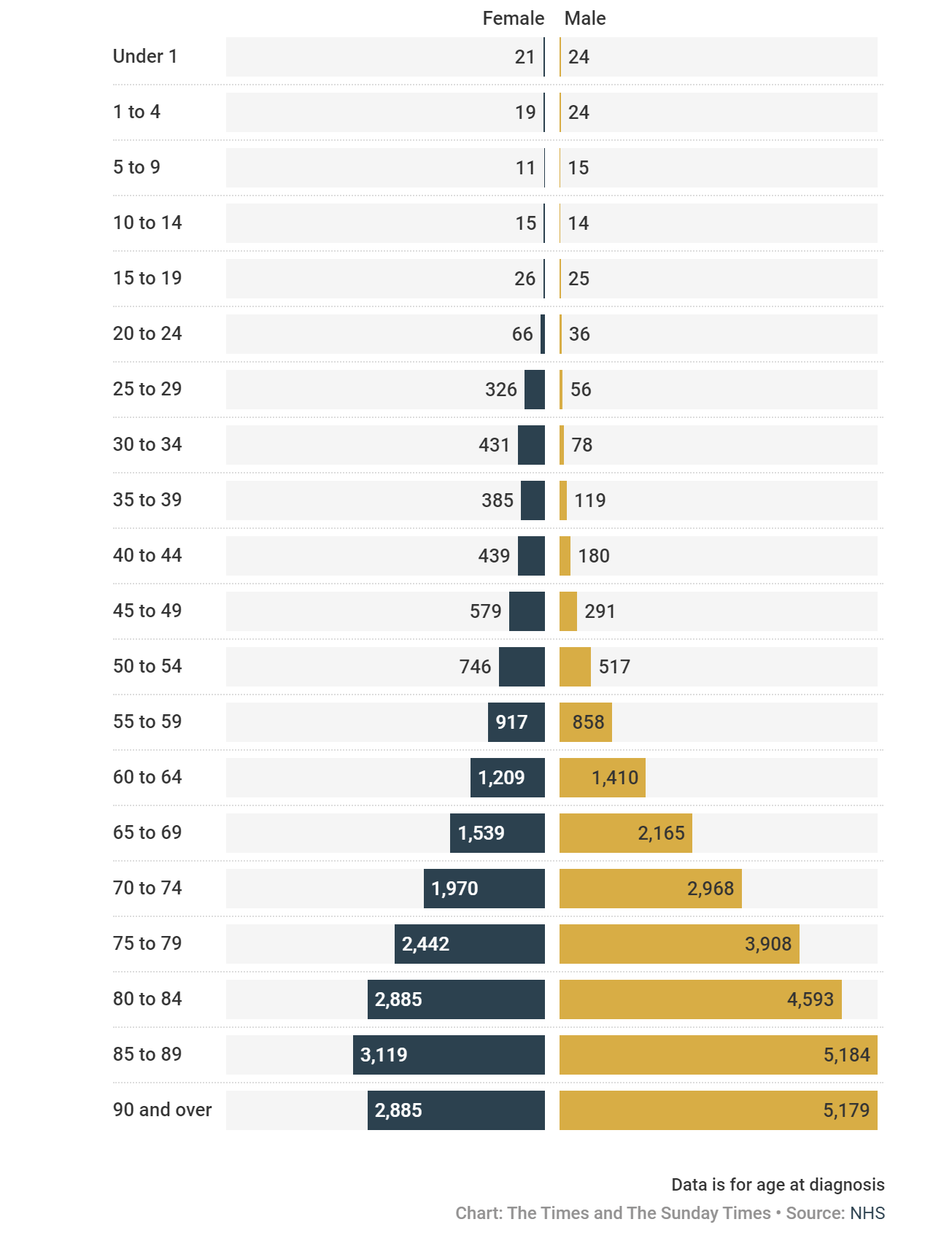
I am a control engineer and statistician and one of the most interesting things in a graph like this is the rate of increase or in this graph’s case the rate of decrease, as the graph effectively has the present at the top.
I have used an old trick and looked at the difference between the groups and the difference between the difference.
Note.
- It seems that the rate of increase of cancer diagnosis with age seems to increase with ages of 60-64 and 25-29.
- This would seem to correspond to those born before 1960 and those born before 1995.
- As a coeliac, I know that the first test for coeliac disease, which used endoscopy was introduced around 1960.
- The modern genetic test for coeliac disease was developed in the 1990s.
Is it coincidence, that the rate of increase of cancer diagnosis with age seems to increase, when a better diagnosis for coeliac disease was introduced?
These are my thoughts!
Coeliac Disease And Me
I am coeliac and I was born in 1947. I wasn’t diagnosed as coeliac until 1997.
I was an unhealthy child, with all sorts of avenues being chased, so in the end they just took my tonsils out.
- It should be remembered, that there was no test for coeliac disease in children until 1960.
- I’ve also only met one coeliac older than me and both her parents were GPs and she was diagnosed by food elimination.
- In fact, I never met a coeliac until I was about 25. He was the two-year-old son of one of C’s friends.
At fifty, an elderly locum gave me a present of a blood test to clear up my long-term health problems. The results showed that my body had very little Vitamin B12. Injections didn’t improve the level, so my GP sent me to Addenbrooke’s.
It was a Monday and all the consultant did was ask a nurse to take several vials of blood. He didn’t ask me any relevant questions or even touch me.
On the Wednesday morning, I got a letter from the hospital saying I was probably coeliac and it would be confirmed by endoscopy.
I must have been one of the first to have been diagnosed by a genetic test on a sample of blood.
Coeliac Disease And My Youngest Son
My youngest son was born in 1972 and after my diagnosis, my late wife felt he was coeliac, as physically he was so like me. But neither him nor our other two sons would get themselves tested.
I am now sure he was coeliac, as his daughter was born with a congenital hernia of the diaphragm and Swedish research says can happen with coeliac fathers. Luckily, she was born in the Royal London Hospital and thanks to heroic surgery at a few days old, she survived and is now in her first year at Southampton University.
Sadly my youngest son died of pancreatic cancer in 2011.
Coeliac Disease And Cancer
Nottingham University have shown that if you are coeliac and stick to a gluten-free diet, you are twenty-five percent less likely to suffer from cancer.
Cancer in the Over Sixties
The following is an extract from A Thought On Deaths Of The Elderly From Covid-19, which I wrote in April 2020.
How many undiagnosed coeliacs are there in those over seventy, who because they are coeliacs, have a compromised immune system?
I would be undiagnosed but for that elderly locum!
How many other coeliacs are there in the UK population?
- Age UK has a figure of twelve million who are over 65 in the UK.
- If 1-in-100, as stated by Coeliac UK, in the UK are coeliac, that is 120,000 coeliacs over 65, who are too old to have been diagnosed as a child, because no test existed.
Note that as of today 177,388 have been diagnosed with Covid-19.
Could the drop in the cancer rate of those born before 1960 be because of the availability of a test for coeliac disease, so that if they were a sickly child like me, they would be diagnosed? As I said earlier diagnosed coeliacs have a lower cancer rate than the general population.
Cancer in the Under Thirties
I was diagnosed in 1997 by a genetic blood test and there is no doubt that I have coeliac disease.
As the test is so simple, I wonder what proportion of coeliacs born since the Millennium have been diagnosed.
And how does this contribute to the drop in cancer cases?
More Research Needs To Be Done
It is obvious to me, that research needs to be done into the link between undiagnosed coeliacs and cancer.
It might be prudent to test every cancer patient for coeliac disease. My GP told me, that the test is not expensive and generally gives the right result.
Asbestos In M&S Killed My Wife — Gove’s Ruling Is A Disgrace
The title of this post, is the same as that of this article in The Sunday Times.
It is in a section of the paper, which is entitled Act Now In Asbestos, where the paper has a campaign.
These are the first three paragraphs.
Janice Allen met and fell in love with her husband, Stuart, when they worked together at Marks & Spencer’s flagship store in London’s Marble Arch.
The shop would end up killing her.
Janice died of mesothelioma, a cancer she got from exposure to asbestos. The M&S store was constructed using the toxic building material and it was found in several locations where she worked. The department store would award her substantial damages before she died at a hospice in Kent in June 2018.
I have only worked with asbestos once.
This picture shows my father’s printing works in Station Road, Wood Green.
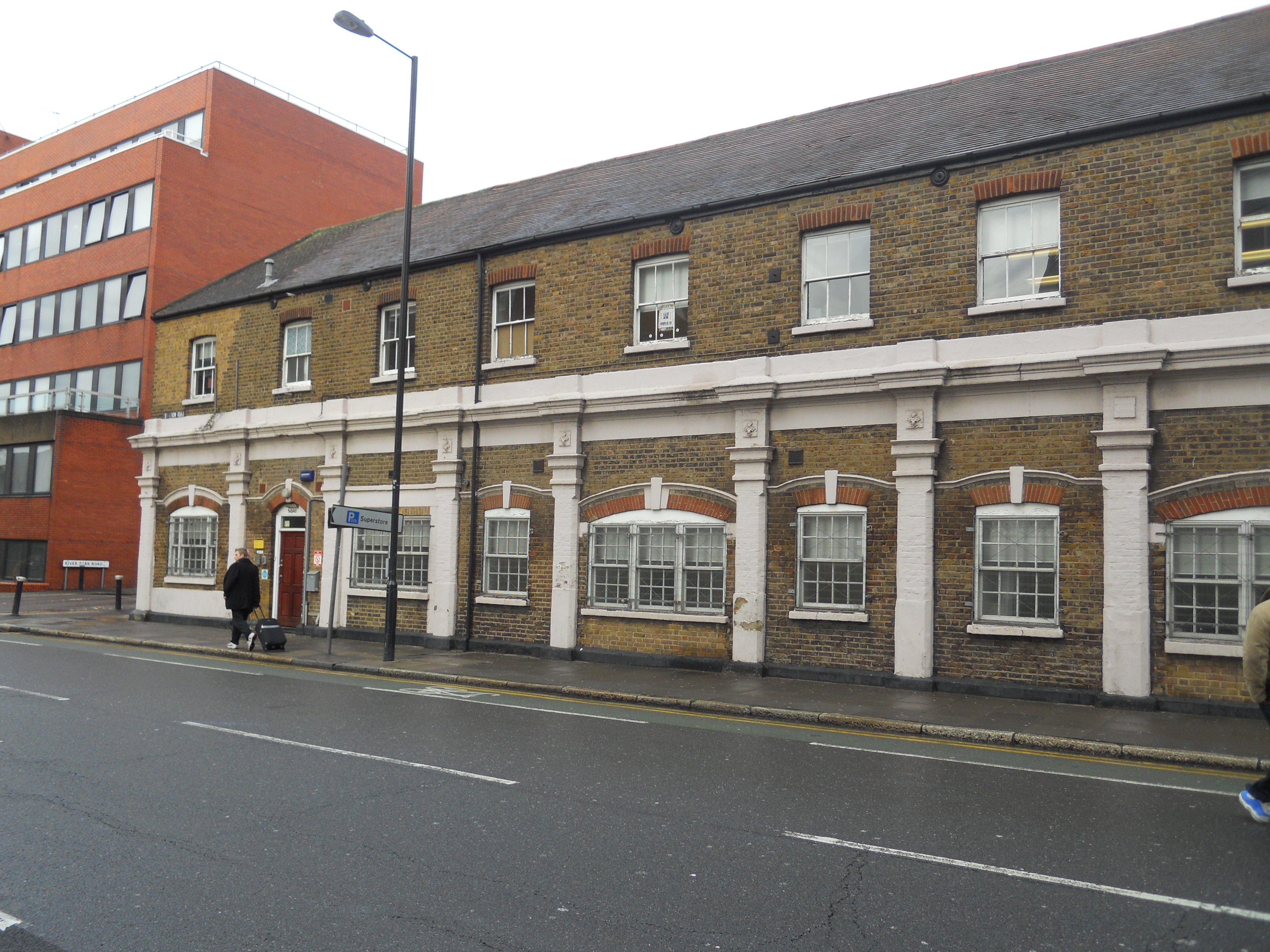
They were not the most salubrious of premises and my father was always making improvements.
My father was a very good practical carpenter and an accomplished painter and decorator.
The back wall of the building was covered on the inside with damp and mould, which even in the 1950s, he thought could be a health hazard, so he decided to do something about it.
- Above a certain height he cleaned the wall and painted it with a standard magnolia paint.
- About two metres above the ground, he fixed a two-by-two batten piece of wood to the wall.
- He also fixed another one to the wall, perhaps halfway up.
- To cover all the damp and mould, he then fixed corrugated asbestos cement sheeting to the two battens with galvanised roofing nails.
- To finish it off he screwed a piece of slatting to the top batten, which he painted a fetching blue colour.
The damp and mould was now out of sight and out of mind.
I remember how this construction was done, as I was my father’s ten-year-old assistant.
Although we’d used asbestos cement sheeting, I don’t think either my father or myself inhaled any asbestos dust, although we weren’t wearing masks, as no-one did in those days.
ICI And Asbestos
My next encounter with asbestos was at ICI in the late 1960s.
- A lot of chemical plants, built before the Second World War were riddled with it.
- But ICI, knew of the problems, and I was given strong warnings about asbestos.
- As I was only putting instruments on plants, with experienced plant fitters, I didn’t have an real encounters with it.
But why if ICI were so anti, were builders still using it and otherwise sensible companies not removing it from their buildings?
This is the large paragraph in The Times article.
An M&S spokesman said: “Like many older buildings, Marble Arch dates back to the interwar era when asbestos was commonly used in construction, and sadly our former colleague Janice Allen worked in the store over 40 years ago, before the consequences of asbestos use were known. Today we rigorously manage asbestos where it is present and ensure the store is safe for every colleague and customer.”
If ICI were worried about asbestos in the late 1960s, why weren’t Marks & Spencer worried about asbestos in the late 1970s.
A Barn In Suffolk
In the 1980s, I put up a new barn, where we lived.
Often, in those days, asbestos was still used for roofing, but I was recommended to use a new British Steel product, where steel was covered in a coloured weatherproof coating.
I Sneeze A Lot
These days, I sneeze a lot, but I didn’t sneeze this much before I was diagnosed as coeliac and went gluten-free.
Could it be that my immune system is so much stronger and when there is something in the air, it is only giving it a good kicking?
I’ve been sneezing a lot for the past few days, as the Council removed a dead tree from outside my house.
But we do know, that Nottingham University have shown, coeliacs on a gluten-free diet have a 25 % lower cancer rate than the general population.
Could this be due to a stronger immune system?
My Coeliac Son Died From Cancer
I believe my youngest son was an undiagnosed coeliac and he lived the rock-n-roll lifestyle on a diet of ciggies, cannabis and Subways, as he was a sound engineer in the music business. He died virtually out of the blue of pancreatic cancer at just thirty-seven.
So on the one hand being a diagnosed coeliac on a gluten-free diet gives you a certain immunity to cancer and other diseases and on the other hand undiagnosed coeliacs are prey to all the nasties we have to live with.
To return to the tragic story in The Times, which gives Stuart’s age as 62, so that places him as being born around 1960 and his late wife; Janice looks about the same age.
I think it is true to say, that in the 1960s, medicine started to change dramatically.
- Serious heart operations and kidney transplants became commonplace.
- The first heart transplant was performed in 1967.
- Drugs were improving.
- Vaccination was stopping polio and other diseases.
- The first test for coeliac disease in children was developed. Sadly, it wasn’t used on me.
But we had little inkling of the role of genes in diseases.
Incidentally, I didn’t come across my first coeliac, until 1972, when a neighbour had a coeliac baby son called Nicholas.
So was the poor lady in The Times story, in some ways a victim of her time?
- Asbestos was wrongly ignored by Marks & Spencer.
- Medicine hadn’t advanced enough to be able to identify, those susceptible to cancer.
- I have heard so many stories of bad use of asbestos.
Sadly, the dangers of asbestos are still ignored by many companies and organisations today and that includes the NHS.
One of my colleagues at ICI in 1968 will be livid at how we are ignoring asbestos.
Is This A Possible Scenario?
Consider.
- Someone is born coeliac and they are not diagnosed.
- If they were born before 1960, there was no test for coeliac disease in children.
- The simple genetic blood test came in around the turn of the century.
- They work with asbestos in their twenties.
- Their immune system is not good enough to protect them.
Just like my son, will they get a serious cancer?
Coeliac Disease And Covid-19
In Risk Of COVID-19 In Celiac Disease Patients, I look at a pier-reviewed paper from the University of Padua.
This sentence, sums up the study.
In this analysis we report a real life “snapshot” of a cohort of CeD patients during the SARS-CoV-2 outbreak in Italy, all followed in one tertiary centre in a red area of Northern Italy. Our data show, in accordance with Emmi et al., the absolute absence of COVID-19 diagnosis in our population, although 18 subjects experienced flu-like symptoms with only one having undergone naso-pharyngeal swab.
There were 138 coeliac disease subjects in the study and they had been gluten-free for an average of 6.6 years.
The downside of this, is how many undiagnosed coeliacs, suffered a severe dose of Covid-19.
Conclusion
Given the pain coeliac disease has inflicted on my family over the years, I believe that all children should be tested for coeliac disease.
I would also recommend, that anybody thinking of working with asbestos or taking a job with a high cancer risk, should get themselves tested for coeliac disease.
Being found to suffer from coeliac disease will not in itself kill you, and with the right diet, it might even prolong your life.
Bonus For GPs If Patients Join Drug Trials In Plan To Lure Firms To NHS
The title of this post, is the same as that of this article on The Times.
This is the sub-heading.
£650m boost for medical research after number of participants slumps
These three paragraphs outline what is to be done.
Tens of thousands more patients will be signed up for clinical trials as ministers promise drug companies better access to the NHS to expand the economy and develop cutting-edge treatments.
Jeremy Hunt, the chancellor, is promising a £650 million package to boost life sciences as he attempts to lure pharmaceutical giants to Britain.
GPs will be offered financial incentives to recruit patients into trials of new treatments and hospitals will be given research targets under plans to reverse a slump in clinical testing while the NHS struggles with the backlog from Covid-19.
It all sounds good to me.
I have been involved in several trials and medical research projects.
- As part of my coeliac disease diagnosis, one endoscopy was performed by Rebecca Fitzgerald at Cambridge, as she was taking samples of bile fluids for her research into Barrett’s esophagus.
- After the death of my wife, I was interviewed by PhD students in the Psychology Department at Liverpool University for their research into widowhood.
- Oxford University interviewed me on diet for their coeliac disease research.
- After my stroke, I spent an entertaining afternoon at the University of East London doing balance tests by computer. Their aim was to develop a reliable balance test for stroke and other patients, that could be carried out by physiotherapists quickly, than by more expensive doctors.
- I have also been on a drug trial at Queen Mary University, but that drug was useless and had no good or bad affects, so the trial was halted. However, it did lead to other enjoyable activities in the field of patient relations with treatment and research.
As a confirmed coward, I should note that with the exception of the drug trial, all of the other projects were low risk.
I should say, that I also sponsor pancreatic cancer research at Liverpool University, in memory of my son, who died from the disease. I wrote about the first Liverpool project in There’s More To Liverpool Than Football And The Beatles!.
A Database Of Projects Open For Volunteers
I believe that this is needed, so that those like me, who like to contribute to research can volunteer.
Perhaps some of the £650 million, that has been promised by Jeremy Hunt, could be used to create the database.
I also believe the database could be used for other non-medical research.
Coeliac Journey Through Covid-19 – Medical Research
Medical Research
I first got involved as a lab-rat in medical research, when I had my second endoscopy to check for coeliac disease at Addenbrooke’s Hospital in 1997. Rebecca Fitzgerald took a sample of fluid from my gut for her Barrett’s oesophagus research.
After my wife died, I asked my contact in Alumni Relations at Liverpool University, if they did widowhood research.
They are one of the few universities that do and I did several interviews for PhD students in the unit, which is in the Psychology Department. It was very much a positive experience and certainly helped with my grieving.
In some ways the most enjoyable piece of research I have been involved in, was at the University of East London, where they were using computers to measure the balance of those recovering from strokes.
My GP also suggested that I get involved in drug tests at Queen Mary University. The tests were abandoned as the drug didn’t have any good or bad effects, but now I’m one of the William Harvey Centre’s lab-rats.
I also help to sponsor pancreatic cancer research at Liverpool University in memory of my son.
In There’s More To Liverpool Than Football And The Beatles!, I detail some research, that I sponsored in a small way.
I may be tempted to do the fund-raising trip again.
I always advise people to get involved in medical or psychological research, as I have found it such a beneficial experience.
One thing that is needed, is an on-line database of all research projects that are looking for volunteers.
Remember, that much medical and psychological research is about as dangerous as meeting someone in a GP’s surgery for a chat or perhaps in a cafe and having a coffee.
Coeliac Journey Through Covid-19 – A Few Bad Years
A Few Bad Years
In 2007, my wife died of what her consultant at Papworth said was one of the worst cancers he’d ever seen. It was a squamous cell carcinoma of the heart.
Her’s was the only occurrence in the UK that year and someone told me, there were four in the United States.
Our youngest son; George, then died of pancreatic cancer in 2009.
When I had been diagnosed as a coeliac in 1997, my wife and I had told our sons to get themselves tested, as is now advised on the NHS web site.
But George was a sound engineer in the music business, who lived the unhealthy rock-and-roll lifestyle.
A year later, I had a serious stroke in Hong Kong.
I had had a warning a year or so before and Addenbrooke’s recommended I go on Warfarin, but my GP in Suffolk, talked me out of it.
Now twelve years later, my GP and myself manage my Warfarin, where I do the testing of my INR on my own meter from Roche.
But then I am a Graduate Control Engineer!
A couple of doctors have said I have made a remarkable recovery, and I’ll go along with that as the only thing I can’t do, that I could before the stroke is drive, as the stroke damaged my eyesight.
On the other hand, the latest therapy for stroke in the United States is B12 injections and I haven’t missed one of my three-monthly injections since 1997.
If anybody is doing serious research into B12 and stroke recovery, then I would be happy to be a lab-rat.
Why A Lucky Few May Help The Rest Of Us Beat Disease
The title of this post, is the same as that of this article in The Times.
This is the sub-title.
A British biotech firm believes patients who defy odds could hold the key in their blood.
These three paragraphs introduce the article.
Patient 82 should be dead. At the age of 63 he was diagnosed with pancreatic cancer. In most cases, he would not have lasted a year. But seven years on, patient 82 is alive. Not merely alive — thriving.
He enjoys gardening. He likes seeing his grandchildren. He enjoys life.
How? The answer, a British biotech company believes, could lie in his blood. Now, with the help of dozens of other anonymous patients, all of whom have defied their cancer prognoses, they hope to find it.
Note, that the company is Alchemab Therapeutics.
The article got me thinking about myself.
I belong to a group of people, who are twenty-five percent less likely to suffer from cancer according to peer-reviewed research at Nottingham University.
I am coeliac and adhere to a strict gluten-free diet.
There may be other benefits too!
I have not had a serious dose of the covids, although I may have had a very mild case at the beginning of 2020 after I shared a train with a large number of exuberant Chinese students, who had recently arrived at Manchester Airport and were going to their new University across the Pennines.
I have also since found at least another seventy coeliacs, who have avoided serious doses of the covids.
Research From The University Of Padua
This paper on the US National Library of Medicine, which is from the University of Padua in Italy.
The University followed a group of 138 patients with coeliac disease, who had been on a gluten-free diet for at least six years, through the first wave of the Covid-19 pandemic in Padua.
This sentence, sums up the study.
In this analysis we report a real life “snapshot” of a cohort of CeD patients during the SARS-CoV-2 outbreak in Italy, all followed in one tertiary centre in a red area of Northern Italy. Our data show, in accordance with Emmi et al., the absolute absence of COVID-19 diagnosis in our population, although 18 subjects experienced flu-like symptoms with only one having undergone naso-pharyngeal swab.
It says that no test subject caught Covid-19, in an admittedly smallish number of patients.
But it reinforces my call for more research into whether if you are a diagnosed coeliac on a long-term gluten-free diet, you have an immune system, that gives you a degree of protection from the Covids.
The Times article mentions the immune system.
I believe my immune system to be strong after the reaction I had to the Astra Zeneca vaccine. I didn’t feel well to say the least after my Astra Zeneca vaccine and my GP and other doctors felt that it could be due to my immune system, thinking that the chimpanzee virus-based vaccine was a danger and attacking it.
Significantly, I had no reaction to the second dose. So had my immune system recognised the vaccine as a friend not a foe?
My son, who my late wife was sure was an undiagnosed coeliac, died of pancreatic cancer at just 37.
How did my late wife know? Don’t question her intuition and also she felt that my son and myself felt the same to her touch.
It should be noted that my son’s daughter was born with a Congenital hernia of the Diaphragm. Congenital defects can happen to people, who have a coeliac father.
At the age of 20, my granddaughter is fine now, after heroic surgery at the Royal London Hospital, at just a few days old.
Why Don’t I Feel The Cold?
It’s been cold today in London, but I didn’t really feel it.
100,000 Newborn Babies Set To Have Their DNA Fully Decoded
The title of this post, is the same as that of this article on the FT.
This sub-heading gives a few more details.
Genomics England programme aims to extend the number of treatable conditions detected to about 200.
I am coeliac and I do wish, I had been diagnosed at birth.
But more importantly, my youngest son, who would have been fifty this year, might still be here.
He was probably coeliac and worked as a sound engineer in the music business.
He lived the rock-and-roll lifestyle on a diet of ciggies, Subways and high strength cannabis.
He probably had an immune system, with all the strength of a plastic colander.
Consequently, he died at 37 of pancreatic cancer.
 The Anonymous Widower