The Three Baltic Countries Sign The Largest Railway Electrification Agreement In History
The title of this post, is the same as that as this news item on the LTG Group web site.
This is the sub-heading.
Today in Vilnius, the institutions of the three Baltic countries responsible for implementing the Rail Baltica project signed a historic agreement on railway electrification. The contract, valued at €1.77 billion (excluding VAT), has been awarded to COBELEC Rail Baltica – a consortium formed by the Spanish companies Cobra Instalaciones y Servicios S.A. and Elecnor Servicios y Proyectos S.A.U.
These three paragraphs add more detail.
The electrification of the Rail Baltica European railway is considered the largest cross-border railway electrification initiative in Europe, implemented as a single, joint project.
“Rail Baltica is more than just infrastructure – it is an economic and security link to the West. This contract is particularly important for our integration into the European railway network, enabling smooth passenger and freight transport while strengthening the resilience of the Baltic region. It is our strategic pathway to the future,” said Eugenijus Sabutis, Acting Minister of Transport and Communications of Lithuania.
One of the largest contracts in the history of the Baltic States was signed by the institutions responsible for implementing the project: LTG Infra, the infrastructure company of the LTG Group; Eiropas Dzelzceļa Līnijas in Latvia; and Rail Baltic Estonia in Estonia. Representatives from the ministries of transport and communications of all three countries also gathered in Vilnius for the occasion.
Note.
- The electrification will be to the European standard of 25 KVAC overhead.
- There will be a total of 2,400 km. of electrification.
- High-speed passenger and freight trains will operate on the full length of the route.
- It is planned that the electricity used will be generated from renewable energy sources.
- I feel everybody will be pleased except Putin.
The Russian dictator and war-monger won’t like it, as the railway will not be built to Russian standards.
Klaipėda – Kyiv Rail Freight Plan
The title of this post, is the same as that of this article on Railway Gazette.
These two paragraphs give more details.
Lithuania’s national train operator LTG Group and Ukrainian Railways have signed a memorandum of understanding to develop an intermodal freight service from the Baltic port of Klaipėda to Kyiv via Poland.
Test runs are planned for this year, ahead of regular services.
I have some thoughts.
The Route
This Google Map shows the route.
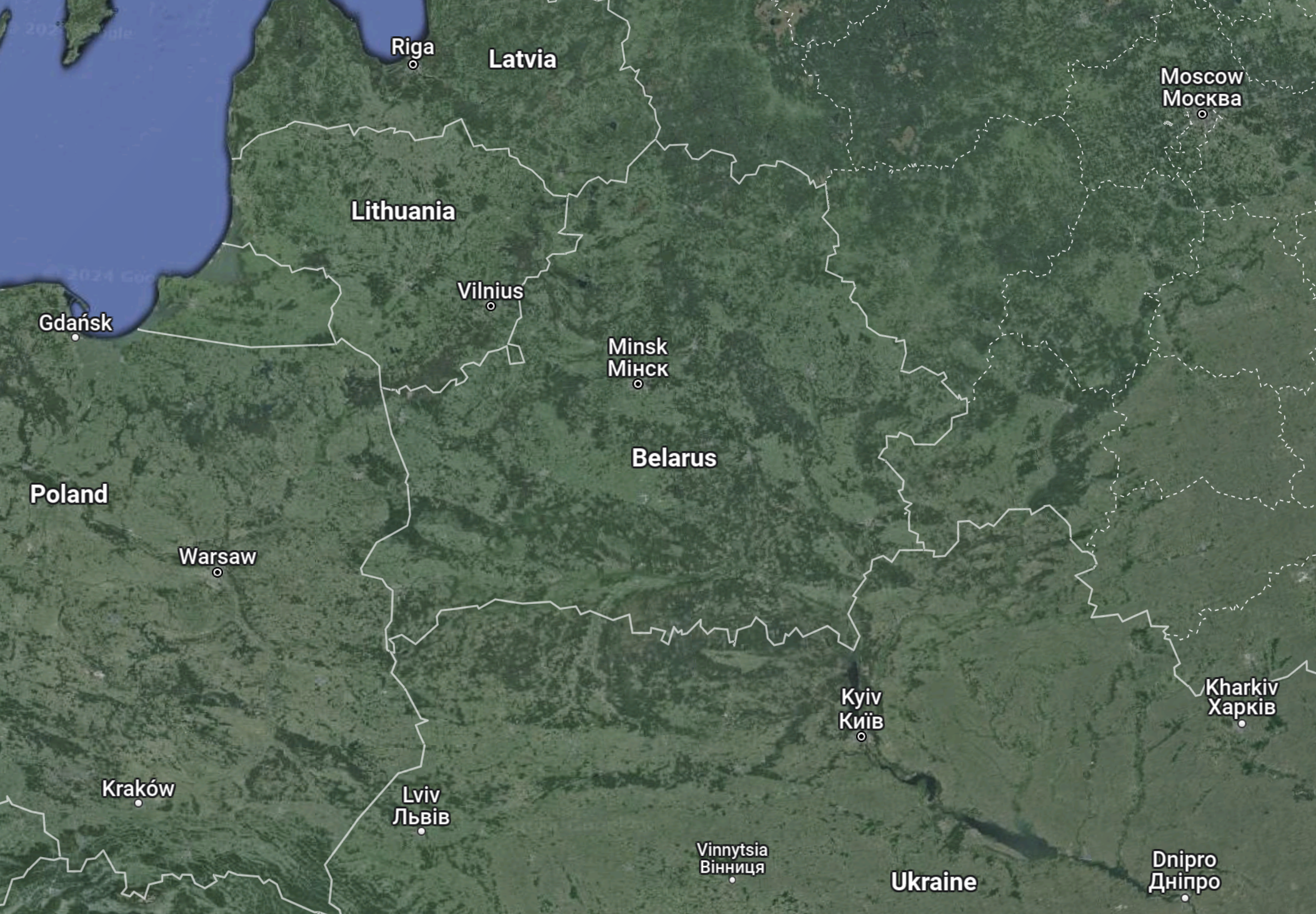
Note.
- Russia is in the North-East corner of the map, with Moscow clearly marked.
- Lithuania is in the North-West corner of the map.
- Klaipėda is on the Lithuanian coast.
- South-West of Lithuania is the Kaliningrad enclave, which is part of Russia.
- South of the Kaliningrad enclave is Poland, where Gdansk, Warsaw and Krakow are clearly marked.
- Belarus is in the middle of the map, with Minsk clearly marked.
- Ukraine is South of Russia and Belarus and East of Poland.
- Dnipro, Kharkiv, Kyiv and Lyiv in Ukraine are clearly marked.
It looks to me, that a possible route would be along the Eastern Polish Border avoiding both Belarus and the Kaliningrad enclave.
The Gauges
This Google Map shows the gauges between Klaipėda and Kyiv.
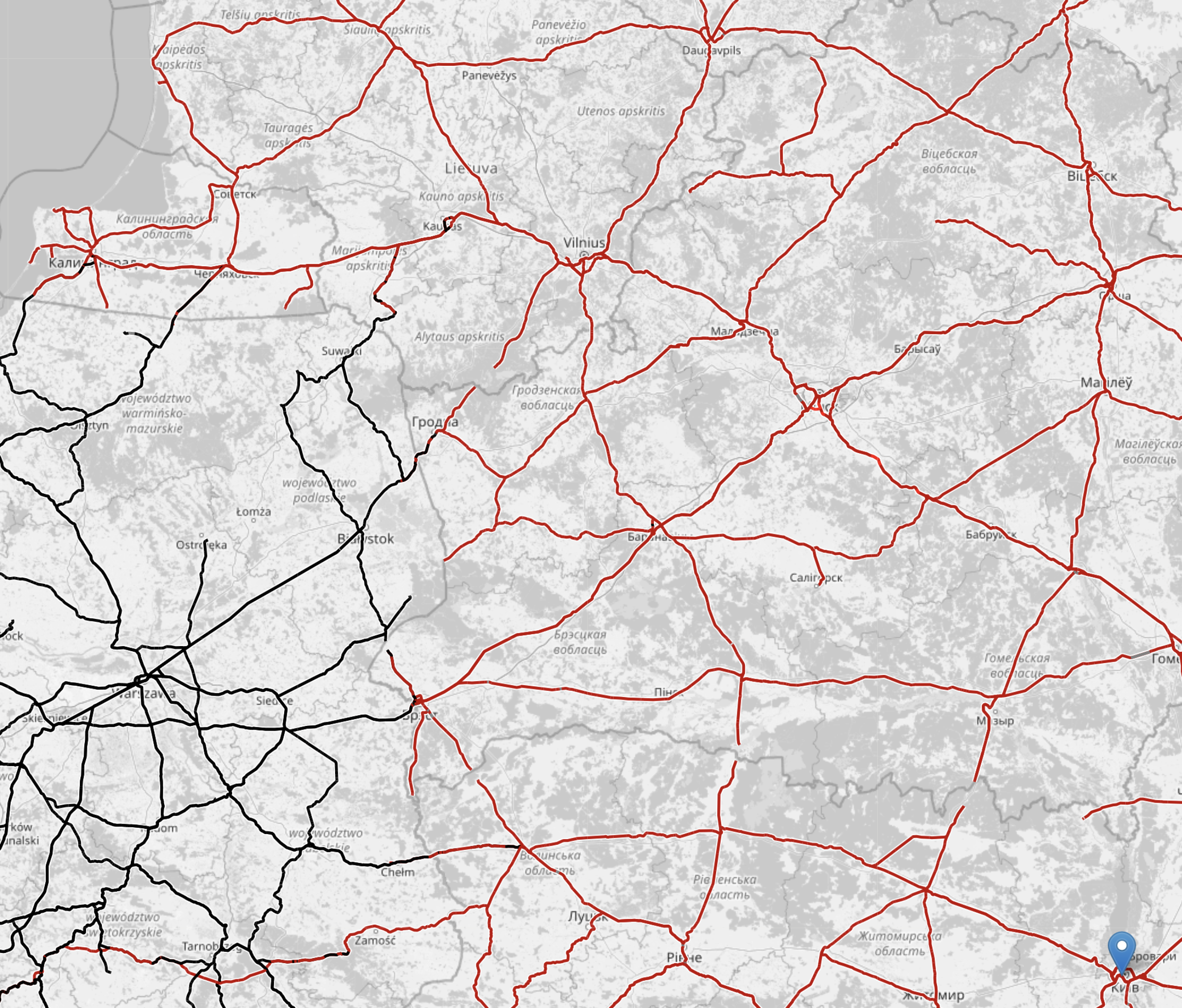
Note.
- Black tracks are Standard gauge of 1435 mm.
- Red tracks are Russian gauge of 1520 mm.
- Klaipėda is on the Lithuanian coast in the North-West corner of the map.
- Kviv is in the South-East corner of the map.
It looks to me, that although Lithuania and Ukraine are Russian gauge, the routes through Poland could be standard gauge.
So there may be a need for some rolling stock, that can run on both Russian and Polish gauges.
This article on Railway Gazette is entitled Ukrainian Railways Produces Cross-Border Grain Wagon.
These two paragraphs describe the wagons.
National railway Ukrzaliznytsia has used mostly domestic components to produce a grain hopper wagon which can operate on both the former USSR’s 1 520 mm broad gauge and the 1 435 mm standard gauge of neighbouring EU countries.
The Type 19-8005-U wagon has a capacity of 70 tonnes and 104 m3, with five loading and six unloading hatches. It is designed for operation at up to 120 km/h.
The wagon certainly looks professional in the pictures.
I don’t think that dual-gauge wagons for containers will be a serious engineering problem for the Ukrainians.
Rail Baltica
The Wikipedia entry for Rail Baltica has this introduction.
Rail Baltica is an under-construction rail infrastructure project that is intended to integrate the Baltic states in the European rail network. Its purpose is to provide passenger and freight service between participating countries and improve rail connections between Central and Northern Europe, specifically the area southeast of the Baltic Sea.
Note.
- As it is an EU-funded project, it is being built as standard gauge.
- It is being built with operating speeds of 145 mph for passengers and 75 mph for freight trains.
- There will be comprehensive connections to airports, freight terminals and major conurbations.
This page on the Rail Baltica web site has an interactive map of Rail Baltica.
It is thought that Putin is not pleased about Rail Baltica, as his extensive fleet of rail transporters for tanks and other military vehicles, are now built for the wrong gauge to invade the Baltic States.
Putin And Dual-Gauge Tracks And Wagons
As they could be used to bring war-related imports to Kyiv, I suspect Vlad the Genocider is against them.
How Will Ukraine Protect The Trains?
Consider.
- Being West of Kyiv will help.
- I suspect the UK have a few ideas for camouflage.
- Will a few brave Ukrainians ride the trains, with a sophisticated train protection missile?
- Drones probably won’t be as effective as ground attack aircraft at attacking trains.
I do suspect though that the Ukrainians have a plan.
Conclusion
This is going to be an interesting development.
Baltic States Agree To Develop Plan To Railway Network’s Conversion According To EU Standards
The title of this post is the same as that of this article on Baltic News Network.
These are the first two paragraphs.
During a meeting of European transport ministers in Brussels, participants agreed that all member states the railway network of which differs from the EU standard, have until 2025-2026 to develop a plan to transition to 1 435 mm. This applies to Latvia as well, as reported by Ministry of Transport.
Latvia and other Baltic States still have railway networks built in accordance with Russian standard of 1 520 mm, whereas the majority of other European countries have railway standard of 1 435 mm. This is also the standard that will be used for the Rail Baltica line.
I have some thoughts.
- Putin won’t like it, as his trains won’t fit the gauge, so it will cramp his invasion plans.
- Will gauge change apply to Spain and Ireland?
- If the Irish Republic converts, will Ulster say no? Undoubtedly they will!
- Will it also apply to trams, as there are quite a few metre gauge tramways.
I doubt that it will ever happen everywhere.
Are These Two Stories Related?
These are two stories recently published in Railway Gazette.
Deutsche Bahn Sells Arriva Businesses To Private Equity Holding Company, which starts with this paragraph.
Deutsche Bahn has reached agreement to sell its Arriva local transport activities in Denmark, Poland and Serbia to München-based private equity holding company Mutares SE & Co KGaA.
That is fairly clear and is probably related with the German government’s desire for DB to concentrate on its core business.seren
This article on Railway Gazette is entitled RENFE Looks At Entering UK Rail Market Through Open Access Partnership, which starts with this paragraph.
Open access passenger service developer Grand Union Trains is working with Spain’s national operator RENFE and private equity firm Serena Industrial Partners on a proposed service between London and Wales.
That also is fairly clear and would bring competition to services to and from South Wales.
It would also help in the financing of Grand Union Trains.
The article also says the following.
- RENFE seem to be expanding into partnerships to run services outside Spain.
- A parkway station at Felindre will be build to avoid the reverse at Swansea, that would save 20 mins.
- It will be a high quality service with new electro-diesel trains.
- Four trains will be needed.
- A 2025 start is envisaged.
Will this partnership with Grand Union Trains proceed with the development of Grand Union Trains’ London and Stirling service?
I have some thoughts and questions.
Will Deutsche Bahn Sell Other Arriva Businesses?
I think this is a reasonable question to ask, especially, as Deutsche Bahn owns two Open Access Operators in the UK; Chiltern Railways and Grand Central Trains.
- Both operators have a good reputation.
- Both operators need to decarbonise, either by updating their current stock or buying new trains.
- Both operators have solid niche markets, where they are often responsible for the stations.
- Both operators have expansion plans.
Would RENFE and Serena Industrial Partners be interested in taking over Arriva UK and developing the business?
The Talgo Factory At Longannet
I believe that there is reason to believe that one of Talgo’s reasons for a factory in Scotland, is that it could have been used to build Russian and dual-gauge trains for Eastern Europe. The trains would have been delivered by ferry from Rosyth.
There is also the not-small matter of the fleet for Rail Baltica, for which Talgo will surely be a bidder.
But Russia’s attack on Ukraine has scuppered that plan, or at least delayed it for a few years. But now, there could be a much larger market for trains in Eastern Europe and especially Ukraine.
If RENFE Acquire Open Access Operators In The UK, They Will Need New Trains
They will certainly need new trains for the South Wales operations, if they go ahead, but if they were to decarbonise Chiltern and Grand Central, the order could be substantial.
With one Spanish train factory in the UK and another a possibility, I would suspect any train order would go to a Spanish train-builder.
If the orders fell right, could we see Talgo’s factory at Longannet built after all?
Amber Train Links The Baltic States To Western Europe
The title of this post, is the same as that of this article on Railway Gazette.
These paragraphs outline the freight link.
A trial Amber Train service between the Baltic States left the Estonian port of Muuga on September 13, arriving the following day at Kaunas in Lithuanian where its load of semi-trailers was transferred to 1 435 mm gauge wagons for onward transport to destinations including France and the Netherlands.
The 1 520 mm gauge wagons returned to Muuga with trailers for onward sea transport to Finland.
This Google Map shows the Estonian port of Muuga Harbour.
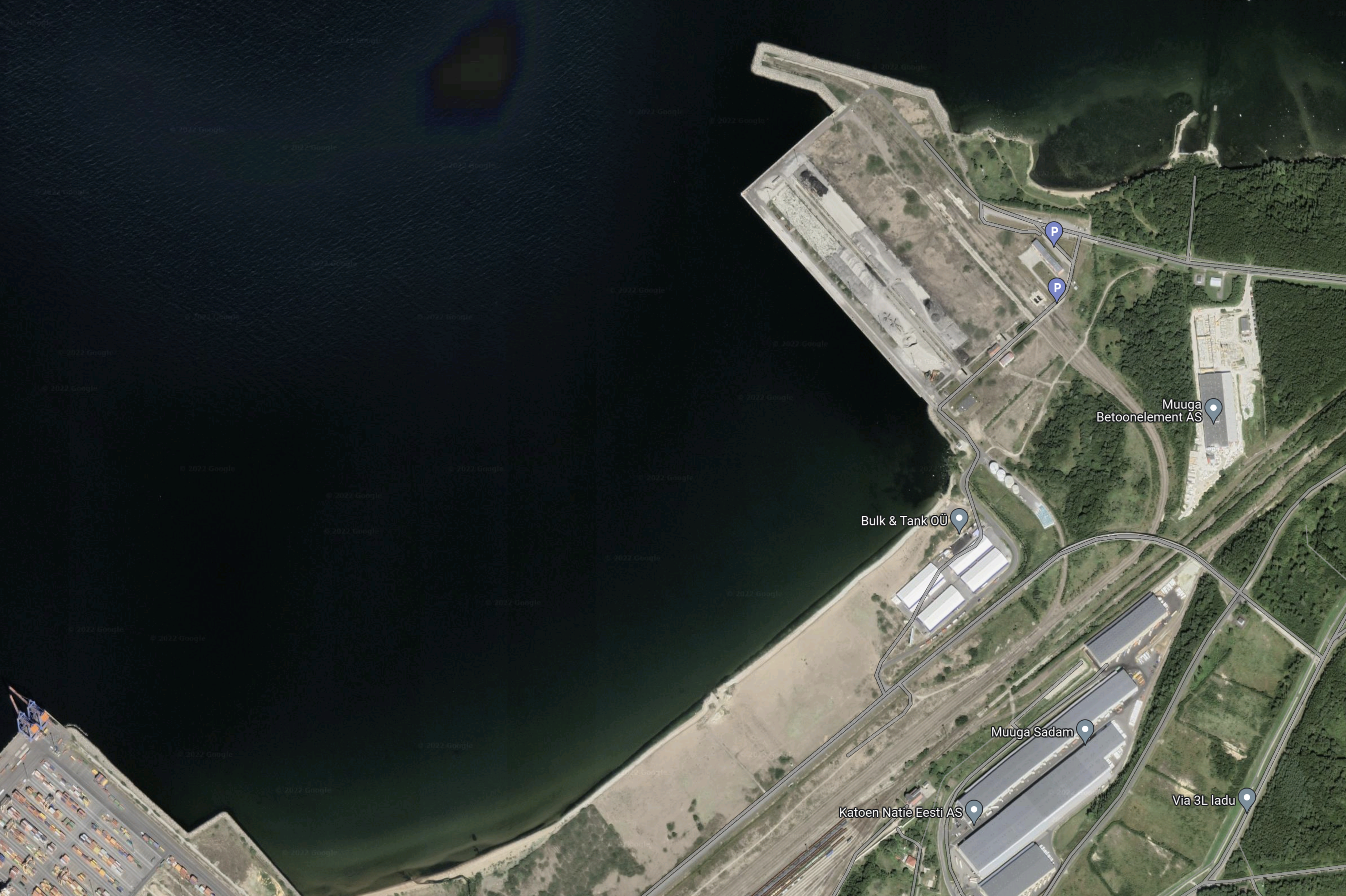
Note.
- Muuga Harbour is the largest cargo port in Estonia, located on the southern coast of the Gulf of Finland, 17 kilometres (11 mi) northeast of the capital Tallinn
- It is one of the few ice-free ports in northernmost Europe and one of the most modern ports in the Baltic Sea region.
- Enlarging the picture shows a lot of rail lines.
It looks like Muuga Harbour is an ideal Northern terminus for the Amber Train freight service.
This Google Map shows the area of the Kaunus Intermodal Terminal.
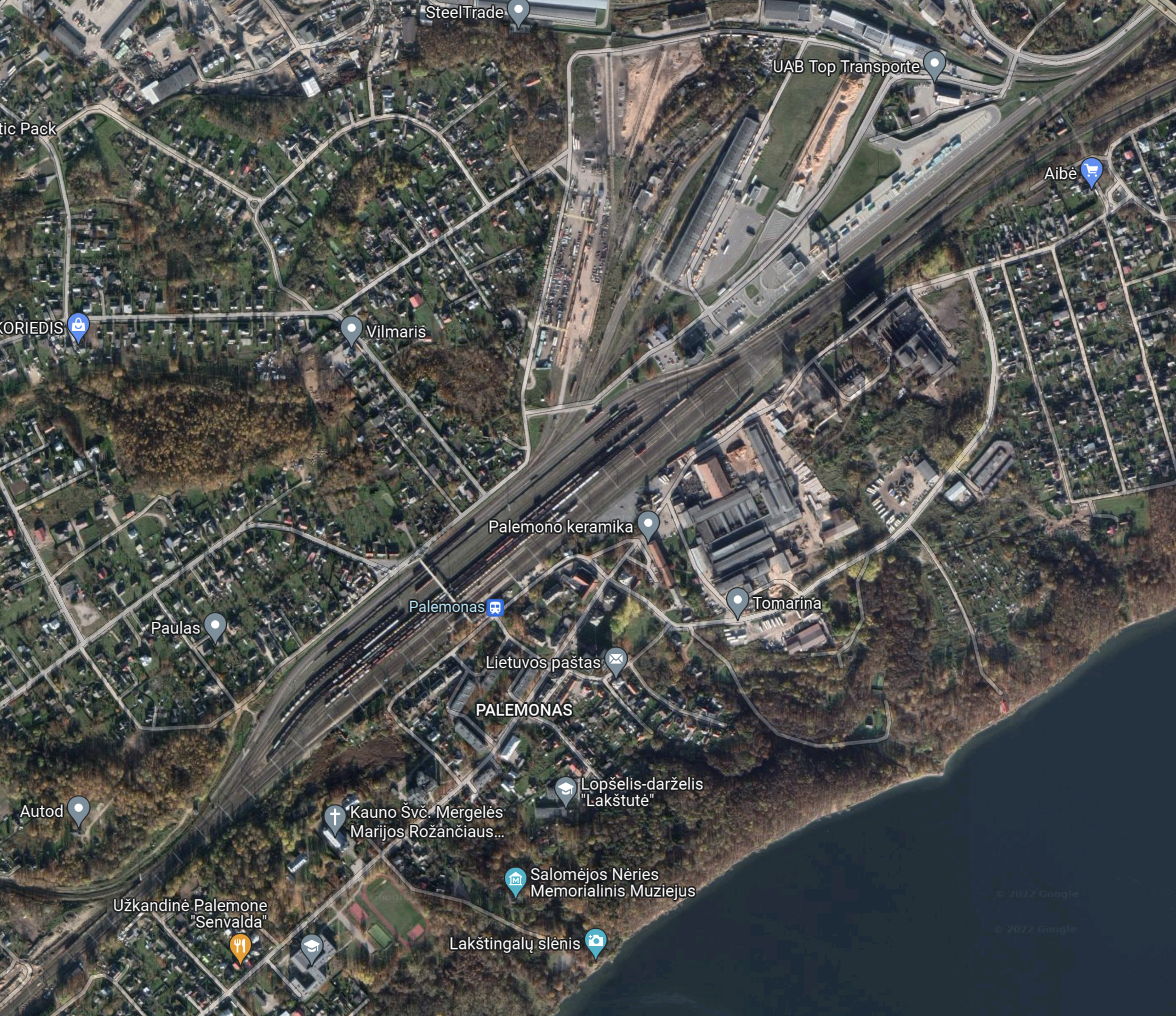
Note.
- The railway runs diagonally across the map.
- Estonia is to the North-East.
- Poland is to the South-West.
This map shows how the different gauges are used in the North-East of the previous map.
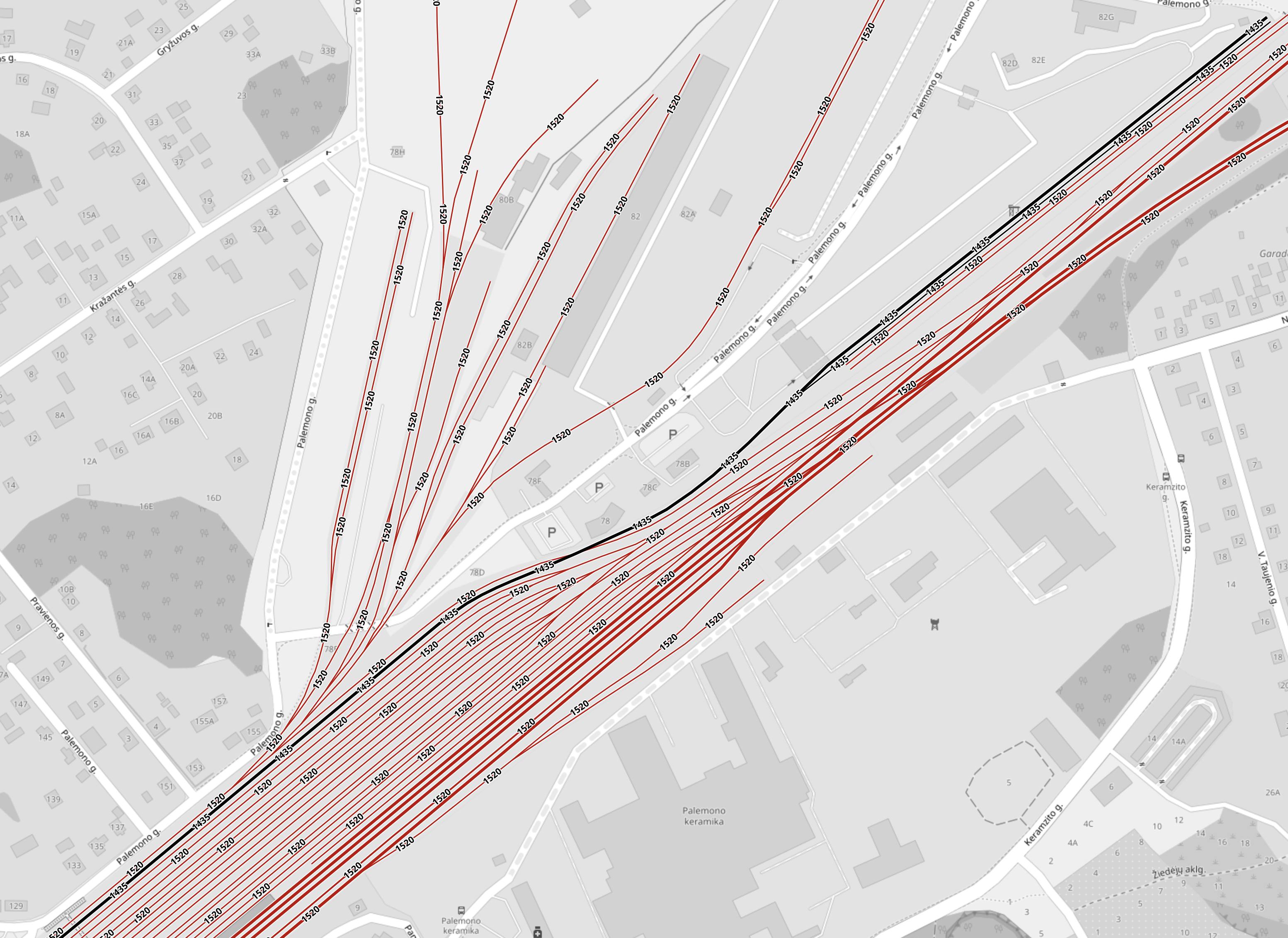
Note.
- Standard gauge tracks are shown in black.
- Russian gauge tracks are shown in red.
- The standard gauge track ends in the North-East corner of the map.
Trucks would probably moved between trains on parallel tracks in this freight terminal.
It appears to be a very simple way to run piggy-back trains of trucks between The Baltic States and Finland and Central and Western Europe.
Rail Baltica
According to Wikipedia, the location for the Kaunas Intermodal Terminal was chosen as it is compatible with the route of Rail Baltica, which will create a new standard gauge route between Kaunas and Tallinn in Estonia.
The Amber Train
The Amber Train has an impressive web site, where this is said on the home page.
Amber Train is a joint project of the national railways of Lithuania, Latvia and Estonia. It is an excellent example of cooperation, that offers road and railway clients convenient and efficient freight logistics.
Amber Train is an intermodal train, which runs on the route Šeštokai / Kaunas – Riga – Talinn, thus connecting the three Baltic States by railways and opening new business opportunities for freight shippers.
Exclusivity of the project is the connection of Western and North Europe, using the unique Šeštokai and Kaunas intermodal terminals, which enable the transshipment of freight from the European gauge to the 1520 mm gauge and vice versa.
The train is planned to run 2 times per week (with a future perspective to run up to 4 times per week), delivery time is 24 hours. Train length – up to 43 container wagons.
It is planned, that already in 2021 customers will be offered the opportunity to transport semi-trailers by railways via all three Baltic States. For this purpose, special “pocket” wagons are already in production.
Operations are managed by AB LTG Cargo (Part of Lithuanian Railways group), Latvia’s LDZ Loģistika and Estonia’s Operail.
It appears to be a well-thought out service.
A few years ago, I was on the roads of North-East Poland, about a hundred miles South of Kaunas.
These roads were crowded with large trucks going between The Baltic States and Finland and Central and Western Europe.
I suspect that once the Amber Train is fully established, a proportion of these trucks will go by rail.
Rail Baltica Electrification Procurement Begins
The title of this post, is the same as that of this article on Railway Gazette.
These two paragraphs define the project.
Rail Baltica project promoter RB Rail has begun procurement of the electrification systems for the future standard gauge line between Poland, Lithuania, Latvia and Estonia, saying it will be the largest railway electrification scheme in Europe to be implemented as a single project.
The energy subsystem contract covers 870 km of double track line from the Polish border to Tallinn including the line from Kaunas to Vilnius, and includes design and construction of substations, connections to the public high voltage grids, control systems and more than 2 000 track-km of overhead equipment.
It looks like the procurement process will be finished by 2023.
Hopefully, Vlad the Mad won’t object to this standard gauge line going too close to lines with his beloved Russian gauge.
Lithuania To Germany Intermodal Service To Launch In April
duiThe title of this post, is the same as that of this article on Railway Gazette.
These are the first two paragraphs.
Lithuanian national railway’s freight business LTG Cargo is to launch a service carrying containers and semi-trailers from the Kaunas Intermodal Terminal to Duisburg in Germany on April 4.
Trains with a capacity of up to 36 semi-trailers and containers will run thrice-weekly on the 1 500 km route. This will be LTG Cargo’s first westward service operating in three countries, with operations in Poland and Germany handled by its LTG Cargo Polska subsidiary.tail
These are more information and my thoughts.
The Route
The route appears to follow a route from Kaunas to Warsaw via
- Marijampolė
- Šeštokai
- Mockava
- Suwalki
- Buchwalowo
- Bialystok
Note.
- The links on the names are to the town’s Wikipedia entry.
- The border between Lithuania and Poland is between Mockava ans Suwalki.
- There are freight yards and change of gauge facilities at Šeštokai and Mockava.
Some of these towns are probably worth a visit, especially if like me, you have Jewish ancestors from the area.
My father’s great-great-grandfather possibly came from Konigsberg in East Prussia and arrived in the UK around 1800.
The Russian And Standard Gauge Solution
Consider.
- Estonia, Latvia and Lithuania have Russian gauge railways which is 1520 mm.
- Poland, Germany, France, Italy and the UK have standard gauge railways, which is 1435 mm.
The solution has been to build between Kaunus and Šeštokai, to build Russian gauge and standard gauge tracks side by side.
Kaunas Intermodal Terminal
This Google Map may show the Kaunas Intermodal Terminal.
Note the rail yards in the middle of the map, have both Russian and standard gauge tracks.
Rail Baltica
The route taken is the standard gauge route of Rail Baltica, which is an EU project.
- It will run between Helsinki and Warsaw.
- Intermediate stops will be Pärnu, Riga, Riga International Airport, Panevėžys, Kaunas and Bialystok
- Vilnius will be served by a branch from Kaunus.
- The line will be double track.
- The line will be electrified with 25 KVAC overhead.
- Passenger trains will operate at up to 249 kph.
- Freight trains will operate at up to 120 kph.
- A tunnel will be built later between Helsinki and Tallinn.
Completion of the route between Warsaw and Tallinn is planned for 2026.
Rail Baltica I
Rail Baltica I is the first section of the route to be opened and is described like this in Wikipedia.
The name Rail Baltica is also sometimes used to mean the first phase of European gauge railway construction from the Poland-Lithuania border to Kaunas in Lithuania.
It opened in October 2016.
The new freight service will use this route to connect to Bialystok and Warsaw.
Conclusion
I have been on the roads in this area of Poland and rail freight services are needed to take the pressure off the roads.
Will Rail Baltica Annoy Putin?
Rail Baltica is described like this in Wikipedia.
Rail Baltica (also known as Rail Baltic in Estonia) is an ongoing greenfield railway infrastructure project to link Finland (via ferry or an undersea tunnel), Estonia, Latvia, Lithuania with Poland and through this with the European standard gauge rail line network. Its purpose is to provide passenger and freight service between participating countries and improve rail connections between Central and Northern Europe, specifically the area in the Southeast of the Baltic sea. Furthermore, it is intended to be a catalyst for building the economic corridor in Northeastern Europe. The project envisages a continuous rail link from Tallinn (Estonia) to Warsaw (Poland). It consists of links via Riga (Latvia), Kaunas and Vilnius (Lithuania). Rail Baltica is one of the priority projects of the European Union.
These are a few more details.
- It will be a double-track railway or four tracks if it handles freight.
- Passenger trains will run at up to 250 kph (155 mph)
- Electrification will be either 25 KVAC or 3 KVDC overhead.
- It will be a standard gauge line.
- There will be no level crossings.
- It is planned to open around 2026.
The biggest problem could be that some of the route is shared with the Russian gauge line, that connect Kaliningrad to Vilnius and then from there to the main part of Russia.
This map from OpenRailwayMap shows the railways between Kaliningrad and Vilnius.
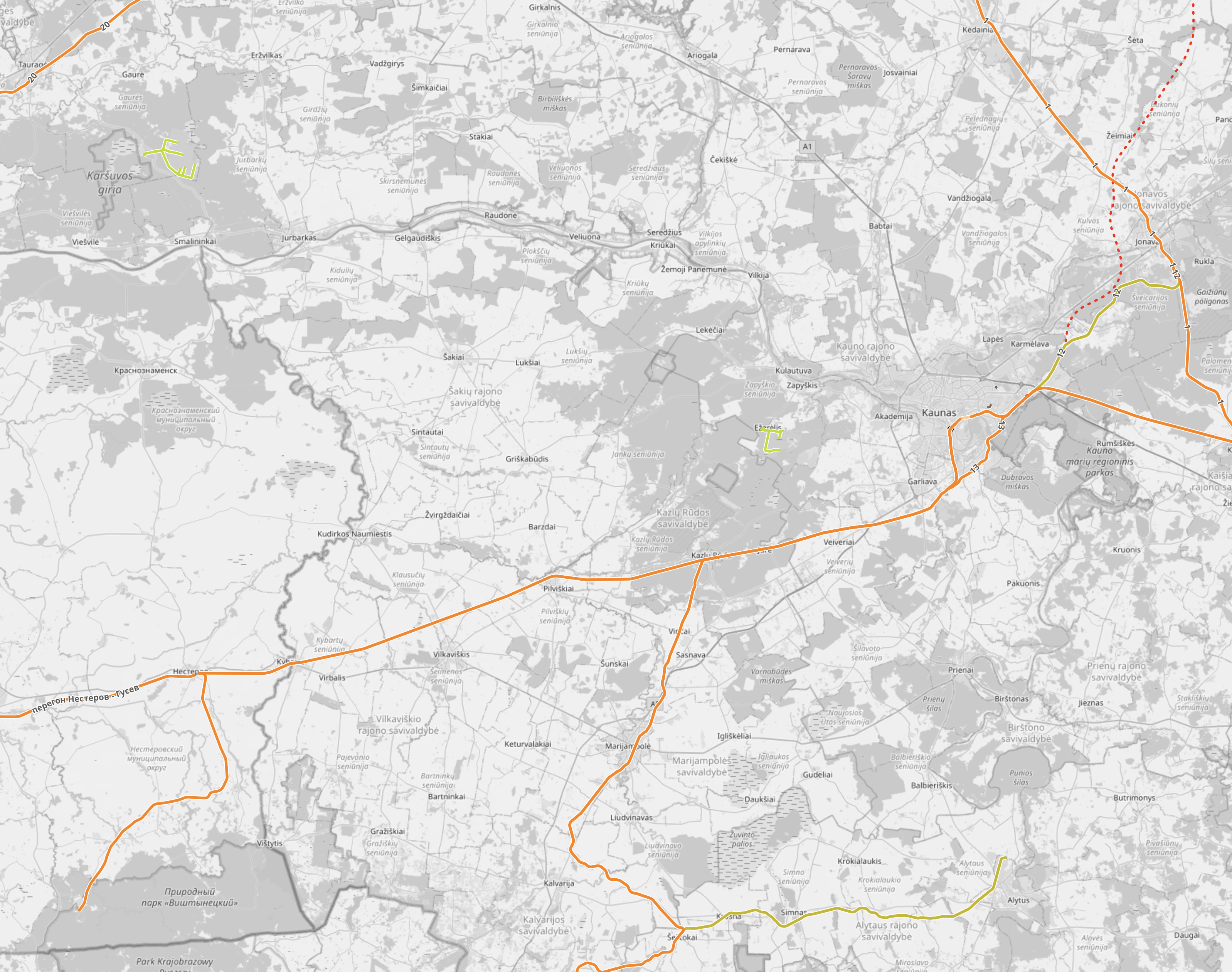
Note.
- The orange lines are main lines.
- The yellow lines are secondary lines.
- The orange line going West goes to Kaliningrad.
- The dark grey line crossing the railway is the border of the Kaliningrad enclave, which was annexed by the Soviet Union in 1945.
- The orange line going South goes to Bialystok, Warsaw and all places to the West.
- The loop in the line is at Kaunus, where there will be an interchange between the two lines.
- The orange lines going East go to Vilnius.
- The dotted red line in the North-East corner of the map, will be new track for Rail Baltica.
The new railway will effectively squeeze itself between Kaliningrad and Kaunus.
Railway Gauges In Poland and the Baltic States
Consider.
- Most, if not all of the railways in the Baltic States are Russian gauge.
- The line between Kaliningrad and Kaunus is Russian gauge.
- Most of the railway lines in Poland are standard gauge.
- The EU likes all new high speed lines like Rail Baltica to be built to standard gauge and have 25 KVAC overhead electrification.
- Kaunus is in Lithuania, so NATO control access to Kaliningrad in sensitive times.
I can’t believe that Vlad likes the current situation and would probably prefer Rail Baltica to be built to Russian gauge, as it would enable the Russian Army to easily move tanks into the Baltic States.
Conclusion
There’s a chance that Vlad will make trouble.
Rail Baltica Concept Trains Inspired By Sun, Sea And Sand
The title of this post, is the same as that of this article on Railway Gazette.
The article shows concept images and I suspect that any of Europe’s train makers could make trains like these.
Rail Baltica will have following route and specification.
- It will eventually run between Helsinki and Warsaw, via Estonia, Latvia and Lithuania.
- There will be a tunnel between Helsinki and Tallinn.
- It will carry both passengers and freight.
- Freight trains will have a maximum length of 1050 metres, as opposed to 775 metres in the UK.
- It will be mainly double-track.
- It will be a standard gauge track with right-hand running, as all countries in the area use right-hand running.
- There will be no level crossings.
- It will have 25 KVAC overhead electrification.
- There will be ERTMS signalling.
- Passenger trains will run at 249 kph (161 mph)
- It is intended to be completed in mid-2026
The specification is similar to High Speed Two, with these exceptions.
- High Speed Two is faster at 205 mph.
- High Speed Two runs on the left.
- High Speed Two will not carry freight.
Phases 1 and 2a of High Speed Two should complete in 2029-2033, with Phase 2b following in 2035.
The bidders to build High Speed Two’s rolling stock include.
- Alstom Transport
- Bombardier Transportation (acquired by Alstom Transport on 29 January 2021) and Hitachi Rail Europe consortium
- Construcciones y Auxiliar de Ferrocarriles
- Patentes Talgo
- Siemens Mobility
I wouldn’t be surprised to see a similar list of companies tendering to build the trains for Rail Baltica.
- Stadler, who have factories in Poland may be added to the list.
- As the trains are being designed at the same time as High Speed Two trains, I wouldn’t be surprised to be similarities.
- They would also have to be designed for both left and right hand running, if there was any chance of a service between Paris and Helsinki.
- Although, they will run under 25 KVAC electrification on Rail Baltica,they may need to be able to run on other voltages.
I very much feel that Rail Baltica will be offered a selection of excellent trains.
Where Will The Trains Be Built?
Consider
- This obviously depends, where winning bidder has factories.
- But there is also the problem of getting trains between the factory and the Baltic.
- This could be difficult for factories in Spain, as there would need to be a gauge change.
- It would be easier, if the route were standard gauge all the way, as it would be from France, Germany, Italy and the UK
- If a Spanish company got the contract, could it build the trains in the UK, as delivery could be easier.
- I puzzle, why Talgo are building a factory in Scotland without any UK orders. But it would be easier to deliver trains to Russia and Eastern Europe by sea from Longannet than Spain.
There are a lot of factors that will define where the trains will be built.
 The Anonymous Widower