Should Railways Have A Pop-Up Service Capability?
Most of us will be familiar with the concept of Pop-Up Retail.
This is the first paragraph of the Wikipedia entry.
Pop-up retail, also known as pop-up store (pop-up shop in the UK, Australia and Ireland) or flash retailing, is a trend of opening short-term sales spaces that started in Los Angeles and now pop up all over the United States, Canada, China,Japan, Mexico, France, Germany, the United Kingdom and Australia. The pop-up industry is now estimated to be a $50 billion industry. Pop-up retail has been an increasing factor during the retail apocalypse of the 2010s, including seasonal Halloween retailer Spirit Halloween, who has operated stores in vacant spaces during the season.
Two of the units are scheduled for export to the United States, to demonstrate for the potential for ‘pop-up’ commuter services; the cost of a one-year period are said to be equivalent to the consultancy costs for opening a new route. Should such an approach be considered in this country too? The gestation period for new services on freight-only routes is probably the best part of 10 years, but it doesn’t have to be like that.
When floods swept away the road bridge at Workington in 2009; Network Rail and Northern constructed a pop-up station and introduced additional trains in less than two weeks.

I can envisage three types of simple stations.
- A one-platform station on a single-track line.
- A two-platform station on a double-track line.
- A one-platform station on a double-track line.
Note
- Type One, would be the simplest and would be worked bidirectionally.
- Type Two, would probably require a bridge across the tracks.
- Type Three, would need crossovers at both ends of the station, to allow the single platform to be worked bidirectionally.
Obviously, Type 1 would be the most affordable and probably easiest to install.


- It would certainly bridge the gap between two platforms with a double-track railway in between.
- In a rail application, the bridge would be interlocked with the signalling and controlled by the signaller.
- Signals and lights could be added to the bridge to ensure complete safety.
- Wikipedia says the original at the Paddington Basin cost £500,000, which could probably be reduced if more were built.
- This page on the Merchant Square web site, shows the bridge in action.
- I suspect this bridge would work on single- or double-track lines, without electrification, or with third-rail or with overhead electrification.
- At many stations it could just be dropped in place from a rail-mounted crane, after preparing the existing platforms.
- I suspect though, that there would be a limit to the number of trains per hour it could handle.
- The ability to execute a fast stop at a station.
- Level access will be possible between train and platform.
- On-board CCTV systems to ensure safe loading and unloading of passengers.
- Modern in-cab digital signalling.
This will enable the trains to make a station stop without causing problems to the existing timetable.
So if Network Rail, had the ability to quickly install a pop-up station, modern trains would allow a service to be tested at a reasonable cost.
The Practicalities Of Installing A Pop-Up Station
Suppose a station were to be installed at Soham or any other suitable place.
I would expect Network Rail to produce standard designs for the foundations of their pop-up stations.
Network Rail periodically close a line to replace track or do various other work. When a line is closed for this work and a pop-up station might be needed on the route, the standard foundations would be installed.
Then, when the budget for the station had been obtained, the station would be installed and commissioned in a suitable possession.
Conclusion
I believe a pop-up station is a feasible proposition.
If a pop-up station is a feasible proposition, then it follows that to install perhaps five stations on a freight-only line to create a totally new passenger service is also a feasible proposition.
The East Beach Cafe At Littlehampton
On my way to Yeovil, I had lunch at the Thomas Heatherwick-designed East Beach Cafe at Littlehampton.




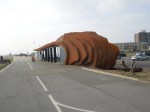
It was a good gluten-free lunch of fish and chips and a glass of wine.
The cafe was very busy too and I suspect on a lovely summer’s, it might be difficult to get a table.
It was also a fair walk to and from the station and as ever the signs could have been better.
I don’t know whether Thomas Heatherwick has ever been to Felixstowe, but the ceiling detail was very like the walls of Charlie Manning’s Amusements in the town.
And Now Thomas Heatherwick Coins A New Word
My Internet trawl for the New Bus for London, picked up this article in the Financial Times called Touched With Madeness about Thomas Heatherwick.
So many quirky ideas, may look good on paper, but can’t be made. His can, although he had a few early ones suffered from problems. But then so did Brunel’s.
Hence the idea that every idea and design should have the quality of madeness or the ability to be made.
Call For Thomas Heatherwick
I have just been re-reading the article in the April 2013 edition of Modern Railways, entitled Time for a fresh look at light rail.
The article says that if we are to get more tram systems in the UK, then they must be cheaper. The writer argues that to be cheaper, they must be lighter and designed without thinking too much of how you build a High Speed Train.
He also argues that they should be innovative in their collection of power, like the trams in Seville. I would go one stage further and use some kind of flywheel power storage, as proposed by Torotrak.
Perhaps now is the time to call for Thomas Heatherwick, to design a lightweight, virtually silent, stylish, high-capacity tram, that didn’t need to have overhead wiring all along its route. Seville has shown some of what can be done. The team that successfully takes the next step, will create a revolution in trams. And with luck make a fortune!
Cool Brands
The BBC is also reporting the coolest brands.
Top is Apple, which proves P. T. Barnum‘s statement of “there’s a sucker born every minute”. In fact of the top twenty brands, I only use five; YouTube, Google, BBC iPlayer, Sony and Nikon.
Surely though, the coolest brand in post-Olympic London is Heatherwick, who designed the Olympic flame and the New Bus for London.
Who’d have thought a bus could be cool, but then, who’d have thought that the BBC, would have designed, something that features highly on the list produced by Cool Brands.
Heatherwick Does It Again!
The cauldron at London 2012 is nothing like I’ve seen at any other Olympics.
And like the New Bus for London, it’s out of the studio of Thomas Heatherwick. Read more about it here.
It enabled a number of promising athletes chosen by our more successful past Olympians to light the cauldron.
I may have found some of the things in the Opening Ceremony a bit naff and politically correct, but I’ll give two hundred out of a hundred for the way the cauldron was designed, built and lit.
A New Bus For London
Last night, I went to a presentation by Stuart Wood of Heatherwick Studio at the London Transport Museum of the proposed New Bus for London. Stuart is the lead designer, who is working in partnership with Wrightbus, who will actually be building the new buses.

A Routemaster, an RT and a New Bus for London
This picture shows the bus alongside two of its predecessors, the Routemaster and an RT. I probably travelled on more RTs, than any other bus, as I used the 29 or 29A to get to school for several years.
When I first saw pictures of the bus, I must admit I wasn’t sure that the three-door, two-staircase design would work. In fact, as the talk revealed, it is one of the design strengths as it enables all of the parts of the hybrid-drive system to be kept out of the useable space, with the battery and fuel tank under the front staircase, the engine/generator under the back one and the electric motors inside the rear wheel arches.
What did surprise me, was that some of the things, they’d have liked to have done, fell foul of the various regulations. For instance, they would have liked to have the handrails in bare metal, as on the original Routemaster, but regulations mean they must stand out, so that those with limited vision can see them. In the end they used a light yellow-gold colour.

Rear Lower Deck Layout
This picture shows the handrails in the proposed layout at the back of the lower deck over the rear axle. Note the high seat backs in this picture on the back-to-back seats over the rear axle. One of the design ideas here was to create some slightly better seats and as there are two groups of four, they also have the advantage of being suitable for families or friends travelling together.
In fact the interior design can be described as quirky in some ways.
- Both staircases are glazed, with the rear one being curved. They are infinitely better than those on the French TGV Duplex trains, which are straight and dark.
- I actually feel that for someone like me with a limited left hand, that I would use the rear staircase to ascend to the top deck, as this would mean I’ll be better balanced. I have climbed onto the top deck of a Routemaster since my stroke and found it not too difficult.
- The design also incorporates a love-seat at the top of the rear staircase, just like the old RT did. I can’t say, I’ve ever sat there on the top deck of a Routemaster, but did a lot on the old 29’s to and from school.
- The rear downstairs seating as the picture showed is definitely quirky with high-backed seats and groups of four. In a way the groups reminded me of how my mother would put me at the age of six on a 107 at Oakwood to go to my aunt’s for piano lessons, on the longitudinal seats of an RT. The conductor would look after you. Although the buses may have conductors at times, these seats might well become family seats, for say father travelling with three or more children.
- I said three or more children, but as the seats all over the bus, are of a bench design, three small ones could easily sit together.
- I also think that those like me, wo do their shopping on the bus, will like the seating, as a bench design will allow you to share a bench with your shopping. I do this regularly on a 56 or a 38 from the Angel, when I return from Waitrose, on the half-empty buses in mid-morning.
So have they designed a bus for all people?
- It has a large capacity that will mean it should be a good commuter bus.
- The large amounts of glass and good visibility might make it a sightseeing bus on central routes.
- The layout is family friendly in my view. For energy saving reasons we must get children to like public transport.
- I do a lot of shopping on the bus. Does it fulfil that role?
- The seating on the lower deck, might encourage people to use buses for longer distances. I used to go miles as a child on the 107 to visit relatives. Now, there is no way other than to drive. But if the bus is comfortable, quiet and spaceous, would people be tempted to use it, in these times of high-energy costs?
Only time will tell if the concept works. But I like it!
 The Anonymous Widower