Filiming Trains At Rochester
I took these pictures at Rochester.










The station is new, as the last picture shows.
I filmed from the North side of the station from a probable development site, where people were working dogs and jogging.
The camera was a top of the range Nikon Coolpix
Aventras Have Underfloor Heating
I have underfloor heating in my house, so why shouldn’t trains.
In this article on Global Rail News, which is entitled First look around Greater Anglia’s Bombardier Aventra mock-up, this is said.
Instead of body-side heaters encroaching on leg room, under-floor heating has been used, seats are cantilevered too to save on space and there will be no doors separating vehicles.
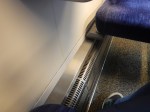
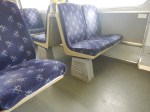
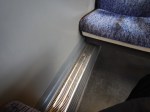
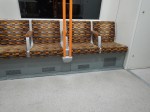
These pictures show the heating in various trains.
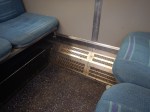

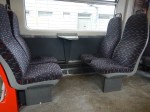
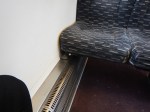
Note.
- The Class 314 trains have the heating built into the seats
- The Class 350 trains have them along the side.
Can this be why the Class 345 trains give an impression of width?
The Garden Station
Stations increasingly are getting to be very grand and expensive buildings.
I was musing today about the design of the Windsor Royal station on the proposed Windsor Link Railway.
This railway could be a double-track railway between the current Windsor and Eton Riverside station and the Slough To Windsor And Eton Line, created in a cut-and-cover tunnel across Windsor.
Much of the area of the route is either car parks or gardens.
The station could be a single island platform with the following characteristics.
- The platform would be long enough for the longest trains to use the route.
- The platform would be wide enough to incorporate booking, passenger and staff facilities in a relaxed layout in the middle.
- Escalator and lift entrances at several places along the platform.
- Minimalist surface buildings much like the fosteritos of the Bilbao Metro.
- Light pipes and other ideas could give the station a lot of natural light.
The surface area would be one large garden with walking routes to the sights of the town.
Any car parking would surely be provided at a Park-and-Ride station outside of the town.
Train Spotting At Samphire Hoe
Samphire Hoe Country Park lies a few kilometres west of Dover.
These pictures show the railway line that runs along the foot of the White Cliffs Of Dover.

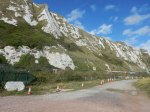
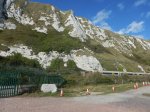
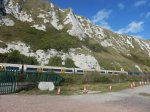
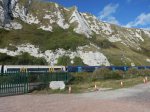
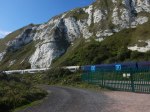
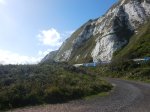
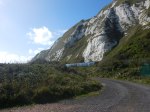
In the time I was there, I only saw the one Class 375 train.
Running Electric Trains Across The Forth Bridge
Search for something like Electrification of the Forth Bridge and you find a lot of speculation and no one who.believes it can be done easily.
A ScotRail conductor said very firmly that it wouldn’t be done.
I think that in addition to the engineering problems of electrifying the Forth railway bridge, there will probably be a lot of opposition from the heritage lobby!
I also think, that if you could solve the engineering oroblems, they will.cost a lot and mean closing the bridge for at least several.months.
Bi-Mode Trains
Virgin are proposing to use Class 800 trains, which are bi-mode and will use diesel power on the bridge. These trains will have no problems crossing the bridge.
They will probably even be quieter than the current InterCity 125s, that will be continued to be used by ScotRail.
Trains With Energy Storage
The bridge is not very long at 2.5 km. and an electric train with onboard energy storage could prossibly cross the bridge, if the tracks were electrified as far as the approaches.
So do I think it is possible that a train with onboard energy storage could cross the Forth Bridge?
The Energy Storage Could Be Full Before Crossing
If the overhead electrification reached to perhaps five hundred metres from the bridge, then the onboard storage would be full.
The train would lower the pantograph and then raise it again, when under the wires on the other side.
The Maximum Speed On The Bridge Is 50 mph
This must help.
The Bridge Deck Appears Level
This must help.
Any Train Manufacturer Who Creates A Train With Onboard Energy Storage Will Gain A Worldwide Reputation
There is a lot of scepticism about trains with onboard energy storage or batteries and this would dismiss it for ever, once the crossing was shown on world-wide television with headlines like.
Battery Train Crosses Forth Rail Bridge Carrying Three Hundred Passengers
I believe that any train manufacturer, who felt they could achieve this feat would be willing to have a go, as the rewards would be immense!
Scotland Would Have A Unique Tourist Attraction
Although, I wouldn’t think it would be unique for long, as other countries would do the same to solve transport problems.
But nothing would ever be as iconic as the Forth Bridge!
I also doubt Scotland and ScoRail would say No!
Could A Class 385 Train Cross The Bridge On Stored Power?
In Hitachi Class 385 Trains, Batteries And Charging Stations, I discussed whether batteries or energy storage could be put into a Class 385 train.
I said this after giving details of Hitachi’s battery trains in Japan.
So will Scotrail’s new Class 385 trains have a battery capability?
Probably not initially!
But Hitachi have obviously been doing a lot of research into battery trains and the JR Kyushu is the first practical application.
Scotland’s rail system outside Edinburgh and Glasgow is not electrified, but it is well-known that Scotland’s Government would like more electrified services and also links to places like Leven and St. Andrews.
Both of these places, and there are probably others as well, are a few miles from a main line, that is very likely to be electrified.
So could we see a battery train charged as the JR Kyushu train on a main line, serving these branch lines on battery power?
I feel that the chance of this happening is very high.
So I feel it is highly likely, that if some form of stored power was fitted to Class 385 trains, that they would be able to bridge the gap between electrification systems North and South of the Forth Bridge.
Electrification Of The Fife Circle Line
Electrification of the Fife Circle Line would be the simplest way to improve the local rail service from North of the Forth Bridge to Edinburgh.
This shows a map of the line North from Edinburgh Gateway station.
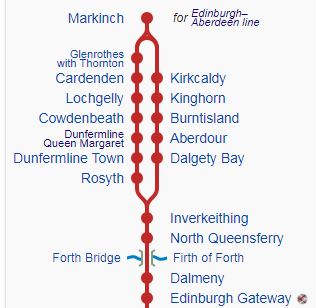
It would need the electrification from Haymarket station through Edinburgh Gateway station to be completed South of the Bridge to an appropriate point on the bridge approach.
North of the Bridge, the circle could be electrified from an appropriate point on the bridge approach, all round the circle to Markinch station.
Running The Fife Circle Service With Class 385 Trains With Onboard Energy Storage
A belt and braces approach might see North Queensferry and Dalmeny stations being the changeover point from overhead to onboard power, so that with any problems, the train is safely in a station, rather than stuck on the bridge.
Currently, the two routes between Glenrothes With Thornton and Edinburgh stations take the following times.
- Via Kirkaldy – 59 minutes with ten stops.
- Via Dunfermline – 62 minutes with eleven stops.
This means a train doing a round trip from Edinburgh takes just over two hours with twenty-one stops.
The Class 385 trains will have the following characteristics compared to the current diesel trains on the route.
- They will be faster.
- They will accelerate better and have smoother regenerative braking.
- They will have a much shorter dwell time at stations.
It would not be unreasonable to assume that the new electric trains could be several minutes under two hours for the round trip.
Trains that didn’t reverse could also go straight round the circle with the driver only changing ends at Edinburgh.
Currently, the route has three trains per hour (tph), so to run this level of service would require six trains.
Running four tph would need an extra two trains and if two tph used each direction, all stations would have a two tph service.
The trains would only need the ability to run between Dalmeny and North Queensferry stations on onboard storage.
Bi-Mode Trains Between Edinburgh And Aberdeen
Virgin Trains East Coast and possibly other operators wlll be running bi-mode Class 800 trains between Edinburgh and Markinch stations.
They will have to use diesel power where there is no electrification, but if the Fife Circle Line were to be electrified, they could use it, to run the trains more efficiently.
Onward From The Fife Circle
The Fife Circle Line could be a bridgehead to extend electrified services to the North.
Consider these distances.
- Markinch to St. Andrews – 20.7 miles
- Markinch to Dundee – 25.1 miles
- Markinch to Perth – 22.7 miles
- Glenrothes to Leven – 7.1 miles
All of these destinations could be reached by a combination of short lengths of electrification and trains with onboard energy storage.
Scotrail’s Extra Ten Class 385 Trains
Scotrail have an extra ten Class 385 trains on option, if the franchise is extended by 7 to 10 years and the trains would enter service in 2023.
Could these trains be to run an electrified Fife Circle Line service and perhaps running to Leven?
Conclusion
Scotrail have some ambitious plans for Scotland’s railways and I wonder, if they include using Class 385 trains with onboard energy storage to get electric trains across the Forth Bridge.
Gluten-Free In Virgin First Class From Carlisle!
Crisps and a banana!
That is just not good enough!
But it was aerved with a smile!
Killing Time In Carlisle
I miscalculated my journey back from Glasgow and have a lot of time to kill in Carlisle.
So I’m in the Costa outside the station, charging my phone and writing these posts.
It’s a convenient place to recharge.
The Wind Of Change Blowing All Over The UK
This has nothibg to do with Brexit or even politics, but the UK and in addition our friends in Denmark, Germany, Ireland and The Netherlands seem to be investing to reap the wind.
To many of my generation, Hornsea is a town on the Yorkshire coast famous for dull ethnic pottery. But now it will the name of the Hornsea Wind Farm, which will have a generating capacity of up to 4 GigaWatt or 4,000,000 KiloWatt. It will be sited around 40 kilomwtres from the nearest land.
To put the size into context, Hinckley Point C, if it is ever built will have a power output of 3.2 GigaWatt.
You may day that wind is unreliable, but then Hornsea will be just one of several large offshore wind farms in the UK.
- Dogger Bank(4.8 GW),
- Greater Gabbard(504 MW)
- Gwynt Y Mor(576 MW)
- London Array(630 MW)
- Race Bank(530MW
- Thanet(300 MW)
- Yriton Knoll(600-900 MW)
- Walney Extension (659 MW).
The electricity produced can be used, stored or exported.
Storage will always be difficult, but then there are energy consumptive industries like aluminium smelting, creating steel from scrap or the electrolysis of water to produce hydrogen, oxygen and ither gases, that could probably be based around an interruptible supply backed-up by a biomass or natural gas power station.
Hydrogen As A Fuel
Hydrogen could be the fuel of the cities for buses, taxis and delivery vehicles. Suppose they were hybrid, but instead of a small diesel engine to xharge the battery, a small hydrogen engine or fuel cell were to be used.
Remember that the only product of burning hydrogen is water and it wouldn’t produce any pollution.
Each bus garage or hydrogen station could generate its own hydrogen, probably venting the oxygen.
Enriched Natural Gas
We can’t generate too much hydrogen and if because of high winds, we have hydrogen to spare it can be mixed with natural gas, ehich contains a proportion of hydrogen anyway.
Carlisle Station – 12th September 2017
The reconstruction of the roof of Carlisle station is coming on apace, as these pictures show.
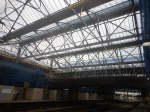


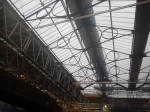
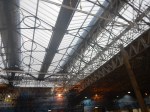
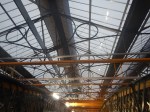
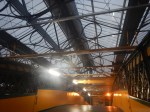
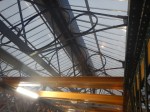
The roof was getting an immense soaking and there was an odd leak and a drumming sound, but it does seem that when everything is completed the station will be the interchange needed for the city.
A Trip To Romantic Paisley Canal Station
Paisley Canal station has the same ring to it, that I talked about in Now You Can Take A New Bus For London To Romantic Clapton Pond.
So I had to take a trip.
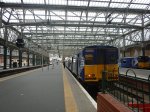
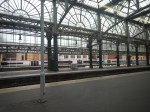

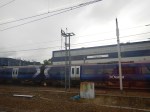
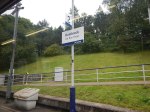
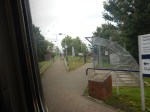

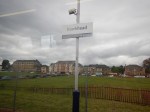


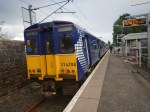
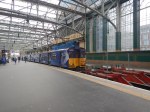
The Paisley Canal Line is very much a line of simple stations, many of which are just a single platform.
Judging by the amount of cars strewn around Hawkhead station, there would appear to be a need for Park-and-Ride station on the line.
The Class 314 Trains
This is a line, that would benefit from some replacement trains for the current Class 314 trains.
Like London’s Class 315 trains, the Class 314 trains are a reliable set of relics from the British Rail era. London’s 313 and 315 trains are all being replaced and I wonder if the new Class 385 trains will enable better stock to run on this line.
Currently, the 75 mph Class 314 trains take eighteen minutes with five stops from Glasgow Central and twenty-one minutes for the return.
As the service is half-hourly, the service requires two trains.
If the service were to be run by modern Class 385 or 380 trains, which are 100 mph trains with much shorter dwell times at stations, the trains would appear to spend a lot of time at Glasgow Central station waiting to return to Paisley Canal.
Unless of course, they are fast enough to do the return trip in under half-an-hour, which would enable the current service to be run with a single train.
Extension To Kilmalcolm
Under Future in the Wikipedia entry for the Paisley Canal Line, this is said.
The reopening of the section between Paisley Canal station and Kilmacolm has been proposed.
The distance is probably not more than a few miles and the length of the extended line would probably allow a modern train to do the round trip in an hour.
If this were the case, a half-hourly service could be performed by two Class 380 or 385 trains.
I also suspect, that should a Class 385 train with onboard energy storage be developed, that such a train might be able to run the service, using stored energy between Paisley Canal and Kilmalcolm stations.
If this were possible, then no extra electrification would be needed.
As the Paisley Canal Branch is single-track from Corkerhill station, would it be possible to build the extension as single-track?
A single-track extension without electrification would surely do wonders for the economics of the project.
 The Anonymous Widower