737 MAX, Airbus And Aventra
I think that there are parallels between these plains and trains.
The 737 MAX is a conventional fifty-year-old design of aircraft, that has been updated with modern technology through the years.
When Airbus designed their fly-by-wire systems about thirty years ago, they were duplicated with two independent systems, programmed by separate teams. I think that the plane could fly on one system, if the other failed. Ittook time to develop, but no-one questions its reliability today.
The design and some of the things it gets up to, like moving fuel around to balance the aircraft help to increase the efficiency of the aircraft.
Efficiency and low pilot workloads help to sell aircraft.
Boeing is now trying desperately to catch up, but doing this in an ageing design appears to be difficult.
One thing I wonder is that is misloading of cargo a problem in the two 737 MAX crashes.
Supposing there was an imbalance of cargo on an Airbus! Would the plane’s computer realise this and move fuel to conpensate? Boeing must rely on a conventional approach using the flying controls.
Boeing are obviously worried as they have installed a special anti-stall conputer system called MCAS.
So what has this got to do with Bombardier’s Aventra train, that is suffering from software problems causing delays.
The Aventra is a radical design, that rewrites the rules, just like Airbus did. It relies heavily on a sophisticated computer system to control everything and bring a higher level of efficiency.
It will take time to get right, but just as Airbus did all those years ago, I believe they will.
The Aventra will change train design by as much as Airbus have changed airliner design.
Finland – Estonia Tunnel Secures €15bn In Funding
The title of this post is the same as that of this article on the International Rail Journal.
This is the first paragraph.
FINEST Bay Area Development has signed a memorandum of understanding (MOU) with Touchstone Capital Partners, China, to secure €15bn in financing for construction of a 100km railway tunnel under the Gulf of Finland between Helsinki, Finland, and Tallinn, Estonia.
Linked to the planned Rail Baltica, it will mean that passengers and freight will be able to use railways between the UK and Finland.
Boost For Borders In New Report
This report on the Scottish Government web site is entitled Borders Transport Corridors – Pre-Appraisal.
It is a comprehensive report with a helpful pag of recommendations.
Recommendations that apply to rail include.
Develop Forestry Route Network
Improve network of internal forestry tracks as well as its connections to roads and railway, including ‘low-tech’ timber
pickup facilities.
This seems sensible, as some of the forests on both sides of the Scottish order are mature and need to be cut down and replanted.
Increase Park and Ride Provision
Increase capacity of existing Park-and-Ride sites and implement new Park-and-Ride schemes for all modes at strategic locations [e.g. Interchanges and Key Employment Areas]
Every part of the UK seems to need more Park-and-Ride. The Borders is no exception.
Borders Railway Extension – South/West
Extend the Borders Railway to Hawick and/or Carlisle
Will it go all the way to Carlisle?
Consider.
- The West Coast Main Line will need a capacity increase through Carlisle because of High Speed Two. These works could be combined with those on the Southern part of the Borders Railway.
- Plans exist for a large freight interchange at Longtown on the former MoD site.
- Linking the Tourist areas North and South of the Scottish Border by rail must be a good thing.
- Extension to Carlisle would give those in the Scottish Borders access to High Speed Two at Carlisle, without a long trip via Glasgow.
For these reasons, I think that the Borders Railway will go to Carlisle.
Borders Railway Extension – South/East
Extend the Borders Railway towards East Coast Main Line (ECML) via Berwick-upon-Tweed
This surprised me, but it does complete the jigsaw.
Does it offer a freight route for moving the timber out of the area?
It woulde certainly offer a scenic route between Edinburgh and Newcastle.
New Rail Stations
New rail stations on the existing Borders Railway
This is surely building on the success of the current Borders Railway.
Extension of Borders Railway Services
Link Borders Railway and Fife Circle, providing interchange at Edinburgh Gateway; West Edinburgh; and potential future link to Glasgow.
Back-to-back services across a city are always a good idea, as they cut the need for terminal platforms
- The Borders Railway and Fife Circle are both half-hourly services, so could be connected together, once suitable rolling stock is available.
- This service would also connect the Borders to the Edinburgh Airport tram at Edinburgh Gateway.
- With extra services, would the capacity of the Borders Railway will probably need to be increased?
Does the South East extension enable better services for the Borders beyond Edinburgh?
Conclusion
There are a lot of projects needing to be developed, but they will create a lot of economic activity in the Borders.
The two railway extensions to Hawick and/or Carlisle and Berwick-on-Tweed are the two most expensive projects, but both have English implications, so I don’t think Westminster will mind paying some of the cost.
Cumbrian Coast’s Coal Comeback?
The title of this post is the same as that of an article in Issue 874 of Rail Magazine.
When I saw this article, I thought it was rather surprising, as coal is rather the arch-demon to environmentalists.
But this is not about coal for producing electricity, but metallurgical coal, that will be used in steelmaking.
West Cumbria Mining are proposing the mine and ofn their web site, the following is said.
West Cumbria Mining is investing in developing plans for the creation of a metallurgical coal mine off the coast near Whitehaven in West Cumbria to supply the UK and European steel-making coal market, which currently imports around 45 million tonnes per annum.
I would assume the 45 million tonnes refers to the total of the UK and European markets. S there is certainly a large market to supply, if the price is right.
Woodhouse Colliery
This extract describes how the mine will be created.
Woodhouse Colliery would be created using the access tunnels to old anhydrite workings at the former Sandwith Drift Mine, on the edge of Whitehaven. Until 2004, the site was occupied by the Marchon chemical works.
Studies have determined that sufficient coal reserves could be accessed to sustain mining operations for at least 50 years.
This picture was taken from their web site.
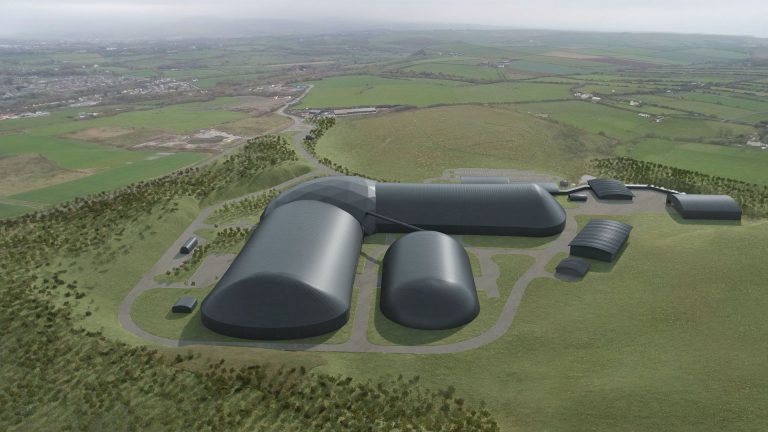
It doesn’t look to be a stereotypical coal mine.
Much of the coal would appear to be mined offshore.
Use Of The Railway
This extract talks about the use of the Cumbrian Coast Line, that passes through Whitehaven.
One of the things that actually makes the project realistic and viable is that we have access to existing infrastructure. There are lots of projects where actually the biggest capital cost is the infrastructure required. We have to remove everything by rail – one: because of the volume of material; but two: we wouldn’t be able to get planning if it was a road solution.
An agreement has been reached with Freightliner to transport the coal to Redcar. With the mine in full production, six trains per day would operate Monday-Friday.
More details about the rail transport are also given.
- There would be a single-track siding for loading.
- The siding would be connected to the mine by a 1.4 mile coal conveyor.
- Everything is covered, so there no dust and gas.
- The loading will be in an acoustically-closed building.
- Trains will have 23 wagons.
- Class 66 or Class 70 locomotives will be used.
It does appear that they are designing most things to a high standard.
These days, if planning permission with conditions is given, the conditions are usually adhered to, as sanctions are now easier to apply through the Courts.
I do have a few thoughts.
Route Between Whitehaven And Redcar
Trains would probably go via Carlisle, Newcastle and Middlesbrough
There would not be much electrification on the route, except for on the East Coast Main Line.
I would estimate that trains would take around three hours between the Woodhouse Colliery and Redcar
Rolling Stock
The article states that the wagons would be a dedicated fleet for the operation.
Surely, they could be designed for fast and quiet operation.
Locomotives
I feel that locomotives that meet the latest European regulations should be used. Class 66 locomotives do not, Class 68 locomotives do!
I also feel that in the next five years or so, more environmentally-friend;y and quieter locomotives will become available.
Improving The Cumbrian Coast Line
The article describes how the Cumbrian Coast Line will be improved if the mine gets Planning Permission.
Conclusion
If we are going to continue to make and use steel in the UK and Europe, it looks like this mine could create wealth in a part of the UK that needs it, without causing too many negatives.
It’s an interesting project.
Insurers Seek Rule Change To Invest In Green Power
The title of this post is the same as that of an article in today’s copy of The Times.
This is the first paragraph.
The mouthpiece for the insurance industry has called on the regulator to overhaul rules to make it easier to invest in green energy projects, such as wind farms and solar power.
Green energy projects are bad investments for the first few years, as they just burn money during construction. After that, the wind or solar farm, just produces electricity, which gives an adequate return fpr perhaps around thirty years.
As the rules stand, the returns in the construction phase are a dodgy investment.
The Prudential Regulation Authority, who make the rules, was setup in 2013, with probably a bunch of dinosaurs drawing up the rules, based on the past not the future.
These figures show the total energy generated by wind power for the last few years.
- 2008 – 5.4 GHh
- 2009 – 6.3 GWh
- 2010 – 7.9 GWh
- 2011 – 12.7 GWh
- 2012 – 20.7 GWh
- 2013 – 24.5 GWh
- 2014 – 28.1 GWh
- 2015 – 40.4 GWh
- 2016 – 37.4 GWh
- 2017 – 49.6 GWh
Note
- Between 2013 and 2017 electricity generated by wind power has doubled.
- In 2017, seventeen percent of our electricity was generated by wind.
These figures show the total energy generated by solar power for the last few years.
- 2008 – 0.17 GHh
- 2009 – 0.20 GWh
- 2010 – .0.33 GWh
- 2011 – 2.6 GWh
- 2012 – 1.3 GWh
- 2013 – 2.0 GWh
- 2014 – 4.1 GWh
- 2015 – 7.6 GWh
- 2016 – 10.3 GWh
- 2017 – 11.5 GWh
Note
- Between 2013 and 2017 electricity generated by solar power has increased fivefold.
- In 2017, 3.4 percent of our electricity was generated by the sun.
This paragraph from Wind Power In The UK on Wikipedia, shows the major growth in offshore wind power.
The total offshore wind power capacity installed in the United Kingdom as of February 2019 is 8,183 MW, the largest in the world. The United Kingdom became the world leader of offshore wind power generation in October 2008 when it overtook Denmark. It also has the largest offshore wind farm in the world, the 175-turbine London Array wind farm, located off the Kent coast.
I don’t think the Prudential Regulation Authority saw that one coming.
Conclusion
The rules should be changed
Schools Should Have ‘No Idling Zones’, Public Health England Chief Says
The title of this post is the same as that of this article on the BBC.
These are the first three paragraphs of the article.
Public health chiefs have proposed a ban on cars idling outside school gates in a bid to cut air pollution.
The measure is among a series of UK-wide recommendations put forward by Public Health England.
PHE medical director Paul Cosford told the BBC: “We should stop idling outside schools and we should make sure that children can walk or cycle to school.”
The article also lists other measures.
- Redesigning cities so people aren’t so close to highly polluting roads by, for example, designing wider streets or using hedges to screen against pollutants
- Investing more in clean public transport as well as foot and cycle paths
- Encouraging uptake of low emission vehicles by setting more ambitious targets for installing electric car charging points
- Discouraging highly polluting vehicles from entering populated areas with incentives such as low emission or clean air zones
All motherhood and apple pie, but it will be a vote loser for any Government, that tries to i9mplement it.
A Lonely Electric Bus
I found this bus at its terminus by the old Barts Hospital.





It is an Alexander Dennis Enviro200ev.
They are built in Britain on a Chinese chassis from BYD.
This week, I read the obituary of Simon Norton, who was a mathematician, who had an interest in group theory and bus routes and timetables.
He could have worked out a strategy, of how to keep London’s fleet of electric buses fully charged.
Consider.
- London’s single-deck routes are generally the shorter ones, so are probably ideal for electric buses.
- My instinct is telling me, that if all small buses were to be replaced with electric ones, the tight network would show up places for charging points.
- Would some be at the end of routes and some where several routes crossed?
It would be a fun calculation.
I suspect, I would solve it using a graphical method.
 The Anonymous Widower