UK Government Grants £30 Million For Long Duration Energy Storage Projects
The title of this post, is the same as that of this article on Solar Power Portal.
These two paragraphs outline the grants and their recipients.
The UK Department for Energy Security and Net Zero (DESNZ) is providing £30 million in grants for three long-duration energy storage (LDES) projects using novel energy storage technologies.
The three projects awarded funding are from Synchrostor, Invinity Energy Systems and Cheesecake Energy. Synchrostor and Cheesecake Energy are to receive £9.4 million each to fund thermal energy storage systems and Invinity Energy Systems receiving £11 million to develop a vanadium flow battery.
The UK Government seems to give out a lot of these grants for research and development purposes and from feedback I have received from recipients and also by applying my own experience, I am of the opinion, that they are spending tax-payers money more in a wise, rather than a foolish direction.
Cheesecake Energy
I wrote about Cheesecake Energy’s grant in Cheesecake Energy Collects £9.4m Government Funding.
The Government’s press release says this about Cheesecake’s grant.
Cheesecake Energy Ltd, Nottingham, which will receive £9.4 million to test their FlexiTanker technology which stores electricity using a combination of thermal and compressed air energy storage and uses a reversible air compression / expansion train to charge and discharge. They will then install pilot units at 2 sites within a microgrid development in Colchester.
If this project proves successful, it surely is one that can be duplicated in many places.
I have had my eye on Cheesecake Energy for some time and this could be their breakthrough.
Invinity Energy Systems
I first wrote about Invinity Energy Systems in UK’s Pivot Power Sees First Battery On Line By 2021.
The Government’s press release says this about Invinity’s grant.
Invinity Energy (UK) Limited, Scotland, which will receive £11 million to develop and manufacture their 7MW, 30MWh 4-hour Vanadium Flow Battery (VFB), the largest in the UK. Invinity will manufacture the 30 MWh VFB at the Company’s factory in West Lothian, Scotland. The location of the plant will be confirmed in due course.
In this article on renews.biz, which is entitled Invinity Wins Funds For 30MWh UK Battery, these two paragraphs introduce the project.
Invinity Energy Systems plc has today been awarded £11m in funding by the Department for Energy Security and Net Zero to build what it says is the largest grid-scale battery ever manufactured in the UK.
The £11m in funding will come from the Longer Duration Energy Storage Demonstration (LODES) Competition, with funding matched by Invinity’s, as yet unnamed, project partner.
These are other points from the article.
- It will be a fast-response 30MWh battery.
- The battery will be assembled at Bathgate in Scotland.
- It will operate as a stand-alone energy storage asset.
- It will be connected to the National Grid.
- Invinity’s vanadium flow batteries are an alternative to lithium-ion.
The aim is to go live by 2025.
This paragraph indicates the differences between a vanadium flow battery and a traditional lithium ion one.
Invinity said this battery is safer as they cannot catch fire, more durable as they do not degrade with use and are almost completely recyclable at the end of their 25+ year life, reducing environmental impacts and disposal costs for project owners.
I believe that there will come a point, when fully-developed vanadium flow batteries, will become very attractive for financial reasons to the successful energy storage funds like Gresham House and Gore Street.
If the UK government’s funding hastens the day, when energy storage funds feel that these new-fangled vanadium flow batteries are a safe investment, then it is money well spent.
It is not as though the money is going to an early start-up, as this page on the Invinity Energy Systems web site indicates at least a dozen installations.
This project for an as yet unnamed customer, which has a capacity of 30 MWh, is probably much bigger and the Government help is probably very much welcomed.
SynchroStor
SynchroStor was new to me, today.
The Government’s press release says this about SynchroStor’s grant.
Synchrostor, Edinburgh, Scotland, which will receive £9.4 million to build a Pumped Thermal Energy Storage (PTES) grid-connected demonstration plant operating at 1MW, with the ability to charge and discharge for a period of 10 hours, longer than current battery technology.
This page named Technology on their web site, explains their technology, both with words and diagrams.
It is probably the most complex technologies of the three batteries, but I don’t think that will be a problem.
Conclusion
The Government has given grants to three different storage technologies.
If all goes well three good sizable pilot plants will be created and those companies like Centrica, Gore Street, Gresham House, National Grid, Ørsted, SSE and others, will be able to judge, which system is best for their needs.
Manchester For The Weekend By Air?
For some weeks now, Manchester has been advertising itself as a weekend break on the giant advertising screen over Silicon Roundabout.












The adverts also seem to be backed by British Airways and are advertising flights from London City Airport.
Perhaps, these are in response to Avanti West Coast’s problems?
Moorgate And Luton Airport Parkway
This morning I went by train from Moorgate to Luton Airport Parkway to have a look at the Luton DART.
I used the following route.
- Elizabeth Line – Moorgate to Farringdon.
- Thameslink – Farringdon to Luton Airport Parkway.
I came back from Luton Airport Parkway on a Luton Airport Express.
I took these pictures on the route.
























Note.
- The change at Farringdon station was very easy.
- You walk past toilets at the Farringdon change.
- There are two bridges, lots of escalators and lifts at Luton Airport Parkway station.
- I didn’t take the DART to the airport.
These are some detailed thoughts.
Luton Airport Parkway Station
It is a much improved station, but still has some work to do.
- There was a problem with one escalator.
- Some of the signage is not finalised.
- I had a problem with ticketing, as I was sold the wrong ticket.
- Staff probably need a bit more training.
But then the station has only been open three weeks.
Luton Airport Express
East Midland Railway’s St. Pancras and Corby service is now branded as Luton Airport Express.
- It has its own web site.
- Trains only stop at Luton Airport Parkway, Luton, Bedford, Wellingborough and Kettering.
- Trains take as little as twenty-two minutes between St. Pancras and Luton Airport Parkway.
- Class 360 trains are used.
- Trains run every thirty minutes.
As it serves the local area, I wonder how many airport employees, now use this train to get to work?
Is There Progress On The West London Orbital Railway?
This short news item is being shown on Railnews under a sub-heading of Overground Plan.
The Mayor of London Sadiq Khan is reported to have predicted that a new London Overground route in west London could be open by the early 2030s. The link had been proposed by the Mayor in his 2018 Transport Strategy. It would run from Hounslow to Acton Central and the new HS2 station at Old Oak Common. From there it would continue to Acton Wells Junction and then along the Dudding Hill line, which is presently used only for freight, via the existing stations on the Euston-Watford Overground route at Harlesden and the Jubilee Line station at Neasden. Trains would continue from Neasden along the Midland Main Line in both directions to West Hampstead Thameslink and Hendon. It is understood that engineering consultants are being chosen to develop a detailed design.
So is there progress at last on what I feel is a much-needed and affordable addition to London’s railway network?
The West London Orbital Railway
In TfL Advances Plans For DLR And Overground Extensions, I said the following about the West London Orbital Railway.
I have written extensively about this railway and you can see my posts here.
This map from the Mayor’s Transport Strategy shows the route.
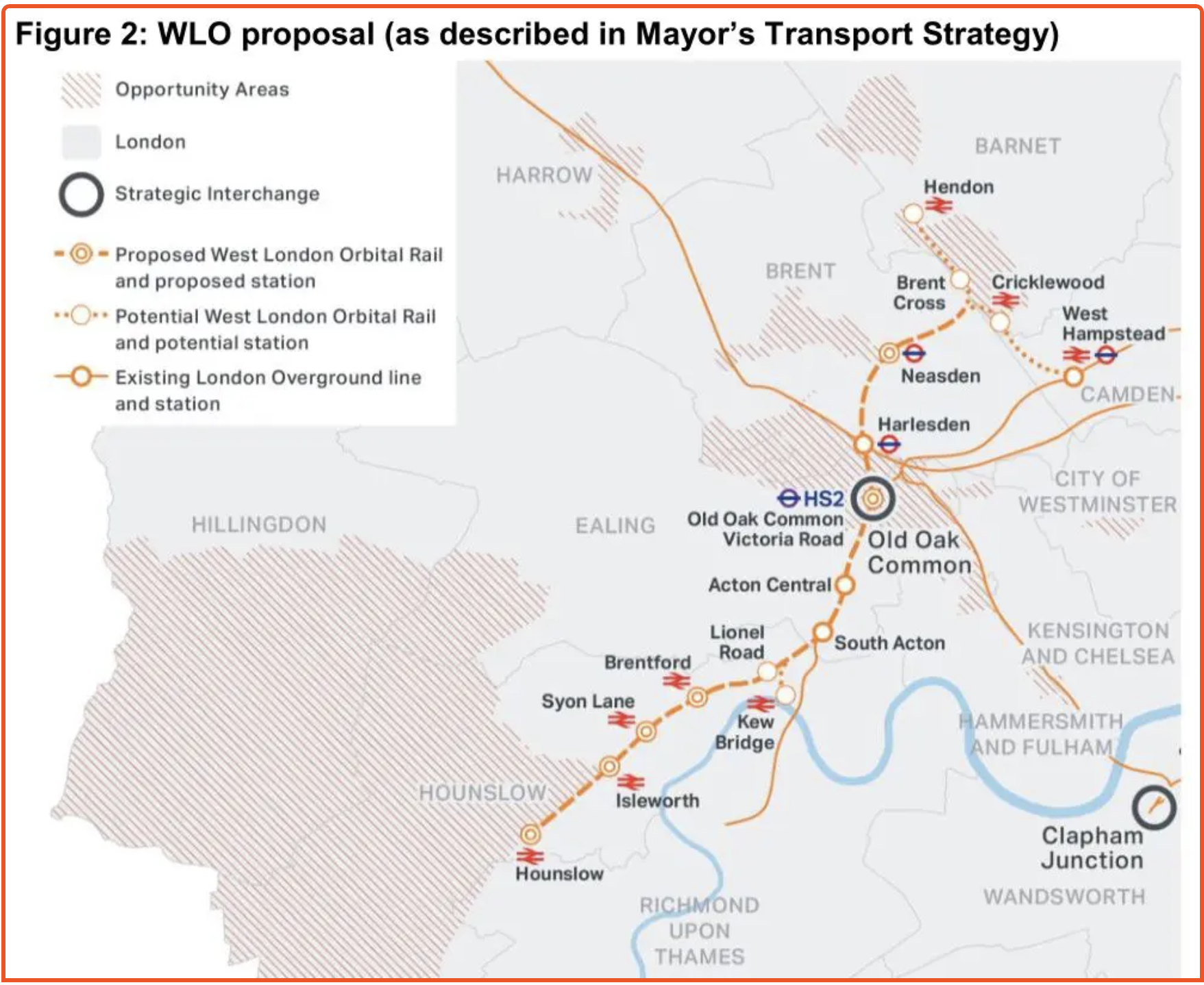
I believe this railway could do the following.
- Level-up much of North-West London.
- Provide better access to Heathrow.
- Link West London to High Speed Two and the Elizabeth Line.
It would also provide better links to Brentford’s new stadium.
The New Civil Engineer says this about funding.
TfL now confirms that the West London Alliance has commissioned feasibility work for the scheme. Meanwhile, TfL is considering options for a Borough Community Infrastructure Levy to help pay for it and has been investigating development opportunities on the route that could unlock funds via Section 106 planning obligations and Carbon Offset funding.
Conclusion
It does appear there are ways and means to fund these schemes, without expecting the rest of the UK to fund London’s transport network.
Cheesecake Energy Collects £9.4m Government Funding
The title of this post, is the same as that of this article on UKTN.
These two paragraphs outline how they will use the grant.
Cheesecake Energy will use the government funding to install its energy storage solution as a microgrid in Colchester to help with local grid limitations.
University of Nottingham spinout Cheesecake Energy’s installation will collect energy made by a solar farm with a capacity of 8MW and a central heat pump that supplies a district heat pump network.
Cheesecake Energy have been on my list of possible successful energy storage systems for some time and this sounds like a very neat application for energy storage.
Cheesecake Energy bill themselves on their web site as The World’s Greenest Battery, which is a big claim to make.
This outline of their technology is given on their Our Technology page.
Cheesecake Energy’s eTanker energy storage system is a stationary, medium to long-duration energy storage solution which delivers cheap, reliable, efficient energy storage in a modular, containerised package.
The technology stores energy in the form of heat and pressurised air, re-tasking ex-service truck engines to become zero-emission electrical power-conversion machines for putting energy into storage and recovering it from storage. The resulting system does not use diesel or any fuel. It is safe, straightforward to operate, has a lifetime of up to 25 years and can deliver turnaround efficiencies of around 70%.
I like the idea of using recycled truck engines at the heart of the system.
Conclusion
The World’s Greenest Battery could be right!
 The Anonymous Widower