Do Rolls-Royce mtu Have A Plan To Decarbonise Their Diesel Engines For Rail Applications?
Data Sheets For Rolls-Royce mtu Diesel Engines For Trains
These are data sheets for various Rolls-Royce mtu diesel engines that can be used in rail applications.
Rolls-Royce Releases mtu Rail Engines For Sustainable Fuels
The title of this section, is the same as that of this press release from Rolls-Royce.
These four bullet points, act as sub-headings.
- mtu Series 1300, 1500 and 1800 engines already released; Series 1600 and 4000 to follow shortly
- Up to 90% CO2 savings by operating existing engines with Hydrotreated Vegetable Oil (HVO/renewable diesel)
- Locally emission-free operation possible in combination with mtu Hybrid PowerPack
- Field tests with DB Cargo and RDC Autozug Sylt
This is the first paragraph.
Rolls-Royce is taking a significant step towards even more climate-friendly rail transport with the release of mtu rail engines for use with sustainable fuels. With synthetic diesel fuels of the EN15940 standard, CO2 emissions can be reduced by up to 100 percent compared to fossil diesel. Hydrotreated Vegetable Oil (HVO or renewable diesel), which is already commercially available today, reduces CO2 emissions by up to 90 percent. If the fuels are produced with the help of renewable energy and green hydrogen – through what is termed a Power-to-X process – existing rail vehicles can be operated in a completely CO2-neutral manner. The mtu Series 1800 engines which are used in mtu PowerPacks, as well as Series 1300 and 1500 for locomotives and multi-purpose vehicles, are already approved for use with synthetic fuels such as HVO. Series 1600 and versions of Series 4000 engines will follow in the near future. The release of engines for climate-friendly fuels requires a series of tests and trials and Rolls-Royce has found strong partners for this activity. DB Cargo and RDC Autozug Sylt have already tested or are currently testing mtu Series 4000 engines with HVO in their locomotives.
How Does That Fit With The UK’s Population Of Rolls-Royce mtu Diesel Engines?
These classes of train have Rolls-Royce mtu engines.
- Class 43 power cars – 6V 4000 R41R
- Class 168 train – 6R 183 TD 13H
- Class 170 train – 6R 183 TD 13H
- Class 172 train – 12V 1800 R83
- Class 195 train – 12V 1800 R85L
- Class 196 train – 12V 1600 R85L
- Class 197 train – 12V 1600 R85L
- Class 800 train – 12V 1600 R80L
- Class 801 train – 12V 1600 R80L
- Class 802 train – 12V 1600 R80L
- Class 805 train – 12V 1600 R80L
- Class 810 train – 12V 1600 R80L
Note.
- Class 168 and 170 trains seem to be powered by older model Rolls Royce mtu engines.
- Class 180, 220,221 and 222 trains are powered by Cummins engines.
- I can’t find what engines power Class 805 and 810 trains, but it is reasonable to assume they have the same engines as the other Hitachi trains.
- As CAF are building LNER’s new tri-mode trains, I suspect these trains will also have Rolls Royce mtu engines.
It would appear that all the Rolls-Royce mtu rolling stock in the UK, with the possible exception of the Class 168 and 170 trains will be able to run on sustainable fuels.
Rolls Royce mtu And Hydrogen
This press release from Rolls-Royce is entitled Rolls-Royce Successfully Tests mtu Engines With Pure Hydrogen.
This is the first paragraph.
Rolls-Royce today announces that it has conducted successful tests of a 12-cylinder gas variant of the mtu Series 4000 L64 engine running on 100% hydrogen fuel. The tests, carried out by the Power Systems business unit, showed very good characteristics in terms of efficiency, performance, emissions and combustion. These tests mark another important step towards the commercial introduction of hydrogen solutions to meet the demand of customers for more sustainable energy.
Engines of mtu’s 4000 family are used in Class 43 power cars, so surely these developments could lead to hydrogen-powered freight locomotives.
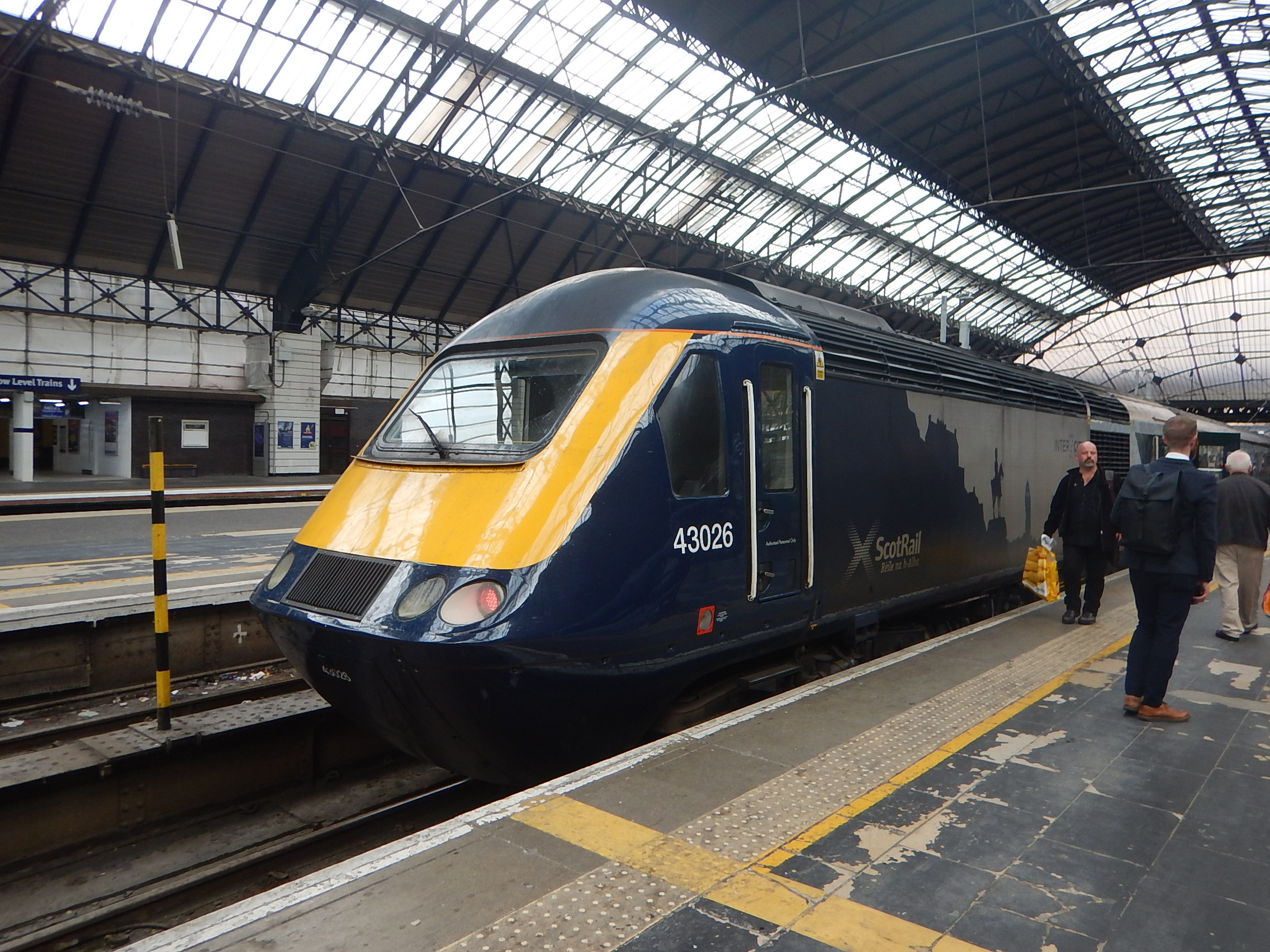
The picture shows a Class 43 power car at Glasgow Queen Street station.
Could Rolls-Royce mtu hydrogen power keep these iconic trains running for a few more years?
In ‘Spirit of Innovation’ Stakes Claim To Be The World’s Fastest All-Electric Vehicle, I look at Rolls-Royce’s Spirit of Innovation, which set the record for an electric vehicle at 555.9 km/hour.
As the InterCity125 already holds the record for the fastest diesel train, perhaps Rolls-Royce will attempt to set a record for the fastest hydrogen-powered train?
Decarbarbonising The CAF Class 195, 196 And 197 Trains
If Rolls-Royce mtu develop a hydrogen version of the 1800 diesel engine, then this could be used to fully decarbonise the CAF trains.
The operators may consider it’s not worth it and continue with using sustainable fuels.
But the possibility is surely there.
There must also be the possibility of developing a fuel cell replacement for the 1800 diesel, that can be slotted into the train.
Decarbarbonising The Hitachi Class 80x Trains
Hitachi are developing battery packs and the data sheet can be downloaded from this page on the Hitachi web site.
Decarbarbonising The CAF Tri-Mode Trains
I feel that as CAF usually use Rolls-Royce mtu engines, I suspect these trains will be designed, so they can be converted to hydrogen.
Conclusion
Rolls-Royce mtu appear to be on a path to decarbonise all their diesel engines.
 The Anonymous Widower
I have to say that I’ve been surprised by the rate of progress that all diesel engine manufactures are making in the quest to introduce hydrogen combustion engines and looks to me that most will have commercially viable products for the off-road, rail and transportation markets in 2025.
So far as the mtu rail business is concerned the old 6R 183 TD 13H engine won’t, I’m sure, be adapted for hydrogen. The basis for these engines is a now defunct Mercedes engine first developed over 50 years ago. The obvious solution, should train operators desire, would be to replace the engine with Series 1600 modern units with their highly developed engine management system. Despite having a lower engine displacement the power, torque and emissions characteristics are far superior.
MTU will in the future have competition from Liebherr who like their competitor now offer engines for rail applications and are at a similar stage of development as regards HVO and hydrogen.
Click to access liebherr-diesel-engines-for-the-railway-industry-application-flyer-en-web.pdf
Comment by fammorris | November 18, 2023 |
Thanks!
As you know, I believe that Stadler have built the Class 99 locomotive with Cummins engines, so that they can be converted to hydrogen power.
Comment by AnonW | November 18, 2023 |
There are some errors here. The engine in Class 43 (HST) is the 16V 4000 R41R. The 6R 183TD 13H engine is also used in Class 171 in addition to Classes 168 and 170. The engine in Class 172 is the 6H 1800 R83. The engine in Classes 195, 196 and 197 is the 6H 1800 R85L.
Comment by Anamyd Mailliw | November 18, 2023 |
I just used what Wikipedia said.
Comment by AnonW | November 18, 2023 |
You put incorrect model numbers, as they somehow got messed up in-between Wikipedia and your blog post, sorry to say.
Please correct them to the correct model numbers I helpfully provided, taken straight from Wikipedia 🙂
Also please include Class 171 (same engine as Classes 168 and 170).
The V16 HST engine has a 16V prefix (not 6V, which would be a V6).
The inline-6-cylinder engines used in Classes 172, 195, 196 and 197 have a 6H prefix (not 12V, which would be a V12).
Comment by Anamyd Mailliw | November 18, 2023