New Baltic Sea Interconnector On Horizon As Lithuania, Latvia, and Germany Plan Cross-Border Link
The title of this post, is the same as that of this article on offshoreWIND.biz.
This is the sub-heading.
Lithuania, Latvia, and Germany are planning a joint offshore interconnector that would enable electricity trading between the Baltic countries and Germany and allow for the integration of up to 2 GW of offshore wind capacity in Lithuania and Latvia
These first two paragraphs add more detail to the article.
The energy ministers of the three countries signed a joint declaration of intent on 18 February, paving the way for the development of the Baltic-German PowerLink interconnector, which would, in addition to electricity trading and offshore wind capacity integration, also enable the expansion of onshore renewable energy capacity.
The Lithuanian, Latvian, and German transmission system operators (TSOs) – Litgrid, Augstsprieguma tīkls and 50Hertz – agreed to assess the feasibility of the hybrid electricity interconnection.
As Germany, has the following connections under development in the West.
- AquaVentus to Aberdeen, Humberside, Denmark, Norway and The Netherlands.
- NeuConnect to the Isle of Grain In England.
- GriffinLink, which is an offshore link to England.
The Germans seem to be putting themselves at the centre of an energy distribution system, that has the capability to stabilise European and UK electricity for thousands of years. Especially, if the network grows to include more countries.
This paragraph says this about the Baltic-German PowerLink project.
The Baltic-German PowerLink project concept developed by Litgrid, Augstsprieguma tīkls, and 50Hertz includes a 2 GW, approximately 600 kilometres long hybrid offshore connection, with the connection point in the Baltic States planned to be on the border between Lithuania and Latvia. The exact location is to be determined after technical studies.
Note.
- The interconnectors may be long, but they are not longer than anything built successfully before in European waters.
- The UK and the Island of Ireland are well-linked.
- There would appear to be no need for challenging projects like the Morocco-UK Power Project
I suspect that Germany will get the energy it needs and the British Isles will get a nice little earner.
If Europe is generating large amounts of wind and solar energy with its variable output it will need lots of energy storage.
What Countries Have The Terrain For Pumped Storage Hydro In Europe?
I asked Google AI and received this answer.
Key countries with ideal, high-elevation terrain and significant existing or planned capacity include:
Alpine Region (The Heart of European Pumped Storage):
Switzerland: Extremely high capacity due to steep, mountainous landscapes and significant water sources, hosting the world’s oldest working pumped storage plant.
Austria: Heavily mountainous, it is a major player in PSH expansion and modernization.
France: Home to one of Europe’s largest, the Grand Maison hydroelectric power station.
Italy: Holds high capacity with numerous planned projects.
Germany: Strong existing infrastructure.
Southern Europe:
Spain: Features some of Europe’s largest plants (e.g., La Muela/Cortes-La Muela).
Portugal: Significant recent investment in large-scale projects like the Tâmega complex.
Other Potential Areas:
Norway: High potential due to its mountainous, water-rich terrain.
United Kingdom: High project volume currently under construction.
Balkans & Central Europe:
Countries like Bulgaria, Romania, and the Czech Republic have suitable terrain for further development.
These countries benefit from significant hydraulic head (steep drop) and natural or artificial reservoir potential, making them ideal for storing energy for peak consumption hours.
Note.
- As expected, the Alpine region is Top of the League.
- The UK is holding its own despite its small mountains.
- There is a lot of potential to be developed.
But then Electric Mountain in Snowdonia is certainly at the top table of pumped storage systems despite being built in the 1980s.
What Countries Have The Terrain For Hydrogen Storage In Europe?
I asked Google AI and received this answer.
Key European countries with suitable geological terrain—specifically salt caverns and depleted gas fields—for large-scale, underground hydrogen storage include Germany, the Netherlands, Denmark, the United Kingdom, and France. Other significant regions for storage potential include Spain, Hungary, and Austria, which are developing porous storage facilities.
Key Regions & Terrain Types:
Salt Caverns (North-Western Europe): Germany, the Netherlands, Denmark, France, and the UK have substantial salt deposits suitable for creating caverns, identified as cost-efficient for large-scale storage.
Depleted Gas Fields (Porous Rock): The Netherlands, Germany, and parts of Central/Southern Europe (Spain, Hungary) have significant capacity in existing porous storage, particularly in the North Sea region.
Specific Projects: Germany (Uniper’s Krummhörn project), Netherlands (HyStock), and France (HYPSTER at Etrez) are active, with Spain and Denmark emerging as major hydrogen hubs.
Capacity Potential: The Netherlands, for instance, holds massive potential (35-60 TWh) due to its offshore and onshore depleted fields.
Salt cavern projects, which offer high-deliverability storage, are heavily concentrated in the North-Western European industrial corridor.
I was lucky enough have a tour of ICI’s salt mine in Cheshire, when I worked there in the 1960s and I remember these facts from those days.
- There was enough salt in the ground under Cheshire to last several thousand years.
- Most salt was extracted from boreholes, for making chlorine using electrolysis and the Castner-Kellner process.
- Hydrogen was a by-product and much of it was mixed with coal gas to raise steam for the works.
The same technique used to make boreholes to extract the salt, is used to hollow caverns in the salt to store gases like hydrogen.
Once, when they were digging salt out of the salt mine at Winsford, a worker broke into an unmarked borehole and ICI nearly lost the mine because of the water rushing in.
Two stories stand out from the rescue of the mine.
- There was a need for dry clothes for all the workers, so ICI took a truck to Marks & Spencer in Northwich and emptied it of anything they might need. I was told the story enriched with plagues of locusts.
- A Ford Transit was found to have travelled a few thousand miles underground in axle deep salt slurry. Rather, than scrap it and buy another, it was offered back to Ford, who were delighted to swap it for a new one. I heard that Ford said, that the accelerated corrosion research would have taken many years, if done on the roads.
Always think out of the box.
To Sheffield In An East Midlands Railway Class 810 Train
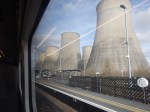
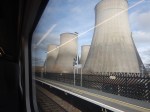
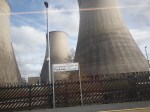
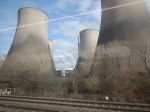
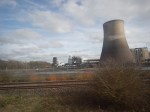
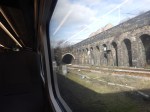
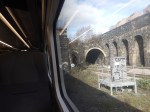
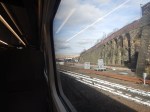
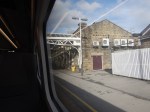
I took these pictures on the journey.
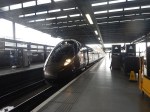


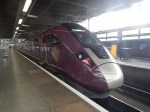





























































































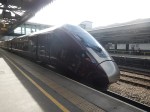
Note.
- Five-car Class 222 And Class 810 trains Have similar lengths, so they can share platforms at St. Pancras – Nice Thinking!
- The Trainspotters will be able to see East Midlands Railway, Eurostar and Southeastern Highspeed.
- The Wymington Deviation was a Victorian fix for a steep gradient. I suspect all trains like it.
- Leicester, Loughborough, East Midlands Parkway and Long Eaton stations are quite close together.
 The Anonymous Widower