Does The UK Need More Passenger Train Capacity Between London And Scotland?
I went from London Euston to Wigan North Western and Blackpool North stations on Wednesday.
Just after the Bank Holiday, the train to the North, which was going to Glasgow Central, seemed fairly busy, but I suspect that a few more souls could have been squeezed in.
Coming South in the early evening, there was a lot more space, but those that had gone to Scotland for the Bank Holiday weekend had probably returned.
At the moment, I am getting a lot of adverts like this, when I read The Times on-line.

It looks to me, that Avanti West Coast, are ecouraging travellers to use trains to travel to and from Glasgow.
How Many Anglo-Scottish Trains Are There?
- Avanti West Coast – 6 tpd – London Euston to Edinburgh Waverley via Birmingham New Street
- Avanti West Coast – 6 tpd – London Euston to Glasgow Central via Birmingham New Street
- Avanti West Coast – 1 tph – London Euston to Glasgow Central via Trent Valley
- CrossCountry – 1 tph – Plymouth to Edinburgh Waverley
- LNER – 2 tph – London King’s Cross to Edinburgh Waverley
- Lumo – 6 tpd – London King’s Cross to Edinburgh Waverley and Glasgow Queen Street
- Lumo – 4 tpd – London Euston to Stirling
- TransPennine Express – 1 tp2h – Manchester Airport to Glasgow Central
- TransPennine Express – 1 tp2h – Manchester Airport to Edinburgh Waverley
- TransPennine Express – 4 tpd – Liverpool Lime Street to Glasgow Central
Note.
- tpd is trains per day.
- tph is trains per hour.
- tp2h is trains per two hours.
- The two Avanti West Coast services via Birmingham New Street alternate.
- The Avanti West Coast London Euston to Glasgow Central via Trent Valley service runs 15 tpd.
- The two TransPennine Express services from Manchester Airport to Scotland alternate.
My initial estimate is that there are 5 x 15 tph +16 tpd or 91 tpd.
How Many Anglo-Scottish Trains Are There On HS2?
In the original design for HS2, this was the service pattern.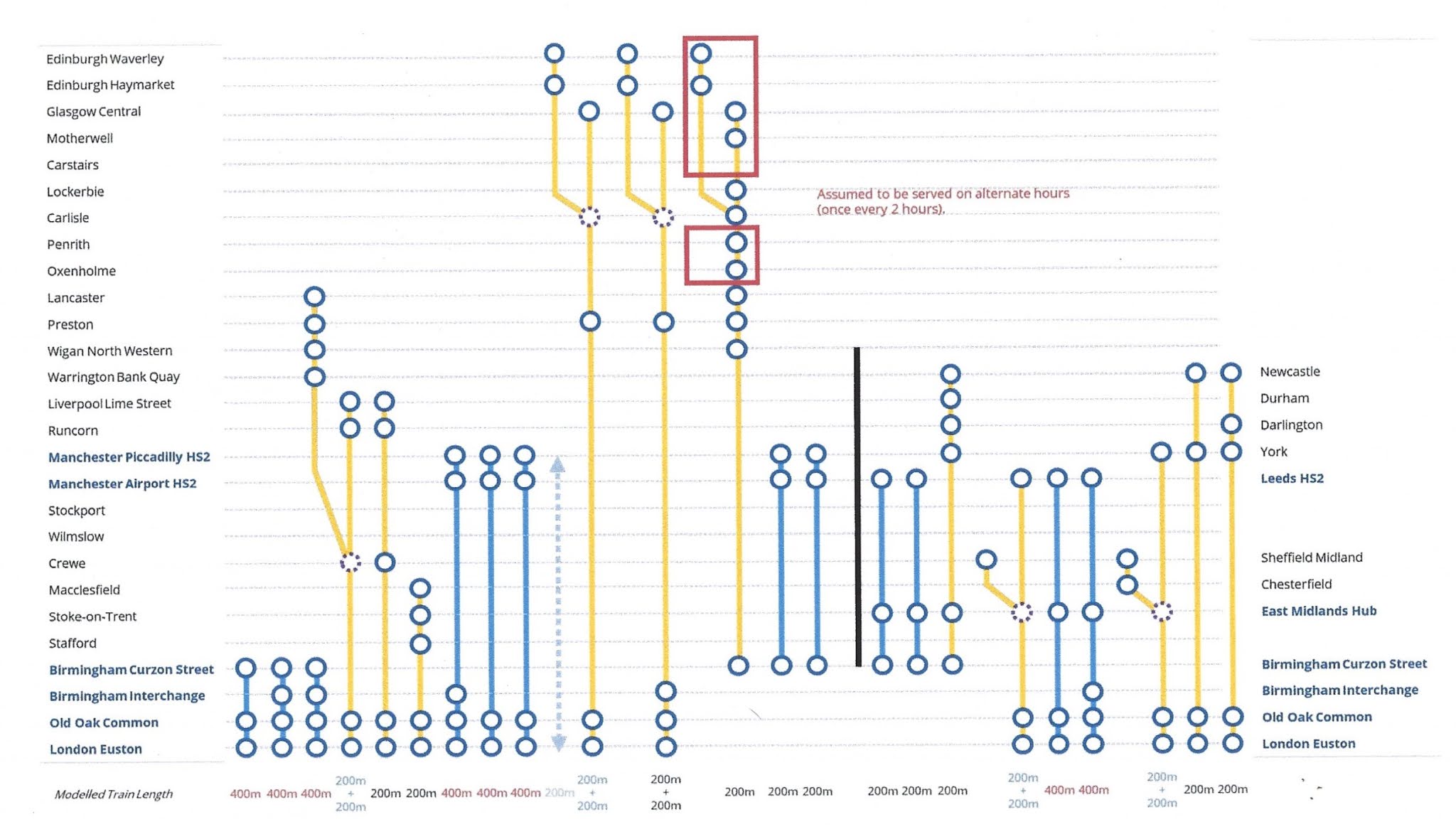
Note.
- Train 10 runs hourly between London and Scotland via Old Oak Common and Preston and splits at Carlisle with one train serving Edinburgh Waverley and the other Glasgow Central.
- Train 11 runs hourly between London and Scotland via Old Oak Common, Birmingham Interchange and Preston and splits at Carlisle with one train serving Edinburgh Waverley and the other Glasgow Central.
- Train 12 runs hourly between Birmingham Curzon Street and Scotland and serves Edinburgh Waverley and Glasgow Central alternatively.
It looks like HS2 contributes 5 tph between England and Scotland or 75 tpd.
But as HS2 is currently configured, these Anglo-Scottish trains will still run.
- CrossCountry – 1 tph – Plymouth to Edinburgh Waverley
- LNER – 2 tph – London King’s Cross to Edinburgh Waverley
- Lumo – 6 tpd – London King’s Cross to Edinburgh Waverley and Glasgow Queen Street
- Lumo – 4 tpd – London Euston to Stirling
- TransPennine Express – 1 tp2h – Manchester Airport to Glasgow Central
- TransPennine Express – 1 tp2h – Manchester Airport to Edinburgh Waverley
- TransPennine Express – 4 tpd – Liverpool Lime Street to Glasgow Central
If these trains continue to run my estimate is that there will be 4 x 15 tph +14 tpd or 74 tpd by classic routes.
This will mean 149 Anglo-Scottish tpd in total.
How Do You Get Between Leeds, Bradford, Sheffield and Hull, and Scotland?
If you look at the diagram, which shows the service pattern for HS2, note the following.
- HS2 does not provide a service between Leeds, York, Durham, Darlington and Newcastle, and Scotland.
- HS2 doesn’t connect to Bradford.
- HS2 doesn’t go past Leeds, but the current LNER services also serve Bradford Forster Square, Harrogate, Shipley and Skipton stations.
There is also no direct trains from the Leeds/Bradford area to Glasgow.
But Consider.
- The Settle and Carlisle Line runs between Skipton and Carlisle and used to host the Thames-Clyde Expresses that were run by the London Midland & Scottish Railway.
- The Wikipedia entry for the Thames-Clyde Express is an interesting read.
- Bradford Forster Square station was recently extended with two platforms , that can handle 10-car trains.
- Bradford Forster Square station has seven trains per day from London via Leeds.
- With a reverse at Bradford Forster Square station trains can call at Leeds, Bradford Forster Square and Skipton stations before taking the Settle and Carlisle Line to Carlisle.
- The Thames-Clyde Express used to take the Glasgow South Western Line to Glasgow Central calling at Dumfries and Kilmarnock.
- LNER’s Class 897 tri-mode trains will probably be able to handle the Settle and Carlisle and the Glasgow South Western Line, without using the diesel engines.
- East Midlands Railway’s Class 810 trains, when fitted with batteries, should probably be able to do the same.
There are a lot of possibilities of how the Settle and Carlisle Line can be used to increase zero-carbon connectivity between Glasgow and London.
The route wouldn’t be the fastest route, but it could be one of the most scenic.
Does Okehampton Interchange Have A Secondary Function To Be Used As A Backup To Cornwall Should Dawlish Be Destroyed Again?
I asked Google AI the question in the title of this post and received this answer.
The new Okehampton Interchange (opening summer 2026) acts as a local transport hub to increase capacity on the Dartmoor Line to Exeter, but it is not a direct backup to Dawlish.
While the Okehampton line via Tavistock is frequently considered as a strategic alternative to the vulnerable coastal route, the new Interchange itself is designed as a single-platform parkway station to serve the local community, not to act as a diversionary route for mainline trains to Cornwall.
Key Details on Okehampton Interchange & Strategic Role:
Purpose:
The £15m Interchange, located near the A30, is designed to relieve parking pressure at the existing Okehampton station and promote sustainable travel with a 200-space car park and bus connections.
Station Setup: It will have a single platform, making it incapable of handling the volume of diverted mainline trains.
Strategic Context: Following the 2014 Dawlish collapse, a northern route via Okehampton/Tavistock was identified as a potential resilient alternative.
However, implementing this would require hundreds of millions in investment to rebuild the track from Okehampton through to Tavistock, not just the new Interchange station.
The Dartmoor Line: The restored line between Okehampton and Exeter, which includes this new interchange, is primarily a local commuter route rather than a main line for Cornish traffic.
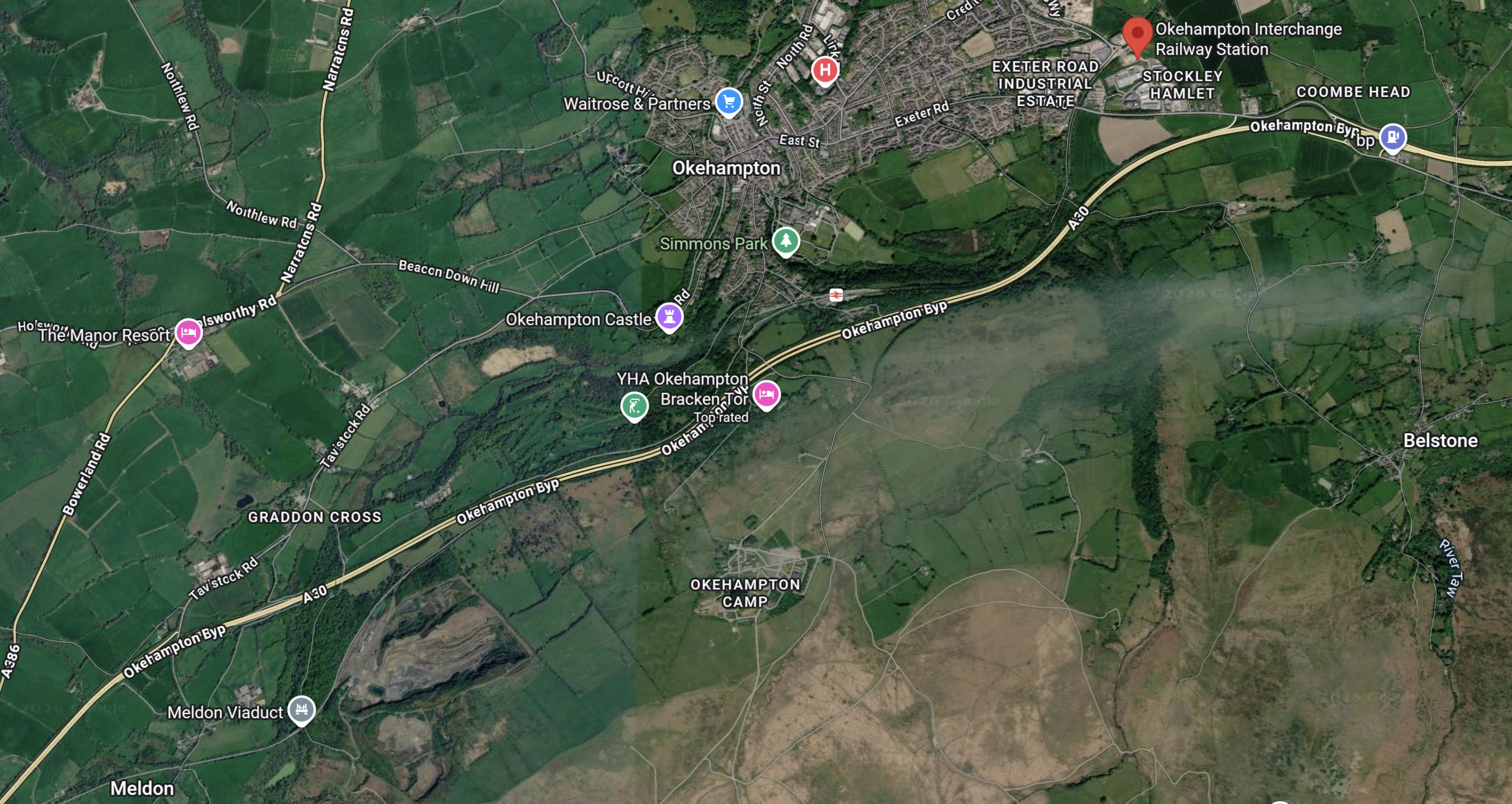
This Google Map shows the Okehampton by-pass.
Note.
- Okehampton Interchange station is shown by the red arrow in North-East corner of the map.
- The town of Okehampton is to the West of the station.
- South of the town is the station symbol, which indicates Okehampton station.
Running across the map is the A30 road, which is described in its Wikipedia entry like this.
The A30 is a major road in England, running 284 miles (457 km) WSW from London to Land’s End.
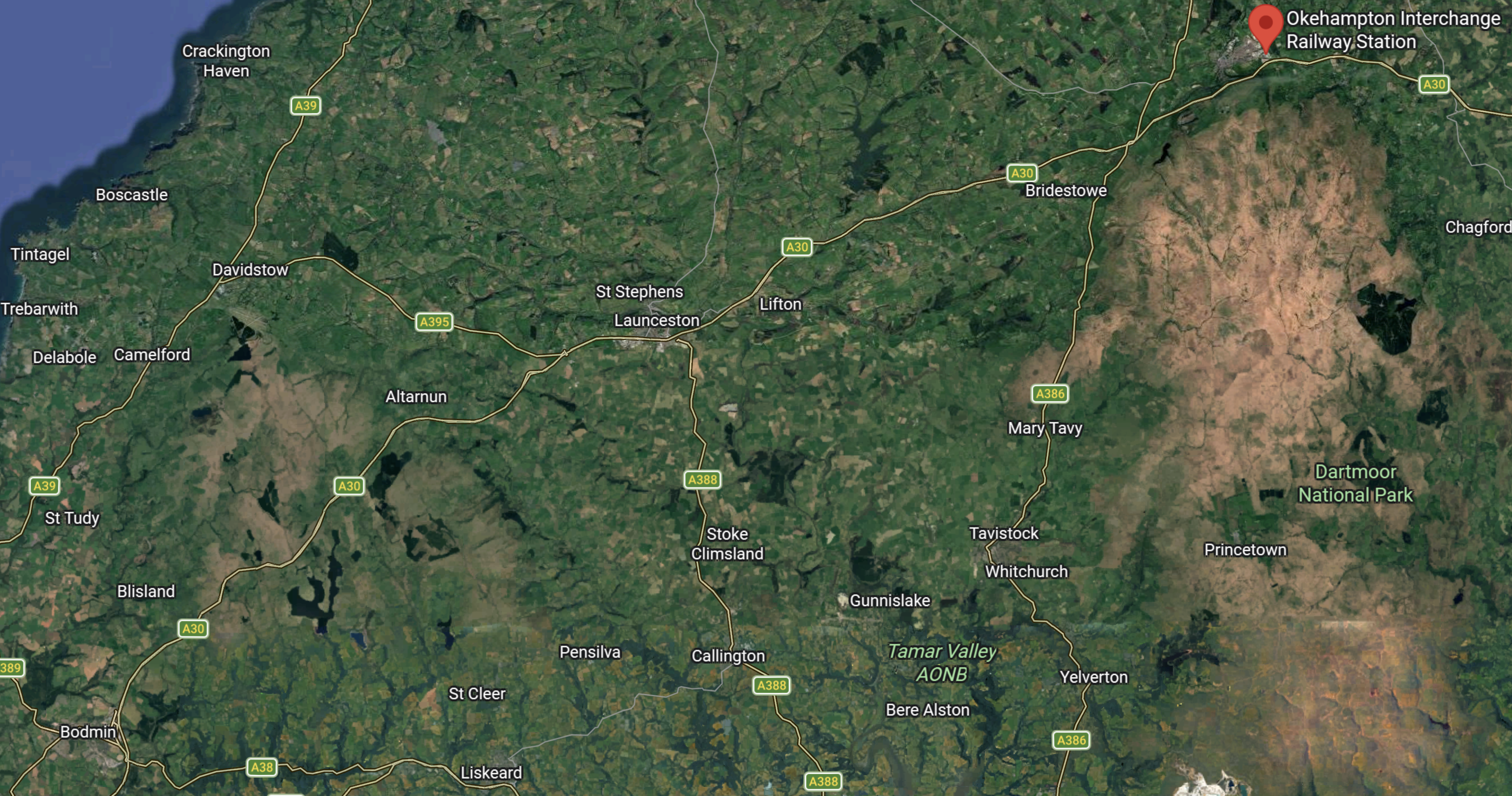
This Google Map shows the A30 between Okehampton and Bodmin.
Note.
- Okehampton interchange station is in the North-East corner of the map.
- Bodmin with Bodmin Parkway station is in the South-West corner of the map.
- In the middle of the map is Launceston, which is on route of the A30.
Wikipedia says this about the road.
The A30 is dual carriageway through Devon and into Cornwall, bypassing Whiddon Down, Okehampton and Launceston.
I believe that if the railway was blocked again at Dawlish, it would be possible for passengers to be taken to Cornwall like this.
- Five-car Class 802 train to either of the Okehampton stations.
- Coach to Launceston and Bodmin Parkway.
- Class 802 trains to Penzance, which called at all stations.
That looks to me to be a practical alternative.
It should also be noted, that high-capacity, hydrogen-powered coaches, with a thousand-kilometer range will be coming into service soon and these will surely be ideal for a duty like this.
Do Coeliacs Have A Sweet Tooth?
I am certainly coeliac and often, when I have a coffee or a hot chocolate, when I’m travelling, I will ask if the cafe has a gluten-free cake to go with it.
Increasingly, I am getting disappointed. But then chains that speciallised in gluten-free like Carluccios and Leon have had a hard time lately and the rise of Greggs, Gails and Pret, who don’t do gl;uten-free doesn’t help.
Usually, whilst I watch, the BBC ten o’clock news, I will have a mug of decaffeinated tea, in which I will dunk, three M & S gluten-free ginger snaps.
After I was diagnosed as a coeliac, my late wife, once said she thought I would eat more biscuits and cakes.
So what does Google AI think, when I ask it the question in the title of this post?
This was the answer I received.
Yes, many people with coeliac disease have a sweet tooth, and it is a common experience to experience intensified sugar cravings after starting a gluten-free diet.
Here is why this happens and how it is managed:
Intensified Cravings: After eliminating gluten, some coeliacs experience strong cravings for sugar, ice cream, and chocolate.
This can occur because the body is suddenly deprived of high-carb foods, or due to underlying imbalances in gut bacteria.
Nutrient Absorption: In the early stages of a gluten-free diet, the body may be absorbing nutrients better for the first time, which can trigger intense hunger and cravings.
Hidden Sugar in GF Foods: Many processed gluten-free products—like biscuits and cakes—contain more sugar to improve taste and texture, which can satisfy, but also encourage, a sweet tooth.
Gut Health Factors: Some individuals suspect that sugar cravings are linked to candida (yeast) overgrowth, which is sometimes associated with coeliac disease.
I suspect with me sometimes, it can be, just because I’m hungry due to low availability of gluten-free snacks.
This week, when I went to Blackpool North, I changed trains at Wigan North Western station, where I bought a delicious lemon tart in the coffee stall.


Note.
- The delicious lemon tart came in the aluminium tray it was baked in. Could this be for protection, as the tart was still in one piece, after some time in my brief case.
- My pictures don’t do the tart justice.
- The coffee stall is on the Northbound platform.
- The toilets are under the Southbound platform, but are some of the cleanest, I’ve found on UK railways.
- Wigan North Western station is fully step-free.
- Wigan North Western station could be ready for High Speed Two trains.
Wigan North Western and Wigan Wallgate stations are only a short walk apart, so it is a well used interchange to get to Northern parts of Merseyside and Greater Manchester, from London and the South.

