Does Okehampton Interchange Have A Secondary Function To Be Used As A Backup To Cornwall Should Dawlish Be Destroyed Again?
I asked Google AI the question in the title of this post and received this answer.
The new Okehampton Interchange (opening summer 2026) acts as a local transport hub to increase capacity on the Dartmoor Line to Exeter, but it is not a direct backup to Dawlish.
While the Okehampton line via Tavistock is frequently considered as a strategic alternative to the vulnerable coastal route, the new Interchange itself is designed as a single-platform parkway station to serve the local community, not to act as a diversionary route for mainline trains to Cornwall.
Key Details on Okehampton Interchange & Strategic Role:
Purpose:
The £15m Interchange, located near the A30, is designed to relieve parking pressure at the existing Okehampton station and promote sustainable travel with a 200-space car park and bus connections.
Station Setup: It will have a single platform, making it incapable of handling the volume of diverted mainline trains.
Strategic Context: Following the 2014 Dawlish collapse, a northern route via Okehampton/Tavistock was identified as a potential resilient alternative.
However, implementing this would require hundreds of millions in investment to rebuild the track from Okehampton through to Tavistock, not just the new Interchange station.
The Dartmoor Line: The restored line between Okehampton and Exeter, which includes this new interchange, is primarily a local commuter route rather than a main line for Cornish traffic.
This Google Map shows the Okehampton by-pass.
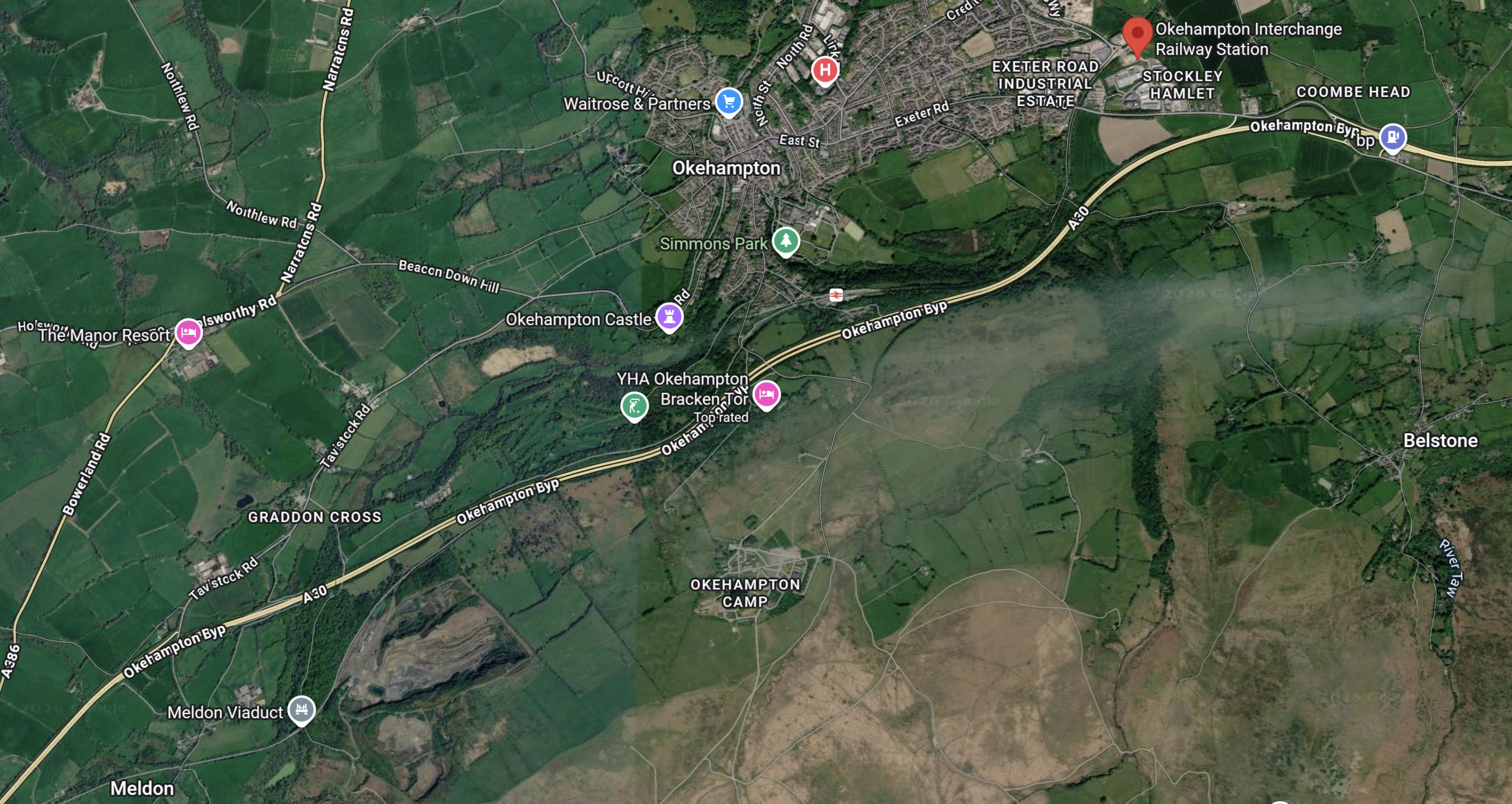
Note.
- Okehampton Interchange station is shown by the red arrow in North-East corner of the map.
- The town of Okehampton is to the West of the station.
- South of the town is the station symbol, which indicates Okehampton station.
Running across the map is the A30 road, which is described in its Wikipedia entry like this.
The A30 is a major road in England, running 284 miles (457 km) WSW from London to Land’s End.
This Google Map shows the A30 between Okehampton and Bodmin.
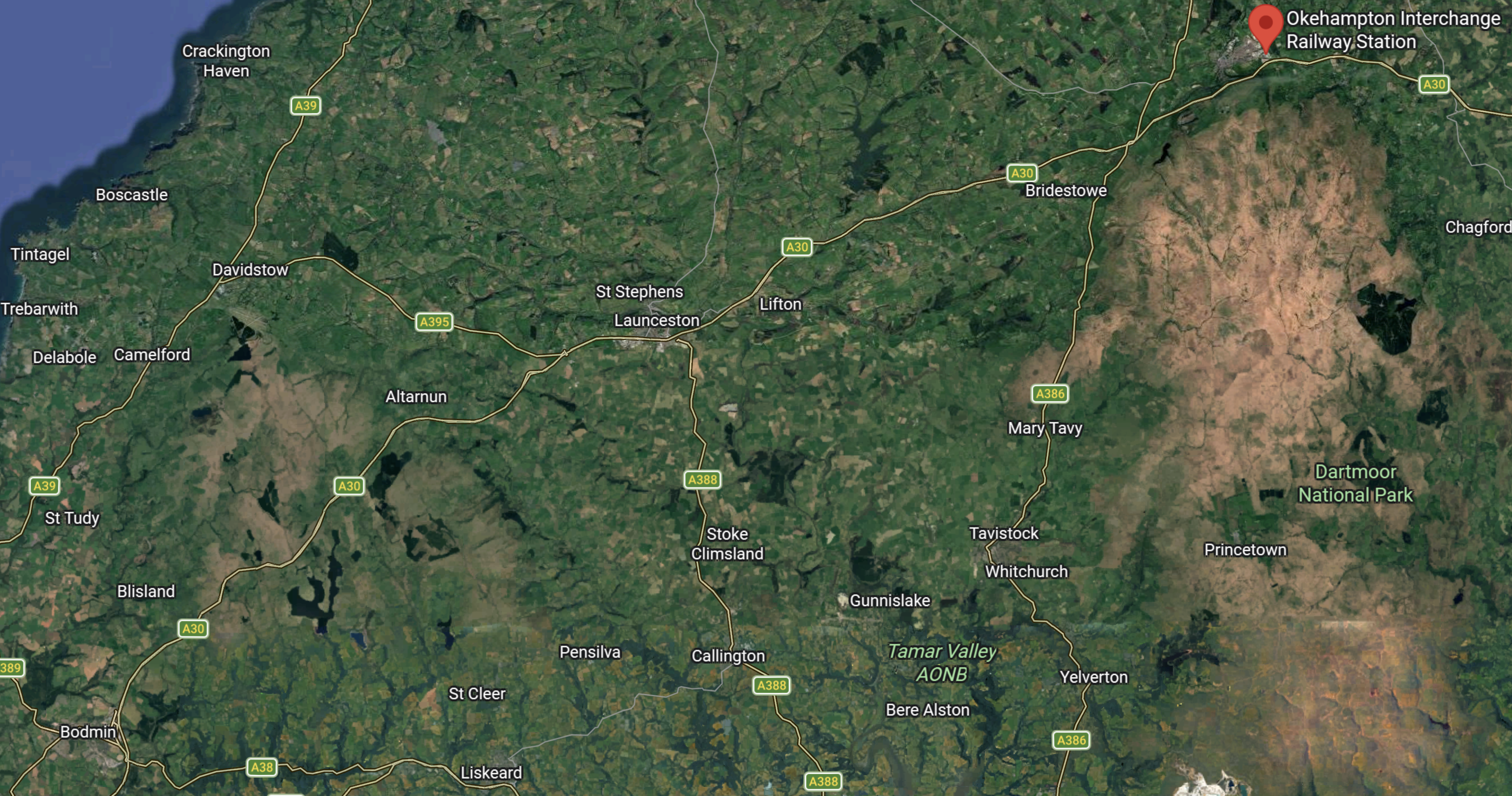
Note.
- Okehampton interchange station is in the North-East corner of the map.
- Bodmin with Bodmin Parkway station is in the South-West corner of the map.
- In the middle of the map is Launceston, which is on route of the A30.
Wikipedia says this about the road.
The A30 is dual carriageway through Devon and into Cornwall, bypassing Whiddon Down, Okehampton and Launceston.
I believe that if the railway was blocked again at Dawlish, it would be possible for passengers to be taken to Cornwall like this.
- Five-car Class 802 train to either of the Okehampton stations.
- Coach to Launceston and Bodmin Parkway.
- Class 802 trains to Penzance, which called at all stations.
That looks to me to be a practical alternative.
It should also be noted, that high-capacity, hydrogen-powered coaches, with a thousand-kilometer range will be coming into service soon and these will surely be ideal for a duty like this.
Dartmoor Rail Service Reopens This Year In Reversal Of Beeching Cuts
The title of this post is the same as that of this article on The Times.
This is the introductory paragraph.
A largely redundant Victorian railway line will be reopened this year as part of plans to resurrect routes closed in the infamous Beeching cuts.
This line was always likely to be one of the first to reopen, as there is a terminal station at Okehampton, with a bus interchange and other facilities, that has been hosting a service from Exeter on summer Sundays for some years.
The BBC have a reporter there this morning and the station looks in better condition, than some I could name.
This paragraph from The Times describes works to be done.
Network Rail said engineers would start a range of works including improvements to drainage, fencing by the trackside, rebuilding embankments and upgrading Okehampton station. Some 11 miles of track will also be replaced. It is envisaged that test trains will run later this year before it fully reopens to passengers.
Some of the BBC footage, showed a great pile of new track by the station, so it looks like Network Rail are starting to relay the track.
It is hoped to run a one train per two hour service by the end of the year, which could go hourly next year.
In Okehampton Railway Return ‘Clear Reality’ After £40m Commitment In Budget, I said more about this reopening project and I speculated that both Okehampton and Barnstaple services will terminate at Exmouth Junction, as the Barnstaple services do now.
Barnstaple has roughly an hourly service from Exeter and to run two hourly services between Exeter and Coleford Junction, where the two routes divide, may need extra work to be done, so that trains can pass each other at convenient points.
This extra work probably explains, why the service won’t be hourly until next year.
I do wonder, if this reopening also enables other improvement and possibilities.
Meldon Quarry
Meldon Quarry used to be an important source of track ballast for British Rail and it is situated a few miles past Okehampton.
This Google Map shows Meldon Quarry and Okehampton.
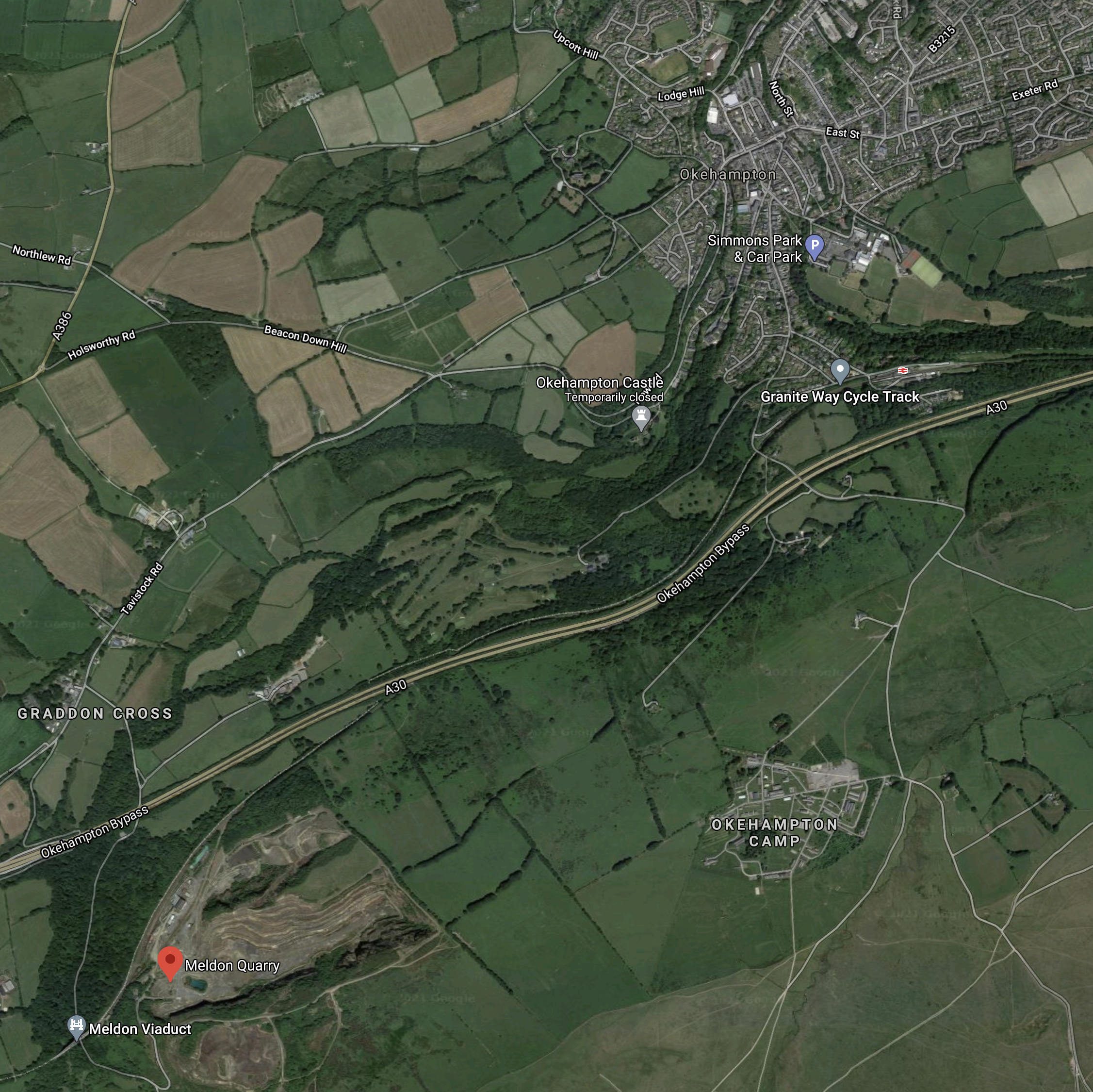
Note.
- Meldon Quarry is in the South-West corner of the map marked by a red marker.
- To its West is Meldon Viaduct, which is part of the old railway line between Okehampton and Plymouth, which is now a walking and cycling route.
- The town of Okehampton is in the North-East of the map.
- Okehampton station is in the South-East of the town close to the A 30.
I wouldn’t be surprised to find, that Network Rail are upgrading the line to Okehampton, so that if they need to obtain quality track ballast from Meldon Quarry, it would not require upgrades to the track East of Okehampton.
Okehampton Camp
Note Okehampton Camp to the South of Okehampton.
Many Army bases like this one need heavy vehicles to be transported to and from the base.
Have Network Rail future-proofed the design of the route to Okehampton, so that heavy vehicles can be transported to the area?
A Railhead For North Devon And North Cornwall
There are two main roads between Exeter and Cornwall.
- The A30 goes to the North of Dartmoor and via Launceston
- The A38 goes to the South of Dartmoor and then via Plymouth
In the past, I’ve always driven to and from Cornwall via the Northern route and I describe one journey in Dancing with Hippopotami.
This Google Map shows the A30, as it passes Okehampton.
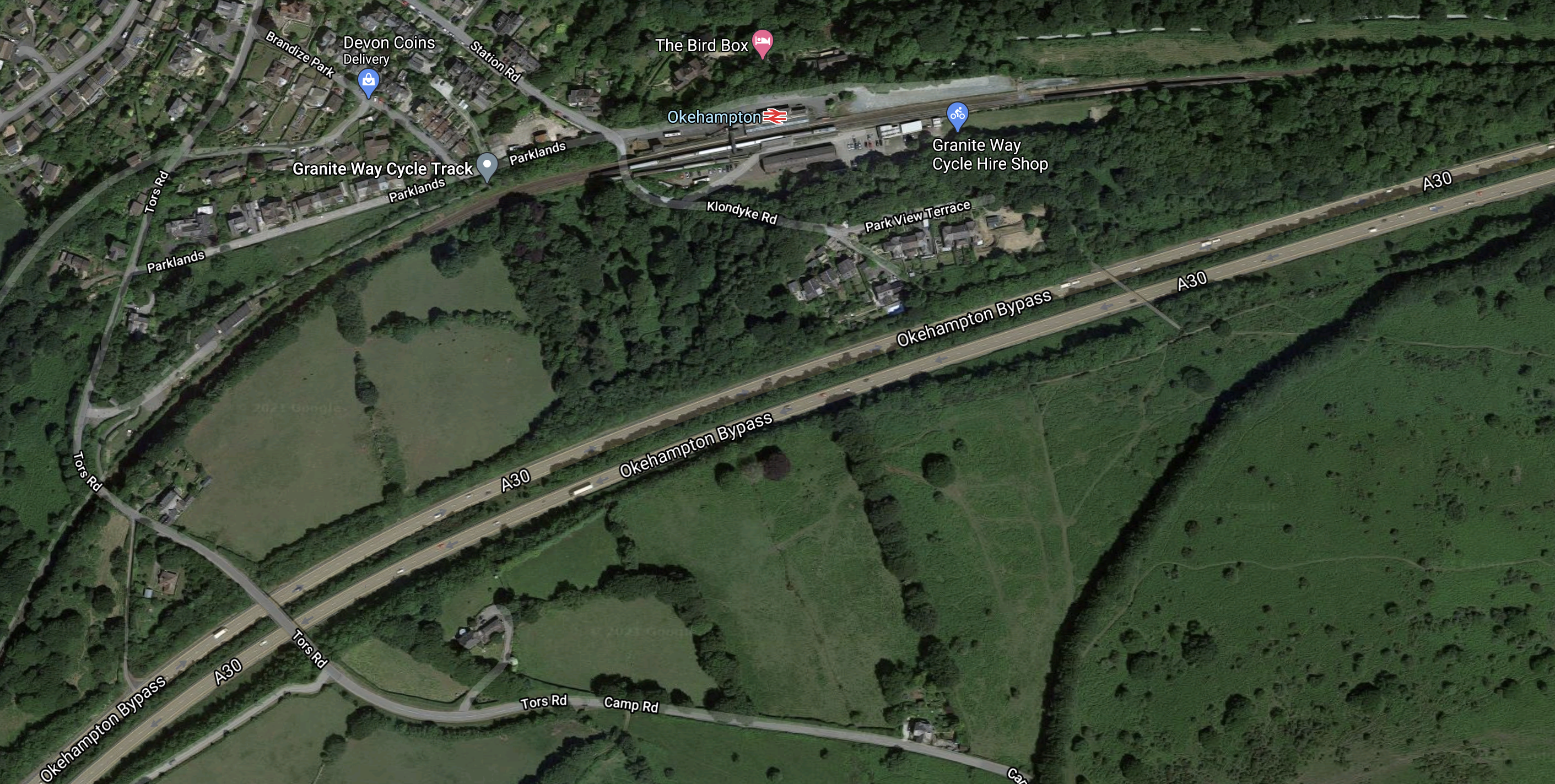
Note that although the station and the A30 are physically close, there would be a few minutes to drive between the two.
But I do feel there is scope to create an appropriate transport interchange between.
- Trains to and from Exeter.
- Buses and coaches to North Cornwall and North Devon.
- Cars on the A30.
It could effectively become a parkway station.
An Alternative Route In Case Of Trouble Or Engineering Works At Dawlish
Bodmin Parkway and Okehampton stations are about 43 miles apart and I suspect a coach could do the journey in around fifty minutes.
Would this be a sensible alternative route in times of disruption?
- It is dual-carriageway all the way.
- Okehampton station can certainly handle a five-car Class 802 train and could probably be improved to handle a nine- or even ten-car train.
- Trains from London could get to Okehampton with a reverse at Exeter St. Davids.
I don’t know the area well, but it must be a possibility.
Could Okehampton Have A London Service?
As I said in the previous section, it looks like Okehampton station can handle five-, nine- and possibly ten-car Class 802 trains and there are many pictures of Great Western Railway’s InterCity 125s or HSTs at Okehampton station in years gone by.
I think it would be feasible to run a small number of services between Okehampton and London.
- The service would have to reverse at Exeter St. Davids station.
- As one service every two hours runs between London Paddington and Exeter St. Davids stations, a service to Okehampton could be run as an extension to the current Exeter service.
- It could also stop at Crediton station.
There must also be the possibility of running a pair of five car trains from Paddington, that split at Exeter St. Davids, with one service going to Okehampton and the second one to Paignton.
- Exeter St. Davids and Paignton are 26.3 miles apart and a fast train takes 34 minutes
- Exeter St. Davids and Okehampton are probably a slightly shorter distance.
I suspect that a sensible timetable could be devised.
The specification of the Hitachi InterCity Tri-Mode Train is given in this Hitachi infographic.

Note.
- It is intended to run these trains to Exeter, Plymouth and Penzance.
- The range of the train on batteries is not given.
These trains could use a mixture of diesel and battery power to travel to and from Okehampton and Paignton.
But I also believe that as Hitachi develop this train and batteries have an increased capacity, that it will be possible for the trin to do a round trip from Exeter to Okehampton or Paignton without using diesel, provided the train can leave Exeter with a full battery.
According to Hitachi’s infographic, the train will take 10-15 minutes to fully charge at a station like Exeter. But that would add up to fifteen minutes to the timetable.
I feel if the roughly thirty-five miles of track between Exeter St Davids station and Cogload Junction, which is to the North of Taunton, were to be electrified, then this would mean.
- Trains would be fully charged for their excursions round Devon.
- Trains would be fully charged for onward travel to Plymouth and Penzance.
- Trains going to London would leave Taunton with full batteries to help them on their way on the ninety mile stretch without electrification to Newbury.
- Trains going between Exeter and Bristol could take advantage of the electrification.
Eventually, this section of electrification might even help to enable trains to run between London and Exeter without using diesel.
As the railway runs alongside the M5 Motorway, this might ease planning for the electrification.
The gap in the electrification between Cogload Junction and Newbury could be difficult to bridge without using diesel.
- Cogload Junction and Newbury are 85 miles apart.
- I’ve never seen so many bridges over a railway.
- I actually counted twenty-one bridges on the twenty miles between Westbury and Pewsey stations.
- I suspect some will object, if some of the bridges are replaced with modern ones.
- There would be a lot of disruption and expense, if a large proportion of these bridges were to be replaced.
- Currently, Great Western Railway run expresses to Exeter, Plymouth and Penzance via Taunton and Newbury.
I think, there needs to be some very radical thinking and low cunning to solve the problem.
- Battery technology and the best efforts of engineers from Hitachi and Hyperdrive Innovation may stretch the battery range sufficiently.
- It might be possible to extend the electrification at the Newbury end to perhaps Bedwyn, as there are only a few bridges. This would shorten the distance by up to thirteen miles.
- It may also be possible to extend the electrification at the Taunton end.
- I would expect some bridges could be dealt with using discontinuous electrification techniques.
But I believe that full electrification between Newbury and Cogload junction might be an extremely challenging project.
There must also be the possibility of using lightweight overhead line structures, where challenges are made about inappropriate overhead gantries.
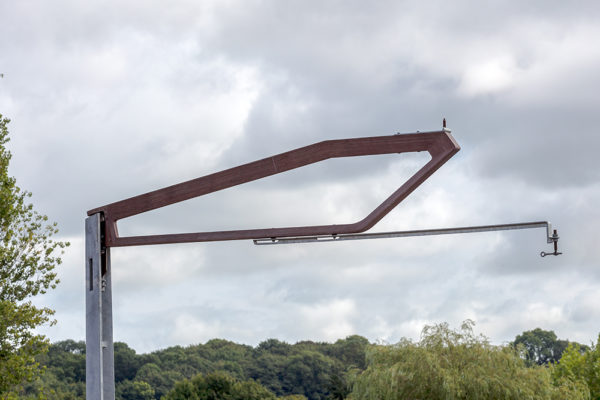
There is also a video.
Note.
- Electrification doesn’t have to be ugly and out-of-character with the surroundings.
- The main overhead structure of this gantry is laminated wood.
These gantries would surely be very suitable for the following.
- Electrifying secondary routes and especially scenic ones.
- Electrifying single lines and sidings.
- Electrifying a bay platform, so that battery electric trains could be charged.
Innovative design could be one of the keys to more electrification.

