Hartlepool Nuclear Reactor Moves To UK Regulatory Assessment
The title of this post, is the same as that of this article on the Northern Echo.
This is the sub-heading.
Plans for a new generation of nuclear power stations moved closer after the Government approved the next regulatory stage for an advanced reactor planned for Hartlepool
These two paragraphs add more details.
The approval follows a partnership between X-energy and Centrica to build a new generation of UK nuclear power stations using Xe-100 Advanced Modular Reactors, starting in Hartlepool.
On the partnership’s first anniversary, the Government directed regulators to begin assessing X-energy’s Xe-100 reactor under the Generic Design Assessment, a major step towards commercial licensing in the UK.
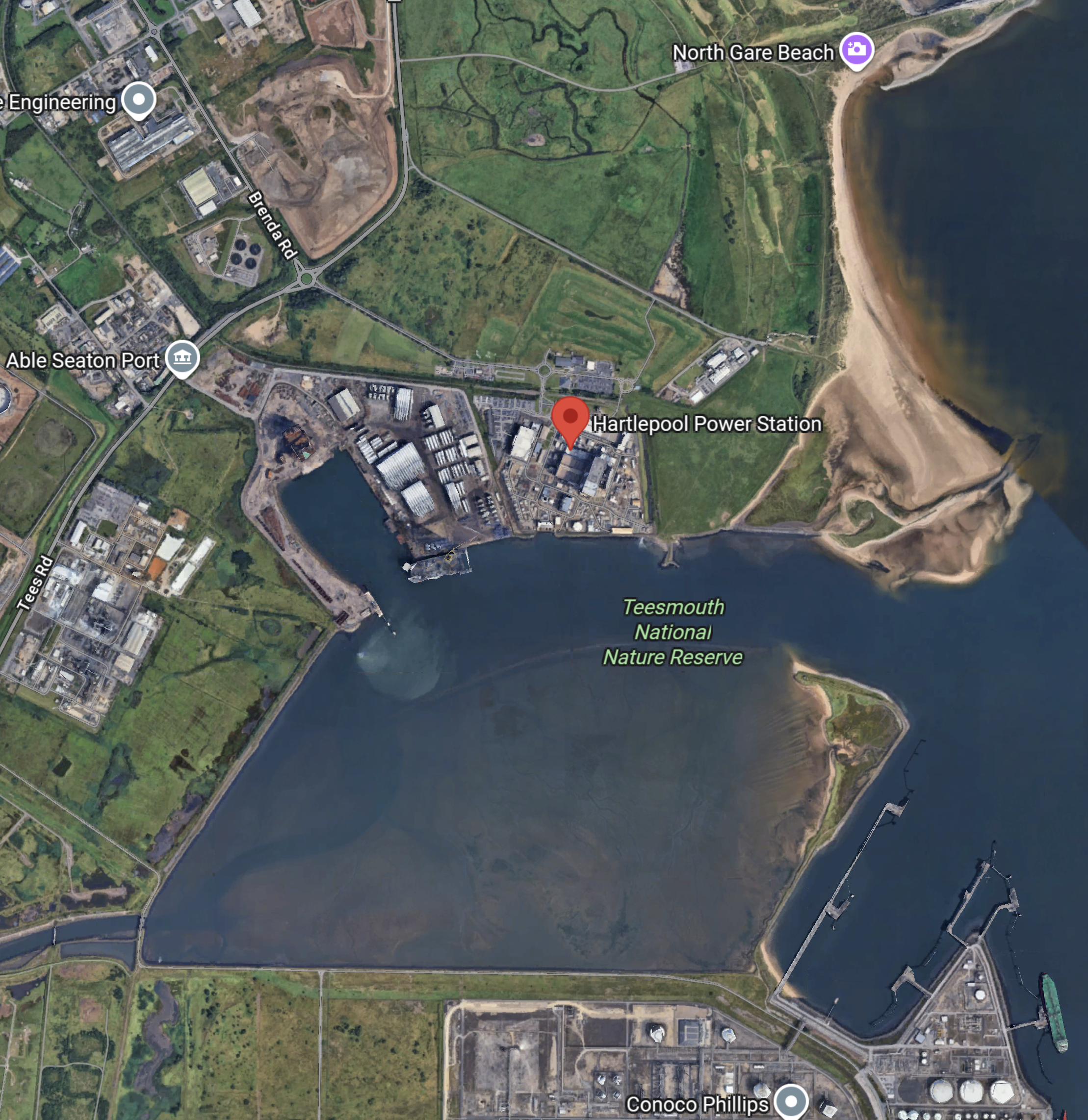
This Google Map shows the area around the current Hartlepool Nuclear Power Station.
Note.
- Hartlepool Nuclear Power Station is indicated by the red arrow.
- Hartlepool serves as a major industrial, manufacturing, and logistics hub supporting offshore wind farms rather than a landing point for their electricity grid connections.
- Full details of the current nuclear power station is given in its Wikipedia entry, but here’s a summary.
- It is an Advanced Gas-Cooled Reactor, which uses carbon dioxide for cooling.
- It was commissioned in 1983.
- It is scheduled to be closed in 2030.
- It produces 1,185 MW of electricity.
- The current site has rail access from the Durham Coast Line.
Nothing is said in the article about the capacity or the timescale for building the new power station.
What Will Be The Capacity Of X-energy’s New Nuclear Power Station At Hartlepool?
I took a quick look with Google AI and received this answer.
AI Overview
X-energy’s planned new nuclear power station at Hartlepool is proposed to have a capacity of up to 960 megawatts (MW), using a 12-unit deployment of its Xe-100 advanced modular reactors.
Project Details
Technology: X-energy Xe-100 high-temperature, gas-cooled small modular reactor (each individual unit generates 80 MW of electricity).
Configuration: A 12-reactor plant (“12-pack” multi-unit layout).
Location: Adjacent to the existing Hartlepool Power Station in Teesside, northeast England.
Timeline: First electricity generation is targeted for the mid-2030s, following the scheduled closure of the current operating plant.
That was an excellent answer, that gave me all I needed.
Hartlepool’s Rail Links
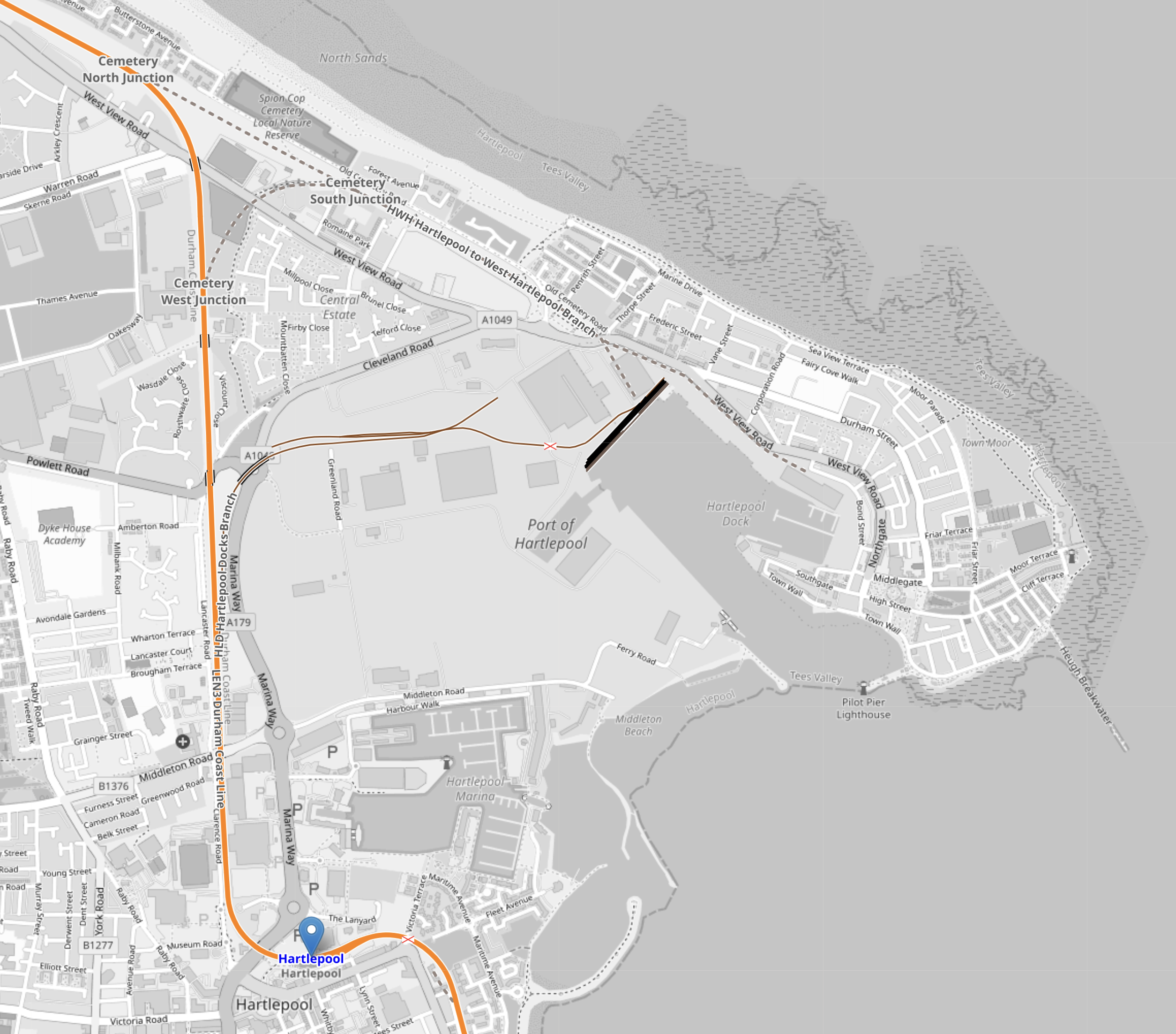
This OpenRailwayMap shows the Durham Coast Line and the rail links to the current Hartlepool Nuclear Power Station.
Note.
- The orange track going North-South across the map is the Durham Coast Line between Newcastle and Middlesbrough.
- Hartlepool station is indicated by the blue arrow.
- A rail connection goes East from the Durham Coast Line to the Port of Hartlepool and the current Hartlepool Nuclear Power Station, which I believe is the big square building by the black line.
- Hartlepool station is served by six trains per day (tpd) to and from London King’s Cross, with five tpd on Sundays.
- All London services are operated by open access operator Grand Central Trains, who have new Hitachi Class 820 tri-mode trains on order for delivery in 2028.
Current timings are a few minutes over three hours, but I suspect that the new Hitachi trains could do the trip very close to three hours.
Toyota Confirms Hydrogen Hilux For 2028 With 248 Mile Range
The title of this post, is the same as that of this article on Motor1.
This is the sub-heading.
Hilux FCEV production starts in 2028 for European fleets, with 248 miles of range, strong towing, and five-minute refueling pitches
These two paragraphs give more details.
Toyota just put a number on the hydrogen Hilux, and it is bigger than anything the electric version can manage. At IAA Transportation 2026 in Hannover the automaker outlined plans for a Hilux fuel cell model targeting a 2028 launch for European professional customers.
The target is 248 miles of WLTP range and 5,512 pounds of towing, plus roughly a five-minute refuel when a station is operating normally. That is a work truck pitch built to beat the battery-electric Hilux on the two numbers that matter most to fleets.
It looks to me, that Toyota have done their research on the specification.
I can verify, that a lot of horsey folk and farmers will find it fits their needs well.
UK Offshore Wind In 2030 – Calculated September 2026
The next general election is likely to be held in 2029, so how much wind energy will be added before the next Parliament?
The Current Position
The Wikipedia entry for the list of operational wind farms in the UK, says this.
In July 2025, there were offshore wind farms consisting of 2,809 turbines with a combined capacity of 16,035 megawatts.
Due To Be Commissioned In 2026
It would appear these wind farms will come on-line in 2026.
- Dogger Bank A – 1235 MW – Fixed
- East Anglia 3 – 1372 MW – Fixed
- Sofia – 1400 MW – Fixed
This would add 3 wind farms and 4,007 MW to give a total of 20,042 MW.
Due To Be Commissioned In 2027
It would appear these wind farms will come on-line in 2027.
- Dogger Bank B – 1235 MW – Fixed
- Dogger Bank C – 1218 MW – Fixed
- Inch Cape – 1080 MW – Fixed
- Llŷr 1 – 100 MW – Floating
- Llŷr 2 – 100 MW – Floating
- Norfolk Boreas – 1380 MW – Fixed
This would add 6 wind farms and 5,113 MW to give a total of 25,155 MW.
Due To Be Commissioned In 2028
It would appear these wind farms will come on-line in 2028.
- East Anglia 2 – 963 MW – Fixed
- Hornsea 3 – 2852 MW – Fixed
This would add 2 wind farms and 3,815 MW to give a total of 28,970 MW.
Due To Be Commissioned In 2029
It would appear these wind farms will come on-line in 2029.
- Green Volt – 400 MW – Fixed
- Norfolk Vanguard East – 1545 MW – Fixed
- Norfolk Vanguard West – 1545 MW – Fixed
This would add 3 wind farms and 3,490 MW to give a total of 32,460 MW.
Due To Be Commissioned In 2030
It would appear these wind farms will come on-line in 2030.
- Caledonia – 2000 MW – Fixed
- Erebus – 100 MW – Floating
- Five Estuaries – 1080 MW – Fixed
- MarramWind – 3000 MW – Floating
- Mona – 1500 MW – Fixed
- Morecambe – 480 MW – Fixed
- N3 Project – 495 MW – Mixed
- North Falls – 504 MW – Fixed
- Outer Dowsing – 1500 MW – Fixed
- Pentland – 92.5 MW – Floating
- Ramplion 2 – 1200 – Fixed
This would add 11 wind farms and 11,951.5 MW to give a total of 44,411.5 MW.
Due To Be Commissioned In 2031
It would appear this wind farms will come on-line in 2031.
- Awel y Môr – 775 MW – Fixed
- Berwick Bank Phase B – 1380 MW – Fixed
- Dogger Bank SE – 1500 MW – Fixed
- Dogger Bank SW – 1500 MW – Fixed
- Spiorad na Mara – 840 MW – Fixed
This would add 5 wind farms and 5,995 MW to give a total of 50,406.5 MW.
UK Offshore Wind Summary 2026 And 2031
I can now summarise UK offshore wind for the next few years.
- 2025 – 16,035 MW
- 2026 – 3 – 4,007 MW – 20,042 MW
- 2027 – 6 – 5,113 MW – 25,155 MW
- 2028 – 2 – 3,815 MW – 28,970 MW
- 2029 – 3 – 3,490 MW – 32,460 MW
- 2030 – 11 – 11,951.5 MW – 44,411.5 MW
- 2031 – 5 – 5,995 MW – 50,406.5 MW
Note.
- The first figure after the year is the number of wind farms to be commissioned that year.
- The middle figure is the expected capacity of the wind farms to be commissioned that year.
- The last figure is the expected total offshore wind capacity at the end of that year.
- Typically, we need about 30 to 35 GW to power the UK.
- The next general election must be held by the 15th August 2029.
So whoever wins the election will inherit a windfall of just under 12 GW of offshore wind.
Centrica, X-energy Advance Nuclear Plans As UK Regulators To Begin Design Review For Xe-100
The title of this post, is the same as that of this press release from Centrica.
This is the sub-heading.
On the one-year anniversary of the Centrica X-energy partnership being signed, the UK Government has directed regulators to accept the X-energy Xe-100 Advanced Modular reactor into the Generic Design Assessment, marking a significant step toward UK commercial licensing.
Under their partnership, the companies intend to deploy up to 6 GW of new nuclear capacity in the UK (10-20 Xe-100 power stations depending on size of each installation)
These first two paragraphs add some details.
Centrica and X‑Energy, Inc., a leading developer of advanced nuclear reactors and fuel technology, today announced that X‑energy’s Xe‑100 Generation IV advanced Small Modular Reactor (“SMR”) has been accepted into the United Kingdom’s Generic Design Assessment (“GDA”) process.
GDA acceptance formally triggers the process of assessing the design’s acceptability for deployment and operation ahead of the technical and environmental evaluations required for site‑specific licensing and permitting. The assessment is expected to take approximately three years and will be administered by the UK Office for Nuclear Regulation (“ONR”), the Environment Agency (EA), and Natural Resources Wales
To learn more, I asked Google AI for what it knows on the Xe-100 reactor and I received this.
The Xe-100 is an advanced Generation IV high-temperature gas-cooled pebble-bed small modular nuclear reactor developed by the American company X-energy.
Key Specifications & Design
Power Output: Generates about 80 megawatts of electricity (MWe) or 200 MW thermal per unit, and can be scaled up into a four-pack configuration yielding 320 MW.
Cooling System: Uses inert helium gas instead of water to remove heat from the core, reaching operating temperatures above 750°C.
Fuel Type: Runs on proprietary TRISO-X fuel pebbles, where each billiard-ball-sized pebble contains roughly 18,000 microscopic TRISO fuel particles that act as individual containment vessels.
Note.
- 320 MW may seem small, but you have to remember Sizewell A was two 210 MW Magnox reactors and it operated for forty years.
- I like the choice of helium for a coolant. Especially, as the gas is widely used for cooling superconducting magnets, so there must be plenty of expertise.
- Helium is also present in the atmosphere at 5.2 parts per million.
- I also like the concept of the fuel pebbles.
These are some of my questions.
Where Was TRISO Fuel Developed?
The Wikipedia entry for TRISO Fuel has a History section, which starts with this paragraph.
Coated-particle ceramic fuels were initially developed in the United Kingdom as part of the Dragon reactor project. During the development of the Dragon reactor, its designers became concerned by the need to purge gaseous fission products from the reactor core and their potential migration to other parts of the reactor This concern led to the choice of coated-particle fuel, where the fuel would be formed from small particles of uranium then coated with pyrolytic carbon. The inclusion of silicon carbide as a diffusion barrier was first suggested by D. T. Livey in 1961, in order to better retain fission products.
Note.
- The United States and Germany made contributions to the development of TRISO fuel.
- the first commercial reactor to use TRISO, was the 330 MWe Fort Saint Vrain Nuclear Power Plant
- The experimental High Temperature Test Reactor in Japan, constructed in 1998, uses prismatic UO2 TRISO fuel.
- Japan has the only TRISO-fueled reactor in commercial operation.
- Oak Ridge National Laboratory in the United States, developed the process used to make TRISO fuel.
The Wikipedia entry for the Dragon reactor is worth a read.
These are the first two paragraphs of its Wikipedia entry.
Dragon was an experimental high temperature gas-cooled reactor at Winfrith in Dorset, England, operated by the United Kingdom Atomic Energy Authority (UKAEA). Its purpose was to test fuel and materials for the European High Temperature Reactor programme, which was exploring the use of tristructural-isotropic (TRISO) fuel and gas cooling for future high-efficiency reactor designs. The project was built and managed as an Organisation for Economic Co-operation and Development/Nuclear Energy Agency international project. In total, 13 countries were involved in its design and operation during the project lifetime.
Originally conceived as a small research reactor, during the design phase it grew larger. The choice of helium coolant was made after a long debate within the UKAEA between proponents of helium and carbon dioxide, with helium ultimately selected. Groundbreaking occurred in 1960. It operated from 1965 to 1976, and is generally considered extremely successful.
Who Are The Technology Partners Of X-energy?
I had to ask Google AI this question and received this reply.
X-energy works with major technology, industrial, and energy partners to develop and deploy its advanced small modular nuclear reactors (SMRs) and TRISO-based fuel technology.
Key Technology and Strategic Partners
Amazon and AWS: A primary investor (through the Climate Pledge Fund) and customer, Amazon collaborates with X-energy on scaling nuclear energy for data centers and AI infrastructure. X-energy, Amazon Web Services (AWS), NVIDIA, and Idaho National Laboratory are founding members of Project Prometheus to apply AI to advanced nuclear deployment.
NVIDIA: A founding partner in Project Prometheus alongside AWS and Idaho National Laboratory, helping integrate AI accelerators and tools into nuclear design and operations.
Doosan Enerbility & Korea Hydro & Nuclear Power (KHNP): South Korean industrial partners collaborating to support multi-gigawatt deployments of Xe-100 reactors and manufacture key components.
Energy Northwest: A utility partner working on X-energy’s first-of-a-kind project development in Washington state.
Dow Inc.: Partnered with X-energy to deploy an initial four-unit Xe-100 plant at Dow’s Seadrift chemical manufacturing site in Texas.
Centrica: Partnered through a Joint Development Agreement to deploy Advanced Modular Reactors and pursue up to 6 gigawatts of new nuclear capacity in the United Kingdom.
IHI Corporation: Partnered to expand U.S.-Japan supply chain collaboration and commercial-scale manufacturing for reactor components.
Oak Ridge National Laboratory: Collaborates with X-energy’s fuel subsidiary, TRISO-X, on advanced nuclear fuel research.
Note.
- There are companies and organisations here from Korea, Japan, the US and the UK.
- Do Amazon and Centrica see an Xe-100 reactor as a reliable way of powering a data centre without a grid connection?
- The Korean and Japanese companies would be ideal to ensure the quality of reactor and other key compoonents.
- Chemical manufacturing sites use a lot of electricity and Dow’s contribution could define a widespread use of the Xe-100.
- Oak Ridge have been a client of mine in the past and like AWRE in England, I would trust their nuclear technology.
I also believe that if you put these companies in a joint venture, you’ll get out more ideas than you expect.
Who Are The Financial Partners Of X-energy?
I had to ask Google AI this question and received this reply.
Amazon & Climate Pledge Fund: Led major funding rounds (including a $500 million investment in 2024 and ongoing backing) and holds a significant stake in the company.
Jane Street: Led X-energy’s oversubscribed $700 million Series D financing round.
Ares Management: Provided financial backing and funds across multiple investment rounds alongside special purpose acquisition sponsorships.
Emerson Collective: Participated as a key venture capital backer across multiple funding rounds.
NGP Energy Capital Management: Contributed significant capital through multiple financing stages.
Segra Capital Management: Acted as an ongoing financial participant in major capital raises.
Other Investors: Includes ARK Invest, Point72, Galvanize, Ken Griffin (Citadel founder), XTX Ventures, Reaves Asset Management, and the University of Michigan.
Note that like the technology, the finance comes from a wide variety of sources.
This all sounds like a good positive start.
Will Centrica, X-energy Be Going For A Multi-Country Design Review For Xe-100?
There are four major countries with extensive nuclear power experience, with stakes in the Xe-100; Japan, Korea, the US and the UK.
There is also Oak Ridge in the US, which appears to be supplying the concept of the fuel.
If this group can’t convince the regulators in these four countries, that they have a safe and viable project, then they shouldn’t be in business.
Conclusion
It’s now mainly up to the regulators.
Unfortunately, you get stories with titles like this article on the BBC, which have a title of Green Party Leader Criticises Nuclear Reactor Plan.

