SSE Renewables Unveils Plans For Wind Farm Offshore Ireland’s Atlantic Coast
The title of this post, is the same as that of this article on offshoreWIND.biz.
This is the sub-heading.
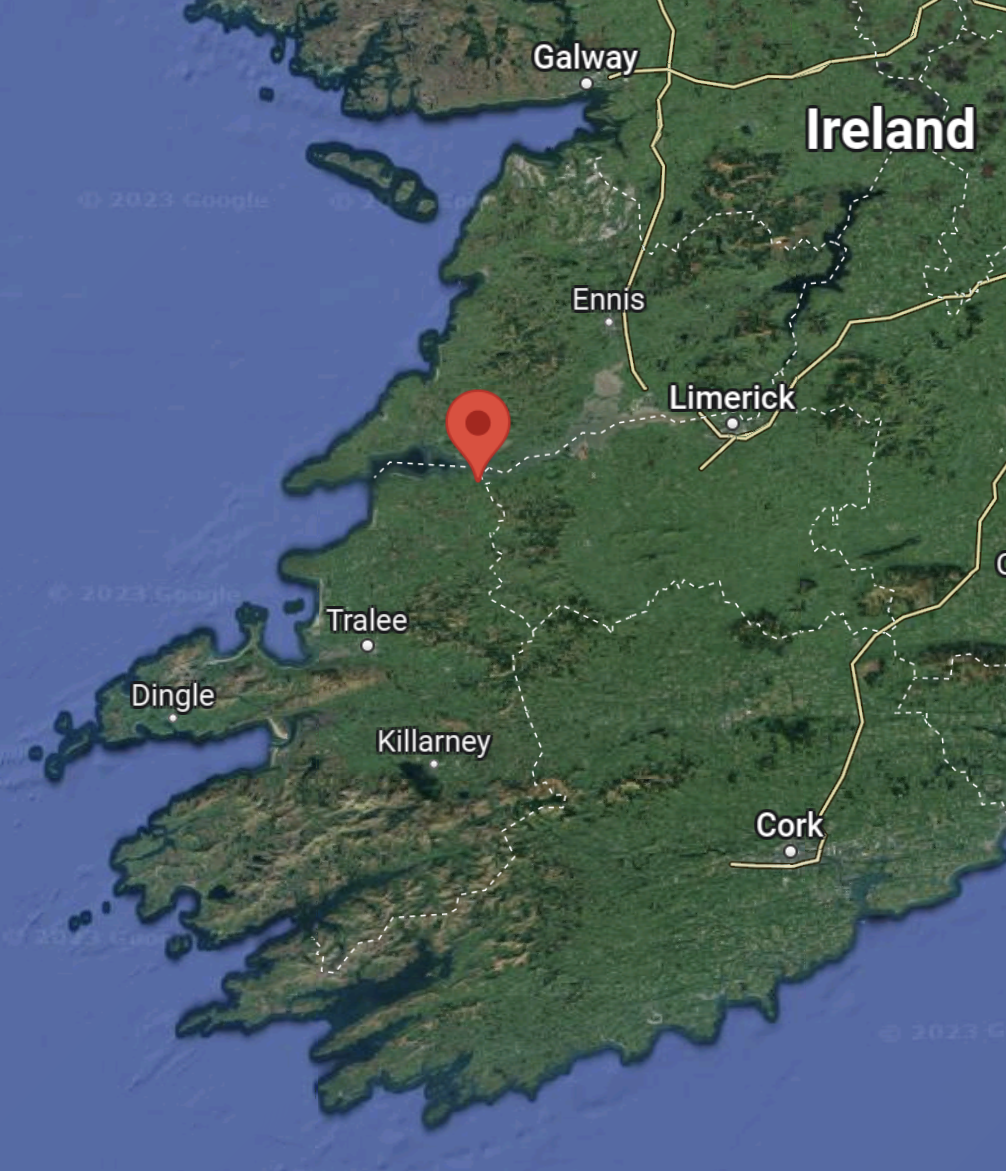
SSE Renewables is seeking an investigative foreshore licence to facilitate survey work for a possible new offshore wind farm in the Atlantic Ocean off the coast of Tarbert, Co. Kerry, Ireland.
This Google Map shows the approximate location of Tarbert.
These two paragraphs outline the project.
SSE Renewables has recently submitted an application for an investigative foreshore licence to Ireland’s Department of Housing, Local Government and Heritage and is seeking approval for investigative surveys of the seabed for an offshore wind project which could generate up to 1 GW of energy.
These geophysical, geotechnical, and environmental surveys are required to inform the renewable energy developer’s understanding of the prevailing environmental and met-ocean conditions at the foreshore investigative array area, which is a minimum of 13 kilometres offshore.
This is SSE Renewables’ first licence application for an offshore wind project off the west coast of Ireland.
In SSE Thermal Secures 10-year Contracts For Two New Low-Carbon Power Stations In Ireland, I talked about two biomass power stations at Tarbert in Co. Kerry and Platin in Co. Meath.
It looks like the Tarbert wind farm and power station will work as a team and back each other up.
We Mustn’t Forget Platin!
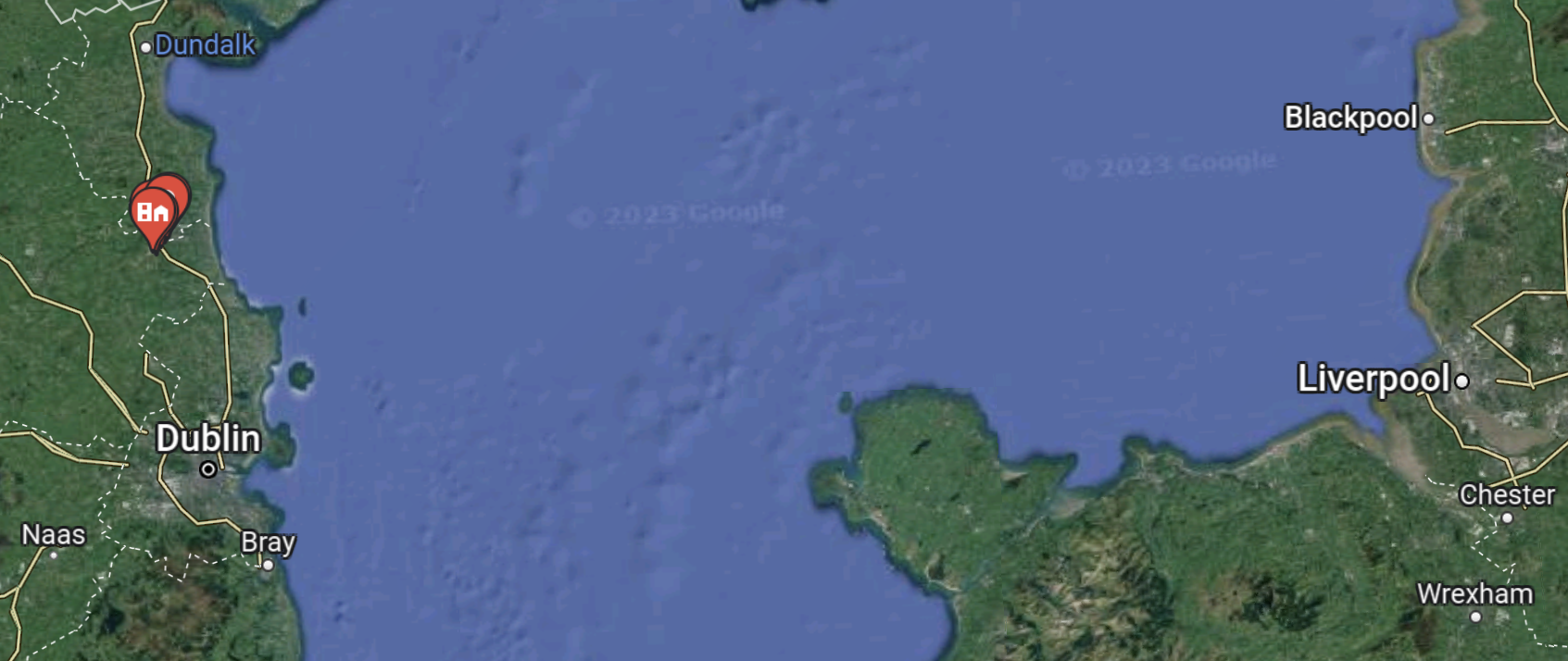
This Google Map shows Dublin and its position relative to the North Wales coast.
Note.
- Platin is marked by the red arrows to the North of Dublin.
- Platin also appears to be the head office and a manufacturing site of Irish Cement, who probably are a large user of energy.
- The sea between Blackpool, Liverpool, Anglesey and the Isle of Man is full of wind turbines.
These wind farms are located in this area of UK waters.
- Barrow – 30 MW
- Burbo Bank – 90 MW
- Burbo Bank Extension – 258 MW
- Gwynt y Môr – 576 MW
- Ormonde – 150 MW
- Rhyl Flats – 90 MW
- Walney – 367 MW
- Walney Extension – 650 MW
- West Of Duddon Sands – 389 MW
- Mona – 1500 MW – Being Planned
- Morecambe – 480 MW – Being Planned
- Morgan – 1500 MW – Being Planned
- Awel y Môr – 500 MW – Being Planned
Note.
- 2600 MW has been commissioned.
- 3980 MW is being planned.
I would not be surprised to see SSE or one of their friends, build a GW-scale wind farm between Anglesey, Dublin and Dundalk.
Is Ireland apparently lagging behind the UK, because the waters near the Irish coast are deeper and would need still-developing floating wind technology?
Conclusion
It looks like the Irish government and SSE are planning a low-carbon electricity system for Ireland.
Highview Power And Ørsted Collaborate To Unlock Greater Value From The Next Generation Of Wind Farms
The title of this post, is the same as that of this press release from Ørsted.
This is the sub-heading.
Highview Power and Ørsted have signed a Memorandum of Understanding aiming to prove the feasibility and economic value of co-locating long duration energy storage with offshore wind.
This first paragraph indicates how the two companies will work together.
The two companies will carry out detailed technical analysis and an economic assessment during 2023 that will investigate how combining Ørsted’s wind technology with Highview Power’s liquid air energy storage can deliver a stronger investment case for future offshore wind projects by reducing wind curtailment, increasing productivity, and helping the move to a more flexible, resilient zero carbon grid.
This all good stuff and as a Control Engineer, I know, there is a very good chance, it will bring forward worthwhile benefits.
Are These Turbines An Alternative To Solar Panels?
I took this picture yesterday of the Ventum Dynamics turbine on Skegness Pier.
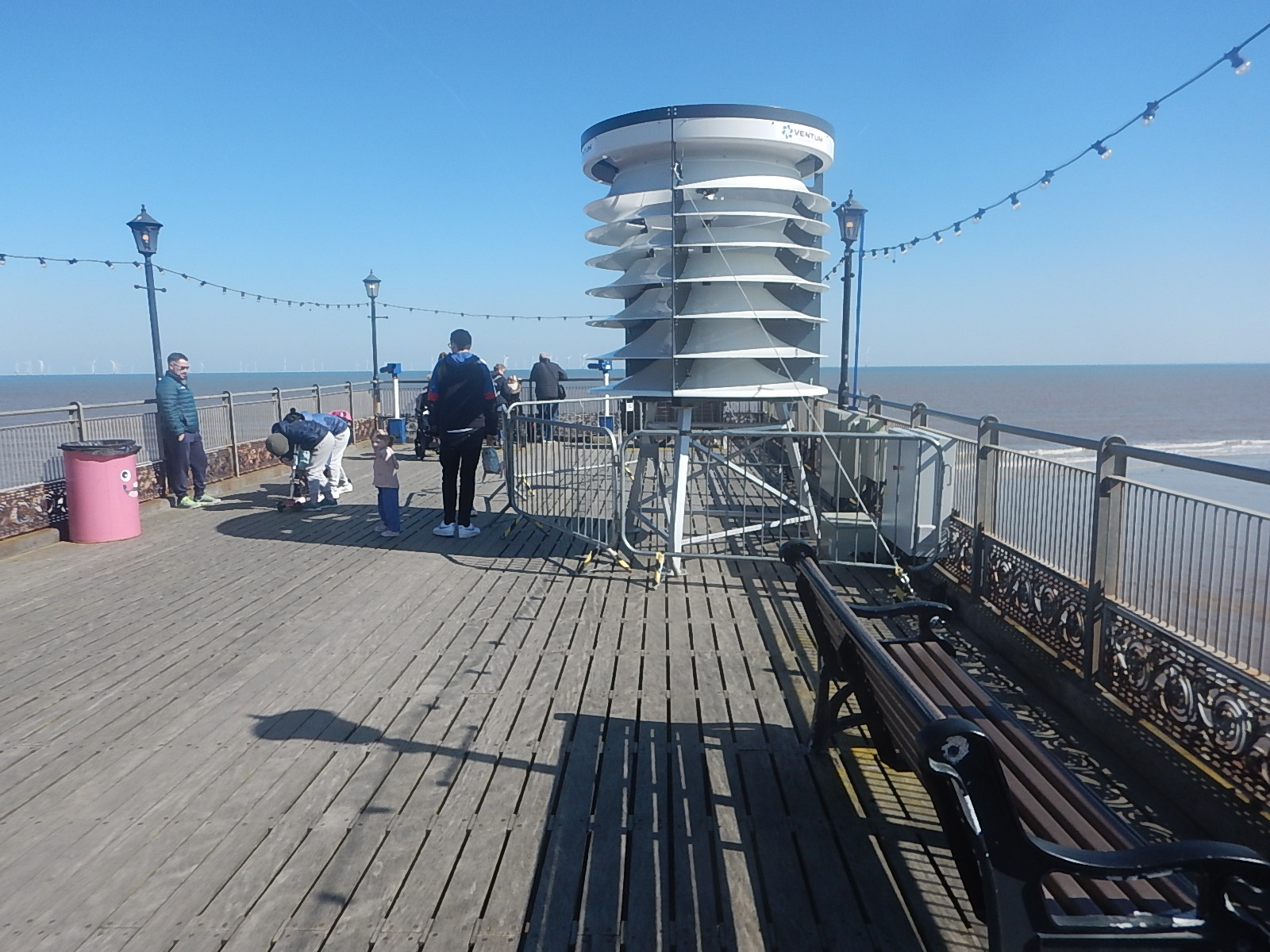
On the Ventum Dynamics web site, there are several pictures of buildings with flat roofs, that have several turbines on each.
I have some thoughts.
Connecting The Turbines
The Skegness turbine has been installed to light up the pier, but it doesn’t seem to have masses of cabling!
So can one of these turbines or a whole fleet of them be connected up by a qualified electrician, who is familiar with connecting up solar panels?
It would certainly, be a positive feature if they could, as these turbines could be another string to the bow of a solar power company.
I would design them to be electrically interchangeable with solar panels, so that roofs could be covered by a mixture of both solar and wind power.
Will We See more Hybrid Systems?
Cleve Hill Solar Park in Kent is being built as a solar park with a battery close to the London Array offshore wind farm.
I can see batteries and Ventum’s turbines being added to solar farms.
Conclusion
Ventum’s turbines are both an alternative and a partner to solar panels.
Windeed’s Floater Solution Gets Bureau Veritas Nod
The title of this post, is the same as that of this article on offshoreWIND.biz.
This is the sub-heading.
Bureau Veritas has granted Approval in Principle (AiP) to Sweden-based Windeed for its low-weight and low-acceleration floater solution for offshore wind turbines.
These three paragraphs fill in more details.
The AiP is a significant milestone in the development of Windeed’s technology, which could offer competitive prices and lower levelised cost of energy (LCOE) compared to other solutions on the market due to its industrialised manufacturing process, the developer said.
Bureau Veritas provided testing and assessment to ensure the solution is safe, reliable, and ready for deployment.
The approval in principle is a testament to the quality and innovation of the company’s technology.
I have been waiting some months for a new more efficient float for offshore wind turbines and then Gazelle Power Systems and Windeed turn up with designs on the same day.
Pictures of Gazelle’s design are available on their web site, but Windeed’s web site is text only, although it does say this.
Our purpose is to provide superior technology and industrialization of floating offshore wind power, lowering costs and environmental impact, to meet the need of more and clean energy.
I wouldn’t be surprised to see other designs!
SSE Thermal Secures 10-year Contracts For Two New Low-Carbon Power Stations In Ireland
The title of this post, is the same as that of this press release from SSE.
These first two paragraphs outline the two projects.
SSE Thermal, as part of SSE plc, has provisionally secured 10-year capacity agreements for its two proposed new-build power stations in Ireland which would run on sustainable biofuel.
The proposed low-carbon units at Tarbert in Co. Kerry and Platin in Co. Meath received the contracts in the T-4 Capacity Auction to commence in the 2026/27 delivery year.
Note.
- Both plants would help to protect security of supply and provide flexible backup to Ireland’s growing renewables sector.
- This Wikipedia entry is entitled Renewable Entry In Ireland and states that by the end of 2021, Ireland had 4.4 GW of onshore wind, with the intention of adding 5 GW of offshore wind, by 2030.
- The proposed units will initially run on Hydrotreated Vegetable Oil (or HVO), which is produced by processing waste oils to create a fossil-free alternative to diesel in accordance with EU sustainability standards.
- It looks like the two new-build HVO-powered station will back up the renewables.
- It is intended that the two new power stations will be in operation in 2026.
The two new power stations will be convertible to hydrogen in the future.
As at Keadby in Lincolnshire, which I wrote about in SSE Thermal Charts Path To Green Hydrogen Future With First-Of-A-Kind Project. it looks like SSE have developed a comprehensive plan to keep the electricity at full power, even when the wind isn’t blowing.
Conclusion
SSE Thermal are showing that in addition to gas, nuclear and pumped storage hydroelectric, renewables can also be backed up by biomass.
Northern Unveils ‘Supersonic’ Leaf Busting Tech
The title of this post, is the same as that of this article on Rail Technology Magazine.
These two paragraphs outline the project.
A collaborative effort between Northern and The University of Sheffield has resulted in the development of an innovative piece of technology, small enough to be fitted onto passenger trains, that clears leaves from the line.
A recent demonstration at the Wensleydale Railway has highlighted the effectiveness of this tech, meaning that the disruptions from fallen leaves to rail operations could soon be a thing of the past.
The process is described in this paragraph.
The new cleaning system, developed by researchers from the University’s Department of Mechanical Engineering, works via firing dry ice pellets in a stream of air at supersonic speed at the railhead, resulting the freezing of the leaves stuck on the line, which are subsequently blasted away as the dry ice pellets turn back into a gas. The dry ice pellets themselves are provided from waste carbon dioxide from other industries.
I suppose the only problem, is that it releases carbon dioxide into the atmosphere.
More Details
This page on the Sheffield University web site, which is entitled End Of The Line For Rail Delays Caused By Autumn Leaf Fall, gives more derails.
Irish Floating Wind Tech Developer Unveils Pilot Project In Portugal
The title of this post, is the same as that of this article on offshoreWIND.biz.
This is the sub-heading.
Dublin-based floating wind technology company Gazelle Wind Power (Gazelle) has partnered with the Portuguese renewable energy developer WAM Horizon to accelerate the development of a pilot project in Aguçadoura, Portugal, which will use Gazelle’s floating wind platform.
And this is the first paragraph.
Within the partnership, WAM will provide Gazelle with strategic advisory to implement the pilot project.
There is also a picture, which does not look like any other float for a wind turbine, that I’ve seen.
Gazelle Wind Power’s home page, has a series of pictures and an explanation of how it works.
The web site claims the technology is Light, Agile and Fast and gives a few details in this paragraph.
Introducing Gazelle’s hybrid attenuated mooring platform, an evolutionary step-change in the design of floating platforms. Lighter, smaller and more agile than current designs, the Gazelle delivers unmatched stability and capacity. Moreover, our design benefits from modularisation, time-tested manufacturing processes, and can easily be assembled at port facilities worldwide.
From my experience of modelling floating structures in the 1970s, I believe that there a lot more permutations and combinations of components, that will work as floats for wind turbines.
Gazelle Wind Power’s design, is one of the first of a new generation of designs.
If anybody comes up with an unusual design and needs someone to criticise or model its floating behaviour, I’d be happy to help.
Gluten-Free Fish And Chips In Skegness
I had some excellent gluten-free fish and chips in Skegness at the Atlantic Fish Bar.





The restaurant is conveniently located just off the walking route between the seafront and the station.
As I had excellent gluten-free fish and chips on the front at Lowestoft, it does seem that the coast may be the place to go to get them.
Skegness Pier With Wind Turbines
These pictures were taken today from Skegness pier.

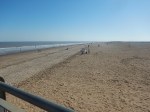
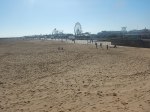

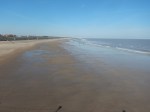
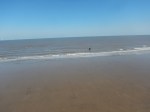
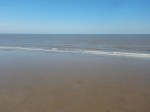
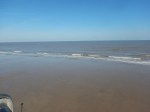
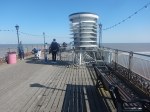

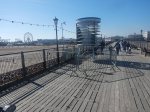

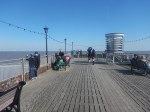
Note.
- The wind turbines on the horizon in the first seven pictures are the 270 MW of the Lincs wind farm and the 194 MW Lynn and Inner Dowsing wind farm.
- All wind turbines are just a few miles offshore.
- All turbine in these wind farms has a capacity of 3.6 MW.
The small cylindrical object actually on the pier in the last five pictures is also a wind turbine.
It is a vertical-axis turbine from Ventum Dynamics of Norway.
In Skegness Wind Turbine Trial To Light Up Pier In UK First, I wondered if it is noisy! It is not!
First Demonstration Of Low-Cost Green Hydrogen Tech Launched By Advanced Ionics
The title of this post, is the same as that of this article on Hydrogen Fuel News.
Advanced Ionics has announced its Early Access Program, sponsored by the Repsol Foundation. This program will be a paid pilot study. Their low-cost green hydrogen production processes are powered by the Symbion electrolyzer technology, which uses process waste heat and is up to 50% more efficient than other technologies. Through the Early Access Program, Advanced Ionics hopes to provide customers with confidence in the potential of its technology. The program is part of an effort from the foundation to support entrepreneurships spearheading industrial decarbonization tech.
Note.
- At a first glance this looks promising.
- Electrolysis and waste heat is suggesting high temperature electrolysis, which appears to be more efficient.
- I suspect that the Repsol Foundation has plenty of funds.
- Advanced Ionics have a comprehensive web site.
I shall add this to my list of electrolyser technology to watch.
 The Anonymous Widower