State Of The Railway Compiler Data Solution (SORClite): Open Access Real-Time Signalling Data
This project was one of the winners in the First Of A Kind 2022 competition run by Innovate UK.
In this document, this is said about the project.
Project No: 10038973
Project title: State Of The Railway Compiler Data Solution (SORClite): Open Access Real-Time Signalling Data
Lead organisation: PARK SIGNALLING LIMITED
Project grant: £217,128
Public description: Our project seeks to support Network Rail in regaining understanding and ownership of key
signalling asset information so that this data can be used to adopt new performance measures,
identify bottlenecks within the rail network and target the 800,000 unexplained delay minutes that
occur annually. The project combines a number of existing technologies to deliver the hardware,
pipeline, analytics, and visualisation as a working demonstration. The data stores will also be
available for use by train operators and the wider data analytics supply chain, removing some of
the systemic blockers around access to data.
My Thoughts And Conclusion
Portable Track Geometry Measurement System
This project was one of the winners in the First Of A Kind 2022 competition run by Innovate UK.
In this document, this is said about the project.
Project No: 10037542
Project title: Portable Track Geometry Measurement System
Lead organisation: MONIRAIL LTD.
Project grant: £249,148
Public description: Rail incidents can take many forms and can results in many different types of intervention from
temporary speed restrictions to full track closures. Many incidents either result from or cause track
damage and in order to remove any speed restrictions or track closures engineers need to be
confident that the track is in a safe condition. It is therefore common practice after many incidents
where track damage is suspected or track repairs have been undertaken for Track Recording
Vehicles (TRVs) to be required to run the track before passenger or freight vehicles are allowed to
run the line again. However, the availability of these vehicles can cause significant delays to line
reopening or removal of speed restrictions.
MoniRail has developed an in-service track monitoring system that can be permanently fitted to
passenger vehicles and is currently on trial with Network Rail (NR) in Scotland and also fitted to 2
Eurostar vehicles on HS1. One potential use-case for the permanent system is for speedier
removal of speed restrictions. However, even with the fixed solution delays are likely as track
monitoring systems are only likely to be fitted to 1/3 to 1/2 of all vehicles, approx 1500 of 5100
vehicles.
This project aims to overcome these delays by providing track engineers with the first ever portable
dynamic track geometry measurement system by modifying the permanent solution into a portable
one that can be temporarily fixed to vehicles along with a lineside sensor array that can provide
additional safety critical track information to the engineer. This solution will therefore provide
immediate track information to track engineers such that can make informed decisions about the
safety of the track and to what extent speed restrictions can be lifted or line re-opened.
My Thoughts And Conclusion
I am surprised that this hasn’t been developed before.
It surely must have export potential.
SBRI: FOAK 2022 Optimising Railway Possessions
This project was one of the winners in the First Of A Kind 2022 competition run by Innovate UK.
In this document, this is said about the project.
Project No: 10038228
Project title: SBRI: FOAK 2022 Optimising Railway Possessions
Lead organisation: FRAZER-NASH CONSULTANCY LIMITED
Project grant: £236,226
Public description: One of the biggest challenges facing the railway industry is the complex process of planning and
possession management. The logistics of diverting, blocking, or closing sections of track can have
implications across the network. As the rail timetable becomes more congested, with increased
services, there is more potential for disruption and less obvious times for possession. Delays on
main-lines could result in huge fines, consequently delivering works and handing back possession
on-time is vital.
In 2020/21, NR spent £1.6bn on enhancements, £1.9bn on maintenance, and £3.2bn on renewals
(Office of Rail and Road, 2021). This translates into thousands of engineering works, most of these
require possessions to allow safe, traffic-free worksites for maintenance activities (e.g. remedial
works, inspections, maintenance and planned renewals).
Possessions result in both planned and unplanned disruption. Unplanned disruption can occur for
many reasons; machine faults, access issues, staff planning, or wrong engineering train
arrangement – all demonstrating the complexity of planning possessions.
Getting staff and equipment to worksites on time and minimising travelling distances are critical
efficiency requirements. The barriers to this are mutual road and rail points, staff numbers and
equipment types. Furthermore, engineering trains typically start in sidings which may be in remote
locations due to available sidings being occupied during large possession works. Consequently,
this cause issues in both timetabling and plans that ensure that engineering trains reach worksites
at the correct time and in the correct formation.
With increasing traffic and reducing availability of possessions this problem is likely to be further
exacerbated. Network Rail have identified a requirement to develop solutions for planning
procedures such that possession efficiency is increased, resulting in the delivery of infrastructure
maintenance work with minimal disruption and cost.
Combining Frazer-Nash’s deep experience in optimisation of railway challenges and eviFile’s
possession management solution, we will innovate to develop a product that will support rapid
planning and replanning of possessions through the application of optimisation and ML algorithms
to identify potential optimal plans. Using wide-ranging railway possessions data we will research
and adapt algorithms that will consider (for example) multiple scenarios, locations and types of
work, and optimise and efficiently manage resources to ensure minimal impact to infrastructure
traffic and capacity.
This will deliver possessions more efficiently, help plan work-activities during possessions more
precisely, manage infrastructure access more efficiently, allow tasks to be planned more efficiently,
and predict the impact of possessions on overall network performance more accurately.
My Thoughts And Conclusion
One of the biggest construction sites near me was the A45 dualling of the 1970s. It was a nightmare as there was no system managing possessions and frequently there were temporary traffic lights and diversions.
Things have got better since then and roadworks on main roads don’t cause as much delay as they used to.
The same improvement that good project management has had on the roads, now needs to be applied to the railways.
Hydrogen-Powered Turbines May Help Clean And Improve Electrical Grid Reliability
The title of this post, is the same as that of this article on Hydrogen Fuel News.
This is the first paragraph.
In less than three years, one or more hydrogen-powered turbines are expected to be up and running at or near New Jersey’s Bayonne Energy Center power plant, which feeds power to New York City.
Note.
- The Bayonne Energy Center is a peaker plant with ten gas turbines, with a total capacity of 640 MW.
- Peaker plants automatically cut in, when power demand is high, but power generation is low.
- The Bayonne Energy Centre transfers power to New York, through an underwater cable.
- The electrolyzers will be made by Ohmium International Inc and I suspect they will be powered by offshore wind.
- The hydrogen that is created will be stored. As Bayonne has a history of chemical manufacturing, there may be salt caverns that can be used or the hydrogen could be stored as a compressed gas or liquid in tanks.
I can see hydrogen being used in peaker plants elsewhere in the world, where there is lots of renewable energy and suitable hydrogen storage.
The hydrogen can also be used to decarbonise local industries and transportation.
The Potential For Wind Power In New Jersey
Wikipedia says this about the potential of wind power in the state.
New Jersey has the potential to generate 373 GWh/year from 132 MW of 80 m high wind turbines or 997 GWh/year from 349 MW of 100 m high wind turbines located onshore as well as 430,000 GWh/year from 102,000 MW of offshore wind turbines.
Note.
- New Jersey used 76,759 GWh in 2011
- It appears that most of these turbines would be located along the coast.
There is also a worry about hurricanes. But solving that is an engineering problem.
From my experience of modelling floating structures, I believe they may stand up to high winds better. But I’m not sure!
Classic Cars Are Being Rebuilt As Hydrogen-Powered Vehicles
The title of this post, is the same as that of this article on Hydrogen Fuel News.
This is the first paragraph.
Arrington Performance has rebuilt a 1964 Ford Falcon Sprint coupe to be powered by H2 in a trend converting classic cars into hydrogen-powered vehicles.
The company has also converted was a 1948 Chevrolet pickup, which it rebuilt with a 6.2-liter GM V8.
Not everybody would consider these to be classic cars, but surely if you can convert a 1948 pickup with a 6.2 litre engine, you can convert a wide range of vehicles.
An Expedition To Muswell Hill To Get Some Lovely Liver
After my plea in Need To Regularly Eat A Large Plate Of Calves’ Liver, I got a recommendation to try The Cilicia at Muswell Hill.
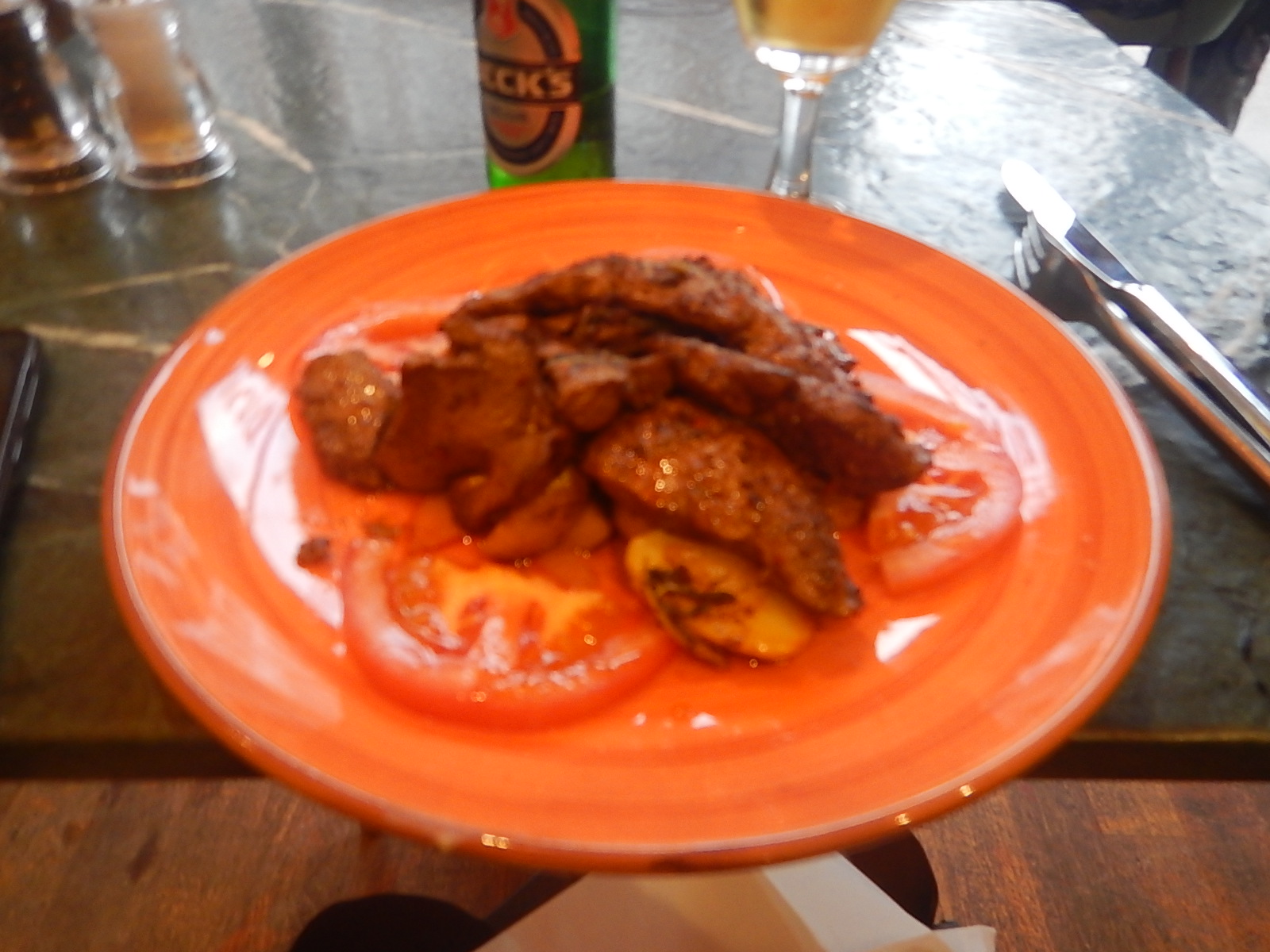
It was delicious and just what my body wanted. The liver had been cooked in sage butter with tomatoes, mushrooms and potatoes.
I shall return!
The only problem is that Dalston and Muswell Hill is not the easiest journey to make by public transport.
My route was as follows.
- I took by taking a 141 bus from close to my house to Manor House station.
- I then got a Piccadilly Line train to Turnpike Lane station.
- From there it was a 144 bus to Muswell Hill Broadway.
It took about 45 minutes.
But it might be quicker to take a 102 bus from Bounds Green station.
Or go to the Angel Islington and get a 43 bus from there to Muswell Hill Broadway.
But my route could all have been so different.
This map shows the Muswell Hill branch which was closed by British Rail and has since been mainly built over.
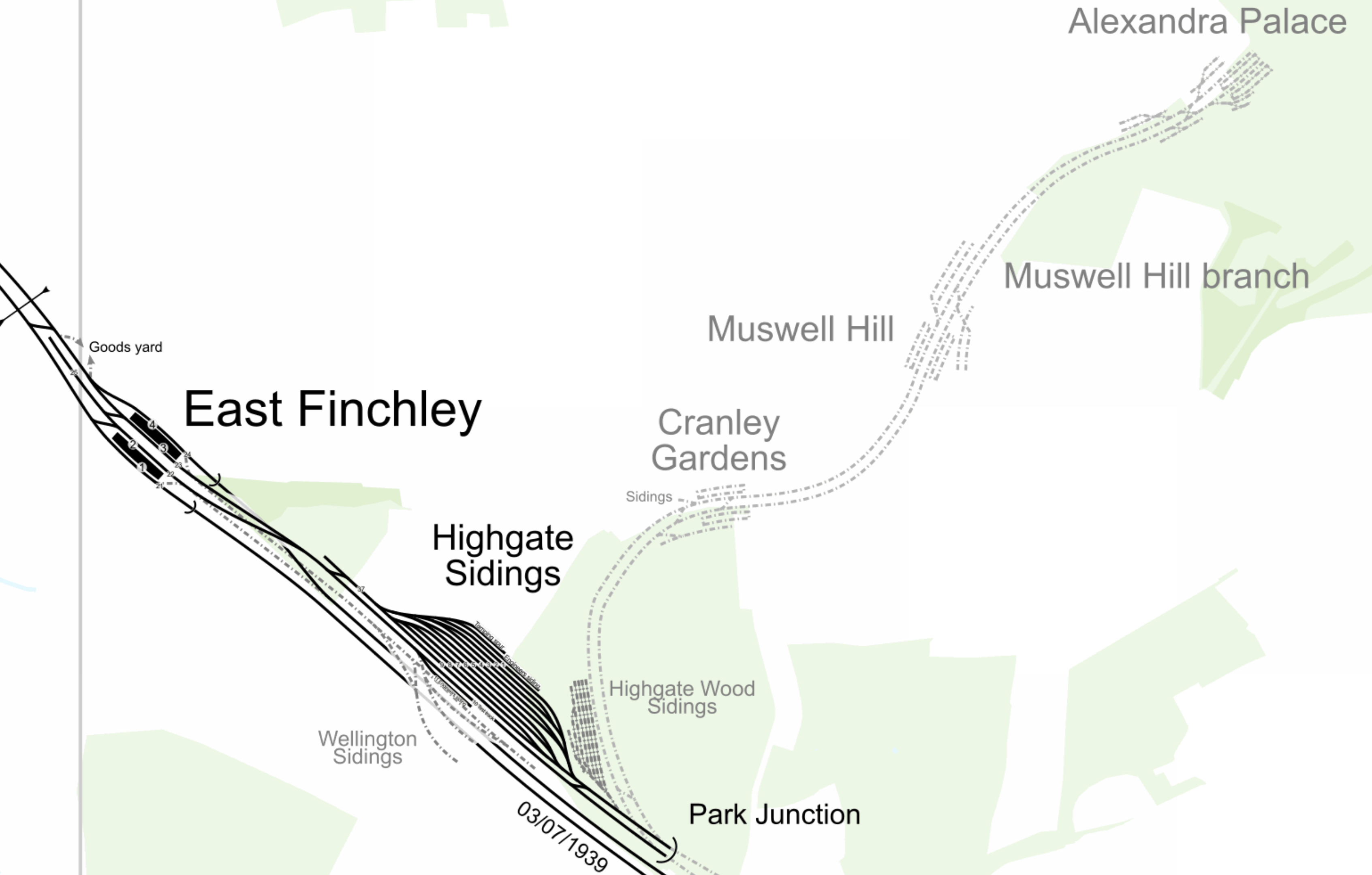
The Muswell Hill branch would have been part of the comprehensive Northern Heights Plan.
- The Northern Line would have been extended from Edgware to Bushey Heath.
- The Mill Hill East branch would have been extended to Edgware.
- If you look at the maps in Wikipedia, the Northern Line would be very different through London.
- The Muswell Hill branch would have given better access to the magnificent Alexandra Palace.
But Austerity after World War II meant the extension never happened.
I can see a case could be made for some parts of the Northern Heights plan, but it is too late now, as viaducts have been demolished and routes have been built over.
My feeling is that if there was a need for the Northern Heights plan in the 1930s, then as London has expanded, that need will need to be fulfilled in the future.
So when Austerity hits as it did after World War II and as it is happening now due to Covid-19 and Vlad’s war in Ukraine, we should make sure we don’t compromise our plans for the future.
I believe that with a small amount of safeguarding in the 1960s, the Northern Line would now have a useful branch to Alexandra Palace and Muswell Hill.
Trains With Brains(R)
This project was one of the winners in the First Of A Kind 2022 competition run by Innovate UK.
In this document, this is said about the project.
Project No: 10036632
Project title: Trains With Brains(R)
Lead organisation: JR DYNAMICS LIMITED
Project grant: £248,046
Public description:
Trains with Brains(r) aims to integrate data from a range of remote condition monitoring sensors
into Network Rail’s monitoring and planning systems/processes, to enable operations and
maintenance teams to address key cost efficiency and performance priorities via more informed
possession planning.
This will be delivered via a head to toe monitoring solution, enabled via bi-directional integration
between Transmission Dynamics and Network Rail.
My Thoughts And Conclusion
Unauthorised Cable Removal And Fault Triage
This project was one of the winners in the First Of A Kind 2022 competition run by Innovate UK.
In this document, this is said about the project.
Project No: 10038790
Project title: Unauthorised Cable Removal And Fault Triage
Lead organisation: FOCUS SENSORS LIMITED
Project grant: £215,310
Public description: When cable thefts occur the operation of the railway, often in nationally critical locations, can be
brought to a standstill with significant impact on passengers and freight supply-chains. Under
extreme industry and public pressure, Network Rail must delay scheduled activities and scramble
teams to effect repairs and get critical railway operational systems working again. Current
technology may not be able to locate the break to better than a few km accuracy, meaning long
periods of manual inspection are required to locate the exact position of the theft before the repair
can be started. This wastes valuable time, increasing the effect of the theft on the efficiency of the
network and creating cost for operators and delays for customers.
This proposal is for a technology solution, using existing trackside optical fibre cables, which can be
used to locate cable thefts instantly to within +/- 1m. After a theft is reported or detected by other
system, automatic analysis will pinpoint the location of the acoustic signatures of the theft activity.
The location of the theft will be instantly displayed, both on a map overlay with geographical
coordinates, and as a linear ELR, miles and yards track location. This will enable first-responder
policing and security to be deployed sooner and more accurately. Secondly, with an accurately
timed and positioned event signature, there is an opportunity for other parties with evidence
collecting abilities (e.g. Forward Facing CCTV on trains) to more proactively, and possibly
automatically, to retain evidence which may support prosecution. Thirdly the Network Rail
engineering team will be given advanced information to allow them to attend the site with the right
materials and resource to affect an earlier resolution.
As secondary activity we will enable location of optical cable by creating a companion
georeferencing co-reference for the trackside fibre cable, so that faults and fibre issues can be
located instantly to a more precise physical location. This provides a valuable tool for Network
Rail’s engineering teams, to reduce time for maintenance and fault finding.
My Thoughts And Conclusions
My software; Daisy was used by British Rail or was it Railtrack to analyse cable faults many years ago. Because of the discussions, we had at the time, I believe that this could be a very successful project.
Optimal Prediction of Sand For Adhesion
This project was one of the winners in the First Of A Kind 2022 competition run by Innovate UK.
In this document, this is said about the project.
Project No: 10039258
Project title: Optimal Prediction of Sand For Adhesion
Lead organisation: GOVIA THAMESLINK RAILWAY LIMITED
Project grant: £153,228
Public description: Train services are affected by seasonal variables particularly leaf fall between September and
December. They can also be compromised by wet weather, icy and snowy conditions at a regional
or very localised level on a particular route. Maintaining wheel-rail contact to ensure adequate and
safe braking requires the use of sand in low adhesion conditions. Sand is dispensed to trains in
response to a combination of train service plans and of weather forecast. However, not all trains
are currently able to be replenished during overnight stabling and servicing with attendant risks of
delays and damage to trains and infrastructure. Also, there is a high level of safety risk when sand
replenishment on trains is carried out on a third-rail yard.
“Optimal Prediction of Sand for Adhesion” (OPSA) lead by Govia Thameslink Railway, the major
Train Operating Company on third rail in the UK, will deliver a more efficient and cost-effective
means of predicting the dispensing of sand to trains to ensure services are not compromised by
adhesion losses and train sets are not required to be removed from planned operating diagrams
because of inadequate on board sand supplies. The algorithm developed as a results of this project
will base the estimates on an integrated framework that includes the forecast adhesion, track
maintenance and the expected speed profile in order to capture the change in weather and the seasonal factors.
The algorithm developed represents a cost effective solution to predict the use of sand and
schedule the maintenance of trains enhancing in turn safety and reducing the impact of delays on
the timetable. The algorithm will be developed including direct measure of sand dispersion, braking,
wheel slip and line speed diagram also accounting for human behaviour effects such as driving
style.
Govia Thameslink Railway has engaged with Cranfield University to deliver the disruptive
innovation proposed in this project. The algorithm will enable a more efficient train scheduling
improving public performance measure (PPM) addressing train delay targeting in particular the
25% of delay up to 15 minutes cause by several concurrent issues including train rescheduling and
the National Rail Passenger Survey satisfaction.
My Thoughts And Conclusions
Rail Flood Defender
This project was one of the winners in the First Of A Kind 2022 competition run by Innovate UK.
In this document, this is said about the project.
Project No: 10038342
Project title: Rail Flood Defender
Lead organisation: University of Sheffield
Project grant: £249,770
Public description: Rail Flood Defender will deliver a more reliable railway network that is safer for all stakeholders,
and empower Network Rail (NR) and the UK to become global leaders in intelligent holistic rail
drainage management. It will future-proof rail transport against the effects of climate change where
more intense and regular rainstorm events are expected.
The project will explore principles of autonomous active flow control to reduce manual operations
associated with protecting rail infrastructure from the effects of flooding. It achieves this by taking
the latest advances in edge computing and applying it to real-time automation of mechanical and
electrical equipment to control the flows in rail drainage systems, thus protecting the track drainage
from being overloaded and flooded during rainstorm events.
The importance of managing rail drainage infrastructure cannot be overstated. It is designed to
carry stormwater safely water away from the track via a system of pipes and channels. When
drainage infrastructure is compromised or inadequate, flooding can occur. Flooding causes delays
to passengers and costs to asset owners, but crucially can also affect other assets such as
structures and signalling, which endangers human life (e.g. Watford Tunnel
Derailment https://www.gov.uk/raib-reports/derailment-and-subsequent-collision-at-watford). This
project aims to collaboratively investigate the application of AI-powered automated real-time control
(RTC) for protecting the railway system and mitigating any impact on adjacent land.
The feasibility project will identify how the following benefits and sustainability opportunities can be
delivered:
- Reduce risk of rail services being disrupted during rainstorm events.
- Make the drainage design process more efficient.
- Avoid capitally and spatially expensive flood solutions (e.g. stormwater retention tanks).
- Provide a means for automated flushing to clear blockages (reduce manual intervention).
- Reduce surcharging on adjacent rural or urban areas.
- Explore additional opportunities such as rainwater harvesting for agriculture.
My Thoughts And Conclusions
Fifty years ago, I wrote and provided the software, that the Water Resources Board used to plan the water flows and new reservoirs in a large part of England. As over the intervening years, there have been few water shortages due to lack of reservoirs, I am led to believe that the WRB must have done a good job.
Now fifty years later our computing capabilities are much more advanced and I feel that the aims of this project are readily achievable.
 The Anonymous Widower